Bayesian Cable Curls: Form, Setup and Whether They Build Bigger Biceps
Bayesian cable curl form explained step by step: pulley height, step-forward distance, elbow position, sets and reps, and what the research really shows.
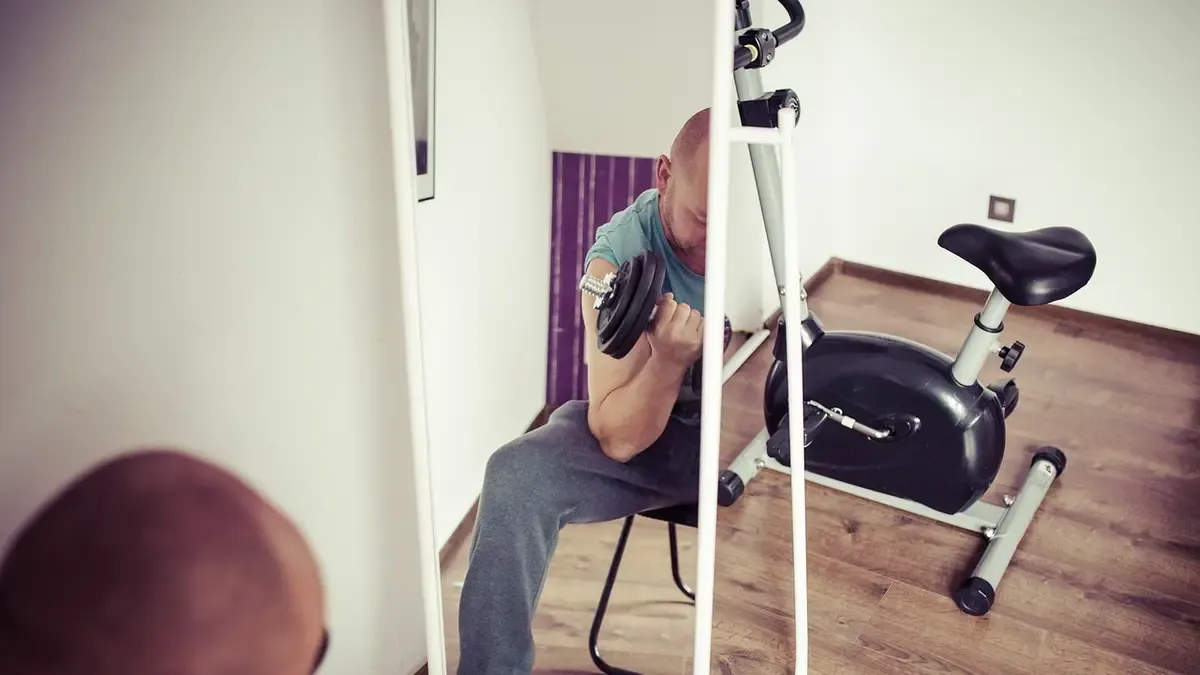
TL;DR. The short answer
- A Bayesian cable curl is a single-arm curl done facing away from a low pulley, with the working arm slightly behind your torso so the biceps is stretched and loaded from the very first inch.
- Set the pulley near wrist or hip height, use a staggered stance, step forward until you feel a mild biceps stretch, pin the elbow in place and curl without leaning back.
- No long-term study has tested the Bayesian curl itself. The case for it rests on lever-arm mechanics and on research into stretched-position training, so treat it as a sensible option, not a proven upgrade.
- In a 2026 MRI trial, curling with the shoulder extended grew the biceps slightly more than preacher curls (22.1% vs 18.9%), while total elbow flexor growth was similar.
- Two to four hard sets, 8-15 reps, 1-3 reps from failure, once or twice a week is a reasonable place to start. Sharp pain in the front of the shoulder or elbow means stop and see a doctor or physio.
Part of our complete guide: Arm Workout Science: The Complete Guide to Biceps, Triceps, Brachialis and Forearm Growth
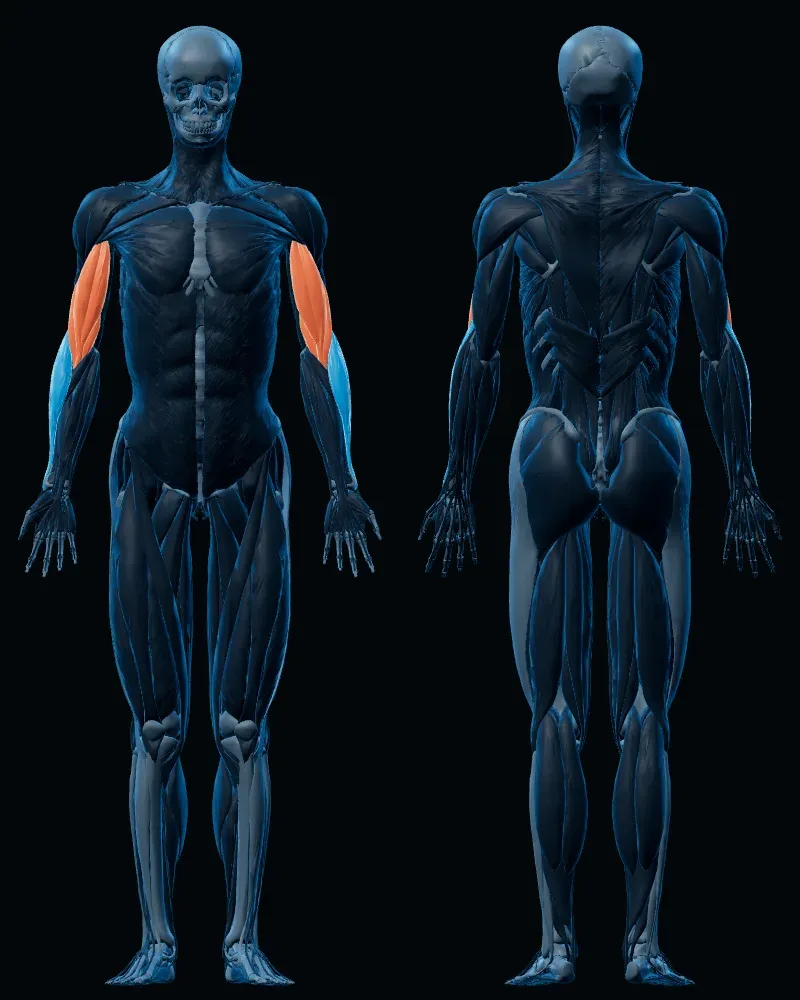
Muscles worked: biceps
Main movers: biceps brachii and brachialis
Assisting: brachioradialis
Table of contents
A Bayesian cable curl is a single-arm cable curl done with your back to the weight stack and the working arm slightly behind your torso. Doing the Bayesian cable curl form correctly means the biceps is stretched and under load from the first inch of the rep, instead of resting at the bottom the way it does in a standing dumbbell curl.
They are all over social media, so it is fair to ask whether they work. Short answer: the logic is sound, the direct evidence does not exist yet, and the exercise is a smart way to train the stretched end of the range. This page covers the setup, the cues, and what research can and cannot tell us. It sits inside our complete arm and forearm training guide.
What is a Bayesian cable curl?
Stand facing away from a low cable pulley. Hold a single handle in the hand closest to the stack, with that arm reaching slightly behind you. Curl the handle up toward your shoulder while the elbow stays put.
The name is gym slang. It has nothing to do with Bayesian statistics. You will also see it called a facing away cable curl or a behind-the-body cable curl.
Two things are happening at once:
- Shoulder slightly extended. With the upper arm behind the torso, the biceps is lengthened across the shoulder as well as the elbow.
- A cable line of pull that never goes slack. The weight stays attached to your hand through the full path.
For a direct comparison with the preacher version, see our breakdown of preacher curls vs Bayesian cable curls.
Why does constant tension matter for a curl?
A standing dumbbell curl has a weak spot. Gravity pulls straight down, so when your arm hangs by your side the forearm is vertical and the dumbbell puts almost no turning force on the elbow. The biceps does little work in the first part of the rep, the load peaks around halfway, then eases off near the top.
A cable changes the direction of the pull. With the pulley low and behind you, the cable runs roughly horizontally back to the stack, which is close to perpendicular to your hanging forearm. That gives the biceps something to work against right at the start.
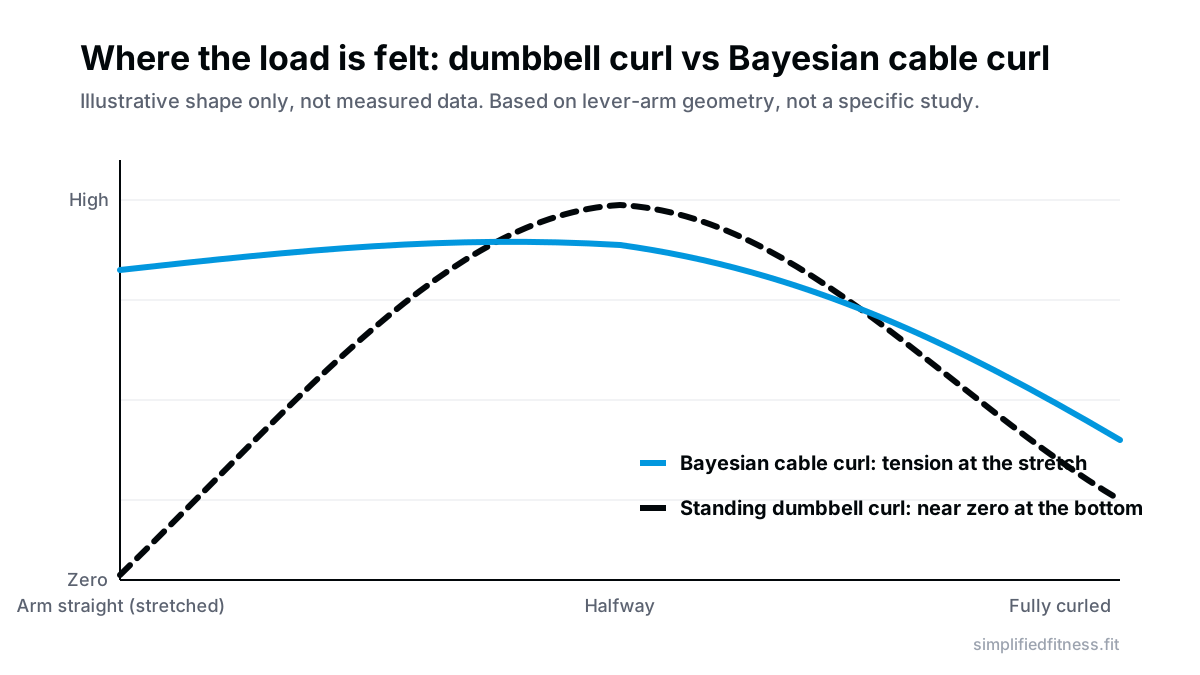
Why care about the stretched start? Mechanical tension is considered one of the main drivers of muscle growth, alongside muscle damage and metabolic stress, according to a widely cited review (Schoenfeld, 2010). And a growing set of studies suggests that training in the stretched position is a good place to put that tension, which we cover in our guide on stretch-mediated hypertrophy and range of motion.
How to do a Bayesian cable curl: step-by-step form
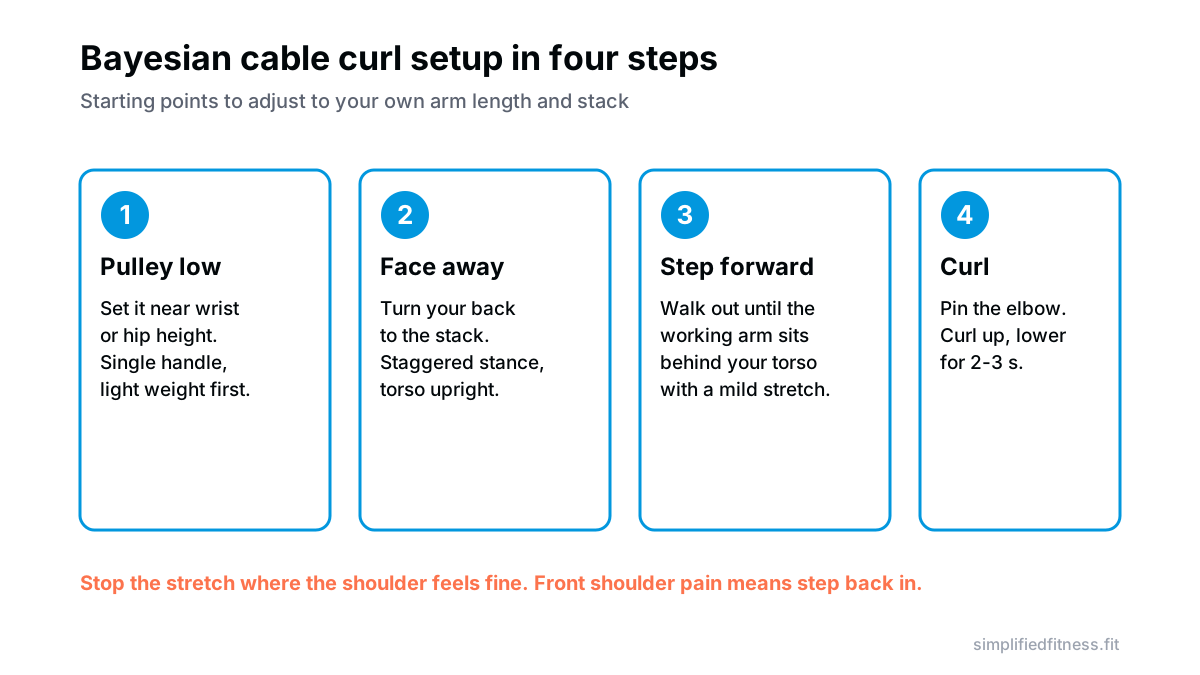
- Set the pulley low. Wrist to hip height is the usual starting point. Clip on a single D-handle. If you are unsure about heights and angles, our cable setup guide for pulley heights and angles covers the basics.
- Pick your stance. Turn away from the stack and stand in a staggered stance, with the foot on the working side behind. This stops the cable from pulling you backward.
- Take a step forward. Walk out until the working arm sits slightly behind your torso and you feel a mild stretch in the biceps. More distance means more stretch, but the point is a controlled start, not the farthest reach.
- Pin the elbow. The upper arm stays where it is. Let the elbow travel forward only a little as you curl. If the elbow swings forward a lot, the exercise drifts toward a standard curl.
- Curl, squeeze, lower slowly. Take 1-2 seconds up and 2-3 seconds down. Let the arm fully lengthen at the bottom without letting the stack crash.
- Reset between reps. Do not bounce at the bottom. The stretch is the whole point.
Cable friction and how to read the weight
Pulleys and cables are not frictionless, and each stack brand feels different. The weight you can curl on one machine will not match the next. Judge sets by effort, not by the number on the stack. Stop 1-3 reps short of failure and log the reps.
What does the research actually show?
Here is the honest part. No study I could find has tested the Bayesian curl directly. Everything below is related evidence, so the Bayesian-specific claim is an extrapolation.
Shoulder position changes which muscle grows
A 2026 trial in 21 untrained adults trained one arm with incline dumbbell curls (shoulder extended) and the other with preacher curls (shoulder flexed) for 12 weeks, using MRI to measure muscle volume. The biceps brachii grew more after incline curls (+22.1% vs +18.9%), while the brachialis (+17.1% vs +21.1%) and brachioradialis (+13.5% vs +17.6%) grew more after preacher curls. Total elbow flexor growth did not differ significantly (Kobayashi et al., 2026).
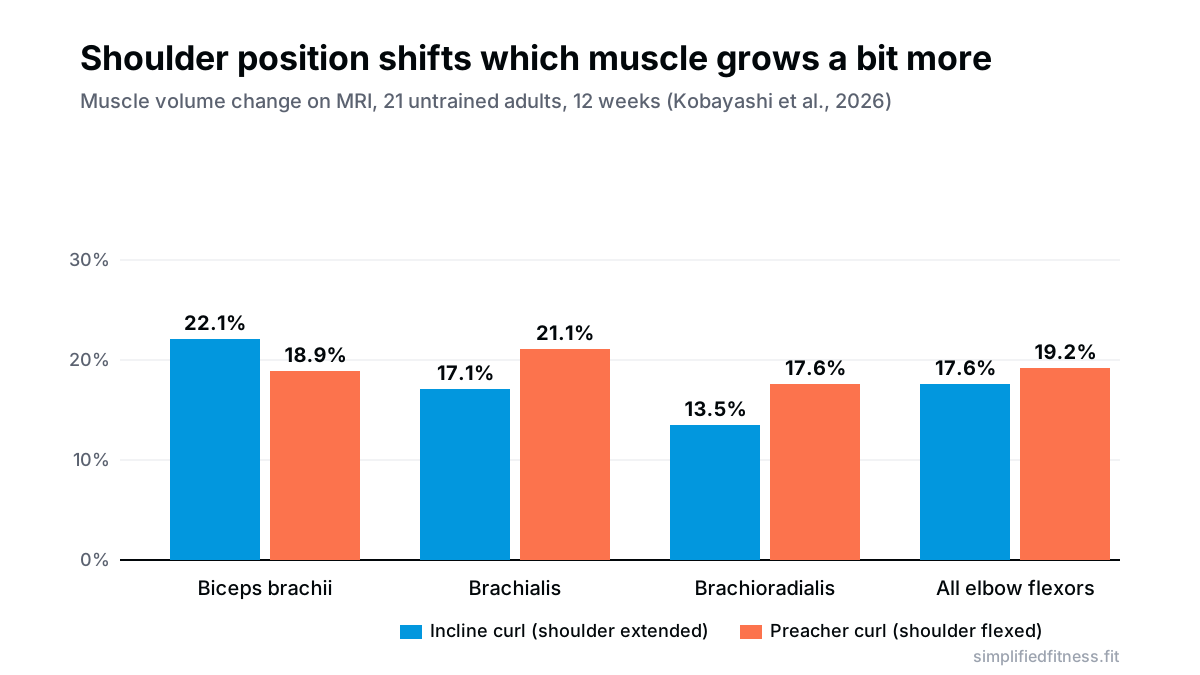
What this suggests: putting the arm behind the body (as in a Bayesian curl) nudges work toward the biceps. Caveats: untrained participants, dumbbells rather than cables, and differences described by the authors as small to moderate. For the full dumbbell version, see our guide to incline dumbbell curls and shoulder hyperextension.
Do stretched, long-range reps beat short ones?
The evidence is mixed, and that matters.
- A 2020 systematic review found that full range of motion helped lower-body hypertrophy, but evidence for the upper limbs was limited and conflicting (Schoenfeld and Grgic, 2020).
- A 2021 meta-analysis agreed: full range of motion was better for strength and lower-limb hypertrophy, with no significant superiority for muscle thickness overall (Pallarés et al., 2021).
- A 2025 trial in 30 resistance-trained people (within-person, 8 weeks) found lengthened partials and full range of motion gave similar elbow flexor and extensor growth. The authors suggested emphasizing the stretched position, by full range or lengthened partials (Wolf et al., 2025).
- A 2025 meta-analysis of 12 studies in young adults found training at longer vs shorter muscle lengths gave similar regional hypertrophy, with the authors urging caution because the length differences were small (Varovic et al., 2025).
Why might these disagree? Studies differ in muscle, exercise, how far “long” really is, and whether participants were trained. A plausible reading: the stretched position is a good place to train, but it is not magic, and short-term studies cannot tell us whether the Bayesian curl beats a well-done preacher or incline curl.
Bayesian curl vs other biceps curls
| Exercise | Where it loads hardest | Shoulder position | Good for |
|---|---|---|---|
| Standing dumbbell curl | Mid-range | Neutral | Simple, easy to load |
| Incline dumbbell curl | Stretched | Extended | Long-head bias, dumbbells only |
| Bayesian cable curl | Stretched, easing near the top | Slightly extended | Tension at the bottom, one arm at a time |
| Preacher curl | Mid to shortened | Flexed | Strict form, brachialis and brachioradialis |
You do not have to pick a winner. If you want more on free weights versus cables, see free weights vs cables vs machines for hypertrophy.
How many sets and reps should you do?
Start with 2-4 hard sets per arm, 8-15 reps, once or twice a week. Take the sets 1-3 reps from failure, with a controlled lowering phase.
More is not always better. A 2026 meta-regression of 67 studies found that gains in muscle size rise with weekly set volume, with diminishing returns (Pelland et al., 2026). Count sets from rows and pulldowns too, since they train the biceps indirectly. Our training volume calculator can help you add up weekly sets, and the free pull day plan shows where biceps work normally fits.
If you like to push past failure with partials in the stretched range, read the lengthened partials guide first. It is an advanced tool, not a starting point.
Common mistakes
- Cranking the stretch. More shoulder extension is not better. A mild biceps stretch is enough.
- Letting the elbow drift. If the elbow rides far forward, you lose the stretched start.
- Dropping the weight at the bottom. Control the lowering phase. The stretch under load is the point.
- Using the same weight on both arms. Most people have a weaker side. Match reps to the weaker arm.
- Treating it as your only curl. The 2026 trial above suggests the other elbow flexors respond a little more to shoulder-flexed curls, so rotating exercises is reasonable.
Is it safe? When to see a doctor
For most healthy lifters, a controlled Bayesian curl with a modest stretch is no more demanding than other curls. The arm-behind-body position does load the front of the shoulder and the long head of the biceps tendon, so ease in.
Back off if you feel sharp pain at the front of the shoulder, a pinch or pop in the biceps tendon, or elbow pain that lasts into the next day. See a doctor or physiotherapist if pain lingers, if you have weakness lifting your arm, or if you notice a new bulge or bruising in the upper arm. Research on this specific exercise in people with shoulder problems does not exist, so this is general caution, not a diagnosis. If you have tendon trouble, our guide to distal biceps tendonitis and elbow rehab is a good next read.
Doing it on a budget, Indian gym edition
Many Indian gyms have a single cable tower or a crowded functional trainer. You can still do this.
- One low pulley is enough. You do not need a fancy stack.
- Use a single D-handle. If there is only a rope or a bar, ask a trainer for a handle, or use the rope loop in one hand.
- No cable at all? A resistance band anchored at a low point behind you works. Band tension rises as it stretches, so it feels different, but the stretched start still applies.
- Hot, crowded gym? Do them early in the session while the cable is free, and keep a towel for grip.
Frequently Asked Questions
What is a Bayesian cable curl?
A Bayesian cable curl is a single-arm cable curl performed with your back to the weight stack and the working arm held slightly behind your torso. The pulley line pulls on the forearm even when the arm is straight, so the biceps works from a stretched position through the whole rep. Start light, because the stretched start position feels harder than it looks.
Why is it called a Bayesian curl?
The name is a gym nickname, not a scientific term, and it appears to come from the online fitness community rather than from any study. It is unrelated to Bayesian statistics, even though some sports science papers do use Bayesian methods. Use whichever name you like, but search for 'facing away cable curl' if you want form videos.
How do you set up a Bayesian cable curl?
Set the pulley low (around wrist to hip height), attach a single handle, turn away from the stack and take a staggered stance. Step forward until your arm sits slightly behind your torso and you feel a mild stretch in the biceps. Keep the elbow fixed there and curl up without swinging your torso.
What pulley height is best for Bayesian curls?
Wrist to hip height is the usual starting point because the cable then runs roughly horizontally, close to a right angle to your hanging forearm, which is what loads the bottom of the rep. Lower pulleys pull more along the forearm and feel different from higher ones, so the best height is the one where you feel the biceps stretch without shoulder discomfort. Try one set at each height and note which feels most controlled.
Are Bayesian curls better than preacher curls?
There is no direct trial comparing them, so nobody can say Bayesian curls are better. Preacher curls load the shortened-to-mid range hardest, while Bayesian curls load the stretched range, and a 2026 MRI trial found small differences between shoulder-extended and shoulder-flexed curls in which muscle grew most. Using both across the week is a reasonable way to cover both ends of the range.
Do Bayesian curls target the long head of the biceps?
They may bias the long head slightly, because the long head crosses the shoulder and is stretched when the arm is behind the body. That is an inference from anatomy, not a measured result for this exact exercise. In the 2026 trial, shoulder-extended curls grew the biceps brachii a bit more than preacher curls, but it measured the biceps as a whole rather than each head separately.
How many sets and reps should I do for Bayesian curls?
Two to four hard sets of 8-15 reps per arm, once or twice a week, is a sensible range for most lifters. Weekly set volume is linked to muscle growth with diminishing returns, so more is not always better. Stop each set 1-3 reps before failure and add reps or small weight jumps over the weeks.
Why do Bayesian curls feel so hard with light weight?
The cable loads the biceps in its stretched, mechanically disadvantaged position, and the slow lowering phase adds to the demand. You are also holding your torso still instead of cheating with momentum. Drop the weight by 30-40% from your usual curl and build back up.
Should I lean forward or stay upright?
Stay mostly upright with a slight forward lean at most, so the stretch comes from the arm position and not from your spine. Leaning back to move the weight turns the exercise into a shoulder swing. If you cannot hold your torso still, the weight is too heavy.
Can Bayesian curls hurt the shoulder or biceps tendon?
They can, if you push the arm too far behind the body or use a weight that forces a jerky start. Pain in the front of the shoulder or at the biceps tendon is a signal to reduce the stretch, lighten the load or skip the exercise. If pain lingers beyond a few days or you notice weakness or bruising, see a doctor.
Can I do Bayesian curls on a home cable or with a resistance band?
Yes. A band anchored low behind you gives a similar line of pull, although band tension rises as it stretches while a cable stays constant. The stretched-start idea still works, so set the band at hip height and use the same cues. Cheap home cable attachments for a door or a rack also work for a single-arm version.
How do I add Bayesian curls to a pull day?
Place them after your heavy rows and pulldowns, when your biceps are already warm, and treat them as one of your two arm exercises. They pair well with an incline curl or a preacher variation so you train different parts of the range. Our free pull day plan shows where biceps work normally fits.
Does constant tension mean more muscle growth?
Not automatically. Mechanical tension is considered a key driver of growth, but a smooth cable curve alone has not been shown to beat a well-run dumbbell or machine curl. What matters most is hard sets close to failure, enough weekly volume and a range of motion you can control.
Sources & References
Every claim above is checked against peer-reviewed research (PubMed, U.S. National Library of Medicine) or guidance from established health bodies. How we fact-check.
- Kobayashi Y, et al. Exercise-specific preferential hypertrophy of individual elbow flexor muscles after incline versus preacher dumbbell curl training. J Sports Sci. 2026. PMID: 42829982
- Schoenfeld BJ, et al. Effects of range of motion on muscle development during resistance training interventions: A systematic review. SAGE Open Med. 2020. PMID: 32030125
- Pallares JG, et al. Effects of range of motion on resistance training adaptations: A systematic review and meta-analysis. Scand J Med Sci Sports. 2021. PMID: 34170576
- Wolf M, et al. Lengthened partial repetitions elicit similar muscular adaptations as full range of motion repetitions during resistance training in trained individuals. PeerJ. 2025. PMID: 39959841
- Varovic D, et al. Does muscle length influence regional hypertrophy? A systematic review and meta-analysis. Int J Sports Med. 2025. PMID: 40570881
- Schoenfeld BJ. The mechanisms of muscle hypertrophy and their application to resistance training. J Strength Cond Res. 2010. PMID: 20847704
- Pelland JC, et al. The resistance training dose response: meta-regressions exploring the effects of weekly volume and frequency on muscle hypertrophy and strength gains. Sports Med. 2026. PMID: 41343037

Umair Hazrami · Founder & Head Coach, Simplified Fitness
Umair Hazrami founded Simplified Fitness and the Simplified Lifter channel to cut through fitness noise. With 4+ years of consistent training and 10+ coaching clients, he writes every guide from the peer-reviewed research and links the sources so you can check them. Our editorial standards.
Educational content only, not medical advice. If you have a medical condition, are pregnant, or take medication, talk to a qualified doctor before changing your diet, supplements or training. Full disclaimer.
Keep reading

Exercise Technique
Antagonist Arm Supersets: Biceps and Triceps Pairing for a Faster, Pumpier Arm Day
A biceps triceps superset workout can shorten arm day while keeping volume close to straight sets. See the research, pairing tips and a 20-minute routine.
9 min read
Exercise Technique
Barbell vs EZ-Bar Curls: Why Straight Bars Hurt the Pinky Side of Your Wrist
Barbell vs EZ bar curls for wrist pain: what EMG research says about biceps activation, forearm rotation and the carrying angle, plus fixes you can use today.
8 min read
Exercise Technique
Close-Grip Bench Press: Triceps Loading, Wrist Spacing, and Elbow Stress
Close grip bench press triceps guide: how narrow to go, what the grip width research shows, and how to protect wrists and elbows. Setup cues included.
8 min read
Exercise Technique
Cross-Body Cable Triceps Extensions: Setup, Form and What the Science Says
Cross body cable triceps extension explained: exact setup, what it does to your elbows and wrists, and what research says about the lateral head claim.
7 min read