Spider Curls: How to Do Them, What They Hit, and Who Should Skip Them
Spider curls form explained: how to set up on a 45 degree bench, what they actually train, and how they compare with preacher and incline curls in studies.
TL;DR. The short answer
- A spider curl is a dumbbell or barbell curl done chest-down on a 45 degree incline bench with your arms hanging straight down, which removes torso swing and shoulder momentum almost completely.
- Spider curls train the whole elbow flexor group (biceps brachii, brachialis, brachioradialis). No study has shown that any curl isolates the 'short head' or builds a 'peak' on its own.
- No trial has tested spider curls directly. The closest evidence, comparing shoulder-flexed (preacher) and shoulder-extended (incline) curls, shows small differences in which muscle grows most and no difference in total arm growth.
- Use a weight you can control for 8-15 reps, lower for 2-3 seconds, and pair spider curls with a lengthened curl such as incline curls rather than treating them as a replacement.
- Elbow or biceps tendon pain that does not settle within a few days is a reason to see a doctor or physiotherapist, not to push through.
Part of our complete guide: Arm Workout Science: The Complete Guide to Biceps, Triceps, Brachialis and Forearm Growth
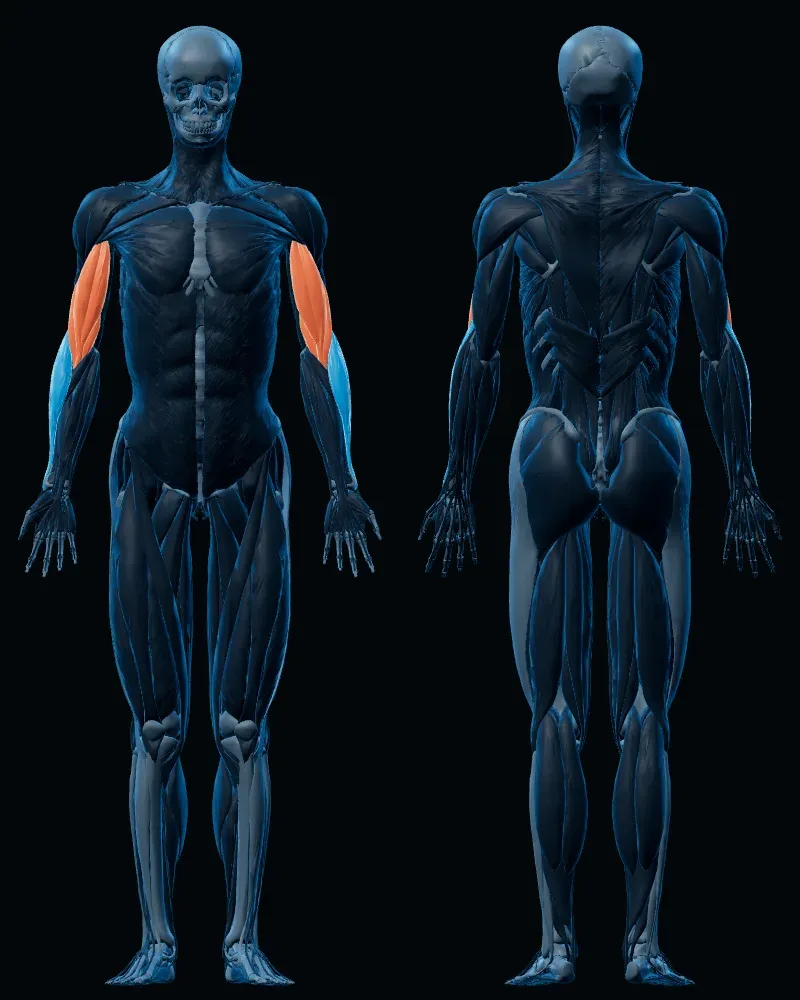
Muscles worked: biceps
Main movers: biceps brachii and brachialis
Assisting: brachioradialis
Table of contents
Spider curls are biceps curls done chest-down on a 45 degree incline bench, with your arms hanging straight toward the floor. The bench pins your torso in place, so swinging, leaning and shoulder shrugging are close to impossible. What is left is the elbow bending under load. That is the whole appeal.
If you have ever noticed that your “heavy” curls are mostly hips and shoulders, this is the fix. This article is part of our complete arm and forearm training guide, and it covers setup, what spider curls really train, and where they fit next to preacher and incline curls. I will also be blunt about two claims you will hear in the gym (short head isolation and a “peak”) that the research does not back.
How do you do spider curls with proper form?
Set an adjustable bench to about 45 degrees and lie with your chest against the pad, so the top of the pad sits just under your chin. Let your arms hang straight down on either side. Pick up the weights with a supinated grip (palms facing forward), which is the grip most often used for biceps work.
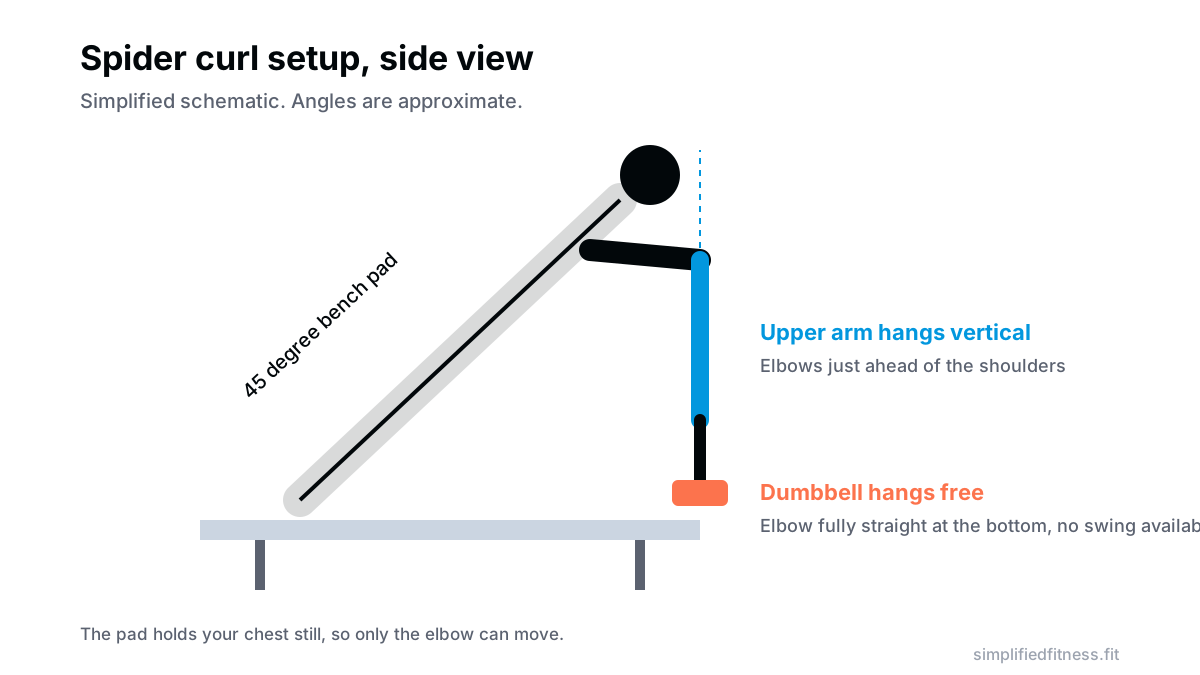
Then run the rep:
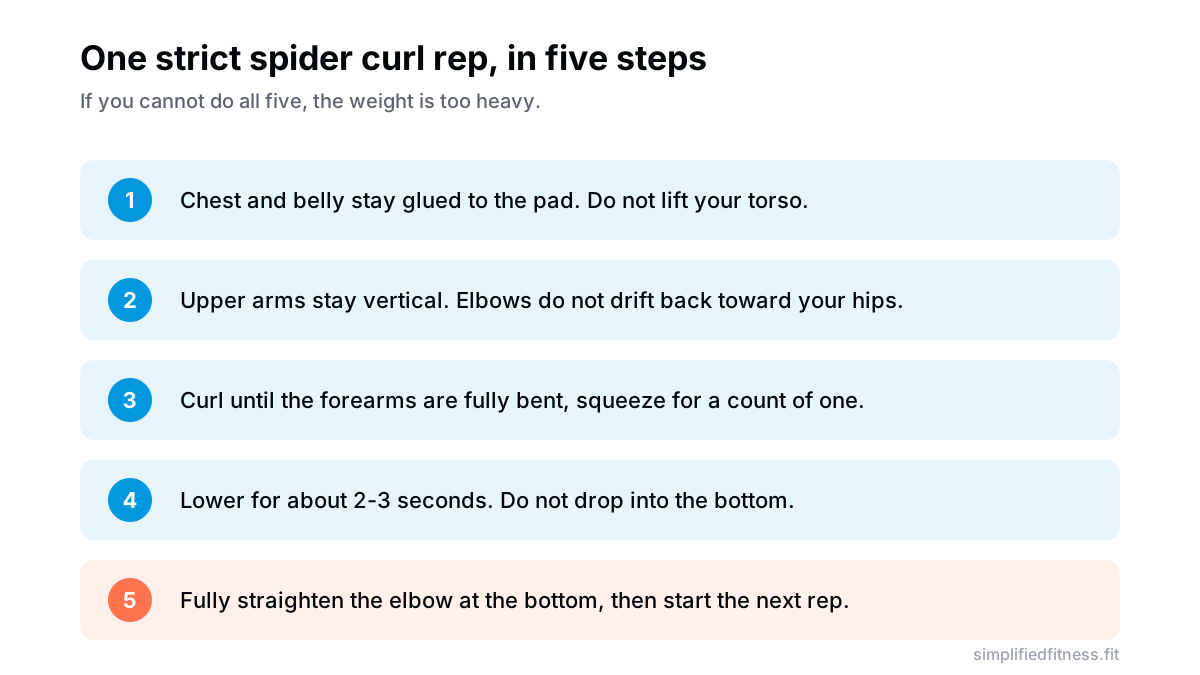
- Start from a fully straightened elbow, with the weights hanging still.
- Curl up by bending only the elbow. Your upper arms should stay vertical.
- Squeeze briefly at the top without letting the elbows drift back.
- Lower for roughly 2-3 seconds until the arm is straight again.
What muscles do spider curls work?
Spider curls work the elbow flexors, which are three muscles. The biceps brachii is the one you see in the mirror. Underneath and beside it sit the brachialis and the brachioradialis, which also bend the elbow.
Grip changes how the work is shared. In a small study of 10 competitive bodybuilders, a supinated grip produced more biceps brachii activation (by surface EMG) than pronated or neutral grips during the lifting phase, while the neutral and pronated grips pushed more work onto the anterior deltoid (Coratella et al., 2023). EMG measures electrical activity, not growth, so treat it as a clue rather than a verdict. The practical read: palms-up spider curls are the safest bet if you want the biceps brachii to do most of the work. For the forearm side, see our guide to hammer curls and arm thickness.
Do spider curls build a biceps peak or hit the short head?
Short answer: not as far as anyone has shown. Both heads of the biceps cross the elbow, and the research I could find on curls looks at the biceps brachii as a whole, not at one head. No trial I know of demonstrates that any curl grows the short head selectively.
The “peak” is a shape question. It depends largely on the length of your muscle belly and where your tendons attach, and training does not change either. What training can change is how much muscle you carry.
Where in the range of motion do spider curls load the biceps?
With your arms vertical, gravity pulls straight down on the dumbbell. The hardest point is usually when your forearm is horizontal, around the middle of the curl. The load eases as your forearm approaches vertical at the top. This is basic mechanics rather than a measured result, and the exact feel varies with your arm length and bench angle.
This is why “peak contraction” is a slightly misleading label. Spider curls are not a magic top-range exercise. They are a mid-range-heavy movement that starts from a straight elbow with very little load on it. If you want constant tension, cables help. Our article on Bayesian cable curls covers that approach.
Whether to emphasise the stretched or the shortened part of the curl is an open question. Here is what the studies found, because they do not agree:
- Pedrosa et al. (2023): in 19 untrained young women, training only the first half of the dumbbell preacher curl range (0-68 degrees of elbow flexion) produced greater growth at 70% of upper arm length than training only the second half, plus a bigger 1RM gain (Pedrosa et al., 2023).
- Nunes et al. (2020): 35 young adults did cable preacher curls (more load when the biceps is shortened) or barbell preacher curls (more load when stretched). Muscle thickness rose 7% vs 8%, so hypertrophy was similar (Nunes et al., 2020).
- Zabaleta-Korta et al. (2023): 38 recreationally trained women did incline or preacher curls for 9 weeks. Only the 70% region in the preacher group grew significantly, with no significant difference between groups or regions (Zabaleta-Korta et al., 2023).
The studies differ in design, bench angle, muscle regions measured and sample, and most used untrained or recreationally trained participants over 8-10 weeks. A systematic review of range-of-motion research also noted that evidence for the upper limbs is limited and conflicting (Schoenfeld & Grgic, 2020). The cautious takeaway is to train through a full, controlled range of motion most of the time and not to get hung up on one end of it.
Spider curl vs preacher curl vs incline curl
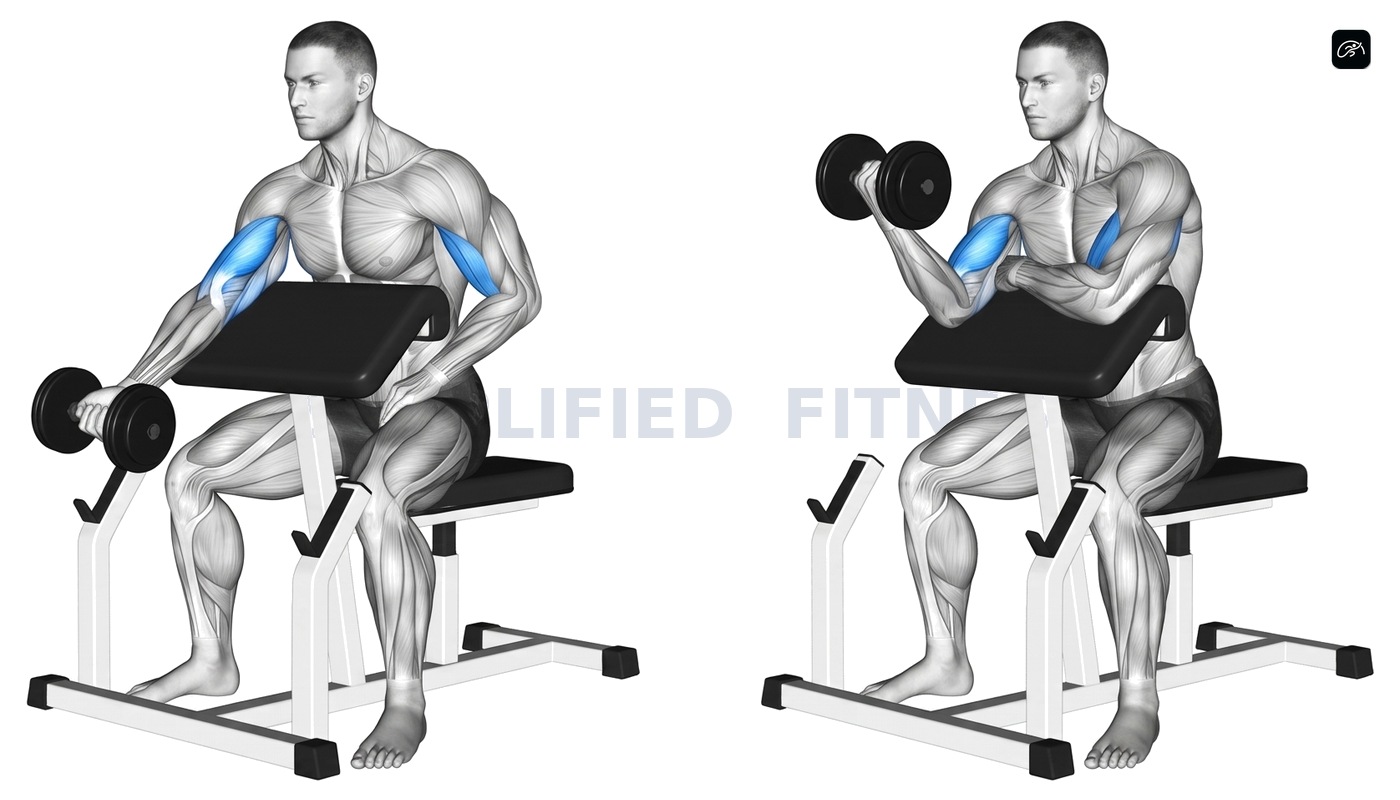
No study has compared spider curls head-to-head with either. What exists is research on shoulder position. Roughly speaking, the spider curl sits close to the preacher end (shoulder flexed, arm in front of the body), while the incline curl sits at the opposite end (shoulder extended, arm behind the body).
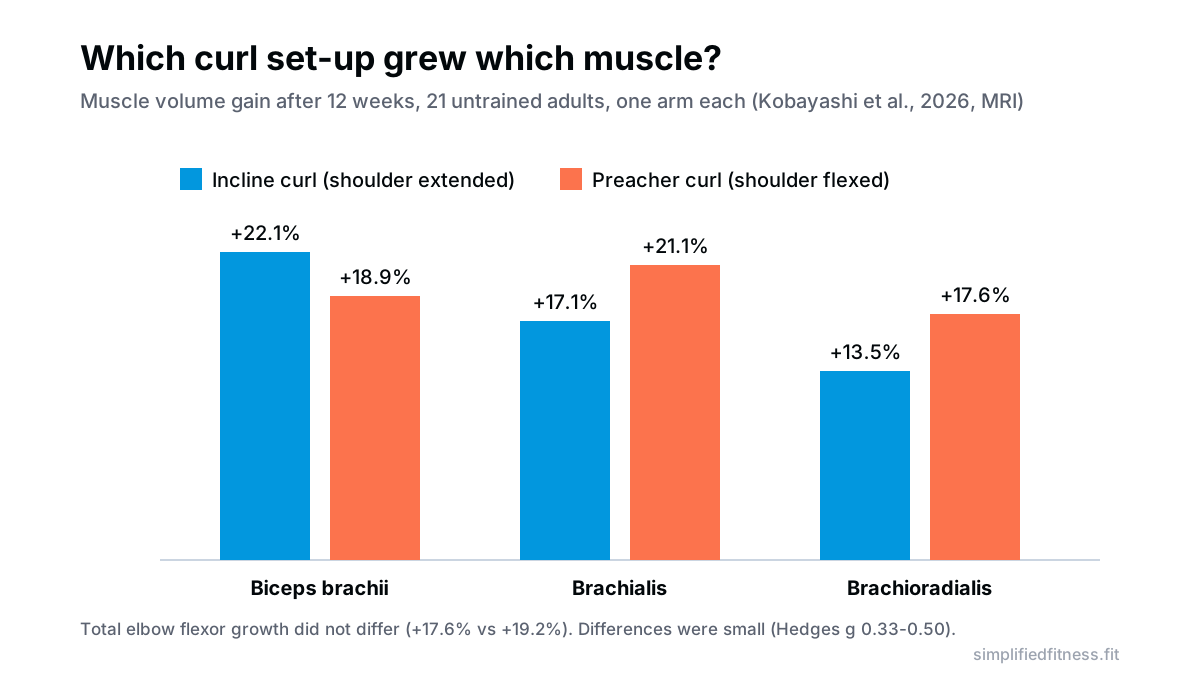
A 2026 MRI study had 21 untrained adults train one arm with incline dumbbell curls and the other with preacher dumbbell curls for 12 weeks. Biceps brachii volume rose more after incline training (+22.1% vs +18.9%, Hedges’ g 0.33), while brachialis (+17.1% vs +21.1%) and brachioradialis (+13.5% vs +17.6%) rose more after preacher training. Total elbow flexor growth did not differ (Kobayashi et al., 2026).
A separate 10-week trial in 15 young men matched resistance profiles and compared shoulder-flexed preacher cable curls with shoulder-extended Bayesian cable curls. Muscle thickness and strength gains were similar (Attarieh et al., 2025). Older EMG work on dumbbell curls found that incline and standard curls loaded the biceps across the whole range, while the preacher version produced high activation only over a short range (Oliveira et al., 2009). Those findings were in untrained or young participants and used different set-ups, so none of this is a ruling on spider curls specifically.
| Feature | Spider curl | Preacher curl | Incline curl |
|---|---|---|---|
| Body position | Chest-down on a 45 degree bench | Seated, arms on a sloped pad | Seated or reclined, arms behind torso |
| Shoulder position | Roughly flexed | Flexed | Extended |
| Momentum | Almost none | Very little | Some, if you rock |
| Best use | Strict, controlled reps | Same idea, bench required | Stretched biceps at the bottom |
For the shoulder-extended side in detail, see incline dumbbell curls. For the pad-supported side, see our guide to preacher curls.
Dumbbell or barbell for spider curls?
Dumbbells let each wrist rotate and each arm work on its own, which evens out a stronger side. A barbell or EZ bar lets you load heavier and is simpler to hand off. Both work. If you are setting the bench up alone, a light EZ bar on the floor is awkward to pick up while lying on the pad, so dumbbells are usually easier. Nothing here is backed by a trial, it is practical coaching.
How to program spider curls
Treat them as an accessory after your rows and pulldowns. Our pull day plan shows where arm work fits.
- Sets and reps: 2-4 hard sets of 8-15 reps.
- Effort: stop with about 1-2 reps left. Use the RIR/RPE calculator if you want a number.
- Frequency: two sessions a week is a reasonable start. Studies in this area typically trained arms two or three times weekly.
- Progression: add a rep or two each week, then add the smallest plate or a heavier dumbbell once you hit the top of the range.
When to stop or see a doctor
Spider curls are low-risk for most healthy lifters, but any exercise can aggravate an elbow or biceps tendon. Stop and get checked by a doctor or physiotherapist if you notice sharp pain at the front of the elbow, a sudden pop with weakness, bruising near the biceps, or pain that has not settled after a few days. This article cannot diagnose anything, and strict form does not make an injured tendon safe to load.
Bottom line
Spider curls are a strict, easy-to-control way to train the elbow flexors. They are not a short-head trick and they will not create a peak. Use a controlled range of motion, choose a load you can lower slowly, and combine them with a stretched-position curl for balance. For the bigger picture on arm volume and exercise selection, go back to the complete arm and forearm guide.
Frequently Asked Questions
What are spider curls?
Spider curls are biceps curls performed lying chest-down on a 45 degree incline bench with your arms hanging straight toward the floor. The bench holds your torso still, so the only joint that can move is the elbow. Set the bench to 45 degrees, hang a dumbbell in each hand and curl without letting your upper arms swing.
What muscles do spider curls work?
Spider curls work the elbow flexors: biceps brachii, brachialis and brachioradialis. A 2026 MRI study of curl variations found all three muscles grow with dumbbell curl training, with small differences depending on shoulder position. Treat spider curls as a general arm builder, not a single-muscle exercise.
Do spider curls build a biceps peak?
There is no good evidence that any curl builds a peak on its own. The shape of your biceps depends largely on muscle belly length and tendon insertion points, which training cannot change, plus how much muscle you carry, which it can. Spider curls help you add muscle in a controlled way, and that is the part you can influence.
Do spider curls target the short head of the biceps?
Probably not in the way gym lore claims. Both heads cross the elbow and both contribute to elbow flexion, and I am not aware of a trial showing a curl that grows one head selectively. Pick spider curls for strict form, not for short head targeting.
Spider curls vs preacher curls, which is better?
Neither has a proven edge for total arm size. In a 2025 trial of 15 young men, preacher-style and Bayesian cable curls produced similar biceps thickness gains over 10 weeks. Choose the one you can do strictly, feel in your biceps and progress over time.
Are spider curls better than incline curls?
They are different, not better. Incline curls keep your arm behind your torso so the biceps is stretched at the bottom, while spider curls keep the arm hanging forward. In a 12-week MRI study, incline curls grew the biceps brachii slightly more (22.1% vs 18.9%) and preacher curls grew the brachialis and brachioradialis slightly more. Use both if you have the time.
What angle should the bench be for spider curls?
Most lifters use about 45 degrees, which is the standard prone incline setup. A steeper bench puts you more upright and a flatter bench makes the chest-down position awkward. Pick the angle where your arms hang free of the bench with your elbows just in front of your shoulders.
How heavy should I go on spider curls?
Go lighter than your standing curl, usually a weight you can lift for 8-15 controlled reps. Strict curls remove momentum, so the same dumbbell feels much heavier. Leave 1-2 reps in the tank on most sets and use our RIR/RPE calculator to check your effort.
Can I do spider curls with a barbell or EZ bar?
Yes. A barbell or EZ bar lets you load both arms evenly and is easier to rack, while dumbbells let each wrist rotate freely. Choose the EZ bar if straight-bar curls bother your wrists.
How many sets and reps of spider curls should I do?
Two to four hard sets of 8-15 reps after your main pulling work is a sensible starting point. Studies on curl variations have typically used 3-5 sets per session, two or three times a week. Add reps or small amounts of weight over the weeks rather than adding more sets.
Are spider curls safe for the elbow?
For most healthy lifters they are comfortable, because the fixed position removes jerky loading. A very heavy, fast drop at the bottom can still irritate the elbow or biceps tendon. If you get sharp or lingering pain near the elbow crease, stop and get it assessed by a doctor or physiotherapist.
Why do my spider curls feel awkward on the bench?
Usually the bench is too high or too low for your torso length. Your chin should sit just above the top edge, and your arms should clear the pad. Adjust the seat height or move up or down the pad until the dumbbells hang freely.
Can I do spider curls at home?
Yes, if you have an adjustable bench and a pair of dumbbells. Without a bench, lean your chest on the back of a sturdy sofa at a similar angle, or use a preacher-style alternative. Keep the weights light until you trust the setup.
Sources & References
Every claim above is checked against peer-reviewed research (PubMed, U.S. National Library of Medicine) or guidance from established health bodies. How we fact-check.
- Schoenfeld BJ, et al. Effects of range of motion on muscle development during resistance training interventions: A systematic review. SAGE Open Med. 2020. PMID: 32030125
- Kobayashi Y, et al. Exercise-specific preferential hypertrophy of individual elbow flexor muscles after incline versus preacher dumbbell curl training. J Sports Sci. 2026. PMID: 42829982
- Zabaleta-Korta A, et al. Regional Hypertrophy: The Effect of Exercises at Long and Short Muscle Lengths in Recreationally Trained Women. J Hum Kinet. 2023. PMID: 37559762
- Pedrosa GF, et al. Training in the Initial Range of Motion Promotes Greater Muscle Adaptations Than at Final in the Arm Curl. Sports (Basel). 2023. PMID: 36828324
- Nunes JP, et al. Placing Greater Torque at Shorter or Longer Muscle Lengths? Effects of Cable vs. Barbell Preacher Curl Training on Muscular Strength and Hypertrophy in Young Adults. Int J Environ Res Public Health. 2020. PMID: 32823490
- Attarieh P, et al. Comparison Between Shoulder Flexed and Extended Positions in Elbow Flexion Resistance Training on Regional Hypertrophy and Maximum Strength: Preacher versus Bayesian Cable Curls. Eur J Sport Sci. 2025. PMID: 40082069
- Oliveira LF, et al. Effect of the shoulder position on the biceps brachii emg in different dumbbell curls. J Sports Sci Med. 2009. PMID: 24150552
- Coratella G, et al. Biceps Brachii and Brachioradialis Excitation in Biceps Curl Exercise: Different Handgrips, Different Synergy. Sports (Basel). 2023. PMID: 36976950

Umair Hazrami · Founder & Head Coach, Simplified Fitness
Umair Hazrami founded Simplified Fitness and the Simplified Lifter channel to cut through fitness noise. With 4+ years of consistent training and 10+ coaching clients, he writes every guide from the peer-reviewed research and links the sources so you can check them. Our editorial standards.
Educational content only, not medical advice. If you have a medical condition, are pregnant, or take medication, talk to a qualified doctor before changing your diet, supplements or training. Full disclaimer.
Keep reading
Exercise Technique
Antagonist Arm Supersets: Biceps and Triceps Pairing for a Faster, Pumpier Arm Day
A biceps triceps superset workout can shorten arm day while keeping volume close to straight sets. See the research, pairing tips and a 20-minute routine.
9 min read
Exercise Technique
Barbell vs EZ-Bar Curls: Why Straight Bars Hurt the Pinky Side of Your Wrist
Barbell vs EZ bar curls for wrist pain: what EMG research says about biceps activation, forearm rotation and the carrying angle, plus fixes you can use today.
8 min read
Exercise Technique
Bayesian Cable Curls: Form, Setup and Whether They Build Bigger Biceps
Bayesian cable curl form explained step by step: pulley height, step-forward distance, elbow position, sets and reps, and what the research really shows.
8 min read
Exercise Technique
Close-Grip Bench Press: Triceps Loading, Wrist Spacing, and Elbow Stress
Close grip bench press triceps guide: how narrow to go, what the grip width research shows, and how to protect wrists and elbows. Setup cues included.
8 min read