Barbell vs EZ-Bar Curls: Why Straight Bars Hurt the Pinky Side of Your Wrist
Barbell vs EZ bar curls for wrist pain: what EMG research says about biceps activation, forearm rotation and the carrying angle, plus fixes you can use today.
TL;DR. The short answer
- EMG studies show the biceps works about as hard on a straight bar as on an EZ-bar, so switching bars costs you very little stimulus. One study of 12 people called the choice a matter of comfort.
- A straight bar locks both forearms into full supination. The EZ-bar angle lets the forearms rotate a little, which many lifters find easier on the wrists, though no study has measured wrist load directly.
- Pinky-side wrist pain is a pattern doctors see in athletes who repeat forearm rotation, wrist deviation and gripping. It is worth taking seriously if it lingers.
- Fixes in order: use an EZ-bar, keep the wrist straight, drop the load a little, or move to dumbbells or cables.
- Swelling, clicking, numbness, night pain or pain that outlasts a week or two of changes needs a clinician, not another bar.
Part of our complete guide: Arm Workout Science: The Complete Guide to Biceps, Triceps, Brachialis and Forearm Growth
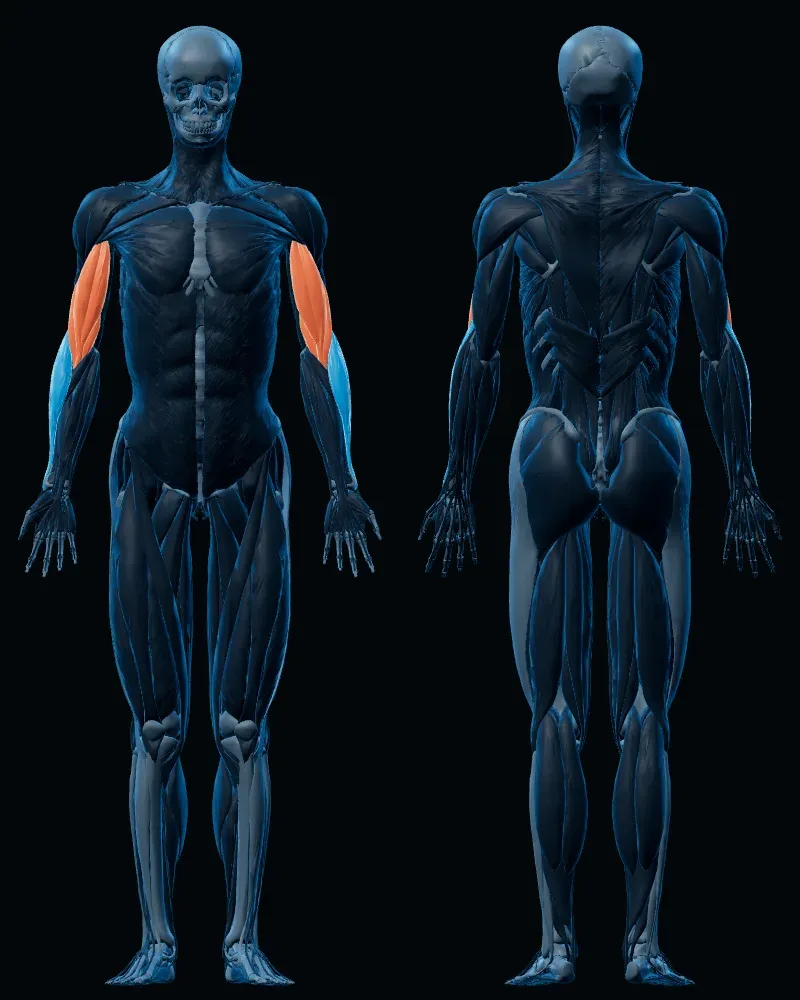
Muscles worked: biceps
Main movers: biceps brachii and brachialis
Assisting: brachioradialis
Table of contents
Barbell vs EZ bar curls is mostly a wrist question, not a biceps question. The research we have shows similar biceps activity on both bars, so if a straight bar makes the pinky side of your wrist ache, switching to an EZ-bar costs you very little.
This article sits inside our complete arm and forearm training guide. Here we stick to one controversy: why a rigid straight bar bothers some wrists, what the evidence does and does not show, and how to fix it without losing arm growth.
Does the EZ-bar build the same biceps as a straight bar?
Almost certainly close. That is the honest summary, and it is a hedge on purpose.
In a 2018 study, 12 participants did a set of 10 curls at 65% of their 1-RM with a dumbbell, a straight bar and an EZ-bar while researchers recorded surface EMG from the biceps brachii and brachioradialis. The EZ-bar produced higher activity than dumbbells in both muscles, and the authors noted that the small difference between straight and EZ-bar variants makes the choice “a matter of subjective comfort” (Marcolin et al., 2018).
Two caveats matter. It was one set in 12 people, not a trial over months. And EMG measures electrical activity, not muscle growth. No long-term study I found compared biceps size after training with each bar, so “equal hypertrophy” is a reasonable expectation, not a proven result.
Why do straight barbell curls hurt the pinky side of the wrist?
Here is the mechanical picture. Stand with your arms hanging and palms forward. Your forearms angle slightly outward from your upper arms. That is the carrying angle, and it varies between people. A straight bar asks both wrists to sit in full supination, parallel and shoulder-width, no matter what your arms would prefer.
For some lifters that means the forearms are forced into a position they would not choose, and the load sits through the outside (ulnar) edge of the wrist. This is the part I want to be careful about. It is a plausible explanation, not a measured one. I could not find a study that measured wrist loading for straight versus EZ-bar curls.
What we do know comes from sports medicine reviews. Ulnar-sided wrist pain is common in athletes, and repetitive forearm rotation, wrist flexion and extension, and radial and ulnar deviation can predispose to injury of the ulnar structures (Dineen and Greenberg, 2020). Another review lists sports that need repeated pronosupination, deviation, axial loading and gripping, with the triangular fibrocartilage complex, the extensor carpi ulnaris tendon and the distal radioulnar joint among the structures commonly affected (Rios-Russo et al., 2021).
Neither review is about curls. The link is an inference, and a cheap one to test.
What does forearm position do to the biceps?
Supination is part of the biceps job, and that is why we like it for curls. The biceps both bends the elbow and rotates the forearm toward palm-up.
Ten competitive bodybuilders did 6-rep sets at 8-RM with supinated, pronated and neutral handgrips. During the lifting phase, biceps brachii excitation was about 19% greater with a supinated grip than with a pronated one and about 12% greater than neutral. The brachioradialis was a smaller 5 to 6% higher in supination. The front delt worked harder with the pronated and neutral grips (Coratella et al., 2023).
A separate 2025 study in 36 healthy men used light isometric holds. It found that the biceps looked more active in supination and the brachioradialis in pronation, and its authors called for further controlled work (Chen et al., 2025).
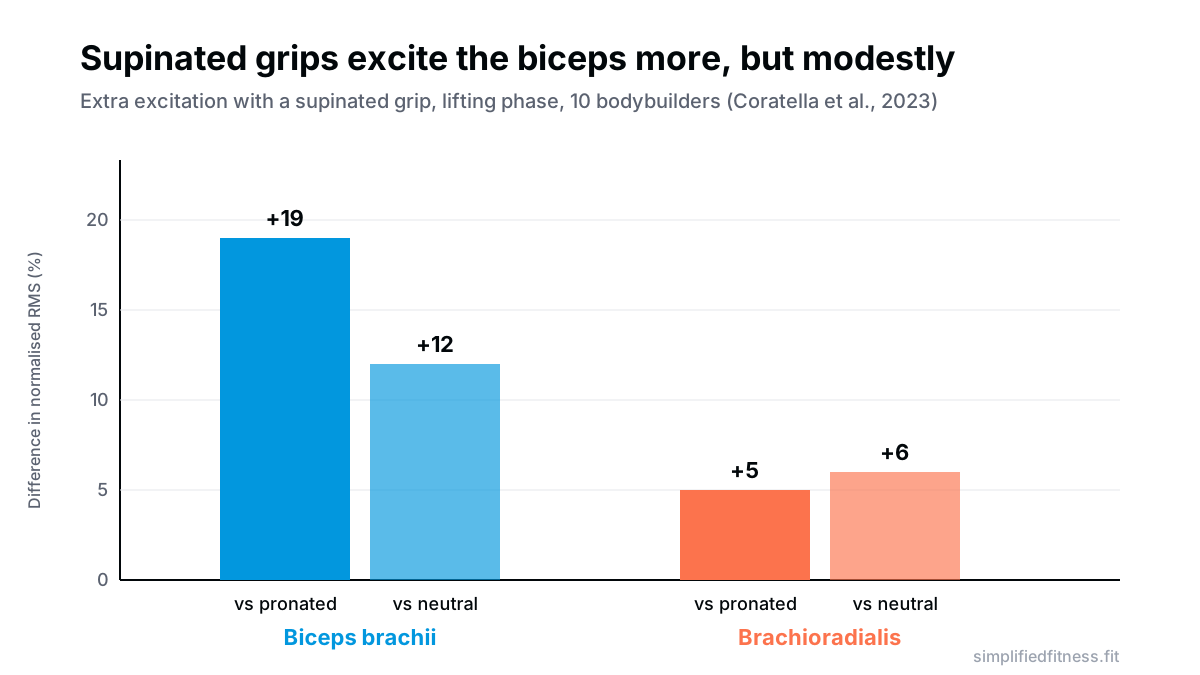
The practical reading: a fully supinated grip is the best for the biceps, the EZ-bar sits between supinated and neutral, and the gap is small enough that comfort can win.
Different studies, different results on exactly how big the grip effect is. That makes sense. Sample sizes are small, the loads differ, and EMG from different grips is not perfectly comparable. Treat the numbers as direction, not precision.
Straight bar vs EZ-bar: how they compare
| Straight bar | EZ-bar | Dumbbells or cables | |
|---|---|---|---|
| Forearm position | Full supination, fixed | Partly supinated, fixed | Free to adjust |
| Biceps EMG | Similar to EZ-bar | Similar to straight bar | Somewhat lower than EZ-bar in some phases in one study |
| Wrist comfort | Bothers some lifters | Often easier | Often easiest |
| Loading small jumps | Easy with plates | Easy with plates | Needs a dumbbell rack or cable stack |
| Best for | Lifters with no pain | Lifters with pinky-side pain | Anyone who wants freedom of path |
Dumbbell and cable comfort claims in the table are coaching observations, not trial results.
How do I fix wrist pain when curling?
Go in order. Do not change four things at once, or you will not know which one helped.
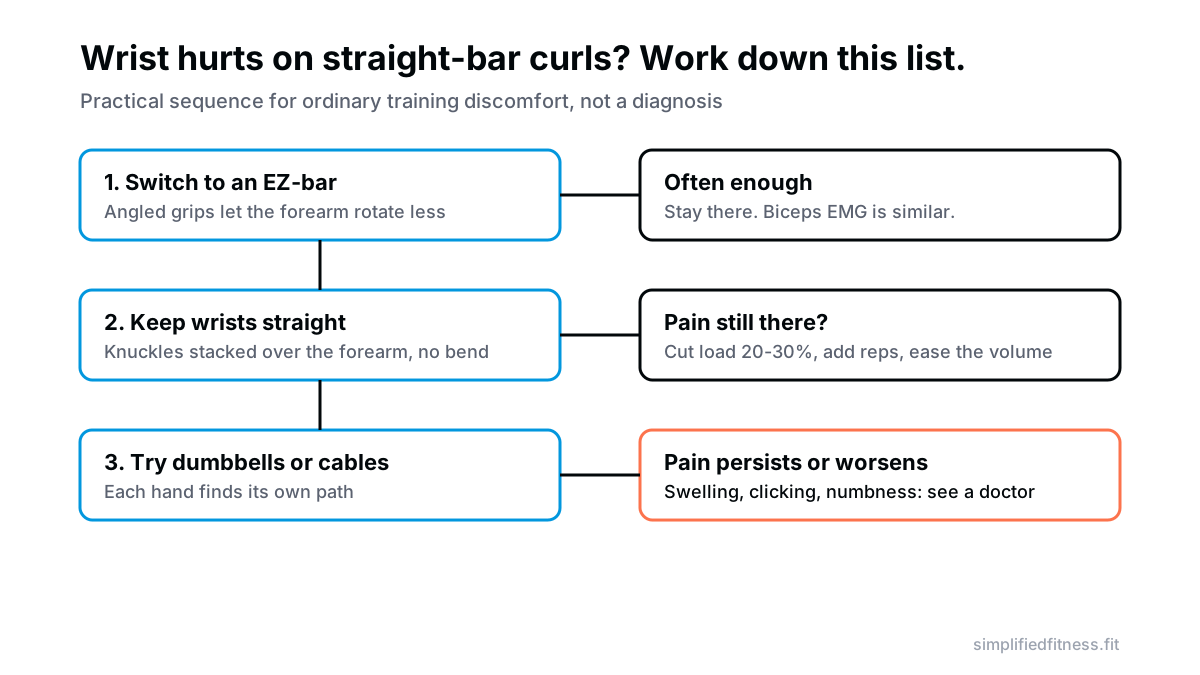
- Swap the bar. Use an EZ-bar on the inner or outer bend and keep the same weight for two or three sessions.
- Check the wrist line. A common mistake here is letting the wrists curl back toward the forearm as the set gets heavy. Keep the knuckles stacked over the forearm.
- Lower the load. Biceps growth is not tied to one narrow rep range. A 2021 review argues muscle adaptations can be obtained across a wide spectrum of loading zones (Schoenfeld et al., 2021). So 12-15 reps with a lighter bar, taken close to failure, is a fair trade for a healthier wrist.
- Change implements. Dumbbells let each hand rotate where it wants. Cables keep tension on the biceps and let you tweak the grip. Our article on Bayesian cable curls covers that option.
- Slow the eccentric. If pain shows up on the way down, control the lowering phase. Do not drop the bar.
Pronated, neutral or supinated: which one should I use?
You do not have to choose one forever. Different grips emphasise different muscles, so rotating them is a legitimate way to spread the stress.
- Supinated (EZ-bar or straight bar): the biceps-first option, with the most biceps excitation in the study above.
- Neutral (hammer curls): friendlier for many wrists, and it brings in the brachialis and brachioradialis. See our guide to hammer curls and upper arm thickness.
- Pronated (reverse curls): less biceps, more forearm. Useful as an accessory, not a replacement.
If you want the anatomy behind why those muscles respond to grip changes, our functional anatomy of the arm flexors article goes through it. For curl variations that train the biceps at different lengths, see incline curls versus preacher curls.
Barbell vs EZ-bar curls for Indian gyms
Many commercial gyms in India have plenty of straight bars but only one or two EZ-bars, and those are often in use. If the EZ-bar is taken, ask for the cable rope or straight cable bar attachment. A cable curl with a short straight bar still lets your wrists float a little. If your gym has only fixed barbells, dumbbells are the free fix.
Also, do not underestimate the heat and humidity. Sweaty hands slip, and a bar that slides in your grip makes you squeeze harder, which can make wrists sorer. Chalk or a dry towel is a small, cheap help.
When wrist pain means stop and see a doctor
Ordinary training discomfort tends to fade within days of changing the setup. Pain that behaves differently needs a clinician.
See a doctor or physiotherapist if you notice:
- swelling or visible puffiness on the pinky side of the wrist
- clicking, snapping or a catching feeling
- numbness, tingling or weakness in the hand
- pain at night or at rest
- pain after a fall or a sudden twist
- no improvement after a week or two of sensible changes
Pinky-side wrist pain has several possible causes, from tendon irritation to cartilage and joint problems, and one of the reviews above notes that abnormal imaging findings can also appear in athletes with no symptoms, so an exam matters. Early treatment is usually non-surgical and often includes splinting, load management and activity modification (Rios-Russo et al., 2021). We cannot diagnose you here.
If the pain sits at the front of the elbow instead, our article on distal biceps tendonitis and golfer’s elbow is the better starting point.
How to program curls once the wrists calm down
Do not overcomplicate it. Two to four hard sets of curls, two or three times per week, is a reasonable start for most lifters. Our free training volume calculator can help you count your weekly sets across muscle groups.
Pick one main curl, such as the EZ-bar. Add a neutral-grip curl to fill the gap. Stay a rep or two from failure on most sets, and push the last set of the session closer to failure. Log your weights. If your logbook shows reps and load rising every few weeks, the bar choice is working.
If you are building a full pull session, our pull day plan shows where arm work fits.
The bottom line
The research on barbell vs EZ bar curls is small but consistent: biceps activity is similar, and a fully supinated grip adds only a modest amount. The wrist side of the story is less well studied, so the case for the EZ-bar rests on anatomy, reviews of ulnar-sided wrist pain and plain comfort. Change one thing at a time, keep your wrists straight, and see a clinician if the pain has red flags.
Frequently Asked Questions
Is an EZ-bar better than a straight bar for biceps growth?
There is no good evidence that one grows biceps better than the other. A 2018 EMG study of 12 participants found only small differences between straight and EZ-bar curls and concluded the choice is mostly about comfort. Pick the bar that lets you train hard without wrist pain and track your reps.
Why do straight barbell curls hurt my wrists?
A straight bar holds both forearms in full supination, and in some lifters that can irritate structures on the pinky side of the wrist. Reviews of ulnar-sided wrist pain in athletes link it to repeated forearm rotation, wrist deviation and gripping, though not specifically to curls. Try an EZ-bar and keep your wrists in line with your forearms.
What is the carrying angle of the elbow?
It is the slight outward angle between your upper arm and forearm when you stand with your arm straight and palm facing forward. It differs from person to person, which is one reason a straight bar feels fine for some lifters and awkward for others. If your forearms drift outward on the way up, a cambered bar may feel more natural.
Does the EZ-bar really reduce wrist strain?
Many lifters report that it does, and the angled grip means the forearm is not forced into full supination. However, no study I found measured wrist joint loading for straight versus EZ-bar curls, so this is a reasonable inference, not a proven fact. Test it yourself over two or three sessions at the same load.
Does supinating the forearm work the biceps more?
Yes, a little. In ten competitive bodybuilders, biceps excitation during the lifting phase was about 19% greater with a supinated grip than a pronated one, and about 12% greater than neutral. The EZ-bar is only partly supinated, so you give up a small amount, which is easy to make up with an extra set.
Should I use an inner or outer grip on the EZ-bar?
There is no reliable research ranking the two grips for hypertrophy. The inner grip is more neutral, the outer grip is more supinated, and wrist comfort usually decides it. Try both across a few sets and keep the one that feels clean.
Can I just wear wrist wraps for curls?
Wraps can make a heavy set feel more stable, but they do not fix a bar or grip that bothers you. Curls are rarely so heavy that you need them. Fix the grip first, and see a clinician if you need support just to curl.
Are dumbbell curls easier on the wrists?
For many people, yes, because each hand picks its own path and can rotate freely. A 2018 EMG study found biceps activity with dumbbells was somewhat lower than with the EZ-bar in some phases, which is not a reason to avoid them. Use dumbbells or cables if both bars bother you.
How heavy should I curl if my wrists are sensitive?
Biceps growth is not tied to one narrow rep range, so a lighter load for 10-20 reps can still work if you train close to failure. A 2021 review argues muscle adaptations can be obtained across a wide spectrum of loading. Drop the load 20-30 percent and add reps until the pain settles.
When is wrist pain from curling a reason to see a doctor?
See one if you have swelling, clicking or snapping, numbness or tingling, pain at night, pain after a fall, or pain that does not ease within a week or two of changing your setup. Pinky-side wrist pain has several possible causes, including cartilage, tendon and joint problems, and imaging plus an exam are needed to tell them apart. Do not push through it.
Do wrist curls or grip work help prevent pain on curls?
There is no good trial showing that they do. One review of ulnar-sided wrist pain lists load management and strengthening the whole kinetic chain as typical early treatment. Build forearm work in gradually and do not use it to push through an active injury.
Is pronated or reverse-grip curling safer for the wrist?
Pronated curling takes the wrist out of full supination, and a 2023 study found biceps excitation was lower in that grip. In a cadaver study, pressure inside the distal radioulnar joint was highest in supination. Cadaver data does not prove reverse curls are safer in living lifters, so treat it as a clue and not a rule.
What if the EZ-bar hurts too?
Then the bar is probably not the problem. Check that your wrists are not bent back, that you are not swinging the bar up with momentum, and that the load is manageable. If dumbbells and cables also hurt, get the wrist examined.
Sources & References
Every claim above is checked against peer-reviewed research (PubMed, U.S. National Library of Medicine) or guidance from established health bodies. How we fact-check.
- Marcolin G, et al. Differences in electromyographic activity of biceps brachii and brachioradialis while performing three variants of curl. PeerJ. 2018. PMID: 30013836
- Coratella G, et al. Biceps brachii and brachioradialis excitation in biceps curl exercise: different handgrips, different synergy. Sports (Basel). 2023. PMID: 36976950
- Chen Y, et al. Forearm rotation and elbow angle differentially modulate biceps brachii and brachioradialis muscle stiffness and EMG activity during low-load isometric contractions. BMC Sports Sci Med Rehabil. 2025. PMID: 40604986
- Dineen HA, et al. Ulnar-sided wrist pain in the athlete. Clin Sports Med. 2020. PMID: 32115090
- Rios-Russo JL, et al. Ulnar-sided wrist pain in the athlete: sport-specific demands, clinical presentation, and management options. Curr Sports Med Rep. 2021. PMID: 34099609
- Gutierrez-Monclus R, et al. Intra-articular pressure in the distal radioulnar joint: a biomechanical study. J Hand Surg Am. 2025. PMID: 38069956
- Schoenfeld BJ, et al. Loading recommendations for muscle strength, hypertrophy, and local endurance: a re-examination of the repetition continuum. Sports (Basel). 2021. PMID: 33671664

Umair Hazrami · Founder & Head Coach, Simplified Fitness
Umair Hazrami founded Simplified Fitness and the Simplified Lifter channel to cut through fitness noise. With 4+ years of consistent training and 10+ coaching clients, he writes every guide from the peer-reviewed research and links the sources so you can check them. Our editorial standards.
Educational content only, not medical advice. If you have a medical condition, are pregnant, or take medication, talk to a qualified doctor before changing your diet, supplements or training. Full disclaimer.
Keep reading

Exercise Technique
Antagonist Arm Supersets: Biceps and Triceps Pairing for a Faster, Pumpier Arm Day
A biceps triceps superset workout can shorten arm day while keeping volume close to straight sets. See the research, pairing tips and a 20-minute routine.
9 min read
Exercise Technique
Bayesian Cable Curls: Form, Setup and Whether They Build Bigger Biceps
Bayesian cable curl form explained step by step: pulley height, step-forward distance, elbow position, sets and reps, and what the research really shows.
8 min read
Exercise Technique
Close-Grip Bench Press: Triceps Loading, Wrist Spacing, and Elbow Stress
Close grip bench press triceps guide: how narrow to go, what the grip width research shows, and how to protect wrists and elbows. Setup cues included.
8 min read
Exercise Technique
Cross-Body Cable Triceps Extensions: Setup, Form and What the Science Says
Cross body cable triceps extension explained: exact setup, what it does to your elbows and wrists, and what research says about the lateral head claim.
7 min read