Triceps Brachii Anatomy: Lateral, Long and Medial Heads Explained
Triceps brachii anatomy made practical: what the long, lateral and medial heads do, why shoulder position matters, and how to build horseshoe triceps.
TL;DR. The short answer
- The triceps brachii has three heads. The long head crosses both the shoulder and the elbow, while the lateral and medial heads cross only the elbow.
- Shoulder position changes the long head the most. With the arm overhead it is stretched before the elbow even moves, and in a 12-week MRI trial overhead training grew all three heads more than pushdown-style training.
- The idea that each head is trained by its own exercise is mostly a myth. In one isometric EMG study, all three heads were activated at similar levels when the elbow was bent to 90 degrees or more.
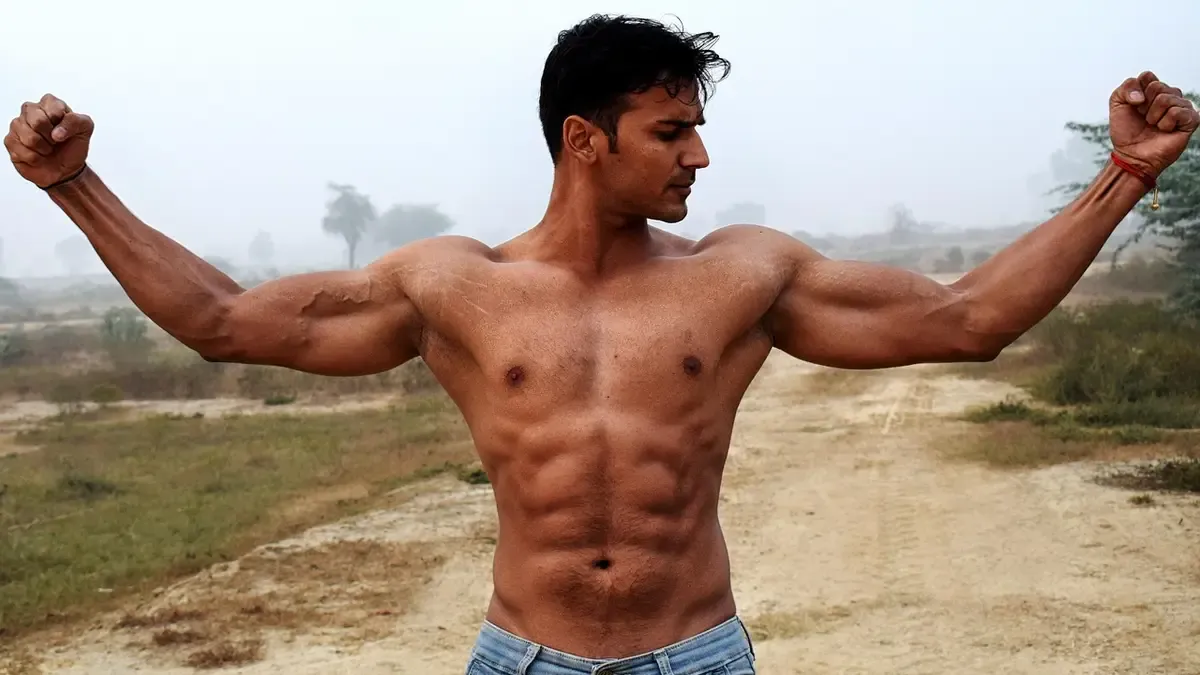
- 'Horseshoe triceps' is the look of a well-developed lateral and medial head sitting alongside the long head. It comes from overall triceps size plus your own muscle shape, not from one magic exercise.
- A simple plan: one overhead extension, one arm-by-your-side movement, 2-3 hard sets each, done twice a week.
Part of our complete guide: Arm Workout Science: The Complete Guide to Biceps, Triceps, Brachialis and Forearm Growth
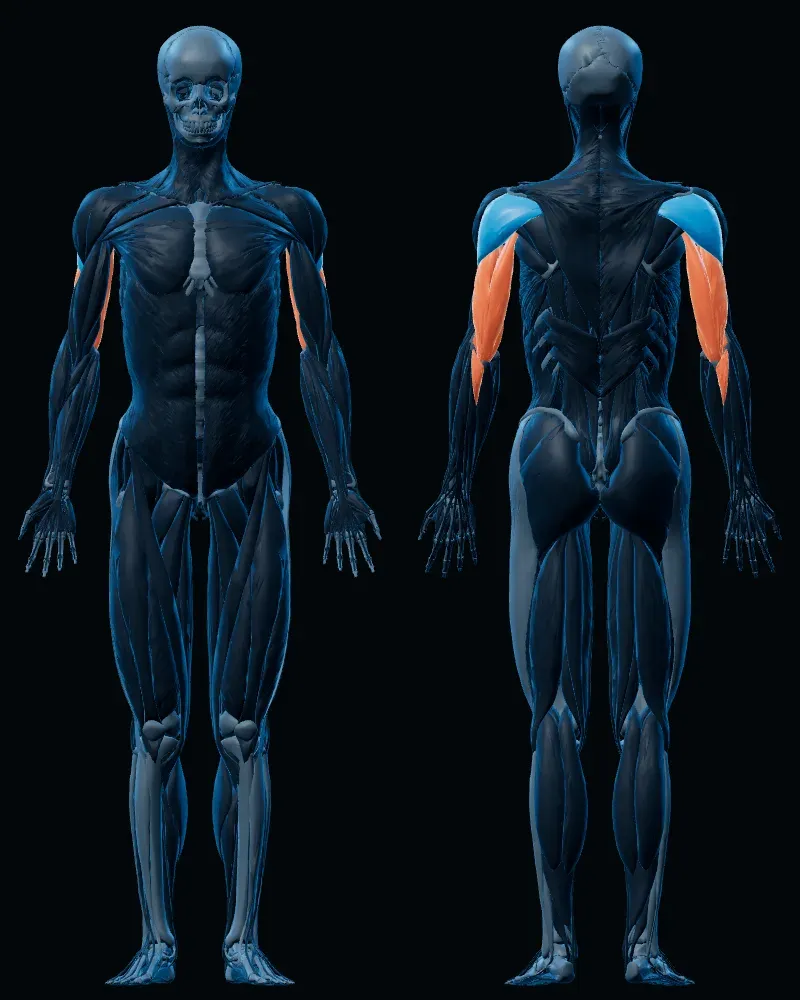
Muscles worked: triceps
Main movers: all three heads of the triceps
Assisting: rear delts
Table of contents
Triceps brachii anatomy is simple to describe and easy to overcomplicate. There are three heads, the long, lateral and medial, and all of them straighten the elbow. Only the long head also crosses the shoulder, and that is the one detail that should change how you train.
This page is the anatomy map for the back of the upper arm. For the full arm picture, including biceps, brachialis and forearms, see our complete arm and forearm training guide. Here we stay on the triceps: what each head is, what the research says about them, and what “horseshoe triceps” really means.
What are the three heads of the triceps brachii?
The name says it: tri-ceps, three heads, one muscle. They all merge into a single tendon that attaches at the point of the elbow, and their job is to straighten it.
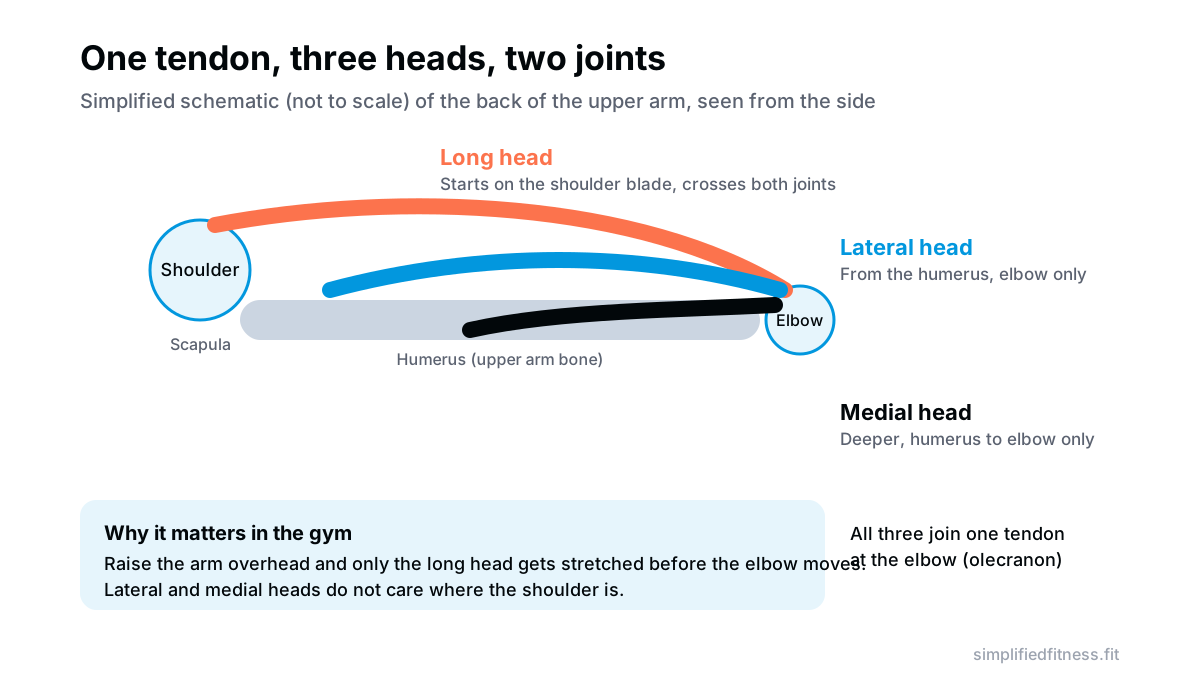
- Long head. Starts on the shoulder blade (scapula), so it crosses both the shoulder and the elbow. This is the biarticular (two-joint) head. It forms most of the underside of your upper arm.
- Lateral head. Starts on the back of the upper arm bone and sits on the outer side. It forms the outer part of the “sweep” you see from behind.
- Medial head. Lies deeper, underneath the other two. It only crosses the elbow, like the lateral head.
That origin and insertion layout is standard textbook anatomy. The interesting question for a lifter is not where the heads sit, but whether they behave differently when you train.
Does the shoulder position change what the triceps do?
Yes, but mainly for one head. Because the long head crosses the shoulder, raising your arm overhead stretches it before you bend the elbow at all. The lateral and medial heads do not care where the shoulder is, since neither crosses it.
Researchers have tested this directly. In one study, ten young men held a submaximal isometric elbow extension until failure with the shoulder at either 0 or 90 degrees of flexion. Long head activity near the end of the hold was greater at 90 degrees, while no other portion of the triceps showed an effect of shoulder angle (Davidson & Rice, 2010). The authors also point out that readings from one head do not represent the whole group.
A 2018 study compared overhead and lying dumbbell extensions in 21 resistance-trained men, recording the long and lateral heads. Both exercises showed similar activation patterns across the range of motion, and the authors suggested the two should not both be prescribed in the same routine (Alves et al., 2018). That is a surface EMG study, so it tells us about activation, not about muscle growth.
What does growth data say about the three heads?
This is where the anatomy becomes useful. In a 2023 trial, 21 adults trained one arm with cable elbow extensions overhead and the other arm with the arm in a neutral position by the side. Both arms did 5 sets of 10 reps at 70% of one-rep max, twice a week, for 12 weeks. MRI showed larger gains in the overhead arm for every part of the muscle: the long head grew 28.5% vs 19.6%, the lateral and medial heads together 14.6% vs 10.5%, and the whole triceps 19.9% vs 13.9% (Maeo et al., 2023).
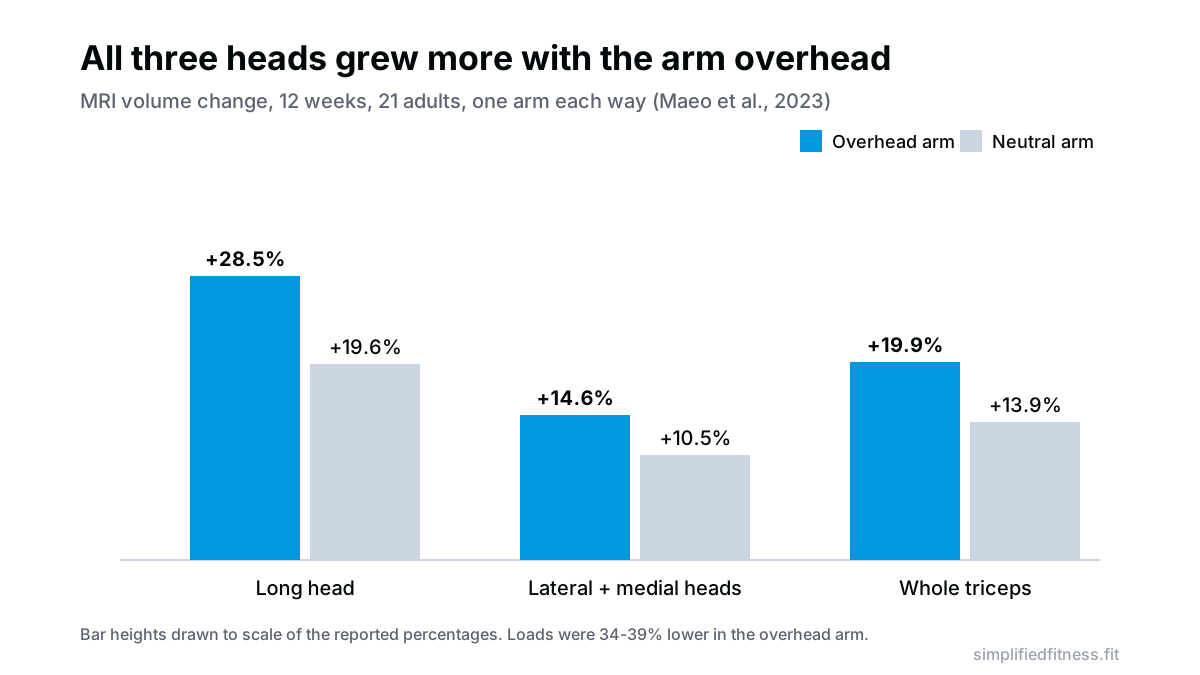
Two details stand out. The overhead arm used lower absolute loads (34-39% lower) and still grew more. And the lateral and medial heads, which do not cross the shoulder, also benefited. The authors link this to training at longer muscle lengths, though the trial itself cannot prove why. It is one study in 21 adults, so I would call the direction convincing and the exact size uncertain. We go deeper on this in overhead vs neutral triceps training.
Is there really a “workhorse” medial head and a “sweep” lateral head?
Gym language gives each head a personality. The medial head is the workhorse that fires on everything, the lateral head is the sweep that needs heavy loads, and the long head is the mass builder. It is a tidy story, and the data are more mixed.
In a 2021 study, 17 adults (7 men, 10 women) did isometric force-matching tasks at 20-80% of maximum, at elbow angles of 60, 90 and 120 degrees. Surface EMG from the three heads did not differ significantly, apart from one small difference between the medial and lateral heads at 20% effort with the elbow at 60 degrees. At 90 degrees or more flexed, the three heads were activated at matched levels relative to force (Akima et al., 2021). So under these conditions there was no clear sign that one head does the work alone.
On fibre type, biopsies of the lateral head in 15 professional tennis players showed roughly two thirds type 2 (fast-twitch) fibres (Sanchís-Moysi et al., 2010). That supports the idea that triceps handle heavy, explosive work well. But it is a small group of racket-sport athletes, it covered only the lateral head, and it does not show that lighter sets grow the muscle any less.
How is the triceps built inside, and why does it matter?
The triceps is a pennate muscle, meaning its fibres sit at an angle to the line of pull instead of running straight along it. In a 2011 study, 40 untrained men trained for 12 weeks (with 9 more as controls), and thickness and fibre angle of the long head were measured at three sites along the arm. Both increased at all three sites with no significant difference between them, which the authors attribute to the pennate fibre arrangement. The biceps, in contrast, grew more at its upper site than its lower one (Matta et al., 2011).
For you, that suggests the long head tends to grow fairly evenly along its length, so you do not need special tricks to “target the lower part.” It is also worth noting that these were untrained men, so results in experienced lifters may differ.
Muscle size also matters more than fibre geometry for strength. In Japanese Olympic athletes, the male-female difference in elbow extension force was mostly explained by cross-sectional area rather than differences in fibre angle (Ichinose et al., 1998). More triceps, stronger lockout.
What is horseshoe triceps, and can you build it?
Horseshoe triceps is a look, not an anatomical term. From behind, a developed lateral head forms the outer curve, the long head fills the inner line, and the medial head shows at the lower arm, giving a “U” outline when the arm is flexed.
Honest answer: how that looks depends on how much triceps you carry and on your own muscle shape and tendon length, which are inherited. Nobody can promise you a specific shape. What you can control is the size of the whole muscle:
- Train through a full range, ending in a hard lockout.
- Include an overhead movement for the long head.
- Add load or reps over time.
- Keep body fat low enough that the separation shows.
How should you train the three heads?
Use two movements per session, one overhead and one with the arm by your side. This covers the long head’s stretch demand and still allows heavy loading.
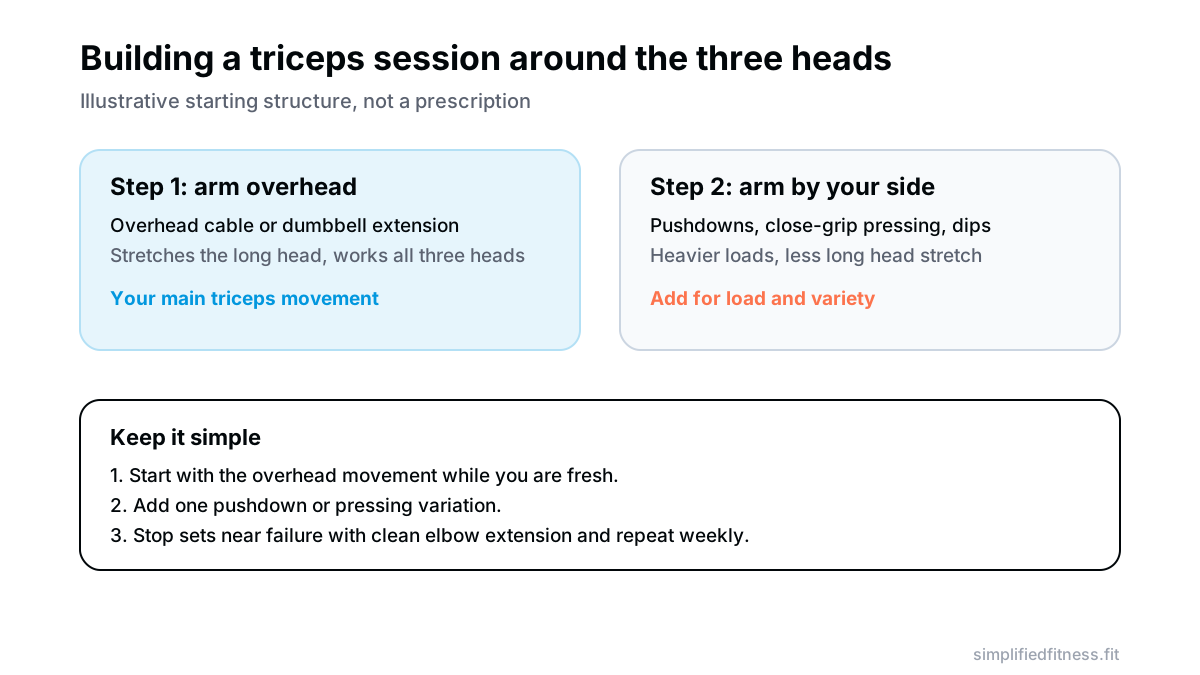
Overhead extension (long head emphasis). A cable or dumbbell extension with the arm overhead. This is the movement the 2023 trial used. Our guide to overhead cable extensions vs pushdowns covers setup and loading in detail.
Arm-by-your-side movement. Pushdowns, close-grip bench or dips let you use more weight. See straight bar vs V-bar vs rope pushdowns for how to choose, and close-grip bench press and wrist spacing if you press.
Dose. Start with 2-3 hard sets of each, 6-15 reps, 1-3 reps from failure, twice a week. If your elbows complain, back off the volume and read our piece on skull crushers and elbow pain. Pain that persists, or comes with swelling, numbness or weakness, is a reason to see a doctor or physio.
If you want a ready structure, our free push day plan already places triceps work after pressing. And for the other side of the arm, see functional anatomy of the biceps and brachialis. Want to chase the lateral head specifically? Cross-body cable extensions are one option, though evidence for isolation is limited.
Quick reference
| Head | Starts on | Crosses | Shoulder position matters? |
|---|---|---|---|
| Long | Shoulder blade | Shoulder and elbow | Yes, stretched when the arm is overhead |
| Lateral | Upper arm bone (outer side) | Elbow only | No |
| Medial | Upper arm bone (deeper) | Elbow only | No |
The bottom line
All three triceps heads straighten the elbow, and no exercise isolates one of them. The long head is the exception that matters, because it crosses the shoulder: stretch it with an overhead movement and growth was larger in every head in the one MRI trial we have. Pair that with a heavier arm-by-your-side lift, train close to failure, and let the horseshoe take care of itself. The evidence here is mostly from short trials and small samples, so treat this as a well-supported starting point and adjust to how your own arms respond.
Frequently Asked Questions
How many heads does the triceps have?
The triceps brachii has three heads: long, lateral and medial. All three join into one tendon that attaches near the point of your elbow. Train the whole muscle through full elbow extension and you work all three.
Which head of the triceps is the biggest?
The long head is usually described as the largest of the three, and it is the head you see on the underside of the arm. The size of each head varies from person to person, so I would not rely on a fixed percentage. If your triceps look flat from behind, favouring overhead work for the long head is a reasonable place to start.
What is the long head of the triceps?
It is the only head that starts on the shoulder blade, so it crosses both the shoulder and the elbow. Because it is a two-joint muscle, the angle of your arm changes how stretched it is. Putting your arm overhead stretches it, which is why overhead extensions are a staple for long head development.
What does the lateral head of the triceps do?
The lateral head sits on the outer side of the upper arm and extends the elbow. In isometric testing its activation matched the other two heads for most force levels and elbow angles. Train it with any hard elbow extension, since no exercise has been shown to isolate it.
What is the medial head of the triceps?
The medial head lies deeper, under the other two, and also only crosses the elbow. People call it the workhorse because it is present in every elbow extension, though measured activation was similar across the heads at 90 degrees of elbow flexion or more. It tends to take a lot of the load in all pushing movements, so your normal pressing and extension work already trains it.
What is horseshoe triceps?
Horseshoe triceps describes a well-developed lateral and long head with the medial head showing at the lower arm, giving a horseshoe outline from behind. It depends on muscle size and on individual muscle shape, which you cannot choose. The practical path is to grow the whole triceps with progressive training and keep body fat low enough to see it.
Can you train one head of the triceps more than the others?
Only partly. Changing shoulder position shifts how stretched the long head is, but the lateral and medial heads are active in every elbow extension. In a 2023 trial, the overhead position produced more growth in all three heads, with the biggest gain in the long head. Pick the exercise that lets you load the muscle well and repeat it consistently.
Does shoulder angle change which triceps head works?
Yes, mainly for the long head. In one study, long head activity during a fatiguing hold was higher with the shoulder at 90 degrees of flexion than with the arm at the side, while the other heads did not change. In practice, arm position changes the stretch on the long head, so use both an overhead and a by-your-side movement.
Are the triceps fast-twitch or slow-twitch?
Biopsy data from the lateral head in 15 professional tennis players found about two thirds fast-twitch (type 2) fibres. That is one small sample of athletes, so it does not tell us how every lifter's triceps are built. It supports the common view that triceps respond well to heavy loads, but moderate and light loads taken close to failure grow muscle too.
What rep range is best for triceps?
There is no single best range. The 2023 trial used about 10 reps per set at 70% of one-rep max, and gains were large. Use 6-15 reps with a load that leaves you 1-3 reps from failure, and progress it over the weeks.
How many sets of triceps do I need per week?
A sensible start is 6-10 hard direct sets per week, spread over two sessions, on top of what you get from pressing. The overhead trial used 10 sets per week to a good effect, though that was a research protocol and not a ceiling. If you already press heavily, the lower end is often enough.
Why do my triceps not grow even though I do pushdowns?
Pushdowns keep the arm by your side, so the long head is in a less stretched position than overhead work. Pushdowns are still effective, but pairing them with an overhead extension may give you more complete growth. Check that you are going to near-failure, adding load over time and fully extending your elbow.
Do dips or close-grip bench press work all triceps heads?
Both involve elbow extension against a heavy load, so all three heads contribute. Chest and shoulder muscles also help, so triceps may not be the limiting muscle. Use them for heavy loading, and add an overhead extension for the long head.
Sources & References
Every claim above is checked against peer-reviewed research (PubMed, U.S. National Library of Medicine) or guidance from established health bodies. How we fact-check.
- Maeo S, et al. Triceps brachii hypertrophy is substantially greater after elbow extension training performed in the overhead versus neutral arm position. Eur J Sport Sci. 2023. PMID: 35819335
- Alves D, et al. Effect of shoulder position on triceps brachii heads activity in dumbbell elbow extension exercises. J Sports Med Phys Fitness. 2018. PMID: 28677940
- Davidson AW, et al. Effect of shoulder angle on the activation pattern of the elbow extensors during a submaximal isometric fatiguing contraction. Muscle Nerve. 2010. PMID: 20740626
- Akima H, et al. Effect of elbow joint angles on electromyographic activity versus force relationships of synergistic muscles of the triceps brachii. PLoS One. 2021. PMID: 34081721
- Sanchís-Moysi J, et al. The upper extremity of the professional tennis player: muscle volumes, fiber-type distribution and muscle strength. Scand J Med Sci Sports. 2010. PMID: 19602193
- Matta T, et al. Strength training's chronic effects on muscle architecture parameters of different arm sites. J Strength Cond Res. 2011. PMID: 21602648
- Ichinose Y, et al. Morphological and functional differences in the elbow extensor muscle between highly trained male and female athletes. Eur J Appl Physiol Occup Physiol. 1998. PMID: 9694308

Umair Hazrami · Founder & Head Coach, Simplified Fitness
Umair Hazrami founded Simplified Fitness and the Simplified Lifter channel to cut through fitness noise. With 4+ years of consistent training and 10+ coaching clients, he writes every guide from the peer-reviewed research and links the sources so you can check them. Our editorial standards.
Educational content only, not medical advice. If you have a medical condition, are pregnant, or take medication, talk to a qualified doctor before changing your diet, supplements or training. Full disclaimer.
Keep reading

Exercise Technique
Antagonist Arm Supersets: Biceps and Triceps Pairing for a Faster, Pumpier Arm Day
A biceps triceps superset workout can shorten arm day while keeping volume close to straight sets. See the research, pairing tips and a 20-minute routine.
9 min read
Exercise Technique
Barbell vs EZ-Bar Curls: Why Straight Bars Hurt the Pinky Side of Your Wrist
Barbell vs EZ bar curls for wrist pain: what EMG research says about biceps activation, forearm rotation and the carrying angle, plus fixes you can use today.
8 min read
Exercise Technique
Bayesian Cable Curls: Form, Setup and Whether They Build Bigger Biceps
Bayesian cable curl form explained step by step: pulley height, step-forward distance, elbow position, sets and reps, and what the research really shows.
8 min read
Exercise Technique
Close-Grip Bench Press: Triceps Loading, Wrist Spacing, and Elbow Stress
Close grip bench press triceps guide: how narrow to go, what the grip width research shows, and how to protect wrists and elbows. Setup cues included.
8 min read