Grip Strength Types: Crushing, Pinching, and Supporting Grip Training Protocols
Grip strength training protocols for supporting, crushing and pinching grip: what each does, which drills work, and how to program them after lifting.

TL;DR. The short answer
- Grip strength is not one thing. Supporting grip holds a load for time, crushing grip closes the hand, and pinching grip holds a smooth object between thumb and fingers, so a single drill will not cover all three.
- For deadlifts and pull-ups, supporting grip is usually the limiter. Dead hangs, heavy holds and farmer's walks train it directly.
- Thick bars make pulling lifts harder: in 11 trained men, deadlift 1RM fell about 28% on a 5 cm bar and 55% on a 7.6 cm bar. Use them as an accessory, not as your main lifting bar.
- Put grip work at the end of a session, 1-3 short drills, once or twice a week. Straps on your heaviest back sets are not cheating, they protect the stimulus on the muscle you came to train.
- Evidence for grip-specific training protocols is thin. Most programming advice here comes from the physiology of how grip fails plus coaching practice, so treat the numbers as starting points.
Part of our complete guide: Arm Workout Science: The Complete Guide to Biceps, Triceps, Brachialis and Forearm Growth
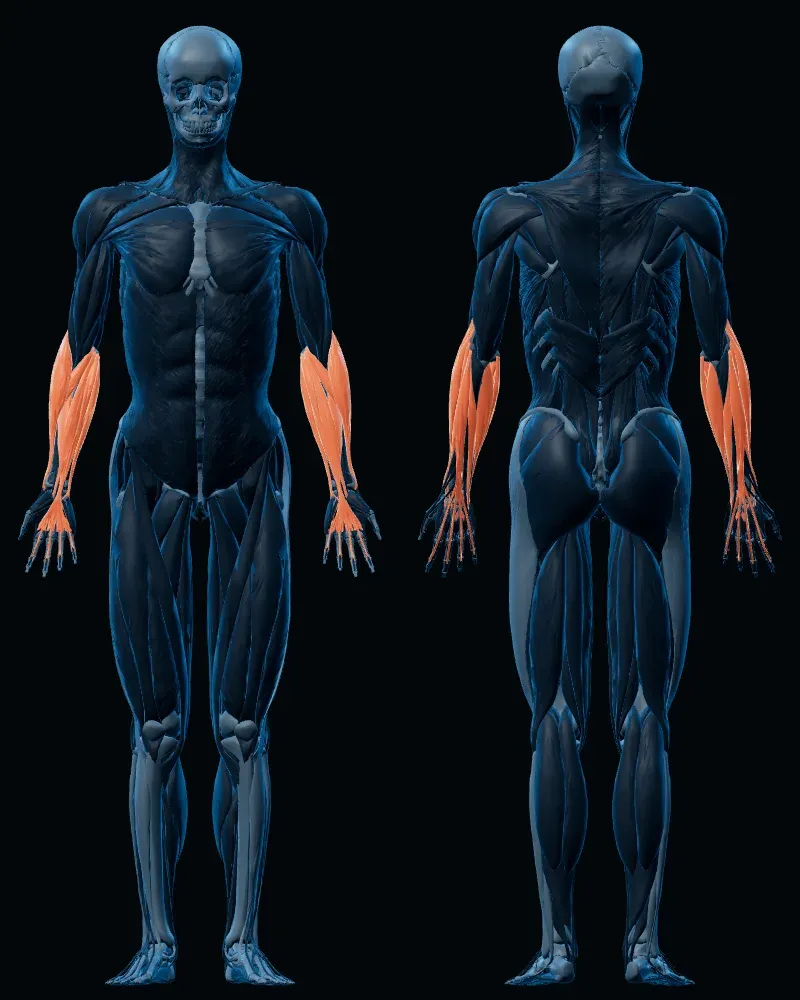
Muscles worked: forearms
Main movers: wrist flexors, wrist extensors and brachioradialis
Table of contents
Grip strength training works best when you split grip into three jobs: supporting (holding a load), crushing (closing the hand) and pinching (holding a smooth object between thumb and fingers). Most lifters who say “my grip is weak” mean supporting grip, the bar slipping out of their hands on deadlifts, rows and pull-ups.
That distinction changes what you should do. This article is part of our complete arm and forearm training guide, and it focuses on the grip side: what each type is, which drills train it, and how to fit it in without wrecking your back training.
One honest caveat before we start. There are very few trials that compare grip programs head to head. What we do have is good evidence on how grip limits pulling lifts, what straps and thick bars do, and which deadlift grips load the forearm most. The rest is coaching logic, and I will flag it when it is.
What are the three types of grip strength?
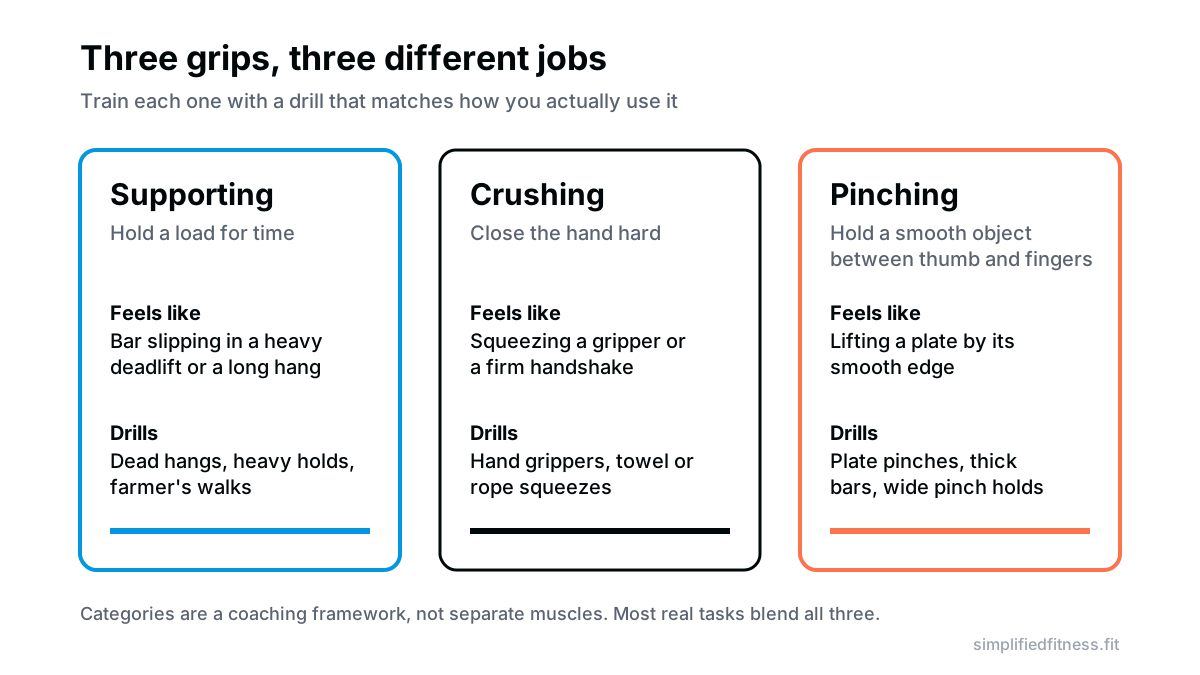
Supporting grip is holding something for time. The bar in a heavy deadlift, your body weight on a pull-up bar, a suitcase on a long walk. The hand stays mostly still while the finger flexors fight to keep from opening.
Crushing grip is closing the hand against resistance. Hand grippers, a firm handshake, wringing out a towel. It is dynamic, with fingers pressing into the palm.
Pinching grip is holding a smooth object between thumb and fingers with no handle to wrap around. Think of lifting a plate by its edge. It leans on the thumb and the span between thumb and fingers.
These categories are a useful way to think, not separate muscles. They share the same forearm and hand muscles, and real tasks usually blend them. A farmer’s walk, for example, is mostly supporting grip but has crush and pinch in it.
Why does my grip fail before my back on deadlifts and rows?
Your hands and forearms hold the same load your back and legs are lifting, and they are much smaller muscles. On heavy or repeated sets they are the weak link.
Researchers have said exactly this. A 2021 study framed it as a “weak link in the kinetic chain” that can leave prime movers under-stimulated, with grip strength often limiting multiple sets of deadlifts and other pulls (Jukic et al., 2021). A 2015 paper made a similar observation: lifters commonly report forearm fatigue as a barrier on deadlifts (Coswig et al., 2015).
If your back is not sore after rows because your hands quit first, the back did not get the work you wanted. We cover that angle in lifting straps for back hypertrophy.
Do straps cut into grip gains?
This is the standard worry: if you strap up, will your grip stay weak? The short answer is that straps change what a set trains, so use them on purpose.
In the 2021 study, 16 men did 4 sets of 4 deadlifts with and without straps. Grip fatigue was lower with straps, and lifters moved the bar faster and rated the effort lower when they used straps with their no-strap 1RM load (Jukic et al., 2021). In the 2015 study, 11 trained lifters did 3 sets to failure at 90% of 1RM, and straps allowed greater force and more work from the target muscles (Coswig et al., 2015).
Both studies were small and short-term, so I would not stretch them far. But the practical takeaway is sensible: straps on your heaviest back sets, no straps on lighter sets and dedicated grip work. You get the back stimulus and the grip stimulus, instead of one compromised by the other.
Which deadlift grip trains grip the most?
A 2020 study measured forearm muscle activity in 29 resistance-trained athletes (15 men, 14 women) using three grips (double overhand, hook and mixed) at 50%, 70% and 90% of 1RM (Pratt et al., 2020). The mixed grip produced the least brachioradialis and flexor carpi ulnaris activation and was ranked easiest at every load. The authors concluded that athletes aiming to maximise muscle activation and potentially develop grip strength should use a double overhand or hook grip.
Two cautions. This was surface EMG, which measures electrical activity, not long-term growth or strength. And “more activation” does not prove better grip gains over months. It is a reasonable reason to prefer double overhand on warm-up and moderate sets, and to save mixed grip or straps for the top sets. For the wider picture on hand position, see grip width and wrist orientation.
Supporting grip: dead hangs, holds and farmer’s walks
Supporting grip drills are where most lifters should spend their time.
- Dead hang. Hang from a pull-up bar with a full grip and shoulders active, not shrugged to your ears. Time it.
- Heavy hold. Pick up a deadlift weight you can lock out, and hold it. Bar thickness and chalk use change the difficulty.
- Farmer’s walk. Carry heavy dumbbells or trap-bar loads over a set distance. Hands, traps and trunk all work.
A reasonable starting point is 2-3 hard efforts of 20-40 seconds with enough rest to repeat them. That is coaching convention rather than a researched dose, so adjust to how it feels.
Progress by adding seconds first, then load. Stop a few seconds before the hold falls apart. A hold that ends in a violent drop is not a better workout, it is just a worse one.
If you want to see how dead hangs connect to pulling strength, our piece on pull-ups versus chin-ups covers the lat side of it.
Crushing grip: do you actually need grippers?
Crushing grip gets a lot of attention relative to how often it limits a gym lift. Closing a gripper is a fairly specific skill, and I would not expect it to carry over strongly to holding a bar, though no trial I found has tested that directly.
If crushing grip matters to you (handshakes, martial arts, gripper sport, a job with tools), train it directly:
- Hand grippers. Start with a gripper you can close for sets of 5-8 controlled reps, and move up when you can.
- Towel or rope squeezes. Squeeze a towel into a tight ball and hold.
Two to three sets after your main lifting is plenty. For deadlifts and pull-ups, I would put crush work well below supporting work.
Pinching grip: plate pinches and thick bars
Pinching grip is useful for awkward objects and for lifters who find smooth, wide handles hard. Plate pinches are the simplest drill: hold two smooth plates flat sides out, thumb on one side and fingers on the other, for time.
There is a related finding on span. A 2002 study of 40 people found lateral pinch strength changed with how wide the thumb-to-finger span was, with strength at the widest functional span about 40% higher than at the smallest (Shivers et al., 2002). That study was about hand-tool design, not training, so use it only as a reminder that span matters.
What about thick bar and fat grip training?
Thick bars (or fat grip attachments) make a pull harder by increasing grip span. The best data we have are acute, not long-term. In 11 resistance-trained men, deadlift 1RM was highest on an Olympic bar, then fell about 28.3% on a 2-inch (5.08 cm) bar and 55.0% on a 3-inch (7.62 cm) bar (Ratamess et al., 2007). Bent-over row fell about 8.9% and 37.3%. The bench press and shoulder press were not different between bars.
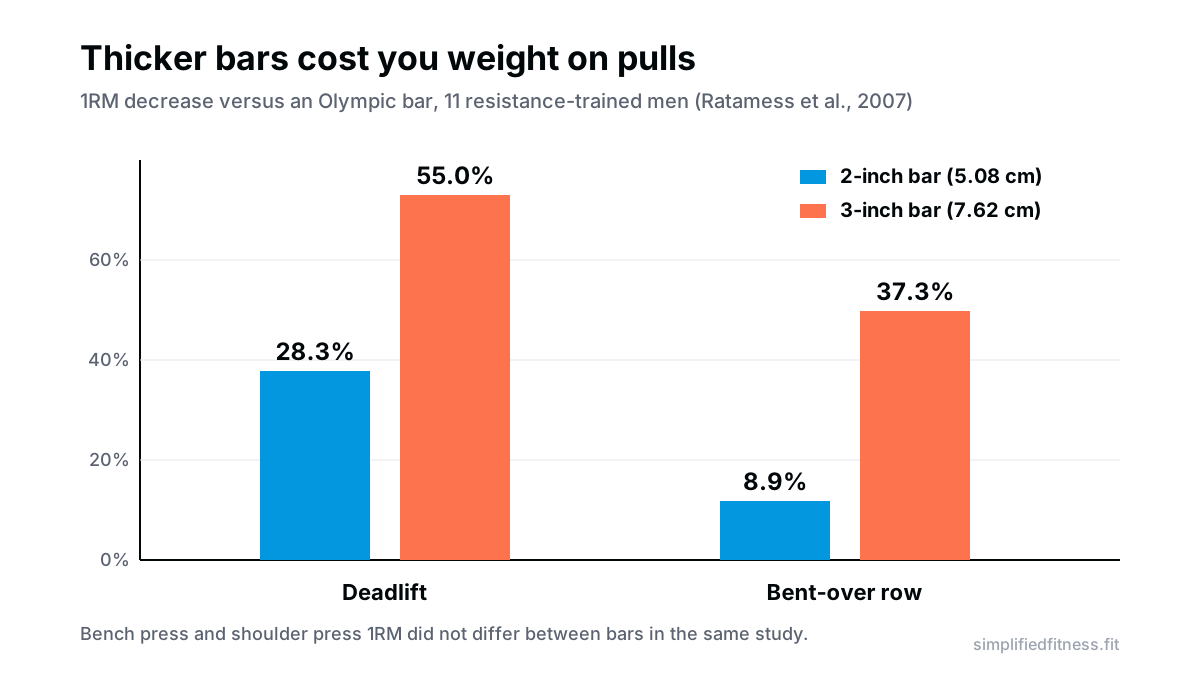
The size of the drop correlated with hand size and maximal isometric grip strength. That tells you the thick bar is leaning hard on grip, which is the point if you want grip work. It also tells you not to use a 3-inch bar as your main deadlift bar if your goal is a big back or a big pull. Those results are about a single test day, though. We do not have good trials showing thick-bar training builds more grip than normal training over months.
What does the research say about training finger strength directly?
Most direct finger training research comes from climbing, not lifting. In a 2024 randomized trial, 31 advanced to elite boulderers either added 5 weeks of dynamic finger flexor training to their usual climbing (3 sessions a week, 3-5 sets of 4-10 reps) or just kept climbing as usual (Saeterbakken et al., 2024).
The training group improved dynamic finger strength by about 11.5% (versus 5.3% in the controls) and also improved isometric finger strength. But the differences between groups were not statistically significant, and bouldering performance did not change in either group. The authors noted that increased finger strength did not improve bouldering performance in that window.
What that means for you: finger-specific training can raise finger strength in trained people, but strength numbers do not automatically become performance in a skill sport. Even so, a lifter whose set ends because the bar slips is in a different situation than a climber, since grip is the direct limiter. Test it with a few sessions before assuming it will not help.
How should I program grip work after lifting?
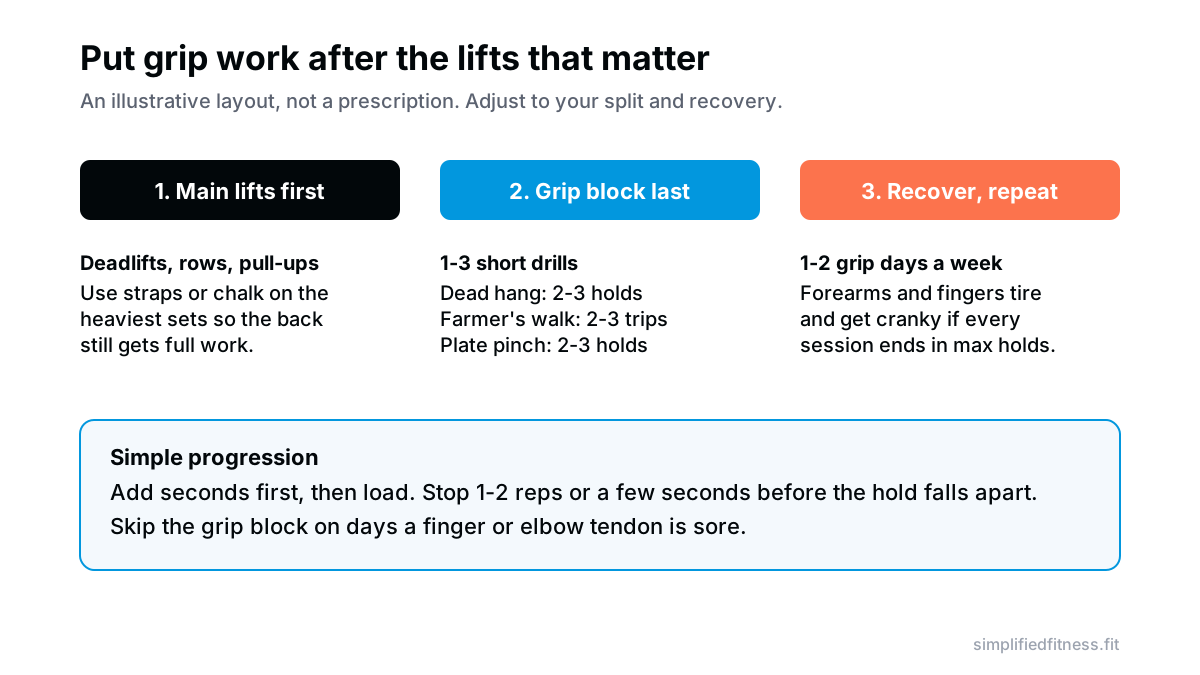
Here is a practical layout. Remember, the set and rep numbers are coaching starting points, not research-derived doses.
| Goal | Drill | Starting dose | Where |
|---|---|---|---|
| Hold the bar longer | Dead hang or heavy hold | 2-3 efforts, 20-40 s | End of pull day |
| Carry more | Farmer’s walk | 2-3 trips, 20-40 m | End of leg or pull day |
| Pinch and wide handles | Plate pinch | 2-3 holds, 15-30 s | End of any day |
| Crush (if needed) | Gripper or towel squeeze | 2-3 sets, 5-8 reps | Separate short slot |
Keep these rules:
- Grip goes last. Fatigue the hands first and your rows and deadlifts suffer.
- One to two grip sessions a week is a sensible default. Your forearms already get indirect work from every pull.
- Use straps or chalk on your heaviest back sets so the grip block does not replace back volume.
- Add time first, then load. Leave a few seconds in reserve.
- Skip it on days a finger tendon or elbow feels sore.
For a pull-day layout to slot this into, use our pull day plan. To pick sensible loads for holds and carries, work out a rough top-set weight with the 1RM calculator. For how many sets forearms and arms need overall, see direct vs indirect arm volume. And for muscle size in the forearm itself, see forearm flexor and extensor hypertrophy.
Is grip strength a health marker or just a gym number?
Both, with a limit. A meta-analysis of 38 studies and about 1.9 million apparently healthy people found higher handgrip strength was associated with lower all-cause mortality (HR 0.69, 95% CI 0.64-0.74) (Garcia-Hermoso et al., 2018). An umbrella review graded the evidence as highly suggestive for general-population mortality, cardiovascular death and disability, but not convincing for any outcome (Soysal et al., 2021).
These are observational studies, so they show association, not that squeezing a gripper will extend your life. Strong hands tend to belong to people who are generally strong and healthy. Treat grip as a useful signal, and train it for lifting and daily use.
If you notice sudden hand weakness, numbness or tingling, or pain that does not ease with rest, see a doctor. That is not a grip training problem.
Common mistakes with grip training
- Training grip first. Pre-fatigued hands cost you back and leg volume.
- Copying a climber’s finger program. Fingerboard-style loading is hard on tendons, and the studies are in people who climb.
- Doing grippers for a deadlift problem. Crushing grip is not the usual limiter on pulls.
- Never using straps. Your hands then cap the work your back gets.
- Always using straps. Then grip never gets a dedicated stimulus. Keep a short grip block.
- Testing grip max every week. Holds to failure beat up forearms and elbows. Leave some in reserve.
A simple grip plan for a busy lifter
If you only want the minimum: finish your pull day with 2-3 dead hangs or farmer’s walks, add one plate pinch set, and use straps on your heaviest rows and deadlifts. Add 5-10 seconds or a little load every week or two. If your hands stay sore into the next session, cut one drill.
That is not glamorous. It does cover the part of grip that decides most pulling sets, and it leaves your back volume alone.
Frequently Asked Questions
What are the three types of grip strength?
They are supporting grip (holding a load for time), crushing grip (closing the hand against resistance) and pinching grip (holding a smooth object between thumb and fingers). This split is a coaching framework rather than three separate muscles, since all of them use the same forearm and hand muscles in different ways. Train the one that matches the task you keep failing at.
How do I increase grip strength for deadlifts?
Train supporting grip directly with heavy holds, dead hangs and farmer's walks, and use a double overhand or hook grip on lighter sets. A 2020 study in resistance-trained athletes found double overhand and hook grips drove more forearm muscle activity than mixed grip, which is the logic behind using them for grip development. Do the grip work after your main lifts so it does not cut your back training short.
Should I use straps on deadlifts?
On your heaviest sets, yes, if your goal is to train your back and legs. A 2021 study of 16 men found straps reduced grip fatigue across sets and let lifters move the bar faster, and a 2015 study found straps allowed more force on multiple sets to failure. Save no-strap work for lighter sets and your dedicated grip block.
How often should I train grip?
One or two short grip sessions a week is a reasonable starting point for most lifters. Your forearms already get indirect work from every pull, so more is rarely needed unless grip is your clear weak link. There is no research-derived ideal frequency, so judge it by how your hands and elbows feel.
Do hand grippers actually work?
They train crushing grip, which is the least common limiter in the gym. Hand grippers will make you better at closing grippers and likely help with handshake-type tasks, but they will not do much for hanging or holding a bar. Use them if crushing grip matters to you, not as a deadlift fix.
Does thick bar training build more grip strength?
It makes grip harder, but we do not have good trials showing it builds more grip than normal training over months. The best-known data are acute: a 2007 study found deadlift 1RM dropped about 28% on a 2-inch bar and 55% on a 3-inch bar. That suggests a strong grip demand, so it is a reasonable accessory at lighter loads.
How long should I dead hang for?
Build toward holds you can complete with clean form, then add time before adding weight. Many lifters start with 2-3 holds of 20-40 seconds and work up from there, but that is coaching convention and not a research-backed target. Stop a few seconds before your grip fails completely.
Is grip strength important for health?
It is a useful marker, but a marker is not a cause. A meta-analysis of 38 studies and about 1.9 million people linked higher handgrip strength to lower all-cause mortality (HR 0.69), and an umbrella review rated the evidence as highly suggestive rather than convincing. Train grip because you want to lift and function better, and see a doctor if you notice a sudden loss of hand strength.
Why does my grip give out before my back on rows and deadlifts?
Your hands and forearms are smaller muscles holding the same load your back is lifting, so they tire first on high-rep or heavy pulls. Studies using lifting straps found grip is a real limiting factor on repeated deadlift sets. Use straps on back-focused sets and train grip separately.
What is the best pinch grip exercise?
Plate pinches are the simplest: hold two smooth plates together, flat sides out, for time. Thickness matters, because a wider span changes how hard the thumb works. Start with two light plates and add time, then load.
Can I train grip every day?
It is possible with very light work, but it is not smart for most lifters. Finger flexor tendons and forearm muscles recover on their own schedule, and daily max holds are an easy way to irritate the elbow or fingers. Stick to 1-2 harder sessions a week and leave the rest to your normal pulling.
Will grip training help me with pull-ups?
It can, if your hands are what ends your set. If your lats are the limit, extra grip work will not fix it. Test by checking whether you fail from slipping or from being unable to pull; the answer tells you where to spend your time.
When should I see a doctor about grip weakness?
See a doctor if you get sudden hand weakness, numbness or tingling, or pain that does not settle with rest. Those are not training problems, and a clinician can check for nerve, tendon or joint causes. Do not push through them with more grip work.
Sources & References
Every claim above is checked against peer-reviewed research (PubMed, U.S. National Library of Medicine) or guidance from established health bodies. How we fact-check.
- Ratamess NA, et al. Acute muscular strength assessment using free weight bars of different thickness. J Strength Cond Res. 2007. PMID: 17313296
- Jukic I, et al. Ergogenic effects of lifting straps on movement velocity, grip strength, perceived exertion and grip security during the deadlift exercise. Physiol Behav. 2021. PMID: 33306977
- Coswig VS, et al. Kinematics and kinetics of multiple sets using lifting straps during deadlift training. J Strength Cond Res. 2015. PMID: 26595133
- Pratt J, et al. Forearm electromyographic activity during the deadlift exercise is affected by grip type and sex. J Electromyogr Kinesiol. 2020. PMID: 32446132
- Saeterbakken AH, et al. Five weeks of dynamic finger flexor strength training on bouldering performance and climbing-specific strength tests: a randomized controlled trial. Front Physiol. 2024. PMID: 39450143
- Garcia-Hermoso A, et al. Muscular strength as a predictor of all-cause mortality in an apparently healthy population: a systematic review and meta-analysis of data from approximately 2 million men and women. Arch Phys Med Rehabil. 2018. PMID: 29425700
- Shivers CL, et al. Effect of grip span on lateral pinch grip strength. Hum Factors. 2002. PMID: 12691366
- Soysal P, et al. Handgrip strength and health outcomes: umbrella review of systematic reviews with meta-analyses of observational studies. J Sport Health Sci. 2021. PMID: 32565244

Umair Hazrami · Founder & Head Coach, Simplified Fitness
Umair Hazrami founded Simplified Fitness and the Simplified Lifter channel to cut through fitness noise. With 4+ years of consistent training and 10+ coaching clients, he writes every guide from the peer-reviewed research and links the sources so you can check them. Our editorial standards.
Educational content only, not medical advice. If you have a medical condition, are pregnant, or take medication, talk to a qualified doctor before changing your diet, supplements or training. Full disclaimer.
Keep reading
Exercise Technique
Antagonist Arm Supersets: Biceps and Triceps Pairing for a Faster, Pumpier Arm Day
A biceps triceps superset workout can shorten arm day while keeping volume close to straight sets. See the research, pairing tips and a 20-minute routine.
9 min read
Exercise Technique
Barbell vs EZ-Bar Curls: Why Straight Bars Hurt the Pinky Side of Your Wrist
Barbell vs EZ bar curls for wrist pain: what EMG research says about biceps activation, forearm rotation and the carrying angle, plus fixes you can use today.
8 min read
Exercise Technique
Bayesian Cable Curls: Form, Setup and Whether They Build Bigger Biceps
Bayesian cable curl form explained step by step: pulley height, step-forward distance, elbow position, sets and reps, and what the research really shows.
8 min read
Exercise Technique
Close-Grip Bench Press: Triceps Loading, Wrist Spacing, and Elbow Stress
Close grip bench press triceps guide: how narrow to go, what the grip width research shows, and how to protect wrists and elbows. Setup cues included.
8 min read