Distal Biceps Tendonitis and Golfer's Elbow: Prevention, Warm-Ups, and Rehab
Golfer's elbow from lifting? See what the research says about eccentric wrist work, the Tyler Twist, grip swaps and how to train around inner elbow pain.

TL;DR. The short answer
- Golfer's elbow from lifting is a tendon problem at the inside of the elbow (flexor-pronator origin). It usually improves with progressive loading of the wrist flexors, not with complete rest.
- The evidence for eccentric exercise in medial epicondylitis is encouraging but low certainty: a 2026 review found only five small studies (143 patients in total).
- A 2014 case series of 20 patients who had failed earlier treatment improved after adding the Tyler Twist (a FlexBar eccentric), but it had no control group.
- Distal biceps tendon pain sits at the front of the elbow crease. A sudden pop, bruising or new weakness is not tendonitis and needs a doctor.
- Most lifters can keep training: swap straight bars for neutral or EZ-bar grips, cut the painful range, and keep pain at a low, settling level.
Part of our complete guide: Arm Workout Science: The Complete Guide to Biceps, Triceps, Brachialis and Forearm Growth
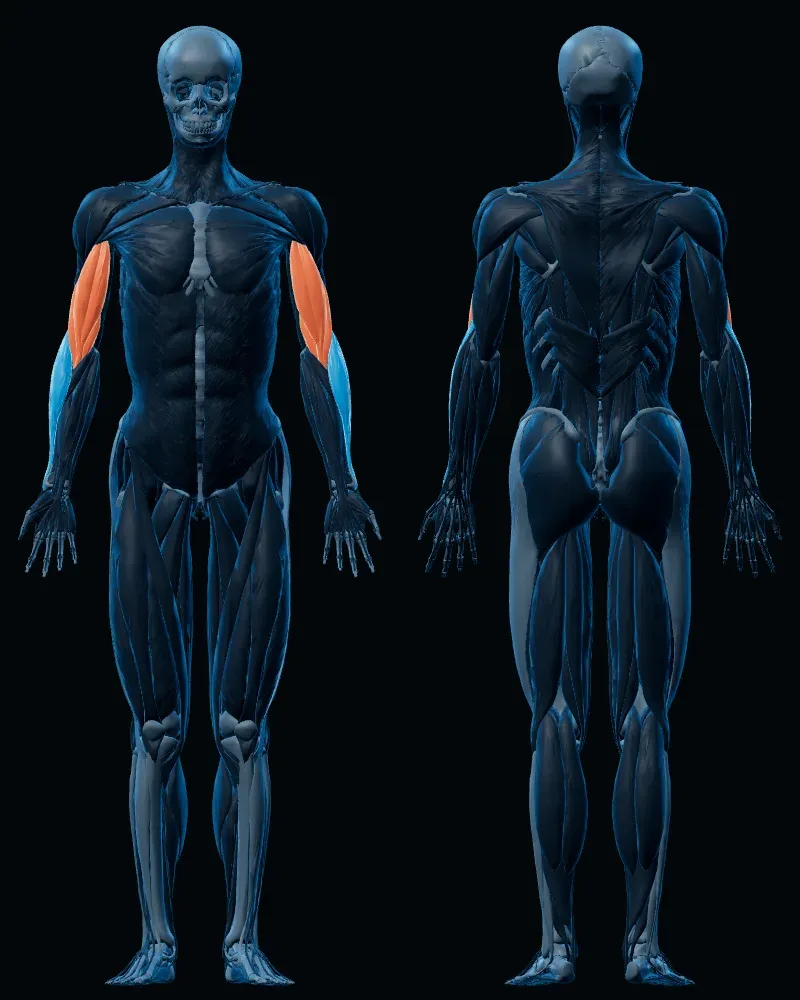
Muscles worked: biceps
Main movers: biceps brachii and brachialis
Assisting: brachioradialis
Table of contents
Golfer’s elbow from lifting is a tendon irritation at the inside of the elbow, and in most gym cases you do not need to stop training to improve it. The usual plan is to calm the aggravating lifts, then load the wrist flexors progressively and slowly. The research supports that idea, but it is thinner than most people assume.
If your pain comes from curls and chin-ups, you are in the right place. This is a supporting guide to our complete arm and forearm training guide, focused on the inner elbow. I will also cover the distal biceps tendon at the front of the elbow, because the two get mixed up all the time.
One honest note up front. This is education, not a diagnosis. Elbow pain has several causes, and a physio or sports doctor can examine you in ways an article cannot.
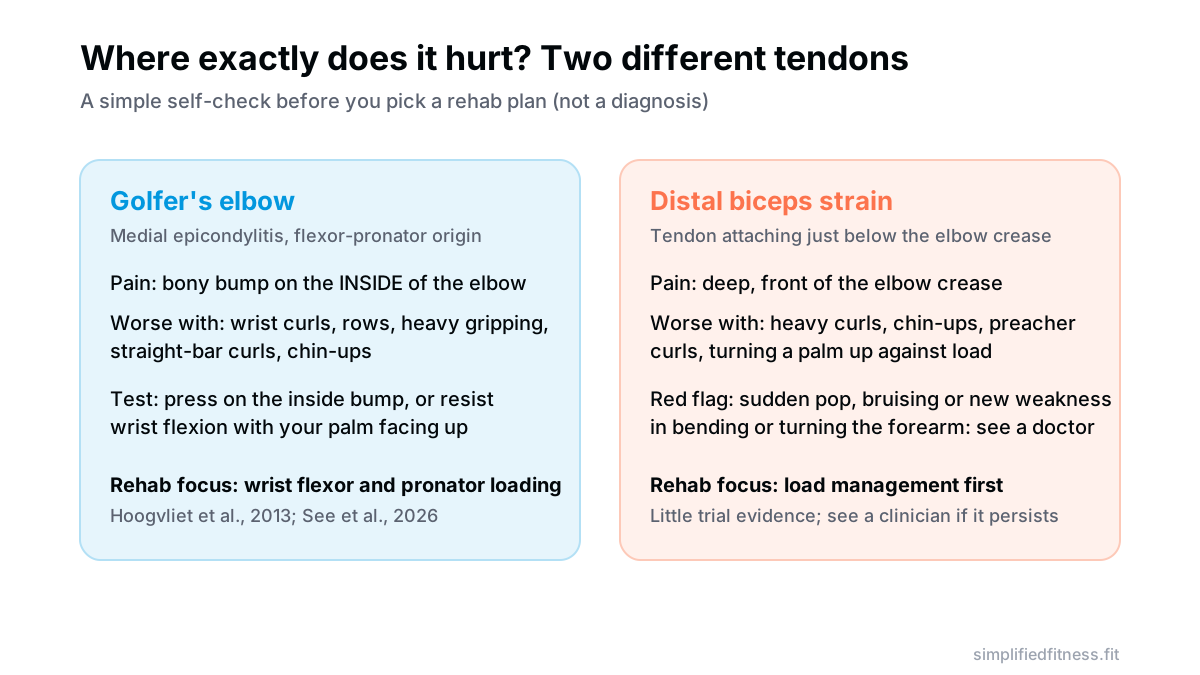
Is it golfer’s elbow or distal biceps tendonitis?
Two different structures, two different spots.
Golfer’s elbow (medial epicondylitis) sits on the bony bump on the inside of the elbow, where the wrist flexors and forearm pronators attach. A 2026 review describes it as a tendinopathy of the flexor-pronator origin that is less studied than tennis elbow (See et al., 2026).
Distal biceps tendon pain is felt deeper, at the front of the elbow crease, and tends to flare with heavy supinated curls, chin-ups or turning a palm up against load.
What the research says about golfer’s elbow rehab
Here is the uncomfortable part. Nearly all the tendon research is on the outside of the elbow.
A 2013 systematic review looked for exercise and mobilisation trials in both medial and lateral epicondylitis. It found one review and 12 RCTs, and all of them studied lateral epicondylitis. The authors still concluded the results support the belief that strength training reduces symptoms in tendinosis, though not conclusively (Hoogvliet et al., 2013).
The medial-specific picture arrived later. A 2026 systematic review of eccentric exercise for medial epicondylitis included only five studies (143 patients). Eccentric exercise was linked with within-group reductions in pain and better function, but between-group superiority appeared in just one RCT. The authors rate the certainty as low and call for larger trials (See et al., 2026).
So the fair summary: loading probably helps, but nobody can promise you a specific protocol will work.
The Tyler Twist: what it is and what it showed
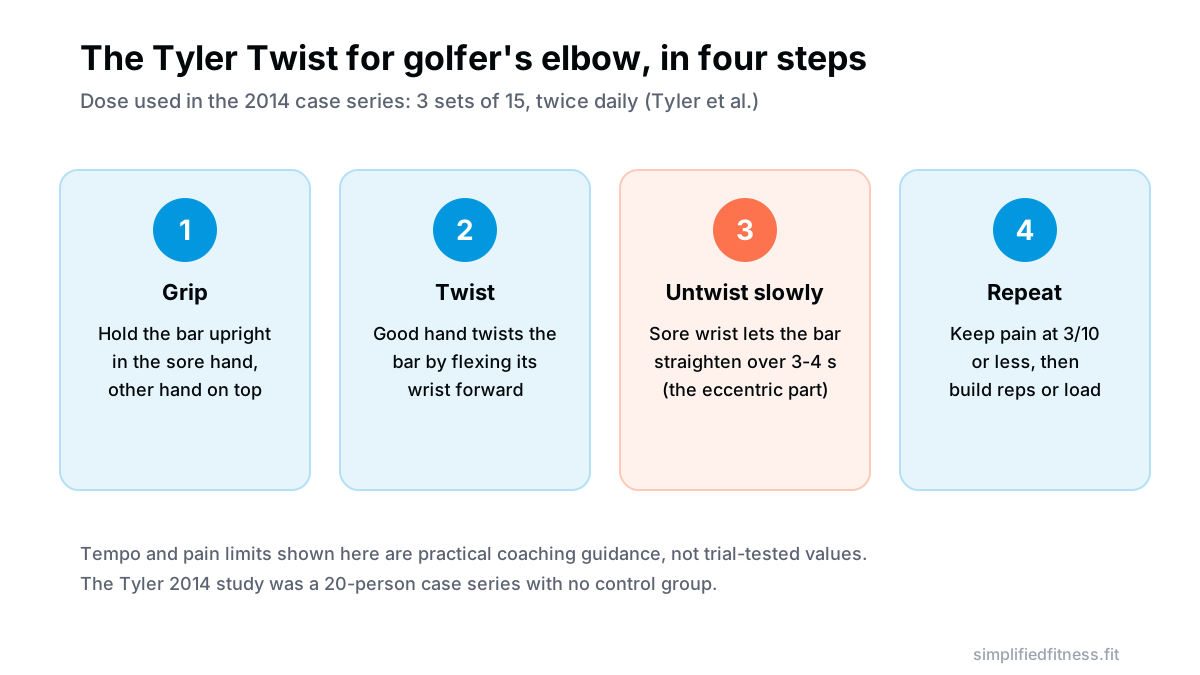
The Tyler Twist is the FlexBar exercise most people mean when they search for golfer’s elbow rehab. The good hand twists a rubber bar by flexing its wrist. The sore wrist then lets the bar untwist slowly, so the flexors work eccentrically (lengthening under load).
The 2014 study behind it enrolled 20 patients (average age 49) with chronic medial epicondylosis who had already failed treatment such as physical therapy, cortisone, PRP or NSAIDs. They added the bar exercise (3 x 15, twice daily) to standard care. Worth knowing for lifters: 14 of the 20 were golfers and only one named weightlifting as the trigger. DASH disability scores fell from 34.7 to 7.9, and treatment lasted about 6 weeks on average (Tyler et al., 2014).
Impressive on paper. But it was a single-group case series, with no control group, and patients also received stretching, ultrasound, massage, heat and ice. Natural recovery, the other treatments and expectation could all play a part. I would use it as a low-cost, low-risk option, not as proof the bar is the cure.
How I would set it up
- Start easy. Use the lightest bar or a light dumbbell. A pain of about 3/10 that settles within a day is a common practical ceiling.
- Go slow on the lowering. A 3-4 second lowering phase is a coaching choice, not a tested number.
- Be consistent. The 2014 patients did sets twice daily, but a meta-analysis of tendinopathy dosing found greater effects with lower frequencies (less than daily) than with daily or more, so more is not automatically better (Pavlova et al., 2023). Many lifters do well with a few sessions a week, which also fits around training.
- Progress the load. In that same 110-study analysis, higher-intensity programs with added external resistance did better than bodyweight-only ones, across tendinopathy sites including the lateral elbow. Once the light version is calm, add weight gradually.
Swap grips, keep training: gym changes that actually help
You do not need a perfect rehab plan to make a difference. Often the biggest early win is reducing what irritates the tendon while the loading work does its job.
Practical swaps that many lifters find helpful:
- Straight bar curls to EZ-bar or neutral grip. A neutral grip often gives the inner elbow an easier time. We cover the wrist angle trade-offs in barbell vs EZ-bar curls.
- Hammer curls instead of supinated curls. A neutral hand position can feel kinder on the forearm attachments.
- Wide pronated lat pulldown and pulls with straps. Straps let you pull without a hard crush grip, which reduces flexor demand. Drop or reduce chin-ups if they spike the pain, and use a pulling day structured around your elbow.
- Shorter range on stretched curls. Preacher-style work can stress the front of the elbow, so cut the bottom few degrees if the crease complains.
- Trade grip-heavy sets for lighter ones. Hold volume steady while the elbow settles, then rebuild.
Direct forearm work matters too, but the order matters. Reintroduce wrist work with the slow loading above before you chase size, and see wrist curls and forearm hypertrophy once the elbow is calm.
A four-stage ladder back to normal lifting
This is an illustrative structure, not a trial-tested protocol. Move up only when the current stage feels calm the next morning.
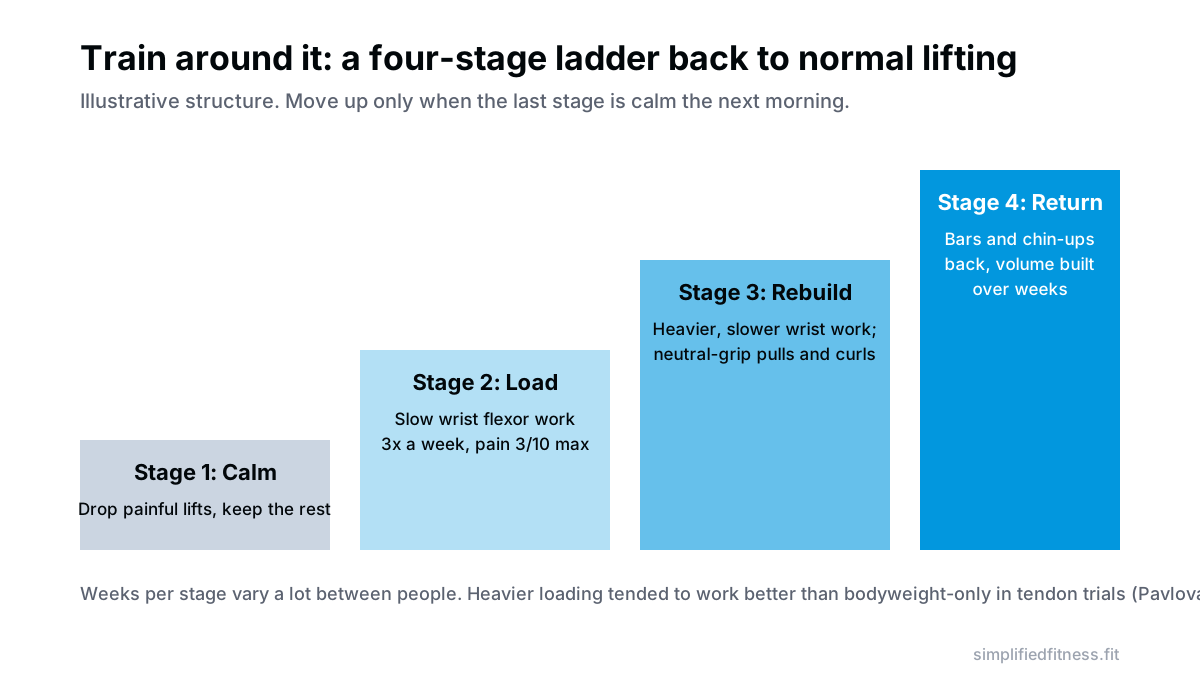
- Calm. Remove the one or two lifts that clearly flare it. Keep training everything else.
- Load. Start slow wrist flexor and pronator work at light weight, every other day or three times a week.
- Rebuild. Raise the weight slowly, then bring back curls and pulls with neutral grips.
- Return. Bring straight-bar and supinated work back at reduced loads. Add volume over weeks.
A review of progressive tendon exercise found pain was the most common criterion for adjusting loads, though it could not say which progression rule is best, and the certainty was low (Ortega-Castillo et al., 2022). That matches how I would coach it: pain-guided, patient, boring.
If your pain is on the outside of the elbow instead, or you want the heavy slow resistance approach for both sides, our guide to golfer’s and tennis elbow in lifters covers that ground.
This also fits the logic in our guide to good pain versus bad pain and the broader piece on tendon vs muscle adaptation.
Warm-ups and prevention for the inner elbow
I do not have trial evidence that a specific warm-up prevents golfer’s elbow. What I can offer is sensible coaching logic.
- Do a short ramp. A few light sets before heavy curls and pulls is a normal practice. Our 7-minute dynamic warm-up is a good base.
- Add forearm work to the ramp. One or two gentle sets of wrist flexion and extension raise blood flow to the area before gripping hard.
- Change volume gradually. The classic trigger is a sudden jump in curls, chin-ups or rows, often paired with a heavier grip. Add sets slowly.
- Mix your grips. Rotating between EZ-bar, dumbbell and neutral-grip variations spreads the stress.
- Do not forget sleep and general recovery. Tired lifters grip harder and rep sloppier.
Do cortisone shots and other options work?
Injections are a common question. The Lancet review of injection trials found corticosteroid injections reduced tennis elbow pain in the short term, with a large effect against no intervention. But the effect reversed at intermediate and long-term follow-up, where no intervention did better (Coombes et al., 2010). That evidence is again from the lateral elbow.
I would not tell anyone what to do here. If you are considering an injection, ask your doctor about the trade-off and pair any decision with a loading plan.
When to see a doctor
Book an appointment if:
- you felt a pop or tearing sensation, or you see new bruising in the elbow crease
- the biceps looks different in shape or you cannot curl or turn your forearm normally
- you notice numbness or tingling in the ring and little fingers
- the pain wakes you at night or keeps worsening
- you see no improvement after several weeks of sensible changes
The bottom line
Golfer’s elbow from lifting is usually a loading problem you can manage: calm the aggravating lifts, then rebuild tolerance with slow, progressive wrist flexor work. The medial-specific evidence is low in certainty, the Tyler Twist rests on a 20-person case series, and heavier loading with sensible frequency has the strongest general tendon support.
Keep the arm work you can do, change the grips that hurt, and be patient. If it is not improving, get it examined rather than guessing. To keep the rest of your week on track, use the free training plans and set your daily protein with the protein calculator.
Frequently Asked Questions
Can I still lift with golfer's elbow?
In most cases yes, if you change what you do rather than stop completely. Tendons respond to progressive loading, and exercise outperformed passive treatments in tennis elbow trials (the best-studied elbow tendon problem). Keep the exercises that stay at low pain, drop the ones that spike it, and see a clinician if it keeps worsening.
What is the difference between golfer's elbow and tennis elbow?
Golfer's elbow (medial epicondylitis) hurts on the inside of the elbow, while tennis elbow (lateral epicondylitis) hurts on the outside. Golfer's elbow involves the wrist flexors and pronators, tennis elbow the wrist extensors. The medial form is far less researched, so much of the rehab thinking is borrowed from the lateral form.
How do I know if it is golfer's elbow or distal biceps tendonitis?
Golfer's elbow is usually felt on the bony bump on the inside of the elbow, distal biceps pain is deeper at the front of the elbow crease. Resisted wrist flexion tends to reproduce the first and resisted curling or forearm turning the second. Overlap is common, so a physio or sports doctor should confirm it if pain lasts more than a few weeks.
What is the Tyler Twist for golfer's elbow?
It is an eccentric wrist flexor exercise using a FlexBar: the good hand twists the bar, and the sore wrist slowly untwists it. A 2014 case series used 3 sets of 15, twice a day, alongside standard physical therapy in 20 patients. It was uncontrolled, and 14 of the 20 patients were golfers, so treat it as a reasonable option rather than proven.
Do I need a FlexBar, or can I use a dumbbell?
A light dumbbell or even a rolled towel can load the wrist flexors eccentrically, though the FlexBar is the version that was actually studied. The mechanism is the same: lower the wrist slowly under control. Start very light and build over weeks.
Should I rest completely until the pain goes away?
Complete rest is rarely the best answer for a tendon. Reviews of tendon rehab suggest progressive loading is the main driver of recovery, and pain-guided programs are common in trials. Reduce the aggravating lifts, keep gentle loading, and expect weeks rather than days.
Will a cortisone injection fix golfer's elbow?
It may reduce pain quickly, but the benefit does not last. In a large systematic review of injection trials for tendon pain, corticosteroid injections for tennis elbow helped in the short term but did worse than no intervention at intermediate and long-term follow-up. Discuss options with a doctor before agreeing to one.
Which gym exercises aggravate inner elbow pain the most?
Heavy straight-bar curls, chin-ups with a supinated grip, wrist curls, rows with a strong grip and anything that combines a hard squeeze with a stretched elbow tend to flare it. Individual triggers vary, so use your own pain response as the guide. Swapping to a neutral grip often reduces the irritation.
How long does golfer's elbow take to heal?
There is no reliable single timeline, and the research on medial epicondylitis is thin. In the Tyler 2014 series the average treatment period was about 6 weeks, but those patients also had around 12 physio visits. Plan on weeks to months of steady work, and see a clinician if there is no progress by 6-8 weeks.
Should I stretch my wrist flexors?
Gentle stretching is commonly included in rehab, and one review found moderate short-term evidence for stretching plus strengthening over ultrasound plus friction massage in lateral epicondylitis. It works best as an add-on to loading, not a replacement. Keep it comfortable, never forced.
Can warm-ups prevent golfer's elbow?
There is no strong trial evidence that any specific warm-up prevents it. Sensible ramp-up sets and a few minutes of light wrist and forearm work make hard sets feel better, and avoiding sudden jumps in curl and chin-up volume is the more reliable prevention. Add arm volume gradually.
When should I see a doctor about elbow pain?
See one if you felt a pop with sudden weakness, have visible bruising or a change in the shape of your biceps, notice numbness or tingling in the ring and little fingers, or have no improvement after several weeks of sensible changes. A distal biceps rupture is a surgical question, not a rehab one. This article is education, not a diagnosis.
Do compression sleeves or straps help?
The trials reviewed for this article did not test them for medial epicondylitis, so I cannot say they work. Some lifters find a strap more comfortable during sessions. Treat it as a short-term comfort aid, not as the treatment.
Sources & References
Every claim above is checked against peer-reviewed research (PubMed, U.S. National Library of Medicine) or guidance from established health bodies. How we fact-check.
- Hoogvliet P, et al. Does effectiveness of exercise therapy and mobilisation techniques offer guidance for the treatment of lateral and medial epicondylitis? A systematic review. Br J Sports Med. 2013. PMID: 23709519
- See ZH, et al. Eccentric exercise therapy for medial epicondylitis: A systematic review of clinical outcomes. Complement Ther Med. 2026. PMID: 41887339
- Tyler TF, et al. Clinical outcomes of the addition of eccentrics for rehabilitation of previously failed treatments of golfers elbow. Int J Sports Phys Ther. 2014. PMID: 24944855
- Pavlova AV, et al. Effect of resistance exercise dose components for tendinopathy management: a systematic review with meta-analysis. Br J Sports Med. 2023. PMID: 37169370
- Ortega-Castillo M, et al. The role of progressive, therapeutic exercise in the management of upper limb tendinopathies: A systematic review and meta-analysis. Musculoskelet Sci Pract. 2022. PMID: 35964498
- Coombes BK, et al. Efficacy and safety of corticosteroid injections and other injections for management of tendinopathy: a systematic review of randomised controlled trials. Lancet. 2010. PMID: 20970844
- Karanasios S, et al. Exercise interventions in lateral elbow tendinopathy have better outcomes than passive interventions, but the effects are small: a systematic review and meta-analysis of 2123 subjects in 30 trials. Br J Sports Med. 2021. PMID: 33148599
- Pitsilos C, et al. Systematic review of distal biceps tendon rupture in athletes: treatment and rehabilitation. J Shoulder Elbow Surg. 2022. PMID: 35367620

Umair Hazrami · Founder & Head Coach, Simplified Fitness
Umair Hazrami founded Simplified Fitness and the Simplified Lifter channel to cut through fitness noise. With 4+ years of consistent training and 10+ coaching clients, he writes every guide from the peer-reviewed research and links the sources so you can check them. Our editorial standards.
Educational content only, not medical advice. If you have a medical condition, are pregnant, or take medication, talk to a qualified doctor before changing your diet, supplements or training. Full disclaimer.
Keep reading
Exercise Technique
Antagonist Arm Supersets: Biceps and Triceps Pairing for a Faster, Pumpier Arm Day
A biceps triceps superset workout can shorten arm day while keeping volume close to straight sets. See the research, pairing tips and a 20-minute routine.
9 min read
Exercise Technique
Barbell vs EZ-Bar Curls: Why Straight Bars Hurt the Pinky Side of Your Wrist
Barbell vs EZ bar curls for wrist pain: what EMG research says about biceps activation, forearm rotation and the carrying angle, plus fixes you can use today.
8 min read
Exercise Technique
Bayesian Cable Curls: Form, Setup and Whether They Build Bigger Biceps
Bayesian cable curl form explained step by step: pulley height, step-forward distance, elbow position, sets and reps, and what the research really shows.
8 min read
Exercise Technique
Close-Grip Bench Press: Triceps Loading, Wrist Spacing, and Elbow Stress
Close grip bench press triceps guide: how narrow to go, what the grip width research shows, and how to protect wrists and elbows. Setup cues included.
8 min read