Forearm Flexor and Extensor Hypertrophy: Wrist Curls, Reverse Curls, and Grip Girth
A forearm workout for hypertrophy needs three targets: flexors, extensors and brachioradialis. See what the research says and a simple weekly plan.
TL;DR. The short answer
- Forearm size comes from three groups: wrist flexors (palm side), wrist extensors (back of the forearm) and brachioradialis (top of the forearm near the elbow). Wrist curls train the first two, reverse and hammer curls train the third.
- No trial has tested rep ranges for forearm size directly. Because muscle growth looks similar across a wide range of loads in other muscles, 15-25 controlled reps for wrist work is a reasonable, joint-friendly choice, not a proven rule.
- Heavy rows, pull-downs and deadlifts already load the forearms, so 4-6 direct sets a week split over two days is a sensible starting point before you add more.
- Brachioradialis research disagrees on how much grip changes its work, so use both hammer and reverse curls rather than chasing one perfect grip.
- Pain at the inner or outer elbow that lingers is a reason to see a doctor or physio, not to push through.
Part of our complete guide: Arm Workout Science: The Complete Guide to Biceps, Triceps, Brachialis and Forearm Growth
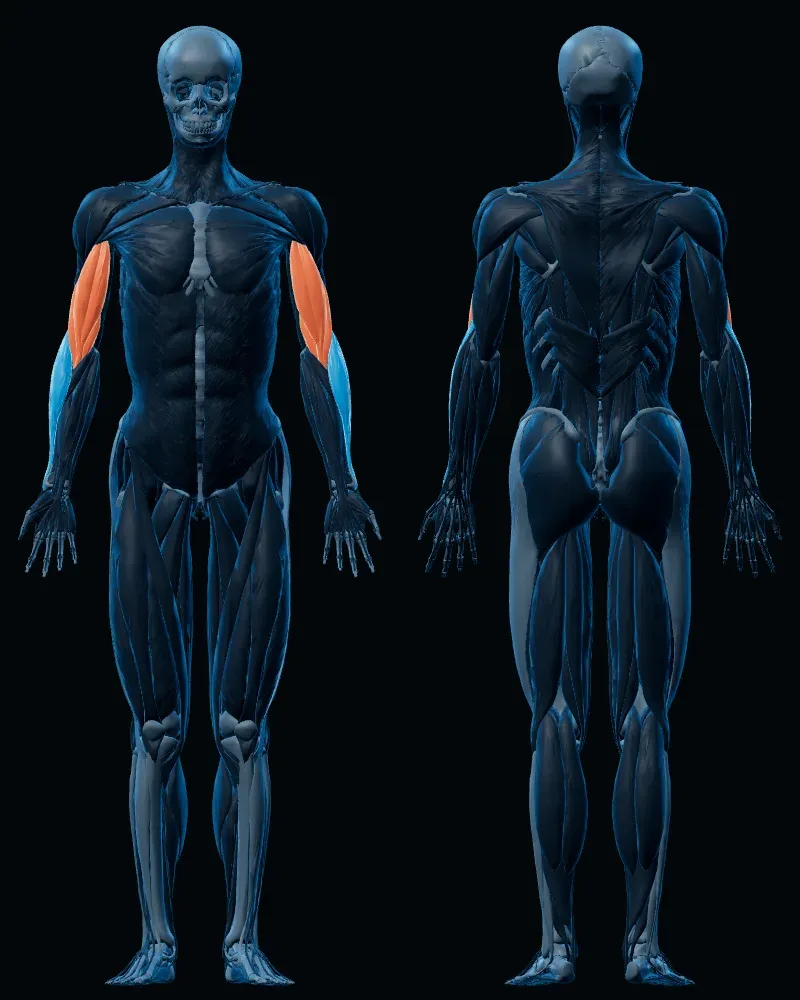
Muscles worked: biceps
Main movers: biceps brachii and brachialis
Assisting: brachioradialis
Table of contents
A good forearm workout for hypertrophy trains three separate targets: the wrist flexors on the palm side, the wrist extensors on the back, and brachioradialis near the elbow. Wrist curls cover the first two, and reverse or hammer curls cover the third. Aim for 15-25 controlled reps on wrist work, stay 1-3 reps from failure, and train two days a week.
That is the practical answer. The honest caveat is that almost no research measures forearm size directly, so much of this is borrowed from what we know about muscle growth in general. This guide is part of our complete arm and forearm training guide, and it covers the forearm belly (the muscle you can see), not grip strength, which gets its own treatment in grip strength types: crushing, pinching and supporting.
What are the forearm flexors, extensors and brachioradialis?
Think of the forearm as a bundle of small muscles with different jobs. For hypertrophy you only need three groups.
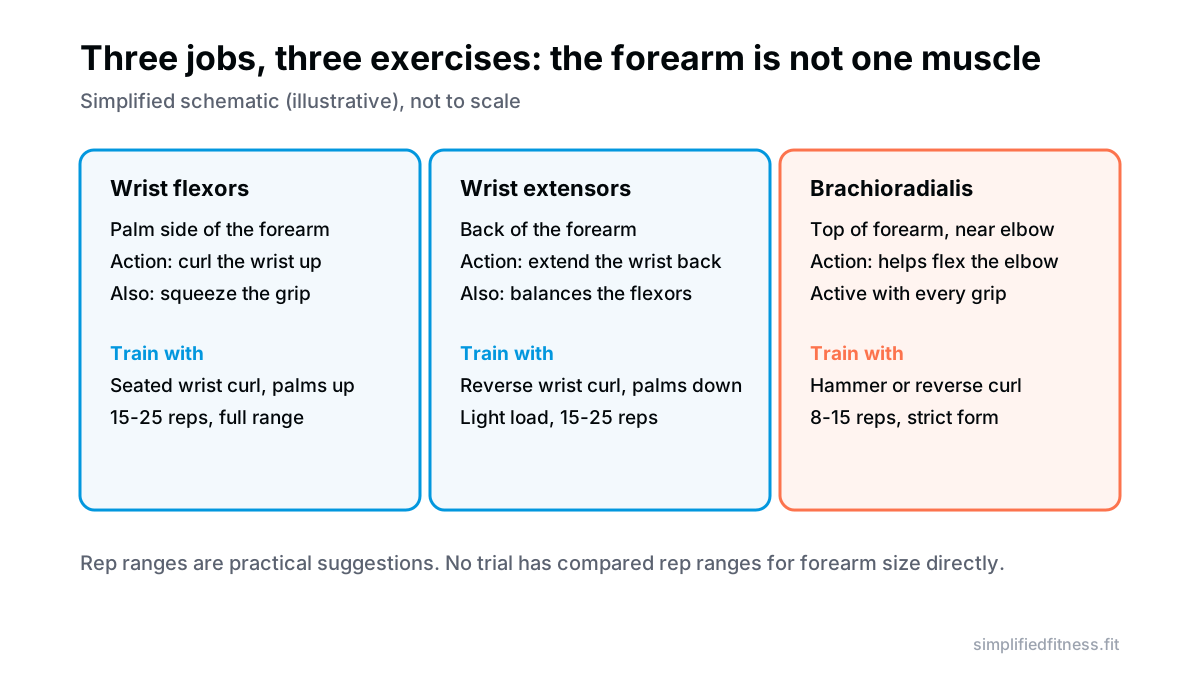
- Wrist flexors: on the palm side. They curl the wrist toward you and do the squeezing when you grip a bar.
- Wrist extensors: on the back of the forearm. They lift the hand back and keep the wrist stable under load.
- Brachioradialis: a thumb-side muscle that starts on the upper arm, near the elbow, and runs down the forearm. It helps bend the elbow.
Most people overtrain the flexors and ignore the other two. The flexors are bigger and get hit by every row and deadlift, so it feels like forearms are covered. The extensors are smaller and get far less work.
How do you build bigger forearms?
There is no forearm-specific hypertrophy trial that I could find to anchor the answer. What we have is indirect: when muscle growth is compared across rep ranges, it looks surprisingly similar. A 2017 meta-analysis of 21 studies, with all sets taken to failure, found that gains in 1RM strength favoured heavy loads, while changes in muscle hypertrophy were similar between low and high loads (Schoenfeld et al., 2017). A later review argued that muscular adaptations can be obtained across a wide spectrum of loading zones, rather than only in a narrow “hypertrophy range” (Schoenfeld et al., 2021).
Those reviews mostly looked at big muscles like the quads and elbow flexors, not wrist flexors. So the 15-25 rep range for wrists is a judgement call, not a finding. Why choose it? Wrists and elbow tendons dislike heavy, jerky loading. Lighter loads taken close to failure let you feel the muscle work without grinding the joint.
Volume matters too. A meta-regression of 15 studies found that more weekly sets were associated with greater muscle growth, with each extra set linked to about 0.37% more gain in muscle size (Schoenfeld et al., 2017). That analysis was not about forearms either, and one extra set per week is a small effect, so this is not a licence to pile on endless sets. Still, it supports the idea that a handful of hard sets a week beats a token set at the end of the session.
Wrist curls vs reverse curls: which one should you do?
Both, because they do different things. This is the most common confusion with the query “wrist curls vs reverse curls,” since the names sound alike.
| Exercise | Main target | Grip | Suggested reps |
|---|---|---|---|
| Seated wrist curl | Wrist flexors | Palms up | 15-25 |
| Reverse wrist curl | Wrist extensors | Palms down | 15-25 |
| Reverse EZ-bar curl | Brachioradialis, elbow flexors | Palms down | 8-15 |
| Hammer curl | Brachioradialis, brachialis | Thumbs up | 8-15 |
How to do a seated wrist curl
Sit on a bench, rest your forearms on your thighs with the wrists hanging past your knees, palms up. Let the bar roll down to your fingertips, then curl it up and squeeze at the top. Go slowly on the way down.
The most common mistake is letting the forearms lift off the thighs and using the biceps to heave the weight up. Pin them down. Use a load you can control for the full range, which for most people is lighter than the ego wants.
How to do a reverse wrist curl
Same setup, palms down. Lower the bar until the wrists drop, then lift the back of the hand up. The weight will feel embarrassingly light, because the extensors are small. Let it be light.
How to do a reverse EZ-bar curl
Grab an EZ bar overhand, hands just inside shoulder width, elbows pinned at your sides. Curl up without swinging. This is an elbow-flexion exercise, so it behaves more like a biceps curl with a forearm emphasis than a wrist exercise. If an EZ bar bothers your wrists, the comparison in barbell vs EZ-bar curls explains why the angle matters.
Does grip change how hard brachioradialis works?
This is where the research gets messy, so here is the fair version.
Study A. In a surface EMG study of 10 competitive bodybuilders doing 6-rep sets with an 8-rep-max load, brachioradialis excitation during the lifting phase was higher with a supinated grip than with a pronated grip (+5%) or a neutral grip (+6%). Biceps excitation differed far more: +19% versus pronated and +12% versus neutral (Coratella et al., 2023). A separate EMG study in 15 young men doing maximal isokinetic elbow flexion also found brachioradialis very active in all three forearm positions, slightly higher in supination (Caufriez et al., 2018).
Study B. A fine-wire EMG study in 10 healthy people found no difference in brachioradialis activation across neutral, pronated and supinated forearm positions during elbow flexion. The authors concluded its main role is as a consistent elbow stabiliser during flexion (Boland et al., 2008). A 2025 study of 36 healthy men under a 1 kg isometric load suggested biceps appeared more active in supination and brachioradialis in pronation, and the authors called for further controlled studies (Chen et al., 2025).
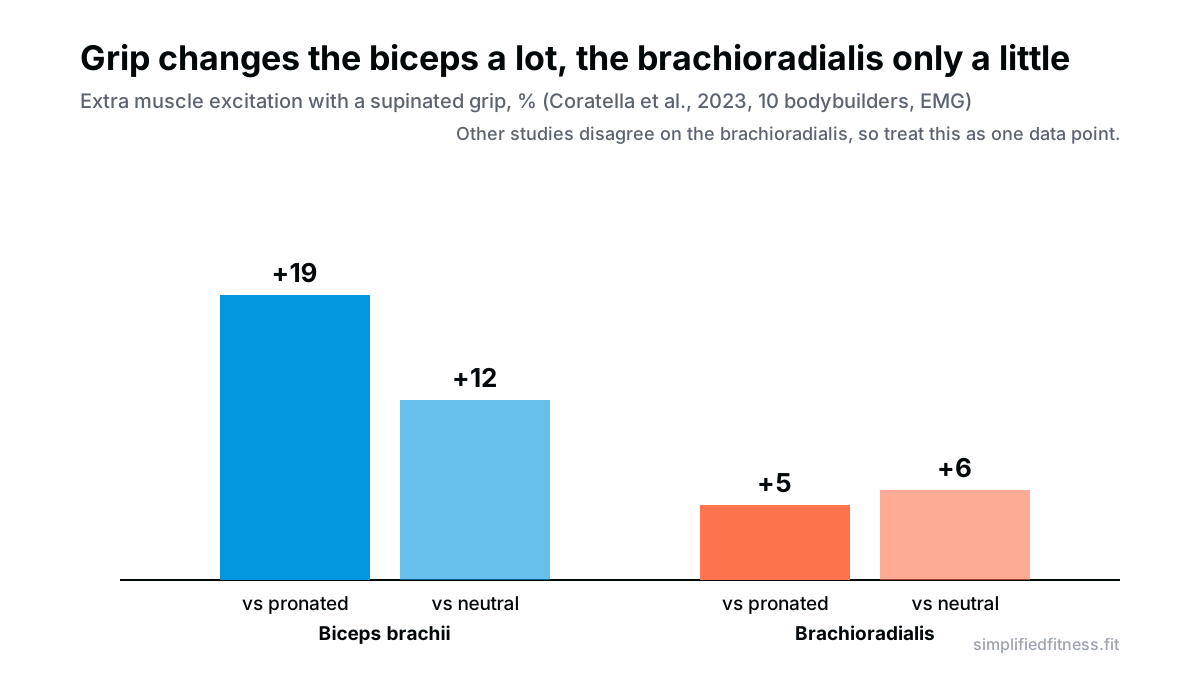
Why might they differ? Different tools (surface versus fine-wire electrodes), different tasks (isometric, isokinetic, or loaded reps), different loads and small samples. None of these studies measured muscle growth, and EMG amplitude is not the same as hypertrophy.
The cautious takeaway: do not hunt for one magic grip. Brachioradialis works in every position, so rotating through hammer curls and reverse curls across your training weeks is a safe way to hit it. For the hammer curl specifics, see hammer curls for brachialis and brachioradialis.
Do forearms grow from indirect work?
Partly. Rows, pull-downs and deadlifts load your grip and wrist muscles, so they are not asleep. In the fat-grip study, 15 resistance-trained men did deadlifts, bent-over rows and pull-ups with and without thick grip attachments. Forearm EMG rose with the thicker grip, while 1RM strength and pull-up reps dropped (Krings et al., 2021). That tells us forearm muscles work during these lifts, but it does not tell us they grow from them.
A different kind of clue: in professional tennis players, MRI scans of 8 players showed 11-15% more muscle volume in the dominant arm’s forearm superficial flexors (and the deltoid, triceps and arm flexors) than in the non-dominant arm (Sanchis-Moysi et al., 2010). It is an observational comparison of a sport, not a training trial, so treat it as a sign that forearm muscle can enlarge with years of heavy use, not a recipe.
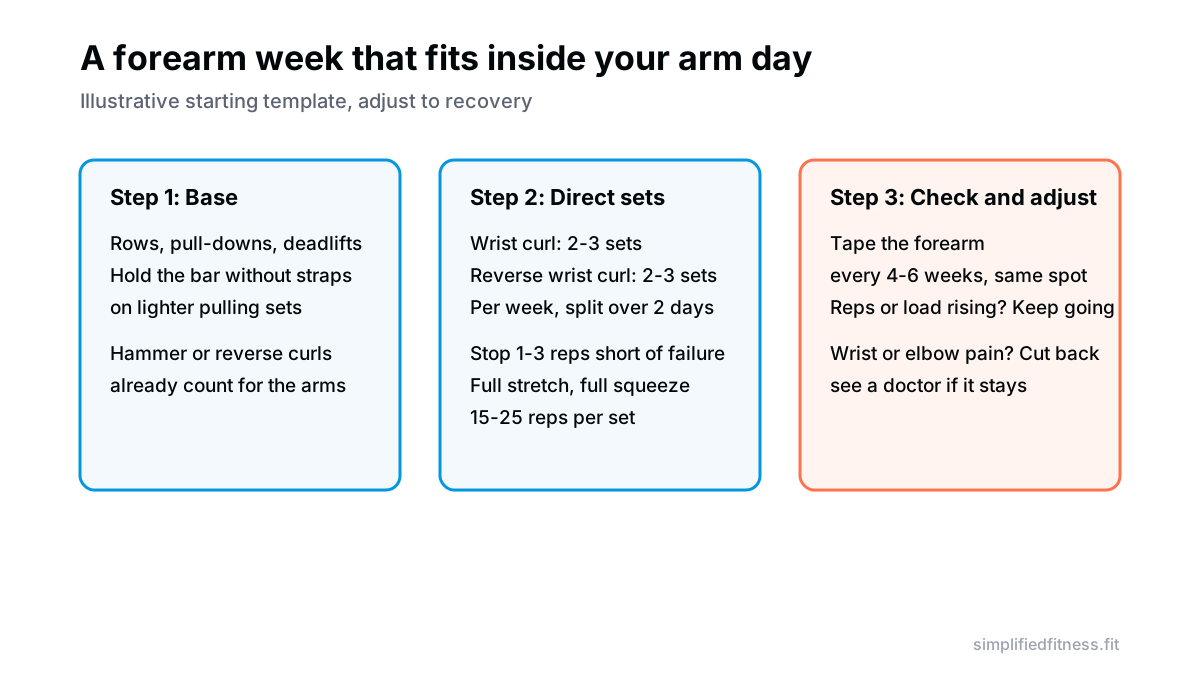
What I would do: let your pulling work count as a base, and add a few direct sets once your forearms look like the weak link. If you use straps on heavy back work, as covered in lifting straps for back hypertrophy, keep a couple of lighter sets strap-free, and add direct wrist work. How much arm work to count directly or indirectly is covered in direct vs indirect arm volume.
How many sets and how often?
Start small. A reasonable plan is 2-3 sets of wrist curls and 2-3 sets of reverse wrist curls each week, split across two days, plus your normal hammer or reverse curls in arm training. That is about 4-6 direct sets a week for the wrist muscles. It is a modest dose on purpose: your pulling work already adds indirect volume, and you can add sets later if your forearms respond well and your elbows stay happy.
Keep reps in the 15-25 range, stop 1-3 reps before failure, and add a rep or a small plate every week or two. If you want to check how this fits your overall weekly volume, our training volume calculator can help, and a pull day template shows where forearm work fits. Pairing wrist curls with your biceps and triceps work in supersets also saves time, which we cover in antagonist arm supersets.
What about wrist rollers?
Wrist rollers are popular as a burnout, and many lifters like the pump. I could not find a trial testing them for forearm size, so I would not build a plan around them. If you enjoy them, use a light load, a few slow rolls up and down at the end of the session, and treat them as a finisher.
Genetics, tendons and realistic expectations
Forearm appearance depends on muscle belly length, tendon length and bone structure, and none of those can be trained. Two people with the same forearm circumference can have very different muscle mass. Be patient: forearms are small muscles, so progress is measured in months, not weeks.
Measure the same spot on the forearm every 4-6 weeks, and judge progress by reps and load too. If you have a stubborn forearm, keep tracking before you change plans.
When to see a doctor
Forearm work loads the tendons at the inner and outer elbow. If you get sharp pain, tingling or numbness in the hand, or elbow pain that lasts more than a couple of weeks, stop the offending movement and see a doctor or physiotherapist. Our guide to golfer’s elbow and distal biceps tendon issues covers what that can look like. This article is education, not diagnosis.
The bottom line
Bigger forearms mean training three targets: flexors, extensors and brachioradialis. Use wrist curls and reverse wrist curls for 15-25 slow reps, hammer and reverse curls for brachioradialis, and let your pulling work cover the base. The research on forearm size specifically is thin, so treat these numbers as sensible starting points, not laws, and adjust to what your tape measure and logbook show.
Want a plan that places all of this? Start with the push, pull and legs plans and work out your protein with the protein calculator.
Frequently Asked Questions
How do I build bigger forearms?
Train the three muscle groups of the forearm directly: wrist flexors, wrist extensors and brachioradialis. Muscle growth tends to respond to hard sets across a wide range of loads, so wrist curls and reverse curls taken close to failure should work like any other isolation exercise. Start with 4-6 direct sets a week split across two days and add reps or load slowly.
Are wrist curls or reverse curls better for forearms?
Neither is better, because they train different muscles. Wrist curls work the flexors on the palm side and reverse wrist curls work the extensors on the back, while reverse and hammer elbow curls load brachioradialis. For a balanced forearm, include a flexor movement, an extensor movement and one curl variation that keeps the thumb up or the palm down.
How many reps should I do for forearm hypertrophy?
15-25 reps per set is a practical range for wrist work, though the evidence comes from other muscles, not forearms. A 2017 meta-analysis found similar hypertrophy across low and high loads when sets were taken to failure. Pick a range where you can control the full movement without letting the weight bounce.
Do forearms grow from deadlifts and pull-ups alone?
They grow some, especially in beginners, but results vary person to person. Heavy gripping loads the forearm muscles, and fat-grip research suggests the forearm muscles are active during pulling exercises. If your forearms lag after months of pulling, add a few direct sets.
How often should I train forearms?
Two sessions a week is a sensible default. Light isolation work is usually easy to recover from, and weekly set volume tends to matter for growth in general. Put wrist curls at the end of arm or pull sessions so grip fatigue does not limit your rows.
What is brachioradialis and how do I train it?
Brachioradialis is the forearm muscle on the thumb side that runs from the upper arm down to the wrist and helps bend the elbow. EMG studies show it is active in curls in every forearm position, so hammer curls and reverse curls both work. Use controlled reps with the elbow pinned at your side.
Do wrist rollers build forearm size?
They can, as a tough high-rep burnout for flexors and extensors, but I could not find trials testing wrist rollers for size. They work the muscles through a limited range, so they suit as a finisher after wrist curls. Keep the weight light enough to stay smooth, and stop if your wrists or elbows hurt.
Should I use straps and will that hurt my forearms?
Straps let you train your back harder without grip failing first, which usually helps back growth. Your forearms still get direct work from wrist curls and carries. Use straps on your heaviest sets and train grip separately so each does its job.
Are fat grips good for forearm growth?
They raise forearm muscle activity, but they also cut how much you can lift. A 2021 study in 15 resistance-trained men found forearm EMG rose with fat grips while 1RM strength dropped on deadlifts and rows and pull-up reps fell. Use them sparingly, not on every main lift.
Why are my forearms not growing?
Common reasons are too few hard sets, stopping well short of failure, rushing the reps, and training the flexors only. Genetics also set how much forearm muscle belly and tendon you carry, and you cannot change tendon length. Track the same measurement every 4-6 weeks and judge progress by reps and load.
Can forearm training cause elbow pain?
Yes, too much sudden volume or heavy wrist work can irritate the tendons at the elbow. Ramp up slowly, use a full but comfortable range and skip sets that provoke sharp pain. If inner or outer elbow pain lasts more than a couple of weeks, see a doctor or physiotherapist.
Do forearms need to match my upper arms?
No rule says they must, and there is no research-backed target ratio. Forearm size depends heavily on bone structure and tendon length, which training cannot change. Focus on getting stronger and measuring your own progress.
Sources & References
Every claim above is checked against peer-reviewed research (PubMed, U.S. National Library of Medicine) or guidance from established health bodies. How we fact-check.
- Schoenfeld BJ, et al. Strength and hypertrophy adaptations between low- vs. high-load resistance training: a systematic review and meta-analysis. J Strength Cond Res. 2017. PMID: 28834797
- Schoenfeld BJ, et al. Loading recommendations for muscle strength, hypertrophy, and local endurance: a re-examination of the repetition continuum. Sports (Basel). 2021. PMID: 33671664
- Schoenfeld BJ, et al. Dose-response relationship between weekly resistance training volume and increases in muscle mass: a systematic review and meta-analysis. J Sports Sci. 2017. PMID: 27433992
- Coratella G, et al. Biceps brachii and brachioradialis excitation in biceps curl exercise: different handgrips, different synergy. Sports (Basel). 2023. PMID: 36976950
- Boland MR, et al. The function of brachioradialis. J Hand Surg Am. 2008. PMID: 19084189
- Caufriez B, et al. The role of the muscle brachioradialis in elbow flexion: an electromyographic study. J Hand Surg Asian Pac Vol. 2018. PMID: 29409427
- Chen Y, et al. Forearm rotation and elbow angle differentially modulate biceps brachii and brachioradialis muscle stiffness and EMG activity during low-load isometric contractions. BMC Sports Sci Med Rehabil. 2025. PMID: 40604986
- Krings BM, et al. Impact of fat grip attachments on muscular strength and neuromuscular activation during resistance exercise. J Strength Cond Res. 2021. PMID: 30694963
- Sanchis-Moysi J, et al. The upper extremity of the professional tennis player: muscle volumes, fiber-type distribution and muscle strength. Scand J Med Sci Sports. 2010. PMID: 19602193

Umair Hazrami · Founder & Head Coach, Simplified Fitness
Umair Hazrami founded Simplified Fitness and the Simplified Lifter channel to cut through fitness noise. With 4+ years of consistent training and 10+ coaching clients, he writes every guide from the peer-reviewed research and links the sources so you can check them. Our editorial standards.
Educational content only, not medical advice. If you have a medical condition, are pregnant, or take medication, talk to a qualified doctor before changing your diet, supplements or training. Full disclaimer.
Keep reading
Exercise Technique
Antagonist Arm Supersets: Biceps and Triceps Pairing for a Faster, Pumpier Arm Day
A biceps triceps superset workout can shorten arm day while keeping volume close to straight sets. See the research, pairing tips and a 20-minute routine.
9 min read
Exercise Technique
Barbell vs EZ-Bar Curls: Why Straight Bars Hurt the Pinky Side of Your Wrist
Barbell vs EZ bar curls for wrist pain: what EMG research says about biceps activation, forearm rotation and the carrying angle, plus fixes you can use today.
8 min read
Exercise Technique
Bayesian Cable Curls: Form, Setup and Whether They Build Bigger Biceps
Bayesian cable curl form explained step by step: pulley height, step-forward distance, elbow position, sets and reps, and what the research really shows.
8 min read
Exercise Technique
Close-Grip Bench Press: Triceps Loading, Wrist Spacing, and Elbow Stress
Close grip bench press triceps guide: how narrow to go, what the grip width research shows, and how to protect wrists and elbows. Setup cues included.
8 min read