Dips for Triceps: Upright Torso Positioning vs Forward Chest Dip Mechanics
Dips for triceps need an upright torso and tucked elbows, while chest dips lean forward. Here is the setup, depth limit and loading plan, with the research.
TL;DR. The short answer
- For dips that bias the triceps, stay upright, keep your elbows close and pointing back, and let your legs hang straight. A forward lean with flared elbows turns the same exercise into a chest dip.
- In a 2022 study of 13 experienced men, bar dips produced higher peak triceps activation (1.04 mV) than bench dips (0.83 mV), and bench dips needed the largest shoulder extension range.
- Going down to roughly a 90 degree elbow bend is a sensible limit for most lifters, especially if your shoulders are cranky. Deeper is not automatically better.
- Add load with a dip belt only once you can do clean sets of 12-15 reps, and stop the set when your torso starts to drift forward.
Part of our complete guide: Arm Workout Science: The Complete Guide to Biceps, Triceps, Brachialis and Forearm Growth
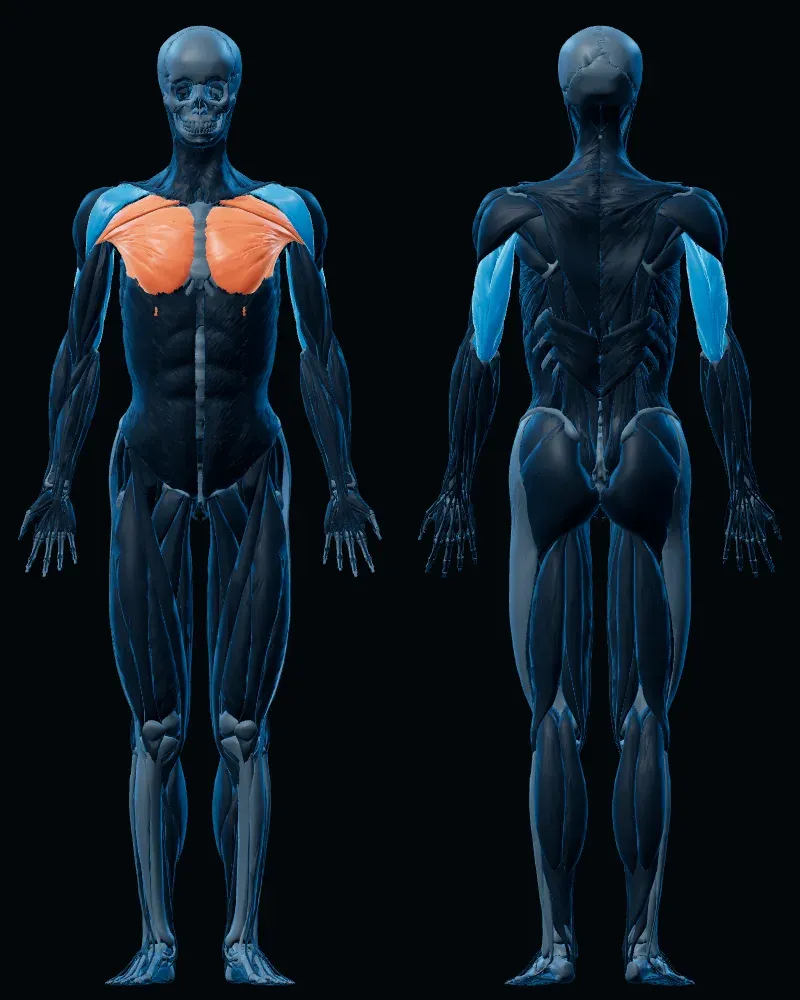
Muscles worked: chest
Main movers: pectoralis major
Assisting: front delts and triceps
Table of contents
If you want dips for triceps vs chest, the difference is mostly your torso and elbows. Stay upright, keep the elbows close and pointing back, and the triceps carry more of the work. Lean forward and let the elbows flare, and the chest takes over.
This is one of the most useful technique switches on parallel bars. It sits inside our wider complete arm and forearm training guide, and here we focus on the setup, the depth limit and how to load it safely.
One honest caveat first. The studies on dips are small, and nobody has run a long training trial comparing upright and leaning dips for triceps growth. What follows combines the biomechanics research we do have with standard coaching practice, and I will flag which is which.
Dips for triceps vs chest: what actually changes
The dip is a pressing movement. Your triceps extend the elbow, your chest and front delts push the upper arm forward and down. Change the torso angle and you change how much each muscle is asked to do.
The practical cues are below. Treat them as coaching conventions, not measured thresholds. Many coaches teach a lean of roughly 30 degrees for chest dips, but I am not aware of a study that locks in a specific number.
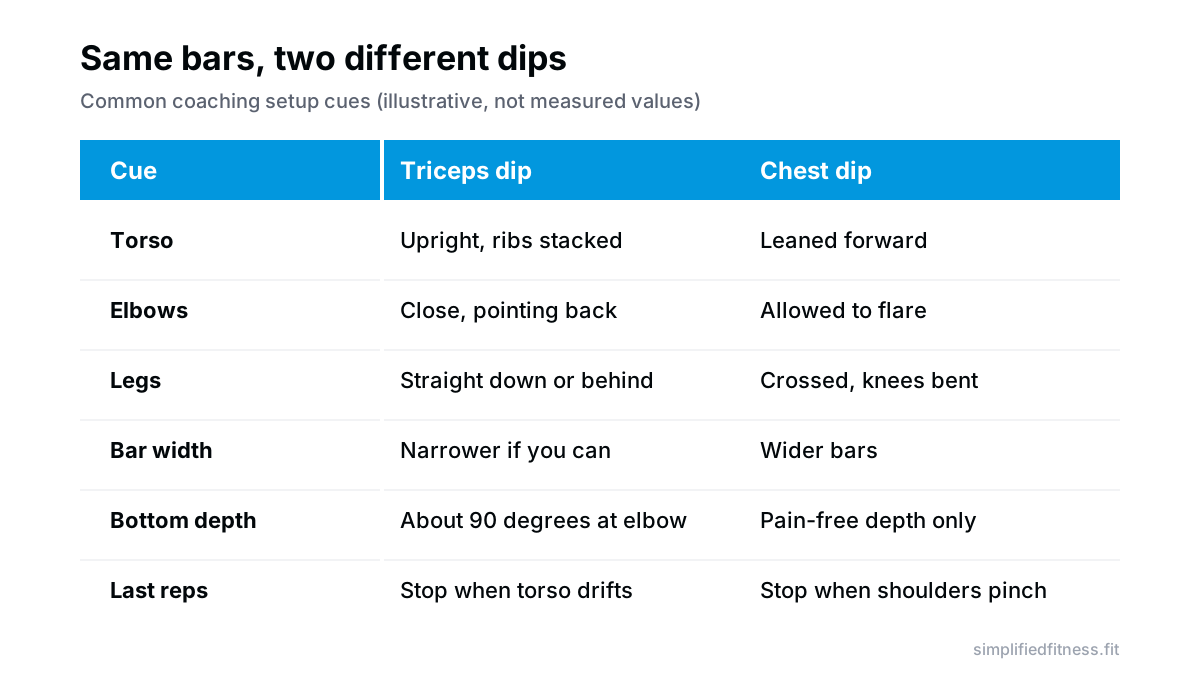
If you want the chest version, we cover it separately in chest dips and forward lean shoulder safety. Here, the question is how to make the dip a triceps exercise.
How to do triceps dips step by step
- Set up on the bars. Use bars about shoulder width or slightly narrower if you can. Press up to lockout with shoulders pulled down, away from your ears.
- Stack your torso. Keep your ribs over your hips and your chest tall. Let your legs hang straight down, or a touch behind you. Crossing the ankles behind you is fine.
- Point the elbows back. Think of drawing your elbows toward your back pockets. They should not drift out wide.
- Lower under control. Take two to three seconds down. Stop around a 90 degree elbow bend.
- Press and finish. Drive up until the elbows are fully straight, without shrugging.
The most common mistake here is chasing depth by diving forward and rolling the shoulders over the hands. That wins you a deeper-looking rep and a chest dip, and often a sore front shoulder.
Which dip variation hits triceps hardest?
A 2022 study put 13 experienced men through bench, bar and ring dips with 3D motion capture and surface EMG. Mean peak triceps activation was 0.83 mV on the bench dip, 1.04 mV on the bar dip and 1.05 mV on the ring dip. The authors described the bar dip as a sensible progression from the bench dip and noted the bench dip needed greater shoulder extension range (McKenzie et al., 2022).
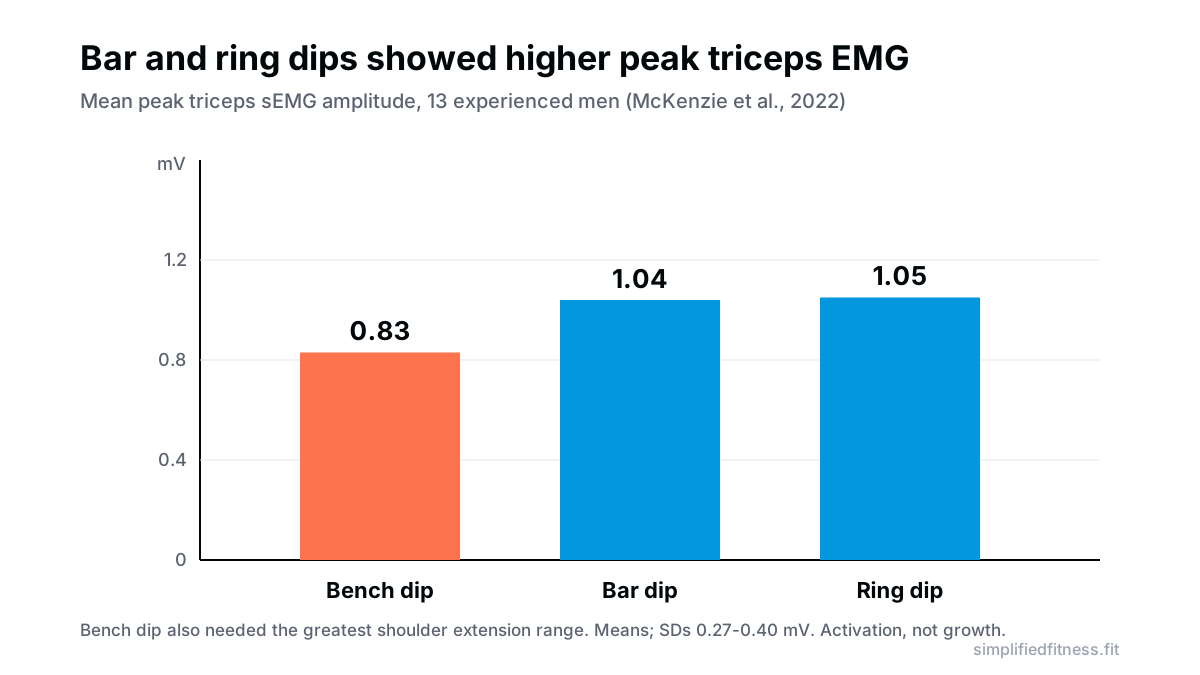
Some limits matter. It was 13 experienced males, four reps each, so it tells us about muscle activation in that moment, not about muscle growth over months. Peak EMG amplitude is also only a rough proxy for stimulus. And the study compared the dip types, not an upright versus leaning bar dip.
Are bench dips bad for your shoulders?
Bench dips put your hands behind you and drop your body in front of the bench. That position needs the largest shoulder extension range of the three variations tested (McKenzie et al., 2022). The authors said their findings have implications for prescribing dips to people with a history of shoulder pain or injury.
What the study did not do is follow lifters over time to count injuries. So the honest read is that bench dips are a plausible irritant for some shoulders, not a proven cause of damage. If they feel fine to you, nothing here says you must quit. If you feel a pinch at the front of the shoulder, they are an easy exercise to drop.
Cleaner alternatives that hit the triceps without that position include triceps pushdowns and close-grip pressing.
How deep should you go? The 90 degree rule
For triceps dips, a roughly 90 degree elbow bend is a practical stopping point. It keeps the upper arm near parallel to the floor, reduces how far the shoulder travels into extension, and still takes the triceps through a long working range.
Is deeper better? The research is mixed. A systematic review found that full range of motion beneficially affects lower-body hypertrophy, but upper-limb research was limited and conflicting (Schoenfeld & Grgic, 2020). A meta-analysis found full range training beat partial range for strength and lower-limb hypertrophy, with no significant difference in muscle thickness overall (Pallares et al., 2021).
A more recent 8-week trial in 30 resistance-trained people trained each arm with either lengthened partial reps or full range. Elbow flexor and extensor thickness improved similarly in both, and the authors concluded trainees should likely emphasise the stretched position, through full range or lengthened partials (Wolf et al., 2025).
What that means for you: you do not need to force extra depth that your shoulder dislikes. A controlled 90 degree dip with a deliberate bottom position is a sound choice.
What about the triceps long head?
Dips keep your arm at your side, so the long head is not strongly stretched. A 2023 trial had 21 adults train one arm with cable elbow extensions overhead and the other at the side for 12 weeks. Triceps muscle volume rose more with the overhead position, 19.9% versus 13.9% for the whole muscle, with the long head showing the biggest gap (Maeo et al., 2023).
That does not make dips useless. It means a complete triceps plan pairs dips with an overhead movement. See overhead cable triceps extensions and the functional anatomy of the triceps heads.
How to load weighted dips for triceps
Bodyweight is a lot of load for many lifters. Once you can do clean sets of 12-15 reps with an upright torso, add weight in small steps.
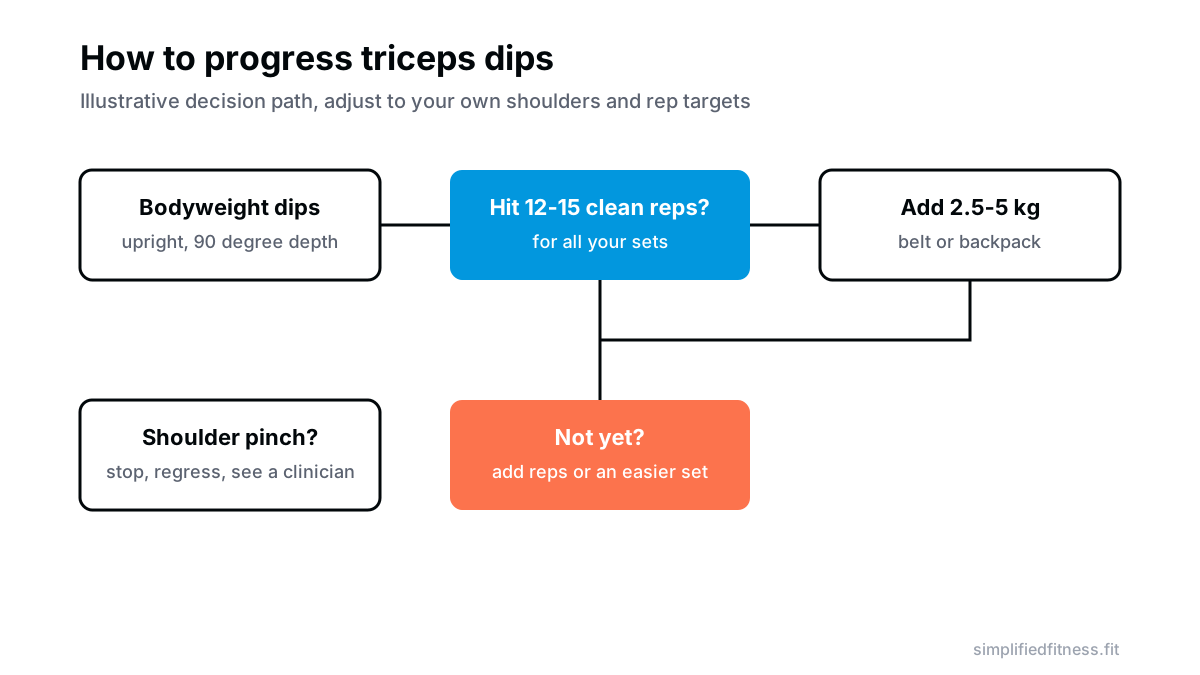
- Dip belt with chain. The standard option. Start with 2.5-5 kg.
- Dumbbell between the feet. Fine for a first step, but can swing.
- Loaded backpack. A budget option if your gym has no belt. A sturdy backpack with plates or books works as a stopgap, as long as the straps are secure.
Rep range is flexible. A review argued muscle growth can occur across a wide spectrum of loads rather than one magic zone (Schoenfeld et al., 2021). So 8-15 reps works well for most people, and heavier or lighter sets are also reasonable.
Triceps failure cues: when to end the set
Instead of grinding to the absolute limit, stop when form shifts. These are good cues:
- Your torso tips forward and the elbows start to flare.
- Your shoulders roll forward past your hands.
- You stop getting to the 90 degree depth.
- You need to swing the legs to get up.
You do not need to hit failure on every set. A meta-analysis of 15 studies found no evidence that training to momentary failure beat stopping short of it for hypertrophy. When every definition of failure was pooled there was a trivial advantage for going to failure, but it disappeared when momentary failure was analysed on its own (Refalo et al., 2023). Leaving 1-3 reps in the tank on dips is also easier on the shoulders.
Who should skip triceps dips for now
Dips are not mandatory. If you are a beginner who cannot yet lower yourself with control, if you are carrying a lot of extra body weight and your shoulders complain, or if you have a history of shoulder pain, start with an easier option. Assisted dips, close-grip push-ups with your hands under your shoulders, and cable pushdowns all train the same elbow extension with less joint demand.
In a hot gym with sweaty hands, also check that the bars are not slippery before adding load. A slip mid-rep with a belt on is a bad way to find out.
Where dips fit in your week
Dips load the triceps, chest and front delts together, so they count toward your pressing volume. A common setup is to put triceps dips early in a push session on one day, and use overhead and pushdown work on another. Our push day plan shows one way to structure it, and the training volume calculator helps you check weekly sets. For the bigger picture on arm sets, see direct vs indirect arm volume.
When to see a doctor
Occasional muscle soreness in the triceps is normal. Sharp pain at the front of the shoulder, pain that lingers for days, a clicking or catching feeling with weakness, or numbness and tingling in the arm are not something to train through. A doctor or physiotherapist can assess it properly. This article is general education, not a diagnosis.
Frequently Asked Questions
Do dips work triceps or chest more?
It depends on how you perform them. An upright torso with close elbows shifts the demand toward the triceps, while a forward lean with flared elbows shifts it toward the chest. Both versions train both muscles, so treat it as a bias, not an on/off switch. Pick the setup that matches the muscle you want to train this session.
How do I do dips to target triceps?
Keep your torso upright, legs straight down or slightly behind you, and elbows close to your sides pointing backward. Lower until your elbows reach about 90 degrees, then press back up to full extension. Slow down on the way down and stop the set when your chest starts tipping forward.
Are bench dips bad for your shoulders?
Bench dips need a larger shoulder extension range than bar dips, which is why they are often avoided by people with shoulder pain. A 2022 study measured that range but did not follow anyone for injuries, so the risk is plausible, not proven. If you feel a pinch at the front of the shoulder, switch to bar dips, pushdowns or close-grip pressing.
How deep should I go on dips for triceps?
Roughly a 90 degree bend at the elbow is a practical depth for most people. Evidence on range of motion is mixed for the upper body, so there is no proven magic depth. Choose the deepest range where the front of your shoulder feels fine and your torso stays upright.
Should my elbows flare or stay tucked on dips?
For a triceps focus, keep them tucked and pointing back. Flaring the elbows usually comes with a forward lean and shifts work toward the chest. Practice in the mirror or film a set from the side and front to check.
Are dips or close-grip bench press better for triceps?
Neither has been proven clearly superior for triceps growth in head-to-head training trials. Dips are a bodyweight movement with a very long range, while close-grip bench lets you load in smaller steps. Use whichever your shoulders and wrists tolerate, and see our [close-grip bench press guide](/blog/close-grip-bench-press-triceps-wrist-spacing) to compare.
How many reps of dips should I do for triceps?
Sets of roughly 8-15 reps are a practical zone, though research suggests muscle can grow across a wide range of loads when sets are hard. Stay about 1-3 reps short of failure on most sets. Once you can hit 12-15 clean reps on all sets, add a small amount of weight.
How do I add weight to dips?
Use a dip belt with a chain, or hold a dumbbell between your feet or wear a loaded backpack. Start with 2.5-5 kg and keep the same upright form. If your torso leans or your shoulders hurt, drop the weight.
What can I do if I cannot do a bodyweight dip yet?
Start with band-assisted dips, an assisted dip machine or slow lowering reps with your feet on a box. These build the same pattern with less load. Aim for slow 3-4 second lowers, and move to full dips when you can control 8 or more.
Can I do dips if I have shoulder pain?
Not necessarily. Pain at the front of the shoulder during the bottom of a dip is a sign to stop, shorten the range or swap the exercise. Ongoing or sharp pain, numbness or weakness needs a clinician, a doctor or physiotherapist, not more dips. Meanwhile train triceps with pushdowns or overhead extensions.
How often should I do dips for triceps?
Two sessions a week with a few hard sets each is a reasonable starting point for most lifters. Dips also load the chest and front delts, so count them toward your pressing volume. Our [training volume calculator](/tools/training-volume-calculator) helps you tally weekly sets.
Do dips build the long head of the triceps?
Dips have the arm hanging beside the body, not overhead, so they are not the best choice for stretching the long head. A 2023 study found overhead elbow extensions grew the triceps more than the same exercise with the arm at the side. Pair dips with an overhead movement for better coverage.
Are dips better than push-ups for triceps?
Dips usually allow heavier loading once you are past bodyweight, while close-grip push-ups are easier to regress and easier on many shoulders. Neither has been shown to be clearly superior for triceps growth. Use the one you can perform with good form for hard, repeatable sets.
Sources & References
Every claim above is checked against peer-reviewed research (PubMed, U.S. National Library of Medicine) or guidance from established health bodies. How we fact-check.
- McKenzie A, et al. Bench, Bar, and Ring Dips: Do Kinematics and Muscle Activity Differ? Int J Environ Res Public Health. 2022. PMID: 36293792
- Maeo S, et al. Triceps brachii hypertrophy is substantially greater after elbow extension training performed in the overhead versus neutral arm position. Eur J Sport Sci. 2023. PMID: 35819335
- Schoenfeld BJ, et al. Effects of range of motion on muscle development during resistance training interventions: A systematic review. SAGE Open Med. 2020. PMID: 32030125
- Pallares JG, et al. Effects of range of motion on resistance training adaptations: A systematic review and meta-analysis. Scand J Med Sci Sports. 2021. PMID: 34170576
- Wolf M, et al. Lengthened partial repetitions elicit similar muscular adaptations as full range of motion repetitions during resistance training in trained individuals. PeerJ. 2025. PMID: 39959841
- Refalo MC, et al. Influence of Resistance Training Proximity-to-Failure on Skeletal Muscle Hypertrophy: A Systematic Review with Meta-analysis. Sports Med. 2023. PMID: 36334240
- Schoenfeld BJ, et al. Loading Recommendations for Muscle Strength, Hypertrophy, and Local Endurance: A Re-Examination of the Repetition Continuum. Sports (Basel). 2021. PMID: 33671664

Umair Hazrami · Founder & Head Coach, Simplified Fitness
Umair Hazrami founded Simplified Fitness and the Simplified Lifter channel to cut through fitness noise. With 4+ years of consistent training and 10+ coaching clients, he writes every guide from the peer-reviewed research and links the sources so you can check them. Our editorial standards.
Educational content only, not medical advice. If you have a medical condition, are pregnant, or take medication, talk to a qualified doctor before changing your diet, supplements or training. Full disclaimer.
Keep reading

Exercise Technique
Antagonist Arm Supersets: Biceps and Triceps Pairing for a Faster, Pumpier Arm Day
A biceps triceps superset workout can shorten arm day while keeping volume close to straight sets. See the research, pairing tips and a 20-minute routine.
9 min read

Exercise Technique
Barbell vs EZ-Bar Curls: Why Straight Bars Hurt the Pinky Side of Your Wrist
Barbell vs EZ bar curls for wrist pain: what EMG research says about biceps activation, forearm rotation and the carrying angle, plus fixes you can use today.
8 min read
Exercise Technique
Bayesian Cable Curls: Form, Setup and Whether They Build Bigger Biceps
Bayesian cable curl form explained step by step: pulley height, step-forward distance, elbow position, sets and reps, and what the research really shows.
8 min read
Exercise Technique
Close-Grip Bench Press: Triceps Loading, Wrist Spacing, and Elbow Stress
Close grip bench press triceps guide: how narrow to go, what the grip width research shows, and how to protect wrists and elbows. Setup cues included.
8 min read