Preacher Curls: Why the Bottom Feels Brutal and What It Does for Your Biceps
Preacher curl benefits and form explained: why the stretched bottom feels so heavy, what studies say about lower biceps growth, and how to protect your elbow.

TL;DR. The short answer
- Preacher curls feel hardest at the bottom because the pad locks your upper arm in place, so the stretched half of the rep carries a lot of the load. Where exactly the load peaks depends on the pad angle and whether you use a dumbbell, barbell or cable.
- Two small studies in women hinted that stretched-position preacher work grows the lower biceps more, though in one of them the regional differences were not statistically significant. A third trial in young men found similar growth across arm regions, so the 'lower biceps' idea is plausible but not settled.
- Biceps thickness grew about the same (7% versus 8%) whether peak load sat at the stretched or the squeezed end of the curl in a 10-week trial. Strength gains were larger for the stretched-emphasis version only at the stretched joint angle.
- No study shows that preacher curls tear the distal biceps tendon. Ruptures are rare, mostly affect middle-aged men (roughly 35 to 55), and heavy lifting is the most common reported cause, so control the bottom: no bouncing, no locked-out elbow.
- Use 8-15 reps, a 2-3 second lowering phase, and stop 1-3 reps before failure. A sudden pop or sharp pain at the elbow crease needs a doctor, not another set.
Part of our complete guide: Arm Workout Science: The Complete Guide to Biceps, Triceps, Brachialis and Forearm Growth
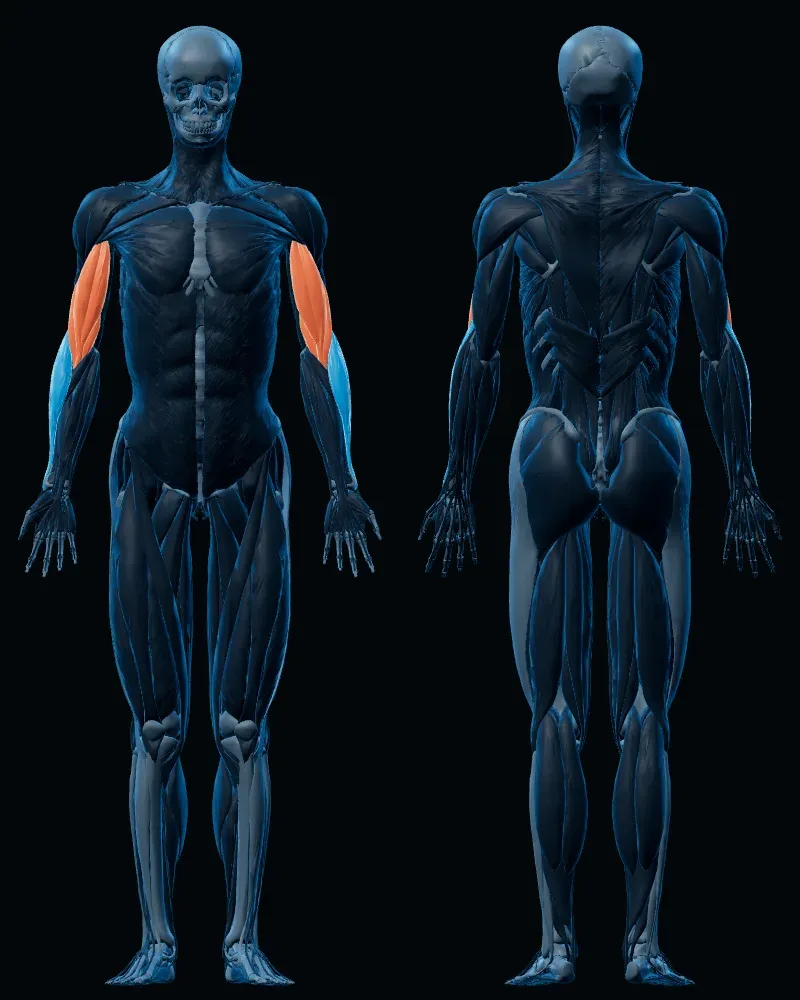
Muscles worked: biceps
Main movers: biceps brachii and brachialis
Assisting: brachioradialis
Table of contents
Preacher curls feel brutally heavy at the bottom because the pad fixes your upper arm in place, so the stretched half of the rep does most of the hard work. That is why the same weight you curl standing can feel too heavy here. Do they grow the lower biceps and put your tendon at risk? Probably a small yes to the first, and no study shows the second, though the bottom position does deserve respect.
This is a deep dive into preacher curl benefits and form, inside our complete arm and forearm training guide. We will cover the mechanics, what the trials actually measured, how to set it up, and where the tendon-tear worry comes from.
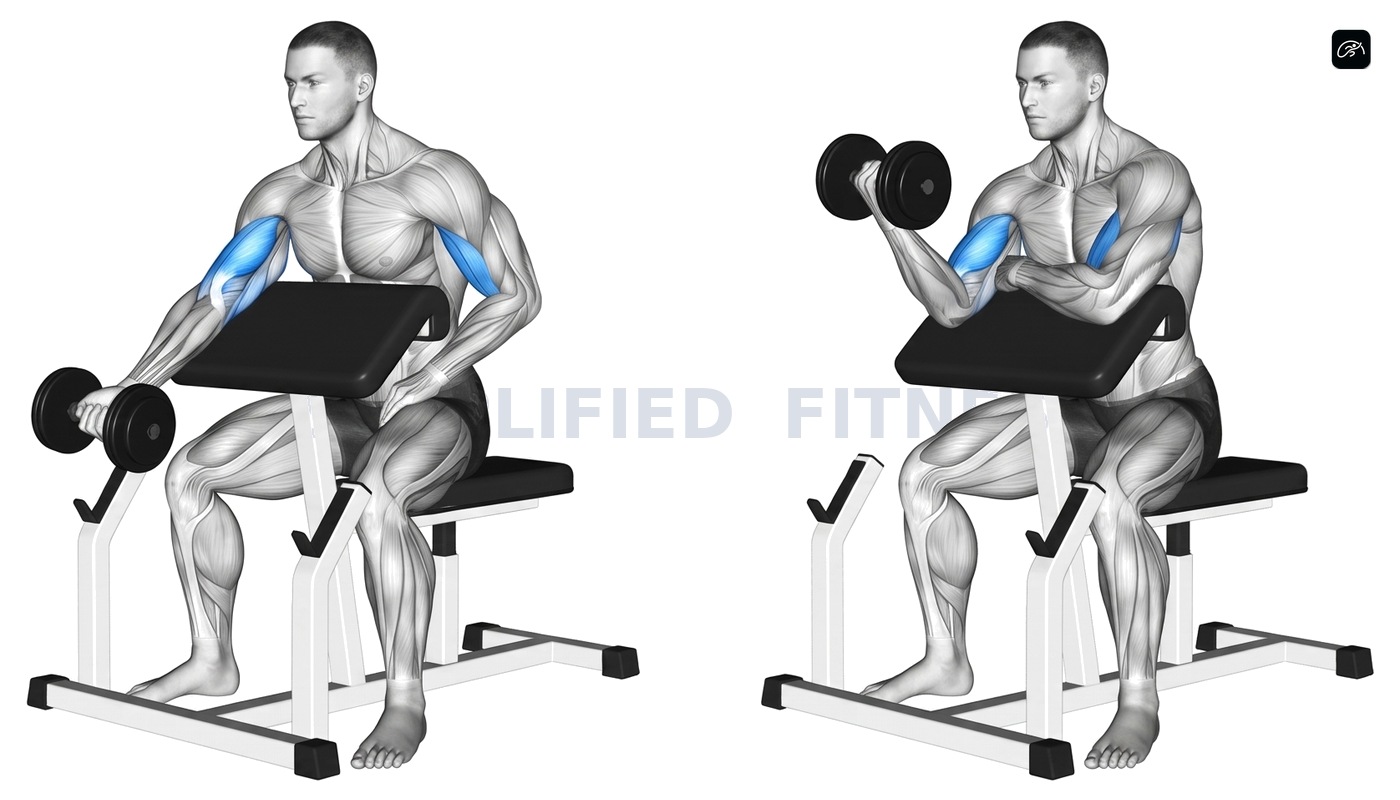
Why do preacher curls feel so heavy at the bottom?
Two things stack up. First, the pad takes away your shoulder, your hips and any swing. Second, a dumbbell or barbell always pulls straight down, so the torque on your elbow depends on how far your forearm sits from the vertical line of the weight.
On a steeply angled pad the forearm hangs far from your body near the bottom, which makes that part of the rep feel heavy. This is basic mechanics, not a result from one study, and it changes with pad angle and body size. Gym preacher benches vary a lot, so what you feel on one bench may differ on another.
The researchers who ran the Nunes trial described the barbell version as applying greater torque when the elbows are extended and the biceps is stretched, and a cable version as applying it when the elbows are flexed (Nunes et al., 2020). That gives us a clean way to think about it: free weights on a preacher bench lean toward the bottom, cables lean toward the top.
Does the preacher curl grow the lower bicep?
Be careful here. You cannot pick where a muscle grows, but some exercises seem to bias growth toward certain regions. Here is what the studies found, and they do not fully agree.
Women, 8 weeks (Pedrosa et al., 2023). Nineteen untrained young women trained one arm in the first part of the range (elbow near straight) and the other in the last part. The stretched-range arm grew more at 70% of upper-arm length, the region nearer the elbow, while the 50% site and the summed CSA were similar (Pedrosa et al., 2023). The stretched-range arm also gained more strength on a full-range test.
Women, 9 weeks (Zabaleta-Korta et al., 2023). Thirty-eight recreationally trained women did either incline curls or preacher curls. Only the 70% region of the preacher group grew significantly, but there were no significant differences between regions or groups, so this is suggestive rather than conclusive (Zabaleta-Korta et al., 2023).
Men, 10 weeks (Attarieh et al., 2025). Fifteen young men trained one arm with a preacher cable curl and the other with a Bayesian cable curl, matched for resistance profile. Both grew the biceps similarly at the proximal, middle and distal regions (about 6-9%), with no significant difference between them (Attarieh et al., 2025).
Why might they differ? Different populations, different exercises being compared, and small samples. All these trials used young, mostly untrained or recreationally trained people. We do not have strong data in advanced lifters.
The cautious takeaway: training the stretched half of the curl looks useful, and it may nudge growth toward the distal biceps, but do not expect a visibly “lower” biceps from one exercise.
Does it matter where the load peaks? Cable vs barbell preacher curls
Not as much as you might expect. In the Nunes trial, 35 young adults trained preacher curls for 10 weeks, three days a week, 3 sets of 8-12. Biceps thickness rose 7% in the cable group and 8% in the barbell group, which was not a meaningful difference. Strength at the 20 degree elbow angle (near extension) rose 30% for cable and 39% for barbell, a significant difference only at the longer muscle length (Nunes et al., 2020).
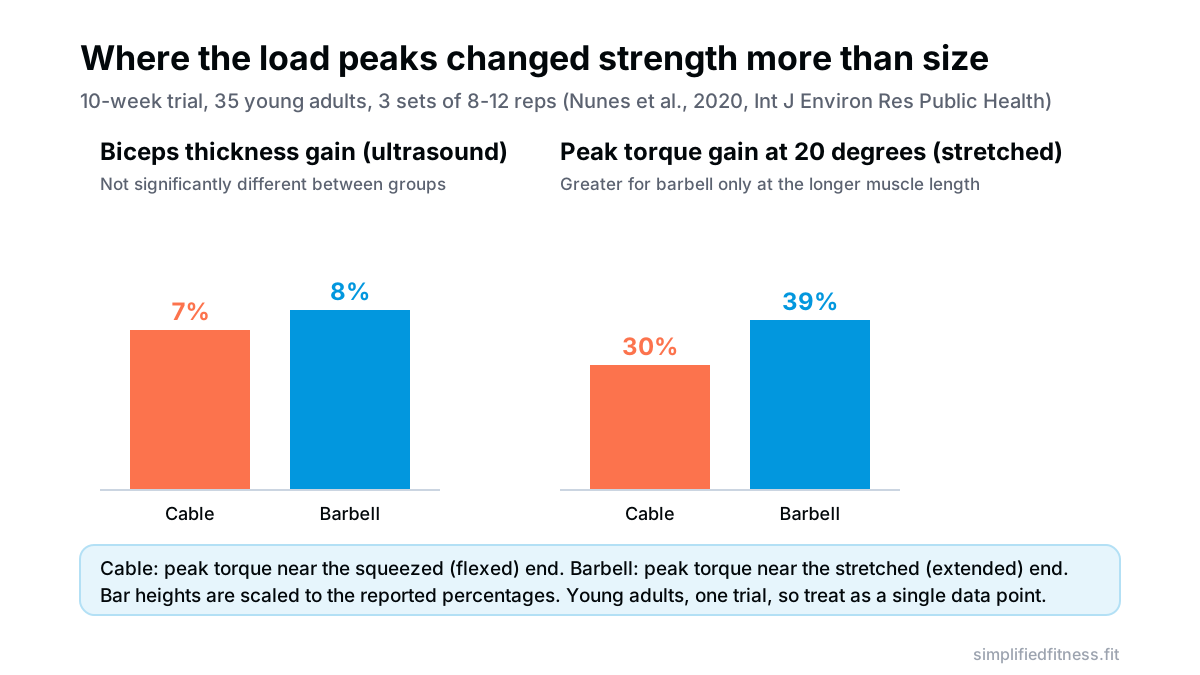
So you get the muscle growth either way. The setup mainly changes which joint angles you get strong at.
A broader review of range-of-motion studies found full range helped lower-body hypertrophy, but upper-limb evidence was limited and conflicting, so strong conclusions were not possible (Schoenfeld and Grgic, 2020). That is a useful reality check on any strong claim about arms.
Preacher curls vs incline curls
If you use both, you are covering both shoulder positions. A 2026 MRI study in 21 untrained adults trained one arm with incline dumbbell curls and the other with preacher dumbbell curls for 12 weeks. The biceps grew more after incline (+22.1% vs +18.9%), while the brachialis (+17.1% vs +21.1%) and brachioradialis (+13.5% vs +17.6%) grew more after preacher. Total elbow flexor growth did not differ (Kobayashi et al., 2026).
The differences were small to moderate. For a head-to-head breakdown, see incline curls vs preacher curls, and for the cable alternative read preacher curls vs Bayesian cable curls.
How to do a preacher curl with good form
The point of the exercise is control at the bottom. Use this setup.
- Adjust the seat so your armpits sit snug on the top of the pad.
- Grip the bar or dumbbell about shoulder-width, wrists neutral.
- Lower for 2-3 seconds until the elbow is almost straight, not locked.
- Curl up without lifting your chest or shoulders off the pad.
- Squeeze briefly at the top, then repeat.
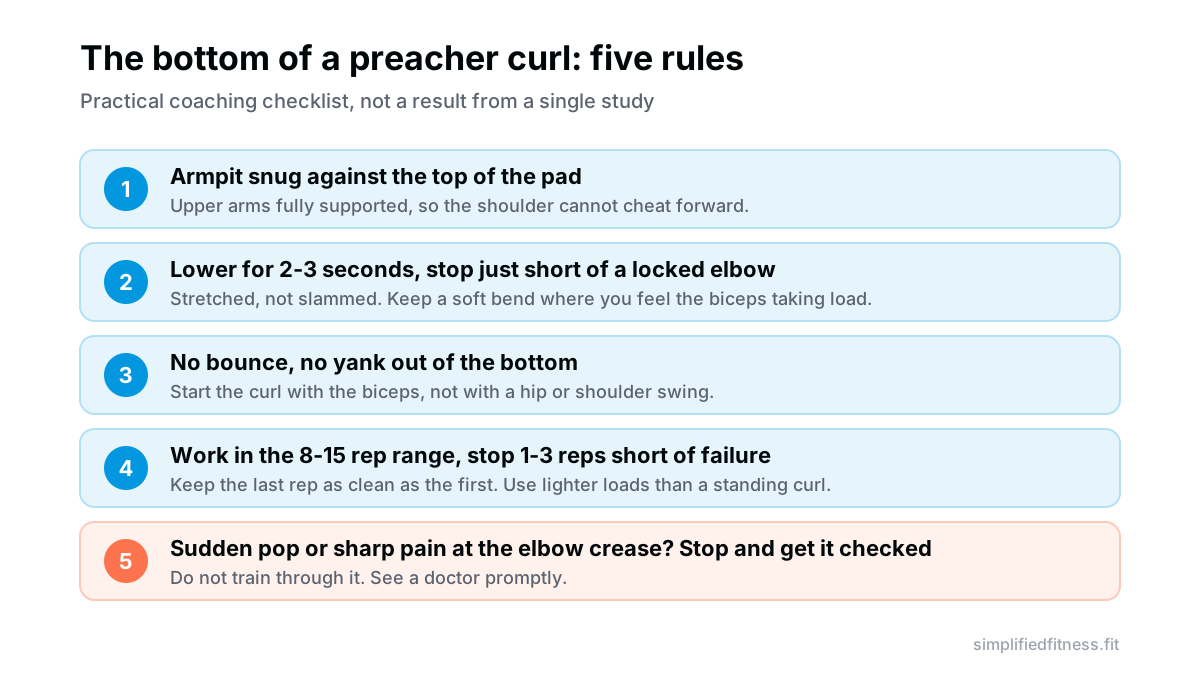
Reps and effort: 8-15 reps works for most people, and a 2024 meta-regression found that muscle growth tended to be greater when sets ended closer to failure, with strength gains similar across a wide range of reps in reserve (Robinson et al., 2024). On preacher curls I would stop at 1-3 reps in reserve, because form tends to fall apart in the stretched position first. Our RIR and RPE calculator can help you check how hard a set really was.
Dumbbell, barbell, EZ-bar or machine: which setup?
| Setup | Where it tends to load hardest | Good for | Watch out for |
|---|---|---|---|
| Single-arm dumbbell | Stretched half (pad angle dependent) | Fixing left-right differences | Weight swinging at the bottom |
| EZ-bar | Stretched half | Heavier loading, easier on wrists | Dropping into the bottom |
| Straight barbell | Stretched half | Max loading | Wrist stress on some people |
| Cable preacher | Squeezed half (per Nunes) | Smooth, steady tension | Needs a proper bench setup |
| Machine | Depends on cam | Beginners, easy control | Poor fit for very short or tall lifters |
Pick the one that lets you control the bottom without pain. No setup is magic. If you are on a budget in an Indian commercial gym, an EZ-bar and a fixed preacher bench are usually enough.
Do preacher curls tear the biceps tendon?
This is where the fear comes from, so here is what is actually known.
The distal biceps tendon attaches near the elbow crease. A distal biceps rupture is a rare injury. A 2025 hospital review of 73 patients (72 men, 1 woman, mean age 45.6) found that lifting heavy objects was the most common cause (43.8%) and sports injuries accounted for 13.7%. The authors note a higher incidence in weightlifters and bodybuilders (Almigdad et al., 2025). A large systematic review of repairs also describes these injuries as typically occurring in the dominant arm of men in their fourth decade (Amarasooriya et al., 2020).
Neither paper links the injury to preacher curls. No study I found shows that preacher curls cause distal biceps ruptures. What we can say is that a heavy, uncontrolled load on an extended elbow is the kind of situation worth avoiding, which is why the rules above stress control.
If you feel a sudden pop, sharp pain at the front of the elbow, bruising, or a sudden loss of curling strength, stop training and see a doctor. Persistent soreness in that area is worth a physiotherapist visit. We cover this further in distal biceps tendonitis and elbow rehab. This article cannot diagnose anything.
How often and how much?
Most of the trials above used two or three sessions a week with 3-5 sets of 8-12 reps. For most people, 2-4 hard sets of preacher curls once or twice a week is enough as one of two or three biceps movements. For total weekly arm volume, see direct vs indirect arm volume.
Start lighter than you think, especially on a new bench, and build up over three or four weeks. If you want to slot this into a split, our free pull day plan shows where curls fit.
The bottom line
Preacher curls are a good, strict biceps exercise. They load the stretched position harder than most curls, they may bias growth toward the lower biceps a little, and they grow the arm about as well as other curl variations in the trials we have. They are not magic, and they are not proven dangerous. The cost is just control: slow the lowering, skip the bounce, stop short of failure and treat sudden elbow pain as a reason to see a doctor.
Frequently Asked Questions
Are preacher curls good for biceps growth?
Yes, they are a solid option. In a 12-week MRI study, preacher dumbbell curls grew the biceps by about 19% in untrained adults, with similar total elbow flexor growth to incline curls. Use them as one of two or three biceps exercises, not the only one.
Do preacher curls grow the lower biceps?
They may, but the evidence is limited and mixed. Two small trials in women pointed to more distal growth with stretched-position curl work (in one, the difference between groups was not statistically significant), while a trial in young men found similar growth across proximal, mid and distal regions. You cannot choose where the muscle grows, so treat the stretch as a bonus, not a guarantee.
Why are preacher curls so hard at the bottom?
The pad removes shoulder help, and a barbell or dumbbell on an angled pad can put a lot of torque on the elbow near full extension, depending on the bench. Start noticeably lighter than your standing curl (a rough rule of thumb, not a tested figure) and control the descent.
Can preacher curls tear your biceps tendon?
There is no study showing that preacher curls cause distal biceps tendon tears. Ruptures are rare and mostly seen in middle-aged men, with heavy lifting the most common cause in one hospital review. Avoid bouncing out of the bottom and avoid ego loads, and see a doctor for sudden pain.
How do you do a preacher curl with proper form?
Sit with your armpits snug on the top of the pad and your upper arms fully supported. Lower for 2-3 seconds until your arms are almost straight, then curl without lifting your shoulders. Stop each set 1-3 reps before you cannot complete a clean rep.
Should you lock out your elbows at the bottom of a preacher curl?
No, stop just short of a fully locked elbow. Lowering to a soft bend keeps tension on the biceps and avoids snapping the joint straight under load. Aim for a deep stretch you can control, not the deepest position you can fall into.
Are preacher curls better than incline dumbbell curls?
Neither is clearly better. In a 2026 MRI trial, incline curls grew the biceps slightly more (22.1% versus 18.9%) while preacher curls grew the brachialis and brachioradialis slightly more. Using both gives you different shoulder positions and a more complete arm.
How many reps and sets of preacher curls should I do?
Most trials used 3-5 sets of 8-12 reps, and 8-15 reps works well for most people. Two to four hard sets once or twice a week is a reasonable range. Add weight only when you can keep the same controlled bottom position.
How close to failure should I train on preacher curls?
Stopping 1-3 reps short of failure is a good default on this exercise. A 2024 meta-regression found that muscle growth tended to be larger as sets were taken closer to failure, so you do not need to stay far from it. Because the stretched position is where form breaks down, stop when the next rep would need a bounce or a shoulder lift.
Is the machine preacher curl or the dumbbell version better?
Both work. In a 10-week trial, a cable preacher curl and a barbell preacher curl produced similar biceps thickness gains (7% and 8%). Choose the one that lets you control the bottom comfortably, and use a machine if your gym's barbell setup bothers your wrists.
Are preacher curls safe with elbow or biceps tendon pain?
If you have elbow pain at the front of the joint, check it with a doctor or physiotherapist before loading it in a stretched position. Pain that is sharp, sudden or comes with bruising needs prompt medical attention. A lighter, shorter-range version may be tolerated, but let a professional decide.
Do preacher curls work for beginners?
Yes, because the pad takes away swinging and teaches strict reps. Start light, because the stretched position is demanding for muscles and tendons that are not used to it. Build up over three or four weeks.
What is the difference between preacher and Bayesian curls?
Preacher curls hold the shoulder in front of the body, while Bayesian curls hold it behind. In a 10-week cable trial with matched resistance profiles, both grew the biceps and brachialis by similar amounts. Pick the one your shoulder prefers.
Sources & References
Every claim above is checked against peer-reviewed research (PubMed, U.S. National Library of Medicine) or guidance from established health bodies. How we fact-check.
- Nunes JP, et al. Placing Greater Torque at Shorter or Longer Muscle Lengths? Effects of Cable vs. Barbell Preacher Curl Training on Muscular Strength and Hypertrophy in Young Adults. Int J Environ Res Public Health. 2020. PMID: 32823490
- Pedrosa GF, et al. Training in the Initial Range of Motion Promotes Greater Muscle Adaptations Than at Final in the Arm Curl. Sports (Basel). 2023. PMID: 36828324
- Zabaleta-Korta A, et al. Regional Hypertrophy: The Effect of Exercises at Long and Short Muscle Lengths in Recreationally Trained Women. J Hum Kinet. 2023. PMID: 37559762
- Attarieh P, et al. Comparison Between Shoulder Flexed and Extended Positions in Elbow Flexion Resistance Training on Regional Hypertrophy and Maximum Strength: Preacher versus Bayesian Cable Curls. Eur J Sport Sci. 2025. PMID: 40082069
- Kobayashi Y, et al. Exercise-specific preferential hypertrophy of individual elbow flexor muscles after incline versus preacher dumbbell curl training. J Sports Sci. 2026. PMID: 42829982
- Sato S, et al. Elbow Joint Angles in Elbow Flexor Unilateral Resistance Exercise Training Determine Its Effects on Muscle Strength and Thickness of Trained and Non-trained Arms. Front Physiol. 2021. PMID: 34616309
- Schoenfeld BJ, Grgic J. Effects of range of motion on muscle development during resistance training interventions: A systematic review. SAGE Open Med. 2020. PMID: 32030125
- Almigdad A, et al. Distal Biceps Brachii Rupture. Clin Orthop Surg. 2025. PMID: 40170776
- Amarasooriya M, et al. Complications After Distal Biceps Tendon Repair: A Systematic Review. Am J Sports Med. 2020. PMID: 32091914
- Robinson ZP, et al. Exploring the Dose-Response Relationship Between Estimated Resistance Training Proximity to Failure, Strength Gain, and Muscle Hypertrophy: A Series of Meta-Regressions. Sports Med. 2024. PMID: 38970765

Umair Hazrami · Founder & Head Coach, Simplified Fitness
Umair Hazrami founded Simplified Fitness and the Simplified Lifter channel to cut through fitness noise. With 4+ years of consistent training and 10+ coaching clients, he writes every guide from the peer-reviewed research and links the sources so you can check them. Our editorial standards.
Educational content only, not medical advice. If you have a medical condition, are pregnant, or take medication, talk to a qualified doctor before changing your diet, supplements or training. Full disclaimer.
Keep reading

Exercise Technique
Antagonist Arm Supersets: Biceps and Triceps Pairing for a Faster, Pumpier Arm Day
A biceps triceps superset workout can shorten arm day while keeping volume close to straight sets. See the research, pairing tips and a 20-minute routine.
9 min read
Exercise Technique
Barbell vs EZ-Bar Curls: Why Straight Bars Hurt the Pinky Side of Your Wrist
Barbell vs EZ bar curls for wrist pain: what EMG research says about biceps activation, forearm rotation and the carrying angle, plus fixes you can use today.
8 min read
Exercise Technique
Bayesian Cable Curls: Form, Setup and Whether They Build Bigger Biceps
Bayesian cable curl form explained step by step: pulley height, step-forward distance, elbow position, sets and reps, and what the research really shows.
8 min read
Exercise Technique
Close-Grip Bench Press: Triceps Loading, Wrist Spacing, and Elbow Stress
Close grip bench press triceps guide: how narrow to go, what the grip width research shows, and how to protect wrists and elbows. Setup cues included.
8 min read