Long Head vs Short Head Biceps: What Shoulder Position and Grip Width Really Change
Biceps long head vs short head: can curls target the peak or inner biceps? See what shoulder angle and grip width really change, with the studies linked.
TL;DR. The short answer
- You cannot isolate the long head or short head of the biceps. Both cross the elbow and both pull on the same tendon, so every curl trains both.
- Shoulder position changes the stretch on the long head. Incline curls (shoulder extended) produced slightly more biceps growth than preacher curls (+22.1% vs +18.9%) in a 12-week MRI trial in untrained adults.
- Wide-grip versus narrow-grip curls as a head-isolation trick has no direct support in the research we found. Treat it as a way to vary the feel of the exercise, not to sculpt one head.
- Bicep 'peak' is mostly genetics (muscle belly length and insertion points) plus the size of the muscle underneath, including the brachialis, which also grew well from curls.
- Pick one stretched-position curl and one shoulder-flexed curl, train them hard for 8-12 reps near failure, and judge them by progress, not by which head you think is working.
Part of our complete guide: Arm Workout Science: The Complete Guide to Biceps, Triceps, Brachialis and Forearm Growth
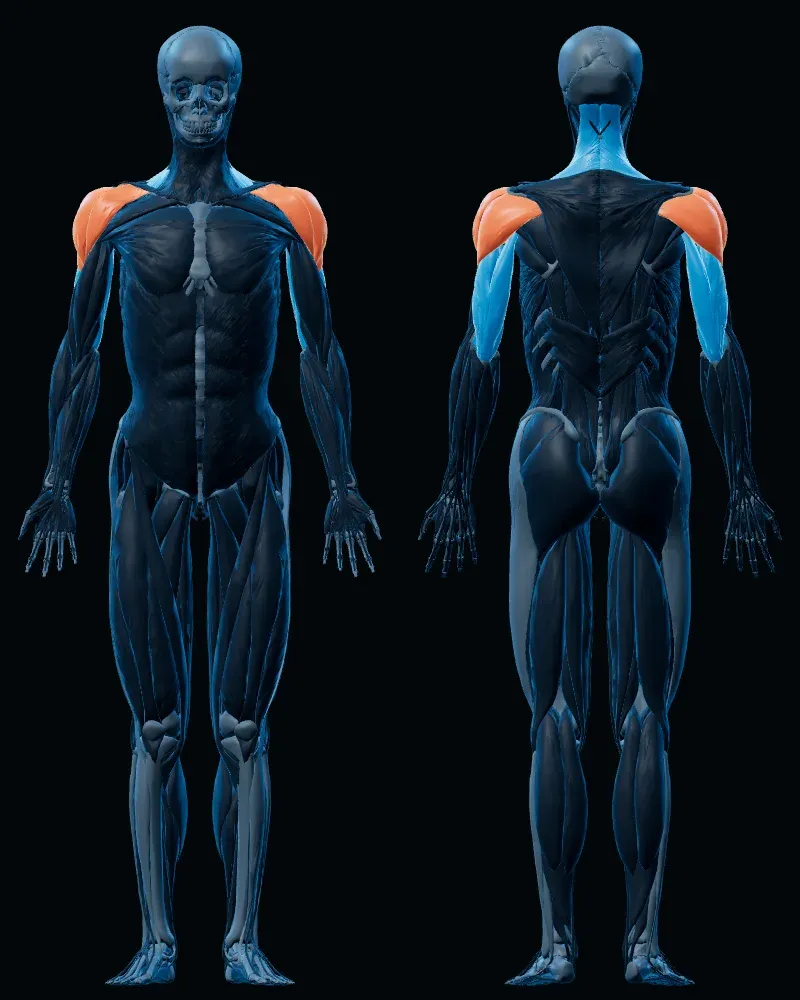
Muscles worked: shoulders
Main movers: all three heads of the deltoid
Assisting: supraspinatus, upper traps and triceps
Table of contents
You cannot train the biceps long head or short head separately. Both heads cross the elbow, join into one tendon and fire together on every curl. What you can do is change how stretched the long head is by moving your shoulder, which gives a small, real bias in how the arm grows.
That is the honest answer to biceps long head vs short head. Everything else, including “wide grip for the inner biceps” and “narrow grip for the peak,” is mostly gym folklore. This article is part of our complete arm and forearm training guide, and here we focus on what the studies actually show, and what they do not.
What are the long head and short head of the biceps?
The biceps brachii has two heads. The long head starts on the shoulder blade above the socket and runs over the top of the upper arm bone. The short head starts on a small bony point at the front of the shoulder blade (the coracoid process). The two bellies sit side by side and merge into one tendon at the elbow.
Two details matter for training.
- Both heads cross the elbow, so both flex it and both help rotate the forearm to a palm-up position.
- Both heads also cross the shoulder, but the long head runs over the top of the joint, so it is more affected by where your upper arm sits.
That second point is why shoulder angle is the only lever with decent evidence behind it. For the full anatomy of the elbow flexors, see our guide to functional anatomy of the arm flexors.
Can you isolate the long head vs the short head?
Not in a way that survives contact with the research. The elbow flexors are driven together as a team, and both biceps heads pull on the same tendon. Changing the exercise changes the mechanics (the lever arm and the muscle length) and so shifts the share of work among the whole group of elbow flexors. It does not hand the job to one head.
A practical wrinkle is that most surface EMG studies sit electrodes over the biceps and cannot separate one head from the other cleanly. When someone tells you a curl “activates the short head more,” ask what was measured. Often the answer is “the whole biceps.”
As a rough illustration (not measured numbers), think of it as nudging the split from 55:45 to 60:40, not from 50:50 to 100:0. That is what “bias” means here.
Does shoulder position change biceps growth?
Yes, modestly. Moving the shoulder behind the torso (incline curl) stretches the biceps, especially the long head. Moving the elbow in front of the body (preacher curl) shortens it at the shoulder. Here is what the trials found.
EMG, 2009. A study of 22 people compared the standard dumbbell curl, the incline curl and the dumbbell preacher curl at 40% of maximum voluntary contraction (Oliveira et al., 2009). Incline and standard curls produced similar biceps activation patterns across the whole range, while the preacher curl produced high activation only over a short range of elbow angles. The authors suggested incline and standard curls may be preferable for improving biceps force.
MRI, 2026. A 12-week trial put 21 untrained adults through incline curls on one arm and preacher curls on the other (5 sets of 10 reps at 70% of 1RM, twice a week) (Kobayashi et al., 2026). Biceps growth was greater after incline curls (+22.1% vs +18.9%, Hedges’ g = 0.33). Brachialis growth (+17.1% vs +21.1%) and brachioradialis growth (+13.5% vs +17.6%) were greater after preacher curls. Total elbow flexor growth did not differ (+17.6% vs +19.2%).
Ultrasound thickness, 2025. In 63 young women, 8 weeks of incline curls produced more growth at the proximal (upper) elbow flexors, and preacher curls produced more growth at the distal (lower) site (Kassiano et al., 2025). Strength followed specificity: each group improved most in the exercise it trained.
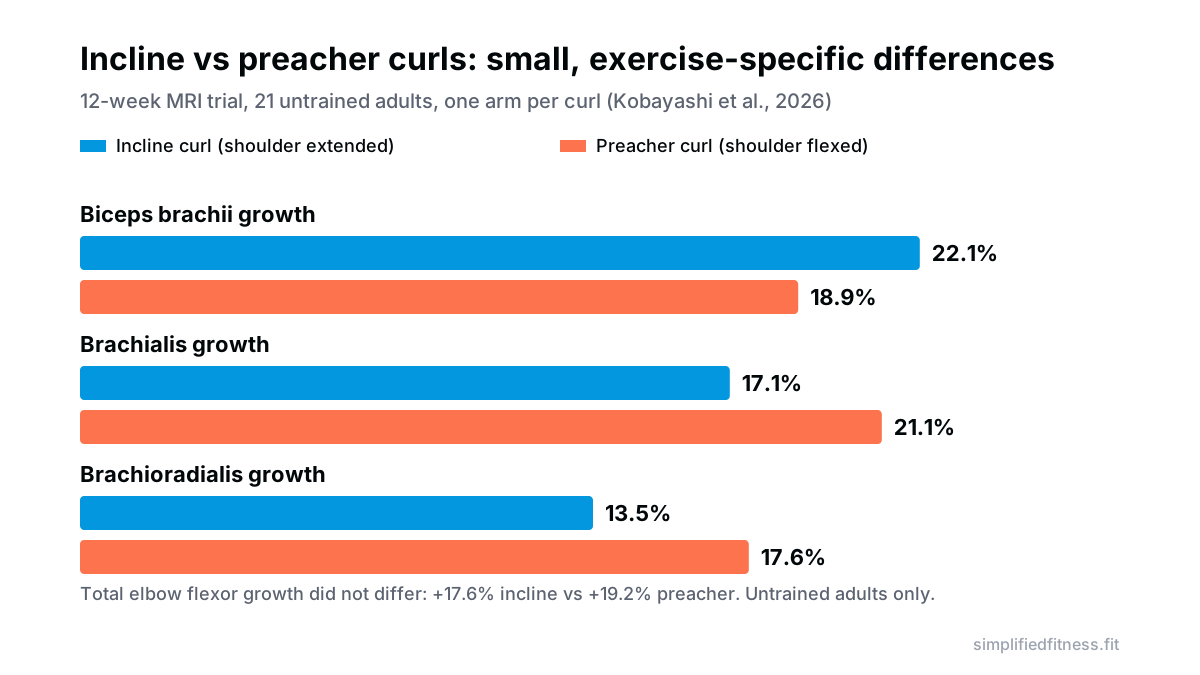
So the two curls shift growth around a little, and the total hardly changes. That is a bias, not a split.
Why do incline curls feel like they hit the long head?
Because the long head is crossing the shoulder joint. Put your arm behind your torso and the muscle is lengthened before you even start the curl. Training at longer muscle lengths has a reasonable track record. A systematic review of 11 studies found that training in the initial (stretched) part of the range of motion, or full range, produced more growth at distal sites of the biceps brachii and brachialis (along with some thigh muscles) than partial reps done at the end range, with effect sizes of 0.20-0.90 across those muscles (Kassiano et al., 2023).
An 8-week trial in 19 untrained young women, training one arm in the first half of the preacher curl range (0-68 degrees) and the other in the second half, saw more distal biceps growth in the stretched-range arm (Pedrosa et al., 2023). The sample was small, untrained and female only, so we hold it loosely.
To read more on the mechanism, see our articles on long muscle length training and regional hypertrophy. For the incline curl itself, see incline dumbbell curls and shoulder hyperextension.
Does wide grip or narrow grip curl hit different heads?
This is the classic myth: wide grip hits the short head (inner biceps) and narrow grip hits the long head (the peak). It sounds neat because a wide grip pushes the elbows out slightly and a narrow grip tucks them in.
We searched PubMed for studies comparing grip width on biceps activation or growth and did not find any that support head-specific effects. So the honest statement is: unproven, and the anatomy argues against it, since both heads attach to the same tendon at the elbow and both flex it regardless of grip width.
What does have evidence is forearm rotation. Ten competitive bodybuilders did 6-rep sets at 8-RM with supinated, pronated and neutral grips (Coratella et al., 2023). During lifting, biceps excitation was 19% greater with the supinated grip than the pronated grip and 12% greater than the neutral grip. Brachioradialis excitation was also higher with supination, by 5-6%, while the anterior deltoid worked harder with pronated and neutral grips (6-9% more).
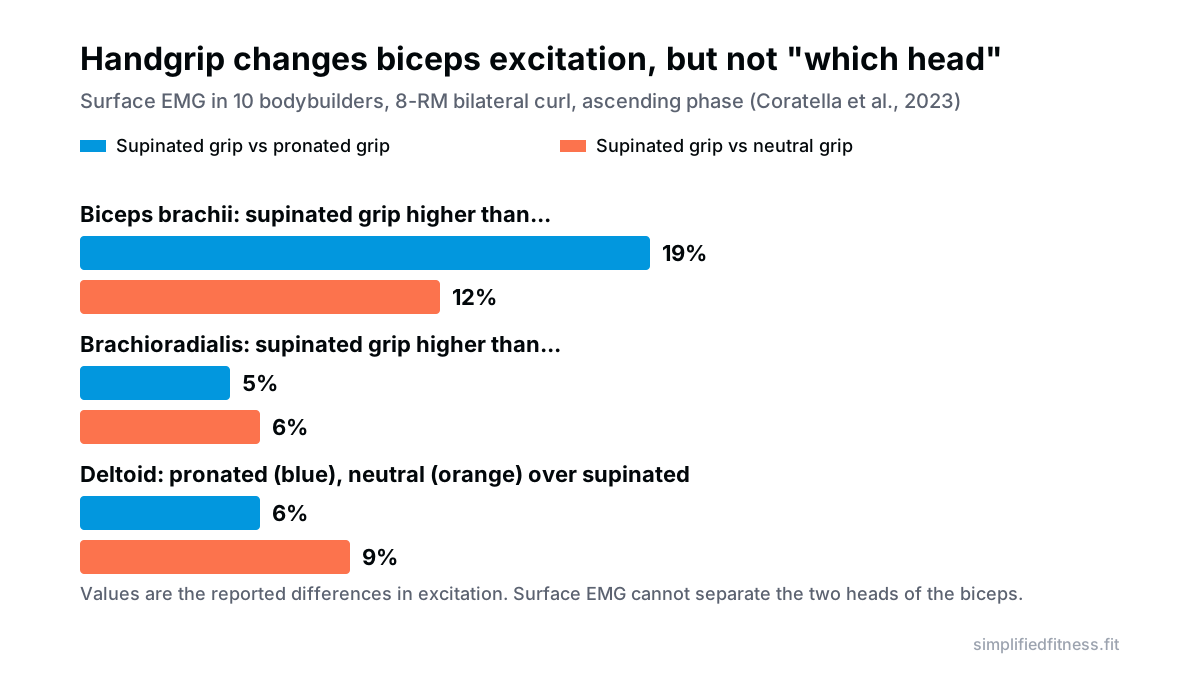
The study was small and measured excitation, not growth. Still, it supports a simple rule: for the biceps, palms up. For the arm’s thickness, add a neutral-grip curl.
How do you get a bigger bicep peak?
Peak is a shape. It depends on the length of your muscle belly and where the tendon inserts, plus how much muscle sits underneath. The first two are inherited, they vary a lot between people, and no curl changes your insertion points.
What you can change is size, and here the brachialis is the underrated piece. It sits under the biceps and flexes the elbow regardless of how the forearm is rotated. A surface EMG study of eight people found that brachialis activity could be assessed separately from biceps activity when forearm supination was added to elbow flexion, and that the biceps predicted supination torque much better than the brachialis (Staudenmann & Taube, 2015). In plain terms, the biceps is the forearm rotator and the brachialis is the workhorse flexor.
In the MRI trial above, the brachialis grew 17-21% over 12 weeks of curls in untrained adults (Kobayashi et al., 2026). It is not a secret, but it is a reason to include a neutral-grip movement. We cover it in hammer curls for brachialis and brachioradialis.
A simple plan for balanced biceps training
You do not need ten exercises. This is what the evidence supports.
| Slot | Example | Why |
|---|---|---|
| Stretched-position curl | Incline dumbbell curl | Long head stretched, more biceps growth in one MRI trial |
| Shoulder-flexed curl | Preacher curl (see preacher curls for distal biceps growth) | More distal and brachialis growth |
| Neutral-grip curl | Hammer curl | Brachialis and brachioradialis thickness |
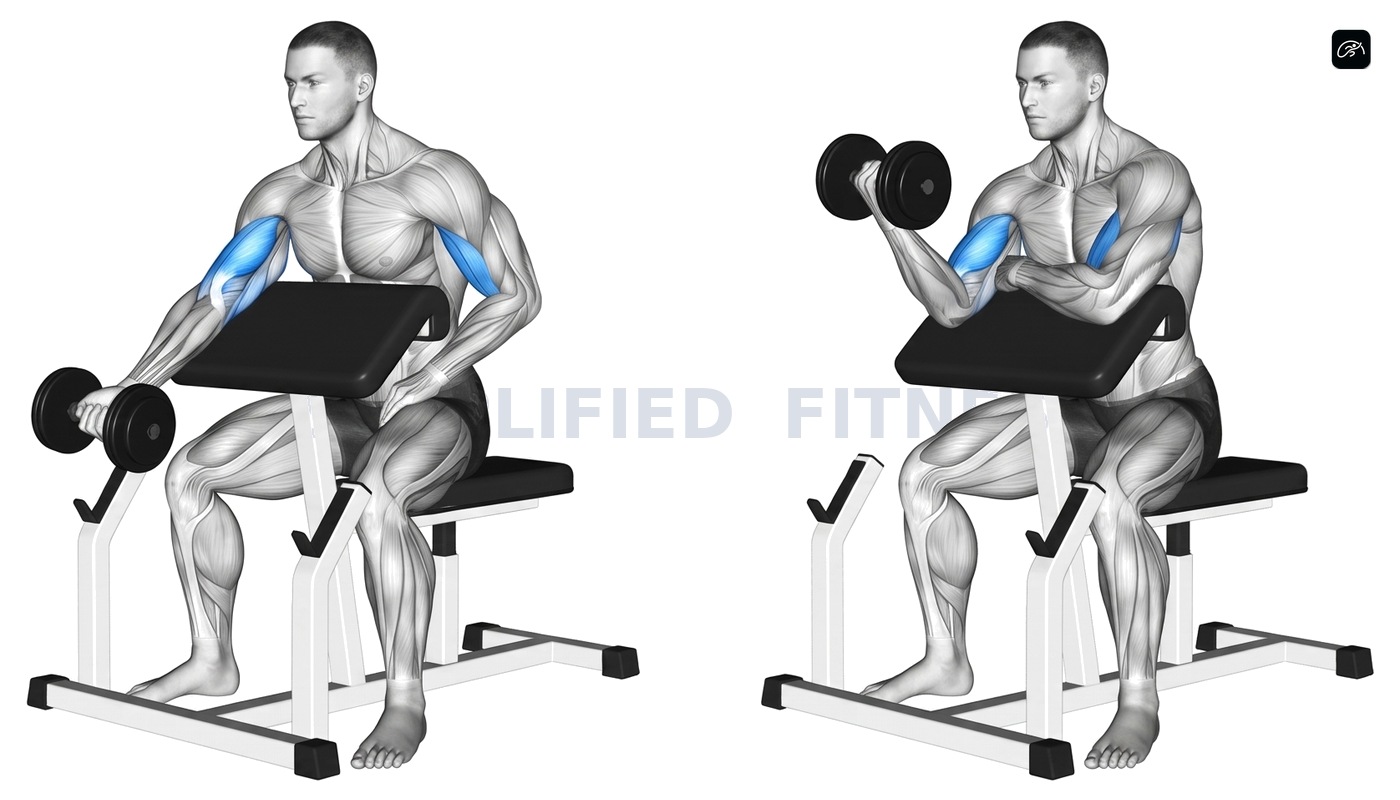
Work in the 6-15 rep range, finish sets 1-3 reps short of failure, and add weight or reps over time. Direct biceps volume also depends on how much rowing and pulling you already do, so use our training volume calculator to count weekly sets before adding more. If you want to compare bar types, see barbell vs EZ-bar curls, and for a broader comparison of the two main variations see incline curls vs preacher curls.
For vegetarians in India, remember that growth still depends on enough protein, so dal, paneer, curd and soya can fill the gap if you are not eating eggs or meat.
Is a stretched curl safe for the tendon?
Mostly yes, with sensible loading. A 2026 elastography study in 18 resistance-trained men measured biceps stiffness after 3 sets of 10 at 80% of 1RM with the shoulder flexed, neutral or extended (de Oliveira Silva et al., 2026). Resting stiffness rose as the shoulder moved from flexed to extended, and the distal long head showed reduced stiffness after exercise in 78.6% of participants, which the authors linked to possible muscle damage. They cautioned that heavy exercise at long muscle lengths should be prescribed carefully in untrained people.
That is a sign to ramp up gradually. It is not a reason to avoid the movement.
See a doctor or physiotherapist if you have sharp pain at the front of the shoulder or elbow that lasts more than a few days, a sudden “pop” followed by a bulge in the upper arm, or new weakness when turning your palm up. Those can be tendon injuries and should not be self-diagnosed. Our guide to distal biceps tendonitis covers rehab basics.
So what should you do with this?
Stop trying to isolate heads. Use shoulder position as a tool for variety, keep your grip supinated for most curls, and add a neutral-grip curl for thickness. The rest is effort, progressive overload, protein and patience.
If you want the bigger picture, our arm and forearm guide ties the pieces together, and you can follow it with a free push, pull and leg plan that already includes the pulling work your biceps need.
Frequently Asked Questions
Can you isolate the long head or short head of the biceps?
No, not in any meaningful way. Both heads cross the elbow, attach to the same radial tuberosity and share the job of flexing the elbow and supinating the forearm. Shoulder position changes how stretched the long head is, so use a mix of curl variations and let both heads grow together.
How do you target the long head of the biceps?
Curl with your shoulder behind your torso, as in an incline dumbbell curl, because the long head crosses the shoulder and gets stretched in that position. In a 2025 trial of 63 young women, incline curls produced more growth at the proximal (upper) elbow flexors than preacher curls. Treat it as a bias, not isolation, and keep the short head work too.
How do you target the short head of the biceps?
There is no reliable way to target the short head alone. Curls with the shoulder in front of the body, such as preacher curls, shorten the long head and shift more work toward the distal part of the elbow flexors. Use them as one of two curl variations, not as a short-head exercise.
Does wide grip or narrow grip curl hit different parts of the biceps?
The popular claim that wide grip hits the short head and narrow grip hits the long head has no direct support in the studies we found. Grip width mainly changes wrist and shoulder comfort, while forearm rotation (supinated versus neutral versus pronated) has measured effects on excitation. Choose the grip width that keeps your wrists and elbows comfortable.
How do you get a bigger bicep peak?
Peak height is mostly set by your genetics, namely how long the muscle belly is and where it inserts. What you can control is muscle size, including the brachialis underneath, which may help lift the biceps visually. Train curls and hammer curls close to failure with progressive overload and eat enough protein.
Is the brachialis really the secret to bicep height?
It helps, but it is not a secret trick. The brachialis lies under the biceps, and when it grows it can lift the biceps visually. In an MRI trial the brachialis grew about 17-21% over 12 weeks of curl training in untrained adults, so ordinary curls already train it.
Do incline curls build the biceps peak?
Incline curls train the biceps in a stretched position and produced slightly more biceps growth than preacher curls in one MRI trial. But 'peak' is a shape created by genetics and overall size, so incline curls will not create a peak the muscle was not built to have. Use them for the stretch and progressive overload.
Are preacher curls bad for the long head?
No. Preacher curls shorten the long head by flexing the shoulder, but they still train the whole biceps and produced larger brachialis and brachioradialis growth than incline curls in one trial. The differences were small to moderate, so using both is a sensible plan.
Does supinating the wrist change which head works?
Supination raises biceps excitation overall, not one head specifically. In ten bodybuilders, biceps brachii excitation was 19% higher with a supinated grip than a pronated grip and 12% higher than a neutral grip. Use a supinated grip for standard curls and a neutral grip when you want the brachioradialis and wrists to share the load.
How many sets of biceps curls do I need per week?
Most lifters do well with a modest number of hard sets per week spread over two sessions, adjusted for what else you train. Rows and pull-downs already hit the biceps, so direct volume needs are lower than people assume. Track weekly sets with our training volume calculator and add sets only if progress stalls.
Should I train the biceps in the stretched position?
Yes, at least some of the time. A systematic review of range-of-motion studies found that training at longer muscle lengths tended to favor growth of the biceps brachii, with effect sizes of 0.20-0.90 for distal sites. Include one stretched-position curl, and do not abandon full range of motion.
Why are my biceps uneven or one head looks bigger?
Differences in shape between arms are common and usually come from genetics, dominant-arm use and muscle insertions, not from training one head more. Studies on regional growth show that parts of a muscle respond slightly differently to different exercises, but the effects are small. Train both arms with the same loads and reps, start sets with the weaker side, and see a doctor if one arm is suddenly weaker or a muscle bulges after a pop.
Can curling with the shoulder extended hurt my biceps tendon?
It puts the biceps under more stretch, so build up gradually. A 2026 elastography study in 18 resistance-trained men found stiffness drops in the distal long head after heavy curls, most notably with the shoulder extended, which the authors linked to possible muscle damage, and advised caution in untrained people. Start light, control the lowering phase, and see a clinician if pain at the front of the shoulder or elbow persists.
Sources & References
Every claim above is checked against peer-reviewed research (PubMed, U.S. National Library of Medicine) or guidance from established health bodies. How we fact-check.
- Oliveira LF, et al. Effect of the shoulder position on the biceps brachii EMG in different dumbbell curls. J Sports Sci Med. 2009. PMID: 24150552
- Kobayashi Y, et al. Exercise-specific preferential hypertrophy of individual elbow flexor muscles after incline versus preacher dumbbell curl training. J Sports Sci. 2026. PMID: 42829982
- Kassiano W, et al. Distinct muscle growth and strength adaptations after preacher and incline biceps curls. Int J Sports Med. 2025. PMID: 39809454
- Coratella G, et al. Biceps brachii and brachioradialis excitation in biceps curl exercise: different handgrips, different synergy. Sports (Basel). 2023. PMID: 36976950
- Kassiano W, et al. Which ROMs lead to Rome? A systematic review of the effects of range of motion on muscle hypertrophy. J Strength Cond Res. 2023. PMID: 36662126
- Pedrosa GF, et al. Training in the initial range of motion promotes greater muscle adaptations than at final in the arm curl. Sports (Basel). 2023. PMID: 36828324
- de Oliveira Silva A, et al. Biceps brachii regional shear modulus following elbow flexion exercises at different muscle lengths. J Biomech. 2026. PMID: 41385870
- Staudenmann D, et al. Brachialis muscle activity can be assessed with surface electromyography. J Electromyogr Kinesiol. 2015. PMID: 25468488

Umair Hazrami · Founder & Head Coach, Simplified Fitness
Umair Hazrami founded Simplified Fitness and the Simplified Lifter channel to cut through fitness noise. With 4+ years of consistent training and 10+ coaching clients, he writes every guide from the peer-reviewed research and links the sources so you can check them. Our editorial standards.
Educational content only, not medical advice. If you have a medical condition, are pregnant, or take medication, talk to a qualified doctor before changing your diet, supplements or training. Full disclaimer.
Keep reading
Exercise Technique
Antagonist Arm Supersets: Biceps and Triceps Pairing for a Faster, Pumpier Arm Day
A biceps triceps superset workout can shorten arm day while keeping volume close to straight sets. See the research, pairing tips and a 20-minute routine.
9 min read
Exercise Technique
Barbell vs EZ-Bar Curls: Why Straight Bars Hurt the Pinky Side of Your Wrist
Barbell vs EZ bar curls for wrist pain: what EMG research says about biceps activation, forearm rotation and the carrying angle, plus fixes you can use today.
8 min read
Exercise Technique
Bayesian Cable Curls: Form, Setup and Whether They Build Bigger Biceps
Bayesian cable curl form explained step by step: pulley height, step-forward distance, elbow position, sets and reps, and what the research really shows.
8 min read
Exercise Technique
Close-Grip Bench Press: Triceps Loading, Wrist Spacing, and Elbow Stress
Close grip bench press triceps guide: how narrow to go, what the grip width research shows, and how to protect wrists and elbows. Setup cues included.
8 min read