Hammer Curls for Arm Thickness: Brachialis and Brachioradialis Training Explained
Do hammer curls for arm thickness really work? See what EMG and MRI studies show about the brachialis and brachioradialis, plus form, rope and pinwheel tips.
TL;DR. The short answer
- Hammer curls use a neutral grip (palms facing each other), which in one EMG study produced roughly 12% less biceps excitation than a supinated curl. That leaves relatively more work for the other elbow flexors.
- The brachialis and brachioradialis are real contributors to elbow flexion and they do grow. In an MRI trial of curl training, brachialis volume rose about 17-21% in 12 weeks in untrained adults.
- Evidence that hammer curls beat regular curls for muscle size is lacking. No trial I found compares the two for hypertrophy, so treat hammers as a complement, not a replacement.
- The idea that a bigger brachialis pushes the biceps up and out is anatomically plausible but untested. Do not expect a visible change from hammers alone.
- A sensible dose is 3-6 hard sets per week, 8-15 reps, elbows still, controlled lowering. Rope cable and cross-body versions are useful variations, not magic.
Part of our complete guide: Arm Workout Science: The Complete Guide to Biceps, Triceps, Brachialis and Forearm Growth
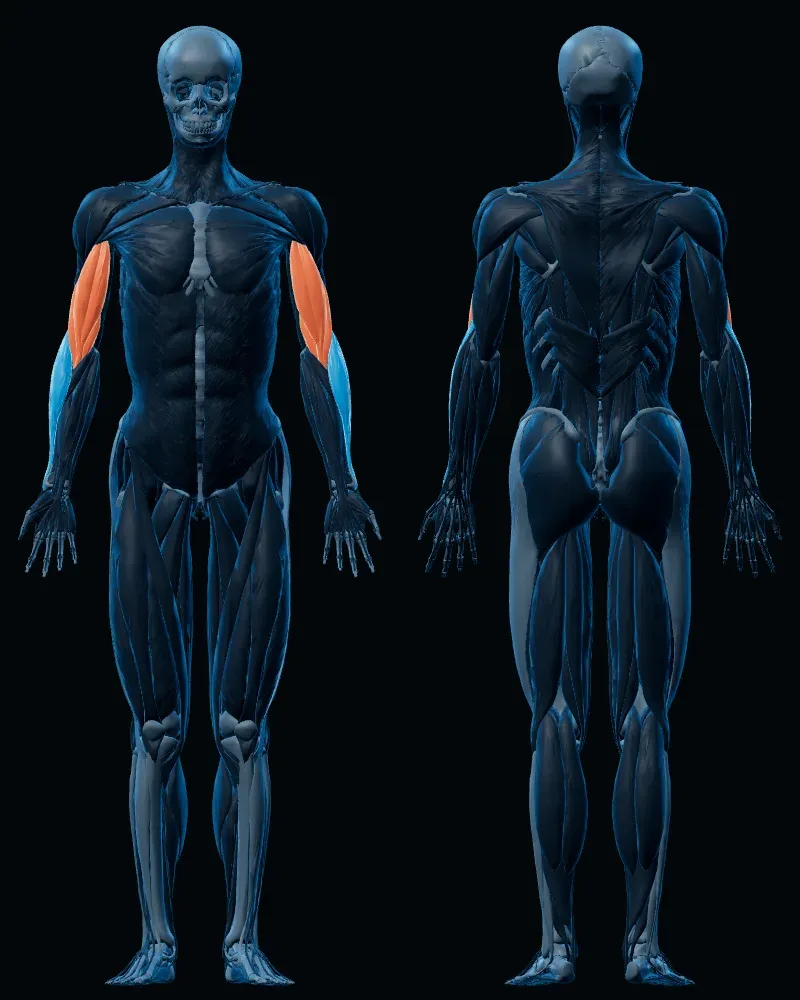
Muscles worked: biceps
Main movers: biceps brachii and brachialis
Assisting: brachioradialis
Table of contents
Hammer curls for arm thickness are worth doing, but the evidence is more modest than gym lore suggests. The neutral grip (palms facing each other) lowers biceps excitation compared with a supinated curl, so the brachialis and the forearm’s brachioradialis carry a relatively bigger share of the work. Those muscles grow with training. What nobody has shown yet is that hammers beat other curls for size.
This article sits inside our complete arm and forearm training guide. If you want the anatomy first, read how the arm flexors work and come back. Here we stick to what the exercise does, what the research supports, and how to perform it well.
What do hammer curls actually work?
Three muscles bend your elbow: the biceps brachii, the brachialis underneath it, and the brachioradialis, which runs down the thumb side of the forearm. In a standard supinated curl (palms up) the biceps does a lot of the job. Rotate your palms to face each other and the job gets shared differently.
Why the biceps? It does two things: it flexes the elbow and it turns the palm up (supination). Cadaver measurements and a computer model show the biceps flexion moment arm is larger when the forearm is supinated (Murray et al., 1995). In plain terms, the biceps has a better lever when your palm faces up and a worse one when it does not. That is a mechanical argument, drawn from two specimens and a model, so treat it as a plausible explanation and not a proof.
The brachialis attaches to the ulna, which does not rotate, so its job is simply to bend the elbow whatever your grip, which is why coaches call it the “workhorse” of elbow flexion.
Does the neutral grip really shift work off the biceps?
Partly, and the data are less tidy than the usual story.
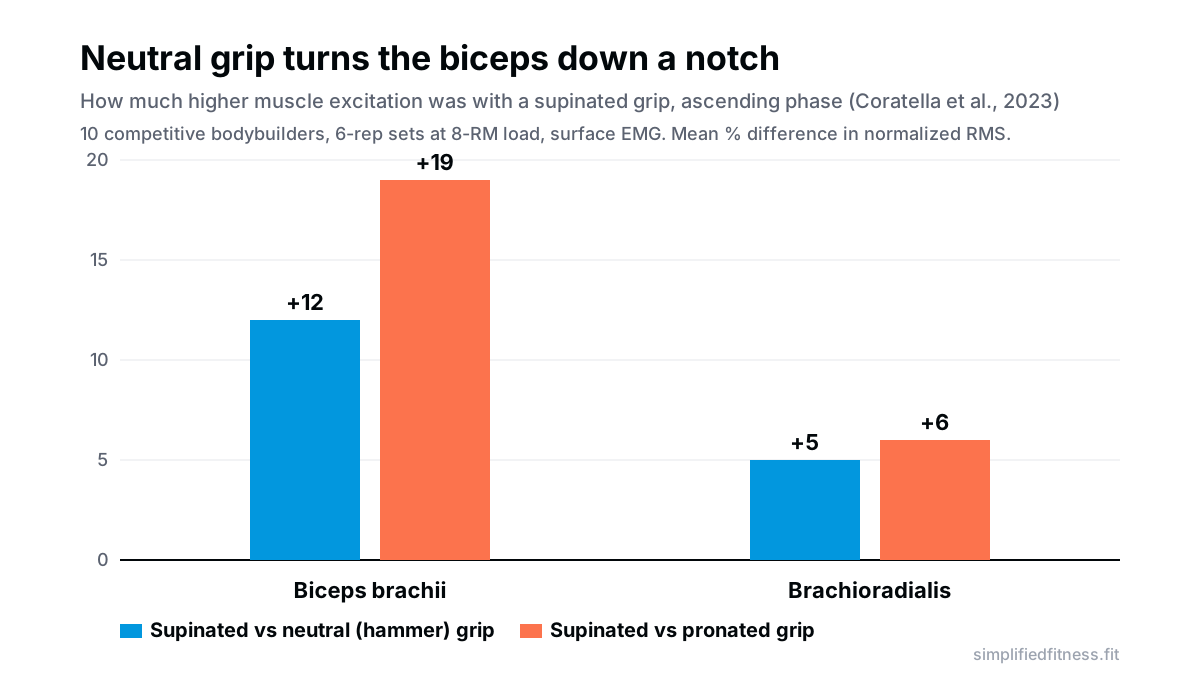
In a 2023 EMG study, 10 competitive bodybuilders did bilateral curls (6-rep sets with an 8-RM load) using supinated, pronated and neutral grips. Biceps excitation on the way up was higher with the supinated grip than with the neutral grip, by about 12% (ES 1.24). Surprisingly for the usual narrative, brachioradialis excitation was also slightly higher with the supinated grip (by about 6%) than with the neutral grip (Coratella et al., 2023).
An older study points the other way for the deep muscles. When nine healthy subjects slowly rotated the forearm while holding the elbow bent, brachialis and brachioradialis EMG was higher with the forearm prone, while biceps was higher with the forearm supine (Naito et al., 1998). A third study in 10 trained men found similar activation across brachialis, both biceps heads and brachioradialis in both supination and pronation on a preacher bench, with no significant differences (Bankoff et al., 2007).
So three small studies, three slightly different answers. Why might that be? Different loads, different tasks (a rotation test versus a full curl), different electrode sites, and surface EMG on deep muscles like the brachialis is hard to interpret. A cautious reading: the biceps seems to do somewhat less in a hammer curl, the brachialis and brachioradialis are always involved, and the exact redistribution is not settled.
Hammer curls vs regular curls: which is better?
There is no head-to-head hypertrophy trial that I could find, so nobody can honestly say one is better.
What we do know: hammer curls were ranked lowest for biceps surface EMG among four curl types (concentration, dumbbell, hammer, incline) in a 2026 study of 15 adults at light-to-moderate loads. The ranking was stable across four sessions at the group level, but one-third of individuals showed only fair-to-moderate consistency (Croskery et al., 2026). Lower biceps activity at light load is not the same as worse growth, though. It may simply mean the work is spread more widely.
Here is the practical comparison.
| Supinated curl (barbell, EZ, dumbbell) | Hammer curl | |
|---|---|---|
| Grip | Palms up | Palms facing each other |
| Biceps excitation (EMG) | Higher | Lower in the studies above |
| Brachialis / brachioradialis | Involved | Involved; share may rise |
| Wrist comfort | Can be harder on wrists | Often more comfortable |
| Hypertrophy evidence vs the other | None found | None found |
The sensible answer is not “one or the other”. Use both in the same week. If you want a full comparison of angle and shoulder position, our incline vs preacher curl breakdown covers that side of arm training.
Do the brachialis and brachioradialis really grow?
Yes. This is the part that is well supported. In a 2026 MRI study, 21 untrained adults trained one arm with incline dumbbell curls and the other with preacher dumbbell curls for 12 weeks (5 sets of 10 reps at 70% 1RM, twice weekly). In the preacher arm, brachialis volume rose 21.1%, brachioradialis 17.6% and biceps 18.9%. In the incline arm the figures were 17.1%, 13.5% and 22.1% (Kobayashi et al., 2026).
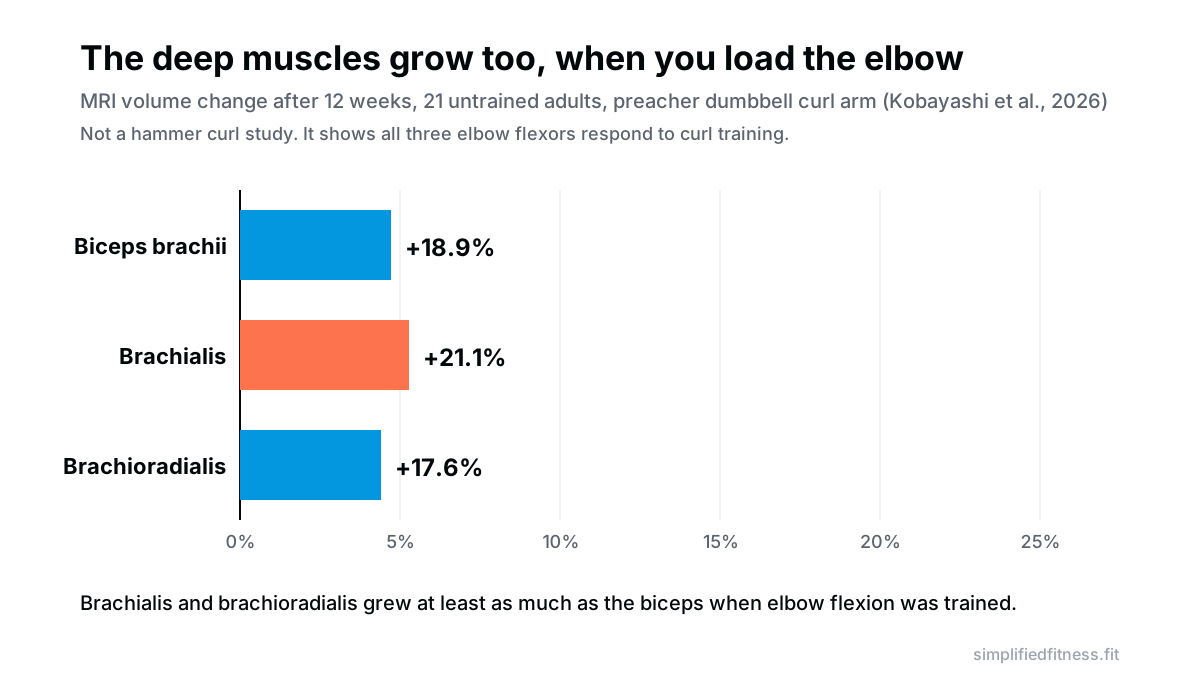
Two cautions. These were untrained people, who grow quickly, so your numbers will be smaller. And the exercises were not hammer curls, so this tells us the muscles are trainable, not that hammers are the best way to train them. Note too that the different exercise setups favoured different muscles: incline curls slightly favoured the biceps, preacher curls the other two. That is a hint that variety across exercises may spread growth around.
Will a bigger brachialis make my arm look wider?
You will hear that the brachialis “pushes the biceps up”. Anatomically it lies directly beneath the biceps brachii, so a larger brachialis could add to the thickness of the front of the upper arm. That reasoning is sensible. But I found no study that measured visible arm width after hammer curl training, so it is an inference, not a finding.
My coaching view: do not expect hammer curls alone to change how your arm looks. Arm size mostly follows total elbow flexor and triceps volume, progressive overload, enough food, and time. The triceps makes up a large share of the upper arm too, so direct versus indirect arm volume matters more than any single curl variation.
Dumbbell hammer curl form
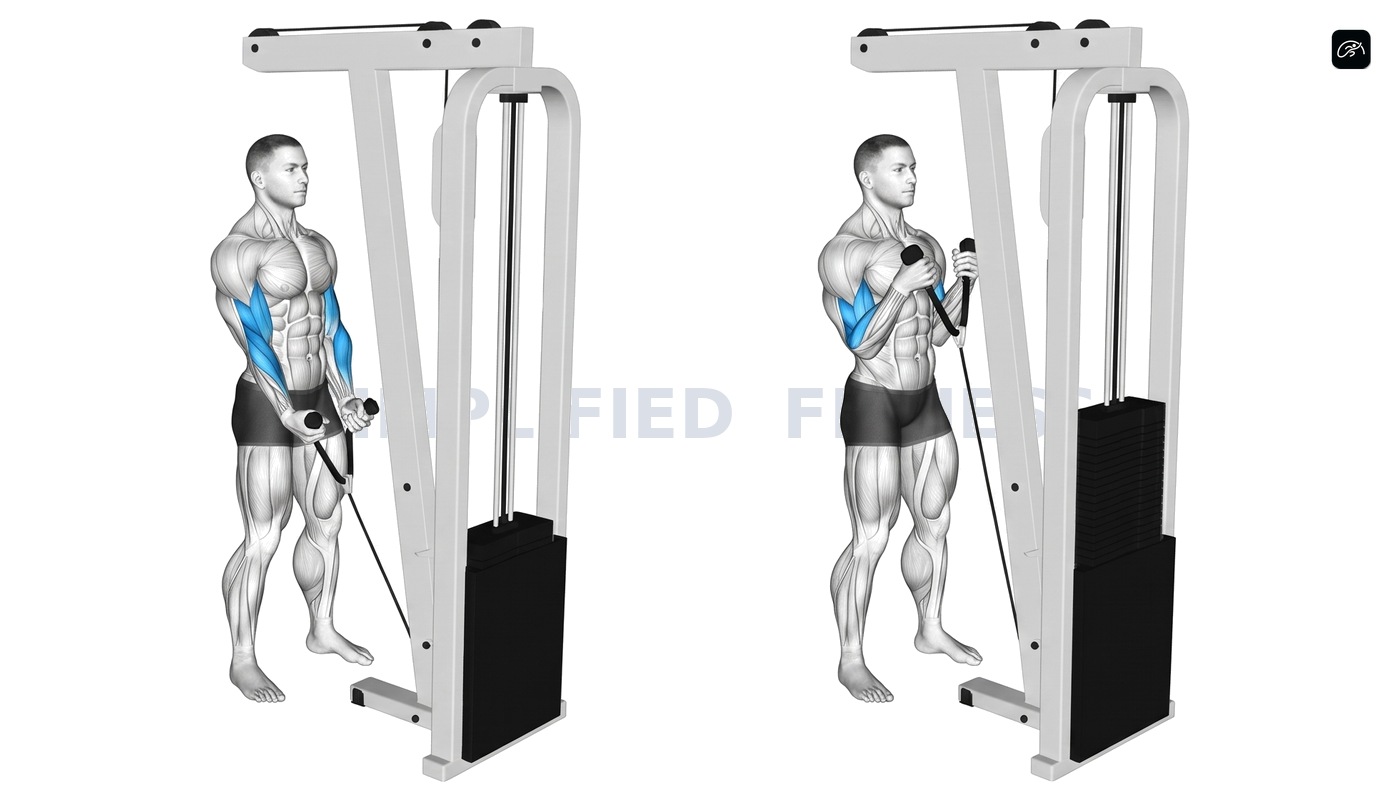
The cable version above is the same movement pattern. For the dumbbell version:
- Stand tall with feet hip width, a dumbbell in each hand, palms facing your thighs. Brace your abs lightly.
- Pin your elbows beside your ribs. They can drift forward slightly at the top; they should not swing.
- Curl until your forearm is vertical or the dumbbell nears your shoulder. Keep wrists straight.
- Squeeze for a beat, then lower over 2-3 seconds until your arm is fully straight.
- Stop the set when the next rep would need body English.
Range of motion matters. A systematic review found that full-range reps, or partial reps in the stretched part of the range, produced more growth at distal biceps brachii and brachialis sites than partial reps in the shortened part (Kassiano et al., 2023). So lower fully until the elbow is almost straight instead of stopping halfway.
Rope cable hammer curls
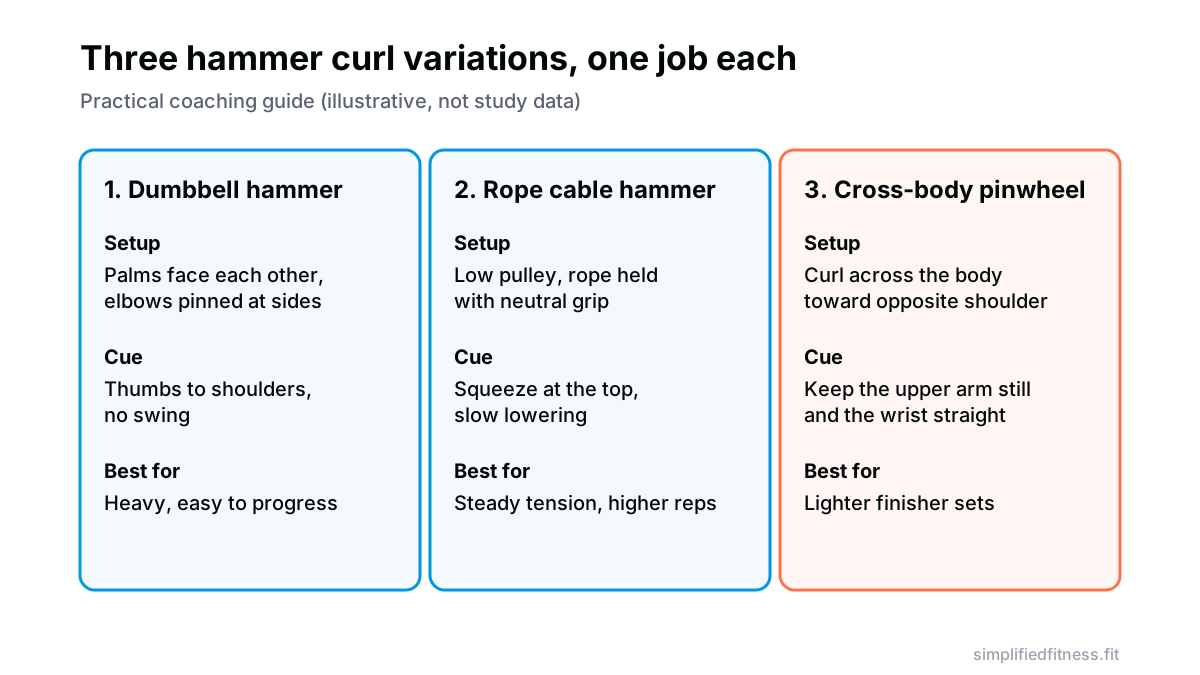
Set a low pulley with a rope attachment. Hold the rope ends with a neutral grip, elbows at your sides, and curl until the rope ends reach shoulder height. Lower slowly.
Why use it? The cable keeps tension on the muscle throughout the rep, which many lifters find more consistent than a dumbbell at the very top and bottom. It is also easier to do strict reps for 10-15 reps. There is no study showing it grows more muscle than the dumbbell version, so the real reason to use it is feel and variety.
Cross-body and pinwheel hammer curls
In a cross-body (pinwheel) curl you curl one dumbbell across your torso toward the opposite shoulder, palm facing in, then alternate arms. It changes the path of the rep and many lifters feel it more in the outer biceps and forearm.
That is a feel claim, not a measured one. I know of no research on pinwheel curls specifically. Use them as a lighter variation, 10-15 reps, and keep the upper arm still so it does not become a swinging shoulder exercise.
How many sets and reps for hammer curls?
Start with 3-4 hard sets per week of hammers, in addition to your regular curls and the biceps work you already get from rows and pull-ups. That is a starting point, not a prescription.
The volume research is reasonably consistent. A meta-regression of 15 studies found a graded dose-response between weekly sets and muscle growth: each extra weekly set was associated with a small increase in gain, about 0.37% (Schoenfeld et al., 2017). Returns do diminish, and recovery counts. For reps, the repetition continuum has been revisited: muscle can grow across a wide range of loads when sets are taken near failure (Schoenfeld et al., 2021). So 8-15 reps with 1-3 reps in reserve is a good range.
Here is one way to place them in a pull day:
- Lat pulldown or row for 3 sets
- Supinated curl (EZ bar or incline dumbbell) for 3 sets of 8-12
- Hammer curl for 3 sets of 10-15
Our free pull day plan is built this way. Track effort with the RIR and RPE calculator if you are unsure how close to failure you are going.
Vegetarian lifters: do you need more protein to grow arms?
Arms respond to total training and total protein, not to a single exercise. If you eat mostly dal, curd, paneer, roti and rice, the main issue is usually total protein, not curl technique. Use the protein calculator to see your daily target, then spread it over 3-4 meals. Our biceps and triceps pairing guide shows how to fit arm sets into a busy session.
When to see a doctor
Muscle soreness for 1-3 days is normal. Sharp pain at the front of the elbow, pain that persists for weeks, a sudden pop in the upper arm, bruising, swelling, or tingling and numbness in the hand are not. Stop training the arm and get it examined by a doctor or physiotherapist. This article is education, not a diagnosis.
The bottom line
Hammer curls are a useful, wrist-friendly way to train the three elbow flexors with a slightly different emphasis. They are not a proven shortcut to bigger arms. Use them for 3-4 hard sets per week next to supinated curls, keep the elbows still, lower slowly, and judge the result by how your logbook moves over months. For the wider plan, return to the complete arm and forearm guide.
Frequently Asked Questions
Do hammer curls build arm thickness?
Yes, they train the elbow flexors, including the brachialis and brachioradialis, and those muscles do grow with curl training. An MRI trial in untrained adults found brachialis and brachioradialis volume rose roughly 14-21% after 12 weeks of dumbbell curls. No study has directly shown hammers add more thickness than other curls, so use them as one part of your arm work.
What muscles do hammer curls work?
Hammer curls work the biceps brachii, the brachialis under it, and the brachioradialis along the top of the forearm. All three cross the elbow and help flex it. The neutral grip changes the mix a little, with EMG showing less biceps excitation than a supinated curl, but the biceps is still working.
Are hammer curls better than regular curls?
There is no good evidence that one is better for growth. Supinated curls produced higher biceps and brachioradialis excitation in a small EMG study, while hammers shift some load toward other flexors. Using both in a week covers more of the arm than picking just one.
Do hammer curls make your biceps wider?
This is plausible but unproven. The brachialis sits beneath the biceps, so growing it could add to the look of upper arm thickness, but I found no study that measured arm width after hammer training. Expect hammers to contribute to overall arm size, not to reshape the arm on their own.
Do hammer curls work the brachialis more than the biceps?
Not exactly. Older EMG work suggests the brachialis and brachioradialis are relatively more active with the forearm pronated (palm down), and the biceps with the forearm supinated. Neutral sits in between and was not tested directly. That is a shift in emphasis, not a switch, so the biceps still works hard in a hammer curl.
What is the correct hammer curl form?
Stand tall, keep your elbows beside your ribs, hold the dumbbells with palms facing each other and curl until your forearms are vertical. Lower slowly over about 2-3 seconds. Stopping the swing keeps tension on the elbow flexors rather than your back and shoulders.
How many sets of hammer curls per week?
Around 3-6 hard sets per week works for most people on top of your regular curls and rows. Meta-analytic data show a graded dose-response between weekly sets and muscle growth, though returns shrink at higher volumes. Add sets only if you are recovering well and progressing.
How many reps should I do for hammer curls?
Somewhere between 8 and 15 reps works well, finishing within a couple of reps of failure. Research on loading suggests muscle can grow across a wide range of loads when sets are taken close to failure. Pick the range that lets you keep strict form.
Are rope hammer curls better than dumbbell hammer curls?
Neither has been shown to be superior for growth. The cable keeps constant resistance through the whole rep, which many lifters find easier to feel, while dumbbells are easier to load heavy. Rotate between them if your gym has both.
What is a cross-body hammer curl or pinwheel curl?
It is a hammer curl where you curl the dumbbell across your torso toward the opposite shoulder, keeping the palm facing inward. It changes the path and feel of the rep, and no study has shown it grows muscle more than a standard hammer. Use it with lighter loads as a variation.
Can hammer curls help forearm size?
They train the brachioradialis, the big muscle on the top of the forearm near the elbow, so they can add to upper forearm size. Wrist flexors and extensors are different muscles that need their own work. Hammer curls plus heavy gripping on rows and carries usually cover most of it.
Why do hammer curls hurt my wrists or elbows?
A neutral grip is often more comfortable than a fully supinated one, but pain can still come from excess load, swinging, or too much volume too soon. Lower the weight, shorten the set, and keep your wrists straight. If pain is sharp, persistent or comes with swelling or numbness, see a doctor or physiotherapist.
Can I do hammer curls every day?
It is not necessary and likely counterproductive. Muscle needs recovery between hard sessions, and elbow tendons can get irritated with high frequency and little rest. Training elbow flexors 2-3 times a week with a day or two between is a reasonable pattern.
Sources & References
Every claim above is checked against peer-reviewed research (PubMed, U.S. National Library of Medicine) or guidance from established health bodies. How we fact-check.
- Coratella G, et al. Biceps Brachii and Brachioradialis Excitation in Biceps Curl Exercise: Different Handgrips, Different Synergy. Sports (Basel). 2023. PMID: 36976950
- Murray WM, et al. Variation of muscle moment arms with elbow and forearm position. J Biomech. 1995. PMID: 7775488
- Naito A, et al. Electromyographic study of the elbow flexors and extensors in a motion of forearm pronation/supination while maintaining elbow flexion in humans. Tohoku J Exp Med. 1998. PMID: 10328159
- Bankoff AD, et al. Electromyographic study of the flexor muscles of the elbow articulation in weightlifting trained subjects. Electromyogr Clin Neurophysiol. 2007. PMID: 17375882
- Croskery M, et al. Inter-day ranking of biceps brachii sEMG amplitude during four arm curl exercises. J Electromyogr Kinesiol. 2026. PMID: 42874306
- Kobayashi Y, et al. Exercise-specific preferential hypertrophy of individual elbow flexor muscles after incline versus preacher dumbbell curl training. J Sports Sci. 2026. PMID: 42829982
- Schoenfeld BJ, et al. Dose-response relationship between weekly resistance training volume and increases in muscle mass: A systematic review and meta-analysis. J Sports Sci. 2017. PMID: 27433992
- Kassiano W, et al. Which ROMs Lead to Rome? A Systematic Review of the Effects of Range of Motion on Muscle Hypertrophy. J Strength Cond Res. 2023. PMID: 36662126
- Schoenfeld BJ, et al. Loading Recommendations for Muscle Strength, Hypertrophy, and Local Endurance: A Re-Examination of the Repetition Continuum. Sports (Basel). 2021. PMID: 33671664

Umair Hazrami · Founder & Head Coach, Simplified Fitness
Umair Hazrami founded Simplified Fitness and the Simplified Lifter channel to cut through fitness noise. With 4+ years of consistent training and 10+ coaching clients, he writes every guide from the peer-reviewed research and links the sources so you can check them. Our editorial standards.
Educational content only, not medical advice. If you have a medical condition, are pregnant, or take medication, talk to a qualified doctor before changing your diet, supplements or training. Full disclaimer.
Keep reading
Exercise Technique
Antagonist Arm Supersets: Biceps and Triceps Pairing for a Faster, Pumpier Arm Day
A biceps triceps superset workout can shorten arm day while keeping volume close to straight sets. See the research, pairing tips and a 20-minute routine.
9 min read
Exercise Technique
Barbell vs EZ-Bar Curls: Why Straight Bars Hurt the Pinky Side of Your Wrist
Barbell vs EZ bar curls for wrist pain: what EMG research says about biceps activation, forearm rotation and the carrying angle, plus fixes you can use today.
8 min read
Exercise Technique
Bayesian Cable Curls: Form, Setup and Whether They Build Bigger Biceps
Bayesian cable curl form explained step by step: pulley height, step-forward distance, elbow position, sets and reps, and what the research really shows.
8 min read
Exercise Technique
Close-Grip Bench Press: Triceps Loading, Wrist Spacing, and Elbow Stress
Close grip bench press triceps guide: how narrow to go, what the grip width research shows, and how to protect wrists and elbows. Setup cues included.
8 min read