Overhead Cable Triceps Extensions: Setup, Form and Why the Long Head Loves Them
Overhead cable triceps extension setup, step by step: pulley height, stance, elbow path and reps, plus the 12-week MRI trial behind why it works.

TL;DR. The short answer
- The overhead cable triceps extension trains the triceps long head with the arm raised, where that muscle is stretched the most. In a 12-week MRI trial, the overhead position grew the long head about 1.5 times more than elbow extensions with the arm at the side.
- Set the pulley around shoulder height or slightly lower, face away from the stack, take a split stance, point your elbows forward and bend deeply behind your head before pressing out.
- Lighter loads are normal here. In the trial, the overhead arm used roughly 34-39% less weight yet still grew more muscle.
- That trial used 21 adults and one arm per position, so it is strong but small. Pushdowns still work, and a mixed approach is reasonable.
- Sharp or lingering elbow pain is a reason to stop and get it checked, not something to push through.
Part of our complete guide: Arm Workout Science: The Complete Guide to Biceps, Triceps, Brachialis and Forearm Growth
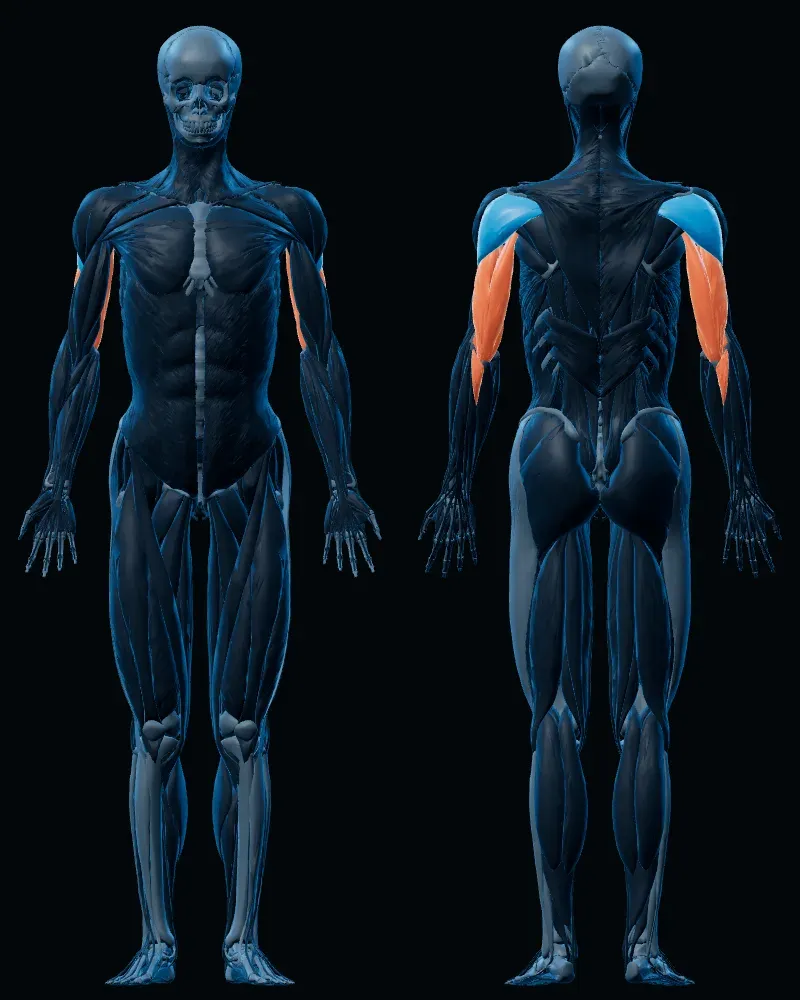
Muscles worked: triceps
Main movers: all three heads of the triceps
Assisting: rear delts
Table of contents
Part of our complete arm and forearm training guide: the overhead cable triceps extension is one of the best ways to train the long head of the triceps, because raising your arm overhead stretches that head more than any pushdown can. In a 12-week MRI trial, elbow extensions done overhead grew the long head about 1.5 times more than the same exercise done with the arm at the side (Maeo et al., 2023).
Why the overhead position works
The triceps has three heads. The lateral and medial heads cross only the elbow. The long head also crosses the shoulder, which is why shoulder position matters so much for it. If you want the anatomy in detail, see our breakdown of the triceps brachii heads.
Here is the key idea. Lift your arm overhead and the long head gets pulled long at the shoulder end. Bend the elbow too and it is stretched at both ends. A pushdown, with your elbow glued to your ribs, never gets it there.
Longer starting length is the whole idea behind this exercise. Our guide to overhead versus neutral triceps long head training goes deeper into that comparison.
What the research actually shows
The best direct evidence is one trial from Ritsumeikan University. Twenty-one adults trained one arm with cable elbow extensions overhead and the other arm with the arm in a neutral position at the side. Both arms did 5 sets of 10 reps at 70% of one-rep max, twice a week, for 12 weeks. Muscle volume was measured by MRI (Maeo et al., 2023).
The overhead arm won in every region:
- Long head: +28.5% versus +19.6%
- Lateral and medial heads combined: +14.6% versus +10.5%
- Whole triceps: +19.9% versus +13.9%
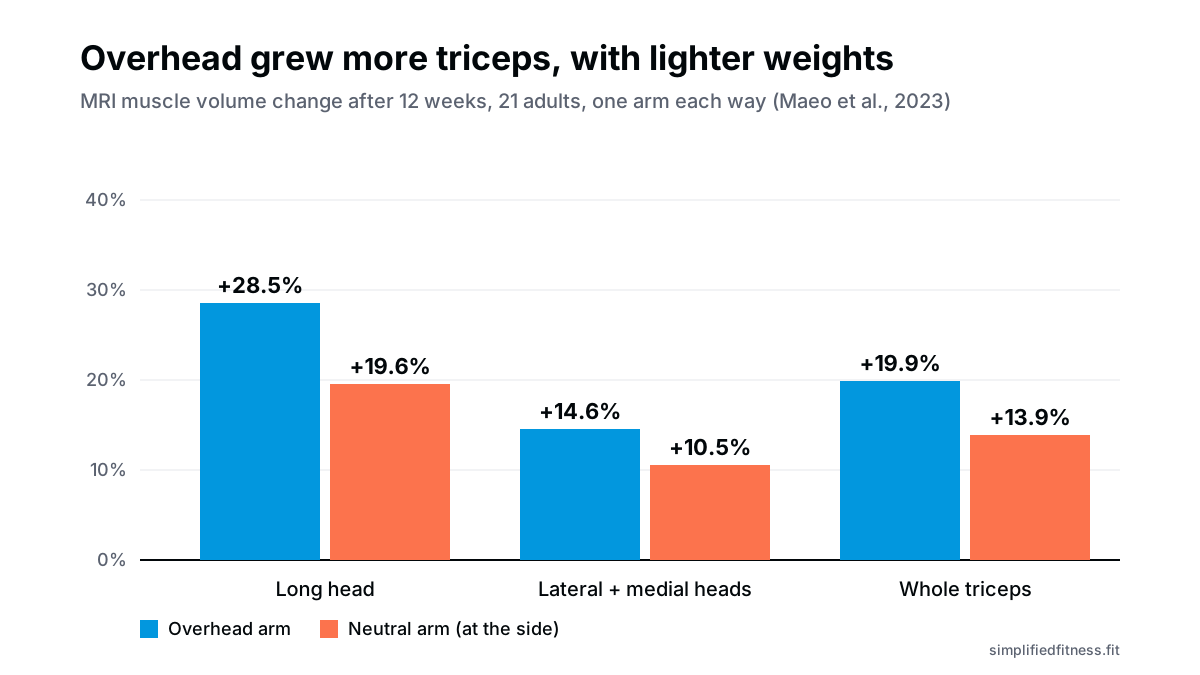
Strength went up similarly in both arms (about +62-71%), yet the overhead arm lifted 34-39% less weight in absolute terms. Lighter bar, bigger growth. That is the surprising part.
Where the evidence gets messy
Not every study agrees that a longer muscle length always wins. A 2025 meta-analysis of 12 studies in young adults found that training at longer versus shorter muscle lengths produced similar regional hypertrophy, with trivial differences and a note of caution because the length differences between conditions were small (Varovic et al., 2025).
An older systematic review also found that research on range of motion in the upper limbs was limited and conflicting (Schoenfeld and Grgic, 2020). And a meta-analysis of range-of-motion training found full range of motion beat partial range for strength and lower-limb growth, but not for muscle thickness overall (Pallares et al., 2021).
Why the mixed picture? Most of those studies compare range of motion, or use different muscles, different methods and shorter differences in length. The triceps trial changed the arm position, which changes the long head’s length far more. So the practical takeaway is cautious: training the triceps in a stretched position looks like a smart bet, and the overhead extension is the clearest example we have. It does not mean every other exercise is useless.
If you are curious about lengthened partials specifically, one 2025 trial in 30 trained people found that lengthened partials and full range of motion gave similar muscle thickness changes in the elbow flexors and extensors over 8 weeks (Wolf et al., 2025). The authors suggested emphasising the stretched position, using either approach. Our lengthened partials guide covers how to use that.
Overhead cable triceps extension setup, step by step
Setup is where most people lose the benefit. Run through these checks before the first set.
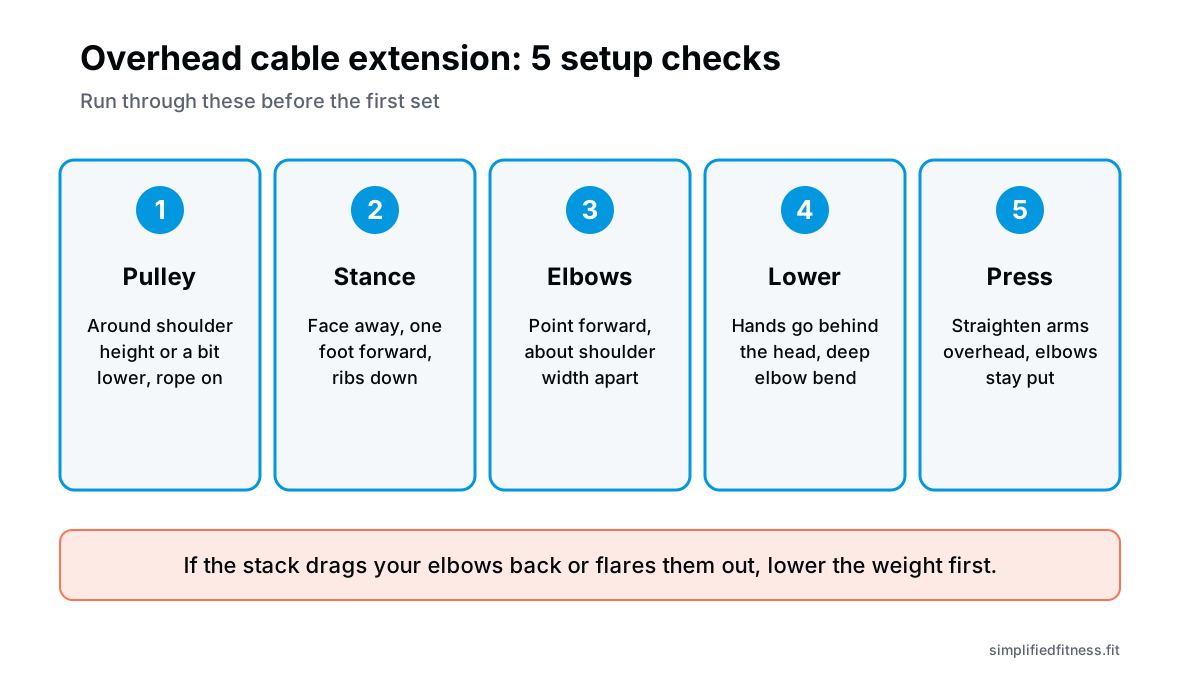
- Pulley height. Around shoulder height or a little lower is a good start. Attach a rope. Our cable setup guide covers pulley heights in general.
- Stance. Face away from the stack, one foot forward, knees soft. The split stance stops the cable from pulling you backwards.
- Grip and elbows. Hold the rope with both hands, raise your arms overhead, and point your elbows forward, roughly shoulder width apart. Ribs down. Do not let your lower back arch.
- Lower. Bend only at the elbows until your hands go behind your head. Stop when you feel a deep stretch in the back of the arm.
- Press. Straighten the elbows and finish with your arms overhead. Hold for a beat, then lower under control.
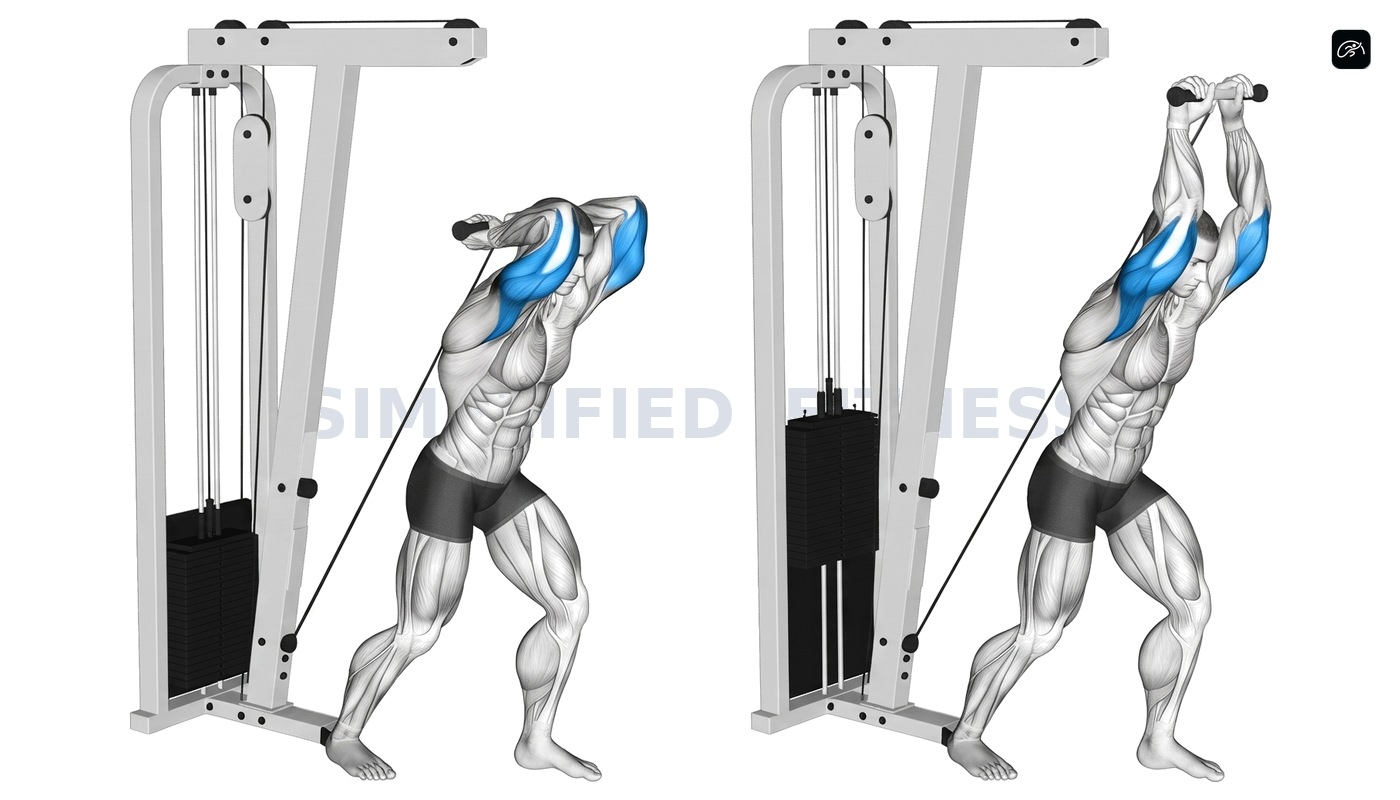
The angle question: overhead or slightly forward?
You will see coaches say to angle the arms around 45 degrees up and forward rather than straight vertical. Nobody has tested a specific angle against another, so treat that as a comfort cue. The research compared overhead against neutral, not 45 degrees against 90. Choose the arm angle that lets your elbows stay still and your shoulders stay comfortable.
How to do it: form cues that matter
- Elbows still. The only joint that moves is the elbow. If your shoulders are doing a pullover, you are cheating.
- Own the stretch. Slow the lowering phase to around two or three seconds. Do not bounce out of the bottom.
- Do not lock out hard. Stop with the elbows straight but not slammed.
- Ribs down, glutes tight. This keeps the lower back from taking over.
- Lighter than you think. The overhead arm in the trial lifted much less than the neutral arm. Ego loading ruins the position.
An electromyography study in 21 resistance-trained men compared overhead and lying dumbbell extensions and found similar activation patterns between them, with activity highest in the part of the range where the elbow is more bent (Alves et al., 2018). That was a small study using dumbbells and a different design, so we use it only as a reminder that the stretched half of the rep is where the work is.
Rope, bar or single arm?
A rope is the usual pick because your hands can separate and your wrists stay neutral. A straight bar can work, but it locks your hands together and some people find it grumbles their elbows or wrists. A single-arm version with a handle lets you angle the cable more freely. None of these has been tested head to head for triceps growth, so choose the one that feels smooth and pain free.
Dual rope versus cross-cable variations
Cross-body variations pull the cable across your body line, which changes the direction of resistance. They are often promoted as a lateral head tool, though no growth trial has tested that, so treat them as a variation rather than a replacement for the standard overhead rope version. We give it its own guide: cross-body cable triceps extensions. If you are choosing between this and pushdowns, see overhead cable extensions versus pushdowns.
Looking after your elbows
The overhead position is a deep stretch under load, so it is worth being sensible.
The Maeo authors noted that the overhead arm worked with much lower absolute loads, which means lower mechanical stress to muscles and joints (Maeo et al., 2023). That is a reasonable argument for moderate loads, but the trial was not designed to measure tendon or joint health, so we cannot promise this protects your elbows.
Practical guardrails:
- Warm up with a few light sets before the heavy work.
- Control the stretch rather than dropping into it.
- Keep your elbows forward, not flared.
- Avoid training through sharp pain.
If skull crushers are what bother your elbows, see our fixes in skull crushers and elbow pain. Some people find the overhead cable version more comfortable, but no trial has compared the two for elbow pain, so try it with light loads and see.
How to fit it into your week
You do not need to copy the 5 sets of 10 twice a week from the trial. A more realistic plan for most lifters:
| Level | Overhead sets per week | Reps | Frequency |
|---|---|---|---|
| Newer lifter | 3-6 | 10-15 | 2 days |
| Intermediate | 6-10 | 8-15 | 2 days |
| Advanced | 8-12 | 6-15 | 2-3 days |
These are practical starting ranges, not research-proven doses. Adjust based on how your elbows and recovery feel. You can check your total weekly sets with the training volume calculator.
Put the overhead extension early in the triceps session, when you are fresh, then add pushdowns for variety. For a full pushing split, see our push day plan. Our pushdown guide covers the other half of triceps work.
Gym tips for India
Many Indian gyms have one cable stack with a rope tied to it, often with crowds in the evening. If the cable is busy, a bench-supported overhead dumbbell extension is a decent stand-in. Start light so you can use the full range of motion even when the gym is crowded.
The bottom line
If you only add one change to your triceps work this month, make one exercise overhead. Set the pulley near shoulder height, stand away from the stack in a split stance, keep your elbows forward and get a real stretch behind your head. Use less weight than your ego wants. Give it a few months and judge by your logbook and the mirror.
Frequently Asked Questions
How do you set up an overhead cable triceps extension?
Set the pulley around shoulder height or a little lower, attach a rope, and stand facing away from the stack with one foot forward. The split stance lets you resist the pull without arching your lower back. Test it with a light weight first and adjust the pulley until the cable runs freely behind your head.
What muscle does the overhead cable triceps extension work?
It works all three triceps heads, but it loads the long head especially hard. The long head crosses the shoulder joint, so raising your arm overhead stretches it more than a pushdown does. Treat it as your main long-head exercise and let pushdowns or other work cover the rest.
Is the overhead triceps extension better than pushdowns?
For long-head growth, the best direct evidence says overhead is better. A 12-week MRI trial found 28.5% long-head growth overhead versus 19.6% with the arm at the side. Keep pushdowns if you like them, but make sure at least one of your triceps exercises is performed overhead.
Where should the pulley be for overhead triceps extensions?
Around shoulder height or slightly lower works for most people. A very low pulley pulls your arms back and makes you lean, while a very high one can pull the cable into your head on the way down. Choose the height where the cable stays out of your way and your elbows stay forward.
How far should I lower the weight on an overhead triceps extension?
Lower until your elbows are deeply bent and you feel a strong stretch in the back of the upper arm, without your elbows drifting out or your back arching. The trial that supports this exercise used a 90 to 0 degree range of elbow extension. Go only as deep as you can control, then drive back up smoothly.
How many sets and reps of overhead cable extensions should I do?
A solid starting point is 2-4 hard sets of 8-15 reps, 1-2 times a week. The Maeo trial used 5 sets of 10 at about 70% of one-rep max twice a week, which is a lot, so you do not need to copy it. Add weight or reps gradually once you hit the top of your range with clean form.
Is a rope or a straight bar better for overhead extensions?
A rope is usually more comfortable because your hands can move apart at the bottom and your wrists stay neutral. Studies we cite used cable elbow extensions, not a rope versus bar comparison, so this is practical coaching advice rather than a research finding. Pick the handle that lets you keep your elbows still and pain free.
Can I do overhead triceps extensions with dumbbells instead of cables?
Yes, an overhead dumbbell extension also trains the triceps in the stretched position. The advantage of the cable is smoother tension through the whole range, especially at the bottom. Use whichever you can perform with steady elbows and a controlled stretch.
Why do my elbows hurt on overhead triceps extensions?
Common reasons are too much weight, elbows flaring wide, or very deep bounces at the bottom. Lowering the load, narrowing the elbows and slowing the lowering phase often calms it down. If pain is sharp, keeps returning or lingers after training, stop and see a doctor or physiotherapist.
Do overhead triceps extensions put the elbow tendon at risk?
The research does not show that they do, but it also was not designed to test tendon health. The authors of the overhead trial noted that lighter absolute loads mean lower mechanical stress on muscles and joints. A practical way to be kind to your elbows is to use controlled reps and moderate loads.
Should I stand or sit for overhead cable extensions?
Standing in a split stance is the usual choice, but a bench set facing away from the stack works too if you want more stability. The key is keeping your ribs down and your upper arms still. Whichever setup you pick, stay consistent so you can track progress.
What is a cross body overhead triceps extension?
It is a variation where the cable crosses your body line, so one handle moves across your head toward the opposite side. It changes the pull direction and is usually promoted for the lateral head, though that has not been tested in a growth trial, so treat it as a variation rather than a replacement for the standard overhead version. We cover it in its own guide, linked in the article above.
How heavy should I go on overhead cable extensions?
Heavy enough that the last one or two reps of a set are hard, with your elbows still pointing forward. Expect to use clearly less weight than on arm-at-side extensions such as pushdowns; in the 2023 trial the overhead arm used 34-39% less. If your lower back is arching to finish the rep, the weight is too heavy.
Sources & References
Every claim above is checked against peer-reviewed research (PubMed, U.S. National Library of Medicine) or guidance from established health bodies. How we fact-check.
- Maeo S, et al. Triceps brachii hypertrophy is substantially greater after elbow extension training performed in the overhead versus neutral arm position. Eur J Sport Sci. 2023. PMID: 35819335
- Alves D, et al. Effect of shoulder position on triceps brachii heads activity in dumbbell elbow extension exercises. J Sports Med Phys Fitness. 2018. PMID: 28677940
- Wolf M, et al. Lengthened partial repetitions elicit similar muscular adaptations as full range of motion repetitions during resistance training in trained individuals. PeerJ. 2025. PMID: 39959841
- Varovic D, et al. Does muscle length influence regional hypertrophy? A systematic review and meta-analysis. Int J Sports Med. 2025. PMID: 40570881
- Schoenfeld BJ, Grgic J. Effects of range of motion on muscle development during resistance training interventions: a systematic review. SAGE Open Med. 2020. PMID: 32030125
- Pallares JG, et al. Effects of range of motion on resistance training adaptations: a systematic review and meta-analysis. Scand J Med Sci Sports. 2021. PMID: 34170576

Umair Hazrami · Founder & Head Coach, Simplified Fitness
Umair Hazrami founded Simplified Fitness and the Simplified Lifter channel to cut through fitness noise. With 4+ years of consistent training and 10+ coaching clients, he writes every guide from the peer-reviewed research and links the sources so you can check them. Our editorial standards.
Educational content only, not medical advice. If you have a medical condition, are pregnant, or take medication, talk to a qualified doctor before changing your diet, supplements or training. Full disclaimer.
Keep reading

Exercise Technique
Antagonist Arm Supersets: Biceps and Triceps Pairing for a Faster, Pumpier Arm Day
A biceps triceps superset workout can shorten arm day while keeping volume close to straight sets. See the research, pairing tips and a 20-minute routine.
9 min read
Exercise Technique
Barbell vs EZ-Bar Curls: Why Straight Bars Hurt the Pinky Side of Your Wrist
Barbell vs EZ bar curls for wrist pain: what EMG research says about biceps activation, forearm rotation and the carrying angle, plus fixes you can use today.
8 min read
Exercise Technique
Bayesian Cable Curls: Form, Setup and Whether They Build Bigger Biceps
Bayesian cable curl form explained step by step: pulley height, step-forward distance, elbow position, sets and reps, and what the research really shows.
8 min read
Exercise Technique
Close-Grip Bench Press: Triceps Loading, Wrist Spacing, and Elbow Stress
Close grip bench press triceps guide: how narrow to go, what the grip width research shows, and how to protect wrists and elbows. Setup cues included.
8 min read