Functional Anatomy of the Arm Flexors: Biceps Brachii, Brachialis, Brachioradialis
Arm flexors anatomy for lifters: what the biceps, brachialis and brachioradialis each do, how grip shifts the load, and which curls train all three.
TL;DR. The short answer
- Three muscles bend your elbow: the biceps brachii (crosses shoulder and elbow, also turns the palm up), the brachialis (deep, crosses only the elbow) and the brachioradialis (a forearm muscle with a long lever).
- The brachialis is described as a pure elbow flexor that works in every forearm position, which is why it is the one you cannot dodge by changing your grip.
- In EMG studies all three muscles were active in every forearm position tested. Grip shifts the share of work, it does not switch muscles off.
- A palm-up grip leans on the biceps. A neutral or palm-down grip asks more of the brachialis and brachioradialis, and in one small lab study elbow flexion was about 50% stronger palm up or neutral than palm down.
- A bigger brachialis plausibly adds upper arm thickness, but no trial has measured that directly. Train all three through a few grips and a full range, then judge by your own arm measurements.
Part of our complete guide: Arm Workout Science: The Complete Guide to Biceps, Triceps, Brachialis and Forearm Growth
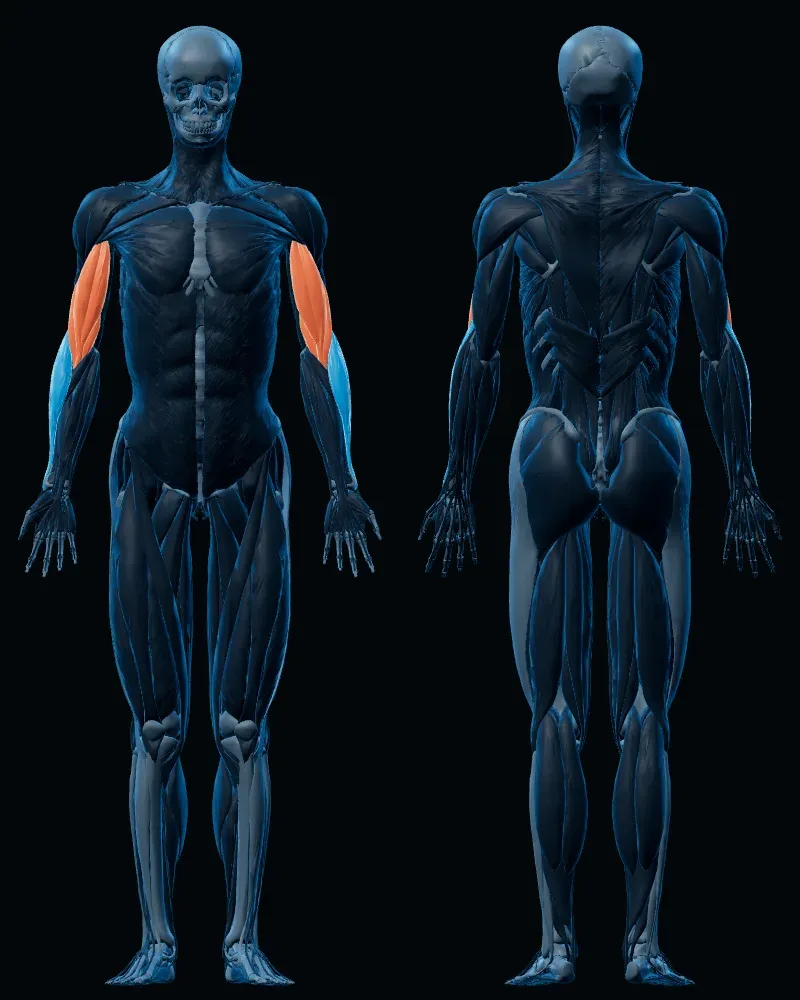
Muscles worked: biceps
Main movers: biceps brachii and brachialis
Assisting: brachioradialis
Table of contents
Arm flexors anatomy comes down to three muscles. The biceps brachii, the brachialis and the brachioradialis all bend your elbow, but they do it from different positions, with different levers, and they react differently when you turn your wrist.
Most lifters train “biceps” and stop there. That leaves two thirds of the elbow flexor team to chance. This guide maps the muscles one by one, shows what the research says about grip, and ends with practical curl choices. It sits inside our complete arm and forearm training guide, which covers the triceps and forearms too.
What are the arm flexors and where do they sit?
Elbow flexion has three main drivers. Here is the short map.
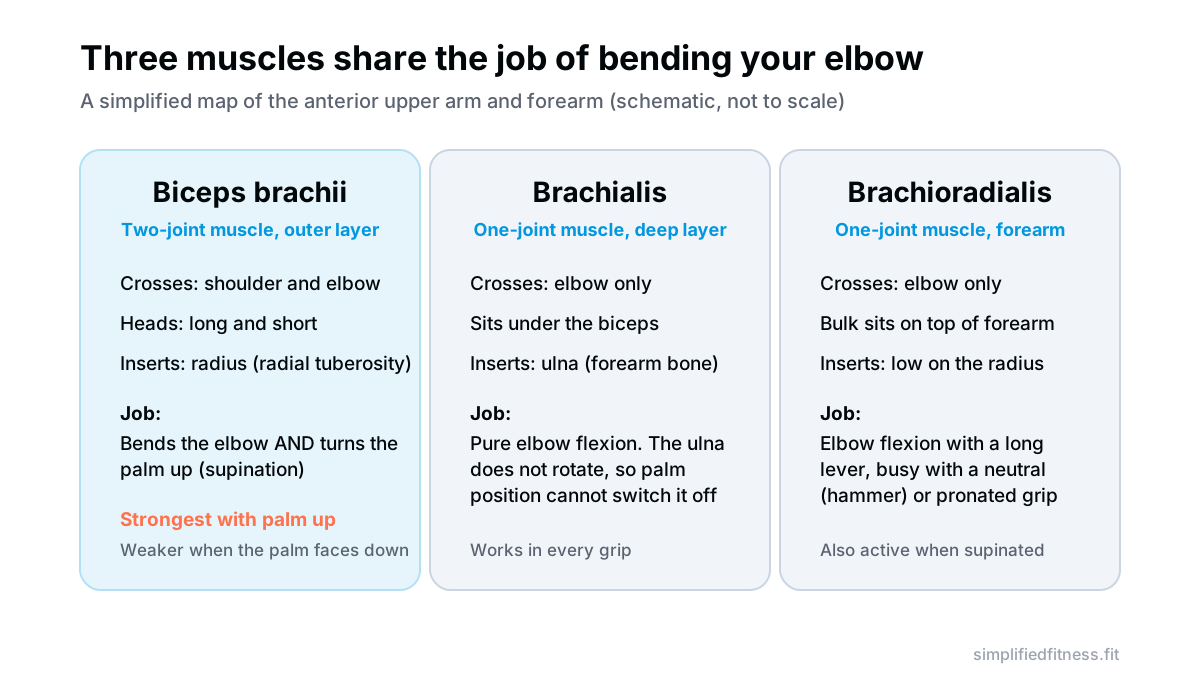
Biceps brachii. The showy one. It has a long head and a short head, both of which cross the shoulder and the elbow. It attaches low on the radius, one of the two forearm bones. Because the radius rotates when you turn your palm, the biceps does two jobs: it bends the elbow and it supinates the forearm (palm up). A 2004 review of human electrophysiology describes the biceps as acting not only as a flexor but also as a forearm supinator, which makes its activity “much different” from the other two flexors (Naito, 2004).
Brachialis. It lies deep, directly under the biceps, on the front of the upper arm bone. A StatPearls anatomy entry describes it as providing elbow flexion at all physiologic positions and as a “pure flexor” of the forearm at the elbow (Plantz et al., 2023). It attaches to the ulna, the forearm bone that stays put when you rotate your palm. Which is why grip cannot take it out of the picture.
Brachioradialis. The forearm one. Its belly sits on the thumb side of your forearm and attaches near the wrist end of the radius. Textbooks have long called it a forearm supinator, but a 2018 EMG study set out to test whether it is also one of the main elbow flexors. We will get to that below.
One note on “forearm flexors”. People searching that phrase usually mean the muscles on the palm side of the forearm that curl your wrist and fingers. Those are a different group. The brachioradialis is the odd one out: it lives in the forearm but bends the elbow. Wrist and grip work gets its own treatment in forearm flexor and extensor hypertrophy.
Why does the biceps work differently from the other two flexors?
Because it crosses two joints and rotates the forearm.
Think of lifting a heavy bag with your palm facing the ceiling. The biceps is perfectly set up: it bends the elbow and holds the forearm in supination at the same time. Now turn the palm to face the floor and try the same lift. You are weaker, and the biceps loses its supination advantage.
A small study measured this. In 11 young men, elbow flexion in supinated and neutral forearm positions was about 50% stronger than in the pronated position, and the supinated and neutral positions were about 60% steadier (Smart et al., 2018). It is a small sample of young men in a lab, so treat the exact figures loosely. The direction matches what you feel in the gym.
How does grip change which flexor works hardest?
It changes the share of the work, not who shows up.
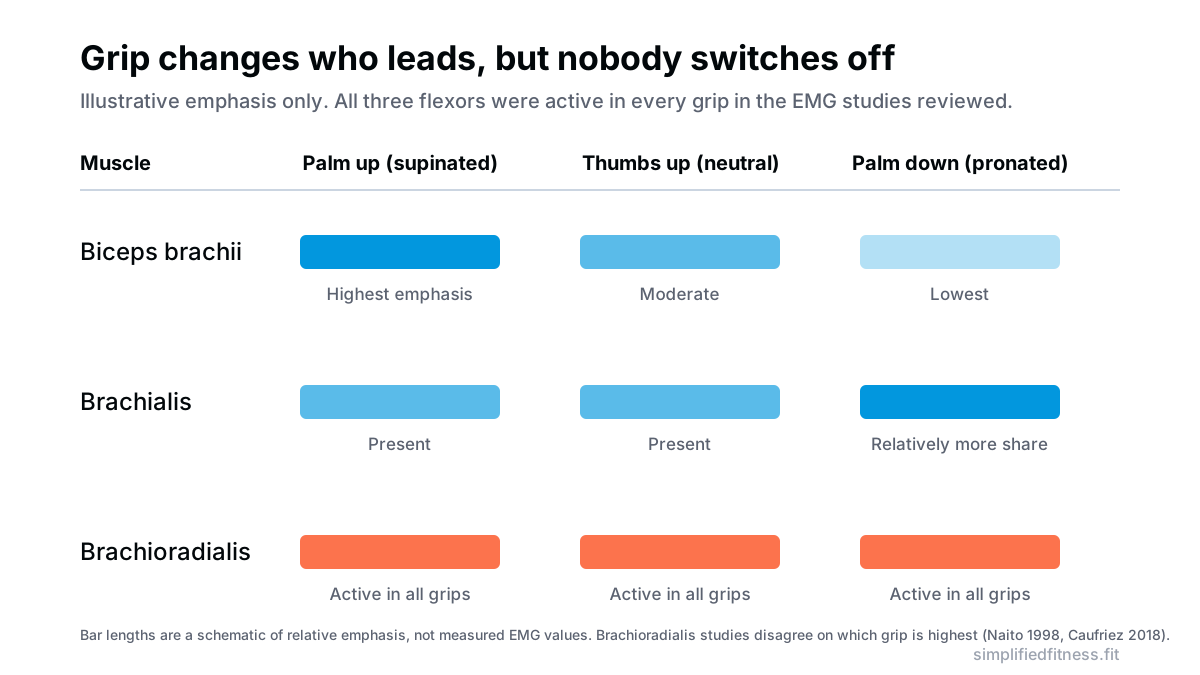
A 2018 study of 15 young men recorded biceps, brachialis and brachioradialis EMG during maximal isokinetic elbow flexions with the forearm neutral, fully pronated and fully supinated. All three muscles were very active throughout resisted flexion in all three positions (Caufriez et al., 2018). Brachioradialis activity peaked at the end of flexion in about 73% of subjects and was slightly higher in supination. The authors conclude the brachioradialis is one of the main elbow flexors, especially in supination.
That sits awkwardly next to the older Naito data, where brachialis and brachioradialis contraction levels were higher with the forearm prone and the biceps’ were higher supine. So what should you take from the disagreement? The studies used different tasks (slow forearm rotation with or without a light load vs maximal isokinetic flexion), different joint angles and tiny samples. Surface EMG also picks up crosstalk between neighbouring muscles, so “which one is highest” is shakier than “all of them are working”.
A 2025 cross-sectional study of 36 healthy men used 1 kg loaded isometric holds at five elbow angles. Biceps surface EMG was higher in supination than neutral and higher in neutral than pronation across 30-90 degrees of elbow flexion, and the brachioradialis responded to both forearm rotation and elbow angle (Chen et al., 2025). Light load, static holds, no training outcome. Useful for the biceps trend, not for programming.
What about trained lifters? Ten men with at least a year of lifting experience did preacher-bench curls at 80% of their maximum in supinated and pronated positions. Activation of the brachialis, both biceps heads and the brachioradialis was similar, with no significant differences between muscles (Bankoff et al., 2007). The authors read this as all the flexors working together to resist the load. Small sample again, and it did not look at growth.
Does the brachialis really “push the biceps up”?
This is the popular claim, so here is what we can and cannot say.
What is anatomically solid: the brachialis sits directly beneath the biceps. A larger deep muscle takes up more room, and the muscle above it has to sit on top of it. That is why many coaches say a developed brachialis adds “height” and thickness to the upper arm.
What is not proven: nobody in the studies reviewed here measured whether growing the brachialis makes the biceps visibly higher or the arm measurably thicker. The claim is a reasonable inference, not a tested result. Treat it as a plausible bonus, not a promise.
What we do know is that the brachialis grows when you curl. In a 2025 randomised trial, 15 young men trained one arm with a preacher-style cable curl and the other with a Bayesian cable curl (shoulder extended) for 10 weeks. Brachialis thickness rose by roughly 10% and 8% respectively, with no significant difference between the two curl types (Attarieh et al., 2025).
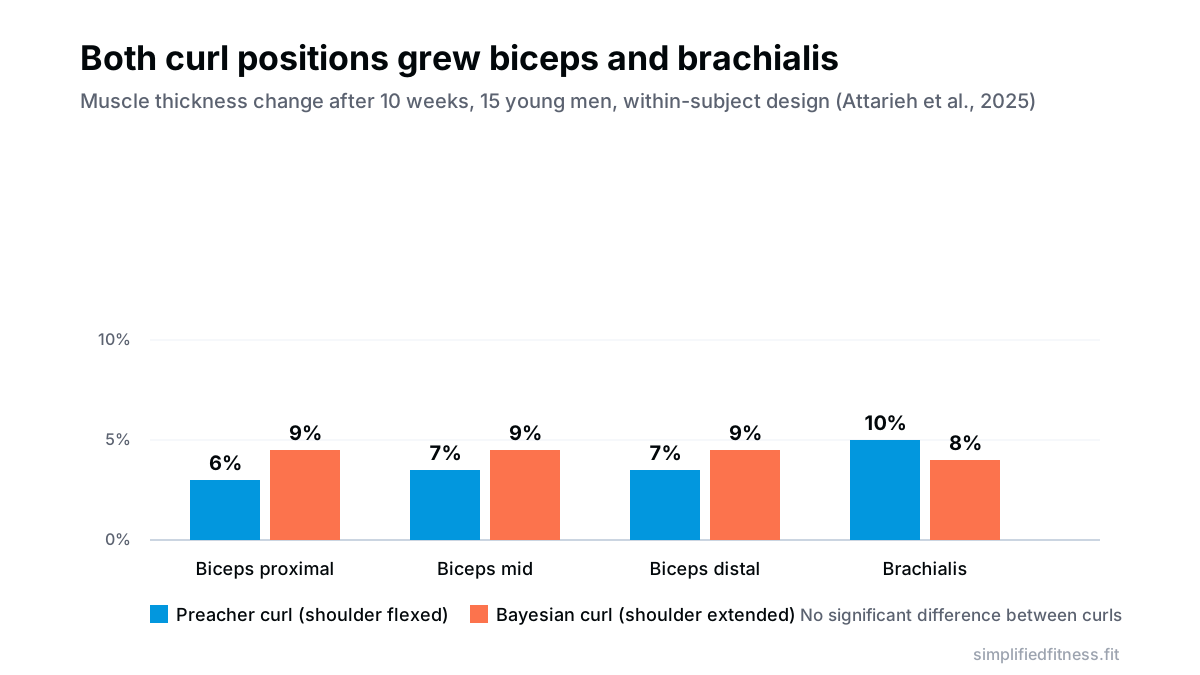
Same study, biceps thickness: 6-7% for the preacher arm and 9% for the Bayesian arm across the proximal, mid and distal regions, again with no significant difference. Fifteen young men is a small sample, and the program was only 10 weeks, so do not read this as the final word on curl variation. It does tell us that curling grows both muscles, and that a shoulder position difference did not matter much when resistance profiles were matched. For the shoulder position question in more depth, see long head vs short head biceps.
What does this mean for the curls you pick?
Short version: use more than one grip.
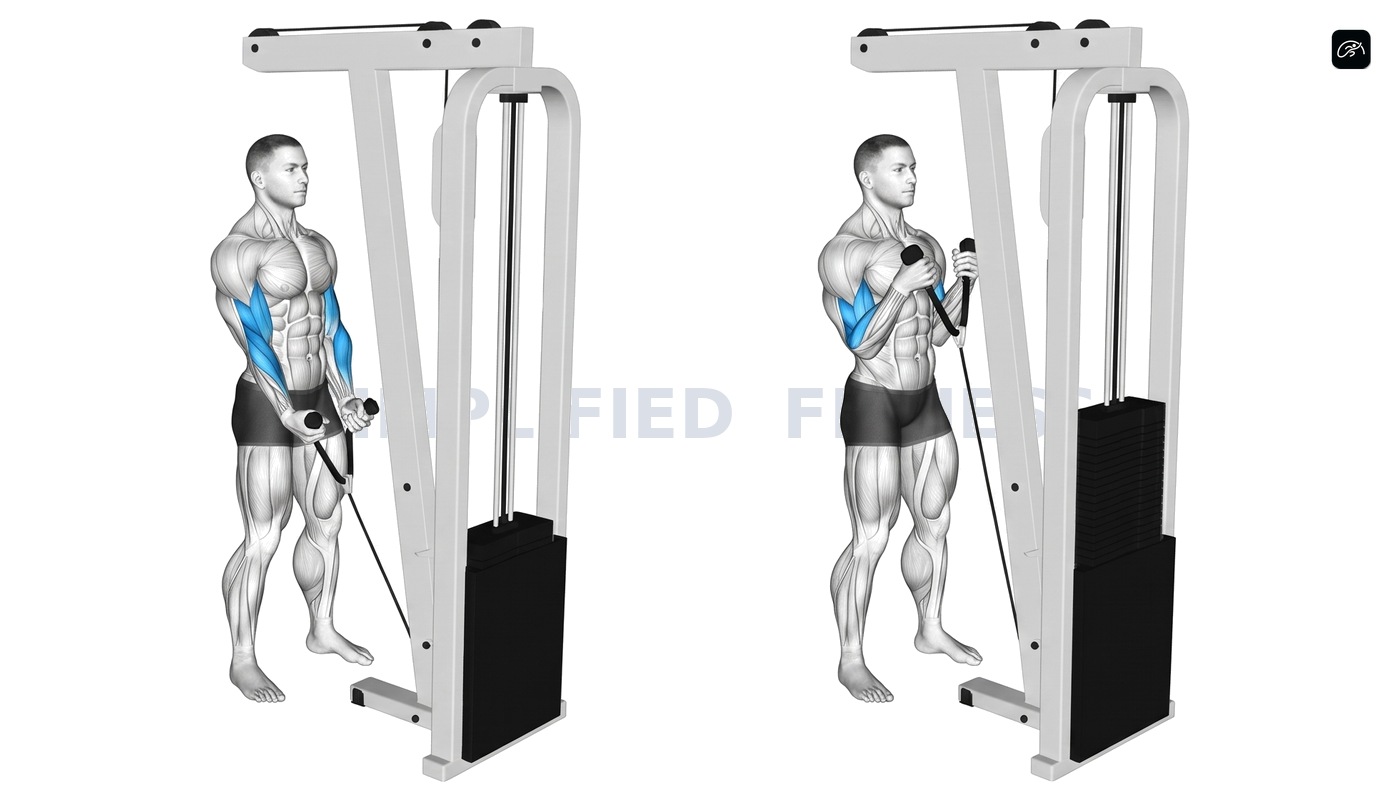
A neutral grip is the standard way to ask more of the brachialis and brachioradialis. Our guide to hammer curls for upper arm thickness covers technique and loading.
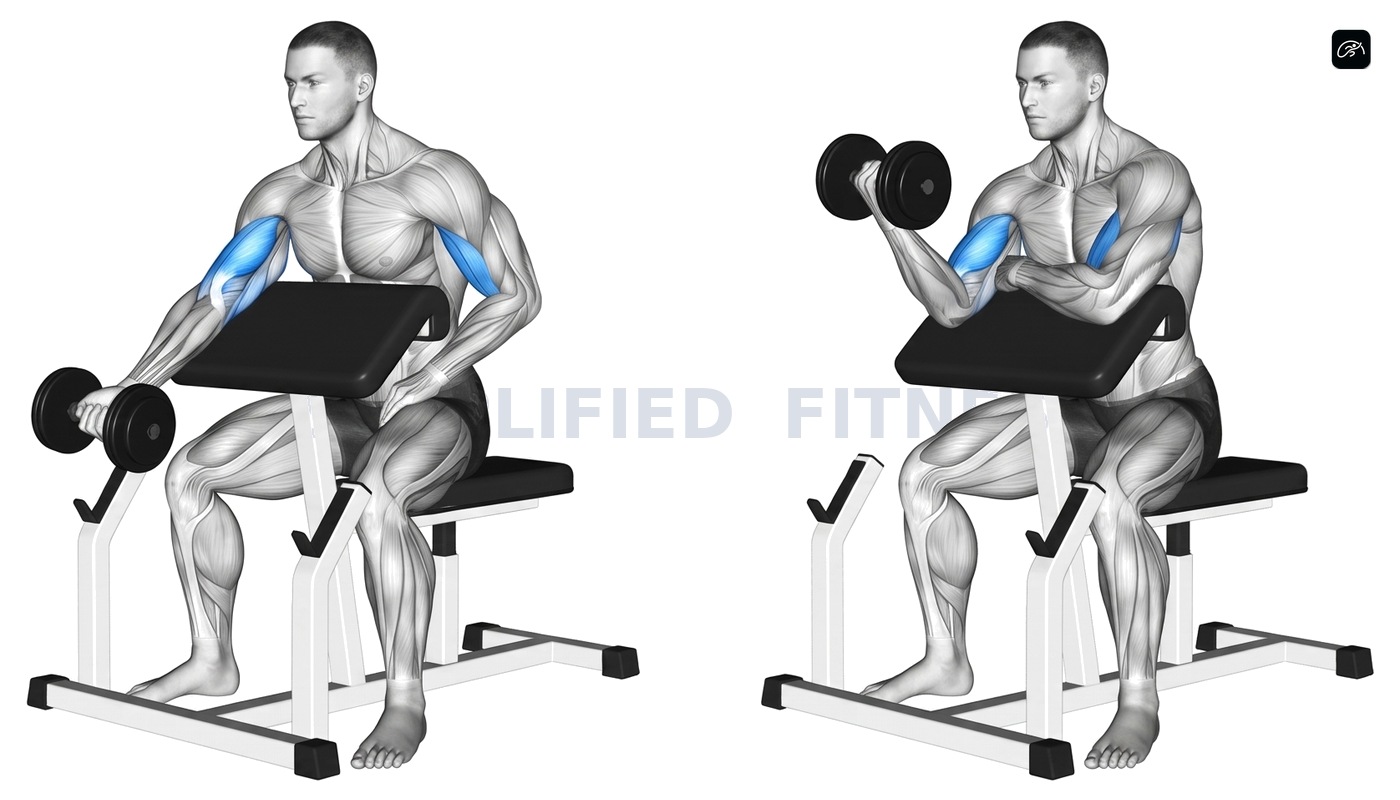
A supinated preacher curl is the classic biceps builder, and a bench supports the upper arm so momentum has fewer places to hide. If the long-length position is what you want, incline dumbbell curls load the biceps with the shoulder behind the body.
A simple template, not a prescription:
| Grip | Leans on | Example exercises |
|---|---|---|
| Palm up (supinated) | Biceps brachii | Preacher curl, incline curl, barbell curl |
| Neutral (thumbs up) | Brachialis, brachioradialis, biceps | Hammer curl, rope curl |
| Palm down (pronated) | Brachioradialis, brachialis | Reverse curl |
Pick one exercise from the supinated row and one from the neutral row most weeks. Add the pronated one if your forearms lag or your grip fails first on pulls. Rows and pulldowns already hit the elbow flexors, so check the weekly total with the training volume calculator before you pile on curls, and read direct vs indirect arm volume for the sets question. If you want a ready-made layout, our free pull day plan already includes arm work.
What about speed and range of motion?
Two quick pointers, both with limits.
A 2022 trial in untrained young adults trained the elbow flexors at extended elbow angles (0-50 degrees) for 5 weeks. Biceps and brachialis thickness rose about 10% with eccentric-only or combined concentric-eccentric work, but not significantly after concentric-only training (Sato et al., 2022). That is a short study in non-trainees, so it is not a reason to skip lifting the weight. It is a reason to lower the dumbbell with control rather than dropping it.
On range of motion, a 2020 systematic review found full range clearly helped leg hypertrophy, but upper-limb evidence was limited and conflicting (Schoenfeld and Grgic, 2020). Practically, go from nearly straight arm to a firm squeeze, and do not cut the stretched position short just because it feels hard.
When should you see a doctor?
Gym soreness is a dull, widespread ache that fades in a few days. Front-of-elbow pain that is sharp, sudden or stays for weeks is different. Distal biceps tendon problems can progress or rupture, and radiology reviews note that brachialis injuries are uncommon and usually follow forced elbow hyperextension (Willaume and Bierry, 2021). If you felt a pop, see a visible bulge in the upper arm, lose strength suddenly or have persistent pain, get it assessed in person. Our guide on distal biceps tendonitis and golfer’s elbow covers common overuse issues, but it is no substitute for an examination.
Frequently Asked Questions
What are the main elbow flexor muscles?
The three main elbow flexors are the biceps brachii, the brachialis and the brachioradialis. The biceps and brachialis sit on the front of the upper arm and the brachioradialis sits on the thumb side of the forearm. Include exercises that use different grips so all three get worked, rather than only doing one style of curl.
What does the brachialis do?
The brachialis bends the elbow and nothing else. It is considered a pure flexor that works in all forearm positions, because it attaches to the ulna, which does not rotate when you turn your palm. Hammer curls and reverse curls keep it busy, so make sure it is part of your arm work.
Does the brachialis make your biceps look bigger?
It plausibly can, but this is anatomical reasoning rather than a measured result. The brachialis lies directly beneath the biceps, so a thicker brachialis can lift the biceps outward, and in a 2025 trial it grew 8-10% over 10 weeks of curling. Train it with a mix of grips, then track your relaxed and flexed arm circumference to see what actually changes for you.
What is the difference between the biceps and the brachioradialis?
The biceps crosses the shoulder and the elbow and also supinates the forearm, while the brachioradialis crosses only the elbow and sits in the forearm. The biceps is strongest with the palm up, whereas the brachioradialis stays busy in neutral and pronated grips. Use hammer or reverse curls when you want the forearm side to take more of the load.
Which grip works the biceps the most?
A palm-up (supinated) grip generally loads the biceps most. EMG work shows biceps activity climbing with supination, and a 2025 study found supinated biceps activity was higher than neutral or pronated at most elbow angles from 30 to 90 degrees. Use standard supinated curls for the biceps, then rotate in other grips for the rest.
Do hammer curls work the biceps at all?
Yes, the biceps still helps flex the elbow in a neutral grip, just with less supination contribution. In EMG research all three flexors were active in every forearm position studied, so hammer curls shift emphasis rather than isolating one muscle. Use them as a complement to supinated curls, not a replacement.
Why am I weaker doing reverse curls?
Your elbow flexors are weaker with the palm down. In one small study of 11 young men, elbow flexion strength in supinated and neutral positions was about 50% greater than in the pronated position. Start reverse curls lighter than you think and add weight slowly.
Are forearm flexors the same as elbow flexors?
No. Elbow flexors bend the elbow, while forearm flexors on the palm side of the forearm mainly flex the wrist and fingers. The brachioradialis is the confusing one because it sits in the forearm but is an elbow flexor. Train wrist and grip muscles separately with wrist curls and carries, as covered in our forearm guide.
Can I isolate the brachialis?
Not completely. The brachialis works with the biceps and brachioradialis during any elbow flexion, so isolation is a matter of emphasis. A neutral or pronated grip reduces the biceps' mechanical advantage, which shifts a larger share onto the other two flexors. Keep the weight controlled and avoid swinging so the shift is real.
How many sets do the elbow flexors need per week?
There is no single proven number, and it depends on your total pulling work. Rows and pulldowns already train the elbow flexors indirectly, so most lifters need a modest amount of direct curling on top. Start with a few hard sets of curls per week, adjust based on recovery and progress, and use the training volume calculator to keep a tally.
Does a full range of motion matter for the elbow flexors?
It may, but the upper-limb evidence is limited. A 2020 systematic review found full range of motion benefits leg hypertrophy, while upper-limb research was limited and conflicting. Use a range you can control from near full extension to a hard squeeze, and avoid cutting reps short because the weight got heavy.
Why does my elbow hurt at the front when I curl heavy?
Front-of-elbow pain can come from the distal biceps tendon or the brachialis, and it is not something to diagnose online. Overload, rapid increases in volume and jerky reps are common aggravators. If the pain is sharp, persists, or follows a pop or sudden weakness, see a doctor or physiotherapist and stop curling until it is checked.
Sources & References
Every claim above is checked against peer-reviewed research (PubMed, U.S. National Library of Medicine) or guidance from established health bodies. How we fact-check.
- Caufriez B, et al. The Role of the Muscle Brachioradialis in Elbow Flexion: An Electromyographic Study. J Hand Surg Asian Pac Vol. 2018. PMID: 29409427
- Naito A, et al. Electromyographic study of the elbow flexors and extensors in a motion of forearm pronation/supination while maintaining elbow flexion in humans. Tohoku J Exp Med. 1998. PMID: 10328159
- Naito A. Electrophysiological studies of muscles in the human upper limb: the biceps brachii. Anat Sci Int. 2004. PMID: 15088788
- Bankoff AD, et al. Electromyographic study of the flexor muscles of the elbow articulation in weightlifting trained subjects. Electromyogr Clin Neurophysiol. 2007. PMID: 17375882
- Chen Y, et al. Forearm rotation and elbow angle differentially modulate biceps brachii and brachioradialis muscle stiffness and EMG activity during low-load isometric contractions. BMC Sports Sci Med Rehabil. 2025. PMID: 40604986
- Smart RR, et al. Influence of forearm orientation on biceps brachii tendon mechanics and elbow flexor force steadiness. J Biomech. 2018. PMID: 29954597
- Attarieh P, et al. Comparison Between Shoulder Flexed and Extended Positions in Elbow Flexion Resistance Training on Regional Hypertrophy and Maximum Strength: Preacher versus Bayesian Cable Curls. Eur J Sport Sci. 2025. PMID: 40082069
- Plantz MA, et al. Anatomy, Shoulder and Upper Limb, Brachialis Muscle. StatPearls. 2023. PMID: 31869094
- Willaume T, et al. Biceps, Brachialis, and Triceps. Semin Musculoskelet Radiol. 2021. PMID: 34706386
- Schoenfeld BJ, et al. Effects of range of motion on muscle development during resistance training interventions: A systematic review. SAGE Open Med. 2020. PMID: 32030125
- Sato S, et al. Comparison between concentric-only, eccentric-only, and concentric-eccentric resistance training of the elbow flexors for their effects on muscle strength and hypertrophy. Eur J Appl Physiol. 2022. PMID: 36107233

Umair Hazrami · Founder & Head Coach, Simplified Fitness
Umair Hazrami founded Simplified Fitness and the Simplified Lifter channel to cut through fitness noise. With 4+ years of consistent training and 10+ coaching clients, he writes every guide from the peer-reviewed research and links the sources so you can check them. Our editorial standards.
Educational content only, not medical advice. If you have a medical condition, are pregnant, or take medication, talk to a qualified doctor before changing your diet, supplements or training. Full disclaimer.
Keep reading
Exercise Technique
Antagonist Arm Supersets: Biceps and Triceps Pairing for a Faster, Pumpier Arm Day
A biceps triceps superset workout can shorten arm day while keeping volume close to straight sets. See the research, pairing tips and a 20-minute routine.
9 min read
Exercise Technique
Barbell vs EZ-Bar Curls: Why Straight Bars Hurt the Pinky Side of Your Wrist
Barbell vs EZ bar curls for wrist pain: what EMG research says about biceps activation, forearm rotation and the carrying angle, plus fixes you can use today.
8 min read
Exercise Technique
Bayesian Cable Curls: Form, Setup and Whether They Build Bigger Biceps
Bayesian cable curl form explained step by step: pulley height, step-forward distance, elbow position, sets and reps, and what the research really shows.
8 min read
Exercise Technique
Close-Grip Bench Press: Triceps Loading, Wrist Spacing, and Elbow Stress
Close grip bench press triceps guide: how narrow to go, what the grip width research shows, and how to protect wrists and elbows. Setup cues included.
8 min read