Cross-Body Cable Triceps Extensions: Setup, Form and What the Science Says
Cross body cable triceps extension explained: exact setup, what it does to your elbows and wrists, and what research says about the lateral head claim.
TL;DR. The short answer
- The cross body cable triceps extension is a pushdown variation done with two high cables, bare ends or small handles, and crossed hands. It is a joint-comfort and variety choice, not a proven way to isolate the lateral head.
- No study has tested this exercise directly. The 30 degree scapular plane and 'no elbow flare' arguments are coaching theory built on biomechanics, not trial results.
- The lateral and medial heads cross only the elbow, so they work in every elbow extension. The long head is the one that responds to arm position, and the best MRI evidence says the overhead position grew it most.
- Use it as a second triceps movement if pushdowns bother your wrists or elbows. Keep the overhead extension as the anchor if growth is the goal.
- Sharp, persistent elbow pain or tingling in the hand is a reason to see a doctor or physio, not to try another cable angle.
Part of our complete guide: Arm Workout Science: The Complete Guide to Biceps, Triceps, Brachialis and Forearm Growth
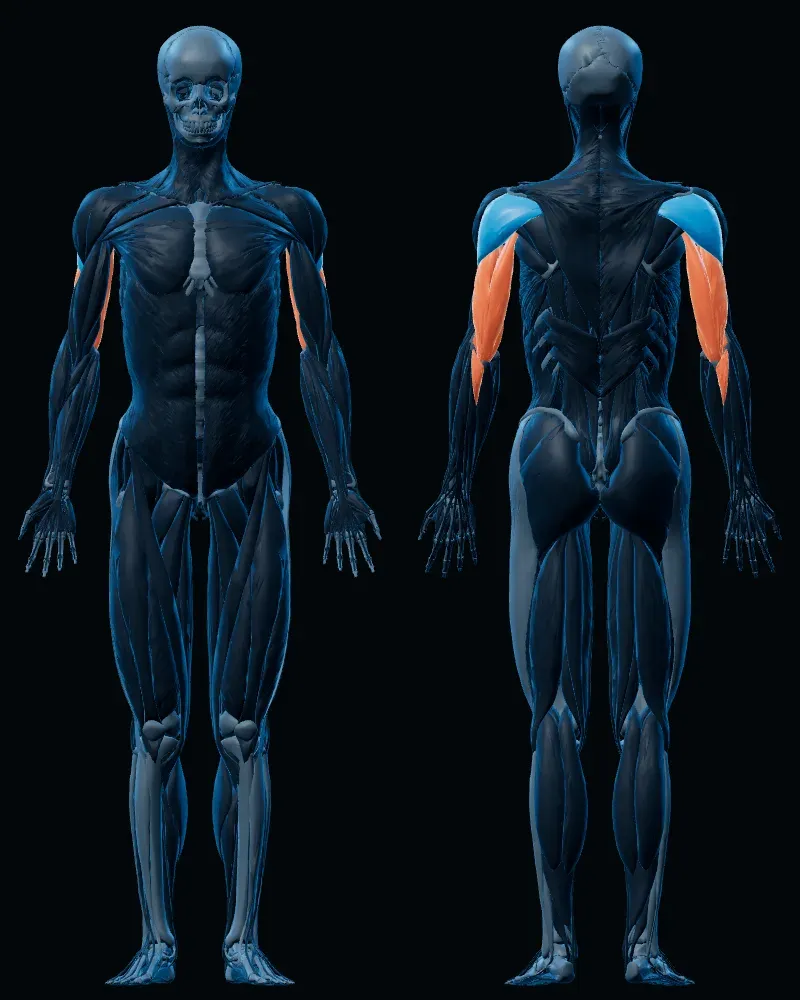
Muscles worked: triceps
Main movers: all three heads of the triceps
Assisting: rear delts
Table of contents
The cross body cable triceps extension is a pushdown variation: two high pulleys, no bar, hands crossed. It can feel kinder on the wrists and elbows, but there is no trial showing it isolates the lateral head or beats rope pushdowns for growth.
That does not make it a bad exercise. It makes it a tool, and this guide shows when to use it, how to set it up, and which claims about it are science versus coaching theory. It sits inside our complete arm and forearm training guide, so start there if you are building a full arm plan.
What is the cross body cable triceps extension?
You stand between two cable towers with both pulleys set high. You cross your arms, grab the opposite cable with each hand (bare cable ends or small handles, no bar or rope), and extend your elbows so the hands travel down and out to your sides, uncrossing as you lock out.
Why would coaches like it? Two reasons, both about comfort:
- A neutral grip. With nothing to hold, your wrists do not have to bend around a straight bar.
- A line of pull that matches your arms. Your elbows sit in front of you, a little closer together than on a typical pushdown, so the cable path lines up with how your arms hang.
The pitch you hear online goes further. It says the position fits a natural shoulder plane of about 30 degrees, removes elbow flare torque, and targets the lateral head. The first two claims are plausible biomechanics. The third is where the research gets thin.
Does the cross body extension isolate the lateral head?
Short answer: not in any way anyone has shown.
The triceps has three heads. The lateral and medial heads are monoarticular, meaning they only cross the elbow. The long head is biarticular, crossing the shoulder as well. For a full tour, see our functional anatomy of the triceps heads.
A 2018 study of 10 healthy people combined surface EMG with a musculoskeletal model across five shoulder elevation angles (Kholinne et al., 2018). At 0 degrees of shoulder elevation the long head produced more force and activation than the other two heads. At 90 degrees and above, the medial head produced the highest force. Notice what is missing: the lateral head was never the star.
Another EMG study (25 people, standing pushdown to failure) found the three heads showed different spectral fatigue patterns, so they do not work in perfect unison (Hussain et al., 2020). But that is a long way from “this setup targets the lateral head.” Small samples, surface EMG, and no growth outcome.
The takeaway: head specific claims are mostly extrapolation. Any full range elbow extension trains the lateral head.
What does arm position actually change?
Mostly the long head, and mostly through muscle length.
In a 12-week trial, 21 adults trained one arm with cable elbow extensions overhead and the other arm with the elbow at the side (neutral). MRI showed the overhead arm gained more volume: long head +28.5% versus +19.6%, lateral plus medial heads +14.6% versus +10.5%, whole triceps +19.9% versus +13.9% (Maeo et al., 2023). The overhead arm even lifted 34-39% less weight.
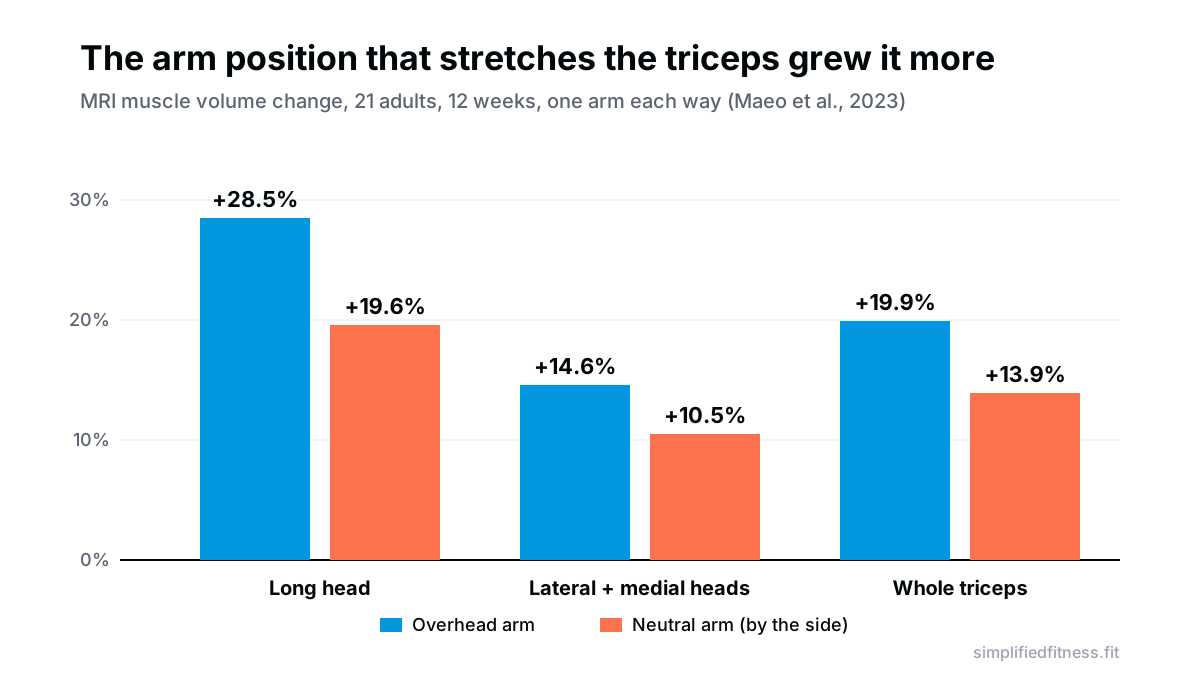
Where does cross body fall? Your arms are in front of the body, nowhere near overhead, so it is a neutral-style position. That means it is unlikely to match overhead work for long head growth, and I would not expect it to be superior to pushdowns for size either. Our overhead cable extension guide covers that anchor movement.
One caution on interpretation. This was a single trial in 21 adults over 12 weeks, so it points a direction. It does not prove a ceiling for any exercise.
Cross body vs rope pushdowns: what is the real trade-off?
Here is the honest trade-off.
| Cross body cable | Rope or bar pushdown | |
|---|---|---|
| Shoulder and arm position | In front, neutral | In front, neutral |
| Grip | Bare cable or small handle | Bar, V-bar or rope |
| Loading | Lighter, harder to progress | Easy to load and track |
| Wrist feel | Often more neutral | Bar can bend the wrist |
| Proven head selectivity | No | No |
In one cable pushdown study, swapping a standard handle for ball handles did not change lateral or long head triceps EMG. It did change forearm muscle patterns (Rendos et al., 2016). That fits the idea that bare cables mostly change the hands and forearms, not the triceps output. Our pushdown attachment comparison goes deeper on bar versus rope.
So the practical rule is simple. If a straight bar bothers your wrists or elbows, cross body is a reasonable swap. If you have no complaints, pushdowns are fine and easier to progress.
How to set up the cross body cable triceps extension
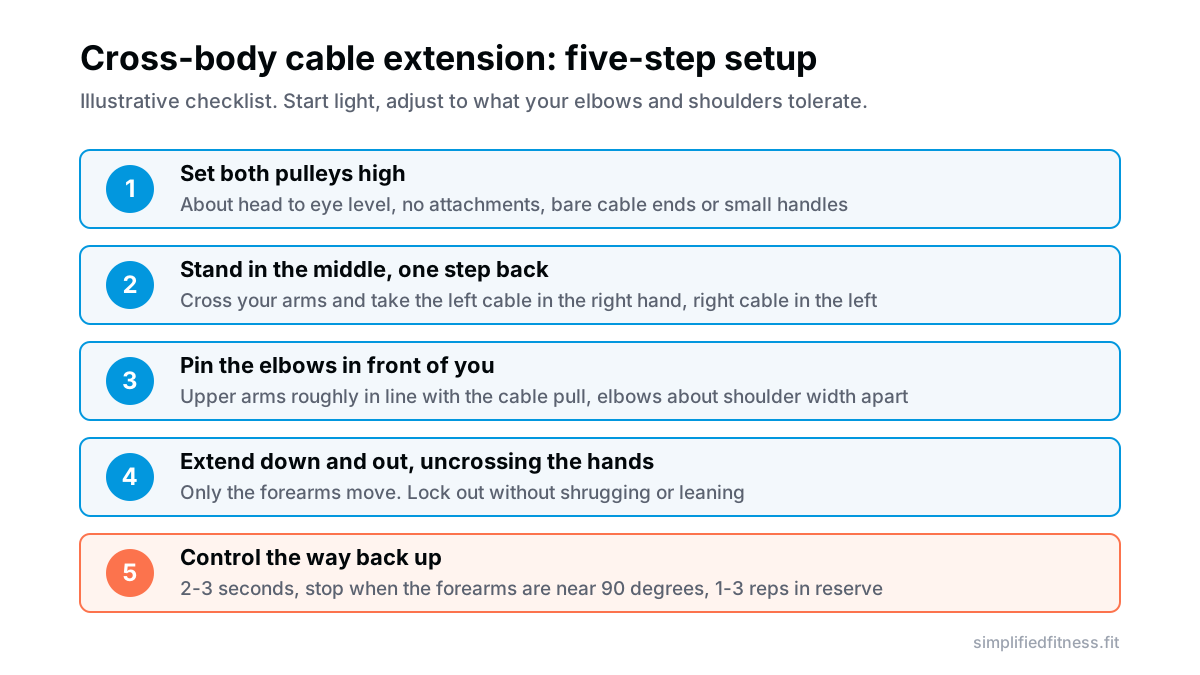
Some detail on each step:
- Pulleys high. Around head to eye level. Remove attachments or use small single handles.
- Stand centered. One step back so the cable never goes slack at the top.
- Cross and grab. Right hand takes the left cable, left hand takes the right one.
- Pin the elbows. Upper arms still, elbows in front. If they drift back, the weight is too heavy.
- Extend, then control. Press down and out so the hands uncross, squeeze at lockout, return slowly until the forearms are near 90 degrees.
The most common mistake here is loading it like a pushdown. The cables are harder to hold and your stabilizers get involved, so start with about half the weight you would use on rope pushdowns and build up.
Who gets the most out of it?
Three kinds of lifter tend to like this movement.
The lifter with cranky wrists. A bare cable or small handle lets the hand stay neutral. That alone can make a hard set feel cleaner, and a set that feels cleaner is a set you can take close to failure.
The lifter who is bored of pushdowns. Variety is not magic, but a new movement can bring back effort and focus. Effort near failure is what matters, and the research on that does not care which cable path you use.
The lifter in a crowded gym. Two cables with no attachments is quick to set up and frees you from queueing for the rope.
Skip it, or at least park it, if you are in a very short program with only one triceps slot. In that case the overhead cable extension earns the spot, going by the MRI data above.
Common mistakes and quick fixes
- Going too heavy. Bare cables are awkward to grip, so the weight you can control is lower than on a bar. Drop the stack until the elbows stay still.
- Cutting the stretch short. Let the forearms rise to roughly 90 degrees under control. Bouncing out of the bottom wastes the part of the rep that matters most.
- Chasing the burn. A burning lateral head is not proof of anything. Track reps, load and proximity to failure across weeks instead.
How many sets and how often?
Treat it as part of your normal triceps volume. In a meta-analysis of 15 studies, each extra weekly set per muscle was associated with a little more growth, a graded dose-response (Schoenfeld et al., 2017). That does not mean more is always better for you. A practical starting point is roughly 6-10 hard weekly sets for triceps, counting pressing as well, adjusted to how you recover, with sets finished 1-3 reps from failure.
A simple example week for someone training each muscle twice:
- Push day A: 2-3 sets overhead cable extension, 2 sets pushdown
- Push day B: 2 sets cross body extension, 2 sets overhead or skull crusher variation
Use our training volume calculator to tally sets, or run the movements inside our push day plan. Skull crushers bothering your elbows? Our skull crusher elbow pain fixes cover that, and the cable setup guide explains pulley height choices in general.
Who should be careful?
Cable triceps work is low risk for most healthy lifters. Even so:
- Elbow pain that lingers after sessions, sharp pain during a rep, swelling or catching: see a doctor or physio before continuing.
- Tingling or numbness in the hand or fingers: get it checked, as it can have causes unrelated to training.
- A past elbow or shoulder injury: use light loads and ask your clinician about range of motion.
Changing the exercise can reduce irritation, but it does not diagnose anything.
The bottom line
The cross body cable extension is a perfectly decent triceps exercise with a slightly overhyped reputation. It probably will not isolate the lateral head, and neutral-arm work is unlikely to beat overhead work for growth. It is a good fit when bars bother your joints or you want variety.
Anchor your triceps training with an overhead movement, add a pushdown or cross body variation, keep reps controlled and finish sets with 1-3 reps in reserve. Put most of your effort into progressive overload, not exotic angles.
Frequently Asked Questions
What is a cross body cable triceps extension?
It is a standing triceps extension where two high pulleys are crossed over, so each hand holds the opposite cable and the hands start crossed in front of you. As the elbows straighten, the hands travel down and out and uncross. Because there is no bar, the hands can sit in a neutral grip and the elbows stay in front of you. It works the same muscle as a pushdown, just with a different line of pull and often less wrist strain.
Does the cross body triceps extension hit the lateral head?
Probably as much as any other elbow extension, but not more. The lateral head crosses only the elbow, so it works whenever the elbow extends, and no study has shown a cross body setup loads it preferentially. If you like the feel, use it, but do not expect head specific isolation.
What is the best exercise for the lateral head of the triceps?
There is no exercise shown to isolate the lateral head. All three heads extend the elbow, and the lateral and medial heads do not change their job much with shoulder position. Train the triceps through a full range with pushdowns plus an overhead movement and the lateral head will be covered.
Is cross body better than rope pushdowns?
Better is not demonstrated either way. Cross body may feel kinder on elbows and wrists for some people because the arms line up with the cable path. Pushdowns are easier to load and track, so many lifters use one of each across the week.
How high should the cables be for cross body extensions?
Set both pulleys roughly at head to eye level, then adjust by feel. The aim is that your forearms travel along the cable line instead of fighting it. If you feel your shoulders hiking up or your elbows drifting back, move the pulleys slightly and reduce the weight.
Why are my elbows flaring on triceps extensions?
Elbows flare when the load is too heavy for the triceps, so the shoulders step in to help. Flaring also changes where the cable pulls, which can irritate the elbow for some people. Lower the weight, pin your upper arms and stop the set when your elbows start to drift.
Do I need to cross my hands to use this exercise?
No, crossing is just a way to put each arm in front of its own shoulder line with a neutral grip. You can also do single arm cable extensions with the same pulley setup. Try both and keep the version that feels smoother at the elbow.
Is the cross body extension good for wrist pain?
It can help some lifters because bare cables or small handles let the wrist stay neutral instead of bent over a straight bar. The evidence is anecdotal, not trial based. If wrist pain is persistent or comes with numbness, get it checked instead of just changing the exercise.
How many sets of cross body extensions should I do?
Two to four hard sets, once or twice a week, is a reasonable start, counted as part of your total triceps volume. Meta-analysis data link more weekly sets with more muscle growth. Finish each set with 1-3 reps in reserve and count it alongside your pressing work.
Should I do cross body extensions or overhead extensions?
If you only pick one for size, pick overhead. In a 12-week MRI trial, overhead cable extensions grew the triceps more than neutral arm extensions. Cross body is a good add-on when you want variety or your joints dislike pushdowns.
Can I do this exercise with resistance bands or a home setup?
Yes, two bands anchored high work and give a similar feel. Bands get heavier toward lockout, which is a different load profile from a cable. Anchor them securely and use light resistance first.
When should I worry about elbow pain from triceps training?
Pain at the back of the elbow that lingers after sessions, sharp pain during a rep, swelling or hand tingling is worth a check with a doctor or physio. Mild muscle soreness is normal, joint pain is not. Reduce load and range until it is assessed.
Sources & References
Every claim above is checked against peer-reviewed research (PubMed, U.S. National Library of Medicine) or guidance from established health bodies. How we fact-check.
- Maeo S, et al. Triceps brachii hypertrophy is substantially greater after elbow extension training performed in the overhead versus neutral arm position. Eur J Sport Sci. 2023. PMID: 35819335
- Kholinne E, et al. The different role of each head of the triceps brachii muscle in elbow extension. Acta Orthop Traumatol Turc. 2018. PMID: 29503079
- Rendos NK, et al. Differences in muscle activity during cable resistance training are influenced by variations in handle types. J Strength Cond Res. 2016. PMID: 26694502
- Hussain J, et al. Muscle fatigue in the three heads of triceps brachii during intensity and speed variations of triceps push-down exercise. Front Physiol. 2020. PMID: 32153422
- Kassiano W, et al. Which ROMs lead to Rome? A systematic review of the effects of range of motion on muscle hypertrophy. J Strength Cond Res. 2023. PMID: 36662126
- Schoenfeld BJ, et al. Effects of range of motion on muscle development during resistance training interventions: a systematic review. SAGE Open Med. 2020. PMID: 32030125
- Schoenfeld BJ, et al. Dose-response relationship between weekly resistance training volume and increases in muscle mass: a systematic review and meta-analysis. J Sports Sci. 2017. PMID: 27433992

Umair Hazrami · Founder & Head Coach, Simplified Fitness
Umair Hazrami founded Simplified Fitness and the Simplified Lifter channel to cut through fitness noise. With 4+ years of consistent training and 10+ coaching clients, he writes every guide from the peer-reviewed research and links the sources so you can check them. Our editorial standards.
Educational content only, not medical advice. If you have a medical condition, are pregnant, or take medication, talk to a qualified doctor before changing your diet, supplements or training. Full disclaimer.
Keep reading

Exercise Technique
Antagonist Arm Supersets: Biceps and Triceps Pairing for a Faster, Pumpier Arm Day
A biceps triceps superset workout can shorten arm day while keeping volume close to straight sets. See the research, pairing tips and a 20-minute routine.
9 min read
Exercise Technique
Barbell vs EZ-Bar Curls: Why Straight Bars Hurt the Pinky Side of Your Wrist
Barbell vs EZ bar curls for wrist pain: what EMG research says about biceps activation, forearm rotation and the carrying angle, plus fixes you can use today.
8 min read
Exercise Technique
Bayesian Cable Curls: Form, Setup and Whether They Build Bigger Biceps
Bayesian cable curl form explained step by step: pulley height, step-forward distance, elbow position, sets and reps, and what the research really shows.
8 min read
Exercise Technique
Close-Grip Bench Press: Triceps Loading, Wrist Spacing, and Elbow Stress
Close grip bench press triceps guide: how narrow to go, what the grip width research shows, and how to protect wrists and elbows. Setup cues included.
8 min read