Incline Dumbbell Curls: Form, Bench Angle and Long-Length Biceps Growth
Incline dumbbell curl form made simple: the best bench angle, how to protect your shoulder, tempo, and what the latest MRI trial says about biceps growth.
TL;DR. The short answer
- Set the bench at 45-60 degrees, sit back with your shoulders on the pad, let the arms hang straight down, and curl while turning the palms up. That is the whole lift.
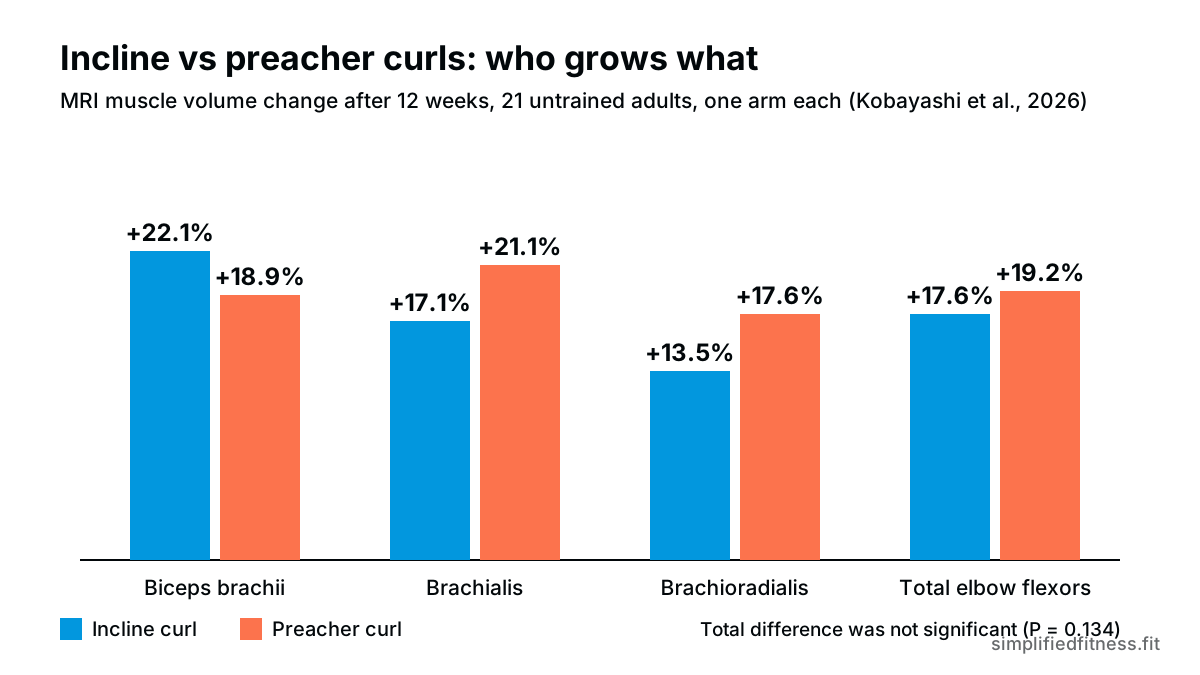
- A 12-week MRI trial in 21 untrained adults found incline curls grew the biceps brachii slightly more than preacher curls (+22.1% vs +18.9%), while preacher curls grew the brachialis and brachioradialis more. Total elbow flexor growth did not differ.
- Evidence that incline curls beat other curls for the biceps is promising but not settled. One trial in women found no measurable growth from incline curls in 9 weeks, so treat it as a strong option, not a magic one.
- If the front of your shoulder aches, raise the bench angle, lighten the dumbbells and shorten the bottom of the range slightly before you give up on the exercise.
- Progress by adding reps first, then load, and lower the dumbbells under control for roughly 2-3 seconds.
Part of our complete guide: Arm Workout Science: The Complete Guide to Biceps, Triceps, Brachialis and Forearm Growth
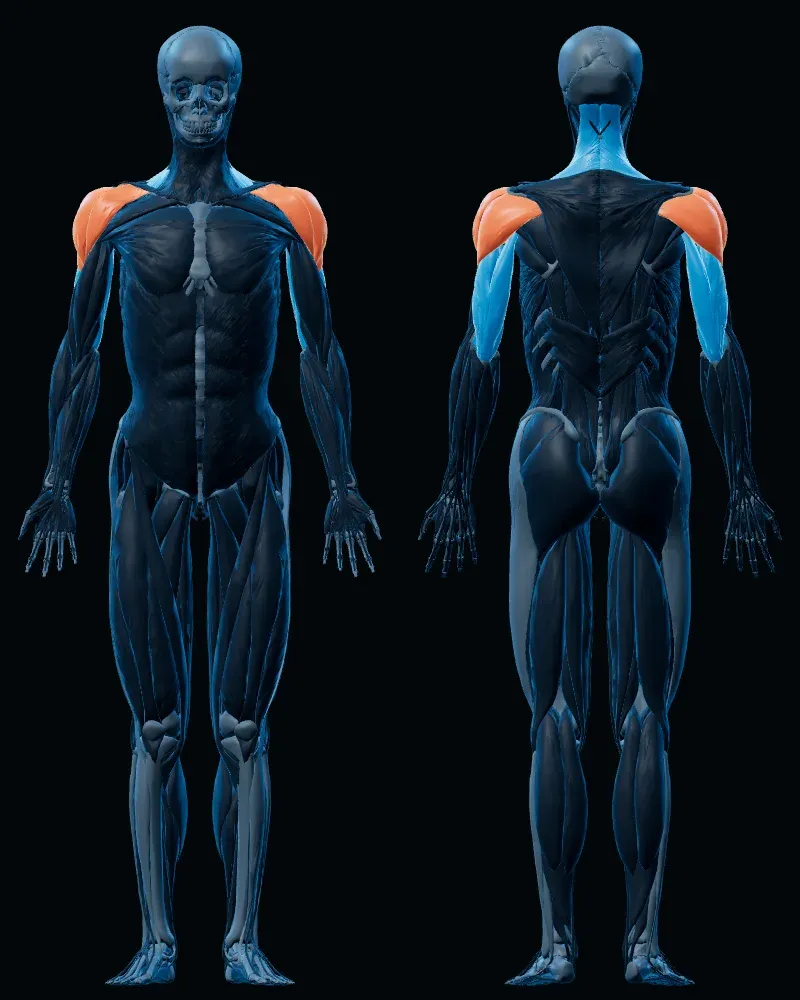
Muscles worked: shoulders
Main movers: all three heads of the deltoid
Assisting: supraspinatus, upper traps and triceps
Table of contents
Good incline dumbbell curl form comes down to four things: a bench at about 45-60 degrees, your upper back supported, arms hanging straight down (slightly behind your torso), and a smooth curl with the palms turning up. That position stretches the biceps at the bottom, which is the reason to use this exercise at all.
It is a strong free-weight option for the biceps, with a caveat I will be honest about below: the research is promising, not final. This guide sits inside our complete arm and forearm training guide and gives you the dedicated how-to.
How do you set up an incline dumbbell curl?
Set the bench first. Everything else follows from it.
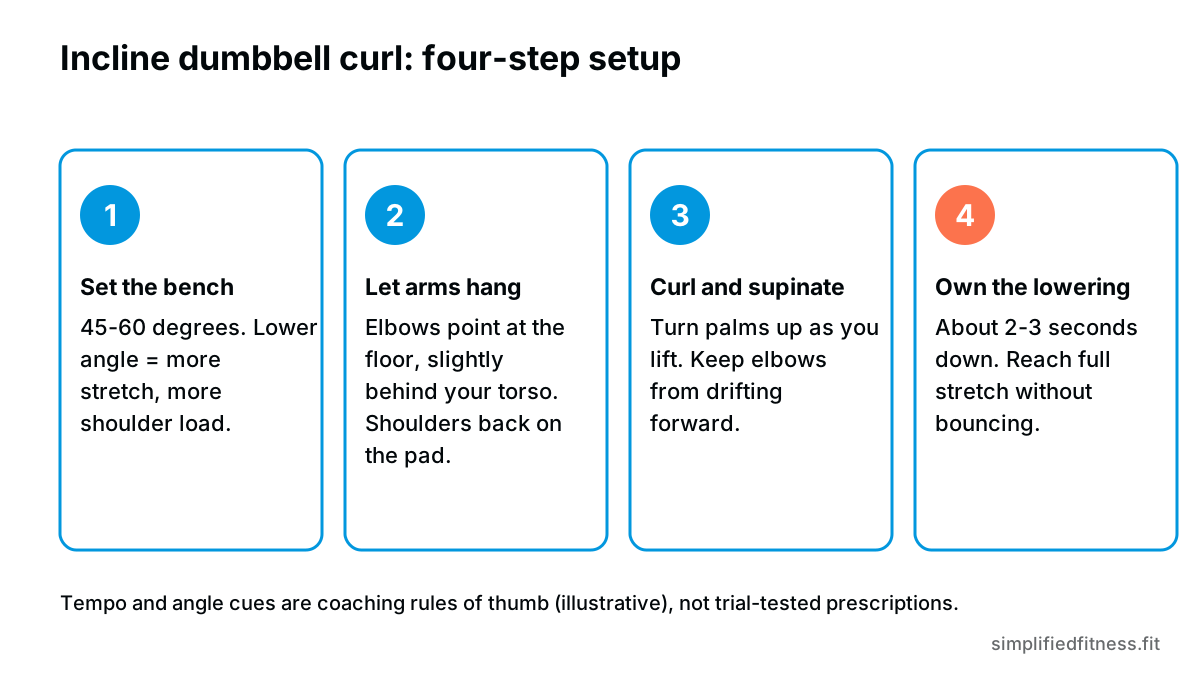
- Bench at 45-60 degrees. Not sure? Start at 60.
- Sit all the way back. Head, upper back and glutes on the pad. Shoulder blades gently pulled back.
- Let the arms hang. Dumbbells point at the floor, elbows pointing down and a touch behind your torso. Palms face forward or slightly in.
- Curl and rotate. As the dumbbell rises, turn the palm up (supination). Keep the elbow where it started.
- Pause lightly at the top, then lower slowly until the elbows are nearly straight.
That hanging position is the point. With the shoulder extended behind the body, the biceps brachii, which crosses both the shoulder and the elbow, is lengthened more than in a standing curl. Our guide on long head vs short head biceps and shoulder position covers the anatomy in detail.
What does the research say about incline dumbbell curl hypertrophy?
Let me lay out two studies, because they do not tell the same story.
Study A: a 2026 MRI trial. Kobayashi et al. (2026) had 21 untrained adults train one arm with incline curls and the other with preacher curls for 12 weeks (5 sets of 10 reps at 70% of one-rep max, twice a week). MRI showed the biceps brachii grew more after incline curls (+22.1% vs +18.9%, Hedges’ g = 0.33). The brachialis (+17.1% vs +21.1%) and brachioradialis (+13.5% vs +17.6%) grew more after preacher curls. Total elbow flexor volume did not differ (+17.6% vs +19.2%).
Study B: a 2023 ultrasound trial. Zabaleta-Korta et al. (2023) trained 38 recreationally trained women for 9 weeks with 4 sets of 12 reps to failure, three times a week, using either incline or preacher curls. Muscle thickness did not significantly increase at any measured site in the incline group, while one distal site grew in the preacher group. There were no significant differences between regions or groups.
Why might they disagree? Different measurement tools (MRI volume vs ultrasound thickness at three sites), different populations (untrained adults vs recreationally trained women), different durations and training frequencies, and, in Study A, each person acted as their own control. I would not read either study as the last word.
A cautious reading: training the biceps in a lengthened position looks useful, and the 2026 trial puts incline curls at least on par with preacher curls for total elbow flexor growth. But a 2020 systematic review of range of motion found upper-limb evidence limited and conflicting, so strong claims about the best curl are premature. For how this compares with the preacher curl in practice, see incline curls vs preacher curls and our deep dive on stretch-mediated hypertrophy.
Which incline bench angle is best?
There is no trial-tested ideal angle. Here is the coaching logic.
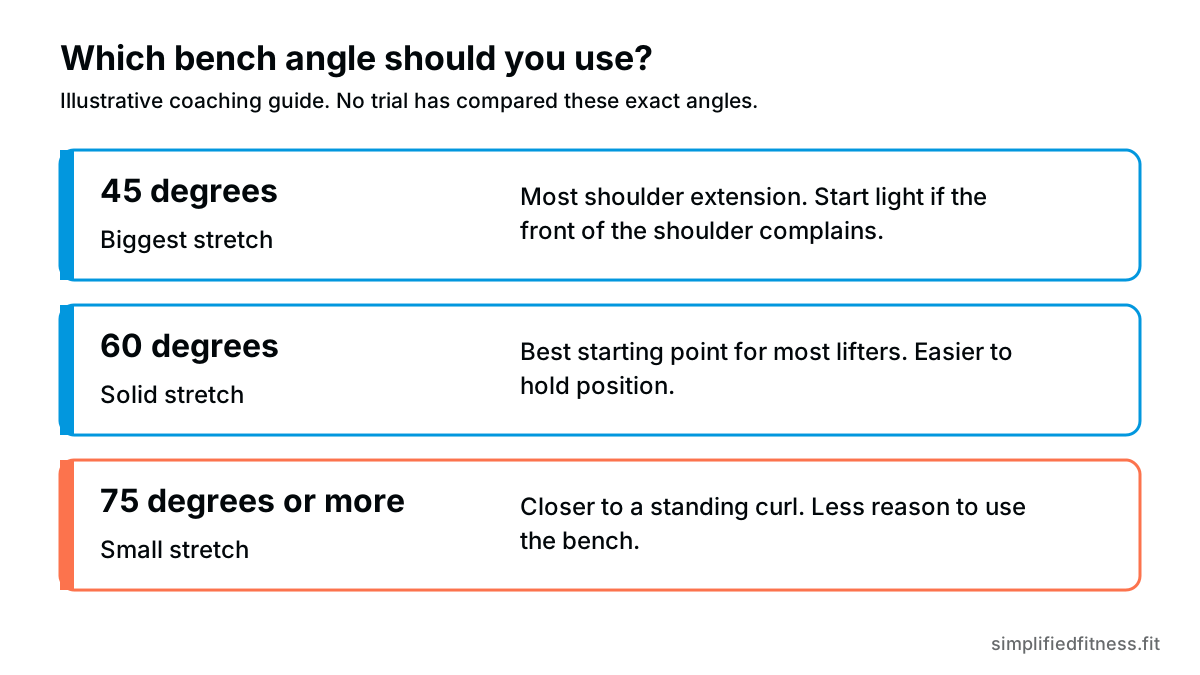
| Bench angle | Stretch on biceps | Shoulder demand | Good for |
|---|---|---|---|
| 45 degrees | Highest | Highest | Comfortable shoulders, light to moderate loads |
| 60 degrees | Solid | Moderate | Most lifters, most of the time |
| 75 degrees or more | Small | Low | Almost no advantage over a standing curl |
Short arms or tight chest and front shoulders? You may find 60 degrees feels like 45 on someone else. Pick the lowest angle that keeps the front of your shoulder comfortable.
How do you avoid shoulder pain on incline curls?
Incline curls place the shoulder in extension while the biceps tendon is stretched. For most healthy lifters that is fine. For some it irritates the front of the joint.
Try these in order:
- Raise the bench a notch.
- Drop the load until you can control every rep.
- Keep your shoulder blades on the pad rather than rolling the shoulders forward.
- Stop the dumbbell just short of the deepest stretch for a few weeks.
- Reduce how often you do it.
Pain that is sharp, lingers for days, causes weakness, or shows up with swelling or a pop is a reason to stop and see a doctor or physiotherapist. This article is not a diagnosis. If you already have elbow tendon pain, read our guide on distal biceps tendonitis and golfer’s elbow first.
How should you control tempo and supination?
Lower the dumbbell for roughly 2-3 seconds, then lift without a jerk. A meta-analysis of repetition duration found similar hypertrophy with durations from 0.5 to 8 seconds, with very slow reps (over 10 seconds) looking inferior, though the authors note a lack of controlled studies. So you do not need a stopwatch. You need to avoid bouncing out of the stretched position.
Supination is simple. Start with palms facing forward or slightly inward, and rotate them toward the ceiling as the dumbbell rises. At the top the pinky side should be a little higher than the thumb side for many people. Do not force a position that hurts your wrist.
How do you progress incline curls?
Use double progression. Pick a rep range, say 8-12. Stay with one weight until you hit 12 reps on all sets with clean form, then go up by the smallest jump your dumbbells allow. Our double progression guide walks through it.
Is 8-12 the only rep range? No. A review of the repetition continuum argues that muscular adaptations can occur across a wide spectrum of loading zones. Because the stretch is uncomfortable under heavy load, many lifters prefer 10-15 reps here.
Take sets close to failure with good form. If you are unsure how close, our RIR/RPE calculator helps you gauge it. Fit one or two weekly sessions into your pull day, using our pull day plan as a template. Do not add more sets unless your recovery allows.
Incline curls on an Indian gym budget
You do not need a fancy station. A basic adjustable bench and a pair of 8-14 kg dumbbells is enough for most people to progress for months. If your gym has only a fixed 45-degree bench, use it and go lighter. If your bench has no angle settings, a bench with a backrest and slight lean works.
Hot, humid gym? Wipe the bench and your palms between sets so the dumbbell does not slip during the lowering phase. A secure grip matters more than the last 2 kg.
What are the most common incline curl mistakes?
Most lifters lose the benefit of this exercise in the same handful of ways.
- Swinging out of the bottom. A bounce skips the stretched part, the whole reason you chose this lift. Pause for a beat at the bottom if you notice it.
- Curling both arms at once with too much weight. Alternating arms makes it easier to keep each rep clean and lets you focus on one elbow at a time.
- Shrugging the shoulders up. If the top of your traps lights up, the weight is too heavy.
- Cutting the lowering short. Stopping with the elbow still bent 30 degrees makes the set easier and the exercise less useful.
- Using it as your first exercise on a stiff shoulder day. Warm up with a couple of light sets and a few arm swings first.
What does a sample set structure look like?
Here is one reasonable way to fit it in. It is a starting point, not a prescription.
- Warm-up: one light set of 12-15 reps with dumbbells about half your working weight.
- Working sets: 2-3 sets of 10-12 reps, stopping about 1-2 reps before failure.
- Rest: around 2 minutes between sets so every set stays strict.
- Next session: if you hit 12 clean reps on every set, add the smallest load jump.
Do the movement on your pull day after rows or pulldowns, when you have already warmed up the elbows and shoulders. Most people find that their biceps already get plenty of indirect work from back training, so you rarely need many extra sets.
Who should be careful with incline curls?
If you have had a shoulder dislocation, a biceps tendon injury, or ongoing front-of-shoulder pain, get cleared by a doctor or physiotherapist before loading the stretched position. For those lifters, a preacher curl or a cable curl with the arm at your side is often a gentler way to train the same muscle. Likewise, if your wrists or elbows flare up with any curling variation, address that first. Using incline curls should feel like a deep stretch in the biceps, not a pinch in the joint.
Frequently Asked Questions
What is the correct incline dumbbell curl form?
Sit on a bench set to 45-60 degrees with your head and upper back supported, let your arms hang straight down with palms facing forward, then curl up while your elbows stay roughly beside your torso. Hanging the arm slightly behind the body puts the shoulder in extension, which stretches the long head of the biceps at the bottom. Lower the weight under control until your elbows are almost straight, then repeat without swinging.
What is the best incline bench angle for biceps curls?
Most lifters do well between 45 and 60 degrees. A lower angle leans you further back, so the arm hangs further behind the body and the biceps stretch more, but it also loads the front of the shoulder harder. Start at 60 degrees and drop toward 45 only if your shoulders feel fine; no trial has compared these exact angles, so this is a coaching rule of thumb.
Do incline curls work the long head of the biceps?
The long head crosses both the shoulder and the elbow, so extending the shoulder while you curl lengthens it more than a standing curl does. A 12-week MRI trial found the whole biceps grew well from incline curls, though a 9-week ultrasound trial in women found no significant growth, and neither study separated the two heads. Use incline curls as a stretched-position biceps exercise rather than expecting to isolate one head.
Are incline curls better than preacher curls?
Neither is clearly better. In a 12-week MRI trial the biceps grew more after incline curls (+22.1% vs +18.9%), while the brachialis and brachioradialis grew more after preacher curls, and total elbow flexor growth was similar. Use both across your training week if you want a rounded arm.
Why do incline curls hurt my shoulder?
The position puts your shoulder in extension while the biceps tendon is stretched, and heavy, jerky reps can irritate the front of the joint. Most of the time the fixes are a steeper bench, lighter dumbbells, keeping the shoulder blades on the pad and not dropping into the very last degrees of stretch. If pain is sharp, lingers after training or comes with weakness or swelling, stop and see a doctor or physiotherapist.
Should my elbows move forward during incline curls?
Keep them roughly in line with your torso or slightly behind it. If the elbows drift forward, the shoulder comes out of extension and you lose the stretch that makes the exercise worth doing. Lighter weight and a slower start from the bottom usually fix it.
How many reps and sets of incline curls should I do?
Sets of 8-15 reps taken close to failure are a sensible range, and a review of loading research suggests muscle growth can occur across a wide spectrum of loads. Two to four hard sets once or twice a week fits most programmes as part of your total biceps volume. Use our RIR/RPE calculator to judge how close to failure you are.
How slow should I lower the dumbbell on incline curls?
A 2-3 second lowering phase is a practical default. A meta-analysis found similar muscle growth with repetition durations from 0.5 to 8 seconds, though very slow reps (over 10 seconds each) looked worse. Control the stretch so you are not bouncing out of the bottom, then stay consistent.
Should I supinate during incline curls?
Yes, turning the palms up as you curl is the standard technique because the biceps both bends the elbow and rotates the forearm to palm-up. Start with palms facing forward or slightly in at the bottom, then rotate as you lift. If your wrists complain, a small amount of supination is fine; the stretch and the control matter more.
Can I do incline curls with a heavy weight?
You can, but this is usually a moderate-load exercise. The stretch at the bottom is demanding on the biceps tendon and front of the shoulder, so very heavy loads tend to encourage swinging. Pick a weight you can lower smoothly for the target reps, then progress in small steps.
What can I use if I do not have an adjustable bench?
A bench with a back support set around 60 degrees works, as does a sturdy chair or Swiss ball with a backrest at a similar lean. Another option is a cable curl with the arm behind the body, which keeps tension on the biceps in a similar stretched position. Whatever you use, the aim is the same: arms hang slightly behind the torso with your back supported.
How often should I train incline curls in a week?
One or two sessions a week is enough for most people. The curl trials discussed here used two or three sessions per week, and your biceps also work during every row and pulldown. Check your pull-day volume before adding more, or try our pull day plan.
Do incline curls work for beginners?
Yes, starting light. The trial showing biceps growth used untrained adults, so beginners clearly respond. Spend the first few weeks mastering the hanging position and the lowering before you chase heavier dumbbells.
Sources & References
Every claim above is checked against peer-reviewed research (PubMed, U.S. National Library of Medicine) or guidance from established health bodies. How we fact-check.
- Kobayashi Y, et al. Exercise-specific preferential hypertrophy of individual elbow flexor muscles after incline versus preacher dumbbell curl training. J Sports Sci. 2026. PMID: 42829982
- Zabaleta-Korta A, et al. Regional Hypertrophy: The Effect of Exercises at Long and Short Muscle Lengths in Recreationally Trained Women. J Hum Kinet. 2023. PMID: 37559762
- Maeo S, et al. Triceps brachii hypertrophy is substantially greater after elbow extension training performed in the overhead versus neutral arm position. Eur J Sport Sci. 2023. PMID: 35819335
- Schoenfeld BJ, et al. Effects of range of motion on muscle development during resistance training interventions: A systematic review. SAGE Open Med. 2020. PMID: 32030125
- Schoenfeld BJ, et al. Loading Recommendations for Muscle Strength, Hypertrophy, and Local Endurance: A Re-Examination of the Repetition Continuum. Sports (Basel). 2021. PMID: 33671664
- Schoenfeld BJ, et al. Effect of repetition duration during resistance training on muscle hypertrophy: a systematic review and meta-analysis. Sports Med. 2015. PMID: 25601394

Umair Hazrami · Founder & Head Coach, Simplified Fitness
Umair Hazrami founded Simplified Fitness and the Simplified Lifter channel to cut through fitness noise. With 4+ years of consistent training and 10+ coaching clients, he writes every guide from the peer-reviewed research and links the sources so you can check them. Our editorial standards.
Educational content only, not medical advice. If you have a medical condition, are pregnant, or take medication, talk to a qualified doctor before changing your diet, supplements or training. Full disclaimer.
Keep reading

Exercise Technique
Antagonist Arm Supersets: Biceps and Triceps Pairing for a Faster, Pumpier Arm Day
A biceps triceps superset workout can shorten arm day while keeping volume close to straight sets. See the research, pairing tips and a 20-minute routine.
9 min read
Exercise Technique
Barbell vs EZ-Bar Curls: Why Straight Bars Hurt the Pinky Side of Your Wrist
Barbell vs EZ bar curls for wrist pain: what EMG research says about biceps activation, forearm rotation and the carrying angle, plus fixes you can use today.
8 min read
Exercise Technique
Bayesian Cable Curls: Form, Setup and Whether They Build Bigger Biceps
Bayesian cable curl form explained step by step: pulley height, step-forward distance, elbow position, sets and reps, and what the research really shows.
8 min read
Exercise Technique
Close-Grip Bench Press: Triceps Loading, Wrist Spacing, and Elbow Stress
Close grip bench press triceps guide: how narrow to go, what the grip width research shows, and how to protect wrists and elbows. Setup cues included.
8 min read