Quantifying Training Volume: Hard Set Counting vs Tonnage (Sets x Reps x Weight)
Hard sets vs tonnage: which volume metric fits muscle growth? See why sets x reps x weight misleads and the simple set-counting rule to log instead.

TL;DR. The short answer
- For muscle growth, counting hard working sets per muscle per week is the more practical volume metric. Tonnage (sets x reps x kg) treats very different efforts as equal, so it can mislead.
- In a 12-week trial of 30 men with volume load matched, thigh growth was about 9% at 20% of 1RM versus about 20% at 40-80% of 1RM, so equal tonnage did not mean equal growth.
- A systematic review of 14 trials in trained lifters concluded that total sets taken to failure or near it is an adequate volume measure for rep ranges of roughly 6 to 20+.
- Count a set only if it is a real working set taken roughly 0-3 reps from failure. This is a practical rule, not a validated cutoff.
- Tonnage is still useful inside one exercise, as a progress check at the same rep range. Just do not use it to compare exercises or rep ranges.
Part of our complete guide: Optimal Training Volume and Frequency: How Many Sets per Muscle Actually Build Muscle
Table of contents
For building muscle, the better question in the hard sets vs tonnage debate has a fairly clear answer. Counting hard working sets per muscle per week is the more useful volume number, because tonnage (sets x reps x weight) treats very different efforts as if they were the same. Tonnage still has a small job, which we will get to below.
This is a cluster of our complete guide to training volume and frequency. Here we only deal with the measuring stick: what to write in your log so your volume number actually means something.
Why tonnage looks smart but misleads
Tonnage, also called volume load, is simple arithmetic. 3 sets x 10 reps x 100 kg = 3,000 kg. Excel loves it, apps chart it, and the number goes up when you get stronger. So what is the problem?
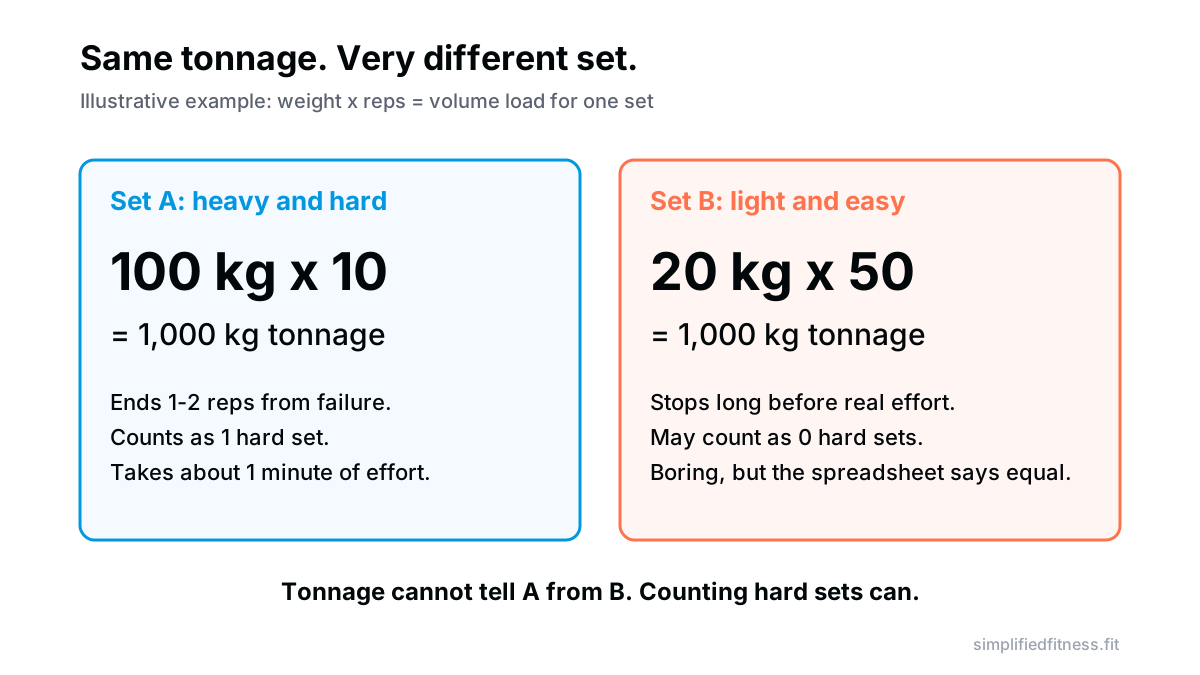
The problem is that the same number can hide completely different training. 100 kg x 10 reps is 1,000 kg. 20 kg x 50 reps is also 1,000 kg. One of those is a hard set that ends near failure. The other might be a long, easy slog that you stopped because you were bored. A spreadsheet cannot tell them apart.
Three other quirks make tonnage weak as a growth metric:
- It ignores effort. Tonnage has no idea whether you stopped 1 rep from failure or 8 reps from failure.
- It rewards load and reps, not the muscle. Switching from a hack squat to a leg press can change your tonnage by hundreds of kilos overnight without changing what your quads are doing.
- It breaks across rep ranges. A set of 30 at a light load can out-tonnage a set of 8 at a heavy load, which tells you nothing about which was the better set for growth.
Researchers have raised the same concern. A 2021 review in Sports Medicine discussed the strengths and shortcomings of the common ways to quantify volume (sets, repetitions and volume load) and noted that not all of them are appropriate for equating training programs (Nunes et al., 2021).
What happened when researchers matched tonnage
The cleanest test is to match volume load between conditions and see whether growth matches too. One 12-week trial did this in 30 men. Each person trained one leg and one arm at 20% of their one-rep max (1RM), while the opposite limbs trained at 40%, 60% or 80% 1RM. Volume load was matched, so tonnage was equal across conditions (Lasevicius et al., 2018).
If tonnage drove growth, every group would have grown about the same. They did not. Vastus lateralis (outer quad) size rose about 8.9% at 20% 1RM versus 20.5%, 20.4% and 19.5% at 40%, 60% and 80% 1RM. The authors concluded that all intensities improved size, but 20% 1RM was suboptimal, and only 80% 1RM was statistically superior to the lighter loads.
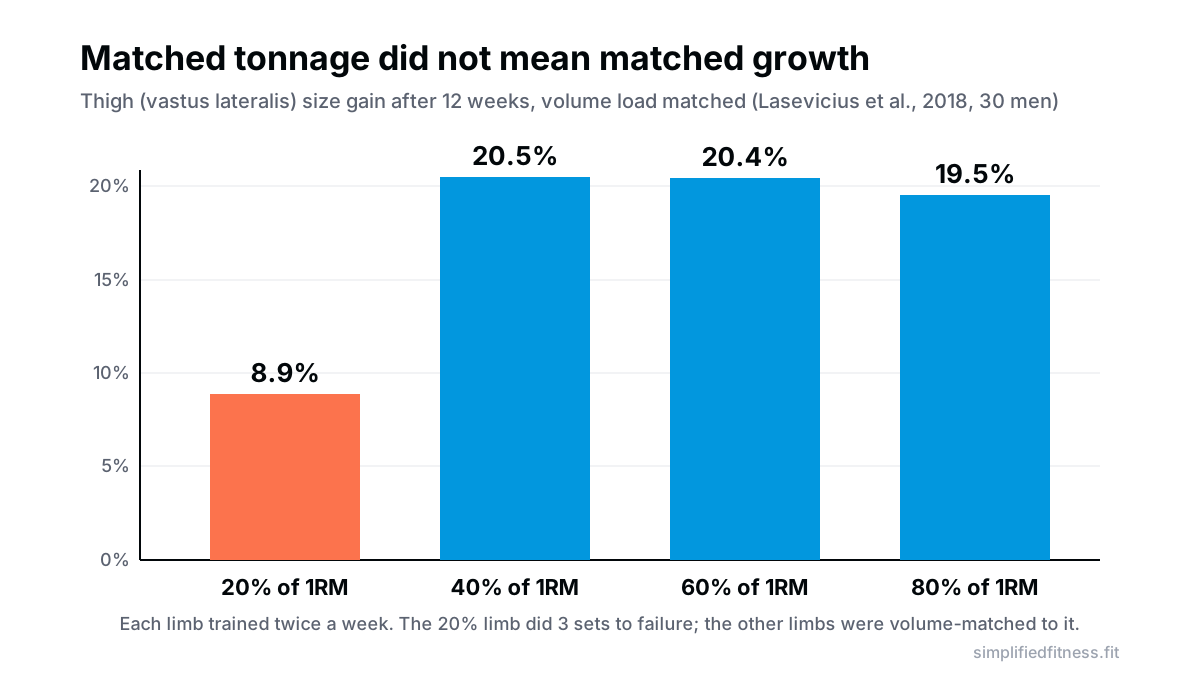
Be careful reading this trial. It was in men, within-person (limb versus limb), and the very light 20% condition is not how most people train. The point is narrow but clear: equal tonnage did not guarantee equal growth.
What the hard-sets method says
Now the other side. A systematic review of 14 randomized trials looked at whether total number of sets is a valid way to quantify volume for hypertrophy. Studies had to last at least 6 weeks and enroll lifters with at least a year of training experience, aged 18 to 35. The review concluded that the total number of sets taken to failure, or near it, seems an adequate method to quantify volume when the rep range sits between about 6 and 20+, provided other variables stay constant (Baz-Valle et al., 2021). The authors also note the approach needs more development to say whether specific set numbers are key.
That is a more modest claim than “scientifically validated gold standard,” and it is the honest one. Set counting is the best practical metric we have for hypertrophy volume, not a perfect one.
The dose-response data point the same way. A meta-regression of 15 studies found that each additional weekly set was associated with an increase in effect size of 0.023, equal to about 0.37% more muscle gain, and a graded relationship between volume and growth (Schoenfeld et al., 2017). A much larger 2026 analysis (67 studies, 2,058 participants) found that gains increase with weekly set volume, with diminishing returns (Pelland et al., 2026). For how that curve looks in practice, see our piece on the weekly set dose-response curve.
Notice that these studies count sets, not kilograms.
What counts as a “hard set”?
This is where most people go wrong. Counting sets only works if the sets are real. Here is a practical working definition:
- It is a working set, not a warm-up or ramp-up set.
- It ends roughly 0-3 reps from failure (reps in reserve, or RIR).
- It is performed with controlled reps through a full range at a load that lets you get roughly 6-30 reps.
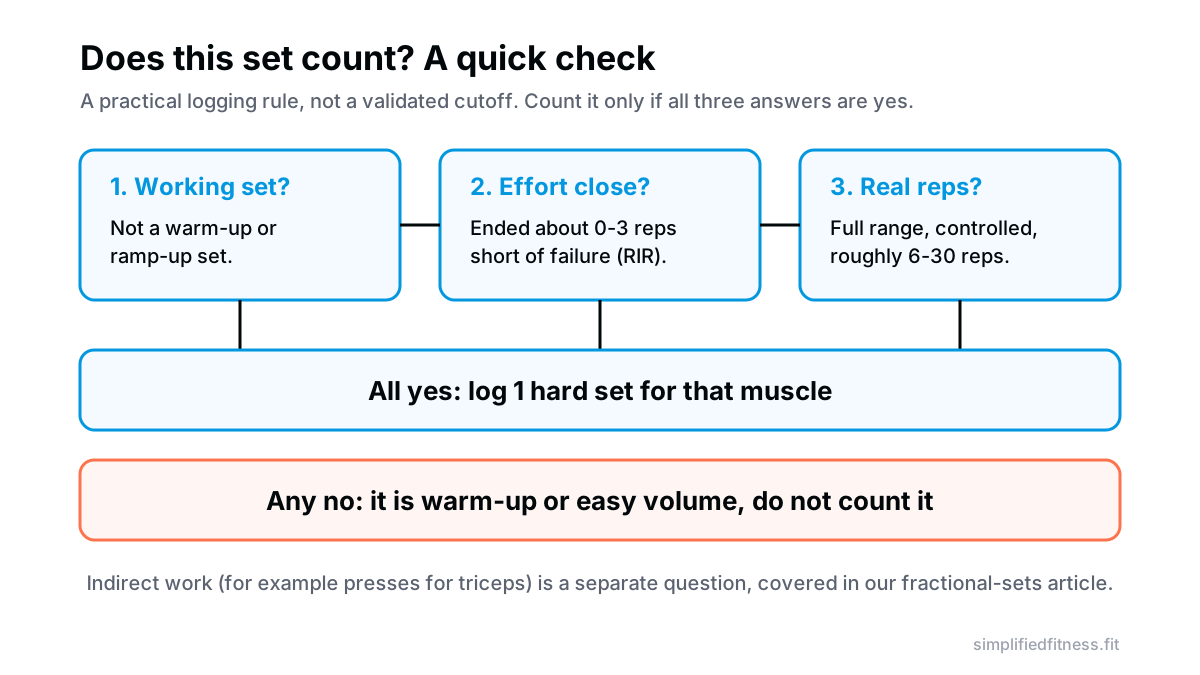
Be clear about the 0-3 RIR part. It is a practical convention, not a proven threshold. A 2023 meta-analysis found only a trivial advantage for training to set failure over non-failure (effect size 0.19), and no advantage for momentary failure itself (Refalo et al., 2023). A 2024 exploratory meta-regression, using estimated reps in reserve, found that hypertrophy tended to increase as sets ended closer to failure, though the authors warn that the exact relationship remains unclear (Robinson et al., 2024).
Put together: sets close to failure appear to be worth more than sets far from it, but you do not need to grind every set to a grinding last rep. A rep or two in the tank is a sensible target. If you are unsure how to judge it, read our guide to the RIR and RPE scale, and practise with the RIR / RPE calculator.
Does a light set to failure count the same as a heavy one?
Mostly yes, with caveats, and this is another place where tonnage fails. An 8-week study in 18 well-trained men compared sets of 25-35 reps with sets of 8-12 reps, both to failure, and found similar growth in the elbow flexors, elbow extensors and quadriceps, with no significant difference between groups in muscle thickness at any site, although the heavier group gained more squat strength (Schoenfeld et al., 2015). In an earlier 10-week trial in young men, a light load lifted to failure (30% 1RM, 3 sets) produced hypertrophy that was not significantly different from heavy load (80% 1RM, 3 sets): 6.8% versus 7.2% in MRI muscle volume (Mitchell et al., 2012).
Light sets taken to failure and heavy sets taken to failure end up with wildly different tonnage, yet similar growth. That is exactly the opposite of what tonnage predicts, and it is why hard sets travel better across loads.
How do you square this with the 2018 trial above, where 20% 1RM lagged? We cannot be sure. The designs differ in load, in how sets were equated and in how reliably the very light sets reached true effort. A cautious reading is that light and moderate loads can work when taken genuinely close to failure, while extremely light loads are not obviously better. For heavy-versus-light trade-offs, see low-load vs high-load training.
What to actually write in your training log
You do not need a complicated spreadsheet. A good log answers three questions: what did I do, how hard was it, and am I progressing?
| Column | What to record | Why |
|---|---|---|
| Exercise | Name, plus the variation | Progress is exercise-specific |
| Load x reps | For every working set | Shows progression at a rep range |
| RIR | Your honest estimate (0, 1, 2, 3+) | Decides whether the set counts |
| Hard sets per muscle | Weekly total | Your actual volume number |
Then use each number for its own job:
- Hard sets per muscle per week: your volume dose. Change it slowly and one muscle at a time.
- Load x reps at a similar RIR: your progress check. If it is going up over weeks, training works.
- Tonnage: optional, and only within one exercise at one rep range. Comparing your bench-press tonnage this month with last month is fine. Comparing bench tonnage with squat tonnage is not.
Where tonnage still has a place
I am not telling you to delete your spreadsheet. Tonnage is useful in a few narrow ways:
- Single-exercise trend lines. If your leg-press tonnage at 10-12 reps and 2 RIR is rising across a mesocycle, you are progressing.
- Spotting a dip. A sudden drop at the same effort can flag fatigue, poor sleep, or stress.
- Sports with a load focus. If your goal is moving heavy weight (powerlifting-style strength), the picture differs from hypertrophy. Here we only address muscle size.
The rule: tonnage is a diary entry, not a dose. For more on progression, see progressive overload beyond adding iron.
Counting compound exercises and indirect work
A fair follow-up is whether bench press “counts” for triceps, or rows for biceps. The research is still developing. In the 2026 meta-regression, indirect sets were classified, and counting them as half a set (a “fractional” method) had the strongest relative evidence, compared with counting them as a full set or as zero (Pelland et al., 2026).
In plain terms: do not count bench press as 3 full triceps sets, and do not ignore it either. We cover the details in our article on direct vs indirect and fractional set counting, so we will not repeat them here.
Practical rules for Indian gyms
Many Indian lifters train on shared equipment with busy floors, lots of machines and limited plate choices. A few notes:
- Plate jumps are often 2.5 kg or 5 kg per side, so tonnage can jump unevenly. Hard-set counting is not affected by this.
- If you train on a crowded floor and rest times drift, your effort per set is still what counts. Judge each set by how many reps you had left, not by the clock.
- If you are vegetarian and training on a modest protein budget (dal, paneer, curd, soya), do not let a big set count compensate for poor recovery. Adequate protein and sleep matter before you push volume up. Check your daily protein with our protein calculator.
When to be careful
Chasing high set counts can backfire. If you get sharp or persistent joint pain, numbness, dizziness during sets, or pain that does not settle after a few days, that is not a metric problem: see a doctor or qualified physiotherapist. And if you are new to lifting, a small number of well-performed sets is a sensible start. The research reviewed here is mostly in healthy young adults, so if you are older, returning from injury or managing a medical condition, check with your doctor before ramping up volume.
The bottom line
- Log hard sets per muscle per week as your volume number.
- Define a hard set honestly: working set, roughly 0-3 reps from failure, controlled reps.
- Use load x reps at a given RIR to track progress.
- Treat tonnage as an optional within-exercise diary, never as a comparison tool.
That is the whole system. If you want a plan to apply it to, start with our free push pull legs plan, and see the parent training volume guide for how many sets to aim for.
Frequently Asked Questions
Is tonnage a good way to measure training volume?
It is a poor way to compare different training styles, though fine for tracking one exercise over time. Tonnage multiplies sets, reps and load, so 100 kg x 10 and 20 kg x 50 both equal 1,000 kg despite very different effort. Use hard sets as your main volume number and keep tonnage only as a within-exercise progress check.
What is a hard set?
A hard set is a working set taken close to muscular failure, commonly defined as about 0-3 reps in reserve. It matters because sets stopped far from failure may add little growth stimulus per set. Skip warm-ups and easy sets when counting.
How do I count volume for hypertrophy?
Count the hard working sets you do for each muscle across the week. A 2017 meta-analysis found that more weekly sets were associated with more muscle growth, and a 2021 systematic review supports set counting when sets are near failure. Log the number once per muscle and adjust it slowly over several weeks.
Does volume load (tonnage) predict muscle growth?
Not reliably across different loads. In a 12-week trial with volume load matched, leg growth was about 9% at 20% of 1RM and about 20% at 40-80% of 1RM. Because the same tonnage produced different results, do not treat it as a growth score.
How many hard sets per muscle per week should I do?
There is no single number, since gains rise with volume but with diminishing returns. A 2017 meta-analysis linked each extra weekly set to roughly 0.37% more growth on average, and the curve flattens at higher volumes. Start with a modest number you can recover from and use our training volume calculator to check your weekly total.
Do warm-up sets count as volume?
No, warm-up sets are not counted as hard sets. They are far from failure and exist to prepare you, not to stimulate growth. Write them down separately or not at all.
Do sets close to failure count more than easy sets?
Probably, up to a point. A 2024 meta-regression using estimated reps in reserve found hypertrophy tended to be greater as sets ended closer to failure, but the authors call it exploratory, and a 2023 meta-analysis found no advantage for reaching momentary failure itself. Aim for hard sets that finish with a rep or two left, and keep the occasional all-out set for safe exercises.
Should I track reps and weight at all if I count sets?
Yes, log them for progression, not for volume. Reps and load tell you whether you are getting stronger at a given rep range, which is the real check on whether training works. The sets count is just the dose you applied.
Is 20 reps at light weight the same as heavy sets for volume?
It can be, if the set is genuinely taken near failure. Trials show low and moderate loads can build similar muscle when sets are hard, though a 2018 trial found 20% of 1RM lagged behind heavier work. Pick a load you can control for 6-30 reps and take the set close to failure.
How do I count compound exercises like bench press for triceps?
Count them as direct volume for the main muscle, and treat the helper muscles carefully. A 2026 meta-regression found that counting indirect sets as half a set predicted results better than counting them as full or zero. Do not double count everything: see our article on fractional sets for the details.
What about drop sets, rest-pause and partial reps?
Count the whole cluster conservatively, for example as one or two hard sets rather than five. Extra reps beyond the first failure are hard but short, and the evidence on exact conversion is limited. Keep it simple and note the technique in your log.
Can I just use an Excel sheet to track tonnage?
You can, but it will not tell you much about growth. A spreadsheet that totals sets x reps x kg treats a light 50-rep set and a heavy 10-rep set as equals. Add one column for hard sets per muscle and one for the date, and ignore the tonnage total.
How accurate does my effort estimate need to be?
Roughly right is enough, since nobody judges reps in reserve perfectly, and estimates tend to be less accurate when the set ends far from failure. Consistency matters more than precision, because you only need to compare this month with last month. Use our RIR calculator to practise.
Sources & References
Every claim above is checked against peer-reviewed research (PubMed, U.S. National Library of Medicine) or guidance from established health bodies. How we fact-check.
- Baz-Valle E, et al. Total Number of Sets as a Training Volume Quantification Method for Muscle Hypertrophy: A Systematic Review. J Strength Cond Res. 2021. PMID: 30063555
- Nunes JP, et al. Equating Resistance-Training Volume Between Programs Focused on Muscle Hypertrophy. Sports Med. 2021. PMID: 33826122
- Lasevicius T, et al. Effects of different intensities of resistance training with equated volume load on muscle strength and hypertrophy. Eur J Sport Sci. 2018. PMID: 29564973
- Schoenfeld BJ, et al. Dose-response relationship between weekly resistance training volume and increases in muscle mass: A systematic review and meta-analysis. J Sports Sci. 2017. PMID: 27433992
- Pelland JC, et al. The Resistance Training Dose Response: Meta-Regressions Exploring the Effects of Weekly Volume and Frequency on Muscle Hypertrophy and Strength Gains. Sports Med. 2026. PMID: 41343037
- Schoenfeld BJ, et al. Effects of Low- vs. High-Load Resistance Training on Muscle Strength and Hypertrophy in Well-Trained Men. J Strength Cond Res. 2015. PMID: 25853914
- Mitchell CJ, et al. Resistance exercise load does not determine training-mediated hypertrophic gains in young men. J Appl Physiol. 2012. PMID: 22518835
- Refalo MC, et al. Influence of Resistance Training Proximity-to-Failure on Skeletal Muscle Hypertrophy: A Systematic Review with Meta-analysis. Sports Med. 2023. PMID: 36334240
- Robinson ZP, et al. Exploring the Dose-Response Relationship Between Estimated Resistance Training Proximity to Failure, Strength Gain, and Muscle Hypertrophy: A Series of Meta-Regressions. Sports Med. 2024. PMID: 38970765

Umair Hazrami · Founder & Head Coach, Simplified Fitness
Umair Hazrami founded Simplified Fitness and the Simplified Lifter channel to cut through fitness noise. With 4+ years of consistent training and 10+ coaching clients, he writes every guide from the peer-reviewed research and links the sources so you can check them. Our editorial standards.
Educational content only, not medical advice. If you have a medical condition, are pregnant, or take medication, talk to a qualified doctor before changing your diet, supplements or training. Full disclaimer.
Keep reading

Programming
Autoregulation of Set Volume: Add or Cut Sets Based on Readiness and Velocity Loss
Autoregulation training volume explained: use warm-up speed, RIR and a 20-25% performance drop to add or cut sets, and what the evidence does or does not prove.
9 min read
Programming
The Biological Cost of High Volume: Sleep, Cortisol and Immune Strain
High volume lifting side effects: what research says about poor sleep, cortisol and colds, which warning signs matter, and how to scale back.
9 min read

Programming
How to Count Compound Sets Toward Weekly Volume: Direct vs Fractional Sets
How to count compound sets volume for arms, delts and hamstrings: the 1.0 and 0.5 fractional rule, a worked weekly example and what the research says.
9 min read

Programming
Distributing Weekly Volume: Full Body 3x vs Upper/Lower 4x vs PPL 6x
Distributing weekly volume across splits: how 12 sets per muscle look in full body, upper/lower and PPL, plus session length math and which fits your week.
9 min read