How to Count Compound Sets Toward Weekly Volume: Direct vs Fractional Sets
How to count compound sets volume for arms, delts and hamstrings: the 1.0 and 0.5 fractional rule, a worked weekly example and what the research says.

TL;DR. The short answer
- A practical way to count compound sets is to give a direct set 1.0 credit and a compound set 0.5 credit for each assisting muscle. A 2026 meta-regression of 67 studies found this fractional method fit the data best.
- Yes, heavy bench press and rows count toward triceps and biceps, but only partly. Counting them as full sets overstates your arm volume, and ignoring them understates it.
- The 0.5 rule is a statistical model, not a physiological constant. Use it to audit your week, then let progress and recovery decide whether to add or remove sets.
- Only hard sets close to failure earn credit. Warm-ups and easy sets count for little or nothing.
- If you already press and row several times a week, most lifters need fewer direct arm and front delt sets than they think.
Part of our complete guide: Optimal Training Volume and Frequency: How Many Sets per Muscle Actually Build Muscle
Table of contents
Wondering how to count compound sets volume toward each muscle? Here is the short answer, and the guide it belongs to is training volume and frequency for muscle growth. Give a hard direct set 1.0 credit, and give a hard compound set about 0.5 credit for each muscle that assists. So a heavy bench press set counts as roughly half a triceps set, and a barbell row set counts as roughly half a biceps set.
That is a planning rule, not a law of physiology. It fixes a very common spreadsheet problem: lifters who either ignore their pressing and rowing or count every set as full volume for every muscle.
Why weekly set counts get misleading
Most volume advice is written as “10-20 sets per muscle per week.” Fine. But your triceps do not know what exercise you called “chest day.”
The triceps work in every press. The biceps work in every row and pulldown. Your front delts help on bench, incline and overhead work. Hamstrings get involved in hinges. If you only count the exercise with the muscle’s name on it, your arm total looks tiny. If you count every set that touches the muscle as a full set, it looks huge.
Both errors cause trouble. The first leads people to pile on curls and pushdowns they may not need. The second makes them think they have plenty when a lagging muscle is under-dosed.
The most common mistake here is a program with 12 sets of direct arm work stacked on top of three pressing days and three pulling days, then wondering why elbows ache by week four.
What the research says about direct and indirect sets
The cleanest evidence on this comes from a 2026 meta-regression in Sports Medicine. The authors pooled 67 studies with 2,058 participants and first classified each set as direct or indirect, depending on how specific it was to the muscle being measured. They then tested three ways to score indirect sets: 1 for “total,” 0.5 for “fractional,” and 0 for “direct” counting only. The fractional method had the strongest relative evidence, so they used it for their main models (Pelland et al., 2026).
Their models showed gains in muscle size increasing as volume increased, with diminishing returns. The authors concluded that distinguishing direct from indirect sets appears essential for predicting adaptations.
Two cautions. This is a statistical comparison across many studies, so 0.5 is the best-fitting average, not a measured value for any one exercise or person. And the average participant was about 25 years old, so the numbers are a starting point for adults who are not elderly, not a prescription.
Older meta-analyses did not make this split. A 2017 meta-regression found that each additional weekly set was associated with a 0.37% larger gain in muscle size, and a graded dose-response relationship overall (Schoenfeld et al., 2017). Those analyses counted sets in the way the original studies reported them, which is part of why newer work tries to be more precise.
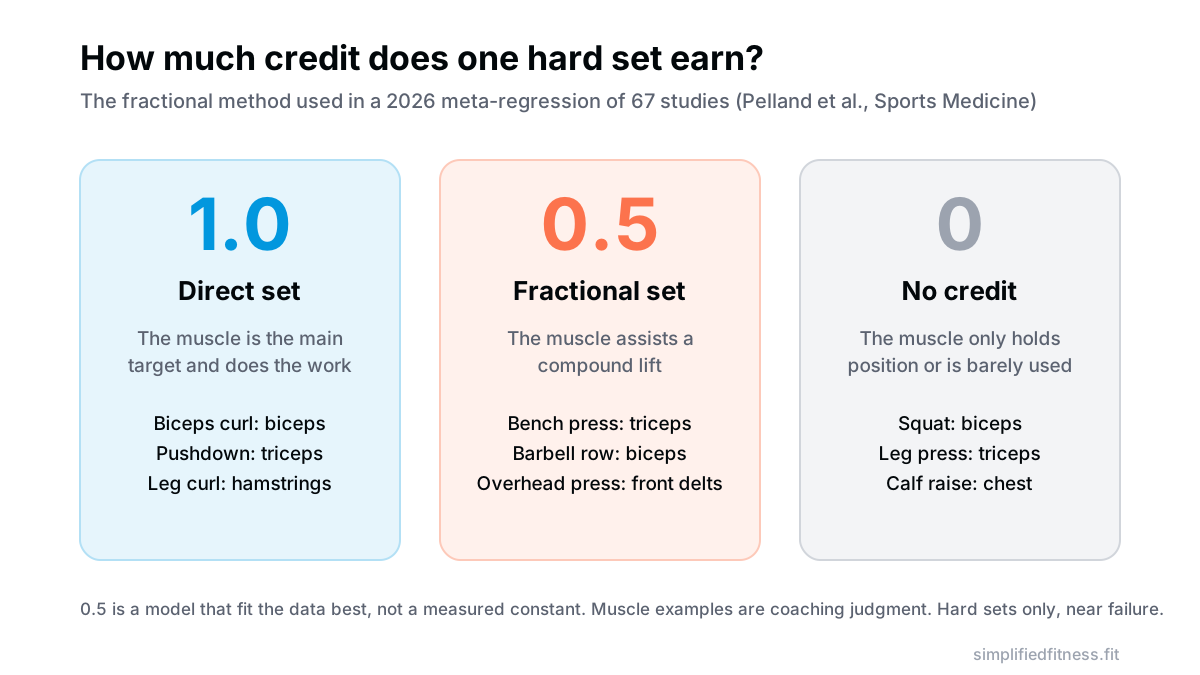
Does bench press count as triceps volume?
Partly, and that is the point of the 0.5 rule.
In a press the triceps extend the elbow against real load, so a hard set is a genuine stimulus. But the chest and front delts share the job, and the triceps are rarely the limiting muscle. A full set of credit would overstate it. Zero would ignore a lot of work.
So score a hard bench, incline, dip or overhead press set as 0.5 triceps sets. The same logic applies to the elbow flexors with rows and pulldowns: each hard set is about 0.5 biceps sets. Close-grip bench and dips lean harder on the triceps than a wide incline press does, so if you want to be generous you could argue for a bit more credit there. Coaching judgment, not data.
Do compound exercises count for arms? What trials show
The practical question behind all this is whether you need dedicated arm work at all. The evidence is mixed, so here is each side.
A 2017 review of 23 studies concluded that in the upper limbs, long-term studies reported no difference between single-joint and multi-joint exercise and no extra effect from adding single-joint work to a multi-joint program (Gentil et al., 2017). A trial in 20 trained men (at least 2 years of lifting experience) over 8 weeks found that adding single-joint exercises to a multi-joint program did not produce significantly different strength or size changes in the arms (de Franca et al., 2015).
On the other side, a small within-person trial in 10 untrained men trained one arm with dumbbell rows and the other with biceps curls for 8 weeks. The curl arm increased elbow flexor thickness by 11.06% against 5.16% for the row arm (Mannarino et al., 2021).
Why might they disagree? The studies measure size differently (arm circumference versus ultrasound thickness), use different training experience, and compare different things: adding curls to a full program versus replacing rows with curls. The 2021 study also trained elbow flexors with just that one exercise each, so it says little about someone who also bench presses and pulls.
The cautious takeaway: compound work clearly trains the arms, but direct sets can be a more efficient way to add arm volume, and they are easy to recover from. If your arms are a priority or a weak point, keep some direct sets. If you are short on time, a good push and pull program already does a lot of the job.
A worked example: counting a week of upper/lower training
Here is a made-up 4-day upper/lower program. All hard sets, 6-12 reps, near failure. The numbers below are illustrative, built only to show the arithmetic.
| Day | Exercises (hard sets) |
|---|---|
| Upper A | Bench press 4, barbell row 4, overhead press 3, EZ-bar curl 3, triceps pushdown 3, lateral raise 3 |
| Upper B | Incline dumbbell press 3, lat pulldown 3, dumbbell shoulder press 3, seated row 3, overhead triceps extension 3, hammer curl 3 |
| Lower A and B | Squats, hinges, leg curls and calves (not counted for arms) |
Triceps. Direct work: pushdown 3 + overhead extension 3 = 6 sets. Pressing: bench 4 + incline 3 + overhead press 3 + shoulder press 3 = 13 sets, times 0.5 = 6.5. Total: 12.5 triceps sets.
Biceps. Direct work: EZ-bar curl 3 + hammer curl 3 = 6. Pulling: row 4 + pulldown 3 + seated row 3 = 10 sets, times 0.5 = 5. Total: 11 biceps sets.
Front delts. No direct work. Pressing: 13 sets times 0.5 = 6.5. Many lifters in this position do fine without front raises.
Lateral raises count as direct work for the side delts and nothing else here.
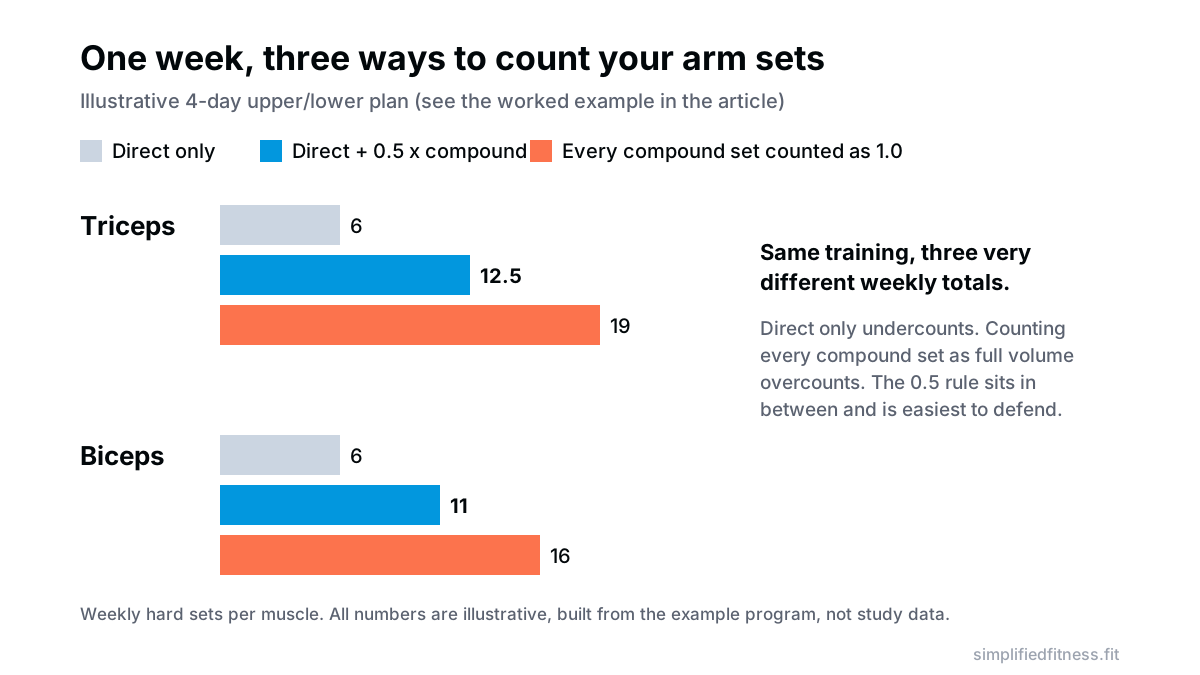
Now compare. If you only counted direct sets, you would think you do 6 triceps sets a week and might add more. If you counted every pressing set in full, you would see 19 and might think you are massively overtraining. The fractional total of 12.5 is a middle estimate that is far easier to act on.
Want a quick check on the raw totals? The training volume calculator can help you add up sets and reps before you apply the credits.
Hamstrings: where the 0.5 rule needs judgment
Hamstrings are the awkward case because they have two jobs: they flex the knee and extend the hip.
A leg curl is a clean direct hamstring set. A stiff-leg or Romanian deadlift loads the hamstrings strongly across the hip, so it earns credit as well, anywhere from 0.5 to 1.0 depending on how much they limit you and how you feel it. Squats and leg presses train the hamstrings far less, so a simple choice is to give them nothing and still plan for a curl.
This part is coaching judgment, because I did not find a trial that tested hamstring credit values directly. If a hamstring estimate matters to you, decide on a rule, write it down, and keep using it.
Do I count every set? Only hard ones
A set only earns credit if it is hard enough to matter. A systematic review of 14 randomized trials in people with at least one year of lifting experience concluded that total sets to failure, or near to it, appears to be an adequate way to quantify hypertrophy volume when the rep range sits between 6 and 20+ and other variables are held constant (Baz-Valle et al., 2021). The authors also said the approach needs further work to decide whether specific set numbers are key.
For you, that means:
- Warm-up sets: zero credit.
- Sets with 5 or more reps left in the tank: little to no credit.
- Hard sets, within roughly 0-3 reps of failure: full credit as above.
Not sure how close to failure you are going? The RIR and RPE calculator helps you gauge it.
Choosing direct exercises that earn their place
If your count shows a gap, pick the direct exercise with the most payoff per set.
For triceps, one trial in 21 adults found that cable elbow extensions performed overhead produced 19.9% whole-triceps growth versus 13.9% with the arm in a neutral position over 12 weeks, measured by MRI (Maeo et al., 2023). That is a single study of 21 adults (one arm per position), so treat it as a hint rather than a rule, but it suggests the overhead position is a good option.
For more on that, and on how the triceps heads work, see triceps anatomy by head. Also see direct vs indirect arm volume and how many sets you need. For where compound lifts fit in the larger picture, read compound vs isolation exercises for hypertrophy.
How to audit your own week in ten minutes
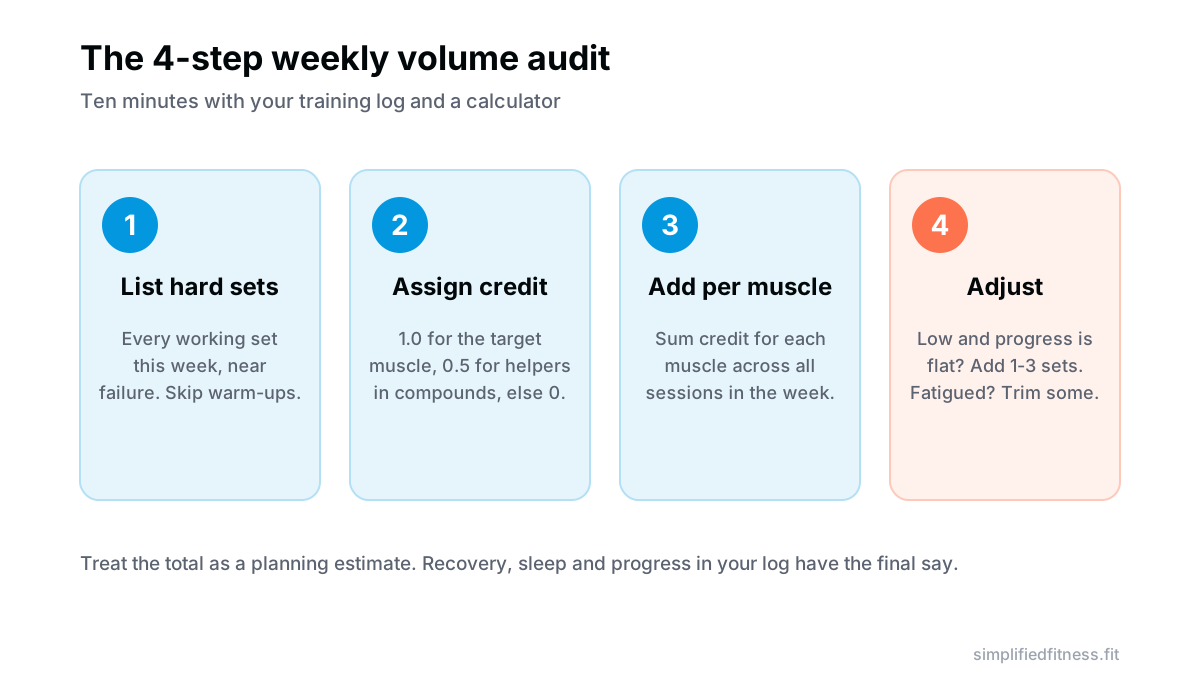
- Write down every hard working set from last week.
- Score each one: 1.0 for the target muscle, 0.5 for assisting muscles in compounds, 0 for the rest.
- Add the credits up for each muscle.
- Compare with how your body is responding. Stalled for a month and recovering well? Add one to three sets. Joints aching and numbers flat? Trim.
Change one thing at a time and give it 4-6 weeks. If you want ready-made weekly structures to start from, try the free push day plan and pull day plan.
When to see a doctor
Sharp or persistent elbow, shoulder or hip pain is not “volume soreness.” If pain lasts more than a couple of weeks, wakes you at night, or comes with numbness, swelling or weakness, see a doctor or physiotherapist before piling on more sets.
The simple version
Count hard sets only. Give 1.0 for direct work and 0.5 for assisting muscles in compounds. Add them up per muscle each week, and use the total to decide whether you need more, less, or just more patience. For the full framework behind weekly sets, frequency and recovery, go back to the training volume and frequency guide.
Frequently Asked Questions
Does bench press count as triceps volume?
Partly. The triceps extend the elbow during every press, so a hard bench set gives them real work, and a fractional method gives it roughly half a set of credit. Research that grouped sets this way found the fractional approach fit best, but that is a model, not a measurement of your own triceps. Count each hard pressing set as 0.5 triceps sets and see how your week adds up.
Do barbell rows count as biceps volume?
Partly, yes. The biceps flex the elbow on every row and pulldown, so these sets contribute, though the back is the main target. Score each hard rowing or pulling set as 0.5 biceps sets rather than a full one. Then check whether your direct curl work still looks sensible.
What is fractional volume in resistance training?
It is a way of counting weekly sets where a muscle gets full credit for direct work and partial credit for compound lifts that involve it. A 2026 meta-regression used 1 for total, 0.5 for fractional and 0 for direct-only counting of indirect sets, and the fractional option had the strongest relative evidence. In practice you give isolation sets 1.0 and synergist work in compounds 0.5.
How many sets per week do I need for biceps and triceps?
There is no single number, because needs vary with training history, recovery and how much compound work you already do. Meta-analytic data show gains rising with weekly volume with diminishing returns, but the exact curve depends on how sets are counted. Use your fractional total as a starting point, hold it for 4-6 weeks, and adjust based on progress.
Do I need direct arm training if I do heavy compounds?
Not always. A trial in trained men found adding single-joint exercises to a multi-joint program gave no significant extra arm benefit over 8 weeks, but it was small (20 men) and short. A separate small study in untrained men found curls grew the elbow flexors more than rows. If you enjoy arm work or your arms lag, keeping a few direct sets is reasonable.
Does overhead press count as front delt volume?
Yes, and probably generously, since the front delts do a lot of work in any pressing movement. Many lifters give heavy overhead and incline pressing 0.5 credit or more for the front delts. If your pressing volume is already high, front raises are rarely needed.
Do squats and deadlifts count as hamstring volume?
It depends on the lift and on your judgment. Stiff-leg and Romanian deadlifts load the hamstrings heavily across the hip, so many coaches give them partial or even full credit. Squats train the hamstrings far less, so count them as zero and keep a direct leg curl in the plan.
Should warm-up sets count toward weekly volume?
No. A systematic review in trained people concluded that total sets taken to failure, or near to it, is an adequate way to quantify volume, which implies easy sets add little. Count only working sets that are hard. Log warm-ups separately so they do not inflate your total.
Do isolation exercises count as 1.0 set for the target muscle?
In the standard method, yes, a hard direct set earns full credit. It also gives small spillover to neighbouring muscles, which you can ignore for simple tracking. The goal is a consistent system, not perfect accounting.
Can I accidentally overtrain my arms by counting wrong?
It is possible to drift into too much arm volume if you stack many direct sets on top of heavy pressing and pulling and forget the indirect work. Warning signs are persistent elbow aches, stalled numbers and arms that are sore when you start the next session. Cut direct sets by a third and see how you feel for two weeks.
Is 0.5 the right number for every exercise and every person?
No. The 0.5 figure comes from comparing how well different counting methods predicted results across studies, so it is an average rather than a value for each lift. A close-grip bench or dip leans more on the triceps than a wide incline press does. Treat it as a planning tool and adjust using your own response.
Does this method work for strength training as well as hypertrophy?
The same meta-regression modelled both outcomes and concluded that separating direct from indirect sets mattered for predicting adaptations to each. The shape of the curve differs, with strength showing more pronounced diminishing returns. If your goal is size, use the weekly fractional total; if it is strength, practising the lift itself matters most.
How accurate is a fractional set count for my own training?
It is an estimate. Muscle size changes in studies are averages across people, and your exercise technique, range of motion and effort all change how much a set really delivers. Use the count to compare one week with another, not to chase an exact number.
Sources & References
Every claim above is checked against peer-reviewed research (PubMed, U.S. National Library of Medicine) or guidance from established health bodies. How we fact-check.
- Pelland JC, et al. The Resistance Training Dose Response: Meta-Regressions Exploring the Effects of Weekly Volume and Frequency on Muscle Hypertrophy and Strength Gains. Sports Med. 2026. PMID: 41343037
- Schoenfeld BJ, et al. Dose-response relationship between weekly resistance training volume and increases in muscle mass: A systematic review and meta-analysis. J Sports Sci. 2017. PMID: 27433992
- Baz-Valle E, et al. Total Number of Sets as a Training Volume Quantification Method for Muscle Hypertrophy: A Systematic Review. J Strength Cond Res. 2021. PMID: 30063555
- Gentil P, et al. A Review of the Acute Effects and Long-Term Adaptations of Single- and Multi-Joint Exercises during Resistance Training. Sports Med. 2017. PMID: 27677913
- de Franca HS, et al. The effects of adding single-joint exercises to a multi-joint exercise resistance training program on upper body muscle strength and size in trained men. Appl Physiol Nutr Metab. 2015. PMID: 26244600
- Mannarino P, et al. Single-Joint Exercise Results in Higher Hypertrophy of Elbow Flexors Than Multijoint Exercise. J Strength Cond Res. 2021. PMID: 31268995
- Maeo S, et al. Triceps brachii hypertrophy is substantially greater after elbow extension training performed in the overhead versus neutral arm position. Eur J Sport Sci. 2023. PMID: 35819335

Umair Hazrami · Founder & Head Coach, Simplified Fitness
Umair Hazrami founded Simplified Fitness and the Simplified Lifter channel to cut through fitness noise. With 4+ years of consistent training and 10+ coaching clients, he writes every guide from the peer-reviewed research and links the sources so you can check them. Our editorial standards.
Educational content only, not medical advice. If you have a medical condition, are pregnant, or take medication, talk to a qualified doctor before changing your diet, supplements or training. Full disclaimer.
Keep reading
Programming
Autoregulation of Set Volume: Add or Cut Sets Based on Readiness and Velocity Loss
Autoregulation training volume explained: use warm-up speed, RIR and a 20-25% performance drop to add or cut sets, and what the evidence does or does not prove.
9 min read
Programming
The Biological Cost of High Volume: Sleep, Cortisol and Immune Strain
High volume lifting side effects: what research says about poor sleep, cortisol and colds, which warning signs matter, and how to scale back.
9 min read
Programming
Distributing Weekly Volume: Full Body 3x vs Upper/Lower 4x vs PPL 6x
Distributing weekly volume across splits: how 12 sets per muscle look in full body, upper/lower and PPL, plus session length math and which fits your week.
9 min read
Programming
HIT (Mentzer Heavy Duty) vs High-Volume Training: What the Evidence Says
Does Mike Mentzer HIT training work? See what meta-analyses say about 1 set to failure vs multiple sets, and a realistic middle ground for busy lifters.
8 min read