Distributing Weekly Volume: Full Body 3x vs Upper/Lower 4x vs PPL 6x
Distributing weekly volume across splits: how 12 sets per muscle look in full body, upper/lower and PPL, plus session length math and which fits your week.

TL;DR. The short answer
- Distributing weekly volume is mostly a scheduling question. Once weekly hard sets per muscle are equal, studies in trained lifters have found similar muscle and strength gains whether sessions were spread over 2, 3, 4 or 6 days.
- Twelve weekly sets can be 3 x 4 (full body), 2 x 6 (upper/lower) or 2 x 6 (push/pull/legs). The total dose is identical, but sets per session, rest days and total gym visits are very different.
- Training each muscle at least twice a week is a sensible floor: a 2016 meta-analysis favoured twice over once, while newer volume-equated analyses suggest frequency itself matters little for size. Three times a week has not been shown to beat twice.
- Upper/lower on 4 days is a sensible default for many natural lifters because it hits each muscle twice with moderate sessions, but the research does not prove it is better than the alternatives.
- Evidence comes mostly from 6-9 week trials in young, healthy participants, so treat split choice as a practical decision, not a magic lever.
Part of our complete guide: Optimal Training Volume and Frequency: How Many Sets per Muscle Actually Build Muscle
Table of contents
Distributing weekly volume is the part nobody explains after they tell you “do 12 sets per muscle.” Twelve sets can be four sets three times a week, or six sets twice a week. For most lifters the research says it matters less than you think, as long as each muscle gets trained at least twice and the total hard sets stay the same.
This article is the maths bridge between volume and your split. If you want the bigger picture first, start with our training volume and frequency guide. If you want a full comparison of how the splits feel in real life, see workout splits compared. Here we stay on one question: how do you spread a weekly dose of sets?
What does distributing weekly volume actually mean?
Pick one muscle, say chest. Count the hard sets you do for it across seven days. That is your weekly volume. Distribution is how those sets are cut into sessions.
Same 12 sets. Very different weeks.
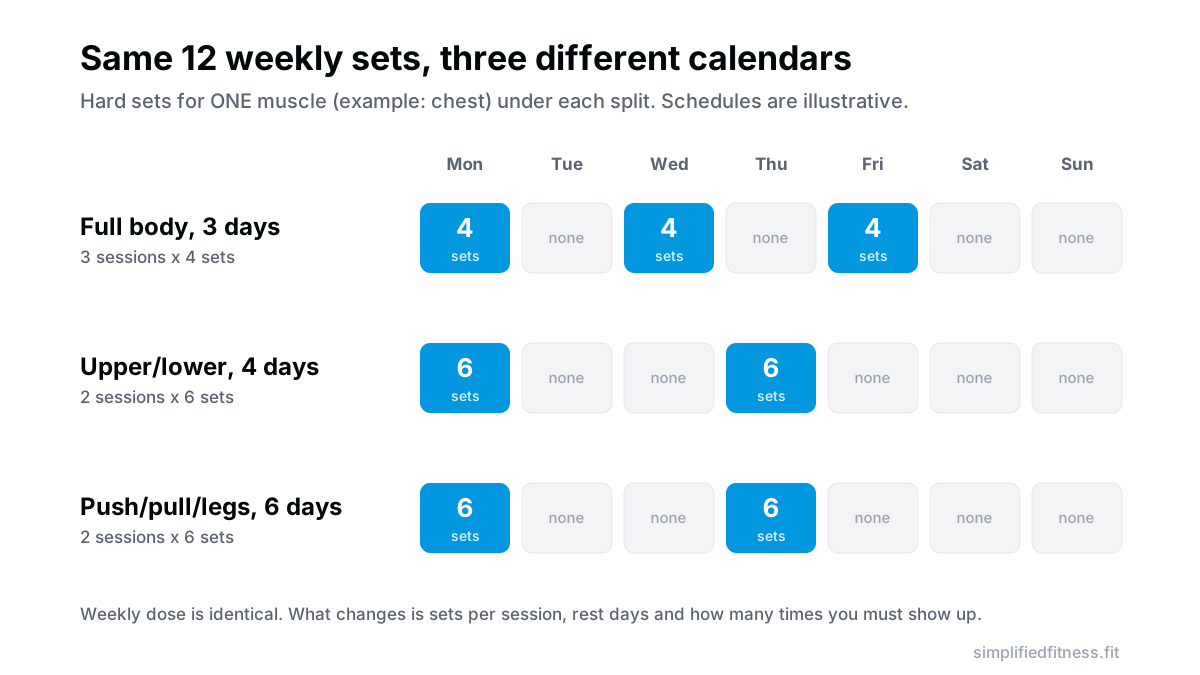
A quick note on what counts. A hard set is a set taken close enough to failure to be a real growth stimulus. Warm-ups do not count. Junk sets with ten reps left in the tank do not count either. We cover counting rules in hard sets vs tonnage, and the 2026 meta-regression we use below found that counting indirect sets as a fraction of a direct set fit the data best (Pelland et al., 2026).
Does the way I split the sets change muscle growth?
Mostly no, once volume is equal. That is the honest summary, with caveats we will get to.
Weekly volume does the heavy lifting. A meta-regression of 15 studies found a graded dose-response: each extra weekly set was associated with a small gain in muscle size, about 0.37% in percentage gain (Schoenfeld et al., 2017). In trained men doing three sessions a week, higher volumes produced more growth in the elbow flexors and thigh muscles, while strength gains were similar across groups (Schoenfeld et al., 2019). The 2026 meta-regression of 67 studies and 2058 participants agrees that gains rise with volume, with diminishing returns (Pelland et al., 2026).
Frequency matters less once volume is matched. Let’s look at the trials that did the matching.
- Colquhoun et al. (2018): 28 resistance-trained men trained 3 or 6 days a week for 6 weeks. Strength and fat-free mass improved in both groups, with no significant differences between them (Colquhoun et al., 2018).
- Saric et al. (2019): 27 resistance-trained men did the same comparison, 3 vs 6 sessions weekly, for 6 weeks. Strength and muscle thickness changes were similar, with one exception: only the 3-day group significantly increased elbow flexor thickness (Saric et al., 2019).
- Hamarsland et al. (2021): 21 trained participants (11 men, 10 women) trained 2 or 4 times weekly for 9 weeks. No differences for lean mass, muscle thickness or strength (Hamarsland et al., 2021).
Where the studies disagree. The 2026 meta-regression found frequency’s effect on hypertrophy was compatible with negligible effects, while for strength the effect on gains was identifiable, with diminishing returns (Pelland et al., 2026). A 25-study meta-analysis also concluded that frequency does not meaningfully change hypertrophy when volume is equated (Schoenfeld et al., 2019). The older 2016 analysis leaned toward frequency helping size, but it had only ten studies, while newer analyses pool far more data and classify sets more carefully. Practical takeaway: aim for at least twice a week per muscle, mainly because it keeps each session manageable, then stop worrying about squeezing in a third day. For the full frequency debate, including bro splits, see training frequency 1x vs 2x vs 3x.
One limit worth stating plainly. These trials ran 6-9 weeks, had small samples, and used young, healthy people. We do not know how this plays out over years, in older lifters, or in people with very high volumes.
The maths: 12 sets per muscle in each split
Let’s do the arithmetic that most split articles skip. Say you train eight muscle groups (quads, hamstrings, chest, back, shoulders, biceps, triceps, calves) at 12 sets each. That is 96 hard sets a week. How that divides depends on the split. These numbers are illustrative, not from a study.
| Split | Sessions per week | Sets per muscle per session | Rough sets per session | Rest days |
|---|---|---|---|---|
| Full body 3x | 3 | 4 | up to about 32 | 4 |
| Upper/lower 4x | 4 | 6 | about 30 (upper), 18 (lower) | 3 |
| PPL 6x | 6 | 6 (each muscle twice) | about 18 (push), 12 (pull), 18 (legs) | 1 |
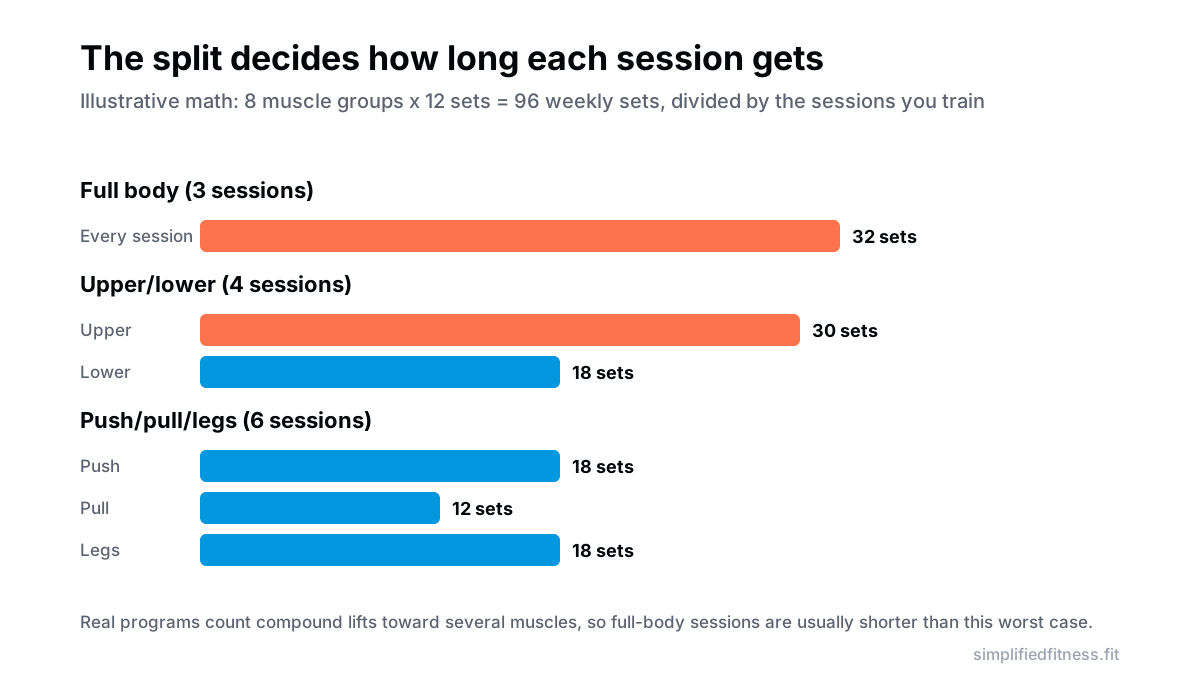
Three things jump out.
Full body gets crowded. Four sets for eight muscle groups is a lot of work in one session. In practice compound lifts overlap (rows hit biceps, presses hit triceps), so the real number is lower, and many full-body lifters trim accessory work. Fine, as long as you know that is a trade.
Upper/lower has an uneven split. The upper session carries more muscles than the lower session. You can balance it by adding calves and glutes work to lower days, or by moving shoulders to the lower day in a different order. Simple fix.
PPL buys short sessions with calendar time. Each session is shorter, but you need six days. Total sets are the same, so total time under the bar is roughly the same too. You are just chopping it into more trips to the gym.
Session length, set quality and fatigue
Here is where the split can quietly change results. If a session is long, late sets are done tired, with shorter rests or sloppier reps. A set that is not close to failure with good technique stops counting as a hard set, even if your log says it was.
We cannot give you a proven per-session cap, because research on that is limited and mixed. We cover what exists in per-session set caps. The coaching version is simpler: if a muscle gets six hard sets in one session and the last two feel like going through the motions, move them to another day.
Systemic fatigue matters too. Heavy squats and deadlifts in a long full-body session can leave you flat for the later exercises. That is another reason lower-body days are often kept to a handful of big lifts.
So is upper/lower the best split for distributing volume?
It is a very good default, but not a proven winner. Let’s separate what the research supports from what is coaching judgment.
Supported: training each muscle about twice a week, with weekly sets matched, gives you what the evidence can currently show. Upper/lower does that on 4 days.
Not shown: that upper/lower beats full body or PPL in a head-to-head trial. The studies above compared frequencies, not named splits, and the lifters were doing different programs. So I would not tell anyone that upper/lower is magically superior for natural lifters.
Why many people land there anyway:
- It reaches the twice-a-week target with 6 sets per muscle per session, a dose most people can do well.
- It leaves three rest days, which helps in a hot Indian summer or a heavy work week.
- It is easy to scale: add or remove a set per muscle per session without rebuilding the program.
- It forgives a missed day better than PPL, where missing one session leaves a muscle at one weekly hit.
We go deeper on the plan itself in the upper/lower 4-day guide. Full body has its own strong case, laid out in the full body 3-day plan, and PPL variants are in the push pull legs guide.
How to choose: a simple decision guide
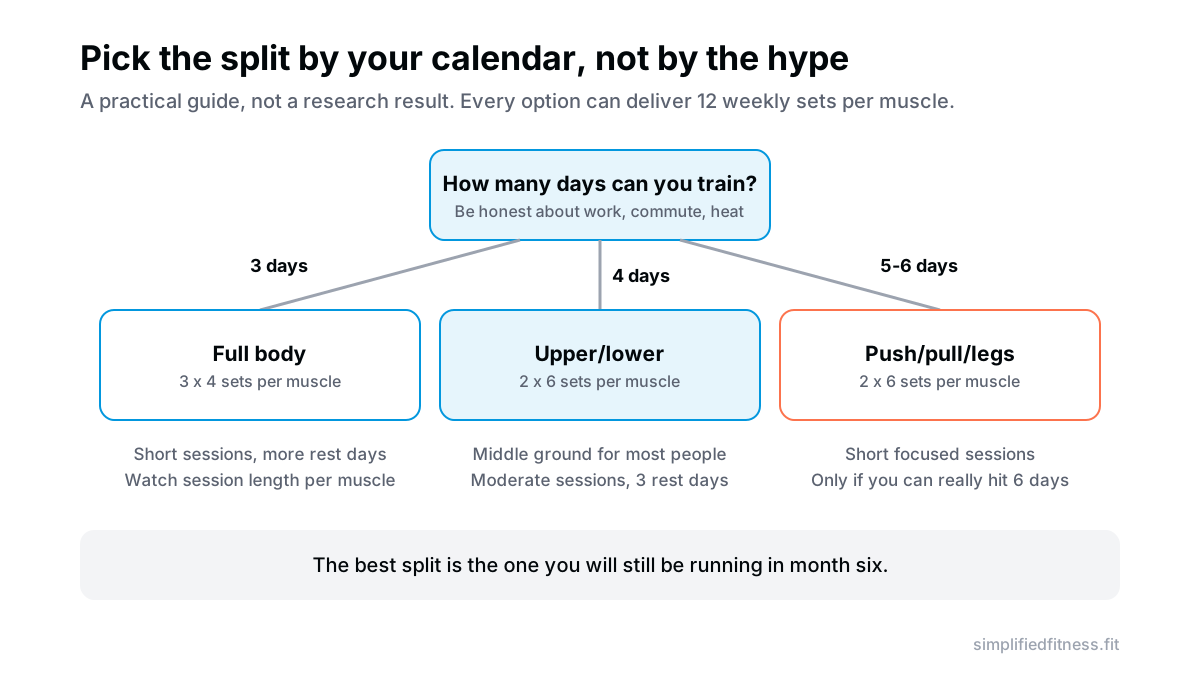
Use these questions in order.
- How many days can you train for the next three months? Not your best week. Your average week, including travel, festivals, exams and office deadlines.
- Does each muscle get at least two exposures? If not, adjust the split.
- Can you finish each session with good effort on the last set? If not, shorten the session or add a day.
- Can you recover? If you are sleeping badly or constantly sore, trim sets before adding days. See volume that outruns recovery.
For the skeleton of how a session is built, our workout splits and session architecture guide covers exercise order and structure. And if you want to see where your current week lands, the training volume calculator counts weekly sets for you. Our free plans give you a ready-made push, pull and legs template to start from.
A worked example: one lifter, three schedules
Take a vegetarian lifter eating dal, paneer and curd, who wants 12 chest sets a week.
- 3 days: 4 chest sets Monday, Wednesday, Friday. Short, simple, and rest days on weekends.
- 4 days: 6 chest sets on upper day one, 6 on upper day two. Rest Wednesday, Saturday and Sunday.
- 6 days: 6 chest sets on push day one, 6 on push day two. Pull and leg days in between.
All three hit 12. If you can only train on weekdays and weekends are for family, the 3-day or 4-day option usually wins on adherence. Diet matters in all three: protein intake still has to support the work, so check yours with the protein calculator.
When to be careful
Training volume is safe for most healthy adults when it is built up gradually. See a doctor before starting or changing a program if you have heart disease, uncontrolled blood pressure, a recent injury, or you are pregnant. Stop and get checked if you get chest pain, dizziness, or joint pain that keeps getting worse. Persistent exhaustion, poor sleep, or a drop in performance across several weeks may mean you are doing too much, and a few lighter weeks is usually the first step.
The bottom line
Distributing weekly volume is a scheduling decision more than a physiological one. Pick your weekly sets, divide them so each muscle is trained about twice, and choose the split that your calendar and recovery can sustain. Full body 3x, upper/lower 4x and PPL 6x can all deliver 12 sets per muscle. Upper/lower is a balanced starting point for many people, but the evidence does not crown it.
Start with the number of days you can really commit to. Then keep the weekly sets steady for a month and watch your strength and measurements, not the name on the program.
Frequently Asked Questions
Which split is best for distributing weekly volume?
There is no single best split once weekly sets are equal. Volume-equated trials in trained people found similar results across different frequencies, so the best split is the one that lets you hit your sets with good effort every week. For most people with 4 free days, upper/lower is a practical starting point.
How should I organize 12 weekly sets per muscle?
Split them across at least two sessions, for example 2 x 6 or 3 x 4. An older meta-analysis favoured twice a week over once for growth, and smaller doses per session make it easier to keep every set hard. Write the plan down by muscle, count your hard sets for one week, and adjust from there.
Is full body 3x per week good for hypertrophy?
Yes, it can work well. Training each muscle three times weekly meets the twice-a-week minimum, and a 2019 trial in trained men found 3 sessions a week produced similar gains to 6 when volume was equal. The catch is session length, so keep the exercise list tight and use compound lifts.
Is upper/lower better than push/pull/legs?
Not on the evidence we have. Both can deliver 12 sets per muscle in two weekly doses, and no study cited here compares those exact splits head to head. Upper/lower needs 4 gym days while PPL as 6 days needs 6, so your schedule usually decides it.
Does training 6 days a week build more muscle than 3 days?
Not when volume is equated. Two 6-week trials in resistance-trained men found similar strength and muscle mass changes with 3 and 6 weekly sessions (one arm measure favored the 3-day group). If you do 6 days, make sure each muscle is not simply getting more total sets, since that is what changes results.
How many sets per session is too many for one muscle?
There is no firm cutoff proven in research, and it varies by person and exercise. A common coaching rule is to avoid piling a whole week of sets into one day, which is one reason we cover it separately in the per-session caps article. If your last sets feel sloppy or your reps fall off sharply, split the work across another day.
Do I need to train a muscle three times a week?
No. A 2016 meta-analysis found twice weekly beat once weekly, while whether three times beats twice remained undetermined. A 2026 meta-regression found frequency's effect on hypertrophy was compatible with negligible. Twice a week is a safe, efficient target.
Does frequency matter for strength differently than for size?
Slightly. The 2026 meta-regression found strength gains rose with frequency, with diminishing returns, while the frequency effect on hypertrophy was compatible with negligible. Practising a lift more often helps skill, so if strength matters to you, favor at least two exposures per lift.
Which split is best for a beginner?
Full body 3 days a week is a common choice because every lift is practised often and sessions can be short. Beginners usually do not need 12 hard sets per muscle yet, so start lower and build. Pick a plan you can repeat without missing sessions.
What if I can only train 3 days but want upper/lower?
You can rotate upper and lower through the week, so each muscle gets trained about once or twice weekly depending on the week. That is a reasonable compromise, but a full body plan makes hitting twice per muscle simpler. Check your actual weekly sets by muscle rather than guessing.
How long should each workout take under each split?
Total gym time is similar because total sets are similar. At roughly 2-3 minutes per hard set including rest, 30 sets takes about 60-90 minutes, which is my rough estimate rather than a study result. Fewer, longer sessions suit people with limited days, and more, shorter sessions suit those who can attend daily.
Should I count compound lifts toward several muscles?
Partly. A 2026 meta-regression found counting indirect sets as a fraction of a direct set predicted gains better than ignoring or fully counting them. In practice, bench press counts mostly for chest and partly for triceps, so do not add a full set for each.
When should I see a doctor about training soreness or fatigue?
See a doctor if you have chest pain, dizziness, sharp joint pain, or fatigue and soreness that do not ease after several days off. Normal muscle soreness fades within a few days. Do not train through symptoms you cannot explain.
Sources & References
Every claim above is checked against peer-reviewed research (PubMed, U.S. National Library of Medicine) or guidance from established health bodies. How we fact-check.
- Schoenfeld BJ, et al. Effects of Resistance Training Frequency on Measures of Muscle Hypertrophy: A Systematic Review and Meta-Analysis. Sports Med. 2016. PMID: 27102172
- Colquhoun RJ, et al. Training Volume, Not Frequency, Indicative of Maximal Strength Adaptations to Resistance Training. J Strength Cond Res. 2018. PMID: 29324578
- Saric J, et al. Resistance Training Frequencies of 3 and 6 Times Per Week Produce Similar Muscular Adaptations in Resistance-Trained Men. J Strength Cond Res. 2019. PMID: 30363041
- Hamarsland H, et al. Equal-Volume Strength Training With Different Training Frequencies Induces Similar Muscle Hypertrophy and Strength Improvement in Trained Participants. Front Physiol. 2021. PMID: 35069251
- Pelland JC, et al. The Resistance Training Dose Response: Meta-Regressions Exploring the Effects of Weekly Volume and Frequency on Muscle Hypertrophy and Strength Gains. Sports Med. 2026. PMID: 41343037
- Schoenfeld BJ, et al. Dose-response relationship between weekly resistance training volume and increases in muscle mass: A systematic review and meta-analysis. J Sports Sci. 2017. PMID: 27433992
- Schoenfeld BJ, et al. How many times per week should a muscle be trained to maximize muscle hypertrophy? A systematic review and meta-analysis of studies examining the effects of resistance training frequency. J Sports Sci. 2019. PMID: 30558493
- Schoenfeld BJ, et al. Resistance Training Volume Enhances Muscle Hypertrophy but Not Strength in Trained Men. Med Sci Sports Exerc. 2019. PMID: 30153194

Umair Hazrami · Founder & Head Coach, Simplified Fitness
Umair Hazrami founded Simplified Fitness and the Simplified Lifter channel to cut through fitness noise. With 4+ years of consistent training and 10+ coaching clients, he writes every guide from the peer-reviewed research and links the sources so you can check them. Our editorial standards.
Educational content only, not medical advice. If you have a medical condition, are pregnant, or take medication, talk to a qualified doctor before changing your diet, supplements or training. Full disclaimer.
Keep reading

Programming
Autoregulation of Set Volume: Add or Cut Sets Based on Readiness and Velocity Loss
Autoregulation training volume explained: use warm-up speed, RIR and a 20-25% performance drop to add or cut sets, and what the evidence does or does not prove.
9 min read
Programming
The Biological Cost of High Volume: Sleep, Cortisol and Immune Strain
High volume lifting side effects: what research says about poor sleep, cortisol and colds, which warning signs matter, and how to scale back.
9 min read

Programming
How to Count Compound Sets Toward Weekly Volume: Direct vs Fractional Sets
How to count compound sets volume for arms, delts and hamstrings: the 1.0 and 0.5 fractional rule, a worked weekly example and what the research says.
9 min read
Programming
HIT (Mentzer Heavy Duty) vs High-Volume Training: What the Evidence Says
Does Mike Mentzer HIT training work? See what meta-analyses say about 1 set to failure vs multiple sets, and a realistic middle ground for busy lifters.
8 min read