Autoregulation of Set Volume: Add or Cut Sets Based on Readiness and Velocity Loss
Autoregulation training volume explained: use warm-up speed, RIR and a 20-25% performance drop to add or cut sets, and what the evidence does or does not prove.

TL;DR. The short answer
- Autoregulating training volume means you let how a session is actually going decide the final set count, instead of forcing the number written in your plan.
- Velocity loss of about 20-25% within a set is one of the most studied stop rules. Higher thresholds tend to give slightly more muscle growth; for strength, one meta-analysis found a small edge for 25% or less while another found the threshold made no difference.
- You do not need a bar-speed sensor. Reps dropping by roughly 20-25% from your first set at the same load, or an RIR estimate that has drifted, is a cheap stand-in, though that translation is a coaching extrapolation, not a tested rule.
- A 2022 meta-analysis found autoregulated and percentage-based load prescription gave similar strength gains in trained people, so autoregulation is a tool for fit and sustainability, not a proven shortcut.
- Feeling flat is not a reason to skip the session. Cut sets only after a proper warm-up, and see a doctor if fatigue or poor performance lasts for weeks.
Part of our complete guide: Optimal Training Volume and Frequency: How Many Sets per Muscle Actually Build Muscle
Table of contents
Autoregulation training volume is a simple idea: the number of sets you finish is decided partly by how the session is going, not only by the number in your spreadsheet. If your first sets are fast and crisp, you can earn an extra one. If reps fall off a cliff, you stop that exercise early and move on. Research supports a speed drop of roughly 20-25% within a set as a sensible stop point, and a similar drop in reps across sets is a reasonable gym translation. It does not show that autoregulation beats a fixed plan for strength.
This sits inside the bigger question of how many sets you need each week, which we cover in our training volume and frequency guide. Here the question is narrower. You walk in feeling wrecked, or feeling unstoppable. What do you do with the set count?
What does autoregulating set volume actually mean?
Plans are written weeks ahead by someone who cannot see how you slept, what you ate, or whether your boss ruined your Tuesday. Autoregulation hands a small part of that decision back to you, using a measurable signal.
Three signals do most of the work:
- Bar speed at a familiar warm-up load.
- Rep performance: how many reps you get at the same weight as last week, and how fast they fall across sets.
- RIR or RPE: how many reps you think you had left.
You still follow a plan. You just write it as a range, say 3-5 sets, and the session picks the number. The mistake I see most often is treating “autoregulation” as a polite word for “do less when it’s hard”. It is not. It works in both directions, and it needs a rule you set before you pick up the bar.
What is velocity loss and why does it set a stop point?
Every rep in a set gets a little slower as fatigue builds. Velocity loss is the percentage drop from your fastest rep to the current one. Researchers use it as a live fatigue meter, ending the set (or the exercise) once the drop hits a threshold such as 10%, 20% or 40%.
A 2023 systematic review and meta-analysis pooled 18 acute and 19 longitudinal studies on this (Jukic et al., 2023). It found a graded relationship: as the allowed velocity loss rises, reps per set, blood lactate and perceived exertion go up, while jump height, sprint times and speed against fixed submaximal loads tend to get worse. Exercise, load and training history modulate the size of those effects.
That graded relationship is the whole logic of volume autoregulation. A set that stops at 20% loss has used less fatigue budget than one that grinds to 40%.
One detail matters for this article. In the training trials below, the velocity loss rule capped the reps within each set, while the number of sets was fixed in advance. Using a performance drop across sets to decide how many sets you do is a practical extension of that idea, not something these trials tested directly.
What do the studies say about 20% versus 40%?
Two trials from the same Seville group are the best-known head-to-heads.
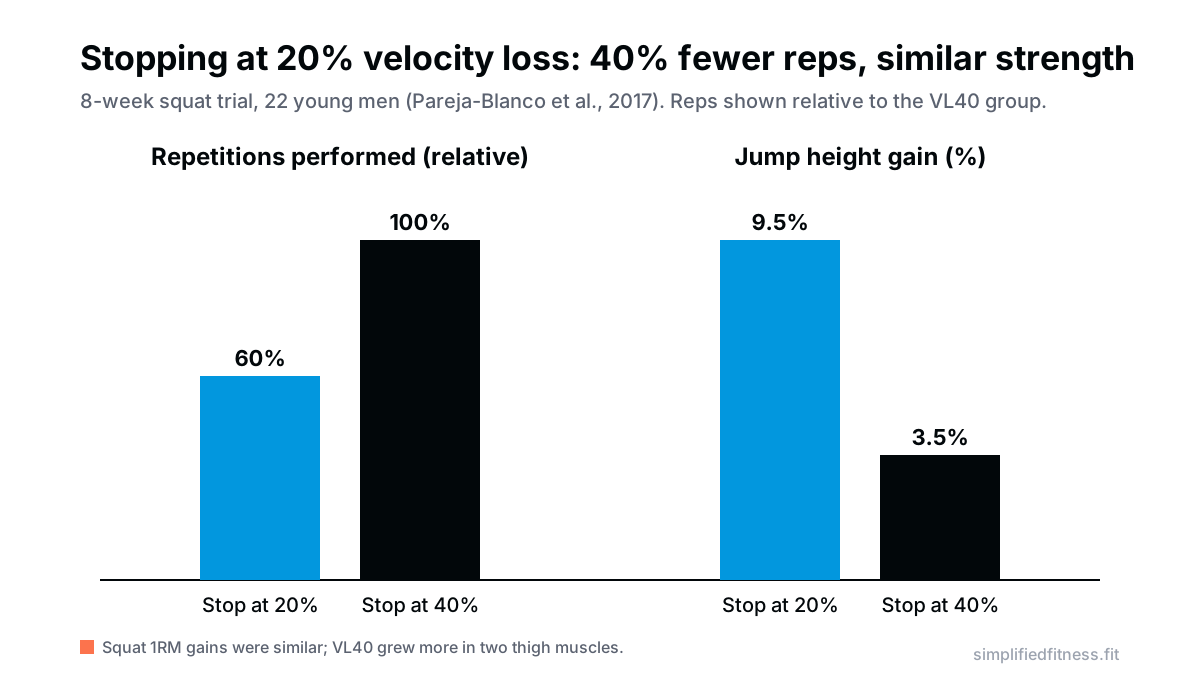
In the first, 22 young men trained the squat for 8 weeks, stopping each set at either 20% or 40% velocity loss (Pareja-Blanco et al., 2017). The 20% group did about 40% fewer repetitions yet gained similar squat strength and improved countermovement jump more (9.5% versus 3.5%). The 40% group did build more muscle in two of the quadriceps muscles measured.
In the second, 64 resistance-trained men were split into 0%, 10%, 20% and 40% groups for 8 weeks of squatting, with sets and relative load matched (Pareja-Blanco et al., 2020). Strength, jump and sprint gains did not differ between groups. The 20% and 40% groups showed significant increases in muscle size, while only the 40% group showed negative neuromuscular changes such as slower force development. The authors suggest moderate thresholds make sense when strength is the priority.
Both trials are small, short and in young men squatting. Treat them as a signal, not a law.
What does the bigger picture show?
Meta-analyses smooth out single-study noise, but they add their own complications.
The 2023 Jukic review concluded that the threshold did not affect strength or muscular endurance gains, that higher thresholds were superior for hypertrophy, and that lower thresholds were superior for jumping, sprinting and speed against submaximal loads.
A 2022 meta-analysis on load and volume autoregulation in resistance-trained people reached a more specific split. Thresholds at or below 25% gave slightly more 1RM strength (about 2.3 kg), while thresholds above 25% gave slightly more muscle cross-sectional area (about 0.6 cm2) (Hickmott et al., 2022). Above 25% did not beat 20-25% for hypertrophy, but it did beat 20% or less.
Then there is the proximity-to-failure meta-analysis. It found no significant hypertrophy difference between high (over 25%) and moderate (20-25%) velocity loss thresholds, and no advantage of momentary failure over stopping short of it (Refalo et al., 2023).
| Source | What it found | Plain read |
|---|---|---|
| Jukic 2023 (37 studies) | Threshold did not change strength; higher thresholds favoured hypertrophy | More fatigue, slightly more growth |
| Hickmott 2022 (15 studies) | 25% or less: a little more strength. Over 25%: a little more size | A trade-off, not a winner |
| Refalo 2023 (15 studies) | No significant gap between over 25% and 20-25% | The curve flattens |
Why the apparent disagreement? Different studies lump thresholds differently, use different exercises, and measure muscle size with different tools. The cautious takeaway: stopping at 20-25% is a good default. If a muscle is a priority, you can let a few sets run a little further, but the extra growth on offer is small.
How to do it without a bar-speed sensor
Velocity trackers are accurate but nobody needs one to apply the idea. Two free substitutes carry most of the signal.
Rep drop at the same load. If your first work set at 60 kg is 10 reps and the third is 7-8, you have lost roughly 20-25% of your output. That is a stop sign for that exercise. This is an extrapolation from bar-speed studies, not a validated rule, so adjust by feel.
RIR as the gate. Recent work suggests lifters can estimate reps in reserve well. In 24 resistance-trained men and women on the bench press, 1 RIR and 3 RIR predictions had a mean absolute error of 0.65 reps, with a small tendency to underpredict (Refalo et al., 2024). Another study of trained and untrained men and women on machine biceps curls, triceps pushdowns and seated rows found accuracy improved closer to failure and in later sets, with no significant effect of sex or experience (Remmert et al., 2023). Use our RIR/RPE calculator to anchor loads.
The takeaway: you are not as bad at guessing as you think, especially near the end of a set.
A simple session-day decision rule
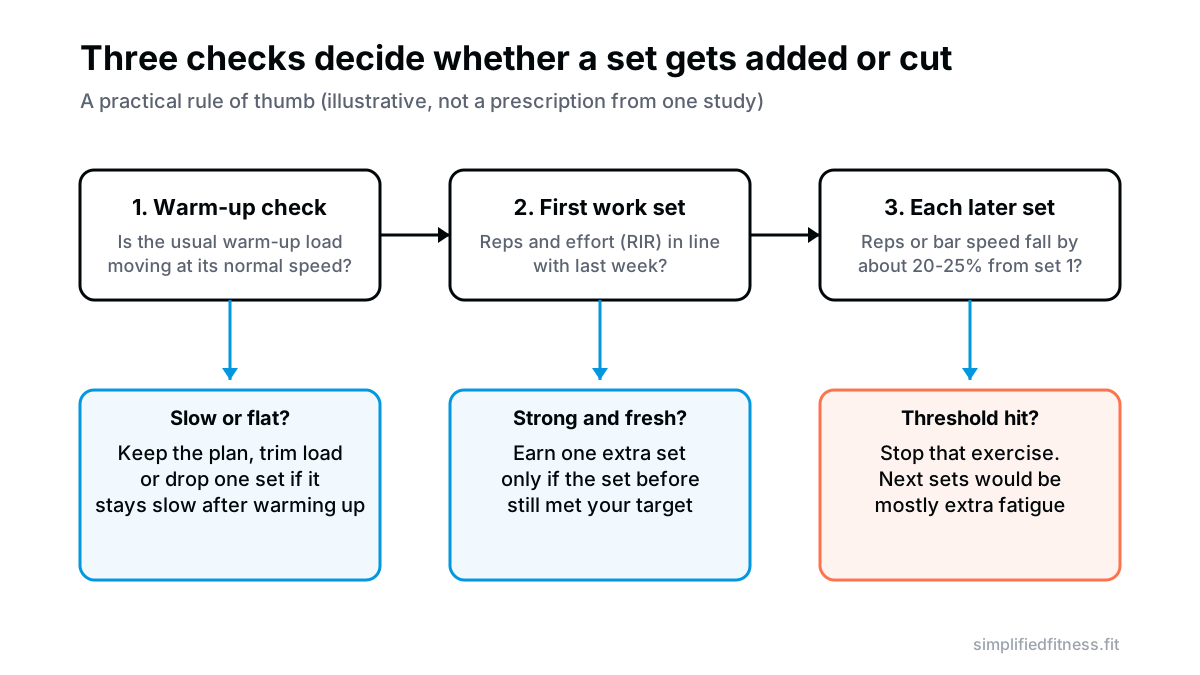
Here is a clean way to run it. Write each exercise as a range, for example 3-5 sets, then:
- Warm up properly. Do not judge your day off a cold first rep.
- Check set 1 against last week. Same load, similar reps, similar effort?
- After each set, check the drop. If reps or speed are down about 20-25% from set 1, stop that exercise.
- Add a set only when the set before met your target with reps to spare, and you are still under your weekly ceiling.
- Cut a set when set 1 is clearly below last week even after warming up.
If you run a push, pull, legs split, the same rule works on any lift. Try it with our push day and see where your set counts land.
When “cutting sets short” is just being lazy
This is the part that gets skipped. Autoregulation is not a free pass.
Warm-up first. A rep that feels heavy at 7 am in a cold gym often feels normal after two ramp-up sets. Judge by the numbers, not by your mood walking in.
Then ask whether this is one flat day or a pattern. One flat day: trim a set or two, keep the session. Three or four in a row, plus poor sleep, low appetite or nagging joint pain: that is a signal to reduce volume across the week, which we cover in overtraining versus non-functional overreaching and deloads and volume resensitization.
If you feel unwell, dizzy, have chest pain or unusual shortness of breath, or fatigue that lasts for weeks, that is a doctor question, not a programming one.
What if you feel on fire?
The opposite problem. First set flies, your PRs are suddenly easy, and the temptation is to add six sets.
Add one, maybe two, on a muscle you are prioritising. Then stop. Weekly volume creeps, and what you can recover from tomorrow is not what you feel today. The per-session ceiling is covered in our guide to set volume per session, and the weekly range in volume landmarks.
Do women need different thresholds?
Possibly, but the data are thin. In an 8-week trial comparing 20% and 40% velocity loss in young men and women, everyone improved and there were no statistically significant differences between groups, though women showed larger effect sizes with 40% in strength and power measures (Rissanen et al., 2022). That is one short study. A reasonable approach is to treat 20-25% as the default and let women experiment toward the upper end if sets feel too easy.
Keeping it sustainable across a mesocycle
Autoregulation changes the daily set count, not the direction of the block. Aim for a weekly set range, start toward the low end, and let good days nudge you up. Weeks where your sessions keep coming in under target are information: either recovery needs attention (sleep, calories, protein) or your plan is too ambitious.
In an Indian context this often means the basics. A hot, humid gym, a long commute, a breakfast of two parathas and chai, then a 6 pm session on four hours of sleep. Speed and reps will tell you the truth long before a diary will. Check the plate before you blame the program, and for how much protein you are actually eating, use our protein calculator.
For a deeper look at rep-based progression rules, see autoregulated progressive overload (APRE), and for the failure question see training to failure versus RIR. To total up your week, use the training volume calculator.
The bottom line
Autoregulating volume is a rule, not a mood. Warm up, compare set 1 with last week, stop an exercise when output has dropped about 20-25%, add a set only when you have earned it, and keep a weekly ceiling and floor. The evidence says the 20-25% zone is a sensible compromise between strength and size, and that autoregulation matches fixed plans rather than beating them. That is enough to make it worth using, and honest enough to not oversell it.
Frequently Asked Questions
What is autoregulation of training volume?
It means adjusting how many sets you do in a session based on how you are performing that day, rather than always completing a fixed number. The input can be bar speed, reps achieved at a set load, or how many reps you feel you have left. The practical move is to write a range (for example 3-5 sets) and let your first sets decide where you land.
What is velocity loss in resistance training?
Velocity loss is how much slower your reps get during a set compared with your fastest rep, usually expressed as a percentage. It rises as fatigue builds, and a 2023 review found reps per set, lactate and perceived exertion all rise with higher thresholds. In practice, a rep that suddenly grinds is the free version of this signal.
What velocity loss threshold is best for muscle growth?
There is no single best number. A 2022 meta-analysis found thresholds above 20-25% were better for hypertrophy than 20% or below, while a 2023 meta-analysis of proximity-to-failure found no significant difference between high (over 25%) and moderate (20-25%) thresholds. A 20-25% stop is a sensible default for most lifters, with the drift toward harder sets reserved for muscles you are prioritising.
Do I need a velocity tracker to autoregulate my sets?
No. Velocity devices measure the signal precisely, but your rep count at a fixed load and your RIR estimate carry similar information for the gym. Compare your first work set with last week, and treat a clear drop in reps at the same weight as your stop signal.
How many reps should I drop before stopping a set or exercise?
Velocity research commonly stops a set at about 20-25% slower reps. Applying the same 20-25% to rep counts across sets is our extrapolation. For a set of 10, that means stopping the exercise once you can only manage around 7-8 at the same load. This is a rule of thumb extrapolated from bar-speed studies, so treat it as a starting point and adjust to how your joints and focus hold up.
How accurate is my RIR estimate for stopping sets?
Reasonably accurate in studies of trained lifters, and better when you are close to failure. In one bench press study of resistance-trained men and women, 1 and 3 RIR predictions were off by an average of about 0.65 reps in absolute terms, with a slight tendency to underpredict. Check your estimate by occasionally taking a final set closer to failure on a safe machine exercise.
When should I cut sets short in the gym?
Cut sets when performance has clearly dropped after a proper warm-up, for example your first work set is well below last week's reps at the same load, or reps fall sharply across sets. Evidence for specific readiness scores is limited, so combine the numbers with how the session feels. Cutting one or two sets on a rough day is a reasonable move; skipping the session because you are mildly tired is not.
How do I tell tiredness from real under-recovery?
A single flat day is common and usually clears after a good warm-up. Several sessions in a row with lower performance, poor sleep, low mood or lingering soreness point toward accumulated fatigue and a need to reduce volume. If it persists for weeks or comes with unusual symptoms, speak to a doctor rather than guessing.
Can I add extra sets when I feel great?
Yes, within limits. If your first sets hit target reps with room to spare, one extra set on a priority muscle is reasonable. Piling on many sets because you feel on fire is how weekly volume quietly climbs past what you can recover from.
Is autoregulation better than a fixed program?
The evidence does not show it is clearly better for strength. A 2022 meta-analysis found no significant difference in 1RM strength between autoregulated and percentage-based load prescription in resistance-trained people. It may still suit you if rigid plans make you push through bad days or stop on good ones.
Does cutting sets lose muscle?
Occasionally trimming a set or two is unlikely to matter, since the benefit of extra sets is small once you are already training hard. Chronic under-training will, though, so keep a weekly target to aim at. Track total hard sets with our training volume calculator to see what your average week actually looks like.
How does autoregulating volume fit with a mesocycle?
Think of the plan as the ceiling and the session as the dial. You still progress volume across weeks, but each day's last set or two is decided by performance. Lift a rough weekly target across the block and let individual days flex around it.
Should beginners autoregulate their sets?
Beginners are better off following a simple fixed plan first. Studies of RIR accuracy found no significant effect of training experience, but beginners often have little feel for how hard a rep really is. Start with fixed sets, then use rep drop and RIR as you gain experience.
Sources & References
Every claim above is checked against peer-reviewed research (PubMed, U.S. National Library of Medicine) or guidance from established health bodies. How we fact-check.
- Jukic I, et al. The acute and chronic effects of implementing velocity loss thresholds during resistance training: a systematic review, meta-analysis, and critical evaluation of the literature. Sports Med. 2023. PMID: 36178597
- Hickmott LM, et al. The effect of load and volume autoregulation on muscular strength and hypertrophy: a systematic review and meta-analysis. Sports Med Open. 2022. PMID: 35038063
- Pareja-Blanco F, et al. Effects of velocity loss during resistance training on athletic performance, strength gains and muscle adaptations. Scand J Med Sci Sports. 2017. PMID: 27038416
- Pareja-Blanco F, et al. Velocity loss as a critical variable determining the adaptations to strength training. Med Sci Sports Exerc. 2020. PMID: 32049887
- Refalo MC, et al. Influence of resistance training proximity-to-failure on skeletal muscle hypertrophy: a systematic review with meta-analysis. Sports Med. 2023. PMID: 36334240
- Refalo MC, et al. Accuracy of intraset repetitions-in-reserve predictions during the bench press exercise in resistance-trained male and female subjects. J Strength Cond Res. 2024. PMID: 37967832
- Remmert JF, et al. Accuracy of predicted intraset repetitions in reserve (RIR) in single- and multi-joint resistance exercises among trained and untrained men and women. Percept Mot Skills. 2023. PMID: 37036795
- Rissanen J, et al. Velocity-based resistance training: do women need greater velocity loss to maximize adaptations? Eur J Appl Physiol. 2022. PMID: 35258681

Umair Hazrami · Founder & Head Coach, Simplified Fitness
Umair Hazrami founded Simplified Fitness and the Simplified Lifter channel to cut through fitness noise. With 4+ years of consistent training and 10+ coaching clients, he writes every guide from the peer-reviewed research and links the sources so you can check them. Our editorial standards.
Educational content only, not medical advice. If you have a medical condition, are pregnant, or take medication, talk to a qualified doctor before changing your diet, supplements or training. Full disclaimer.
Keep reading

Programming
The Biological Cost of High Volume: Sleep, Cortisol and Immune Strain
High volume lifting side effects: what research says about poor sleep, cortisol and colds, which warning signs matter, and how to scale back.
9 min read

Programming
How to Count Compound Sets Toward Weekly Volume: Direct vs Fractional Sets
How to count compound sets volume for arms, delts and hamstrings: the 1.0 and 0.5 fractional rule, a worked weekly example and what the research says.
9 min read
Programming
Distributing Weekly Volume: Full Body 3x vs Upper/Lower 4x vs PPL 6x
Distributing weekly volume across splits: how 12 sets per muscle look in full body, upper/lower and PPL, plus session length math and which fits your week.
9 min read
Programming
HIT (Mentzer Heavy Duty) vs High-Volume Training: What the Evidence Says
Does Mike Mentzer HIT training work? See what meta-analyses say about 1 set to failure vs multiple sets, and a realistic middle ground for busy lifters.
8 min read