Junk Volume Explained: Why Extra Sets Stop Building Muscle
Junk volume hypertrophy explained: what research says about diminishing returns, why 25-30 sets a session drains you, and how to spot a wasted set.
TL;DR. The short answer
- Junk volume means sets that cost you a lot of fatigue and recovery but add little or no extra muscle growth. It is a coaching term, not a lab-defined threshold.
- Research shows more weekly sets generally build more muscle, but with diminishing returns: each added set contributes less than the one before it.
- There is no single number of sets that turns 'useful' into 'junk'. For most lifters, 12-20 hard sets per muscle per week is a sensible range, and 25-30 sets for the same muscles in one session is probably well past the point of useful returns, though no trial has tested that directly.
- A set is likely junk if your reps and load have dropped sharply, you are far from the target rep range, or the extra fatigue is costing you the next workout.
- Feeling exhausted without growth is a reason to cut volume and check sleep, food and recovery. Persistent fatigue, poor sleep or mood changes are worth discussing with a doctor.
Part of our complete guide: Optimal Training Volume and Frequency: How Many Sets per Muscle Actually Build Muscle
Table of contents
Junk volume hypertrophy is the idea that some sets cost you a lot of fatigue and give back very little muscle. The research does not show a hard cutoff where sets become useless. It does show diminishing returns: more weekly sets usually build more muscle, but each extra set adds less than the one before.
This article is about the lifter doing 25-30 sets in a workout, feeling flattened, and not seeing the mirror change. For the full picture of how volume and frequency fit together, start with our training volume and frequency guide. Here we stay on one question: when do extra sets stop paying you back?
What is junk volume in lifting?
Junk volume means sets that are technically work, but not productive work. The term comes from coaching, not from a lab. Nobody has measured a point where a set flips from “useful” to “zero”.
In practice, a set tends to be junk when most of these are true:
- Your reps have dropped sharply compared with your first set.
- You are grinding with form that has gone loose.
- You are well outside your target rep range, or so far from the working weight that the muscle is barely challenged.
- The fatigue it adds makes your next session worse.
The most common mistake here is treating every set as “free” because it feels hard. Hard is not the same as productive. A set that leaves you wrecked but happens at 60% of your usual load and half your usual reps is mostly fatigue.
Does more volume build more muscle? What diminishing returns look like
Yes, up to a point, and with a shrinking payoff. A 2017 meta-regression of 15 studies found a graded dose-response: each additional weekly set was linked to a small increase in muscle growth, about 0.37% extra gain per set. Higher-volume groups gained roughly 3.9% more than lower-volume groups (Schoenfeld et al., 2017).
A much larger 2026 analysis pooled 67 studies and 2,058 participants. It found that gains in size and strength keep rising with volume, but the best-fitting models both showed diminishing returns, with strength returns flattening more sharply (Pelland et al., 2026).
So “more is better” and “more is wasteful” are both partly true. More helps, less each time.
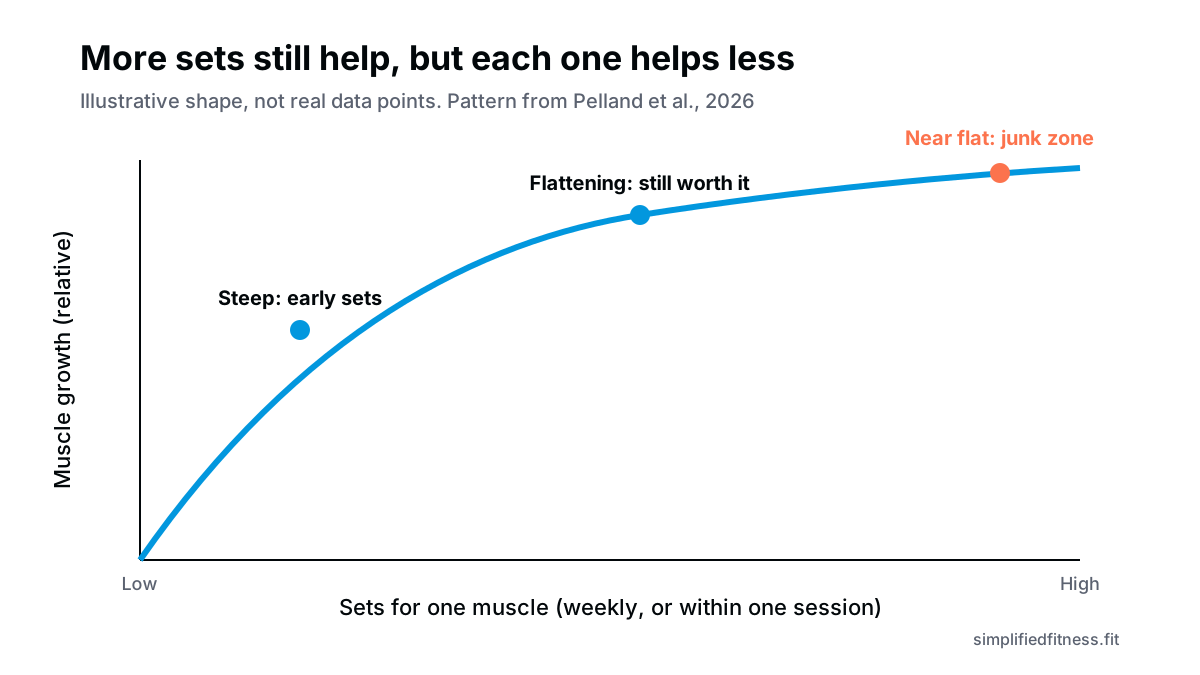
One more caveat. These are averages from mostly young, mostly male groups, and studies count weekly sets, not sets in a single session. They tell you about diminishing returns in general, not the exact set where your own returns fade.
How many sets is junk volume?
There is no universal number. What the evidence gives us is a rough neighbourhood.
A 2022 systematic review of trained young men (18-35 years, at least a year of lifting) compared low (under 12), moderate (12-20) and high (over 20) weekly sets. Moderate and high volumes gave similar growth for the quadriceps and biceps, while high volume looked better for the triceps. The authors suggested 12-20 weekly sets per muscle as a reasonable range (Baz-Valle et al., 2022). Only six studies were in the quantitative analysis, so treat that as a starting point.
Three individual trials in trained people show why no single number works:
- In 49 experienced men, 9, 18 or 27 weekly biceps sets for 6 weeks all increased muscle thickness, with no significant differences between groups. The moderate and high groups showed moderate-to-large effect sizes against the low group (Heaselgrave et al., 2019).
- In 35 trained people (squatting about twice body weight on average), 12, 18 or 24 weekly lower-body sets over 8 weeks did not differ for muscle thickness or fat-free mass. Squat strength showed a trend favouring the 18-set group over the 24-set group (Aube et al., 2022).
- In 34 trained men, 1, 3 or 5 sets per exercise (three sessions a week, 8 weeks) gave similar strength gains. Muscle size favoured the higher-volume groups at several sites (Schoenfeld et al., 2019).
Those results do not fully agree, and that is the honest picture. Differences in muscle, exercise, training age, how hard sets were, and short study length all matter. Small trials can also miss real differences.
Why 20-30 sets in one workout often backfires
Take a typical chest day with 28 sets. By set 10 your reps and load are probably already dropping. By set 20 you are mostly chasing a pump while form slides.
Here is what the research supports, and what it does not.
What is supported. Fatigue builds during resistance exercise regardless of volume and intensity, and it has both muscular (peripheral) and nervous system (central) components (Zajac et al., 2015). The ISSN position stand notes that muscle glycogen stores are depleted most by high-volume exercise (Kerksick et al., 2017). That is a real cost, but it does not prove that glycogen is the limiter of growth in a typical workout.
What is not proven. You will see claims online about “excitation-contraction uncoupling” or cellular exhaustion shutting growth off after a set number of sets. We could not find human trial evidence that confirms a clean on/off mechanism like that, so we are not going to state it as fact. What we can say is that fatigue lowers the quality of later sets, and quality is what makes a set count.
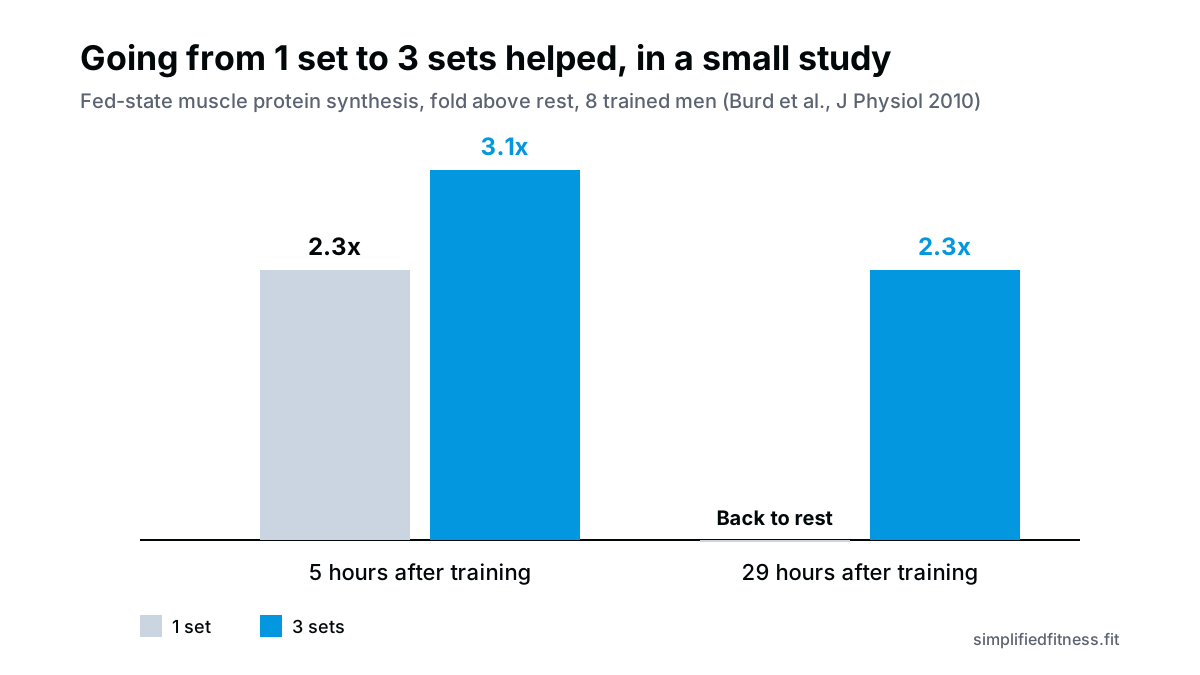
Also note a real pattern in the other direction. A small study measured muscle protein synthesis after 1 set versus 3 sets of leg extension in 8 resistance-trained men. Three sets raised synthesis more at both 5 hours and 29 hours (Burd et al., 2010). So going from 1 to 3 hard sets clearly matters. Going from 10 to 20 is a different question that this study did not test.
Does fatigue itself build muscle? The conflicting evidence
This is where “fatigue is bad” gets too simple.
In a trial of 22 young men, a squat program that stopped sets at 20% velocity loss was compared with one allowing 40% loss. The 20% group did about 40% fewer reps and had similar strength gains, while the 40% group showed greater growth of two quadriceps muscles (vastus lateralis and intermedius) (Pareja-Blanco et al., 2017). So more fatigue within a set bought a little more local growth.
In contrast, 18 trained people trained one leg to failure and the other to a perceived 1-2 reps in reserve for 8 weeks. Quadriceps thickness gains were almost identical, while failure produced more rep and velocity loss (Refalo et al., 2024).
Why might these differ? Different protocols, different muscles measured, and small samples. A cautious takeaway: pushing sets close to failure can help, but you rarely need to grind through the last grim reps of every set. In the trial above, stopping 1-2 reps short gave similar growth with less fatigue, so leaving 1-3 reps in reserve is a sensible default.
How to spot junk sets in your own training
Use a simple check instead of a number.
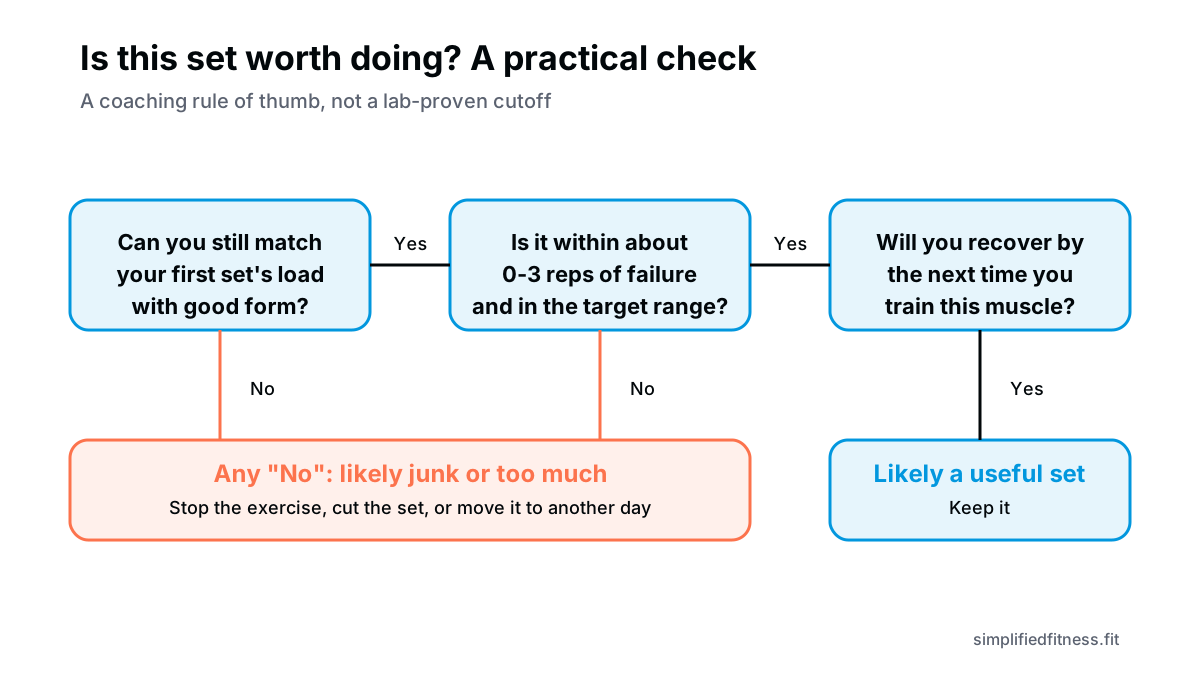
Practical signs a set is not earning its place:
- Rep drop-off. You hit 10 reps on set 1 and 5 on set 6 at the same weight.
- Form decay. Your back rounds, you bounce, or you start using momentum.
- Next-session cost. You cannot match last week’s numbers on the same lift.
- Joint or tendon niggles rather than muscle fatigue.
- No change in two to four weeks despite adding sets.
Our RIR and RPE calculator helps you judge how close to failure a set really was, and the training volume calculator helps you count weekly hard sets per muscle. For counting, see hard sets versus tonnage.
What should you do instead of 25-30 sets?
Cut and spread. Do not just add more.
- Count your hard sets per muscle for the week. Include only sets within roughly 0-3 reps of failure.
- Trim session sets first. If one muscle gets 15-20 sets in a single session, drop it to about 6-10 and move the rest to a second day. The best evidence is on weekly sets, so this is a coaching judgment, not a proven cap.
- Keep the first sets heavy and fresh. Put the most important lift first.
- Hold effort, drop sets. Remove the last one or two sets per exercise, not the effort.
- Give it three to four weeks. Track top-set weight and reps, and the tape measure.
If your numbers hold or improve with fewer sets, those cut sets were junk for you. If they fall, add one set back. Our volume landmarks guide explains how to find your own range.
Indian lifter notes: food, heat and recovery
Recovery is where junk volume hurts most, so the basics matter.
- Protein. A vegetarian lifter eating mostly dal and roti may be short on protein. Add paneer, curd, soya chunks or whey, and check your target with our protein calculator.
- Carbs. Long, high-volume sessions pull on glycogen, so rice, roti, poha or banana around training helps you keep reps up.
- Heat and hydration. In a hot gym, long sessions can feel worse. Shorter workouts help.
- Sleep. Late nights eat into recovery faster than any extra set can make up for.
When to see a doctor
Fatigue from training should improve with a few easy days. See a doctor if you have persistent exhaustion, poor sleep, low mood, repeated illness, unexplained weight loss, chest pain, dizziness or fainting, or sharp joint pain that does not settle. These are not signs of “just junk volume”, and this article cannot diagnose them. Our guide to overtraining syndrome versus overreaching covers the difference in more detail, and the recovery costs of high volume go deeper on sleep and stress.
The bottom line
Diminishing returns are real, and “junk volume” is a useful way to talk about them. But it is a coaching shorthand, not a measured cutoff. Early hard sets matter a lot, extra sets add progressively less, and the cost in fatigue keeps climbing.
If you are doing 25-30 sets per session and feel drained without progress, cut volume, spread it over the week, and keep your effort high on the sets that remain. Then watch your lifts and measurements for a month. That is a better test than any number in an article, including this one. For a ready-made structure, try our free push, pull and legs plan.
Frequently Asked Questions
What is junk volume in lifting?
Junk volume is training volume that adds a lot of fatigue but little extra muscle growth. It is usually sets done after your muscles are already worn down, so the reps are poor and recovery suffers. It is a practical coaching idea rather than a measured cutoff, so treat it as a guide, not a rule.
How many sets is junk volume?
There is no exact number, because it depends on your training age, the muscle, the exercise and how close to failure you train. Meta-analyses suggest returns flatten as weekly sets rise, and 12-20 weekly sets per muscle is a reasonable range for trained lifters. If you are doing 25-30 sets in one session and your performance collapses halfway, much of it is probably past useful.
Is junk volume real or a myth?
Diminishing returns are real: a 2026 meta-regression found gains rise with volume but flatten. The label 'junk' is a simplification, since extra sets rarely add exactly zero. Think of it as sets where the cost in fatigue and recovery outweighs the small gain.
Do more sets always build more muscle?
Not in a straight line. Studies in trained people show more volume usually gives a bit more growth, but the extra benefit shrinks and sometimes disappears in individual trials. Add sets slowly and keep them only if your reps, recovery and progress hold up.
Why do I feel exhausted but not growing?
Fatigue and growth are not the same thing. You can drain yourself with lots of sets and still get a small growth signal, especially if sleep, calories or protein are short. Cut volume by about a third for a few weeks, eat and sleep properly, and see whether strength and size move.
Is 20 sets in one workout too much for one muscle?
It is probably more than most people need in one session. The best evidence is on weekly sets rather than per-session sets, so there is no proven cap, but quality drops as sets pile up. Split those sets across two sessions in the week so each set is done fresh.
What is the difference between junk volume and overtraining?
Junk volume describes individual sets that are not worth their cost, while overtraining describes a long-lasting drop in performance and wellbeing from too much training without enough recovery. You can have junk volume without being overtrained. If you feel unwell for weeks, see a doctor rather than guessing.
Does training to failure on every set create junk volume?
Not necessarily. An 8-week trial in trained people found similar quadriceps growth when sets stopped 1-2 reps short of failure versus going to failure. Failure adds fatigue without clearly adding growth, so leaving 1-3 reps in reserve is a safer default for most sets.
How do I know if a set is junk?
Look at your reps and form. If you lose several reps from your first set, cannot hold the load, or are grinding with poor technique, the set is probably not adding much. Cut it and put the energy into the next session.
Can I build muscle with fewer sets?
Yes. A trained-men trial found that one, three or five sets per exercise all raised strength by similar amounts, though muscle size favoured higher volumes. If time is short, fewer well-done sets still work, they just leave some growth on the table.
How should I cut volume without losing progress?
Drop the last one or two sets of each exercise and keep the effort and load of the rest. The remaining sets are done fresher, so progress often holds, though this is coaching logic rather than trial data and responses vary. Track your top-set weight and reps for three or four weeks to confirm.
Should I cut volume when I am in a calorie deficit?
Often, yes. When you are eating less, recovery is usually tighter, so the same sets can cost more fatigue than they did at maintenance. Hold your load and effort, trim a set or two per exercise, and watch whether your lifts stay steady.
Sources & References
Every claim above is checked against peer-reviewed research (PubMed, U.S. National Library of Medicine) or guidance from established health bodies. How we fact-check.
- Schoenfeld BJ, et al. Dose-response relationship between weekly resistance training volume and increases in muscle mass: A systematic review and meta-analysis. J Sports Sci. 2017. PMID: 27433992
- Baz-Valle E, et al. A Systematic Review of The Effects of Different Resistance Training Volumes on Muscle Hypertrophy. J Hum Kinet. 2022. PMID: 35291645
- Pelland JC, et al. The Resistance Training Dose Response: Meta-Regressions Exploring the Effects of Weekly Volume and Frequency on Muscle Hypertrophy and Strength Gains. Sports Med. 2026. PMID: 41343037
- Burd NA, et al. Resistance exercise volume affects myofibrillar protein synthesis and anabolic signalling molecule phosphorylation in young men. J Physiol. 2010. PMID: 20581041
- Schoenfeld BJ, et al. Resistance Training Volume Enhances Muscle Hypertrophy but Not Strength in Trained Men. Med Sci Sports Exerc. 2019. PMID: 30153194
- Heaselgrave SR, et al. Dose-Response Relationship of Weekly Resistance-Training Volume and Frequency on Muscular Adaptations in Trained Men. Int J Sports Physiol Perform. 2019. PMID: 30160627
- Aube D, et al. Progressive Resistance Training Volume: Effects on Muscle Thickness, Mass, and Strength Adaptations in Resistance-Trained Individuals. J Strength Cond Res. 2022. PMID: 32058362
- Refalo MC, et al. Similar muscle hypertrophy following eight weeks of resistance training to momentary muscular failure or with repetitions-in-reserve in resistance-trained individuals. J Sports Sci. 2024. PMID: 38393985
- Pareja-Blanco F, et al. Effects of velocity loss during resistance training on athletic performance, strength gains and muscle adaptations. Scand J Med Sci Sports. 2017. PMID: 27038416
- Kerksick CM, et al. International society of sports nutrition position stand: nutrient timing. J Int Soc Sports Nutr. 2017. PMID: 28919842
- Zajac A, et al. Central and Peripheral Fatigue During Resistance Exercise: A Critical Review. J Hum Kinet. 2015. PMID: 26839616

Umair Hazrami · Founder & Head Coach, Simplified Fitness
Umair Hazrami founded Simplified Fitness and the Simplified Lifter channel to cut through fitness noise. With 4+ years of consistent training and 10+ coaching clients, he writes every guide from the peer-reviewed research and links the sources so you can check them. Our editorial standards.
Educational content only, not medical advice. If you have a medical condition, are pregnant, or take medication, talk to a qualified doctor before changing your diet, supplements or training. Full disclaimer.
Keep reading

Programming
Autoregulation of Set Volume: Add or Cut Sets Based on Readiness and Velocity Loss
Autoregulation training volume explained: use warm-up speed, RIR and a 20-25% performance drop to add or cut sets, and what the evidence does or does not prove.
9 min read
Programming
The Biological Cost of High Volume: Sleep, Cortisol and Immune Strain
High volume lifting side effects: what research says about poor sleep, cortisol and colds, which warning signs matter, and how to scale back.
9 min read

Programming
How to Count Compound Sets Toward Weekly Volume: Direct vs Fractional Sets
How to count compound sets volume for arms, delts and hamstrings: the 1.0 and 0.5 fractional rule, a worked weekly example and what the research says.
9 min read

Programming
Distributing Weekly Volume: Full Body 3x vs Upper/Lower 4x vs PPL 6x
Distributing weekly volume across splits: how 12 sets per muscle look in full body, upper/lower and PPL, plus session length math and which fits your week.
9 min read