Natural vs Enhanced Volume Tolerance: Why Pro Bodybuilder Splits Fail Natural Lifters
Natural vs enhanced training volume explained: what steroids change, what research shows, and how many sets a natural lifter can realistically recover from.

TL;DR. The short answer
- Enhanced lifters probably tolerate more volume than natural lifters, but this is an inference. Nobody has run a trial comparing volume tolerance in the two groups directly.
- Supraphysiologic testosterone (600 mg per week for 10 weeks) increased muscle size and strength even in men who did not train, so drugs change the starting point, not just recovery.
- For natural lifters, more weekly sets still help up to a point, but returns diminish. A 30-set chest day is more fatigue than most people can recover from or use.
- For trained natural lifters, a sensible default is about 6-10 hard sets per muscle per session, 2 sessions per week (beginners can start lower), adding sets only when progress stalls and recovery is fine.
- Tendon pain that lingers, or strength that keeps falling over several weeks, is a reason to cut volume and see a doctor or physio.
Part of our complete guide: Optimal Training Volume and Frequency: How Many Sets per Muscle Actually Build Muscle
Table of contents
Natural vs enhanced training volume is not a fair comparison. People using anabolic steroids and other performance-enhancing drugs (PEDs) probably tolerate more weekly sets than drug-free lifters, though no trial has tested that head to head. For a natural lifter, copying a 30-set pro chest day usually means more fatigue than growth.
If you have ever followed an IFBB pro’s split and ended up sore, stalled and a bit flat, this is why. It sits inside our wider guide to training volume and frequency for hypertrophy, and it matters for the whole natural muscle-building framework.
I want to be careful here. The honest version has three parts: what drugs clearly do, what we can only infer, and what a drug-free lifter should do about it.
What do anabolic drugs actually change?
Start with the one thing that is well demonstrated. In a 1996 randomized trial, 43 healthy men received either placebo or 600 mg of testosterone enanthate weekly for 10 weeks. Some lifted three times a week, others did not exercise at all (Bhasin et al., 1996).
The non-exercising men on testosterone gained muscle. Their quadriceps area rose by about 607 mm2 versus a loss of 131 mm2 on placebo, and their bench press and squat went up too. Men who combined testosterone with lifting did best: fat-free mass rose by 6.1 kg and quadriceps area by about 1,174 mm2.
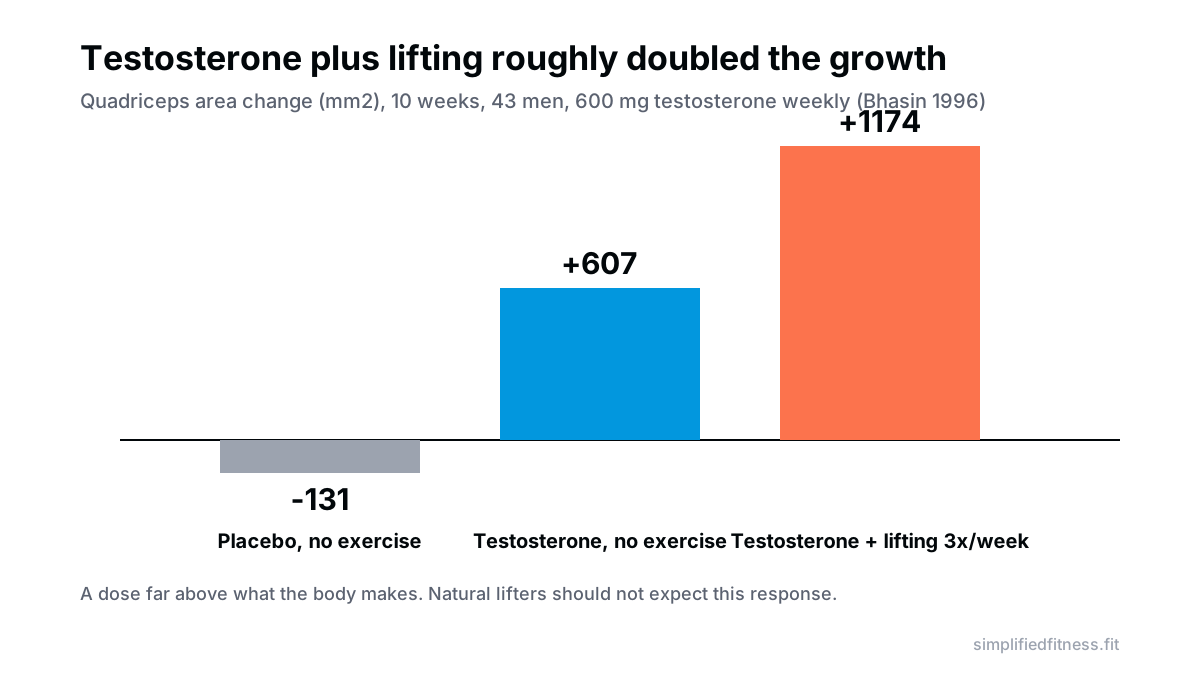
That matters for this topic. The enhanced lifter is not just recovering faster. They are building muscle from a different physiological starting point. A review of hormones and hypertrophy notes that supplementing with AAS and other hormones may lead to supraphysiological hypertrophy, especially when compounds are combined, whereas the short-lived hormone bump from your own workout does not seem to be directly tied to growth (Fink et al., 2018).
So do enhanced lifters really train more?
By their own account, often yes. A 2023 survey compared 187 competitive male bodybuilders, 40 who reported using PEDs and 147 who reported being natural (Li et al., 2023).
In the off-season, the PED users reported more exercises per muscle group, more reps-to-failure per set and shorter rests between sets. Advanced techniques such as partials, negatives and pre-exhaust sets were also more popular among them.
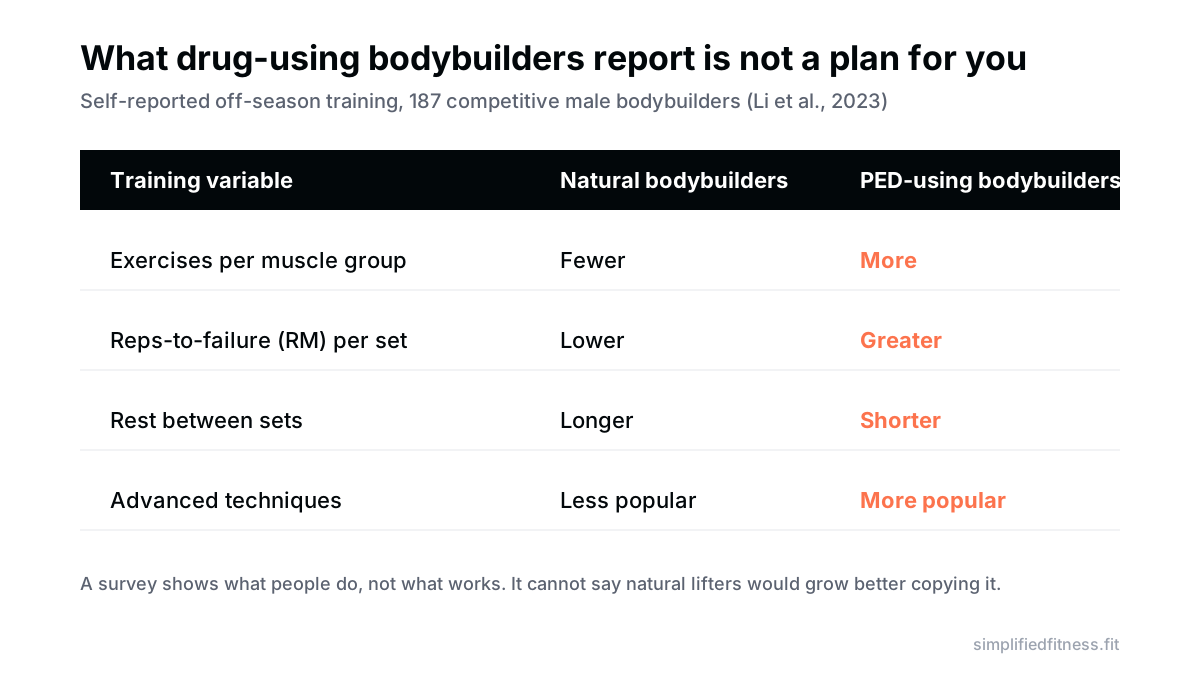
Read that carefully. It is a self-reported survey. It cannot tell us whether the extra work caused extra growth, or whether it was simply what that crowd does. It also does not give a set count per session. So the claim that “enhanced lifters can handle more” is plausible and consistent with this data, but it is an inference.
Why would natural lifters tolerate less?
Here is the reasoning, flagged as reasoning. Drug-assisted muscle building raises the amount of growth available from a given workout, and pros usually pair that with years of conditioning, genetics that selected them into the sport, and full-time recovery (sleep, food, naps). Natural lifters, especially those with a job, commute and a 6-hour sleep night, do not get all three.
I am not aware of a controlled trial that isolates “recovery speed” in natural versus enhanced lifters under equated programs. So I will not tell you steroids shorten muscle protein synthesis windows by a specific number of hours. What I can say is that:
- the drug effect on size is large and demonstrated (above)
- the connective tissue may lag behind, which I cover below
- the natural dose-response curve flattens, which I cover next
Do natural lifters get more growth from more sets?
Yes, up to a point. A meta-analysis of 15 studies (34 treatment groups) found a graded dose-response relationship: each additional weekly set was associated with a small gain in effect size, equivalent to about 0.37% more muscle growth per set (Schoenfeld et al., 2017). Higher versus lower volume categories differed by about 3.9% in muscle gain.
A larger 2026 meta-regression, using 67 studies and 2,058 participants, agreed that more volume means more hypertrophy, but its best-fit models showed diminishing returns (Pelland et al., 2026). The authors also note that they, like many in this field, work as fitness coaches and writers, so read it with that in mind.
The practical takeaway is not “low volume forever.” It is that each extra set buys less than the last, and fatigue keeps climbing. We cover the curve itself in our weekly set volume dose-response guide. The studies are mostly in younger, often not highly trained participants over a few months, so the numbers do not map perfectly to an advanced lifter in year ten.
Where does the 6-10 sets per session number come from?
It is a practical rule of thumb, not a law of nature. The reasoning is that quality drops late in a long session and that you recover and use more total volume if you split it across the week. If you hit each muscle twice, 6-10 hard sets per session gives you roughly 12-20 weekly sets. That matches the 12-20 set range a systematic review of trained young men suggested as a good general target (Baz-Valle et al., 2022). Beginners usually grow well on less.
Frequency itself is not the magic part. A meta-analysis of 25 studies found no significant difference in hypertrophy between higher and lower frequencies when volume was equated, and said people can choose frequency based on preference (Schoenfeld et al., 2019). Splitting is a tool for keeping sets high quality, not a growth hack.
If you want the per-session reasoning in depth, see per-session set volume caps.
| Variable | Pro bodybuilder split (typical) | Natural default (starting point) |
|---|---|---|
| Hard sets per muscle per session | Often well above 10 | 6-10 |
| Sessions per muscle per week | Varies, often 1-2 | 2 |
| Rest between sets | Often shorter | 2-3 minutes on big lifts |
| Exercises per muscle per session | Many | 2-3 |
| Progression plan | Varies widely, rarely published | Add sets slowly if stalled |
The pro column is a generalization from the survey above and common programming, not a measured average. Treat it as illustrative.
Why the tendons are part of the story
Muscle can grow quickly on drugs. Tendons do not follow as readily. In a study of long-term lifters, the patellar tendon of steroid users was 26% stiffer and showed 30% higher modulus than that of drug-free lifters, along with higher maximal tendon stress. The authors suggest this reflects different collagen remodeling and could be linked to a higher risk of tendon injury (Seynnes et al., 2013).
Notice the hedge: it compared groups of lifters at one point in their training lives rather than following a randomized intervention, and “could be linked” is as strong as the authors go. Still, it fits the common pattern of strong muscles loading connective tissue that has not adapted in step. For you, the lesson is simple. Tendon pain is a signal to cut volume, not push through.
Does “muscle memory” change the picture?
Possibly. A small 2023 biopsy study of 25 recreationally training men, only 7 of them former steroid users, found that those former users still had higher myonuclei density in fast-twitch fibers about 4 years after stopping, which the authors suggest may mean enhanced retraining capacity (Nielsen et al., 2023). That is intriguing, but the sample was tiny and it says nothing about a natural lifter’s volume. I mention it because it is a common talking point, and the honest answer is “early and unproven.”
What should a natural lifter do instead?
Build from a moderate base and let progress tell you when to add sets.
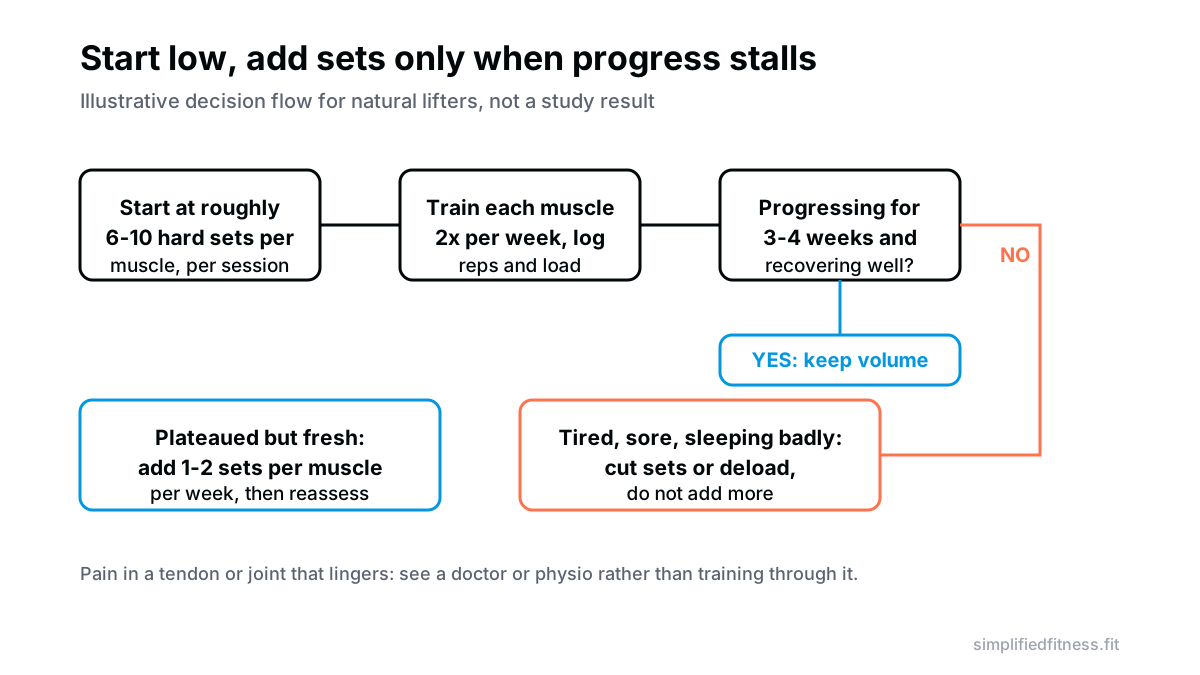
- Start at roughly 6-10 hard sets per muscle per session, 2 sessions a week, 1-3 reps in reserve on most sets. If you are in your first year of lifting, fewer sets usually work fine.
- Log reps and load. If those are rising for 3-4 weeks, do not touch the volume.
- If you stall but feel fresh, add 1-2 weekly sets per muscle and reassess after a few weeks.
- If you feel worn down, with poor sleep, nagging joints and falling numbers, cut sets by about a third for a week or two.
- Use a calculator. Our training volume calculator helps you count weekly hard sets per muscle, and our free push pull legs plan already respects these limits.
To judge how much volume you personally can handle, work through the factors in individual recovery profiling. And for the body’s response when you overshoot, see the biological cost of high volume. For why more is not always better, read our take on junk volume and diminishing returns.
Indian context: recovery resources matter
A lot of Indian lifters train after a full workday, on 6 hours of sleep, in summer heat, on a mostly vegetarian diet. That combination lowers how much volume you can recover from, so it is a good reason to be conservative with sets. Make sure your daily protein is covered from dal, paneer, curd, soya and eggs if you eat them (use our protein calculator), and protect sleep before adding another set.
When to see a doctor
Persistent tendon or joint pain, strength that keeps falling despite rest, unusual fatigue, or any symptoms you are worried about deserve a doctor or physio, not another program tweak. This article does not diagnose anything. And if you are considering performance-enhancing drugs, speak to a qualified doctor first: these drugs carry real health risks, and they are banned in many tested sports.
The bottom line
Pro bodybuilders and drug-free lifters are doing the same sport on different biology. The drug effect on muscle size is large and demonstrated. Whether it changes volume tolerance is plausible but unproven. For you, the best evidence says more volume helps with diminishing returns, so start moderate, add sets slowly, and judge by progress.
Frequently Asked Questions
Do steroid users train with more volume than natural lifters?
Often, yes, at least by self-report. A 2023 survey of 187 competitive male bodybuilders found that drug-using bodybuilders reported more exercises per muscle group, more reps-to-failure per set and shorter rests than natural ones. A survey cannot show the extra work was necessary, so do not treat it as a target.
Why can't natural lifters train like enhanced bodybuilders?
Because the recovery and growth ceiling is different, and the evidence suggests natural lifters get diminishing returns from very high volume. Drug-assisted muscle gain happens even without training, so a pro split is built on a different baseline than yours. Start moderate, track progress, and add sets only when you stall.
Can a natural lifter do 20 sets for chest in one session?
You can physically do it, but it is unlikely to be the best use of your recovery. Volume has a dose-response relationship with growth, yet the curve flattens, and later sets in a very long session are usually lower quality. Spreading the sets over two sessions per week is a safer way to get volume.
How many sets per muscle per workout is right for a natural lifter?
About 6-10 hard sets per muscle per session is a practical range for most natural lifters. The research does not give one exact number, and individual tolerance varies. Begin at the lower end, watch your performance and soreness, and move up only if you are progressing and recovering.
Do steroids really increase muscle growth without training?
In a 1996 randomized trial, men who took 600 mg of testosterone enanthate weekly and did not exercise gained muscle size and strength compared with placebo. Adding lifting produced larger gains still. This was a very high dose given to healthy men for 10 weeks, so it tells you about drug effects, not about what you can reach naturally.
Do steroids make tendons more injury prone?
Evidence points that way but is limited. A study of long-term lifters found patellar tendon stiffness was 26% higher in steroid users than in drug-free lifters, which the authors linked to a possible higher injury risk. If a tendon aches for more than a couple of weeks, cut the volume and get it assessed.
Does muscle memory from steroids last after stopping?
There is early evidence that it might. A small 2023 biopsy study found higher myonuclei density in fast-twitch fibers of men who had stopped steroids around 4 years earlier. Only 7 of its 25 men were former users, so treat it as suggestive, not settled.
Is training frequency or volume more important for natural lifters?
Volume matters more than frequency. A meta-analysis of 25 studies found no meaningful difference in hypertrophy between frequencies when weekly volume was equated. Frequency is still useful as a tool to split the sets into quality sessions.
Are natural lifters stuck with low volume forever?
No. Meta-analytic data show more weekly sets generally produce more growth, with diminishing returns, so many natural lifters do benefit from gradually adding sets over time. The key is adding them slowly and only when recovery supports it, not copying someone else's number.
How do I know my volume is too high?
Look for performance falling across two or three weeks, joints or tendons that stay sore, poor sleep, and sets that feel worse rather than better. These signs suggest your recovery is not keeping up. Drop sets by roughly a third for a week or two and see if numbers bounce back.
Can I follow a pro bodybuilder's routine if I just reduce the weight?
Lowering the weight does not solve the problem, because the issue is total hard sets and recovery cost. Pro routines are typically written for people with different drug use, genetics and years of conditioning. Use their exercise selection if you like, but build your own set count from a moderate base.
What about Indian lifters on vegetarian diets and hot climates?
The same principles apply, but recovery resources matter more. Aim for enough protein from dal, paneer, curd, soya and eggs if you eat them, and protect your sleep through hot months. Lower fatigue tolerance on poor sleep or low calories is a good reason to keep volume conservative.
Sources & References
Every claim above is checked against peer-reviewed research (PubMed, U.S. National Library of Medicine) or guidance from established health bodies. How we fact-check.
- Bhasin S, et al. The effects of supraphysiologic doses of testosterone on muscle size and strength in normal men. N Engl J Med. 1996. PMID: 8637535
- Fink J, et al. The role of hormones in muscle hypertrophy. Phys Sportsmed. 2018. PMID: 29172848
- Li J, et al. Self-reported training and supplementation practices between performance-enhancing drug-user bodybuilders compared with natural bodybuilders. J Strength Cond Res. 2023. PMID: 36165879
- Seynnes OR, et al. Effect of androgenic-anabolic steroids and heavy strength training on patellar tendon morphological and mechanical properties. J Appl Physiol. 2013. PMID: 23620489
- Nielsen JL, et al. Higher myonuclei density in muscle fibers persists among former users of anabolic androgenic steroids. J Clin Endocrinol Metab. 2023. PMID: 37466198
- Schoenfeld BJ, et al. Dose-response relationship between weekly resistance training volume and increases in muscle mass: a systematic review and meta-analysis. J Sports Sci. 2017. PMID: 27433992
- Pelland JC, et al. The resistance training dose response: meta-regressions exploring the effects of weekly volume and frequency on muscle hypertrophy and strength gains. Sports Med. 2026. PMID: 41343037
- Baz-Valle E, et al. A Systematic Review of The Effects of Different Resistance Training Volumes on Muscle Hypertrophy. J Hum Kinet. 2022. PMID: 35291645
- Schoenfeld BJ, et al. How many times per week should a muscle be trained to maximize muscle hypertrophy? A systematic review and meta-analysis of studies examining the effects of resistance training frequency. J Sports Sci. 2019. PMID: 30558493

Umair Hazrami · Founder & Head Coach, Simplified Fitness
Umair Hazrami founded Simplified Fitness and the Simplified Lifter channel to cut through fitness noise. With 4+ years of consistent training and 10+ coaching clients, he writes every guide from the peer-reviewed research and links the sources so you can check them. Our editorial standards.
Educational content only, not medical advice. If you have a medical condition, are pregnant, or take medication, talk to a qualified doctor before changing your diet, supplements or training. Full disclaimer.
Keep reading
Programming
Autoregulation of Set Volume: Add or Cut Sets Based on Readiness and Velocity Loss
Autoregulation training volume explained: use warm-up speed, RIR and a 20-25% performance drop to add or cut sets, and what the evidence does or does not prove.
9 min read
Programming
The Biological Cost of High Volume: Sleep, Cortisol and Immune Strain
High volume lifting side effects: what research says about poor sleep, cortisol and colds, which warning signs matter, and how to scale back.
9 min read

Programming
How to Count Compound Sets Toward Weekly Volume: Direct vs Fractional Sets
How to count compound sets volume for arms, delts and hamstrings: the 1.0 and 0.5 fractional rule, a worked weekly example and what the research says.
9 min read

Programming
Distributing Weekly Volume: Full Body 3x vs Upper/Lower 4x vs PPL 6x
Distributing weekly volume across splits: how 12 sets per muscle look in full body, upper/lower and PPL, plus session length math and which fits your week.
9 min read