Mesocycle Volume Progression: Starting at Minimum Effective Dose and Adding Sets Responsibly
Mesocycle volume progression explained: should you add sets every week? Compare flat vs ramped volume, see what trials show, and get simple add-a-set rules.
TL;DR. The short answer
- You do not need to add sets every week. If your load or reps are still going up on the same number of sets, adding volume is optional and often just adds fatigue.
- A common coaching model starts a mesocycle near your minimum effective volume (often about 8-10 hard sets per muscle per week) and adds 1-2 sets a week for 3-5 weeks. No trial has directly tested this exact ramp against flat volume.
- Meta-analyses show more weekly sets tend to produce more muscle growth, with diminishing returns. Moderate (12-20 sets) and high (over 20) volumes produced similar growth for quads and biceps in trained young men.
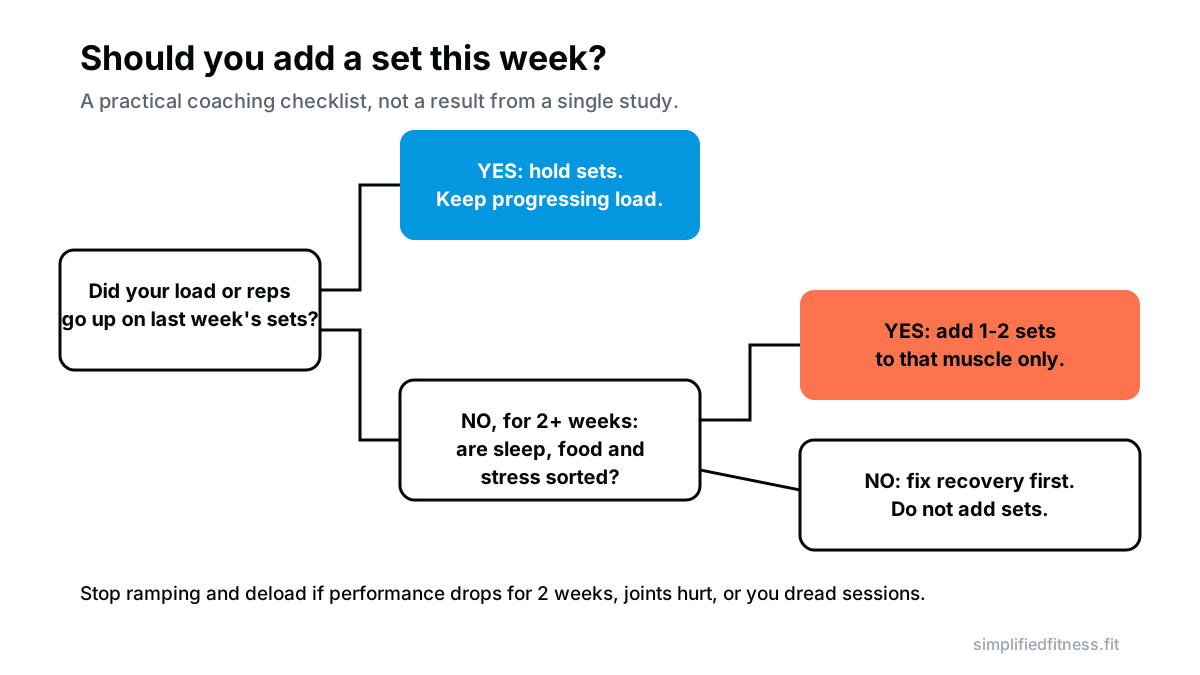
- Add sets only when progress has stalled for about two weeks and sleep, food and stress are in order. Add them to the lagging muscle, not to everything.
- A planned deload is not clearly required for muscle size. One trial found a full week off at the midpoint of 9 weeks did not change lower body hypertrophy but did reduce strength gains.
Part of our complete guide: Optimal Training Volume and Frequency: How Many Sets per Muscle Actually Build Muscle
Table of contents
No, you do not have to add sets every week. Mesocycle volume progression means planning how your weekly hard sets change across a 4-8 week block, and the lowest-effort version is simply keeping sets flat while the weight or reps go up. Ramping volume, starting near your minimum effective dose and adding 1-2 sets a week, is a second tool for when load progress slows.
This article sits under our full guide to training volume and frequency for hypertrophy. Here we look at one variable only: the decision to add sets. For how a whole block is built, see mesocycle architecture.
What mesocycle volume progression actually means
A mesocycle is a block of training, usually 4-8 weeks, with one purpose. Volume progression is how you treat the number of hard sets per muscle inside that block.
Two plans dominate gym conversations.
- Flat volume. You pick a sensible number of sets (say 12 per muscle per week) and keep it. Progress comes from adding load or reps.
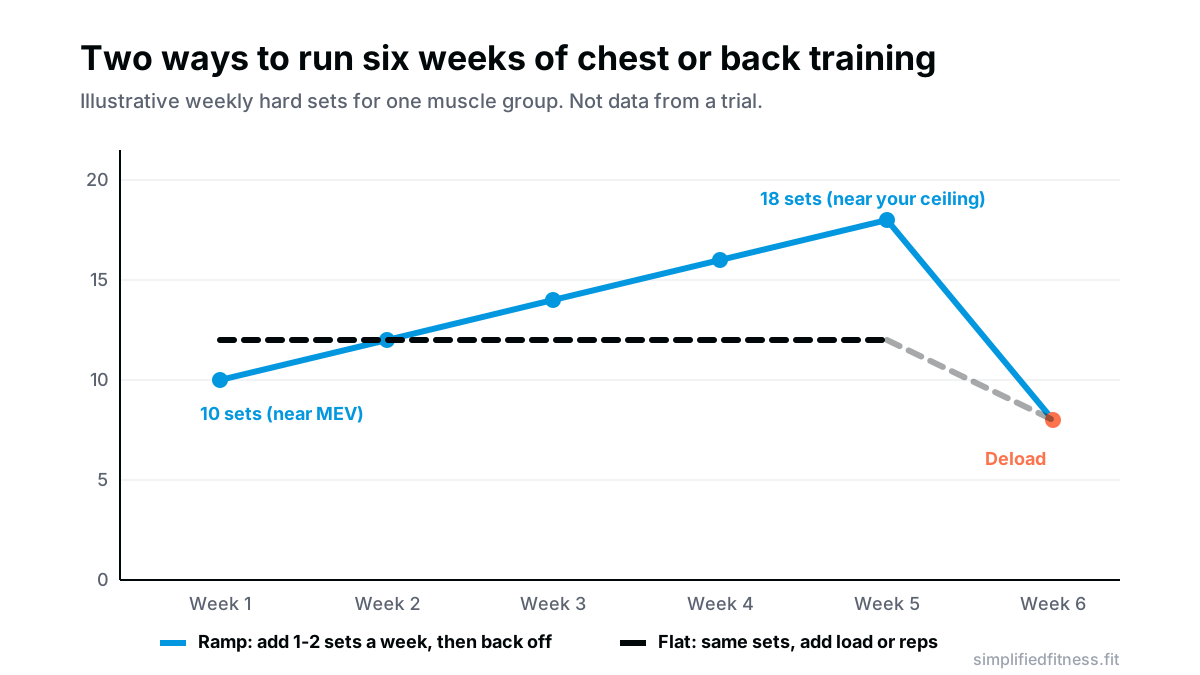
- Ramped volume. You start low, near your minimum effective volume (MEV), and add 1-2 sets per muscle each week. The block ends near your maximum recoverable volume (MRV), then you back off.
MEV, MAV and MRV are coaching landmarks, not lab-measured thresholds. If those terms are new, our breakdown of volume landmarks (MV, MEV, MAV, MRV) covers them. For now, think of MEV as “the least you can do and still progress” and MRV as “the most you can do before recovery falls behind.”
Does more volume actually build more muscle?
On average, yes, up to a point. That is the reason ramping exists at all.
A meta-regression of 15 studies (34 treatment groups) found a significant graded effect of weekly sets on muscle size. Each additional weekly set was associated with a 0.37% larger gain, and higher-volume groups gained about 3.9% more than lower-volume groups (Schoenfeld et al., 2017). When the authors split volume into three bands (under 5, 5-9 and 10+ sets per muscle) the trend did not reach significance, so the signal is a gradient, not a cliff.
A larger and newer analysis (67 studies, 2,058 participants, mostly young men) reached a similar conclusion with a twist. Gains in size and strength rose as volume rose, but both showed diminishing returns, and the strength curve flattened much sooner than the muscle-size curve (Pelland et al., 2026).
And what about people who already train? A systematic review limited to young, trained men (at least a year of experience, studies of 6+ weeks) compared low (under 12 weekly sets), moderate (12-20) and high (over 20) volumes. Moderate and high volumes did not differ for quads or biceps, but high volume did better for triceps. The authors suggested 12-20 weekly sets per muscle as a reasonable range for this group (Baz-Valle et al., 2022). Only six studies went into the quantitative analysis, so treat this as a decent guide, not a law.
Flat volume vs progressive volume ramping
Here is how the two strategies compare in practice.
| Flat volume | Progressive ramp | |
|---|---|---|
| Sets per muscle per week | Same all block (e.g. 12) | Start near 8-10, add 1-2 a week |
| Main progression lever | Load and reps | Sets first, then load |
| Fatigue across the block | Fairly stable | Climbs week by week |
| Best for | Lifters still adding weight or reps | Lifters whose load progress has slowed |
| Common failure | Staying at a volume that no longer stimulates you | Ending the block too fatigued to train well |
| Evidence | Indirect | Indirect |
Neither wins on the evidence we have. Which one you choose should depend on whether load progression is still working.
The most common mistake here is adding sets while the bar is still moving up. If you added 2.5 kg to your incline press last week, the program is already doing its job. More sets would just take recovery you might need later.
Starting at MEV: how many sets is that?
There is no single MEV number. It depends on your training history, the muscle, how hard you take each set, sleep, and food. Still, you need somewhere to start.
The 2026 American College of Sports Medicine position stand, an overview of 137 systematic reviews, found that muscle hypertrophy was enhanced by higher volumes, with a cut-off of at least 10 sets per week. It also found that strength was enhanced by lifting heavier loads for 2-3 sets (Currier et al., 2026). Ten weekly sets is where the reviews start to show a difference from lower volumes, and that is close to where many coaches set MEV.
A practical starting point looks like this.
- Intermediate lifters: about 8-10 hard sets per muscle per week. If that is going well, stay there.
- Muscles you already hit indirectly (triceps after pressing, biceps after rows): start lower, because those sets count partly. The Pelland meta-regression found that counting indirect sets at half value fit the data best.
- Muscles you struggle to grow: this is where a ramp is most useful.
What counts as a hard set? Roughly, a set taken within about 0-3 reps of failure with controlled technique. Our quantifying training volume guide goes through this in detail, and the training volume calculator can total your weekly sets.
How to add sets: a simple 4-5 week ramp
Here is one way to run a ramp for a lagging muscle group such as chest, with the other muscles held flat.
- Week 1. Start at 10 hard sets for that muscle. Leave 1-3 reps in the tank on most sets.
- Weeks 2-4. Add 1-2 sets each week, spread across the week (one extra set on two exercises, not three extra on one). Keep load progressing where you can.
- Week 5. Hold or add 1 set only if recovery still looks fine.
- Week 6. Cut volume back by roughly half for a lighter week, or start a fresh block.
That produces something like 10, 12, 14, 16, 18, then 8. It is a template. If you reach week 3 and performance has already slipped, stop ramping right there. Your ceiling is lower than the template assumed.
When adding sets is useful (and when it is junk volume)
Adding sets helps when load progression has stalled for about two weeks, the muscle is a genuine priority, and the rest of your life supports recovery. That means roughly 7-9 hours of sleep, enough protein and calories, and stress that is not through the roof.
It is junk volume when you add sets because you feel you should, when the extra sets are done tired and sloppy, or when the muscle is not recovered between sessions. Our article on junk volume and diminishing returns shows how to spot this.
One thing the evidence does not support is “more effort always wins”. A meta-analysis of 15 studies found a trivial advantage for training to set failure over non-failure (effect size 0.19, 95% CI 0.00 to 0.37), and no advantage for training to momentary muscular failure (Refalo et al., 2023). So if you are choosing between adding a set and pushing every set to absolute failure, adding sets near, not at, failure is a reasonable path.
Do you need a deload at the end?
Maybe, but the evidence does not make it mandatory.
In a randomized trial of 39 resistance-trained adults, one group stopped lifting for a full week at the midpoint of a 9-week high-volume program while the other trained continuously. Lower body muscle size, local endurance and power did not differ between groups, but the continuous group improved lower body strength more (Coleman et al., 2024). The sample was small, the lower body was supervised but the upper body was not, and it was a full week off rather than a reduced-volume week.
The ACSM overview also found that periodization did not consistently affect training outcomes (Currier et al., 2026). So the fair reading is this. A deload does not appear to be needed for muscle size on a fixed schedule. It is still a handy way to dump accumulated fatigue when you feel flat. Our guide on volume resensitization and deloads covers this question in more depth.
Signs you have gone too far
These are hints, not diagnoses, and each has other causes.
- Reps or load fall for two weeks in a row on lifts that were improving.
- Persistent joint aches (not muscle soreness) in the elbows, knees or shoulders.
- Sleep gets worse, or you wake up unrested.
- You dread sessions you used to enjoy.
If volume is the cause, drop sets by about a third to a half for a week and see if numbers recover. If you have pain that is sharp, persistent or that does not settle with rest, see a doctor or physiotherapist rather than programming around it. Our piece on overtraining syndrome versus non-functional overreaching goes into more detail.
Indian lifters: recovery realities that cap your ramp
Ramping assumes you can recover from the extra work. Common situations here make that harder.
- Protein. A vegetarian diet can reach target protein with dal, paneer, curd, soya chunks, and whey if budget allows, but it takes planning. If you are well below your protein target, fix that before adding sets. Try the protein intake calculator.
- Heat. Summer sessions in a non-air-conditioned gym raise perceived effort. A ramp that works in winter may need to be shorter in May.
- Sleep. Late work shifts and commutes eat sleep, which is the cheapest recovery tool you have.
The same ramp can feel very different depending on these. This is why a template should be a starting guess, not a rule.
Where to go next
If you are unsure what to do right now, run flat volume at 10-12 sets per muscle per week and push load for a block. If progress stalls on one muscle for two weeks despite good sleep and food, add 1-2 sets to it and track what happens. For ready-made splits, see our free workout plans, and for how this fits with the big picture of growth, read the natural muscle hypertrophy guide.
If you have a medical condition, an injury, or are returning from a layoff, check with a doctor or qualified coach before raising training volume.
Frequently Asked Questions
Should I add sets every week in my workout program?
No. Adding sets every week is one way to progress, not a rule. If your weights or reps are still climbing on the same number of sets, keep the sets flat and let load do the work. Add volume only when load progression has stalled and your recovery is solid.
What is mesocycle volume progression?
It is the plan for how your weekly hard sets change across a training block, usually 4-8 weeks. A common version starts low, adds 1-2 sets per muscle each week, then ends with a lighter week. The idea is to give your body a bigger stimulus only as fast as it can recover from it.
How many sets should I start a mesocycle with?
Many coaches start around 8-10 hard sets per muscle per week, then adjust to how you recover. The research behind this is indirect, since meta-analyses show a graded dose-response rather than a fixed starting line. If 8-10 sets produces steady progress, there is no need to start higher.
How many sets per week can I add each week?
One to two sets per muscle per week is the usual range in coaching practice. Spread across the week, that is one extra set on one or two sessions, not a whole extra exercise. Smaller jumps make it easier to spot when you have gone too far.
What is the difference between MEV and MRV?
MEV is the minimum effective volume, the fewest weekly sets that still drive growth, and MRV is the maximum recoverable volume, the most you can do before recovery falls behind. They are coaching estimates, not lab-measured thresholds, and they differ between people and muscles. Treat them as a rough range and let your own training log decide.
Is flat volume or progressive volume better for muscle growth?
There is no trial that cleanly compares the two for hypertrophy, so neither can be called better. Flat volume with progressive load is simpler and works while you can still add weight or reps. Ramping volume gives you a built-in lever once load progress slows.
How do I know if I have reached my maximum recoverable volume?
Look for two or more weeks of stalled or falling performance, joint aches, poor sleep, or low motivation for sessions. These signs are not specific, so check food, sleep and life stress before blaming volume. If volume is the cause, drop sets by 30-50% for a week and reassess.
Do I need a deload week at the end of every mesocycle?
Not necessarily. A 2024 randomized trial in resistance-trained adults found that a full week off at the midpoint of a 9-week program did not change lower body muscle growth, but strength gains were smaller. Use a lighter week when you feel run down, not by default.
Does adding more sets always build more muscle?
No. Meta-analyses show more sets tend to give more growth, but with diminishing returns, and gains also depend on effort, exercise choice and recovery. Extra sets done at low effort or after you are already fatigued are what lifters call junk volume. Add sets only if you can keep every set close to the same quality.
Should I add sets to every muscle at the same time?
No, usually not. Muscles differ in how much volume they respond to and recover from, and your whole body has one shared recovery budget. Pick one or two lagging muscles to ramp and keep the rest steady.
What if my strength is going up but I am not seeing muscle growth?
Strength can rise from skill and neural adaptation even when size changes are slow, and visible size changes take months. Check that you are training close to failure, eating enough protein and calories, and sleeping well before changing volume. If all of that is in place and size has stalled for 8-12 weeks, a gradual set increase is reasonable.
Can beginners use a volume ramp?
Beginners rarely need one. Novices tend to grow on modest volume and improve quickly just by adding load, so extra sets mostly add soreness. A ramp becomes more useful once load progress slows, typically after the first year of consistent training.
How do I track weekly sets properly?
Count hard sets per muscle per week, meaning sets taken close to failure with decent technique, and note that pressing also counts partly toward triceps and rows toward biceps. The 2026 Pelland meta-regression found that counting indirect sets at half value fit the data best. A simple spreadsheet or our training volume calculator works fine.
Sources & References
Every claim above is checked against peer-reviewed research (PubMed, U.S. National Library of Medicine) or guidance from established health bodies. How we fact-check.
- Schoenfeld BJ, et al. Dose-response relationship between weekly resistance training volume and increases in muscle mass: a systematic review and meta-analysis. J Sports Sci. 2017. PMID: 27433992
- Baz-Valle E, et al. A systematic review of the effects of different resistance training volumes on muscle hypertrophy. J Hum Kinet. 2022. PMID: 35291645
- Pelland JC, et al. The resistance training dose response: meta-regressions exploring the effects of weekly volume and frequency on muscle hypertrophy and strength gains. Sports Med. 2026. PMID: 41343037
- Currier BS, et al. American College of Sports Medicine position stand. Resistance training prescription for muscle function, hypertrophy, and physical performance in healthy adults: an overview of reviews. Med Sci Sports Exerc. 2026. PMID: 41843416
- Coleman M, et al. Gaining more from doing less? The effects of a one-week deload period during supervised resistance training on muscular adaptations. PeerJ. 2024. PMID: 38274324
- Refalo MC, et al. Influence of resistance training proximity-to-failure on skeletal muscle hypertrophy: a systematic review with meta-analysis. Sports Med. 2023. PMID: 36334240
- American College of Sports Medicine. American College of Sports Medicine position stand. Progression models in resistance training for healthy adults. Med Sci Sports Exerc. 2009. PMID: 19204579

Umair Hazrami · Founder & Head Coach, Simplified Fitness
Umair Hazrami founded Simplified Fitness and the Simplified Lifter channel to cut through fitness noise. With 4+ years of consistent training and 10+ coaching clients, he writes every guide from the peer-reviewed research and links the sources so you can check them. Our editorial standards.
Educational content only, not medical advice. If you have a medical condition, are pregnant, or take medication, talk to a qualified doctor before changing your diet, supplements or training. Full disclaimer.
Keep reading

Programming
Autoregulation of Set Volume: Add or Cut Sets Based on Readiness and Velocity Loss
Autoregulation training volume explained: use warm-up speed, RIR and a 20-25% performance drop to add or cut sets, and what the evidence does or does not prove.
9 min read

Programming
The Biological Cost of High Volume: Sleep, Cortisol and Immune Strain
High volume lifting side effects: what research says about poor sleep, cortisol and colds, which warning signs matter, and how to scale back.
9 min read

Programming
How to Count Compound Sets Toward Weekly Volume: Direct vs Fractional Sets
How to count compound sets volume for arms, delts and hamstrings: the 1.0 and 0.5 fractional rule, a worked weekly example and what the research says.
9 min read

Programming
Distributing Weekly Volume: Full Body 3x vs Upper/Lower 4x vs PPL 6x
Distributing weekly volume across splits: how 12 sets per muscle look in full body, upper/lower and PPL, plus session length math and which fits your week.
9 min read