Training Frequency: 1x vs 2x vs 3x Weekly with Equated Total Set Volume
Training frequency for hypertrophy explained: what meta-analyses say about hitting a muscle 1x, 2x or 3x a week when total sets are equal, and how to choose.

TL;DR. The short answer
- When weekly hard sets are equal, a 2019 meta-analysis of 25 studies found no significant hypertrophy difference between training a muscle once, twice or three times a week.
- An earlier 2016 meta-analysis of only 10 studies favoured 2x over 1x per week, so treat it as a nudge rather than a rule now that a larger update exists.
- Twice a week is a practical sweet spot because it splits your sets into shorter, fresher sessions, not because 2x has a special growth switch.
- A properly run once-a-week split can work if total sets are matched, but it forces a lot of sets into one session, which is where quality tends to drop.
- Strength gains show a clearer benefit from higher frequency than muscle size does in a 2026 dose-response analysis, though returns diminish.
Part of our complete guide: Optimal Training Volume and Frequency: How Many Sets per Muscle Actually Build Muscle
Table of contents
When your weekly sets are the same, training frequency for hypertrophy matters much less than the internet claims. A 2019 meta-analysis of 25 studies found no significant difference in muscle growth between hitting a muscle once, twice or three times a week once volume was equated (Schoenfeld et al., 2019). Twice a week is still a smart default, but the reason is practical, not magical.
This article sits inside our complete guide to training volume and frequency. Here we zoom in on one question: if you do 12 sets for a muscle per week, does it matter whether they happen in one day, two days or three?
Does training frequency matter for hypertrophy?
Short answer: less than volume does, and probably less than you think.
Frequency and volume are tangled together. Train a muscle three times a week and you will probably end up doing more sets than if you train it once. So when studies compare frequencies without matching sets, the higher-frequency group often “wins” simply because it did more work. That is not a frequency effect. That is a volume effect wearing a frequency costume.
The cleaner question is the equated one: same sets, different distribution. That is what we focus on below.
What do the meta-analyses say about 1x vs 2x vs 3x?
Two meta-analyses from the same research group reached different conclusions, and that is worth being upfront about.
2016, the “twice a week” paper. A systematic review of 10 studies compared training a muscle 1-3 days per week on a volume-equated basis. Using higher versus lower frequency as the predictor, higher frequency had a larger hypertrophy effect size (0.49 vs 0.30). The authors concluded that training twice a week promoted superior outcomes to once a week, and that whether three times beats twice was still unknown (Schoenfeld et al., 2016). Notably, the abstract also says they could not analyse studies matched for muscle-group frequency while varying session frequency, because there were too few of them.
2019, the update. A larger analysis with 25 studies found no significant difference between higher and lower frequency on a volume-equated basis. That held for direct measures of growth, for resistance-trained participants, and for upper and lower body separately. The authors called it strong evidence that frequency does not meaningfully affect hypertrophy when volume is equated, so lifters can choose by preference (Schoenfeld et al., 2019). A separate review reached a similar view: once per week produced similar hypertrophy to two or three times per week in studies that measured muscle directly (Grgic et al., 2019).
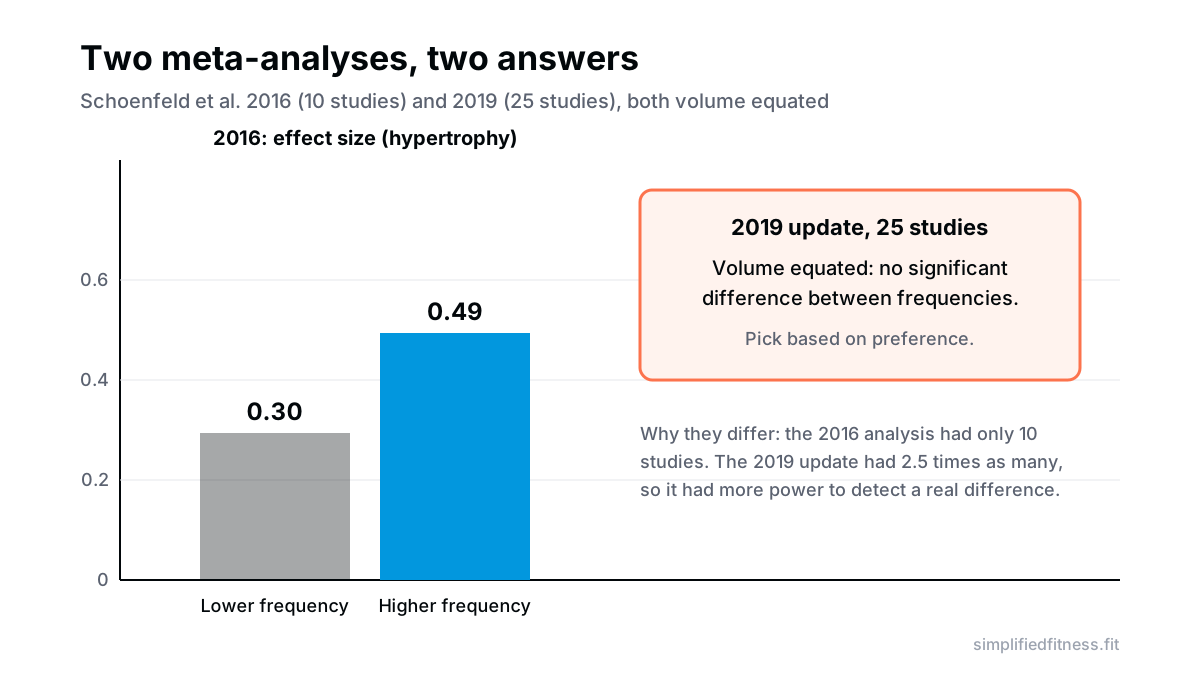
Why might they differ? The 2019 paper had 2.5 times as many studies and analysed volume-equated and non-volume-equated designs separately, so it had more power to isolate frequency. Both papers also pool short trials, mostly a few weeks to a few months, in mixed populations. Neither can tell you what happens over five years.
Do trained lifters respond differently?
The individual trials point the same way. They are small, so treat each one as a data point, not a verdict.
- 2x vs 3x: In a 10-week trial, 36 resistance-trained men (28 finished) did equal volume as either a split routine (muscles twice a week) or a total-body routine (three times). Strength and triceps and quadriceps thickness improved in both with no significant differences, while the biceps did not measurably grow in either group. Effect sizes leaned toward the split group for all hypertrophy measures (Lasevicius et al., 2019).
- 3x vs 6x: In 6 weeks, 28 trained men did either three or six sessions a week with equal volume and intensity. Strength and fat-free mass rose similarly in both, and the authors saw no added benefit from the higher frequency (Colquhoun et al., 2018). Fat-free mass is a lean-mass estimate, not a direct muscle measure.
- 2x vs 4x: In a 9-week trial of 21 trained men and women doing whole-body training, moderate (2 sessions) and high (4 sessions) frequency gave no differences in lean mass, muscle thickness or strength (Hamarsland et al., 2021).
These studies are short (6-10 weeks) and small (21-36 people enrolled). A real difference of a few percent would be easy to miss. That is why the practical advice below leans on logistics rather than on a claimed biological edge.
So why is 2x a week still the sweet spot?
Because of how sets behave inside a single session.
Say your target for chest is 12 hard sets a week. Do all 12 on Monday and you are probably pressing through set 9, 10, 11 with fading effort, shorter ranges and more fatigue. Split it into 6 and 6 and every set starts fresher. Same weekly total, more of it high quality. We cover that idea in junk volume and diminishing returns and the per-session set cap.
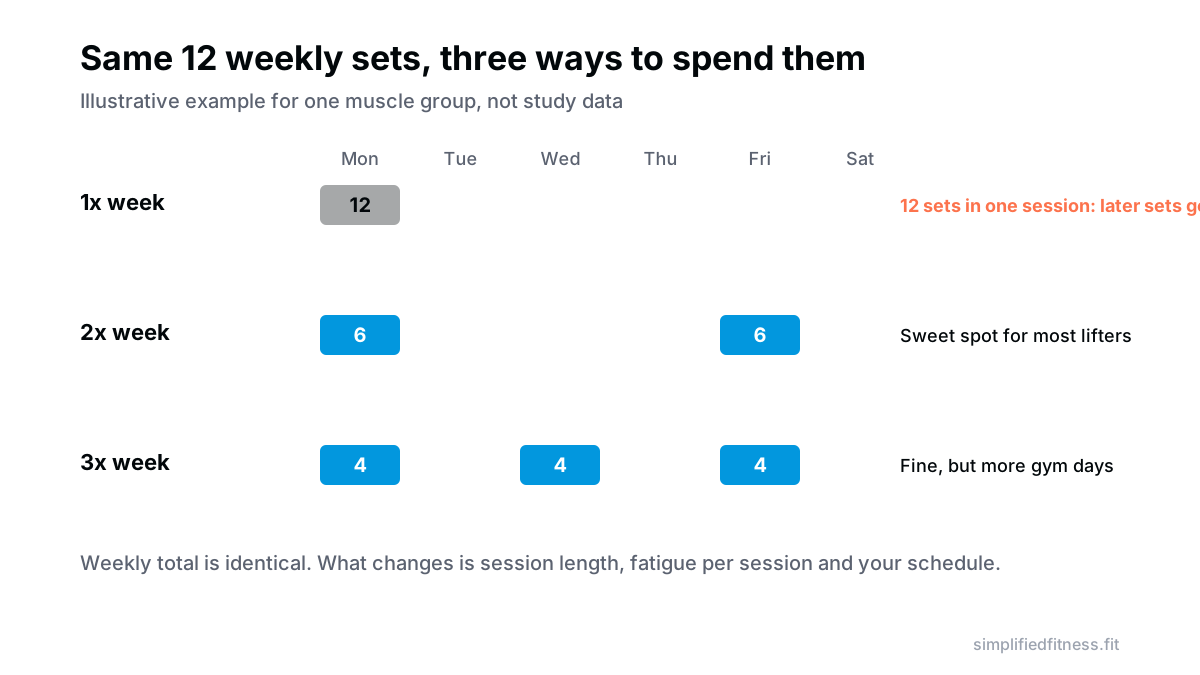
I should be clear about what is supported and what is a coaching judgement. The equated-volume meta-analysis does not show that 2x grows more muscle. The idea that smaller per-session doses keep effort higher is plausible and matches how most lifters feel, but it is a practical inference, not a finding from those trials.
Where frequency does seem to matter
A 2026 meta-regression pooled 67 studies with 2,058 participants and modelled weekly volume and frequency together. Volume had a clear dose-response with hypertrophy and strength, with diminishing returns. Frequency’s effect on hypertrophy was compatible with negligible. For strength, though, the frequency effect was consistent, again with diminishing returns (Pelland et al., 2026).
In plain gym terms:
- For size, count weekly sets first. Frequency is a distribution tool.
- For strength on a lift, practise it more often. The pooled data favour higher frequency for strength, and a plausible reason is that skill builds with repetition.
Is a bro split bad? Putting it in context
A bro split (chest Monday, back Tuesday, and so on) trains each muscle once a week. Based on the equated-volume data, that is not automatically inferior. The problem is what usually goes wrong:
- Total sets end up low, because one session per muscle feels “done” after 8-9 sets.
- Or sets end up very high and sloppy, because the lifter tries to cram a week’s work into one day.
- A missed session means that muscle goes unstimulated for 14 days.
Most of these are execution issues, not proof that once-weekly cannot work. If a bro split is the program you love and you hit a sensible weekly set count with real effort, you are not doing it wrong. If you are stuck, moving to two exposures per muscle is the simplest fix. Our comparison of full body, upper/lower and PPL walks through the trade-offs.
How to choose your frequency
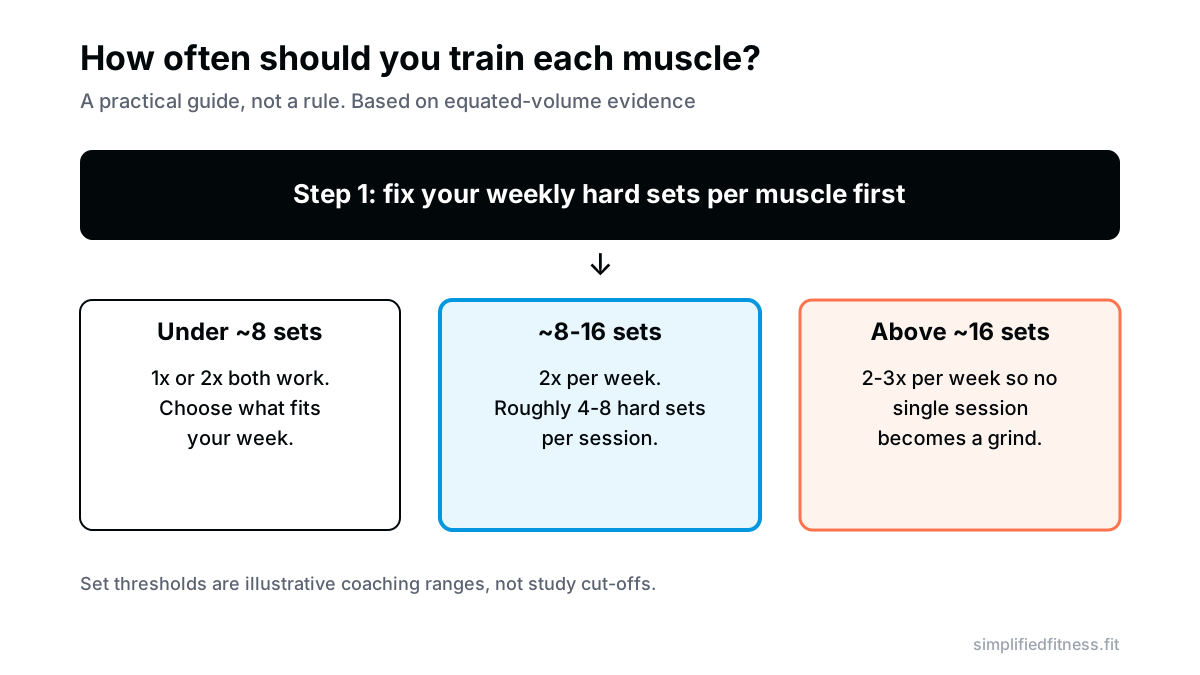
Use this simple order of decisions:
- Pick a weekly set target per muscle. Many intermediates work somewhere in a moderate range. Our weekly set dose-response article covers how to choose it.
- Divide by how many days you can attend. If you can train 3-4 days a week, a total-body or upper/lower structure gives two hits per muscle naturally. See the 3-day full-body plan or the 4-day upper/lower guide.
- Check session quality. If your final sets for one muscle in a session feel like survival, move some of them to another day.
- Run it for 8-12 weeks. Then adjust based on strength and measurements, not feelings after one week.
| Frequency | Good fit | Watch out for |
|---|---|---|
| 1x per muscle | Very busy weeks, low weekly volume, people who love bro splits | Cramming sets into one session, a missed day leaves a muscle idle |
| 2x per muscle | Most natural lifters, 3-5 gym days | Needs a plan so both sessions have enough effort |
| 3x per muscle | Higher volume goals, strength focus, lagging muscles | Recovery across the week, more gym time |
You can check your numbers with our training volume calculator.
Indian lifter context
Many Indian gym-goers train 5-6 days around work and commute, with a trainer-led bro split. If that is you, you do not need to rip it up. Look at the weekly count per muscle. If chest and back each get 6-8 sets once a week, adding a second light-to-moderate exposure on another day, such as a few sets after shoulders, is often the simplest upgrade. If you are on a vegetarian diet, protein intake from dal, paneer, curd and soya still matters more than split choice, so check yours with the protein calculator. Heat and long commutes make shorter sessions appealing too, which is another practical argument for two shorter exposures instead of one marathon.
When to see a doctor
Muscle soreness is normal. Pain that is sharp, one-sided and persistent, swelling, dark urine after very hard training, or numbness are not. Stop and see a doctor if you notice these. This article is general education, not a personal diagnosis or prescription.
The bottom line
When weekly hard sets are equal, frequency is a secondary lever for hypertrophy. The larger and more recent analyses suggest 1x, 2x and 3x can all work, while 2x tends to make high-quality volume easier to deliver. Use it as a default, not a law. Set your weekly volume, split it sensibly, and keep showing up. For the full picture, return to the volume and frequency guide.
Frequently Asked Questions
How often should you train each muscle for hypertrophy?
Twice a week is a sensible default for most lifters. Meta-analyses show that when total weekly sets are matched, frequency has little independent effect, but 2x lets you spread those sets across shorter sessions. Start with two sessions per muscle and adjust to your schedule.
Is training a muscle once a week enough to build muscle?
It can be, if you do enough total hard sets in that single session. A review of studies with direct measures of muscle growth found once-weekly training gave similar hypertrophy to two or three times a week. The catch is that fitting 10 or more sets of one muscle into one workout is hard to do well, so the later sets often turn into junk volume.
Is 2x a week better than 1x a week for muscle growth?
Sometimes, but not consistently. A 2016 meta-analysis favoured twice weekly, while a larger 2019 meta-analysis of volume-equated studies found no significant difference. If you choose 2x, do it because it makes your sessions easier to run well, and keep your weekly sets the same.
Is a bro split bad for muscle growth?
Not by definition. A bro split hits each muscle once a week, and equated-volume research says that is not automatically worse. The usual problem is that it concentrates sets into one long session, and many people never reach a useful weekly volume. Count your weekly hard sets per muscle before you judge any split.
Is full body 3x a week better than an upper/lower split?
Research does not show a clear winner. A 10-week trial of trained men (36 started, 28 finished) compared muscles trained twice (split routine) with three times (total-body routine) at equal volume and found similar gains, though effect sizes leaned toward the 2x group. Pick the one you will attend consistently.
Does training a muscle more often mean I can do more total sets?
Yes, it can. Higher frequency makes it easier to fit more weekly sets without any single session becoming too long. More volume has been linked to more growth up to a point, so frequency can be a tool for reaching higher volume rather than a growth driver itself.
Is 6 days a week of training too much?
Not necessarily if total volume is controlled. In a 6-week trial of 28 resistance-trained men, training 3x versus 6x per week with equal volume and intensity gave similar strength and fat-free mass gains. Daily gym visits are only worth it if you enjoy them and sleep and food are on point.
Does frequency matter more for strength than for muscle size?
A 2026 meta-regression of 67 studies found a clearer effect of frequency on strength, with diminishing returns, while the effect on hypertrophy was compatible with negligible. Practising a lift more often gives more chances to build skill. If strength on a given lift matters, train it at least twice a week.
How many sets per session is too many for one muscle?
There is no single proven cap. As a coaching rule, many lifters notice quality dropping past roughly 6-8 hard sets for one muscle in one session, but that is practical experience, not a study cut-off. If your last sets feel like survival, move some to another day.
Can beginners train each muscle once a week?
Yes, beginners can grow on very low volumes, so once weekly can work at first. Most beginner studies are short, so do not overread them. Training each muscle twice a week builds skill faster and sets you up for later progress.
What is the best training frequency for a natural lifter on a busy schedule?
Three full-body days or four upper/lower days both give every muscle two weekly hits without living in the gym. At equal volume, the evidence says either is fine. Choose the one you can repeat for months, because consistency beats optimisation.
Can I skip a day and still keep a 2x per week frequency?
Yes, as long as the two sessions are spaced reasonably, for example Monday and Thursday. Studies do not show that exact spacing is critical for muscle size. If you miss a session, add a few sets to the next one instead of adding a bonus day.
Does training soreness mean I should wait before training a muscle again?
Not strictly. Soreness fades with repeated exposure and is a poor guide to growth. A better check is whether performance on your first sets is back to normal, and if not, delay the session by a day.
Sources & References
Every claim above is checked against peer-reviewed research (PubMed, U.S. National Library of Medicine) or guidance from established health bodies. How we fact-check.
- Schoenfeld BJ, et al. Effects of Resistance Training Frequency on Measures of Muscle Hypertrophy: A Systematic Review and Meta-Analysis. Sports Med. 2016. PMID: 27102172
- Schoenfeld BJ, et al. How many times per week should a muscle be trained to maximize muscle hypertrophy? A systematic review and meta-analysis of studies examining the effects of resistance training frequency. J Sports Sci. 2019. PMID: 30558493
- Colquhoun RJ, et al. Training Volume, Not Frequency, Indicative of Maximal Strength Adaptations to Resistance Training. J Strength Cond Res. 2018. PMID: 29324578
- Hamarsland H, et al. Equal-Volume Strength Training With Different Training Frequencies Induces Similar Muscle Hypertrophy and Strength Improvement in Trained Participants. Front Physiol. 2021. PMID: 35069251
- Pelland JC, et al. The Resistance Training Dose Response: Meta-Regressions Exploring the Effects of Weekly Volume and Frequency on Muscle Hypertrophy and Strength Gains. Sports Med. 2026. PMID: 41343037
- Grgic J, et al. Resistance training frequency and skeletal muscle hypertrophy: A review of available evidence. J Sci Med Sport. 2019. PMID: 30236847
- Lasevicius T, et al. Similar Muscular Adaptations in Resistance Training Performed Two Versus Three Days Per Week. J Hum Kinet. 2019. PMID: 31531139

Umair Hazrami · Founder & Head Coach, Simplified Fitness
Umair Hazrami founded Simplified Fitness and the Simplified Lifter channel to cut through fitness noise. With 4+ years of consistent training and 10+ coaching clients, he writes every guide from the peer-reviewed research and links the sources so you can check them. Our editorial standards.
Educational content only, not medical advice. If you have a medical condition, are pregnant, or take medication, talk to a qualified doctor before changing your diet, supplements or training. Full disclaimer.
Keep reading

Programming
Autoregulation of Set Volume: Add or Cut Sets Based on Readiness and Velocity Loss
Autoregulation training volume explained: use warm-up speed, RIR and a 20-25% performance drop to add or cut sets, and what the evidence does or does not prove.
9 min read
Programming
The Biological Cost of High Volume: Sleep, Cortisol and Immune Strain
High volume lifting side effects: what research says about poor sleep, cortisol and colds, which warning signs matter, and how to scale back.
9 min read

Programming
How to Count Compound Sets Toward Weekly Volume: Direct vs Fractional Sets
How to count compound sets volume for arms, delts and hamstrings: the 1.0 and 0.5 fractional rule, a worked weekly example and what the research says.
9 min read

Programming
Distributing Weekly Volume: Full Body 3x vs Upper/Lower 4x vs PPL 6x
Distributing weekly volume across splits: how 12 sets per muscle look in full body, upper/lower and PPL, plus session length math and which fits your week.
9 min read