The Biological Cost of High Volume: Sleep, Cortisol and Immune Strain
High volume lifting side effects: what research says about poor sleep, cortisol and colds, which warning signs matter, and how to scale back.
TL;DR. The short answer
- High volume lifting side effects show up as a cluster: worse sleep, higher resting heart rate, slower bar speed, low mood and more minor illness. No single sign proves you are overdoing it.
- Research on sleep restriction in trained females found cortisol up 42%, perceived effort up 11% and slower squat speed, while total volume lifted barely moved. Effort can climb while output looks unchanged.
- Cortisol, testosterone and heart rate are noisy markers. A 2013 ECSS/ACSM consensus says none of the hormonal, immune or performance markers meets all criteria for general use.
- The evidence that heavy training raises infection risk is mostly from endurance athletes and is disputed. Lifters should treat repeated colds as one clue, not a verdict.
- If you feel run down on 25+ weekly sets, cut sets by roughly 30-50% for a week or two and see whether sleep and bar speed recover. Persistent symptoms deserve a doctor.
Part of our complete guide: Optimal Training Volume and Frequency: How Many Sets per Muscle Actually Build Muscle
Table of contents
Picture the lifter doing 25-plus hard sets per muscle per week. Sleep is patchy, they have had three colds this year, the shoulders ache, and the bar feels slower than it did last month. The question is whether the training is the cause. The honest answer: high volume lifting side effects are real for some people, but the evidence is thinner and messier than most gym content admits.
More sets generally build more muscle, up to a point that differs from person to person (that trade-off is mapped in our complete guide to training volume and frequency). This article is about the other side of the ledger: what chronic high volume can cost your sleep, stress hormones and immune system, which signs are worth acting on, and what to do about them.
What are the side effects of high volume lifting?
Researchers describe a spectrum. At one end is functional overreaching: a short-term performance dip that turns into a gain after rest. Further along is nonfunctional overreaching, then overtraining syndrome, where performance and mood stay down for much longer. The ECSS/ACSM consensus statement says the line between the last two is very difficult to draw, and that the athlete often shows the same clinical and hormonal signs in both (Meeusen et al., 2013).
In plain gym terms, the cluster to watch for is:
- sleep that gets worse, lighter or more broken
- a morning pulse that creeps up
- lifts that feel heavier at the same weight, or bar speed that drops
- low motivation, irritability, or dread before sessions
- more minor illness than usual
- aches that do not settle between sessions
One sign alone means little. Three or four together, lasting two weeks or more, is a pattern.
Can too much gym volume ruin sleep?
Here is where I have to be careful. The best lifting-specific sleep research asks the reverse question: what does bad sleep do to lifting? I could not find a good trial that raised weekly sets in lifters and measured slow-wave (deep) sleep. So the claim that high volume directly suppresses deep sleep is plausible, but I cannot back it with a trial. Treat it as a hypothesis.
What we do have is useful. A 2022 crossover trial put 10 resistance-trained females through nine nights of 5-hour sleep and nine nights of normal sleep, with four lifting sessions each. Total volume load fell by under 1%. But bar speed on lower-body lifts slowed by up to 15%, speed loss within back squat sets was up to 7% greater, salivary cortisol area under the curve rose 42%, training distress rose 84%, and session perceived exertion rose 11% (Knowles et al., 2022).
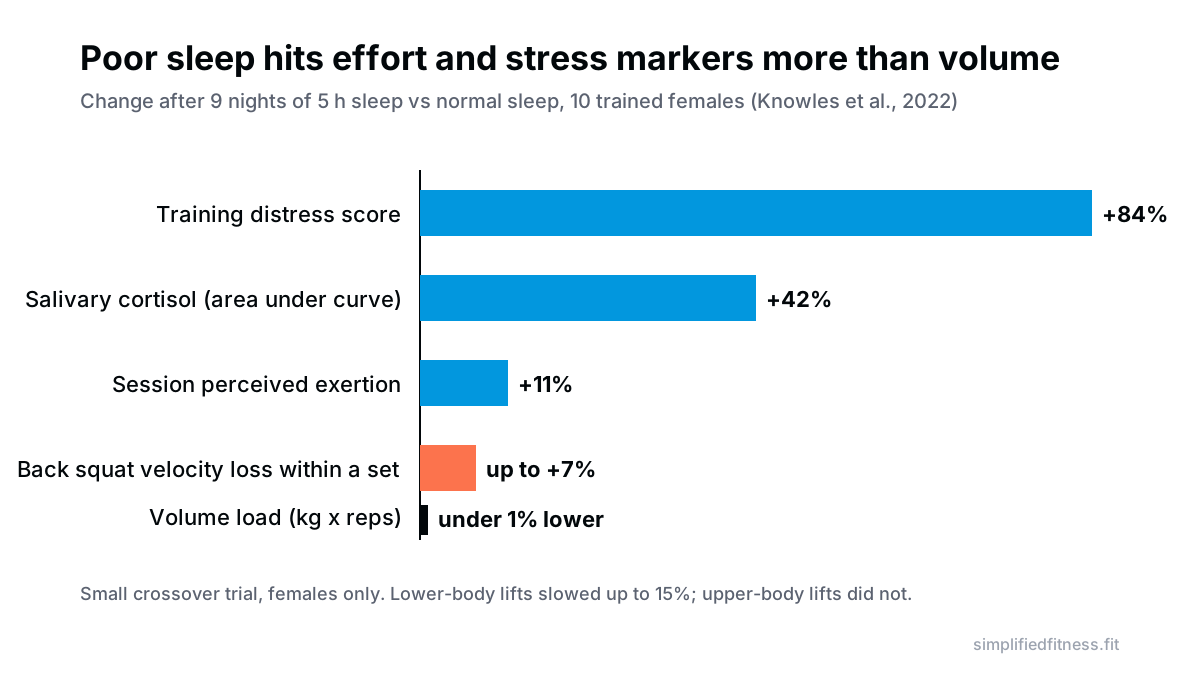
Two cautions. This was 10 females, and it tested sleep loss, not high volume. But it shows a pattern that matches what lifters report: the session still gets done, it just costs more.
A 2018 systematic review of 17 studies (rated moderate or weak quality) agrees in direction: consecutive nights of sleep restriction could reduce force output in multi-joint but not single-joint movements, while hormonal findings were conflicting (Knowles et al., 2018).
Does lifting raise cortisol, and does it matter?
Yes, hard sessions raise cortisol acutely. That is a normal stress response, not a problem. The concern is a chronic pattern, and here the research gets murky.
A review of the neuroendocrine literature found that responses to high-volume resistance overtraining look somewhat similar to those in aerobic overtraining, but that excessive resistance training intensity produces a distinctly different profile. The authors concluded that some hormonal markers often suggested for overtraining may not apply to every scenario (Fry and Kraemer, 1997). The later consensus statement is blunter: hormones, performance tests, psychological tests, and biochemical and immune markers are all used, but none meets all the criteria for general acceptance (Meeusen et al., 2013).
So where does that leave a gym-goer who has read that cortisol is “the stress hormone that kills gains”?
- A single high cortisol reading proves little. It swings with time of day, sleep and the session you just did.
- Testosterone-to-cortisol ratios are sold as overtraining tests. The consensus says no marker has earned that role.
- Your sleep, mood, bar speed and appetite are cheaper and probably more informative.
Does resting heart rate rise when volume is too high?
Sometimes, but it is a weak signal. A meta-analysis of competitive athletes found that short overload blocks (under 2 weeks) produced a moderate rise in resting heart rate (SMD 0.55), while longer blocks showed no change in resting values. The authors concluded that the changes are small enough to fall within day-to-day variability, and that heart rate must be read alongside other signs (Bosquet et al., 2008).
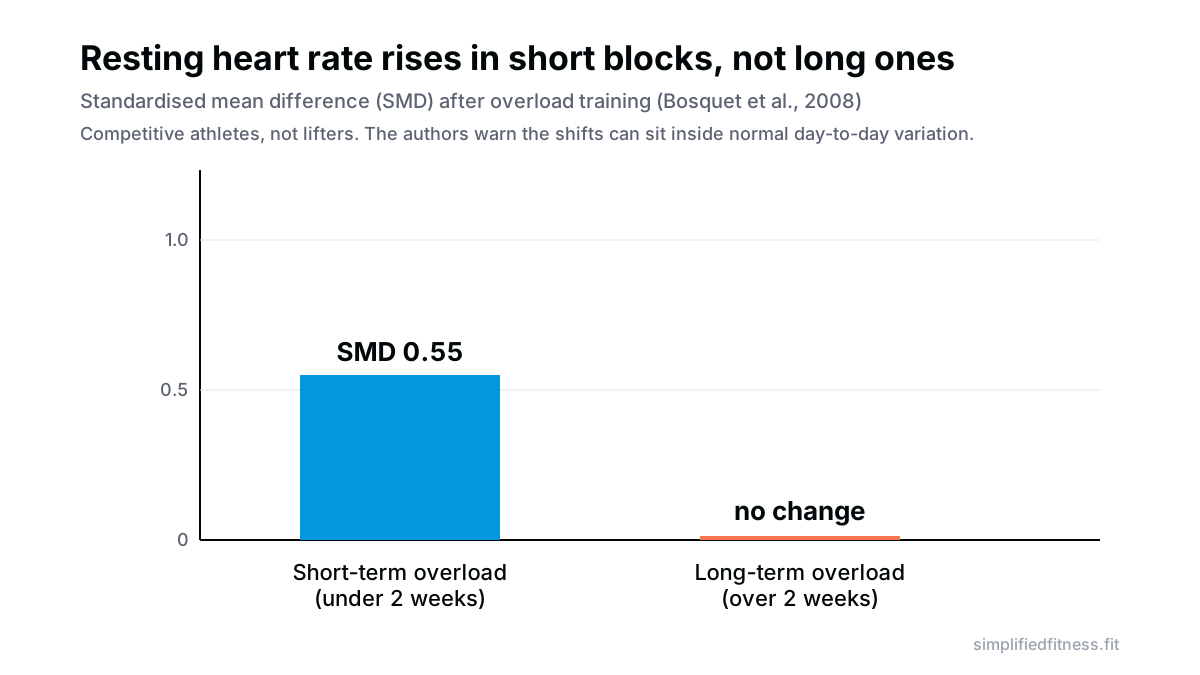
That meta-analysis is based on competitive athletes rather than recreational lifters, so it may not map neatly onto a recreational lifter’s week. Practical version: take your pulse lying down each morning for a few weeks to learn your normal range. A jump of several beats that persists, together with bad sleep and flat lifts, is worth acting on. A single odd morning is not.
Do heavy training blocks weaken your immune system?
This is the claim with the most conflicting evidence, so here is both sides.
What supports it. Reviews of athletes suggest that prolonged intense training may slightly impair measures such as neutrophil function, immunoglobulin levels and possibly natural killer cell activity. The authors say athletes are not clinically immune deficient, but that small changes combined could reduce resistance to minor illnesses like upper respiratory tract infection, and advise avoiding overtraining and getting adequate rest (Mackinnon, 2000). Another review notes that endurance athletes appear to have more infections during heavy training periods, but that most athletes do not get ill, and regular exercise without overreaching is linked with lower infection risk (Nieman, 2000).
What pushes back. A 2018 review argues that the “open window” idea is overstated: limited reliable evidence shows vigorous exercise raises infection risk, and the post-exercise dip in blood lymphocytes likely reflects cells moving to tissues rather than suppression (Campbell and Turner, 2018).
Why they differ. The data are mostly from endurance athletes and old lab studies, measuring immune markers whose link to actual illness is shaky. Almost none is from lifters doing high weekly set counts.
Cautious takeaway. Treat repeated colds as one clue. Before blaming volume, check the usual suspects: sleep, protein and energy intake, stress, and who you are being exposed to. If colds keep coming and other signs line up, a lighter week is cheap to try.
What about persistent joint aches?
Honest answer: I found no trial that ties weekly set count to joint pain. Joint aches have many causes: exercise selection, technique, abrupt load jumps, long-standing niggles, and poor recovery between sessions. High volume can plausibly contribute because it means more repeated loading with less time to settle, but that is a coaching inference, not a proven link.
What to do: rotate the irritating exercise for a joint-friendlier variation, trim sets on that muscle, and see a physio or doctor if pain is sharp, swollen, wakes you at night, or lasts more than a couple of weeks.
Will cutting volume fix it, and will I lose muscle?
The brief version of this story online says that dropping volume “immediately restores deep sleep and growth.” The evidence does not go that far. What the research does show is gentler and still useful.
A study of 14 recreationally strength-trained men (21-30 years) followed an 8-week strength block, then cut volume by about 54% immediately or tapered it over two weeks. Squat 1RM rose in both groups, more in the immediate-cut group (3.4% vs 1.7%), and in the immediate-cut group testosterone and the testosterone to SHBG ratio rose after the first taper week (Seppänen and Häkkinen, 2022). It is small, short, and about strength, not size or sleep. It does support one idea: a brief volume drop after hard training does not make a trained lifter weaker.
For muscle growth, the dose-response meta-analysis found each additional weekly set was associated with a 0.37% larger gain in muscle size, with graded benefits as volume rose (Schoenfeld et al., 2017). That is the reason volume matters, and why a short pullback is a trade you can usually afford. It does not say 25 sets beat 15 for everyone, and past a personal threshold the extra sets often turn into junk volume.
How to scale back without wrecking progress
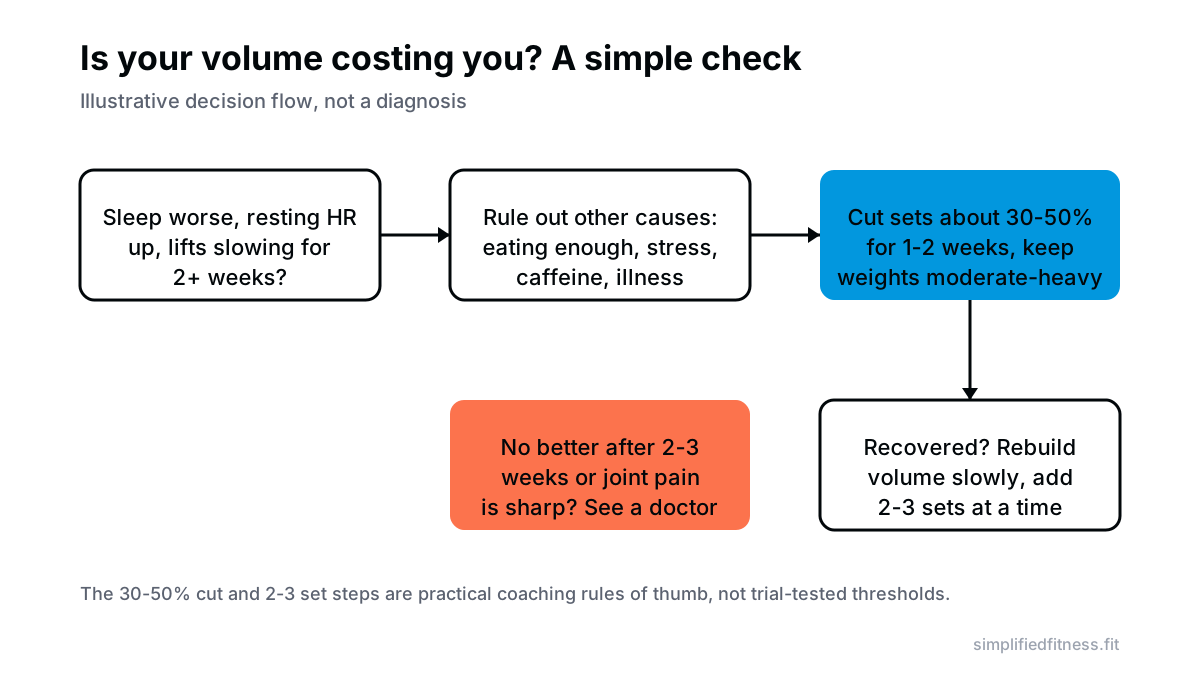
- Confirm the pattern. Two weeks or more of worse sleep, higher morning pulse, slower lifts, low drive. Not one bad day.
- Rule out the boring causes. Are you eating enough? A calorie deficit plus high volume is a classic combo. Sleeping 7 hours or fewer? Caffeine late? Illness brewing? The consensus statement itself lists caloric restriction, low carbohydrate or protein intake, and iron or magnesium deficiency as things to exclude (Meeusen et al., 2013).
- Cut sets, keep the weight. A reduction of roughly 30-50% of sets for one to two weeks is a coaching rule of thumb, not a trial-tested number. Keep loads moderate to heavy so you stay practiced.
- Rebuild slowly. Add two or three weekly sets at a time, not ten. Our guide to volume landmarks shows how to find your maximum recoverable volume without overshooting, and deloads and volume resensitization covers planned pullbacks.
- Log your own baseline. Count your weekly hard sets with the training volume calculator and compare against how you slept and lifted.
Signs versus causes: a quick comparison
| Sign | Could point to high volume | Other common causes |
|---|---|---|
| Broken sleep | Sustained high stress load | Caffeine, screens, shift work, stress, heat |
| Higher morning pulse | Short overload block | Illness, dehydration, alcohol, poor sleep |
| Frequent colds | Possible contributor | Poor sleep, low energy intake, exposure, low vitamin D |
| Joint aches | More repeated loading | Technique, load jumps, old injuries |
| Slower bar speed | Accumulated fatigue | Sleep loss, calorie deficit, heat |
When to see a doctor
Overtraining is a diagnosis of exclusion, which means infections, thyroid problems, anaemia and other conditions must be ruled out first. See a doctor if fatigue and poor sleep last beyond two to three weeks of reduced training, or come with unexplained weight loss, palpitations, chest pain, fainting, persistent low mood, or joint swelling. This article is general education, not a diagnosis.
The bottom line
High volume is a tool, not a virtue. The research shows that stress markers and perceived effort can rise while output looks unchanged, that heart rate and hormone markers are unreliable alarms, and that immune claims are contested and mostly from endurance athletes. Judge by a cluster of signs over weeks, remove the boring causes, then trim sets for a week or two and watch what happens.
For the full picture of how much volume to aim for, start with the training volume and frequency guide, and if the picture looks worse than one rough week, read overtraining syndrome vs non-functional overreaching. To spot your own limit, see individual recovery profiling and volume tolerance.
Frequently Asked Questions
What are the side effects of high volume lifting?
The usual picture is poor or broken sleep, a resting heart rate that creeps up, lifts that feel heavier than they should, low mood and nagging aches. These overlap with many other causes, so no single sign is proof. Look for several appearing together over two or more weeks, then reduce volume and see what changes.
Can too much gym volume ruin sleep?
It can for some people, though the research is stronger for the reverse direction. Studies mostly show that poor sleep worsens lifting, and I found no trial proving that extra sets directly disturb sleep. If your sleep drops while sets climb, trim volume for a week and track whether it improves.
Does lifting weights raise cortisol?
Yes, every hard session raises cortisol temporarily, and that is normal and not harmful. Problems are suggested only when stress markers stay high alongside poor recovery and falling performance. Judge by how you feel, sleep and lift rather than chasing a cortisol number.
How many sets per week is too many?
There is no universal ceiling because tolerance depends on the muscle, your training age, sleep, food and life stress. A 2017 meta-analysis found more weekly sets generally produced more growth, so the cost is individual rather than a fixed number. If you are above about 20-25 hard sets for a muscle and recovering poorly, test a reduction.
Does overtraining weaken your immune system?
Reviews suggest intense training blocks may slightly change some immune measures in athletes, but a 2018 review argues the idea of exercise-induced immune suppression is overstated. Most of the data is from endurance athletes, not lifters. If you keep getting sick, look at sleep, food, stress and exposure first, then consider cutting volume.
Is a high resting heart rate a sign of overtraining?
It can be one clue, but not a reliable one. A meta-analysis in competitive athletes found resting heart rate rose moderately after short overload blocks, yet the authors said the shift can sit within normal daily variation. Track your own morning pulse for a few weeks and only act when it moves alongside other signs.
Do joint aches mean I am doing too much volume?
They can, but joint pain has many causes including technique, exercise choice, sudden load jumps and old injuries. I found no trial linking weekly set count directly to joint aches, so treat the link as a reasonable coaching suspicion. Swap irritating exercises, trim sets and see a physio or doctor if pain is sharp, swelling or lasts.
How long does it take to recover from too much training volume?
A 1997 review describes overreaching as recoverable in a few days, while full overtraining can take many weeks or months to recover from. Most lifters are at the milder end. Cut volume early, since waiting turns a short fix into a long one.
Will cutting volume lose my muscle?
Not in the short term for most people. A study of 14 recreationally strength-trained men found that cutting volume for two weeks after an 8-week block still raised squat strength. A week or two at lower volume is a recovery tool, not a step backwards.
Can poor sleep reduce muscle growth?
Poor sleep hurts lifting quality, and that likely matters for growth. A systematic review found consecutive nights of sleep restriction can reduce force in compound lifts, though long-term growth data are limited. Aim for consistent sleep and treat it as part of your program.
What is the difference between overreaching and overtraining?
Functional overreaching is a short dip in performance that turns into a gain after rest, while nonfunctional overreaching and overtraining syndrome involve longer maladaptation. The consensus statement admits separating them is very difficult. Practically, both mean you need less training stress and more recovery now.
Should I see a doctor for constant fatigue and bad sleep?
Yes, if symptoms persist beyond a few weeks of reduced training or come with unexplained weight loss, chest symptoms, fainting or low mood. Overtraining is a diagnosis of exclusion, meaning other conditions must be ruled out first. A doctor can check things like thyroid, iron and infection, which training changes will not fix.
Sources & References
Every claim above is checked against peer-reviewed research (PubMed, U.S. National Library of Medicine) or guidance from established health bodies. How we fact-check.
- Knowles OE, et al. Inadequate sleep and muscle strength: Implications for resistance training. J Sci Med Sport. 2018. PMID: 29422383
- Knowles OE, et al. Sustained Sleep Restriction Reduces Resistance Exercise Quality and Quantity in Females. Med Sci Sports Exerc. 2022. PMID: 36136596
- Fry AC, et al. Resistance exercise overtraining and overreaching. Neuroendocrine responses. Sports Med. 1997. PMID: 9068095
- Meeusen R, et al. Prevention, diagnosis, and treatment of the overtraining syndrome: joint consensus statement of the European College of Sport Science and the American College of Sports Medicine. Med Sci Sports Exerc. 2013. PMID: 23247672
- Bosquet L, et al. Is heart rate a convenient tool to monitor over-reaching? A systematic review of the literature. Br J Sports Med. 2008. PMID: 18308872
- Nieman DC. Is infection risk linked to exercise workload? Med Sci Sports Exerc. 2000. PMID: 10910297
- Mackinnon LT. Chronic exercise training effects on immune function. Med Sci Sports Exerc. 2000. PMID: 10910293
- Campbell JP, et al. Debunking the Myth of Exercise-Induced Immune Suppression: Redefining the Impact of Exercise on Immunological Health Across the Lifespan. Front Immunol. 2018. PMID: 29713319
- Schoenfeld BJ, et al. Dose-response relationship between weekly resistance training volume and increases in muscle mass: A systematic review and meta-analysis. J Sports Sci. 2017. PMID: 27433992
- Stina S (indexed name; author Seppänen S), Häkkinen K. Step vs. Two-Phase Gradual Volume Reduction Tapering Protocols in Strength Training: Effects on Neuromuscular Performance and Serum Hormone Concentrations. J Strength Cond Res. 2022. PMID: 33337705

Umair Hazrami · Founder & Head Coach, Simplified Fitness
Umair Hazrami founded Simplified Fitness and the Simplified Lifter channel to cut through fitness noise. With 4+ years of consistent training and 10+ coaching clients, he writes every guide from the peer-reviewed research and links the sources so you can check them. Our editorial standards.
Educational content only, not medical advice. If you have a medical condition, are pregnant, or take medication, talk to a qualified doctor before changing your diet, supplements or training. Full disclaimer.
Keep reading
Programming
Autoregulation of Set Volume: Add or Cut Sets Based on Readiness and Velocity Loss
Autoregulation training volume explained: use warm-up speed, RIR and a 20-25% performance drop to add or cut sets, and what the evidence does or does not prove.
9 min read

Programming
How to Count Compound Sets Toward Weekly Volume: Direct vs Fractional Sets
How to count compound sets volume for arms, delts and hamstrings: the 1.0 and 0.5 fractional rule, a worked weekly example and what the research says.
9 min read
Programming
Distributing Weekly Volume: Full Body 3x vs Upper/Lower 4x vs PPL 6x
Distributing weekly volume across splits: how 12 sets per muscle look in full body, upper/lower and PPL, plus session length math and which fits your week.
9 min read
Programming
HIT (Mentzer Heavy Duty) vs High-Volume Training: What the Evidence Says
Does Mike Mentzer HIT training work? See what meta-analyses say about 1 set to failure vs multiple sets, and a realistic middle ground for busy lifters.
8 min read