Training Volume While Cutting: Should You Reduce Sets in a Calorie Deficit?
Training volume while cutting: should you add sets to burn fat or trim them to recover? See what trials show on muscle retention and how to adjust your sets.

TL;DR. The short answer
- Do not add more sets to burn more fat. Lifting protects muscle during a cut, while the deficit itself, not extra volume, drives fat loss.
- Cutting volume by roughly 20-30% is a common coaching rule of thumb when recovery drops, but no trial has tested that exact number. Treat it as a starting point, not a law.
- Keep the load on the bar and keep hard sets near failure. Trim the filler sets that add fatigue without much extra stimulus.
- A 2022 review found data insufficient to say higher volume spares lean mass in a deficit, though programs with 10 or more weekly sets per muscle showed little lean mass loss (mostly in women) and reducing volume over time did not look better.
- A 4-week trial found 12 and 30 weekly sets per muscle retained the same fat-free mass at a 40% calorie cut, so more is not clearly better.
Part of our complete guide: Optimal Training Volume and Frequency: How Many Sets per Muscle Actually Build Muscle
Table of contents
Training volume while cutting is the one thing most lifters get backwards. They see the scale stall, so they add sets and extra cardio to “burn more.” The better move is usually to hold your heavy lifting and, if recovery is slipping, trim some sets. Adding more rarely helps.
This article is a cluster inside our complete guide to training volume and frequency for hypertrophy. Here we only cover what changes when calories drop. Be warned about one thing early: the popular “cut volume by 20-30%” rule is a coaching habit, not a number any trial has tested. The honest picture is more interesting than that.
Does lifting burn fat when you are cutting?
Not enough to matter. A weights session burns some calories, but fat loss in a cut comes from the gap between what you eat and what you spend. Piling on sets mostly adds fatigue.
What lifting does is tell your body to keep its muscle. That is its job in a deficit. You are not lifting to lose fat, you are lifting to make sure what you lose is fat.
What does a deficit actually do to muscle gain?
A 2022 meta-analysis pooled randomized trials where people lifted for at least 3 weeks while in an energy deficit. Lean mass gains were lower than in people lifting at normal calories (effect size -0.57), while strength gains were comparable (effect size -0.31, not significant) (Murphy and Koehler, 2022).
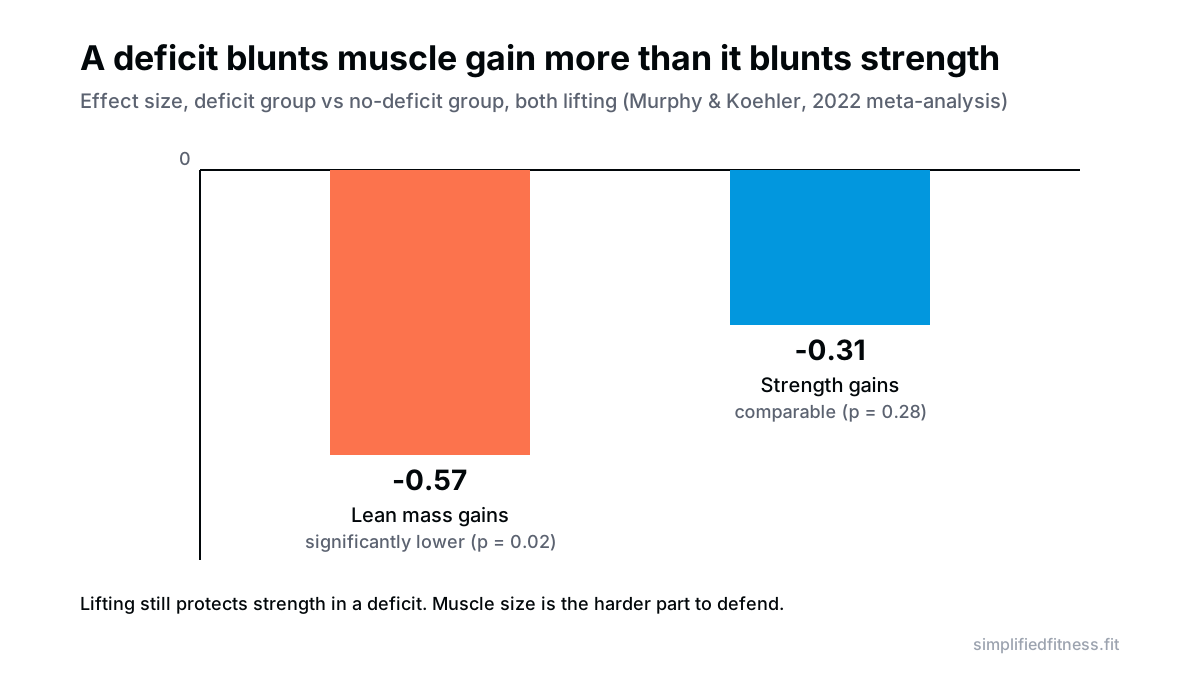
Two things to read carefully. First, those trials were mixed, and many involved people trying to gain muscle, not just keep it. Second, the same paper’s meta-regression found a deficit of about 500 kcal per day was enough to prevent lean mass gains, and the authors suggest avoiding deficits above that if preserving lean mass is the goal. If you want help picking a deficit that is not crushing, our guide on moderate versus aggressive calorie deficits goes deeper.
Why would you reduce volume in a calorie deficit?
The case for trimming sets is about recovery, and it is reasonable even if it is not proven.
- Less fuel. Eating less usually means less carbohydrate available for hard sets. This is a plausible reason sessions feel flat, though the studies below did not directly test it.
- Slower repair at rest. In young men and women, 5 days of energy deficit lowered resting muscle protein synthesis by 27%. A bout of lifting brought it back to the level seen in energy balance, and protein after training pushed it higher (Areta et al., 2014). That was a 5-day study in 15 people, so do not stretch it to a 12-week diet.
- More stress, less sleep. Dieting is stressful, and a hungry lifter often sleeps worse. Recovery is not only about muscle, it is also about how well you slept last night.
So in theory the same 18 sets that were manageable at maintenance can leave you cooked in week eight of a cut. That is the reasoning behind the usual 20-30% trim. Treat it as a way to match your volume to your recovery, not as a fixed rule.
What does the research say about high versus low volume in a cut?
Here is where the story gets less tidy.
A 2022 review looked at 15 studies of resistance-trained athletes in caloric restriction. Only 4 of those studies reported enough detail to calculate weekly sets or tonnage. Programs with 10 or more weekly sets per muscle showed low-to-no lean mass loss, mostly in female athletes, and studies where volume was increased during the restriction showed no-to-low lean mass loss compared with studies that reduced volume. The authors still concluded the evidence is insufficient to say higher volume is better at sparing lean mass, partly because most studies did not report their training details (Roth et al., 2022). They noted the data seemed to favour higher volume in female athletes.
Then a small randomized trial from 2026 tested it more directly. Sixteen resistance-trained people ate a high-protein diet (2.3 g/kg) with a 40% calorie cut for 4 weeks, training 5 days per week at either 12 or 30 sets per muscle per week. Fat loss and fat-free mass changes did not differ between groups. The 30-set group did gain more on the 5-rep max in chest press and leg press (Nait-Yahia et al., 2026).
| Study | Who | What they found |
|---|---|---|
| Roth et al., 2022 (review) | Resistance-trained athletes, 15 studies | 10+ weekly sets per muscle showed little lean mass loss, mostly in women; evidence insufficient to prove higher volume spares lean mass |
| Nait-Yahia et al., 2026 (RCT) | 16 trained people, 4 weeks, 40% deficit | 12 vs 30 sets: same fat-free mass; strength rose more with 30 sets |
| Murphy and Koehler, 2022 (meta-analysis) | RCTs lifting 3+ weeks in a deficit vs normal calories | Lean mass gains lower in deficit; strength comparable |
How do these fit together? Possibly like this. Very low volume probably is not ideal, but past a reasonable floor, more sets did not clearly protect extra muscle in the studies we have. The 4-week trial was short and small, and a longer cut with leaner lifters might look different. So the sensible reading is: do not slash volume to almost nothing, do not add volume hoping it saves muscle, and stay in a middle range you recover from.
Can you keep muscle with fewer sets?
Quite possibly, yes. This is where a trim becomes easier to trust.
A 2011 trial put 70 adults through 16 weeks of lifting three times per week, then 32 weeks of either detraining or maintenance at one-third or one-ninth of the earlier dose. Both maintenance doses preserved the muscle size gained in the young group (20-35 years), but not in the older group (60-75 years). The one-third dose even led to extra fibre growth in the young (Bickel et al., 2011).
Remember the limits. These were not people in a calorie deficit, and the study measured maintenance after a growth phase, not a cut. Still, it shows muscle is easier to keep than to build. That is the logic behind trimming sets on a diet. For the extreme end, see our article on maintenance volume and how little training keeps muscle.
On the other side, volume does still matter for growth. A meta-analysis found a graded dose-response between weekly sets and muscle growth in general (Schoenfeld et al., 2017). But that is about building muscle, usually at normal calories. A cut is not the time to chase it.
What should you keep and what should you trim?
Here is the simple version.
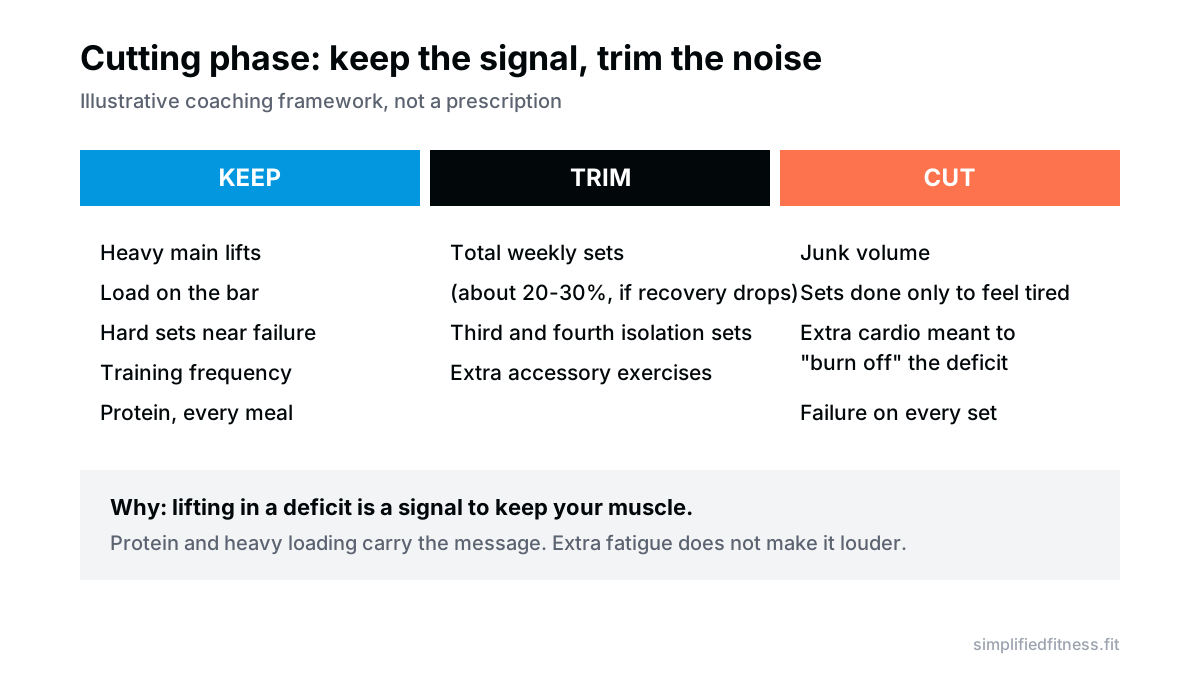
Keep:
- The heavy compound lifts you already do, at the same loads
- Hard sets close to failure (more on that in proximity to failure in a deficit)
- Your weekly frequency, so each muscle still gets hit a couple of times
- Protein at every meal
Trim (only if recovery is slipping):
- Third and fourth sets of isolation work
- The extra “finisher” exercises
- Total weekly sets by about a fifth to a third
Cut:
- Junk volume, meaning sets that add tiredness but no useful stimulus (see junk volume explained)
- Extra cardio that you added just to “burn off” the diet. Our piece on cardio during a cutting phase covers how much is sensible.
A simple example of trimming sets
Say your pre-cut plan had you at 16 sets for chest and 18 for back each week. Here is how a roughly 25% trim might look. This is illustrative, not from a study.
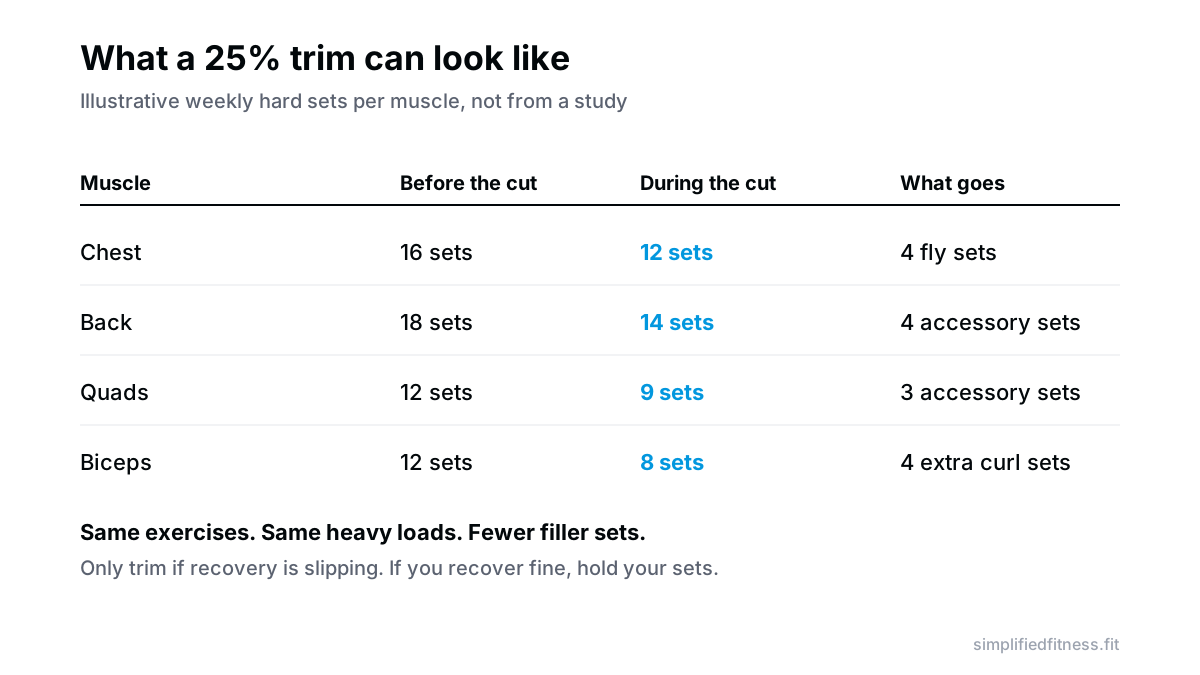
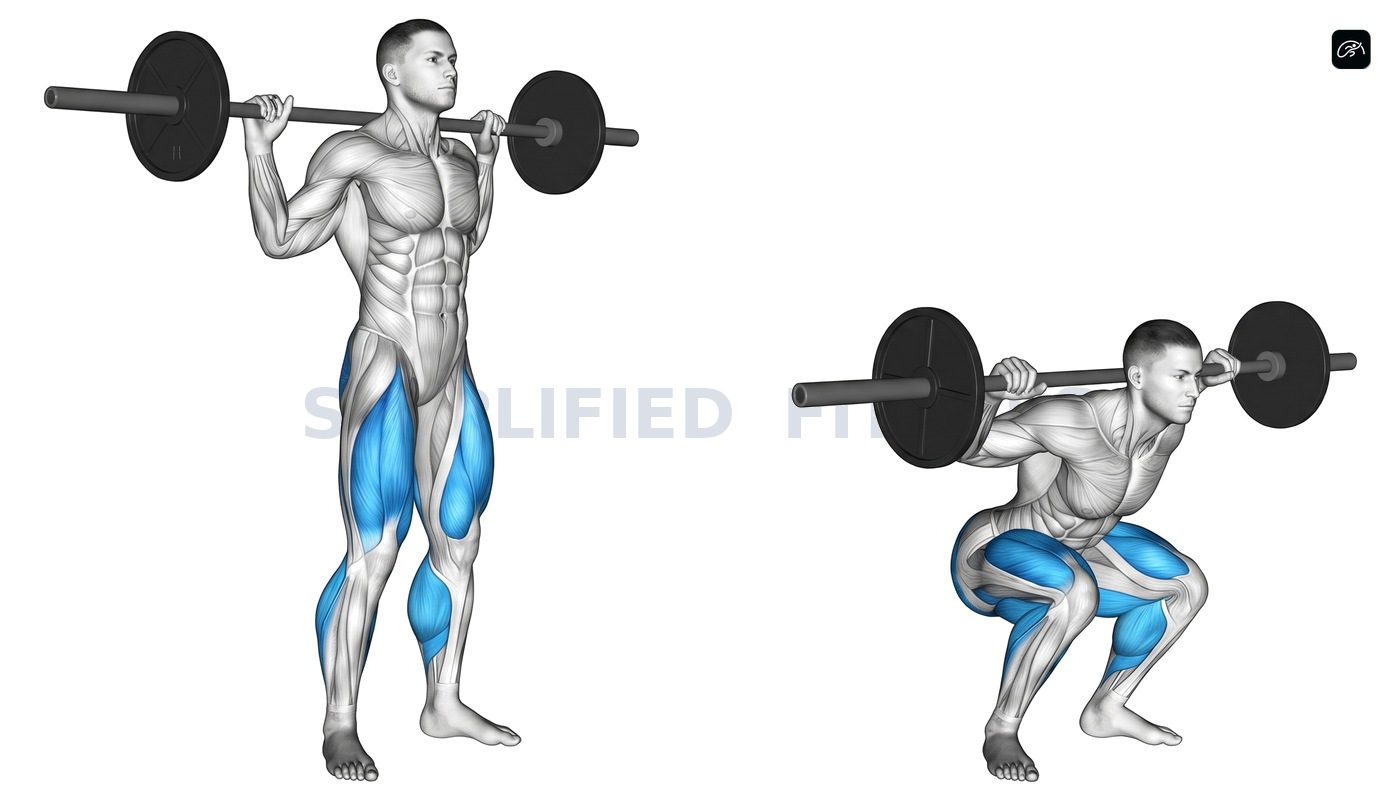
Notice what disappears: the sets you would score lowest for effort. The heavy bench, the row, the squat stay. If your leg day centres on the barbell back squat, keep that lift and drop the finisher.
To see how your own weekly total compares, use the training volume calculator. If you are unsure whether a deficit is set sensibly, start with the calorie calculator.
How much protein protects muscle in a cut?
Protein is the other half of keeping muscle, alongside the lifting itself. A systematic review of lean, resistance-trained athletes in a deficit concluded protein needs are likely 2.3-3.1 g/kg of fat-free mass, scaling up with the severity of the restriction and leanness (Helms et al., 2014). The 2026 ISSN position stand likewise calls resistance training and sufficient protein indispensable for limiting lean mass loss in a sustained deficit (Aragon et al., 2026).
For an Indian vegetarian lifter this is where the work lies. Dal and roti alone will not do it. Build meals around paneer, curd, soya chunks, eggs if you eat them, and a whey or plant protein if the budget allows. Our guide to high protein during a cut has meal-level detail.
How do you know your volume is too high?
Judge by trends, not one bad day. Watch for these over two or more weeks:
- Your top sets are getting lighter or slower on the same exercises
- Sleep gets worse, or you wake up tired
- Joints feel sore beyond normal muscle soreness
- Your motivation to train drops sharply
Two or three of those together mean it is time to trim sets, not to push through. If none are happening, your volume is fine and you do not need to cut it just because you started a diet. When the feeling of being run down continues after a deload and a diet break, see the guidance in our full volume guide.
When to see a doctor
A cut should feel like effort, not like illness. Speak to a doctor if you notice dizziness or fainting, unusual coldness, constant fatigue for weeks, missed periods, or if thoughts about food and weight start taking over your day. This article is general education and does not diagnose anything. If you have a medical condition or a history of disordered eating, plan your cut with a professional.
The bottom line
Do not add volume to burn fat. Keep your heavy lifts, keep hard sets close to failure, eat plenty of protein, and trim filler sets only if your recovery tells you to. The 20-30% figure is a decent starting point, not a proven rule. Stay in the middle: enough training to send the “keep your muscle” message, not so much that you cannot recover from it.
Frequently Asked Questions
Should I increase training volume when cutting?
Usually no. Extra sets do not burn enough calories to matter, and a 4-week trial in trained people found 30 weekly sets per muscle did not retain more fat-free mass than 12 sets during a 40% calorie cut. If your recovery is fine, hold your current volume; if it is slipping, trim rather than add.
Should I reduce training volume in a calorie deficit?
It depends on how you recover. Many coaches trim weekly sets by about 20-30% as the diet gets harder, but a 2022 review found the evidence insufficient to prove that lower or higher volume is better for lean mass. Keep your heavy lifts, and cut sets only if performance and sleep start to suffer.
How many sets per muscle per week should I do while cutting?
A reasonable starting range for most lifters is about 8-14 hard sets per muscle per week, adjusted to your own history. A 2022 review noted that programs with 10 or more weekly sets per muscle showed low to no lean mass loss, mostly in female athletes, though few studies reported sets clearly. Use the training volume calculator to see where your current plan sits.
Does lifting weights while cutting burn fat?
Lifting burns some calories, but its main job in a cut is telling your body to keep its muscle. Fat loss comes from the calorie deficit, and a meta-analysis shows lifting in a deficit protects strength well even when muscle gains are blunted. Lift to keep muscle and use your diet and daily steps to lose fat.
Will I lose muscle if I cut my training volume?
Not necessarily. In a trial of young adults, training at one-third or one-ninth of earlier volume for 32 weeks preserved muscle gained earlier, although that was not done in a calorie deficit. The practical takeaway is that a modest trim with heavy loads and high protein should be safe for most lifters.
Why do workouts feel harder when I am in a calorie deficit?
You have less fuel and often less sleep and more stress, and short-term research shows muscle protein synthesis at rest dropped by 27% after 5 days of energy deficit. Lifting restored it to normal levels in that study, so training is still worth doing. If sessions feel flat, check your sleep, protein and weekly set count before blaming willpower.
Should I keep lifting heavy when cutting?
Yes, keep the loads as heavy as you can handle with good form. A 2022 meta-analysis found strength gains in a deficit were comparable to those at normal calories, so your strength work is still worth doing. Drop to lighter loads only if a joint complains, and keep tracking your top sets.
Is high volume or low volume better for keeping muscle in a cut?
Neither has clearly won. A 2022 review found data favoured higher volume in female athletes but called the overall evidence insufficient, and a 4-week trial found 12 sets and 30 sets kept fat-free mass equally. Pick the volume you can recover from and repeat consistently.
How big a calorie deficit is too big for lifting?
Smaller is kinder to muscle. A meta-regression found that a deficit of about 500 kcal per day was enough to prevent lean mass gains, and the authors advise avoiding bigger deficits when the goal is preserving muscle. A slow loss of around 0.5-1% of body weight per week is a commonly recommended range.
Should I do more cardio instead of lifting when cutting?
No. Cardio does not send the signal to keep muscle, and the 2026 ISSN position stand calls resistance training and enough protein indispensable for limiting lean mass loss in a deficit. Keep your lifting, add walking for energy expenditure, and read our guide to cardio while cutting for the details.
How much protein do I need while cutting?
Research on lean, trained athletes in a deficit suggests about 2.3-3.1 g per kg of fat-free mass, scaling up with leaner physiques and bigger deficits. Protein is the main dietary tool for keeping muscle when calories drop. Spread it over three or four meals using dal, paneer, curd, eggs, soya or chicken.
When should I see a doctor during a cut?
See a doctor if you feel dizzy, faint, unusually cold or exhausted for weeks, notice missed periods, or find that food and weight dominate your thoughts. These can be signs your deficit or training load is too much for your body. A deficit should be uncomfortable, not harmful, so speak to a professional rather than pushing through.
Sources & References
Every claim above is checked against peer-reviewed research (PubMed, U.S. National Library of Medicine) or guidance from established health bodies. How we fact-check.
- Roth C, et al. Lean mass sparing in resistance-trained athletes during caloric restriction: the role of resistance training volume. Eur J Appl Physiol. 2022. PMID: 35146569
- Murphy C, et al. Energy deficiency impairs resistance training gains in lean mass but not strength: A meta-analysis and meta-regression. Scand J Med Sci Sports. 2022. PMID: 34623696
- Nait-Yahia S, et al. A 4-week caloric restriction with high volume resistance-training and high-protein diet does not increase fat-free mass sparing but increases strength. Eur J Clin Nutr. 2026. PMID: 42103927
- Areta JL, et al. Reduced resting skeletal muscle protein synthesis is rescued by resistance exercise and protein ingestion following short-term energy deficit. Am J Physiol Endocrinol Metab. 2014. PMID: 24595305
- Bickel CS, et al. Exercise dosing to retain resistance training adaptations in young and older adults. Med Sci Sports Exerc. 2011. PMID: 21131862
- Schoenfeld BJ, et al. Dose-response relationship between weekly resistance training volume and increases in muscle mass: A systematic review and meta-analysis. J Sports Sci. 2017. PMID: 27433992
- Helms ER, et al. A systematic review of dietary protein during caloric restriction in resistance trained lean athletes: a case for higher intakes. Int J Sport Nutr Exerc Metab. 2014. PMID: 24092765
- Aragon AA, et al. International Society of Sports Nutrition position stand: diets for body weight reduction. J Int Soc Sports Nutr. 2026. PMID: 42867412

Umair Hazrami · Founder & Head Coach, Simplified Fitness
Umair Hazrami founded Simplified Fitness and the Simplified Lifter channel to cut through fitness noise. With 4+ years of consistent training and 10+ coaching clients, he writes every guide from the peer-reviewed research and links the sources so you can check them. Our editorial standards.
Educational content only, not medical advice. If you have a medical condition, are pregnant, or take medication, talk to a qualified doctor before changing your diet, supplements or training. Full disclaimer.
Keep reading

Programming
Autoregulation of Set Volume: Add or Cut Sets Based on Readiness and Velocity Loss
Autoregulation training volume explained: use warm-up speed, RIR and a 20-25% performance drop to add or cut sets, and what the evidence does or does not prove.
9 min read
Programming
The Biological Cost of High Volume: Sleep, Cortisol and Immune Strain
High volume lifting side effects: what research says about poor sleep, cortisol and colds, which warning signs matter, and how to scale back.
9 min read

Programming
How to Count Compound Sets Toward Weekly Volume: Direct vs Fractional Sets
How to count compound sets volume for arms, delts and hamstrings: the 1.0 and 0.5 fractional rule, a worked weekly example and what the research says.
9 min read
Programming
Distributing Weekly Volume: Full Body 3x vs Upper/Lower 4x vs PPL 6x
Distributing weekly volume across splits: how 12 sets per muscle look in full body, upper/lower and PPL, plus session length math and which fits your week.
9 min read