Weekly Set Volume for Muscle Growth: 6-10 vs 10-20 Sets per Muscle
Optimal sets per week for muscle growth: what meta-analyses and trials show about 6-10 vs 10-20 sets per muscle, and how to pick your number.

TL;DR. The short answer
- Muscle growth rises with weekly hard sets, but each extra set adds less than the one before. A 2017 meta-analysis linked each additional weekly set to roughly 0.37% more muscle gain.
- For trained young men, a 2022 review suggested 12-20 weekly sets per muscle as a sound target, though higher volume looked better for the triceps only.
- Fewer sets still work. In one trial of trained men, strength gains were similar from one, three or five sets per exercise, while muscle size favoured more sets.
- The best number is the highest volume you can recover from, not the highest you can survive. Start near 8-10 hard sets per muscle and add sets slowly.
- Poor sleep, high stress or a heavy work month are good reasons to sit in the lower range for a while.
Part of our complete guide: Optimal Training Volume and Frequency: How Many Sets per Muscle Actually Build Muscle
Table of contents
The optimal sets per week for muscle growth is not one number. Research shows a dose-response curve: more hard sets per muscle generally build more muscle, but every extra set pays back a little less. For most lifters, somewhere between 8 and 20 hard sets per muscle per week is the productive zone, and the right spot inside it depends on how well you recover.
This article is the evidence base behind that statement. If you want the full programming picture, including frequency and splits, start with our complete guide to training volume and frequency.
What does the dose-response curve for muscle growth look like?
Picture a curve that climbs steeply at first and then flattens. That is the pattern across the volume literature.
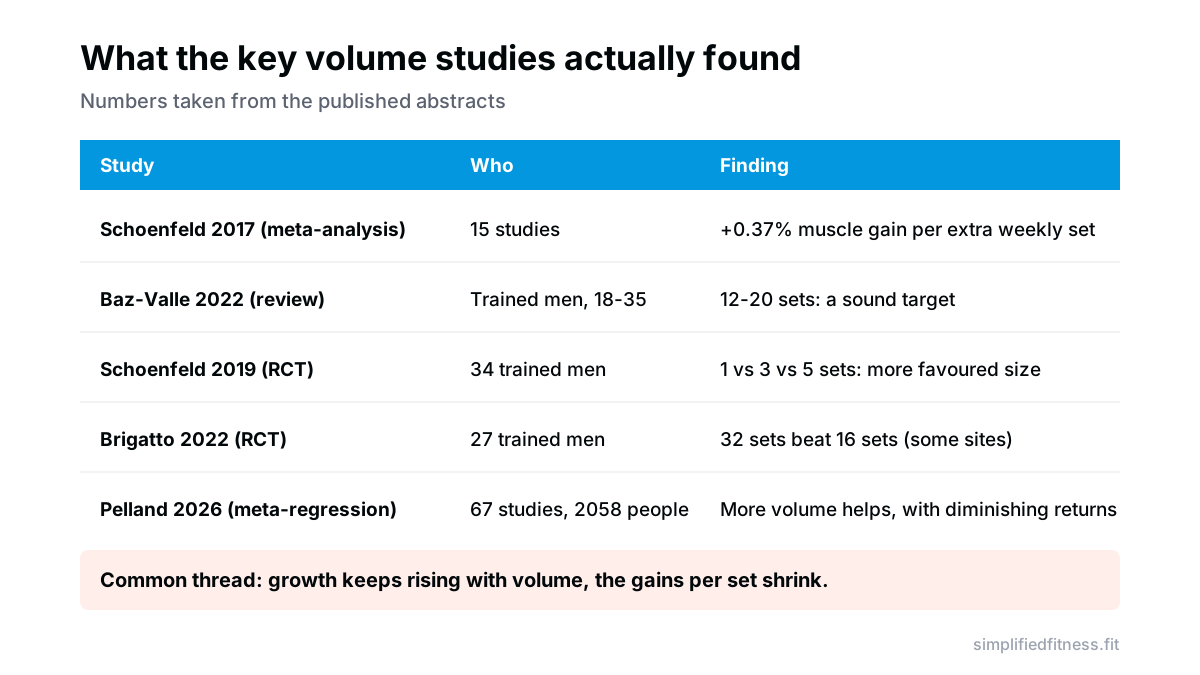
The best-known analysis is a 2017 meta-analysis of 15 studies (34 treatment groups). Treating weekly sets as a continuous number, each additional set was associated with an effect size increase of 0.023, which worked out to roughly 0.37% more muscle gain per set (Schoenfeld et al., 2017). Comparing lower against higher volumes within each study, the difference was about 3.9% in percentage gain.
Here is the part that gets lost on social media. When the same authors split studies into three groups (fewer than 5, 5-9, and 10 or more weekly sets per muscle), the effect showed only a trend (P = 0.074). So “6-10 sets gets you 80% of the result” is a tidy coaching rule, not something that abstract proves. The honest summary is a graded relationship, with no hard cliff.
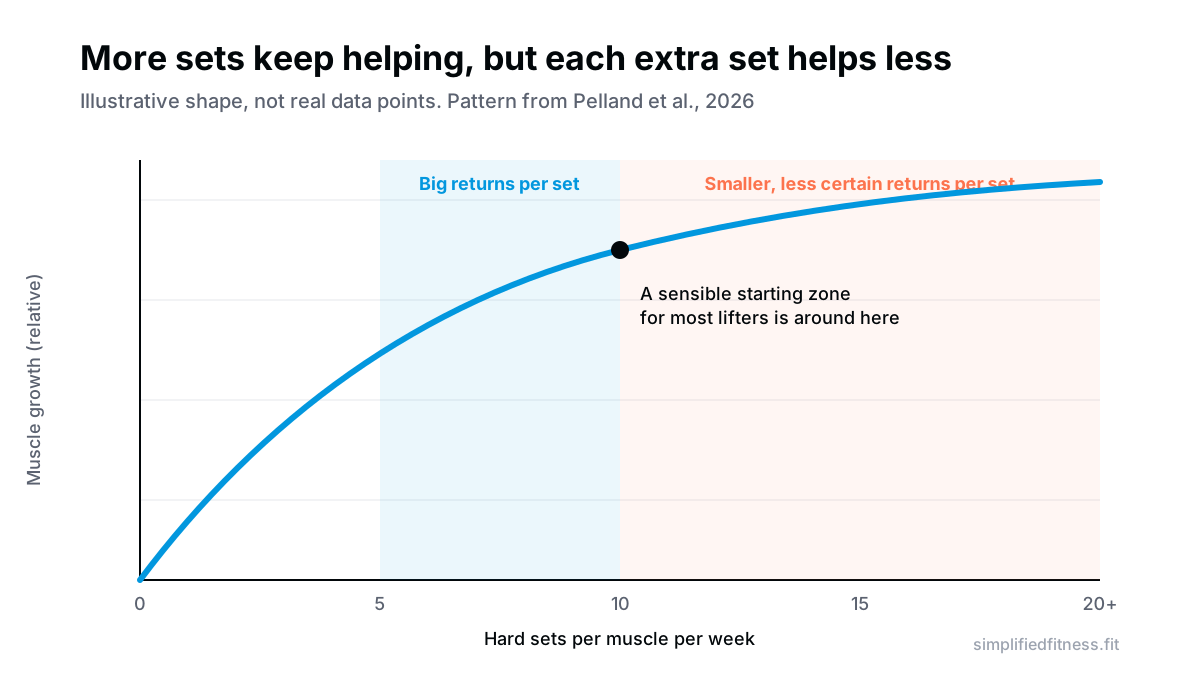
A newer analysis supports the flattening. A 2026 meta-regression pooled 67 studies and 2,058 participants (about 79% male, average age about 25). Gains in muscle size increased with volume, and the best-fitting model showed diminishing returns (Pelland et al., 2026). It also found that counting indirect sets (for example, triceps work from bench press) as “fractional” sets, about half a set each, predicted outcomes best.
Is 6-10 sets per week enough for muscle growth?
For plenty of people, yes. This matters if you only train three or four days and can spare 45-60 minutes.
Muscle size does increase at lower volumes. In an 8-week trial, 34 resistance-trained men did one, three or five sets per exercise, three sessions a week. All groups gained strength and endurance with no significant differences between them, so even the low-volume group improved. Muscle size told a different story: significant increases favouring the higher-volume groups appeared in the elbow flexors, mid-thigh and lateral thigh (Schoenfeld et al., 2019).
Read that carefully. Strength gains were similar across volumes. Size gains followed volume. If your goal is mostly strength, low volume goes a long way. If your goal is the biggest possible muscle, more sets help, within limits.
An older meta-analysis agrees directionally. Across 8 studies, multiple sets per exercise produced larger hypertrophy effects than a single set, in trained and untrained people. The 2-3 set versus 4-6 set comparison was not significant (Krieger, 2010).
Do 10-20 sets per muscle per week beat 6-10?
Often, yes, particularly in young trained men, though the evidence is smaller and messier than the headline suggests.
A 2022 systematic review included 6 trials in its quantitative analysis, all in men aged 18-35 with at least one year of lifting experience, each lasting 6 weeks or more. It compared moderate (12-20 weekly sets) and high (more than 20 weekly sets) volume. There was no difference for the quadriceps (p = 0.19) or biceps (p = 0.59), but high volume looked better for the triceps (p = 0.01). The authors concluded that 12-20 weekly sets per muscle group may be a sound standard recommendation for young trained men (Baz-Valle et al., 2022).
So why would triceps respond differently? The abstract does not say. A reasonable guess is that heavy pressing already gives the triceps indirect work, which makes counting “sets” less clean. Treat that as speculation.
Even higher volumes can still pay off in the short term. In an 8-week trial of 27 resistance-trained men doing 16, 24 or 32 weekly sets per muscle, all groups improved. The 32-set group showed larger gains in lower-body strength and thickness, and in triceps thickness, than the 16-set group. Small groups of nine men each, so treat it as one data point (Brigatto et al., 2022).
Why the studies do not perfectly agree
Conflicting numbers are normal here. Three things explain most of it.
- Short trials. Most last 6-12 weeks. Very high volume may look great early and behave differently over months.
- Mostly young men. The Baz-Valle review covered men aged 18-35, and the 2026 meta-regression was about 79% male. Results in women, older adults and people with demanding jobs are less certain.
- Counting differences. Studies count sets per exercise, per session or per muscle, and treat indirect work differently. The same “10 sets” can mean different things.
One more caveat. The studies compare group averages. Individual responses vary widely, so your own training log is evidence too.
When more volume stops helping
Diminishing returns do not mean extra sets are harmful by default. They mean the return per set drops while the cost, in fatigue, time and recovery, does not.
In the 2026 meta-regression, both hypertrophy and strength showed diminishing returns, with strength flattening more sharply (Pelland et al., 2026). That is why very high volume mainly makes sense for a muscle you are specifically trying to bring up. For a deeper look at where extra sets become wasted effort, see our guide to junk volume and diminishing returns.
A common mistake is jumping straight to 20 sets everywhere. You end up fatigued, lifting worse, and counting sets that were too tired to be hard sets.
How to pick your weekly sets per muscle
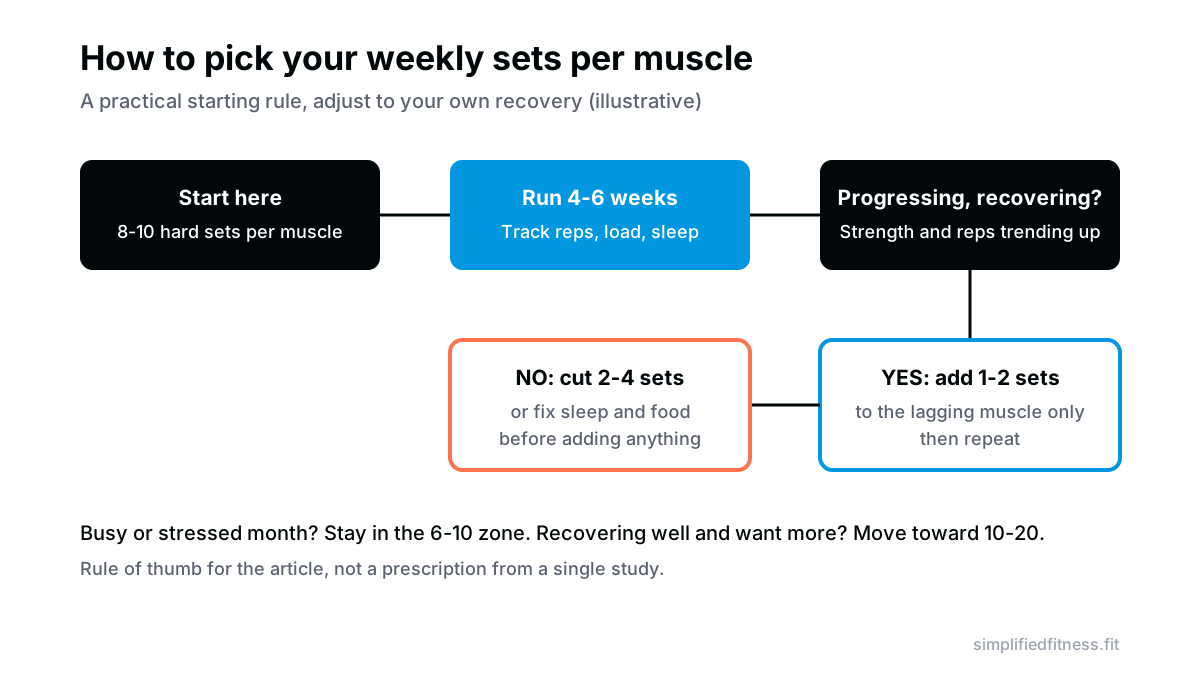
Use a simple loop instead of guessing.
- Start near 8-10 hard sets per muscle. Spread over two sessions a week is a good default.
- Run it for 4-6 weeks. Log weights and reps. Watch sleep and soreness.
- If you are progressing and recovering well, add 1-2 sets to the muscle you most want to grow. Only that muscle.
- If progress stalls or you feel run down, cut 2-4 sets and fix sleep and food first.
- Repeat. Your number will drift up and down with life.
Not sure how to count a week of training? Our training volume calculator tallies sets per muscle for you, and the guide on quantifying training volume explains hard sets versus tonnage. For the effort side, see reps in reserve and RPE.
Matching volume to your life stress
Training volume competes with everything else you do. Long commute in 38 degree heat, rotating shifts, a vegetarian diet where protein takes planning, exam season: all of these reduce what you can recover from. The research does not test these conditions directly, so this is coaching logic, not a study result.
A practical way to use it:
- Heavy month at work: sit at 6-10 hard sets per muscle and protect your sessions.
- Stable month, sleeping 7-9 hours, eating enough protein: build toward 10-15.
- Fully dialled in and wanting more: experiment with 15-20 for one or two lagging muscles, and watch for warning signs.
Protein and calories matter here too. Dal, paneer, curd, soya chunks, eggs or chicken help, but if you are under-eating, more sets will not rescue you. Use our protein calculator to check your daily target.
Different muscles also tolerate different volumes, and frequency changes how you spread sets. Both are covered in dedicated guides: muscle-specific volume tolerance, training frequency with equated volume, and volume landmarks.
When to see a doctor
Normal training fatigue should settle with a lighter week. Persistent chest pain, dizziness, unusual shortness of breath, sharp joint pain that does not ease with rest, or a long period of exhaustion and mood changes are not “volume problems.” Speak to a doctor or physiotherapist before pushing harder.
What a “hard set” looks like in practice
Every number above assumes hard sets. In the gym, that means a set where the last two or three reps slow down and your form is still clean. If you could have done six more reps, it was a warm-up, not a working set.
This also explains why studies and real life disagree. A trial controls effort tightly. In a normal gym, people drift: they chat between sets, stop early on leg day and rush the last exercise. If your logged 15 sets include a few of those, your real volume may be closer to 10. That is not a failure, it is just worth knowing before you decide “20 sets did nothing for me.”
The bottom line
The evidence supports a simple view. Weekly hard sets and muscle growth are positively linked, the curve flattens, and 12-20 sets per muscle is a well-supported target for trained young men, with lower volumes still productive. Individual tolerance, sleep and stress decide where you land.
Pick a starting number, track it, and change it slowly. For a ready-made structure, try our free push, pull, legs plans, then adjust the sets using the loop above.
Frequently Asked Questions
What is the optimal number of sets per week for muscle growth?
There is no single magic number, but meta-analyses point to a graded relationship where more weekly sets produce more growth with diminishing returns. A 2022 review of trained men suggested 12-20 weekly sets per muscle as a reasonable target. Start around 8-10 hard sets per muscle and move up only while you keep progressing and recovering.
Are 6-10 sets per muscle per week enough to build muscle?
Yes, for many people, especially beginners and anyone short on time. Trials show muscle size still increases at lower volumes, but groups doing more sets often gain more size. If your life is busy, 6-10 hard sets per muscle is a legitimate, productive place to be.
Is 20 sets per muscle per week too much?
Not for everyone, but it is not where most people should start. Research in young trained men found 12-20 sets performed well, and the extra gain above that was inconsistent. Build up to it gradually and cut back if your lifts stall, joints ache or sleep suffers.
Do more sets always mean more muscle?
More sets tend to mean more muscle, but with shrinking returns. A 2026 meta-regression of 67 studies found gains rise with volume while the curve flattens. Past a point, extra sets cost recovery without paying back much, so add them only where you are lagging.
How many sets per exercise should I do?
Think in sets per muscle per week, not per exercise. A 2010 meta-analysis found multiple sets beat a single set per exercise, with no clear difference between 2-3 and 4-6 sets. Spread your weekly total across 2-3 exercises and sessions.
Do beginners need less volume than advanced lifters?
Beginners usually grow on less volume because almost any hard training is a new stimulus. Experienced lifters often need more to keep progressing, though research on this is mixed. Begin at the lower end of the range and let results, not ego, tell you when to add sets.
Are volume landmarks like MEV and MRV scientifically proven?
They are a practical coaching framework, not exact lab-measured thresholds. The underlying idea, that too little does little and too much stalls recovery, fits the dose-response data. Treat the numbers as starting guesses and adjust to your own response.
What counts as a hard set?
A hard set is one taken close enough to failure that the last few reps are genuinely slow and difficult. Warm-up sets and easy sets stopped far from failure do not count toward the weekly total. Aim for about 1-3 reps in reserve on most sets.
Should I count compound lifts toward muscle volume?
Yes, partly. The 2026 meta-regression found that counting indirect sets as about half a set predicted results best. So bench press adds some triceps volume, but not a full set of it. Our guide on [direct vs indirect sets](/blog/direct-vs-indirect-fractional-compound-set-volume) shows how to count.
How do I know if I am doing too many sets?
Warning signs are strength or reps trending down for two or more weeks, persistent joint pain, poor sleep and workouts you dread. These suggest volume exceeds your recovery. Drop 2-4 sets per muscle, check sleep and food, and reassess in a few weeks.
Can I build muscle with 10 sets per week if I train hard?
Yes. Intensity of effort matters as much as the set count, so ten genuinely hard sets beat twenty casual ones. Keep most sets 1-3 reps from failure and progress your loads or reps over time.
Does the best volume change when I am cutting or stressed?
It often does, because recovery capacity drops when you eat less, sleep less or carry more stress. Evidence here is limited, so use performance as your guide. Trim volume slightly when progress stalls and recovery feels poor.
Sources & References
Every claim above is checked against peer-reviewed research (PubMed, U.S. National Library of Medicine) or guidance from established health bodies. How we fact-check.
- Schoenfeld BJ, et al. Dose-response relationship between weekly resistance training volume and increases in muscle mass: A systematic review and meta-analysis. J Sports Sci. 2017. PMID: 27433992
- Baz-Valle E, et al. A Systematic Review of The Effects of Different Resistance Training Volumes on Muscle Hypertrophy. J Hum Kinet. 2022. PMID: 35291645
- Pelland JC, et al. The Resistance Training Dose Response: Meta-Regressions Exploring the Effects of Weekly Volume and Frequency on Muscle Hypertrophy and Strength Gains. Sports Med. 2026. PMID: 41343037
- Krieger JW. Single vs. multiple sets of resistance exercise for muscle hypertrophy: a meta-analysis. J Strength Cond Res. 2010. PMID: 20300012
- Schoenfeld BJ, et al. Resistance Training Volume Enhances Muscle Hypertrophy but Not Strength in Trained Men. Med Sci Sports Exerc. 2019. PMID: 30153194
- Brigatto FA, et al. High Resistance-Training Volume Enhances Muscle Thickness in Resistance-Trained Men. J Strength Cond Res. 2022. PMID: 31868813

Umair Hazrami · Founder & Head Coach, Simplified Fitness
Umair Hazrami founded Simplified Fitness and the Simplified Lifter channel to cut through fitness noise. With 4+ years of consistent training and 10+ coaching clients, he writes every guide from the peer-reviewed research and links the sources so you can check them. Our editorial standards.
Educational content only, not medical advice. If you have a medical condition, are pregnant, or take medication, talk to a qualified doctor before changing your diet, supplements or training. Full disclaimer.
Keep reading
Programming
Autoregulation of Set Volume: Add or Cut Sets Based on Readiness and Velocity Loss
Autoregulation training volume explained: use warm-up speed, RIR and a 20-25% performance drop to add or cut sets, and what the evidence does or does not prove.
9 min read
Programming
The Biological Cost of High Volume: Sleep, Cortisol and Immune Strain
High volume lifting side effects: what research says about poor sleep, cortisol and colds, which warning signs matter, and how to scale back.
9 min read

Programming
How to Count Compound Sets Toward Weekly Volume: Direct vs Fractional Sets
How to count compound sets volume for arms, delts and hamstrings: the 1.0 and 0.5 fractional rule, a worked weekly example and what the research says.
9 min read
Programming
Distributing Weekly Volume: Full Body 3x vs Upper/Lower 4x vs PPL 6x
Distributing weekly volume across splits: how 12 sets per muscle look in full body, upper/lower and PPL, plus session length math and which fits your week.
9 min read