Maintenance Volume (MV) Science: How Few Sets Keep Your Muscle in Busy Phases
The minimum workout to keep muscle during exams, work crunches or travel: maintenance volume trial data, a weekly set range and a simple 2-day template.

TL;DR. The short answer
- Maintenance volume is the least training that keeps the muscle and strength you already built. In a 2011 trial, young adults held their muscle size on one-third or even one-ninth of their earlier training dose for 32 weeks.
- Older adults (60-75 years) did not hold muscle fibre size on those reduced doses, so the 'one-third is enough' finding applies most clearly to young, healthy people.
- A practical translation is roughly 2-4 hard sets per muscle per week, 1-3 reps short of failure. That number is a coaching rule of thumb, not a figure any trial proved.
- Strength is the stickiest quality: it was largely retained even when people stopped training completely for 32 weeks, and it holds up well for a few weeks of travel or exams.
- Stopping entirely for two months cost untrained men about 5% of quadriceps size and 23% of squat strength, while one or two sessions a week lost nothing significant.
Part of our complete guide: Optimal Training Volume and Frequency: How Many Sets per Muscle Actually Build Muscle
Table of contents
The minimum workout to keep muscle is smaller than most people fear. That smallest dose is called maintenance volume: the least training that keeps the muscle and strength you already have. For healthy younger lifters, the best trial data suggests that roughly one-third of a normal training dose can hold muscle size for months, as long as the sets stay hard.
This article is part of our complete guide to training volume and frequency. If you want the long-term physiology of maintenance, including how older adults differ, read how little training keeps muscle for months. Here we stay practical and zoom in on the busy-phase question: exams, a work deadline, a new baby, a month of travel. What is the minimum workout to keep muscle, and how much of the “I am losing everything” panic is real?
Short version: less than you think. But the research is narrower than the Instagram version, so let’s go through what was actually tested.
What is maintenance volume?
Think of training volume as a dial. Building muscle needs the dial high enough to push you into growth. Maintenance needs it just high enough that your body keeps the tissue it already built, and the detraining data below show muscle shrinks when training stops completely.
Those two thresholds are not the same. Maintaining is much cheaper than building. If you want the full ladder (maintenance, minimum effective, adaptive, maximum recoverable), see our breakdown of MV, MEV, MAV and MRV.
One honest caveat first. The landmark numbers you see online (“exactly 4 sets”) are practical estimates, not laboratory constants. The trials give us direction and rough size, and we turn that into a coaching rule of thumb.
How little training can you get away with? The Bickel trial
The study everyone cites is a 2011 trial from the University of Alabama at Birmingham. Seventy adults first trained three days a week for 16 weeks. Then, for 32 weeks, they were randomly assigned to stop training, or to continue at one-third or one-ninth of that original dose (Bickel et al., 2011).
Results in the young group (20-35 years): both reduced doses preserved the muscle hypertrophy gained in phase 1. The one-third dose even led to additional myofiber growth. Strength gained during phase 1 was largely retained through full detraining too, with only a slight reduction at the final time point.
Results in the older group (60-75 years): the reduced doses did not preserve muscle fibre hypertrophy. The authors concluded older adults need a higher weekly dose than the young to maintain fibre size, though their strength stayed well preserved.
So the claim holds up for young, healthy people over months, and it is weaker for older adults and for very advanced lifters, where we have much less direct data.
Does the number of sessions matter when volume is low?
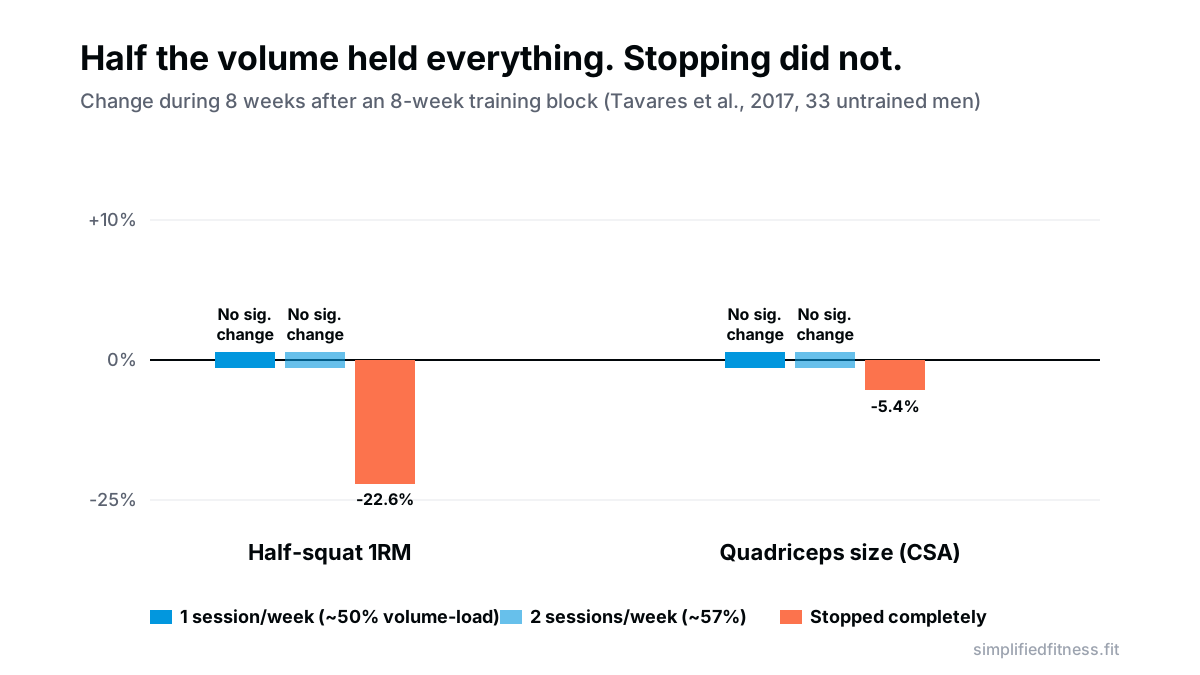
You might assume you need to hit every muscle twice a week to maintain. A 2017 trial in Brazil suggests not. Thirty-three untrained young men did eight weeks of training, then eight weeks of reduced training at either one or two sessions a week, or stopped altogether (Tavares et al., 2017).
The reduced groups trained at about 50-57% of their earlier volume-load. After eight weeks, neither reduced group changed significantly in half-squat 1RM or quadriceps cross-sectional area. The group that stopped lost 22.6% of squat 1RM and 5.4% of quadriceps size. The authors concluded frequency did not matter for maintenance as long as volume-load was matched.
That matches the wider frequency research. A meta-analysis of 25 studies concluded that when volume is equated, training frequency does not significantly or meaningfully change muscle growth (Schoenfeld et al., 2019). For busy people, that is the permission slip: fit your sets into whatever days you actually have.
So how many sets per week is that?
Let’s translate the research into gym numbers, carefully.
In growth research, weekly sets are strongly linked to results. A meta-regression of 15 studies found each additional weekly set was associated with about 0.37% more muscle gain (Schoenfeld et al., 2017). Growth is dose-dependent. Maintenance is the low end of that same dial.
For strength, a systematic review of resistance-trained men found that a single set of 6-12 reps at about 70-85% 1RM, taken to high effort, 2-3 times per week, produced significant squat and bench press gains over 8-12 weeks. Those gains were described as suboptimal but real (Androulakis-Korakakis et al., 2020). That review measured strength gains, not muscle size, but if one hard set can still make a trained lifter stronger, it is very likely enough to hold the strength you have.
Put together, a sensible maintenance prescription looks like this:
- Sets: about 2-4 hard sets per muscle per week. Start at 3.
- Effort: every working set finishes with 1-3 reps in reserve.
- Exercises: the same compound lifts every week, so you can see whether performance holds.
- Reps: 5-12 for compounds, up to 15 for isolation.
- Sessions: one to three, whichever your week allows.
That 2-4 number is a coaching estimate drawn from the studies above, not a trial result. If you want to count your sets properly, our training volume calculator does the sums.
Does effort matter more than set count?
Yes, and this is where busy people go wrong. Dropping to three sets means nothing if those sets are warm-up-level easy.
Maintenance only works when each set is a real signal. A 2023 meta-analysis of 15 studies found no evidence that training to momentary failure produced more hypertrophy than stopping short of it, and it suggested a non-linear relationship between proximity to failure and growth (Refalo et al., 2023). Plainly: you do not need to grind every set to death, but you do need to get close.
A useful target is 1-3 reps left. If you are not sure how to judge that, read our guide to reps in reserve (RIR) and RPE, or see training to failure vs RIR. The RIR/RPE calculator helps set loads.
A simple 2-day maintenance template
Here is the template we suggest when life gets crowded. It is an illustrative starting point, not a protocol tested in a trial. Two full-body sessions, 30-40 minutes each, covering every major muscle with 2-3 hard sets.
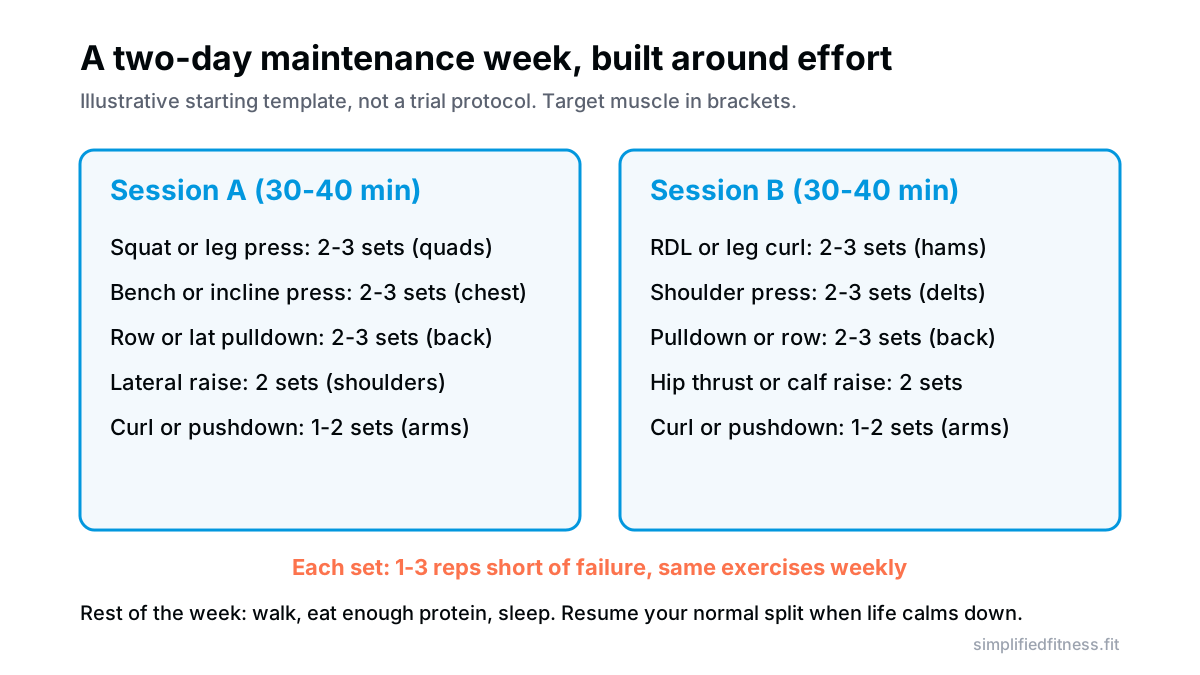
A few notes on using it:
- Swap exercises for whatever you have. A leg press, hack squat or goblet squat all work for quads.
- Keep your loads. If a weight drops, that is useful information, not failure.
- If you can only manage one session, do Session A and B stitched into a 45-minute full-body workout.
- For the full 2-day setup and how to split it, see our 2-day-per-week routine for busy professionals.
How long can you keep muscle on maintenance volume?
The honest answer is: months in young healthy people, less certain beyond that. In the Bickel trial, the maintenance doses held hypertrophy through 32 weeks, which is about seven and a half months (Bickel et al., 2011). Longer periods have not been tested in the same way.
There is also an upside to taking a proper break. In a small trial, 14 young men did three cycles of 6-week training separated by 3-week breaks, and by 24 weeks they got similar overall gains in muscle size and strength as men who trained continuously (Ogasawara et al., 2013). That study used young men, a single bench press exercise and a short time frame, so we should not push it too far. But it does suggest that a short layoff is not the disaster it feels like.
Does “muscle memory” make coming back easy?
Partly. Researchers have found that muscle fibres can keep the extra nuclei they gained from training even after detraining. In one study of 12 previously untrained men and women, myonuclei were maintained after 16 weeks of detraining, but the previously trained muscle did not clearly regrow faster during retraining (Cumming et al., 2024). Another study of 19 people found the retraining response was no better in the previously trained leg either (Psilander et al., 2019).
The takeaway is cautious. The cellular memory seems to exist, but its practical payoff is still unclear. In Psilander’s study, strength stayed well above baseline after 20 weeks off while muscle size returned to baseline, which fits a lasting motor-learning effect. Do not treat any of this as a reason to quit; treat it as a reason not to panic if you do have to stop.
What about food, sleep and stress?
Maintenance volume sits on top of the basics. A low training stimulus is easier to hold if you keep protein steady (dal, paneer, curd, eggs, soya chunks or whey), eat roughly at maintenance and sleep properly. Cutting calories hard during a crunch while also training less is a good way to lose muscle. If you are trying to cut during a busy phase, read volume adjustments during cutting first.
Hot weather and long commutes make recovery harder in India too. Stay hydrated, keep the sessions short and do not add extra sets to “make up” for missed ones.
Health note: if you have an injury, a medical condition, or you are over 60 and were told to be careful with exercise, check with your doctor or physiotherapist before changing your program.
Dropping the gym guilt
Here is the reality. Most of the muscle you built does not vanish because of a hard month. Strength in particular is sticky: in Bickel’s trial it was largely retained even when training stopped for 32 weeks.
If you do two short, hard sessions a week, you are not “slacking.” You are using the exact strategy the research supports for busy phases. Then, when life calms down, you rebuild volume over a few weeks and carry on.
Limits of the evidence
Be honest about what we do not know:
- Most reduced-volume trials used untrained or recently trained young people, and the evidence in long-term advanced lifters is thinner.
- Older adults needed higher doses to hold fibre size.
- Trials last weeks to months, not years.
- The “2-4 sets” rule is a practical estimate, not a measured threshold.
- Results vary between individuals. If your lifts or measurements keep falling for 3-4 weeks, add a set or a session.
Frequently Asked Questions
What is the minimum workout to keep muscle?
For most healthy adults, one or two short full-body sessions a week with a few hard sets per muscle group is enough to keep what you have. In a 2011 trial, young adults kept their muscle on one-third of their earlier training dose, and an untrained-men trial found no significant loss on one or two sessions a week at roughly half the volume. Pick 5-6 big exercises, take each set close to failure, and keep the same lifts every week.
How many sets per week do you need to maintain muscle mass?
No trial has fixed one exact number, but a working range is about 2-4 hard sets per muscle per week for most people. That range is a practical estimate built from reduced-volume trials, not a result from a single study. Start at 3 sets and add one if your lifts or measurements start slipping.
Can you maintain muscle by training once a week?
Yes, for a while at least. Untrained men who trained one session a week at about half their earlier volume-load kept their quadriceps size and squat strength over 8 weeks. Training frequency matters little when volume is matched, so one well-built full-body session is a valid fallback for a hectic fortnight.
How long can you stop lifting before losing muscle?
Strength holds longer than size. In a 2011 trial, gains in strength were largely retained across 32 weeks of full detraining, with only a slight drop at the end, while untrained men who stopped for 8 weeks lost about 5% of quadriceps size and 23% of half-squat strength. For a trip of one to three weeks, most trained people will notice little, so enjoy the break.
Do I need to train to failure to maintain muscle?
You need the sets to be hard, but not necessarily to failure. A 2023 meta-analysis found no evidence that momentary failure beat stopping short of it for muscle growth, though sets that are far from failure probably count for less. Finish most sets with 1-3 reps left in reserve and your maintenance work will count.
Is maintenance volume the same for everyone?
No. The 2011 trial found older adults needed a higher dose than young adults to hold muscle fibre size. Experience, age, stress, sleep and calorie intake also shift how little is enough. If you are over 60, keep maintenance blocks short and use a higher dose than the young-adult findings suggest.
Will I lose muscle on a 2-day-a-week routine?
Not if the sessions are hard and the exercises cover your major muscles. Reduced-volume trials found muscle maintained at roughly one-third to one-half of normal volume. Use two full-body sessions with 2-3 sets per muscle and keep your loads steady or slightly rising.
Does muscle memory mean I can come back easily after a break?
Partly. Human biopsy work shows muscle fibres keep extra myonuclei after detraining, but two studies found this did not clearly speed up regrowth during retraining. Many lifters feel that regaining size is faster than building it the first time, but the human studies so far have not clearly shown it, so do not treat a long break as free.
Should I cut protein or calories during a maintenance phase?
Do not cut protein. Maintenance volume is a low training stimulus, so you want your diet to support it rather than undermine it. Keep protein at your usual level (dal, paneer, curd, eggs, soya or whey are all fine) and eat at maintenance or a small surplus if you can.
Should I do cardio instead of lifting when I am busy?
Cardio is good for health but does not replace lifting for keeping muscle. Muscle is held by mechanical loading, which means you need at least some resistance sets. A brisk walk on the off days is a good add-on, not a swap.
What if I can only train at home with no gym?
You can still maintain, as long as your sets are hard. Push-up variations, bodyweight squats and single-leg work, backpack-loaded rows and pull-ups can all be taken close to failure. Use slower tempos or harder variations so 8-15 reps feels difficult.
When should I return to normal volume?
Go back when your schedule lets you train 3 or more days a week again, usually after the crunch ends. Add sets gradually over 2-4 weeks rather than jumping straight back. Our training volume calculator helps you count weekly hard sets as you rebuild.
Is it normal to feel flat or smaller after a stressful busy period?
Yes, often. Stress, poor sleep and less food can lower muscle glycogen and water, which makes muscles look and feel smaller without real tissue loss. Eat properly and train normally for a couple of weeks before judging.
Sources & References
Every claim above is checked against peer-reviewed research (PubMed, U.S. National Library of Medicine) or guidance from established health bodies. How we fact-check.
- Bickel CS, et al. Exercise dosing to retain resistance training adaptations in young and older adults. Med Sci Sports Exerc. 2011. PMID: 21131862
- Tavares LD, et al. Effects of different strength training frequencies during reduced training period on strength and muscle cross-sectional area. Eur J Sport Sci. 2017. PMID: 28316261
- Androulakis-Korakakis P, et al. The Minimum Effective Training Dose Required to Increase 1RM Strength in Resistance-Trained Men: A Systematic Review and Meta-Analysis. Sports Med. 2020. PMID: 31797219
- Schoenfeld BJ, et al. Dose-response relationship between weekly resistance training volume and increases in muscle mass: A systematic review and meta-analysis. J Sports Sci. 2017. PMID: 27433992
- Schoenfeld BJ, et al. How many times per week should a muscle be trained to maximize muscle hypertrophy? A systematic review and meta-analysis of studies examining the effects of resistance training frequency. J Sports Sci. 2019. PMID: 30558493
- Refalo MC, et al. Influence of Resistance Training Proximity-to-Failure on Skeletal Muscle Hypertrophy: A Systematic Review with Meta-analysis. Sports Med. 2023. PMID: 36334240
- Ogasawara R, et al. Comparison of muscle hypertrophy following 6-month of continuous and periodic strength training. Eur J Appl Physiol. 2013. PMID: 23053130
- Psilander N, et al. Effects of training, detraining, and retraining on strength, hypertrophy, and myonuclear number in human skeletal muscle. J Appl Physiol. 2019. PMID: 30991013
- Cumming KT, et al. Muscle memory in humans: evidence for myonuclear permanence and long-term transcriptional regulation after strength training. J Physiol. 2024. PMID: 39159314

Umair Hazrami · Founder & Head Coach, Simplified Fitness
Umair Hazrami founded Simplified Fitness and the Simplified Lifter channel to cut through fitness noise. With 4+ years of consistent training and 10+ coaching clients, he writes every guide from the peer-reviewed research and links the sources so you can check them. Our editorial standards.
Educational content only, not medical advice. If you have a medical condition, are pregnant, or take medication, talk to a qualified doctor before changing your diet, supplements or training. Full disclaimer.
Keep reading

Programming
Autoregulation of Set Volume: Add or Cut Sets Based on Readiness and Velocity Loss
Autoregulation training volume explained: use warm-up speed, RIR and a 20-25% performance drop to add or cut sets, and what the evidence does or does not prove.
9 min read

Programming
The Biological Cost of High Volume: Sleep, Cortisol and Immune Strain
High volume lifting side effects: what research says about poor sleep, cortisol and colds, which warning signs matter, and how to scale back.
9 min read

Programming
How to Count Compound Sets Toward Weekly Volume: Direct vs Fractional Sets
How to count compound sets volume for arms, delts and hamstrings: the 1.0 and 0.5 fractional rule, a worked weekly example and what the research says.
9 min read

Programming
Distributing Weekly Volume: Full Body 3x vs Upper/Lower 4x vs PPL 6x
Distributing weekly volume across splits: how 12 sets per muscle look in full body, upper/lower and PPL, plus session length math and which fits your week.
9 min read