Volume Landmarks by Experience Level: How Many Sets Novice, Intermediate and Advanced Lifters Need
Training volume by experience level: how many weekly sets beginners, intermediates and advanced lifters need, and why 30 sets is a myth. Studies linked.

TL;DR. The short answer
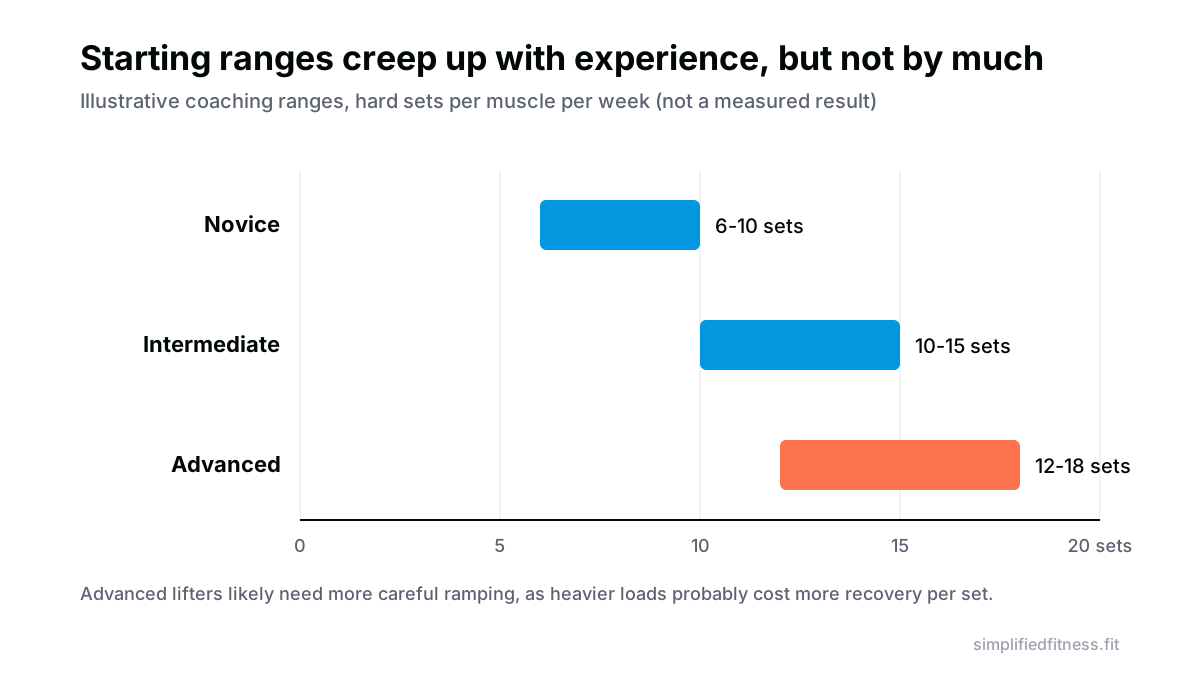
- A common coaching rule of thumb is about 6-10 hard sets per muscle per week for novices, 10-15 for intermediates and 12-18 for advanced lifters. These are practical heuristics, not numbers any single study proved.
- Beginners grow on surprisingly little. In an untrained-men trial, 3 sets beat 1 set for arm growth, but the 1-set arm still grew, so more is not required to start.
- Trained lifters still show a dose-response: in an 8-week trial, 5 sets per exercise built more muscle than 1 set, while strength gains were similar across groups.
- Advanced lifters do not need 30 sets. Returns diminish as volume climbs, and heavier absolute loads probably make each set cost more recovery.
- Add sets only when progress stalls and sleep, food and stress are fine. Extra volume on a body that cannot recover just adds fatigue.
Part of our complete guide: Optimal Training Volume and Frequency: How Many Sets per Muscle Actually Build Muscle
Table of contents
Training volume by experience level follows a loose pattern. Beginners tend to grow on roughly 6-10 hard sets per muscle per week, intermediates on about 10-15, and advanced lifters on about 12-18. Those figures are coaching rules of thumb built on trial data, not numbers a single study has proven, and they sit inside the bigger picture in our guide to training volume and frequency.
The surprise for most people is the direction. Volume needs rise with experience, but only modestly. Nobody needs 30 sets per muscle.
How much training volume do you need at each experience level?
Here is the rule-of-thumb version, then the evidence behind it.
| Level | Typical training age | Starting range (hard sets per muscle per week) | Main limiter |
|---|---|---|---|
| Novice | 0-1 year | 6-10 | Technique and consistency |
| Intermediate | 1-3 years | 10-15 | Progression and recovery |
| Advanced | 3+ years | 12-18 | Recovery and joint stress |
Training age here means years of consistent, hard training, not years since you first joined a gym. Plenty of people have “five years” of lifting that was really one year repeated five times.
A hard set means a set taken close to failure, roughly 0-3 reps in reserve. Warm-up sets and easy sets do not count. If you want help counting, the training volume calculator does the arithmetic.
What does research say about volume for beginners?
Less than you think is needed. Two trials in untrained people show the shape of it.
In one, eight untrained young men trained each arm with a different dose for 12 weeks: 1 set on one arm, 3 sets on the other. The 3-set arm grew more (13.3% vs 8.0% in cross-sectional area), but the single-set arm still grew by a meaningful 8% (Sooneste et al., 2013). It was only eight people, so treat it as a clue.
A larger one had 34 untrained men and women train one leg with 1 set per exercise and the other with 3 sets for 12 weeks. Moderate volume produced bigger gains in muscle size and strength on average. But not everyone responded the same way: 13 of the 34 showed a clear extra hypertrophy benefit from the higher dose (Hammarström et al., 2020).
The most common mistake here is a beginner copying an advanced lifter’s 20-set chest day. You do not need it, your recovery is not built for it, and your technique will fall apart by set six.
What do trained lifters need?
More, on average. Not unlimited.
A 2017 meta-analysis of 15 studies found a graded dose-response: each additional weekly set was linked to a small increase in muscle growth, about 0.37% extra gain per set (Schoenfeld et al., 2017). That is a pooled average across short trials, not a promise that every extra set adds the same amount.
A 2019 trial put numbers on it in trained men. Thirty-four resistance-trained men did 1, 3 or 5 sets per exercise, three times a week for 8 weeks. Strength gains were similar in all three groups, but muscle size favoured the higher-volume groups at the elbow flexors, mid-thigh and lateral thigh (Schoenfeld et al., 2019).
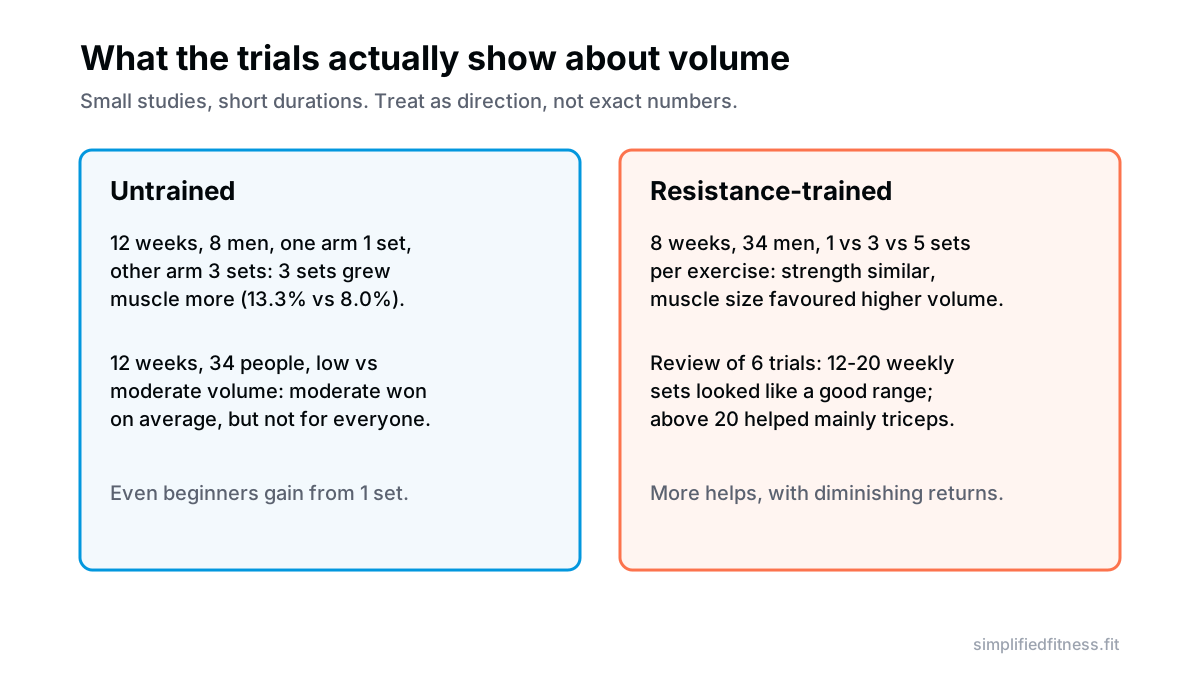
For people with at least a year of training, a systematic review of six trials (young men only) compared moderate (12-20 weekly sets) and high (more than 20) volumes. There was no difference for quads or biceps, though the triceps did better with high volume. The authors suggested 12-20 weekly sets per muscle as a good general range for young trained men (Baz-Valle et al., 2022).
That 12-20 range is the evidence-based anchor for the 12-18 advanced rule of thumb above.
Why more is not always the answer
A 2026 meta-regression of 67 studies and 2058 participants found that muscle gains keep rising with volume, but with diminishing returns. The effect on strength showed more pronounced diminishing returns than hypertrophy (Pelland et al., 2026). Translation: the first sets after the minimum buy a lot, and the 25th buys very little.
This also explains the strength result above. If strength is the goal, a very small dose goes a long way. A review of trained men found that a single set of 6-12 reps taken to failure, 2-3 times per week for 8-12 weeks, still produced significant squat and bench press gains, though that was “suboptimal” compared with higher doses (Androulakis-Korakakis et al., 2020).
Why do advanced lifters feel more fatigue per set?
This part is physiology and coaching logic rather than something the trials above directly measured, so hold it loosely.
An advanced lifter squats 150 kg where a novice squats 60. Same effort, but the absolute load on muscles, tendons, spine and nervous system is much larger. Each hard set costs more to recover from. That plausibly explains why stronger lifters often feel flattened by volumes a beginner shrugs off, and why they spread sets across the week instead of piling them into one session.
Advanced lifters also have less room to grow, so the same extra set returns less. Bigger cost, smaller reward. That combination is why smart advanced programmes are fussy about where volume goes rather than simply raising it.
How should volume progress over the years?
Think of it as a ladder you climb only when you have to.
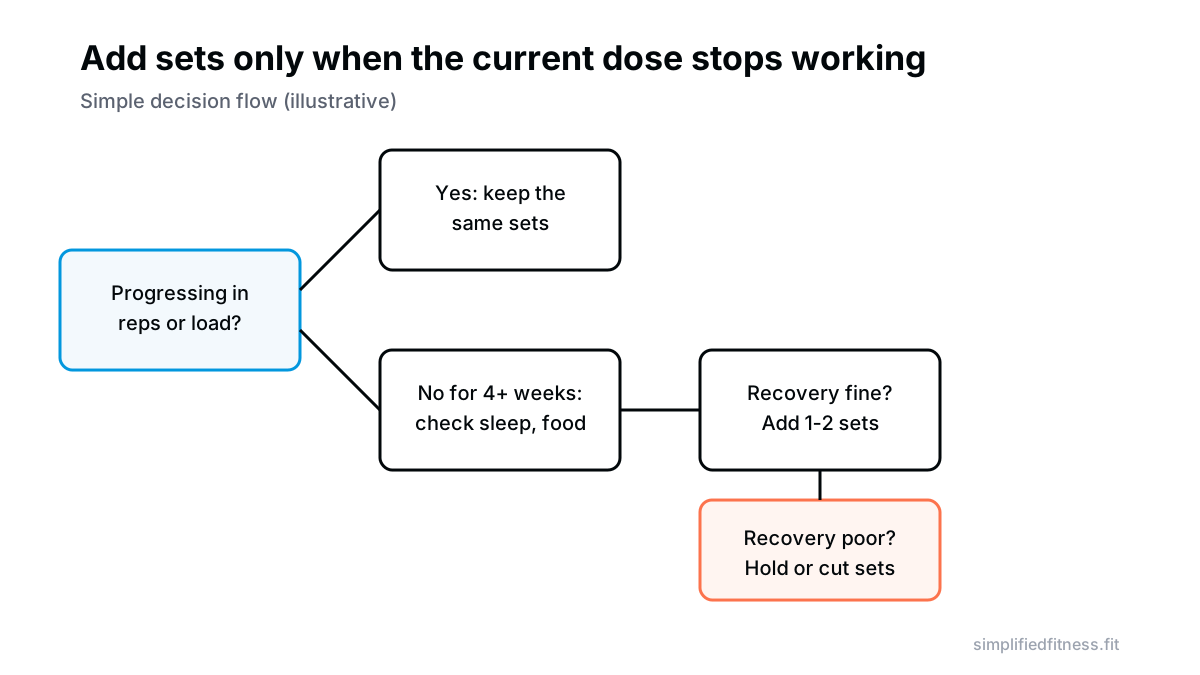
- Year one: 6-10 hard sets per muscle. Focus on technique and showing up.
- Years 1-3: Move toward 10-15 as simple progress slows. Add one or two sets per muscle, not ten.
- Beyond: Sit in 12-18 for most muscles. Rotate higher-volume blocks for lagging muscles, then return to a lower baseline. We cover that structure in mesocycle volume progression.
Look at volume landmarks like MEV and MRV for the framework these ranges plug into, and junk volume for what to cut when you have overshot.
What does a sensible week look like at each level?
A rough picture helps. These are examples, not prescriptions.
Novice, 3 days a week, full body. One or two exercises per muscle group per session, 2-3 hard sets each. Chest might get 3 sets of incline dumbbell press on each of three days, which lands around 9 weekly sets. Simple, repeatable, easy to recover from.
Intermediate, upper/lower, 4 days. Each muscle is hit twice. Quads might get 4 sets of squats plus 2 sets of leg extensions on lower A, and 4 sets of leg press plus 2 of lunges on lower B, which lands around 12 weekly sets. Back and chest sit in a similar range.
Advanced, 5-6 days, body-part emphasis. Most muscles sit near 12-16 weekly sets, while one or two lagging muscles get a temporary push toward the top of the range. Everything else holds at a lower baseline so total fatigue stays manageable.
Notice the pattern. The advanced week is not three times bigger. It is more selective.
Common mistakes when scaling volume
- Counting junk sets. Sets taken far from failure inflate your totals but do little. Count only hard sets.
- Changing everything at once. New split, new exercises and 6 extra sets makes it impossible to know what worked.
- Adding volume to fix a recovery problem. If you sleep five hours and eat little protein, more sets will not help.
- Ignoring exercise quality. Ten well-controlled sets beat sixteen sloppy ones.
- Copying a pro’s split. Published routines often come from people with years of training, genetic advantages and sometimes drug support.
Not all muscles or people respond the same
The ranges above are per-muscle averages. A small muscle such as the side delts may behave differently from quads, which is why muscle-specific volume tolerance matters. Recovery also varies between people, so see individual recovery profiling before copying anyone’s numbers.
Two honest caveats. Most trials ran 8-12 weeks, so we know much less about what happens over years. And most participants were young men, so results are less certain for women and older lifters.
If you are trained and using enhancing drugs, volume tolerance can be different again, and we cover that separately in natural vs enhanced volume tolerance.
Indian lifter notes
Hot weather, long commutes and mostly vegetarian diets with modest protein can all shave recovery. If dal, paneer, curd and soya leave you short of roughly 1.6 g/kg protein, fix that before you add sets. Our protein calculator gives you a number for your body weight. Need a structure to apply these ranges? Start with the free push pull legs plan.
When to see a doctor
Hard training should feel tiring, not alarming. See a doctor if you get sharp or persistent joint pain, chest pain, dizziness, unusually dark urine after training, or soreness that does not settle after a week. Do not push through those by cutting sleep or adding sets.
The bottom line
Training volume by experience level rises gently. Start around 6-10 hard sets per muscle per week as a novice, work toward 10-15, and live in roughly 12-18 once advanced, adjusting per muscle and per person. More sets help on average but with diminishing returns, and the ranges here are practical guides, not laws.
Frequently Asked Questions
How many sets per week should a beginner do for each muscle?
A reasonable starting point is about 6-10 hard sets per muscle per week. Untrained people respond strongly to a small dose, and one trial in untrained men found even a single set per session grew muscle, though 3 sets grew it more. Start at the low end, keep 1-2 reps in reserve, and add sets only when progress slows.
How many sets per week for an intermediate lifter?
Most intermediates do well somewhere around 10-15 hard sets per muscle per week. The Schoenfeld meta-analysis found a graded relationship where more weekly sets were linked to more growth, so moving up from beginner numbers usually makes sense. Raise volume by one or two sets at a time and judge it by your logbook, not by how wrecked you feel.
How many sets do advanced lifters need?
Roughly 12-18 hard sets per muscle per week is a sensible range for many advanced lifters, with some muscles tolerating more. A 2026 meta-regression found diminishing returns as volume rises, so each extra set buys less. Use the lowest volume that still keeps you progressing, and spend the rest on sleep and food.
Do advanced lifters really need 30 sets per muscle?
No, there is no good evidence that 30 weekly sets is a requirement. A review of trials in trained young men suggested 12-20 weekly sets as a good general range, with the benefit of going above 20 seen mainly for the triceps. If you are doing 30 sets and stalling, try cutting back before adding more.
Why do beginners need fewer sets than advanced lifters?
Beginners are far from their genetic ceiling, so almost any hard training is a new stimulus. Trials in untrained people show clear gains from small doses, while trained lifters tend to show a clearer benefit from higher volumes. Start low, and let your results tell you when to climb.
Should I increase volume every year I train?
Not automatically. Volume is a tool you use when progress stalls, not a yearly upgrade. Plenty of lifters get better results by refining effort, exercise choice and recovery before adding sets. If your lifts are still going up, your current volume is working.
How do I know if I am doing too many or too few sets?
Too few looks like flat strength and muscle size for 4-6 weeks despite hard effort. Too many looks like falling performance, nagging joint pain, poor sleep and dreading sessions. Track your top sets weekly and change volume by one or two sets at a time.
Do I need more volume for strength or for muscle size?
Muscle size seems to be more volume-sensitive than strength. In a trial of trained men, strength gains were similar with 1, 3 or 5 sets per exercise, while muscle growth favoured higher volumes at several sites. If strength is your main goal, moderate volume with heavy, high-quality sets is usually enough.
Why do advanced lifters fatigue more per set?
They lift heavier absolute loads, so each hard set puts more total stress on muscles, joints and the nervous system. A 150 kg squat likely costs more recovery than a 60 kg one, even at the same effort, although trials have not measured this directly. That is one reason more sets may not scale neatly for strong lifters, and why you may want to spread them across the week.
Can a beginner do advanced volume and grow faster?
Probably not faster, and it may backfire. A beginner has a low work capacity and unproven recovery, so jumping to 18 sets can bring soreness, poor technique and burnout. Build up gradually, as a trial in untrained people found that dose helped on average but not everyone responded the same.
Is the same volume right for every muscle?
No. Small muscles like biceps and side delts often tolerate and need different volumes than quads or back. Treat the ranges here as per-muscle starting points, and adjust per muscle based on how it responds. Our muscle-specific volume guide covers this in detail.
How should I split my weekly sets across sessions?
Spreading sets over two or more sessions per muscle is usually more comfortable than cramming them into one. Very high single-session volumes tend to feel sloppy by the last sets. Aim for around 4-8 hard sets per muscle per session and add a second exposure when weekly totals climb.
Do these numbers apply to women or older lifters?
Most volume trials were in young men, so these ranges are less certain for women and older adults. There is no strong reason to think the general pattern is different, but recovery may be slower in some people. Start at the low end of the range and use your own response as the guide.
Sources & References
Every claim above is checked against peer-reviewed research (PubMed, U.S. National Library of Medicine) or guidance from established health bodies. How we fact-check.
- Schoenfeld BJ, et al. Dose-response relationship between weekly resistance training volume and increases in muscle mass: A systematic review and meta-analysis. J Sports Sci. 2017. PMID: 27433992
- Baz-Valle E, et al. A Systematic Review of The Effects of Different Resistance Training Volumes on Muscle Hypertrophy. J Hum Kinet. 2022. PMID: 35291645
- Schoenfeld BJ, et al. Resistance Training Volume Enhances Muscle Hypertrophy but Not Strength in Trained Men. Med Sci Sports Exerc. 2019. PMID: 30153194
- Pelland JC, et al. The Resistance Training Dose Response: Meta-Regressions Exploring the Effects of Weekly Volume and Frequency on Muscle Hypertrophy and Strength Gains. Sports Med. 2026. PMID: 41343037
- Androulakis-Korakakis P, et al. The Minimum Effective Training Dose Required to Increase 1RM Strength in Resistance-Trained Men: A Systematic Review and Meta-Analysis. Sports Med. 2020. PMID: 31797219
- Sooneste H, et al. Effects of training volume on strength and hypertrophy in young men. J Strength Cond Res. 2013. PMID: 23249767
- Hammarström D, et al. Benefits of higher resistance-training volume are related to ribosome biogenesis. J Physiol. 2020. PMID: 31813190

Umair Hazrami · Founder & Head Coach, Simplified Fitness
Umair Hazrami founded Simplified Fitness and the Simplified Lifter channel to cut through fitness noise. With 4+ years of consistent training and 10+ coaching clients, he writes every guide from the peer-reviewed research and links the sources so you can check them. Our editorial standards.
Educational content only, not medical advice. If you have a medical condition, are pregnant, or take medication, talk to a qualified doctor before changing your diet, supplements or training. Full disclaimer.
Keep reading

Programming
Autoregulation of Set Volume: Add or Cut Sets Based on Readiness and Velocity Loss
Autoregulation training volume explained: use warm-up speed, RIR and a 20-25% performance drop to add or cut sets, and what the evidence does or does not prove.
9 min read
Programming
The Biological Cost of High Volume: Sleep, Cortisol and Immune Strain
High volume lifting side effects: what research says about poor sleep, cortisol and colds, which warning signs matter, and how to scale back.
9 min read

Programming
How to Count Compound Sets Toward Weekly Volume: Direct vs Fractional Sets
How to count compound sets volume for arms, delts and hamstrings: the 1.0 and 0.5 fractional rule, a worked weekly example and what the research says.
9 min read

Programming
Distributing Weekly Volume: Full Body 3x vs Upper/Lower 4x vs PPL 6x
Distributing weekly volume across splits: how 12 sets per muscle look in full body, upper/lower and PPL, plus session length math and which fits your week.
9 min read