HIT (Mentzer Heavy Duty) vs High-Volume Training: What the Evidence Says
Does Mike Mentzer HIT training work? See what meta-analyses say about 1 set to failure vs multiple sets, and a realistic middle ground for busy lifters.
TL;DR. The short answer
- One hard set to failure can build muscle and strength, especially in beginners and busy lifters, but a 2010 meta-analysis found multiple sets were linked to about 40% larger hypertrophy effects than a single set.
- In 34 trained men over 8 weeks, 1, 3 or 5 sets per exercise gave similar strength gains, but muscle size favoured the higher-volume groups at several sites.
- Mentzer was right that intensity and recovery matter, and that junk sets are wasted. He was probably wrong that one set is the best dose for size.
- Training to failure is not required: a 2023 meta-analysis found no evidence that momentary failure beats stopping short for hypertrophy.
- A sensible middle ground is a handful of hard sets per muscle per week to start, adding sets only when progress stalls and recovery is good.
Part of our complete guide: Optimal Training Volume and Frequency: How Many Sets per Muscle Actually Build Muscle
Table of contents
Mike Mentzer HIT training, the “Heavy Duty” idea of one set to absolute failure, does build muscle, but the research suggests it leaves growth on the table (see our training volume and frequency guide for the bigger picture). Meta-analyses link multiple sets with larger hypertrophy than a single set, while also showing that strength and very short sessions hold up surprisingly well.
This article is a fair audit rather than a takedown. It answers one narrow question: should you do one brutal set per exercise, or several? The answer depends on your goal, your schedule and how well you recover, so we will go through the studies first and then build a practical plan you can run from Monday.
What Mike Mentzer’s Heavy Duty actually claims
Heavy Duty is usually described as very few working sets per exercise, each taken to momentary failure (sometimes with forced reps or slow negatives), with long rest between sessions so the body can recover. The logic: intensity is the growth signal, and anything extra is wasted effort that eats into recovery.
I am describing the popular version, not quoting a program. Versions on social media vary a lot, so judge the idea by the research, not the reel.
Does one set to failure work? What the science says
Yes, it works. The better question is whether it works as well as doing more.
The most cited paper here is a 2010 meta-analysis of 8 studies (19 treatment groups, 55 effect sizes). Multiple sets were associated with a larger hypertrophy effect than a single set, and the author reported about 40% greater hypertrophy-related effect sizes for multiple sets, in both trained and untrained subjects (Krieger, 2010). The average effect sizes were 0.24 for 1 set, 0.34 for 2-3 sets and 0.44 for 4-6 sets per exercise. The difference between 2-3 and 4-6 sets was not statistically significant.
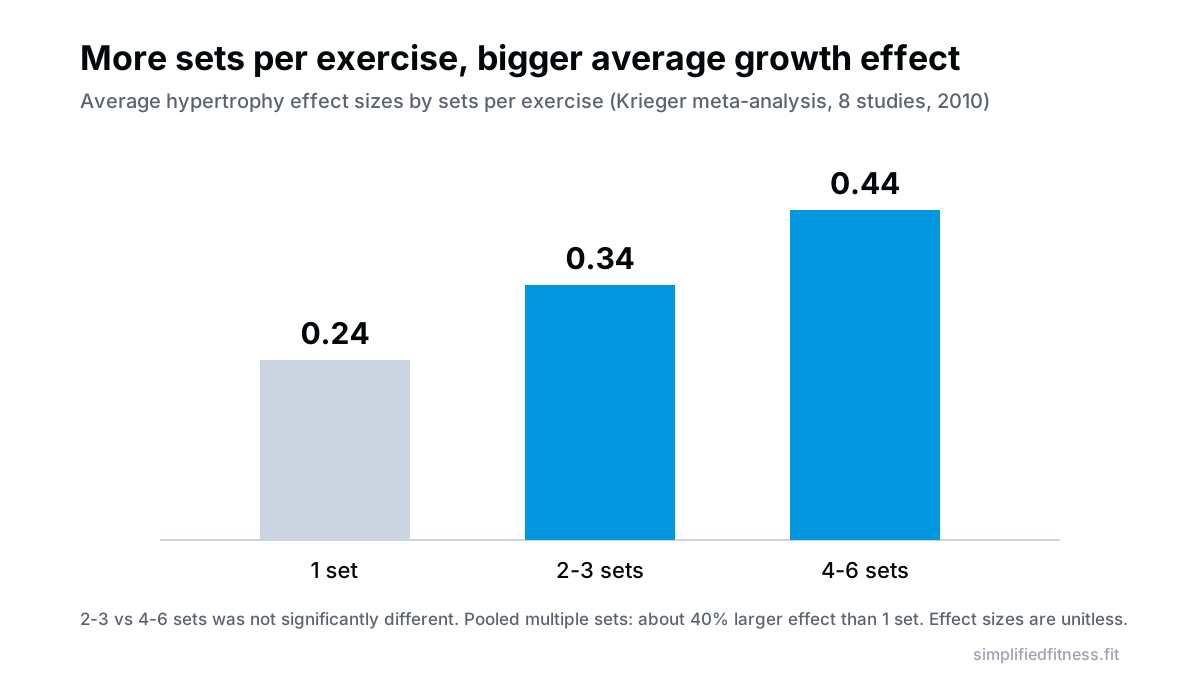
Note the limits. Eight studies is a small base, and some trends in the dose-response model only reached significance with permutation tests.
A newer, much larger analysis looked at weekly sets across 67 studies and 2058 participants. It found gains in muscle size increase as volume increases, with diminishing returns (Pelland et al., 2026). An earlier meta-regression of 15 studies reached the same direction: each added weekly set was associated with a small increase in growth, and higher versus lower volumes differed by about 3.9% in percentage gain (Schoenfeld et al., 2017).
What happens in trained lifters: the 1 vs 3 vs 5 set trial
Meta-analyses mix beginners and veterans, so a direct trial in trained people is useful. In one randomized study, 34 resistance-trained men did 1, 3 or 5 sets per exercise, three days a week for 8 weeks (Schoenfeld et al., 2019).
- Strength and muscle endurance rose in all groups with no significant differences between them.
- Muscle size favoured the higher-volume conditions at the elbow flexors, mid-thigh and lateral thigh.
The authors noted that large strength and endurance gains were possible with just three 13-minute sessions a week, similar to those from a much bigger time commitment.
That is the honest summary of HIT: excellent return on time, especially for strength, but a lower ceiling for size. It is also only 8 weeks and 34 men, so treat it as supportive, not final.
Where Mentzer was right
Credit where it is due.
- Hard sets matter. Easy sets far from failure do little. Our piece on junk volume and diminishing returns covers why filler sets are a poor use of time.
- Time efficiency is real. If three short sessions beat zero sessions, HIT wins that comparison by default.
- Recovery is a genuine limit. More is not automatically better, and people differ in how much they tolerate.
- Strength holds up on low volume. The trained-men trial above supports this.
Where the evidence disagrees with Heavy Duty
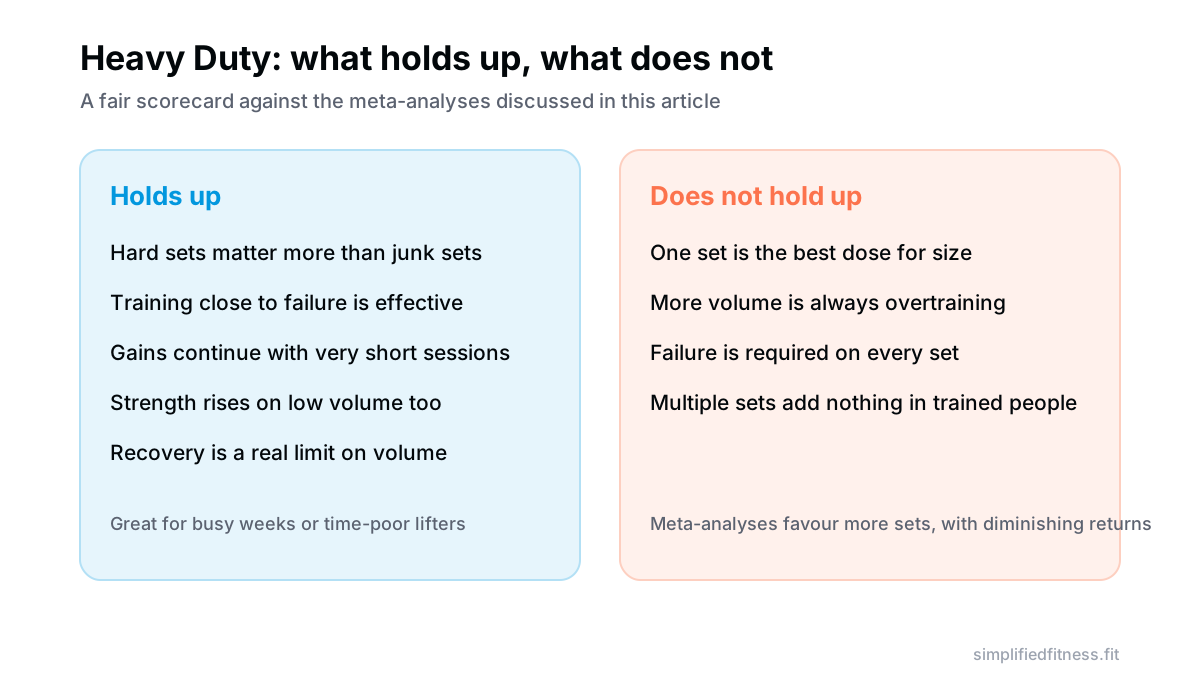
One set is probably not the best dose for size. Covered above: multiple sets are linked to larger hypertrophy effects.
Failure on every set is not required. A 2023 systematic review of 15 studies found a trivial advantage for training to any definition of set failure (effect size 0.19), but no advantage for momentary muscular failure versus non-failure (effect size 0.12, confidence interval crossing zero) (Refalo et al., 2023). The authors concluded there is no evidence that momentary failure is superior for hypertrophy.
But proximity still matters, a bit. A 2024 meta-regression estimated reps in reserve and found hypertrophy improved as sets ended closer to failure, while strength was fairly flat across a wide range. The authors stress the analysis was exploratory and the reps-in-reserve estimates were uncertain (Robinson et al., 2024).
Why do these two papers look conflicting? One compared categories (failure versus not), the other modelled a continuous scale with estimated RIR. Both are compatible with a practical rule: get close to failure on hard sets, but do not make failure a religion. Our deeper dive on failure versus RIR sorts out the details, and rep ranges and load are a separate lever.
High volume has its own problem
Do not swing to the other extreme. A systematic review of young trained men found no differences between moderate (12-20 weekly sets) and high (more than 20) volume for quadriceps and biceps, though higher volume looked better for triceps (Baz-Valle et al., 2022). The authors suggested 12-20 weekly sets per muscle group as a reasonable standard for trained young men. That review included only 7 studies (6 in the pooled analysis), so it is a guide, not a law.
In plain terms: once you are past the moderate range, extra sets cost recovery and time for little extra return. For those lifters, the reality is usually sleep, food and consistency, not a magic set count.
A realistic middle ground
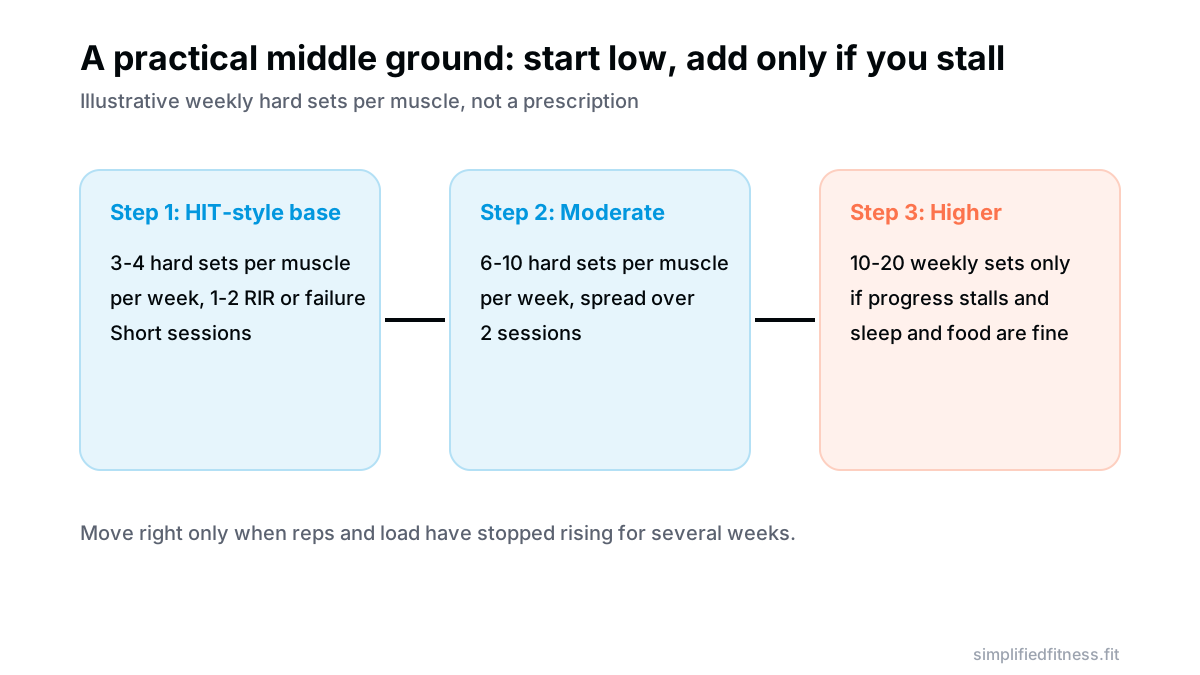
The brief version of the research: you do not need to choose a camp. A practical approach:
- Start with a HIT-style base. A few hard sets per muscle per week, taken to 0-2 reps in reserve. This is a good fit if you are new, returning after a break or short on time.
- Move to moderate volume. Roughly 6-10 hard sets per muscle per week, split over two sessions, is a sensible next step for many people. This is a practical range from the dose-response curves, not a number any single study proves.
- Go higher only if progress stalls. If reps and loads have not risen for several weeks and you sleep and eat well, add a set or two. The 12-20 range in trained young men sits here.
Use the training volume calculator to count weekly sets per muscle, and the RIR and RPE calculator to check how close to failure your sets really are. If counting is confusing, see hard sets versus tonnage. For how weekly volume scales in more detail, read the weekly set volume dose-response curve.
Who should lean toward HIT?
- Beginners. Almost any hard training produces gains early, so there is little need for high volume yet.
- Busy people and shift workers. Consistency over months is worth more than the ideal set count.
- People returning after a layoff or recovering from fatigue. A lower-volume phase can be a reasonable restart.
- Lifters chasing strength more than size, given the trained-men trial.
If you are an experienced lifter chasing maximum size, the evidence points toward more weekly sets, not fewer, with the diminishing returns above in mind. Individual recovery varies, so tune it yourself.
How to run a HIT-style block properly
If you still like the idea, do it well. Pick a small number of exercises that load the big muscles, such as a leg press or squat, a row, a press and a pulldown. Warm up with a couple of light sets, then do one or two truly hard working sets per exercise. Add reps or weight whenever you can, and write it down. Keep technique strict: a set taken to failure with sloppy form teaches you little and raises injury risk. Run it for 6-8 weeks, then review your logbook. If everything is still climbing, stay. If it has stalled, add a set per exercise before changing anything else.
When to see a doctor
Training hard is not a diagnosis tool. If you notice persistent fatigue, unusual soreness that does not settle, chest pain, dizziness, a drop in performance over weeks, or poor sleep, ease off and speak to a doctor. Do not assume it is just “needing more rest” or “more intensity.”
The bottom line
Mentzer’s core instincts, train hard, avoid filler and respect recovery, are good. The extreme version, one set as the best dose for size, is not supported by the meta-analyses. Think of HIT as the fast lane for a time-poor week and moderate volume as the default when you want the best growth for the effort.
Frequently Asked Questions
Does Mike Mentzer HIT training work?
It works for gaining strength and some muscle, particularly in beginners and anyone short on time. Evidence reviews, however, link multiple sets with larger hypertrophy than a single set. If you enjoy the format, use it as a minimum-effective-dose phase rather than as the ceiling.
Is 1 set to failure enough to build muscle?
It is enough to grow, but probably not enough to grow as much as you could. A 2010 meta-analysis found multiple sets were associated with about 40% larger hypertrophy effect sizes than one set, in trained and untrained people. If you only have 30 minutes, one very hard set per exercise is better than skipping the gym.
Is high-volume training better than HIT for muscle growth?
Generally yes for size, with diminishing returns. A 2026 meta-regression found gains rise as weekly volume rises, with the curve flattening. Add sets gradually and stop adding when your logbook stops improving or your recovery slips.
How many sets per muscle per week did Mentzer-style training use?
As commonly described, Heavy Duty used very few working sets, often one to two per exercise with long gaps between sessions. That works out to a very low weekly volume per muscle compared with typical research protocols. Treat exact numbers from social media with caution and judge by your own progress.
Do you have to train to failure to grow?
No. A 2023 meta-analysis of 15 studies found no evidence that training to momentary failure is superior to stopping short for hypertrophy. A later meta-regression suggested growth improves as sets finish closer to failure, with caveats about estimating reps in reserve. Leaving 1-3 reps in the tank on most sets is a reasonable default.
Can beginners use HIT training?
Yes, and beginners respond to almost any hard training. Low volume lets you learn technique without heavy fatigue. Once progress slows, add a second or third set per exercise.
Is HIT good for natural lifters?
Natural lifters can grow on low volume, but the research on volume in trained men points to better size gains with more sets. Recovery capacity varies between people, so there is no single answer. Start modest, track reps and loads, and add sets only if you are recovering well.
Does more volume cause overtraining?
Not automatically. Too much volume with poor sleep and food can stall progress, but most lifters are nowhere near that limit on a normal programme. If strength drops across weeks, you feel unusually run down or sleep suffers, cut sets back and see a doctor if symptoms persist.
How long should HIT workouts take?
A full session of one or two working sets per exercise can take 30-45 minutes. In one 8-week trial, three weekly sessions of one set per exercise took about 13 minutes each. Fit the plan to the time you will actually keep showing up for.
What is the best number of sets per muscle per week?
There is no single best number. A review of trained young men suggested 12-20 weekly sets per muscle as a reasonable range for hypertrophy, while a time-poor lifter can still progress on fewer. Start at the lower end and add sets when progress stalls.
Is HIT better for strength than hypertrophy?
The evidence is friendlier to HIT for strength. In trained men, strength gains were similar across 1, 3 and 5 sets per exercise over 8 weeks, while size favoured more volume. If strength is your main goal, low volume with heavy loads is a valid option.
Can I combine HIT with higher volume?
Yes. Many lifters use one very hard top set plus a few back-off sets, or run a low-volume phase before a higher-volume block. This keeps intensity high while still giving the muscle enough total work.
Is rest between sessions more important than frequency?
Recovery matters, but a 2026 meta-regression found frequency had a small to negligible effect on hypertrophy once weekly volume is accounted for. Training a muscle more than once a week mainly helps you spread volume across sessions. Pick the schedule you can repeat, and keep weekly hard sets in view.
Sources & References
Every claim above is checked against peer-reviewed research (PubMed, U.S. National Library of Medicine) or guidance from established health bodies. How we fact-check.
- Krieger JW. Single vs. multiple sets of resistance exercise for muscle hypertrophy: a meta-analysis. J Strength Cond Res. 2010. PMID: 20300012
- Refalo MC, et al. Influence of resistance training proximity-to-failure on skeletal muscle hypertrophy: a systematic review with meta-analysis. Sports Med. 2023. PMID: 36334240
- Schoenfeld BJ, et al. Resistance training volume enhances muscle hypertrophy but not strength in trained men. Med Sci Sports Exerc. 2019. PMID: 30153194
- Schoenfeld BJ, et al. Dose-response relationship between weekly resistance training volume and increases in muscle mass: a systematic review and meta-analysis. J Sports Sci. 2017. PMID: 27433992
- Robinson ZP, et al. Exploring the dose-response relationship between estimated resistance training proximity to failure, strength gain, and muscle hypertrophy: a series of meta-regressions. Sports Med. 2024. PMID: 38970765
- Baz-Valle E, et al. A systematic review of the effects of different resistance training volumes on muscle hypertrophy. J Hum Kinet. 2022. PMID: 35291645
- Pelland JC, et al. The resistance training dose response: meta-regressions exploring the effects of weekly volume and frequency on muscle hypertrophy and strength gains. Sports Med. 2026. PMID: 41343037

Umair Hazrami · Founder & Head Coach, Simplified Fitness
Umair Hazrami founded Simplified Fitness and the Simplified Lifter channel to cut through fitness noise. With 4+ years of consistent training and 10+ coaching clients, he writes every guide from the peer-reviewed research and links the sources so you can check them. Our editorial standards.
Educational content only, not medical advice. If you have a medical condition, are pregnant, or take medication, talk to a qualified doctor before changing your diet, supplements or training. Full disclaimer.
Keep reading
Programming
Autoregulation of Set Volume: Add or Cut Sets Based on Readiness and Velocity Loss
Autoregulation training volume explained: use warm-up speed, RIR and a 20-25% performance drop to add or cut sets, and what the evidence does or does not prove.
9 min read
Programming
The Biological Cost of High Volume: Sleep, Cortisol and Immune Strain
High volume lifting side effects: what research says about poor sleep, cortisol and colds, which warning signs matter, and how to scale back.
9 min read

Programming
How to Count Compound Sets Toward Weekly Volume: Direct vs Fractional Sets
How to count compound sets volume for arms, delts and hamstrings: the 1.0 and 0.5 fractional rule, a worked weekly example and what the research says.
9 min read

Programming
Distributing Weekly Volume: Full Body 3x vs Upper/Lower 4x vs PPL 6x
Distributing weekly volume across splits: how 12 sets per muscle look in full body, upper/lower and PPL, plus session length math and which fits your week.
9 min read