Volume Landmarks Explained: MV, MEV, MAV and MRV for Muscle Growth
Volume landmarks for hypertrophy explained: what MV, MEV, MAV and MRV mean, how to find yours, and how to ramp sets across a 6-week mesocycle with evidence.
TL;DR. The short answer
- Volume landmarks are four coaching markers for weekly hard sets per muscle: maintenance (MV), minimum effective (MEV), maximum adaptive (MAV) and maximum recoverable (MRV). They were popularised by Dr Mike Israetel and are a practical framework, not lab-proven cutoffs.
- Typical coaching ranges are about 4-6 sets to maintain, 6-10 to start growing, 12-18 for most progress, and 20-25 as a ceiling. Trial data fit the general shape, and a 2022 review of trained men suggested 12-20 weekly sets per muscle as a sensible target.
- You find your own landmarks by watching reps, loads, soreness and joints in a logbook, not by copying a number. The signs that you have gone past MRV are falling performance, lingering soreness and dreading sessions.
- A simple mesocycle starts near MEV, adds 1-2 sets a week for 4-5 weeks, then deloads. Stop adding sets the moment progress stalls or recovery slips.
Part of our complete guide: Optimal Training Volume and Frequency: How Many Sets per Muscle Actually Build Muscle
Table of contents
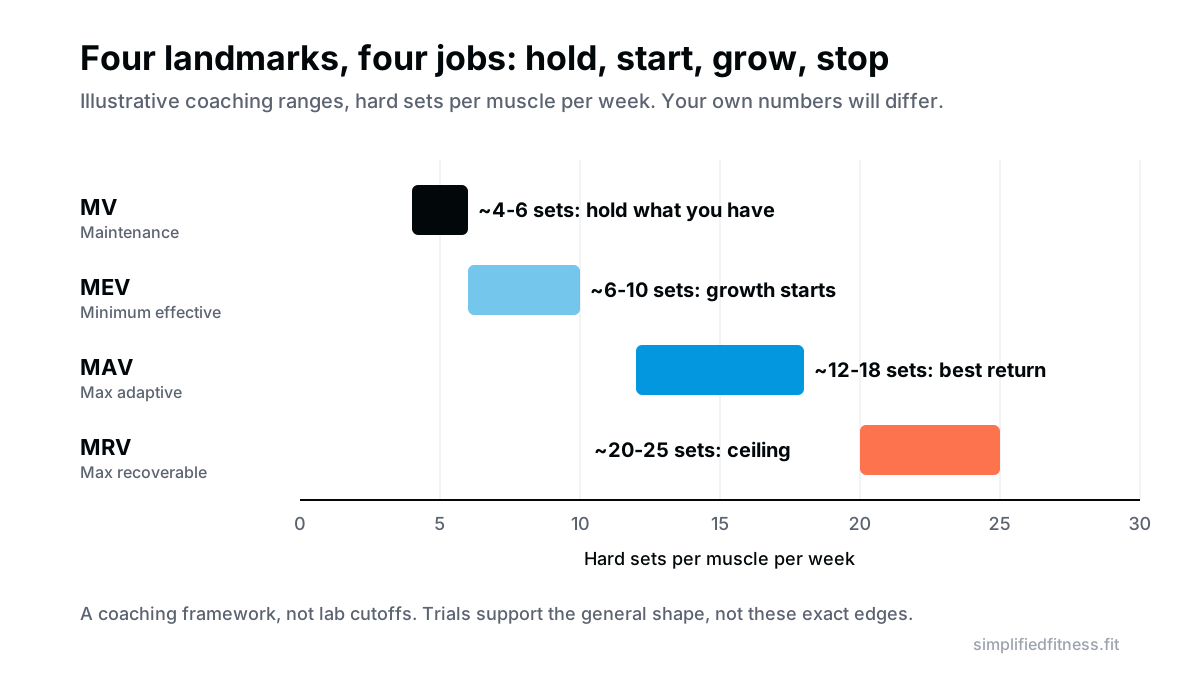
Volume landmarks for hypertrophy are four reference points, part of our training volume and frequency guide, for how many hard sets per muscle you do each week. MV is the amount that holds your muscle, MEV is where growth starts, MAV is where growth is best, and MRV is the most you can recover from. Coaches usually quote about 4-6, 6-10, 12-18 and 20-25 sets, but those are coaching estimates, not laboratory cutoffs.
Here the job is narrower: explain what each landmark means, how to work out which one you are in right now, and how to move through them across a 6-week block.
What are volume landmarks in hypertrophy training?
The framework was popularised by Dr Mike Israetel and the Renaissance Periodization team. It turns a vague question (“how much should I train?”) into four concrete markers per muscle, per week.
A “hard set” here means a working set taken close to failure, roughly 0-3 reps short, on a movement that genuinely trains that muscle. Warm-ups and easy sets do not count. If you are unsure how to tally it, our piece on hard sets versus tonnage covers the counting rules.
MV: how many sets to maintain muscle?
Maintenance volume is the least work that keeps the muscle you already built. In coaching practice it is quoted at about 4-6 hard sets per muscle per week, sometimes less.
The research suggests it may be even lower, as long as the weight stays heavy. A 2021 narrative review concluded that in younger people, strength and muscle size could be maintained for up to 32 weeks with as little as one strength session a week and one set per exercise, provided relative load was kept up. In older adults, holding muscle size may need up to two sessions a week and 2-3 sets per exercise (Spiering et al., 2021). The authors’ main point: intensity is the key variable, while volume and frequency can drop a lot.
One more data point, with a caveat. A trial in 33 previously untrained young men first trained for eight weeks, then cut training frequency and roughly halved volume-load for another eight. Quadriceps size and squat strength held steady, while the group that stopped completely lost ground (Tavares et al., 2017). Untrained people, short study, so do not stretch it too far.
MEV: the minimum effective volume
MEV is the smallest dose that still moves the needle. Below it you hold muscle, above it you start adding some.
A 2017 meta-regression of 34 treatment groups from 15 studies found a graded dose-response: each extra weekly set was linked to roughly 0.37% more muscle gain, and higher-volume groups beat lower-volume groups by about 3.9% (Schoenfeld et al., 2017). The three-level split (under 5, 5-9, 10+ sets) only showed a trend, so the exact edge is blurry.
In trained men, a 6-week trial gave 49 participants 9, 18 or 27 weekly biceps sets. All three groups grew, and 9 sets was enough to increase muscle thickness. Differences between groups were not statistically significant, though effect sizes were moderate to large for the 18 and 27 set groups compared with 9 (Heaselgrave et al., 2019). One muscle, six weeks, men only: take it as supportive, not final.
Untrained people show a similar story. In a 12-week study of 34 untrained adults, one leg trained 3 sets per exercise and the other 1 set. The 3-set leg gained more cross-sectional area (5.2% vs 3.7%) (Hammarstrom et al., 2020). So even beginners respond to a bit more, though 1 set still worked.
Put together, “6-10 sets” is a reasonable place to start a block. That is why most mesocycles open near MEV rather than at the top.
MAV: where most of your growth comes from
Maximum adaptive volume is the zone where each extra set still pays you back meaningfully relative to the fatigue it costs. Coaches usually put it around 12-18 hard sets per muscle per week.
A 2022 systematic review of seven trials (six pooled in the meta-analysis) in young, trained men (at least a year of lifting experience, 6+ weeks) compared moderate (12-20 sets) with high (over 20 sets) volume. There was no difference for the quads or biceps, while the triceps did better with high volume. The authors suggested 12-20 weekly sets per muscle as a sensible standard recommendation for this group (Baz-Valle et al., 2022).
The big picture matches. A 2026 meta-regression of 67 studies and 2,058 participants found that gains in size and strength rise with volume, but with diminishing returns, and the strength curve flattens harder than the muscle-size curve (Pelland et al., 2026). For the full curve, see our article on the weekly set dose-response for hypertrophy.
MRV: the ceiling you do not want to live at
Maximum recoverable volume is the most training you can do before recovery stops keeping up. Coaching ranges sit around 20-25 hard sets per muscle per week, but this is the shakiest landmark of the four. It depends on sleep, food, stress, exercise choice and how close to failure you train.
This is also why the landmark is moving. Your MRV in a calorie deficit, a stressful exam month or a heatwave in Delhi is lower than in a well-fed, well-slept block. You do not want to sit at MRV. You touch it briefly, if at all, then back off. For the recovery side of the story, our article on overtraining versus non-functional overreaching goes deeper.
Signs you are at or past it:
- Reps or loads fall across two or more sessions, not just one bad day
- Soreness hangs around for 3+ days
- Joints ache more than usual
- Sleep gets worse and appetite drops
- You dread sessions you normally like
None of this is a diagnosis. If pain, dizziness or fatigue persists after a few easy weeks, see a doctor.
How to tell which landmark you are in right now
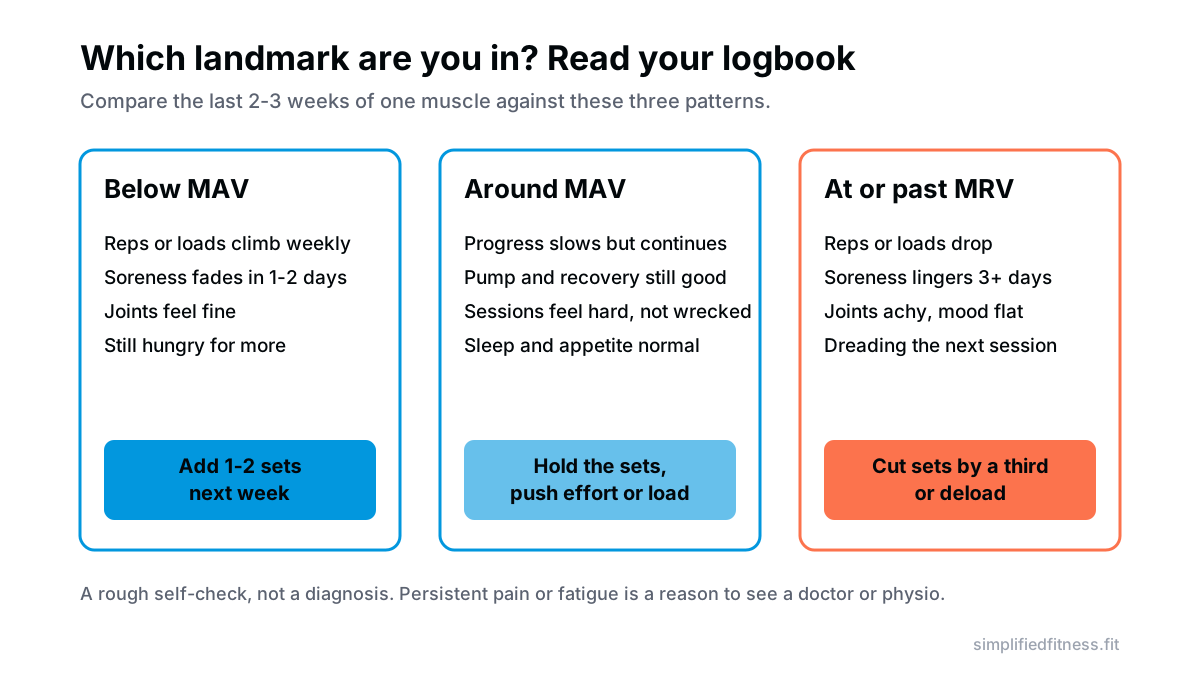
Your logbook is the diagnostic tool. Look at one muscle over the last 2-3 weeks and match it to a pattern.
Here is the quick version in a table.
| What the log shows | Likely zone | What to do next |
|---|---|---|
| Reps or loads rise most weeks, recovery fast | Below MAV | Add 1-2 sets next week |
| Progress slow but steady, sessions hard not wrecking | Around MAV | Hold sets, push effort or load |
| Performance falls, soreness lingers, joints ache | At or past MRV | Cut sets by about a third or deload |
| Nothing changes, effort feels easy | Near MV or below MEV | Raise effort first, then add sets |
The last row matters. A common mistake here is blaming “low volume” when sets are simply too easy. If you stop 5 reps from failure, you are doing fewer hard sets than you think. Check your effort first with the RIR and RPE calculator, then count sets with the training volume calculator.
Different experience levels land in different places on the dial, which we cover in volume landmarks for novice, intermediate and advanced lifters. Muscles also differ, so see volume tolerance in small versus large muscles.
How to progress volume across a 6-week mesocycle
A mesocycle is just a block of training, usually 4-6 weeks. The landmark idea fits it neatly: start near MEV, add sets steadily toward MAV, and finish with a lighter week.
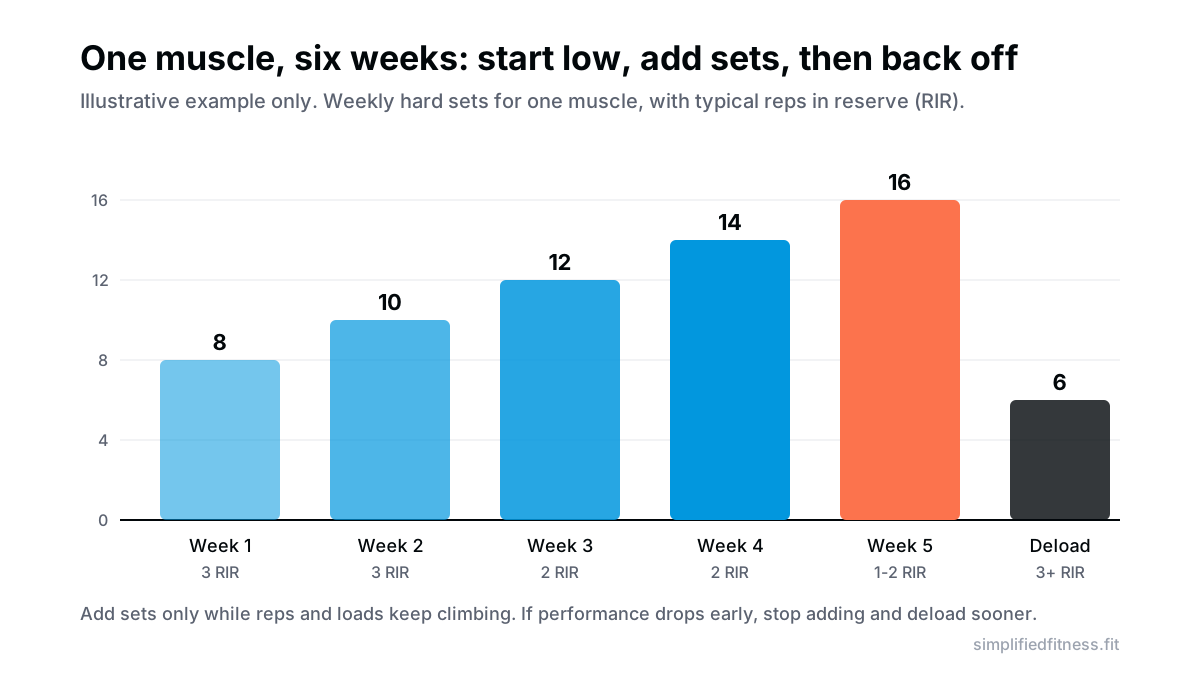
A simple version for one muscle:
- Week 1: about 8 hard sets, 3 reps in reserve. Treat this as a baseline week, not a test.
- Weeks 2-4: add roughly 2 sets per week if the previous week felt fine. Let effort creep toward 2 reps in reserve.
- Week 5: top set count (for example 16), with 1-2 reps in reserve on most sets.
- Week 6: deload. Cut sets to roughly a third to half and ease off effort.
Those numbers are an illustration, not a prescription. For the full planning logic, including how to reset between blocks, read mesocycle volume progression from MEV to MRV and our piece on deloads and volume resensitization.
A few practical rules help:
- Add sets to the muscle that is lagging, not to everything at once
- Spread sets across the week instead of cramming them into one day
- Keep at least a couple of exercises stable so you can read progress
- End the block early if recovery collapses
If you want a ready structure to try these ideas, our free push pull legs plan gives you a starting layout you can scale up or down.
Common mistakes with volume landmarks
Treating the ranges as rules. They are ranges and they move. A person sleeping 8 hours and eating plenty of protein from dal, paneer, curd and eggs recovers differently from someone running on five hours of sleep and a thin diet.
Counting junk sets. Ten easy sets do not equal ten hard ones. Count only sets taken near failure with good form.
Chasing MRV all year. Living at your ceiling is how people get stale, sore and burned out. Most progress comes from spending time around MAV and visiting higher volume only briefly.
Ignoring indirect sets. Heavy presses train triceps, rows train biceps. The 2026 meta-regression found that counting indirect sets as half a set matched results best, so a lifter doing lots of pressing may need fewer direct triceps sets than a quick tally suggests (Pelland et al., 2026).
Forgetting everything else. Calories, protein and sleep set the ceiling on what any volume can do. If recovery is poor, fix that before adding sets.
Conflicting evidence: what we do and do not know
Research here is mixed in places. The 2017 meta-regression found a steady rise with more sets, while the 6-week trial in trained men found no significant differences between 9, 18 and 27 sets. The 2022 review found no gain from going over 20 sets for quads and biceps, but found a benefit for triceps.
Why the differences? Small samples, short durations, different muscles, different effort levels and different ways of counting sets. Most trials are also in young men, so results may not transfer to women or older lifters. A cautious takeaway: begin a block near MEV (around 8-12 sets), add sets only while you keep progressing, and let your own recovery set the ceiling.
The bottom line
Volume landmarks give you a shared language: hold at MV, start growing at MEV, spend most of your time around MAV, and touch MRV rarely. The exact numbers are coaching estimates, but the pattern is backed by trial data showing more sets help, with diminishing returns.
Start a block lower than you think, add sets while your logbook keeps improving, and back off when it does not.
Frequently Asked Questions
What are volume landmarks in hypertrophy training?
Volume landmarks are four reference points for how many hard sets per muscle per week you do: MV, MEV, MAV and MRV. They describe the amount needed to hold muscle, to start growing, to grow best, and the most you can recover from. Use them as a map for planning, then adjust to your own logbook.
What does MEV mean in lifting?
MEV is minimum effective volume, the smallest number of weekly hard sets that still produces measurable muscle growth. It is usually quoted around 6-10 sets per muscle per week, though it varies by person and muscle. Start a training block near this number so you have room to add sets later.
What does MRV mean in lifting?
MRV is maximum recoverable volume, the most weekly work you can do before recovery falls behind. Coaches often quote roughly 20-25 hard sets per muscle, but the real number differs between people. If your performance drops and soreness lingers, you are probably at or past it, so cut sets or deload.
How many sets per week do you need to maintain muscle?
Often far fewer than you think. A 2021 review found that younger people maintained strength and muscle for up to 32 weeks with as little as one session per week and one set per exercise, provided the load stayed heavy. Older adults may need about two sessions and 2-3 sets per exercise, so keep your intensity high when time is short.
What is the difference between MEV and MAV?
MEV is where growth begins, while MAV is the range where growth is best relative to the effort and fatigue you pay. MAV usually sits around 12-18 sets per muscle per week in coaching practice. You start a block near MEV and move toward MAV as you adapt.
Are volume landmarks scientifically proven?
Not as exact numbers. The framework comes from coaching practice, while research supports its general shape: more sets tend to give more growth, with diminishing returns. Treat the ranges as starting estimates and test them against your own progress.
How many sets per muscle per week is best for hypertrophy?
A 2022 systematic review of trained young men suggested 12-20 weekly sets per muscle group as a sensible range. Meta-analyses show a dose-response trend with diminishing returns rather than a hard peak. Start around 8-12 sets and add more only while you keep progressing and recovering well.
How do I know if I am past MRV?
Look for reps or loads dropping across two sessions, soreness lasting three days or more, achy joints, poor sleep and dreading training. One bad day does not count, a pattern over 1-2 weeks does. Reduce sets by about a third or take a deload week, and see a doctor if pain or fatigue persists.
How long should a mesocycle be?
Five to six weeks is common, with the last week a deload or lighter week. This gives you enough time to add sets gradually without piling up fatigue. If recovery crashes at week three, end the block early rather than push on.
Should every muscle use the same volume?
No. Muscles differ in size, exercise selection and how much indirect work they get from other lifts, so the same number of sets does not hit each equally. Track each muscle's own response, and start with the same moderate number for all before adjusting.
Do beginners need to work up to MRV?
No. Beginners usually grow on modest volume, and trials in untrained people show that even a few sets per exercise work. Stay nearer MEV, focus on technique and consistency, and add sets slowly as progress slows.
Should I count sets from compound lifts toward volume?
Partly. A bench press trains your chest but also your triceps and front delts, so some of those sets count as indirect work. A 2026 meta-regression found that counting indirect sets as half a set predicted results best, so use that as a rough rule.
Can I go below maintenance volume and still keep muscle?
For short periods, probably yes. Research on reduced training suggests heavy load matters more than set count for holding muscle, although long gaps will eventually cost you. Keep a couple of heavy sets per muscle during busy weeks and return to normal volume when you can.
Sources & References
Every claim above is checked against peer-reviewed research (PubMed, U.S. National Library of Medicine) or guidance from established health bodies. How we fact-check.
- Schoenfeld BJ, et al. Dose-response relationship between weekly resistance training volume and increases in muscle mass: A systematic review and meta-analysis. J Sports Sci. 2017. PMID: 27433992
- Baz-Valle E, et al. A Systematic Review of The Effects of Different Resistance Training Volumes on Muscle Hypertrophy. J Hum Kinet. 2022. PMID: 35291645
- Pelland JC, et al. The Resistance Training Dose Response: Meta-Regressions Exploring the Effects of Weekly Volume and Frequency on Muscle Hypertrophy and Strength Gains. Sports Med. 2026. PMID: 41343037
- Heaselgrave SR, et al. Dose-Response Relationship of Weekly Resistance-Training Volume and Frequency on Muscular Adaptations in Trained Men. Int J Sports Physiol Perform. 2019. PMID: 30160627
- Spiering BA, et al. Maintaining Physical Performance: The Minimal Dose of Exercise Needed to Preserve Endurance and Strength Over Time. J Strength Cond Res. 2021. PMID: 33629972
- Hammarstrom D, et al. Benefits of higher resistance-training volume are related to ribosome biogenesis. J Physiol. 2020. PMID: 31813190
- Tavares LD, et al. Effects of different strength training frequencies during reduced training period on strength and muscle cross-sectional area. Eur J Sport Sci. 2017. PMID: 28316261

Umair Hazrami · Founder & Head Coach, Simplified Fitness
Umair Hazrami founded Simplified Fitness and the Simplified Lifter channel to cut through fitness noise. With 4+ years of consistent training and 10+ coaching clients, he writes every guide from the peer-reviewed research and links the sources so you can check them. Our editorial standards.
Educational content only, not medical advice. If you have a medical condition, are pregnant, or take medication, talk to a qualified doctor before changing your diet, supplements or training. Full disclaimer.
Keep reading

Programming
Autoregulation of Set Volume: Add or Cut Sets Based on Readiness and Velocity Loss
Autoregulation training volume explained: use warm-up speed, RIR and a 20-25% performance drop to add or cut sets, and what the evidence does or does not prove.
9 min read

Programming
The Biological Cost of High Volume: Sleep, Cortisol and Immune Strain
High volume lifting side effects: what research says about poor sleep, cortisol and colds, which warning signs matter, and how to scale back.
9 min read

Programming
How to Count Compound Sets Toward Weekly Volume: Direct vs Fractional Sets
How to count compound sets volume for arms, delts and hamstrings: the 1.0 and 0.5 fractional rule, a worked weekly example and what the research says.
9 min read

Programming
Distributing Weekly Volume: Full Body 3x vs Upper/Lower 4x vs PPL 6x
Distributing weekly volume across splits: how 12 sets per muscle look in full body, upper/lower and PPL, plus session length math and which fits your week.
9 min read