How Many Sets per Muscle per Workout? Why 6-8 Hard Sets Is a Smart Cap
How many sets per workout per muscle? Most lifters grow well on about 6-8 hard sets a session. See what the research says, and when to split volume.
TL;DR. The short answer
- For most lifters, about 6-8 hard sets per muscle per workout is a sensible ceiling. It is a practical rule of thumb, not a hard biological limit proven by a single study.
- The first few hard sets give the biggest return. Studies comparing 1 set with 3 sets show a clear jump in muscle protein synthesis, and weekly-volume meta-analyses show diminishing returns as sets pile up.
- No trial has tested a fixed 'cap' per session directly. The number comes from putting acute protein synthesis data, weekly volume research and gym practicality together.
- If your weekly plan needs more than about 8 sets for a muscle, split them over two or more days instead of stacking them into one long session.
- Only count sets taken close to failure with controlled technique. Warm-ups and easy sets do not count towards the cap.
Part of our complete guide: Optimal Training Volume and Frequency: How Many Sets per Muscle Actually Build Muscle
Table of contents
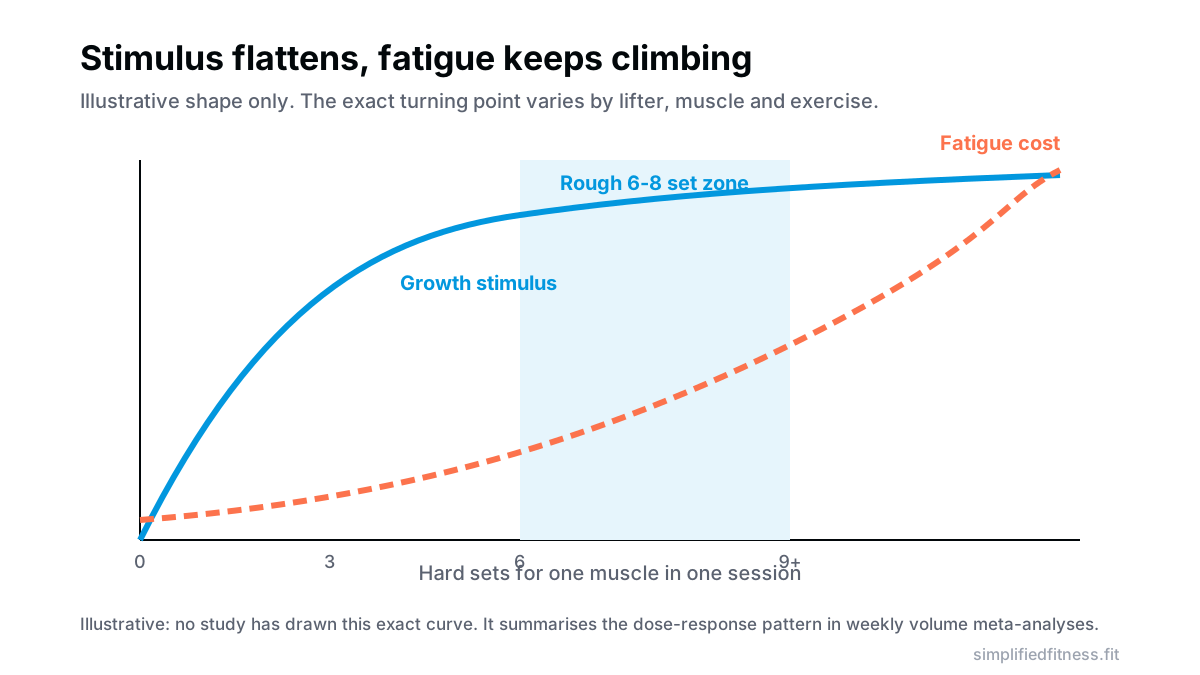
How many sets per workout per muscle do you actually need? For most lifters, about 6-8 hard sets is a smart ceiling for one muscle in one session. The first few sets do most of the work, and past that point you tend to buy more tiredness than more growth.
One honest caveat up front: that 6-8 figure is a practical rule, not a law of physiology. No study has put two groups through the same week and changed only the per-session cap. What we have is a pile of related evidence that points the same way. This article sits inside our complete guide to training volume and frequency, and it zooms in on one question: what is a sensible limit for a single workout?
Where does the 6-8 sets per session idea come from?
It comes from three lines of evidence that agree more than they disagree.
First, acute lab studies. These measure how much a muscle’s protein synthesis rises after a bout of training. Second, weekly volume meta-analyses, which show more sets generally means more growth, but with shrinking returns. Third, plain gym experience: set 12 of a chest session is rarely your best set.
None of these says “stop at set 8, exactly.” Together they say the early sets are the most valuable, the late ones are the least efficient, and the crossover sits somewhere in the middle single digits for many people.
What does muscle protein synthesis say about sets in one session?
The cleanest lab test is Burd and colleagues in 2010, and it is smaller than people remember. Eight resistance-trained men did one-legged leg extensions to failure, one leg for 1 set and the other for 3 sets (Burd et al., 2010). Muscle protein synthesis in the fed state rose 2.3-fold at 5 hours after 1 set and 3.1-fold after 3 sets. At 29 hours the 1-set leg had returned to resting levels, while the 3-set leg was still 2.3-fold above rest.
So going from 1 to 3 sets clearly matters. What the study did not test is 6 versus 9 versus 12 sets, so it cannot show where the ceiling is. It also used one exercise and only 8 people.
This is where a lot of internet claims overreach. You will see “muscle protein synthesis maxes out after 6-8 sets” stated as if someone measured it. As far as I can verify, nobody has mapped that curve set by set in trained lifters.
Does more weekly volume keep helping? The diminishing-returns picture
Over weeks, the picture is more useful. A 2017 meta-analysis of 15 studies found a graded dose-response: each extra weekly set was linked to a 0.37% bigger gain in muscle size, and higher volumes beat lower ones by about 3.9% (Schoenfeld et al., 2017).
Newer work refines this. A 2026 meta-regression of 67 studies and 2058 participants found that muscle gain rises with volume, but with diminishing returns (Pelland et al., 2026). Strength showed even stronger diminishing returns. That fits what most lifters feel: the first sets pay well, the next ones pay a little.
Note these are weekly numbers. Weekly volume is a separate question from the per-session cap, and we cover the full weekly curve in our piece on the weekly set volume dose-response curve.
What happens in trained lifters who do much more?
Here the evidence gets less tidy, and that is worth knowing.
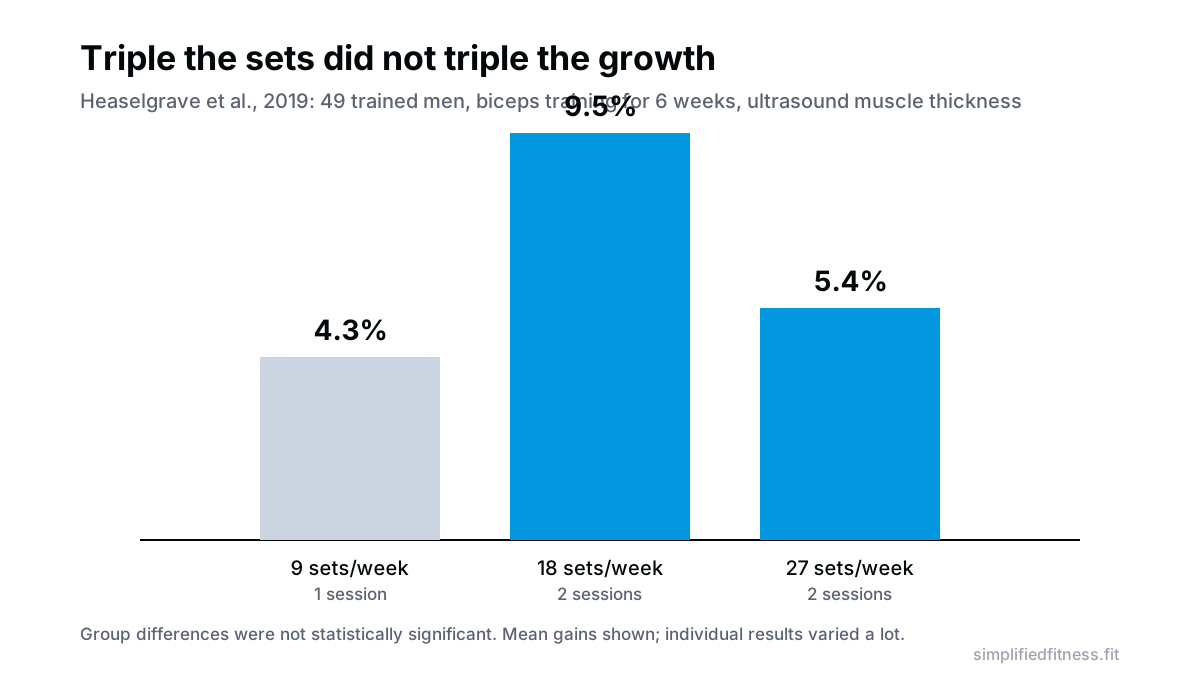
Heaselgrave and colleagues randomized 49 trained men to 9, 18 or 27 weekly sets of biceps work for 6 weeks (Heaselgrave et al., 2019). The low group trained once a week, the other two trained twice. Biceps thickness rose 4.3%, 9.5% and 5.4% respectively. The differences between groups were not statistically significant, although effect sizes were moderate to large for the 18 and 27 set groups versus 9. The authors concluded that 9 weekly sets in one session was enough to increase muscle thickness, and that 18-27 sets over two sessions might help strength more.
Two takeaways. First, 27 sets was not better than 18, which hints at diminishing returns even when split across two days. Second, the study was only 6 weeks, in one muscle, so it cannot settle the per-session question either.
A 2025 narrative review looked at exactly this puzzle: is there a “volume saturation point” in trained people? The authors found conflicting results and argued that differences in muscle group, exercise choice, prior training volume and individual variability make the picture hard to read (Camargo et al., 2025). They also noted that excessive volume may raise muscle protein breakdown, though results are not universal.
So the fair summary is mixed. Some lifters clearly tolerate more, some do not, and the research cannot yet tell you which one you are.
Why do later sets in a session give less?
Part of it is mechanics, part is common sense.
By set 9 or 10 on chest, your triceps and front delts are fried. The prime mover may not be the limiting factor anymore, so you are no longer training it hard. Reps get shorter, rest gets rushed, and range of motion quietly shrinks. The most common mistake here is logging those sets as “hard sets” when they were really survival sets.
There is also a biology angle. In a trial of untrained people training one leg with 3 sets per exercise and the other with 1 set, the moderate-volume leg grew more, with bigger signals for ribosome building (Hammarström et al., 2020). That supports the idea that more sets help early on. It did not test where more stops helping, and those were untrained people, so it does not tell us about a per-session cap.
What counts as a hard set?
A hard set means something specific. It is a working set taken close to failure, roughly 0-3 reps in reserve, with controlled form and a full range of motion.
Why proximity to failure matters: a 2024 series of meta-regressions found that muscle growth improved as sets were stopped closer to failure, while strength gains were similar across a wide range of reps in reserve (Robinson et al., 2024). The authors flagged that the RIR estimates were rough and the analysis was exploratory, so treat it as a direction rather than a rule.
What does not count:
- Warm-up sets.
- Sets stopped with 5+ reps left.
- Reps cut short on range of motion.
- Sets where you failed because of a different weak link (grip, breathing, balance).
If you want help picking loads that land at the right effort, our RIR / RPE load calculator is a quick starting point. For a deeper look at how to count, see how to quantify training volume.
How many sets per workout per muscle should you do? A practical guide
Use the table as a starting point, then adjust based on how you recover.
| Situation | Hard sets per muscle per session | Notes |
|---|---|---|
| Beginner (first year) | 2-4 | Almost any stimulus is new, so more is not needed |
| Intermediate, training each muscle twice a week | 4-6 | Two sessions of 4-6 gives 8-12 weekly sets |
| Intermediate, training each muscle once a week | 6-8 | Upper end of the range, in one session |
| Advanced, wants higher weekly volume | 6-8, over 2-3 sessions | Add sessions rather than sets |
| Small muscles (biceps, side delts, calves) | 3-6 | Often get indirect work from compound lifts |
| Busy week, very short on time | 3-4 | Still counts, just aim for quality |
These are conservative ranges from putting the research together, not clinical thresholds. Start low and add a set only when you are progressing and recovering well.
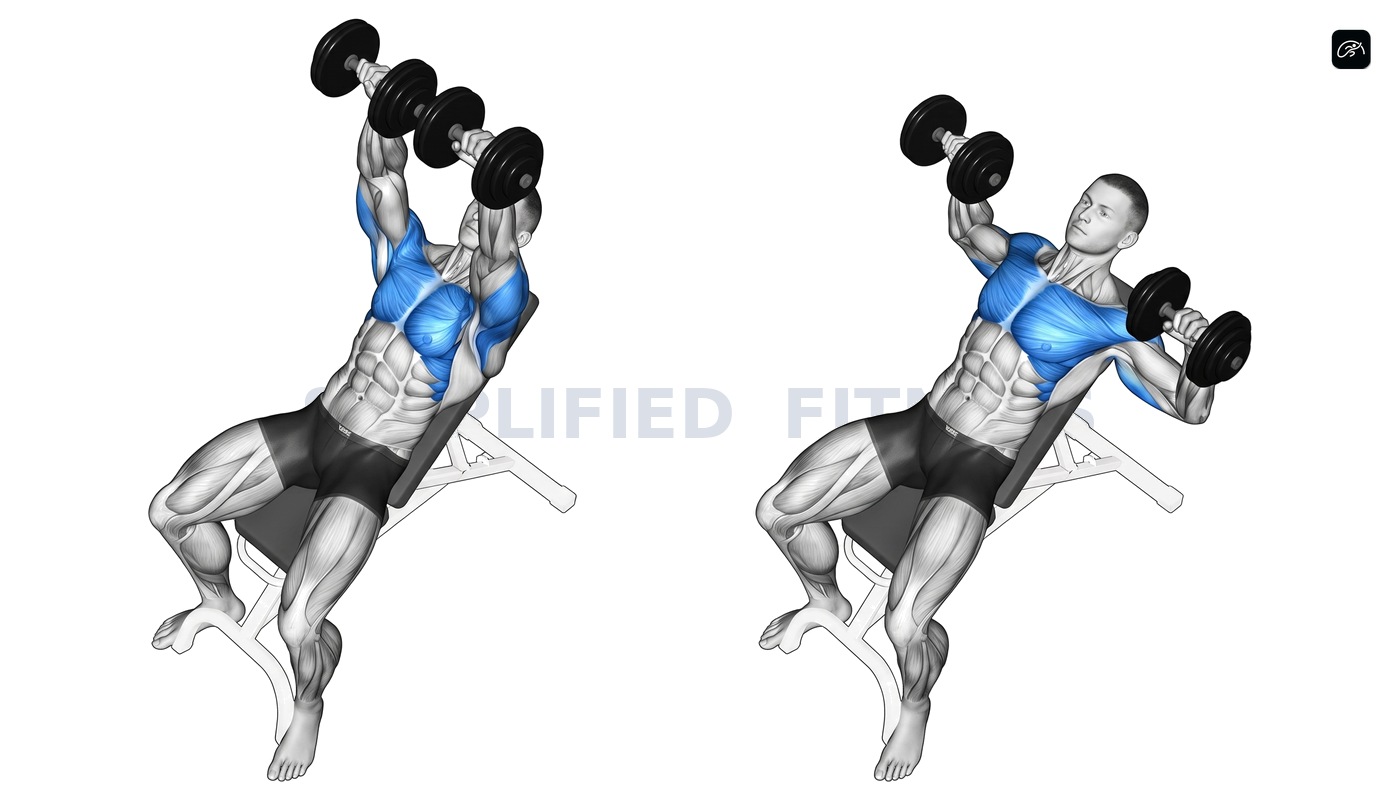
For chest, a simple session might be an incline press, a flat press and a fly. Here is the photo version of one useful press.
How should you split sets across days?
If your weekly plan needs more than about 8 hard sets for a muscle, split it. A 2016 meta-analysis found that, with volume matched, training a muscle twice a week gave better hypertrophy outcomes than once a week, with the effect size at 0.49 versus 0.30 (Schoenfeld et al., 2016). The review could not say whether three times beats twice, and data that held per-session frequency separate was too thin to analyse. A larger 2019 update of 25 studies then found no significant difference between frequencies once volume was equated (Schoenfeld et al., 2019).
So the sensible reading is: splitting does not appear to cost you anything, twice a week is a safe default, and the main reason to split is protecting set quality. Our article on training frequency at 1x, 2x and 3x with equal volume goes deeper, and the guide to distributing weekly volume across full-body, upper-lower and PPL splits shows how to lay it out.
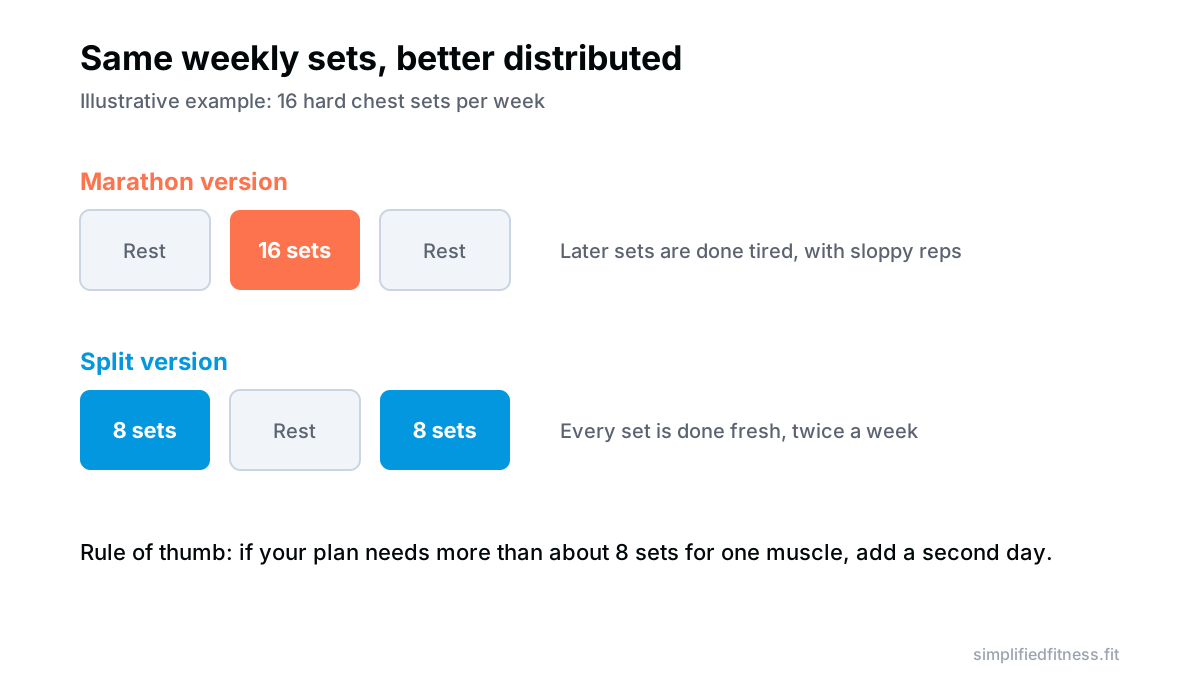
If you follow a push, pull, legs routine, our push day plan is a good template for keeping chest, shoulders and triceps inside a sensible per-session range.
How do you know when you have gone too far?
Watch for these signals, rather than a number on paper:
- Reps and loads fall across the sets of the same exercise.
- Soreness lingers for more than about 3-4 days.
- The next session for that muscle is worse than the last.
- Joints, especially elbows and shoulders, start to nag.
- The workout takes well beyond 75-90 minutes.
None of these alone proves you did too much, but two or three together are a good reason to trim a set or two. This is the same idea as junk volume, where extra sets add effort without adding results. See junk volume explained for the full picture, and autoregulating set volume for adjusting by readiness.
What does this mean for an Indian lifter with a busy schedule?
Many Indian lifters train 4-5 days around work, with limited time and a crowded gym at peak hours. That makes the per-session cap a time saver too.
If you only have 45-60 minutes, 6-8 hard sets per muscle for two muscles beats 20 half-hearted sets for one. Keep rest periods honest, and eat enough protein across the day from dal, paneer, curd, eggs, soya or chicken. Our protein calculator can give you a range for your body weight. In hot weather, long sessions also drag down rep quality faster, which is another reason to keep sessions tight and well hydrated.
When should you talk to a doctor?
Normal muscle soreness is dull and fades in a few days. Sharp joint pain, swelling, numbness or tingling, severe weakness, or dark urine after a very hard session is not normal. Stop training and see a doctor in those cases. This article is general education, not a diagnosis, and anyone with a medical condition, an injury or pain that keeps returning should get personal advice first.
The simple version
- Count only hard sets, taken close to failure with good form.
- Aim for about 6-8 hard sets per muscle per session as a ceiling, fewer for beginners and small muscles.
- If your weekly total needs more, add a second day instead of extending the first.
- Track your reps. If they collapse late in the session, you have found your personal cap.
- Treat every number here as a starting point and adjust to your own recovery.
Want help turning this into a plan you can follow? Our training volume calculator shows how your sets add up across the week.
Frequently Asked Questions
How many sets per workout per muscle is enough?
For most lifters, about 3-8 hard sets per muscle per session is enough to drive growth. The early sets carry most of the benefit, and research on weekly volume shows returns shrinking as sets increase. Start near 4-6 hard sets, and add a set only when you recover well and keep progressing.
What is the maximum number of sets per muscle group in one session?
There is no proven maximum, but about 8 hard sets is a reasonable working ceiling for most people. Beyond that, the extra stimulus is probably small while fatigue and session length grow, though individuals and muscles differ. If you need more weekly volume, add another session rather than lengthening one.
How many sets for chest in one workout?
Around 4-8 hard sets for chest per session works for most people, spread over two or three exercises such as a press, an incline press and a fly. Chest also gets indirect work from shoulder and triceps movements. If you press twice a week, 4-6 sets per day is often plenty.
Are 10 or 12 sets per muscle in one workout too many?
For many lifters, yes, because later sets are done tired and quality drops. That does not mean it never works, since some trained people tolerate more, and the research on a true saturation point is still mixed. If you do 10-12 sets, check whether your reps and loads fall in the last few sets, and if they do, move those sets to another day.
What counts as an effective set?
An effective set is one taken close to failure, roughly 0-3 reps in reserve, with a load you can control through a full range of motion. Meta-regression data suggest muscle growth tends to be better when sets end closer to failure, though the estimates are exploratory. Warm-ups and sets stopped far from failure should not count toward your hard-set total.
Is it better to do more sets in one workout or split them across days?
Splitting is usually the safer choice. Volume-equated frequency research suggests training a muscle about twice a week is at least as good as once a week, and splitting keeps more of your sets fresh. Use our training volume calculator to see how your weekly sets break up per session.
Does the 6-8 set rule apply to small muscles like biceps and side delts?
It is a guide, and small muscles often do well with fewer hard sets per session, around 3-6, since they also get work from compound lifts. Indirect work from rows and presses already covers part of the stimulus. Watch your elbows and shoulders for nagging pain and trim volume if it appears.
Do beginners need as many sets per session as advanced lifters?
No. Beginners typically grow on fewer sets, often 2-4 hard sets per muscle per session, because almost any stimulus is new. The research on volume tolerance in trained people is mixed, so advanced lifters should add sets slowly and only when progress stalls. Fewer, better sets is a good rule for the first year.
Do drop sets and supersets count as more than one set?
Treat a drop set as roughly one long hard set, or two at most, not as three or four separate sets. The extra fatigue is real, but the added growth is not guaranteed to match it. Count honestly, and keep your total near the cap.
What if I only train a muscle once a week?
Then you can use the upper end of the range, around 6-8 hard sets, in that one session, though it may be less efficient than splitting. The Heaselgrave trial found 9 weekly sets in one session was enough to grow the biceps in trained men. If your schedule allows a second light day, moving a few sets there is a simple upgrade.
Can I do all my weekly sets in one session if I am short on time?
You can, and it will still work, because a small amount of hard training beats none. It is just not the most efficient use of your sets, as later sets are done fatigued. Keep the cap near 8 hard sets and accept a smaller weekly total on busy weeks.
How long should rest be between sets so that the cap works?
Rest long enough to repeat good-quality reps, often about 2-3 minutes on big compound lifts and 1-2 minutes on isolation work. Short rests make later sets weaker, which lowers the quality of the sets you are counting. Time your rests for a week and see if your reps hold.
When should I see a doctor about post-workout pain?
See a doctor if you have sharp joint pain, swelling, numbness, dark urine, or soreness that is severe and not improving after several days. Normal muscle soreness is dull, eases within 2-4 days and improves as you adapt. High-volume sessions are a common trigger for overdoing it, so do not push through pain that feels wrong.
Sources & References
Every claim above is checked against peer-reviewed research (PubMed, U.S. National Library of Medicine) or guidance from established health bodies. How we fact-check.
- Burd NA, et al. Resistance exercise volume affects myofibrillar protein synthesis and anabolic signalling molecule phosphorylation in young men. J Physiol. 2010. PMID: 20581041
- Schoenfeld BJ, et al. Dose-response relationship between weekly resistance training volume and increases in muscle mass: A systematic review and meta-analysis. J Sports Sci. 2017. PMID: 27433992
- Schoenfeld BJ, et al. Effects of Resistance Training Frequency on Measures of Muscle Hypertrophy: A Systematic Review and Meta-Analysis. Sports Med. 2016. PMID: 27102172
- Schoenfeld BJ, et al. How many times per week should a muscle be trained to maximize muscle hypertrophy? A systematic review and meta-analysis of studies examining the effects of resistance training frequency. J Sports Sci. 2019. PMID: 30558493
- Heaselgrave SR, et al. Dose-Response Relationship of Weekly Resistance-Training Volume and Frequency on Muscular Adaptations in Trained Men. Int J Sports Physiol Perform. 2019. PMID: 30160627
- Hammarström D, et al. Benefits of higher resistance-training volume are related to ribosome biogenesis. J Physiol. 2020. PMID: 31813190
- Pelland JC, et al. The Resistance Training Dose Response: Meta-Regressions Exploring the Effects of Weekly Volume and Frequency on Muscle Hypertrophy and Strength Gains. Sports Med. 2026. PMID: 41343037
- Camargo JBB, et al. Is there a volume saturation point for muscle hypertrophy in resistance-trained individuals? A narrative review. Eur J Appl Physiol. 2025. PMID: 40883636
- Robinson ZP, et al. Exploring the Dose-Response Relationship Between Estimated Resistance Training Proximity to Failure, Strength Gain, and Muscle Hypertrophy: A Series of Meta-Regressions. Sports Med. 2024. PMID: 38970765

Umair Hazrami · Founder & Head Coach, Simplified Fitness
Umair Hazrami founded Simplified Fitness and the Simplified Lifter channel to cut through fitness noise. With 4+ years of consistent training and 10+ coaching clients, he writes every guide from the peer-reviewed research and links the sources so you can check them. Our editorial standards.
Educational content only, not medical advice. If you have a medical condition, are pregnant, or take medication, talk to a qualified doctor before changing your diet, supplements or training. Full disclaimer.
Keep reading
Programming
Autoregulation of Set Volume: Add or Cut Sets Based on Readiness and Velocity Loss
Autoregulation training volume explained: use warm-up speed, RIR and a 20-25% performance drop to add or cut sets, and what the evidence does or does not prove.
9 min read
Programming
The Biological Cost of High Volume: Sleep, Cortisol and Immune Strain
High volume lifting side effects: what research says about poor sleep, cortisol and colds, which warning signs matter, and how to scale back.
9 min read

Programming
How to Count Compound Sets Toward Weekly Volume: Direct vs Fractional Sets
How to count compound sets volume for arms, delts and hamstrings: the 1.0 and 0.5 fractional rule, a worked weekly example and what the research says.
9 min read
Programming
Distributing Weekly Volume: Full Body 3x vs Upper/Lower 4x vs PPL 6x
Distributing weekly volume across splits: how 12 sets per muscle look in full body, upper/lower and PPL, plus session length math and which fits your week.
9 min read