Volume Resensitization for Hypertrophy: Do Deloads Reset Muscle Growth?
Volume resensitization hypertrophy explained: does a low-volume phase restart growth after 20+ sets? See what the trials show and how to test a reset safely.

TL;DR. The short answer
- Volume resensitization is the hypothesis that a short break or low-volume phase makes muscle respond better to training again. It is plausible, but no trial has proven it in lifters.
- In a 2024 trial of resistance-trained people, a full week off in the middle of a 9-week high-volume block did not improve lower body muscle growth and led to smaller lower body strength gains.
- A small 2013 bench press trial found that 3-week breaks between 6-week training blocks gave about the same muscle growth over 24 weeks as training non-stop, which suggests short breaks cost little muscle.
- If you are stuck on 20+ sets, a 2-4 week phase at roughly 4-6 sets per muscle, then a rebuild at 8-10 sets, is a reasonable experiment, not a guaranteed fix.
- Check sleep, calories, protein and technique first. Persistent pain, fatigue or mood changes deserve a doctor, not a new program.
Part of our complete guide: Optimal Training Volume and Frequency: How Many Sets per Muscle Actually Build Muscle
Table of contents
Volume resensitization hypertrophy is the idea that after months of high-volume training, a short low-volume phase makes your muscles respond to training again. It is a reasonable idea, but it is not proven. The one randomized trial in resistance-trained people found that a full week off did not improve growth.
If you are doing 20+ sets per muscle and the mirror has stopped changing, this article tells you what the research does and does not support, and how to run a sensible reset anyway. For the bigger picture on sets and frequency, start with our complete guide to training volume and frequency.
What is volume resensitization (and where did the idea come from)?
The argument goes like this. Muscle grows when training sends a signal to build more protein and add more nuclei to the fibre. If you hammer that signal every day for months, the response to each extra set might shrink. Take a break, and the response might come back.
That is a hypothesis built from muscle biology and coaching experience, not a measured result in lifters. The 2024 deload trial that tested it began by describing it as “emerging evidence” that brief breaks may re-sensitize muscle to anabolic stimuli (Coleman et al., 2024). Note the wording: emerging, and may.
You will also see the phrase “anabolic resensitization.” Same idea, same level of proof.
Does a deload reset muscle growth? What the trial found
The cleanest test is Coleman et al. Thirty-nine resistance-trained young men and women were split into two groups. One followed a 9-week high-volume program straight through. The other took one full week off from lifting at the midpoint. Researchers measured muscle thickness in the quads and calves, plus strength, power and endurance.
Results: no appreciable difference in lower body muscle size, local endurance or power. The group that trained continuously gained more lower body strength. In other words, the week off did not give a growth bonus, and it cost some strength (Coleman et al., 2024).
Fair caveats. It was one week, not several. It was a complete break rather than a low-volume phase. The upper body was trained unsupervised. And the sample was small. So the study does not close the question, but it does argue against “take a week off and grow faster.”
Does a break cost you muscle? The periodic training study
A different design gives a more reassuring answer. In a 2013 trial, 14 young men did bench press three times a week. One group trained for 24 weeks without stopping. The other did three 6-week blocks separated by 3-week breaks, so they trained fewer total weeks.
Overall gains in muscle size and strength ended up similar. Growth in the continuous group slowed after the first six weeks, while the periodic group showed larger gains in the second retraining block (Ogasawara et al., 2013).
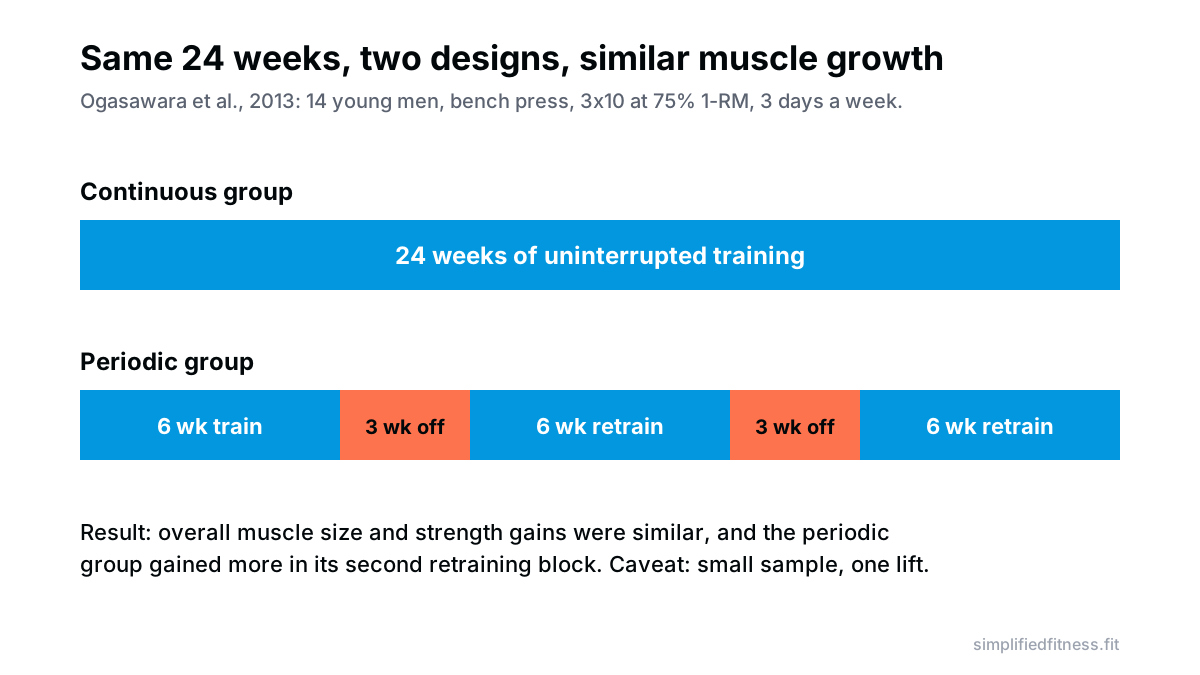
What this suggests: short breaks are cheap, and growth restarts quickly. What it does not show: that breaks cause extra growth, or that this applies to experienced lifters, women, or the legs. It was one upper-body lift in 14 men, and total training time was lower in the periodic group for the same result, which is interesting but not conclusive.
Is “muscle memory” the mechanism?
Muscle memory is often used to explain why retraining feels fast. Muscle fibres add nuclei when they grow, and some research suggests those stay after you stop.
Two human studies from the same research network show where the evidence stands. In one, 9 men and 10 women trained one leg for 10 weeks, detrained for 20 weeks, then retrained both legs. The previously trained leg did not respond better than the untrained leg, and myonuclear number did not rise during the first block (Psilander et al., 2019).
A 2024 arm study did find that myonuclei were gained and then maintained through 16 weeks of detraining. But gains during retraining were not clearly greater, so the researchers said the physiological benefit remains to be determined (Cumming et al., 2024). The 2024 study recruited untrained men and women, and neither study tested long-term lifters.
Do you actually need 20+ sets in the first place?
Here is the part many stalled lifters skip. Before resetting, ask if the volume was right.
A meta-analysis of 15 studies found a graded dose-response: each extra weekly set was linked to about 0.37% more muscle gain, and higher-volume groups gained about 3.9% more than lower-volume ones (Schoenfeld et al., 2017). More sets help on average. But the gain per set is small, and the studies were mostly short.
In trained men, 49 participants did 9, 18 or 27 weekly sets of biceps work for 6 weeks. All three groups added muscle thickness, with no significant differences between groups, though effect sizes were larger for the higher-volume groups (Heaselgrave et al., 2019). So 9 sets worked, and more may have helped a bit. That is exactly why dropping from 20+ to 8-10 sets is plausible: you give up a small edge, in exchange for much better recovery.
If you do not know how many hard sets you really do, count them with the training volume calculator. Many “20 set” weeks include warm-ups and sets stopped far from failure. Our article on junk volume and diminishing returns covers that trap.
How to run a volume reset (practical version)
No study has tested a specific resensitization protocol, so what follows is a coaching template built on the evidence above. Treat it as an experiment.
- Check the basics for a week. Aim for consistent sleep and enough food. In India, that often means checking if your protein from dal, paneer, curd, eggs or soya is actually reaching your target, not assumed. Our protein calculator gives a starting range.
- Reset for 2-4 weeks at about 4-6 hard sets per muscle per week. Keep exercises the same and keep the weight heavy. Reducing sets while keeping load is what research on maintenance supports: a 2021 review reports that muscle size in younger people can be held for up to 32 weeks with 1 session a week and 1 set per exercise, if relative load is maintained (Spiering et al., 2021). That review notes older people may need up to 2 sessions a week and 2-3 sets per exercise to hold muscle size.
- Rebuild at about 8-10 hard sets per muscle per week. Train within 1-3 reps of failure. Use the RIR and RPE calculator if you are unsure how hard that is.
- Add sets only when two weeks pass without progress. Add 1-2 sets to one muscle, not everything at once.
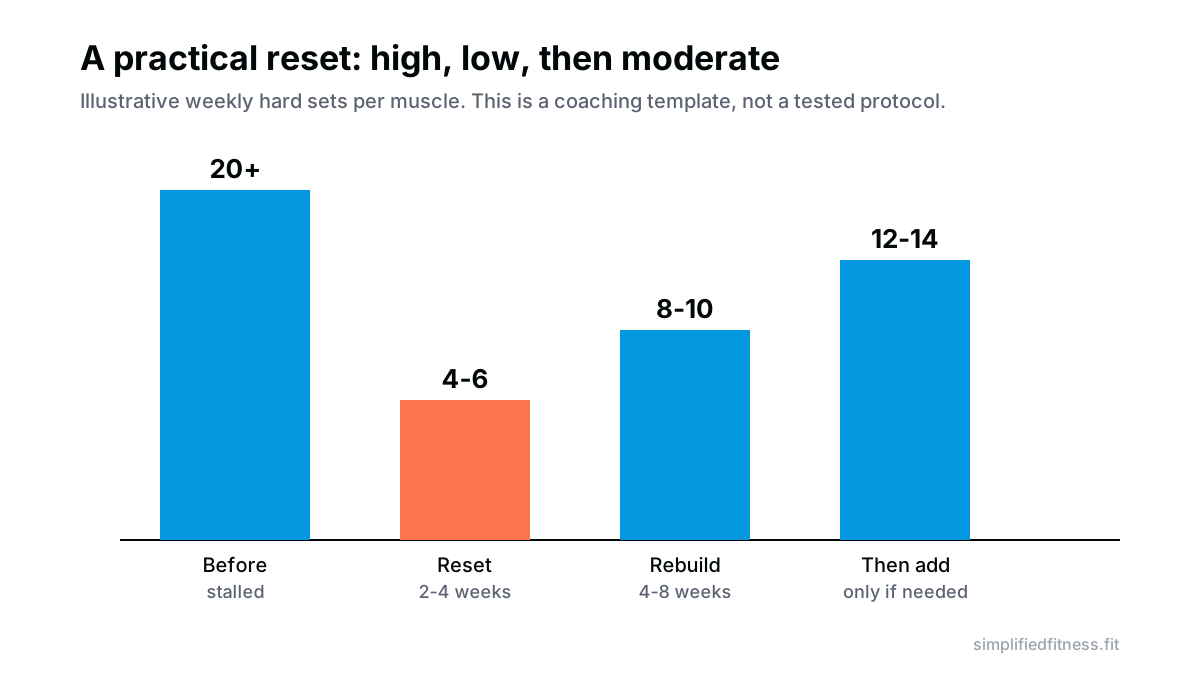
You can also think of it as a planned mini-cut in volume. Our guide to maintenance volume goes deeper on the low end, and volume landmarks explains how to place yourself between minimum and maximum.
Reset, deload or just rest: which one do you need?
These get mixed up, so here is a quick comparison.
| Approach | What changes | Best for | Evidence for growth |
|---|---|---|---|
| Deload (about 1 week) | Lower sets and effort | Accumulated fatigue, sore joints | No hypertrophy benefit in one trial |
| Volume reset (2-4 weeks) | Sets cut to about 4-6, load stays heavy | Long high-volume phase, stalled lifts | Untested, plausible |
| Full break | No lifting | Illness, injury, burnout | Short breaks did not cost muscle in one study |
| Staying the course | Nothing | Progress is still happening | Dose-response favours more sets, modestly |
The deload versus reset line is blurry. A deload is usually shorter and fatigue-driven. For methods, see deloading methodologies and the signs in signs you need a deload. A survey of 246 competitive strength and physique athletes found that deloads averaged about 6 days, roughly every 5-6 weeks, mainly for fatigue management (Rogerson et al., 2024). That shows common practice, not proven best practice. The related plan on low-volume resensitization blocks covers block structure in more depth.
When should you see a doctor?
A stall in the gym is a training problem. These are not: pain that does not settle, chest pain, fainting, unusual shortness of breath, weeks of exhaustion, a sudden drop in strength with weight loss, or low mood and trouble sleeping that will not lift. Under-eating or poor hydration in hot weather can also mimic a plateau. If anything above applies, get checked rather than reducing volume and hoping.
The bottom line
Volume resensitization is a useful frame but an unproven mechanism. The evidence supports three modest conclusions: short breaks or lower volume do not cost muscle, a full week off did not add growth in one trial, and 8-10 hard sets per muscle can be enough for many lifters to keep growing. If you are stuck on 20+ sets, a 2-4 week reset is a low-risk experiment. Run it, track it, and keep what works.
For the wider picture on stalls, see our progressive overload, deloads and plateaus guide.
Frequently Asked Questions
What is volume resensitization in bodybuilding?
It is the idea that after long periods of high volume, muscle becomes less responsive to more sets, and a short low-volume phase restores that response. The proposed mechanism is cellular, such as reduced sensitivity to the growth signal after repeated training. It remains a hypothesis, so treat any reset plan as an experiment you track.
Does a deload help muscle growth?
Not directly, according to the one randomized trial that tested it in resistance-trained people. A 1-week full break at the midpoint of a 9-week program gave similar lower body muscle growth to training straight through, with smaller lower body strength gains. A deload is still useful if you feel beaten up, so use it for fatigue, not as a growth trick.
How long should a volume reset last?
There is no tested length, but 2-4 weeks at about 4-6 hard sets per muscle per week is a common coaching template. Research on short breaks (3 weeks off in one trial) suggests muscle size is rebuilt quickly, so a longer reset rarely adds anything. Choose the shortest reset that lets you feel fresh, then rebuild.
How many sets per muscle should I do after a reset?
Start around 8-10 hard sets per muscle per week and add sets only if progress stalls. A 2019 trial in trained men found 9 weekly sets raised biceps thickness, while 18-27 sets showed larger effect sizes without a significant group difference over 6 weeks. Use the training volume calculator to count your weekly sets.
Can I build muscle on 8-10 sets per week?
Yes, many lifters can, especially if they train close to failure with good technique. Meta-analytic data show more sets tend to give more growth on average, but the gain per extra set is small, about 0.37% per set. If your progress stalls, check sleep, food and effort before piling on volume.
Is anabolic resensitization real?
It is plausible but unproven in people who already train. Some theories borrow from muscle memory research, yet human studies found the retained cell changes did not clearly speed up regrowth. Until better trials exist, think of it as a coaching idea.
What is muscle memory and does it apply here?
Muscle memory refers to long-lasting changes, such as extra myonuclei, that stay in a muscle after training stops. A 2024 study confirmed myonuclei persist after 16 weeks of detraining in men and women, but regrowth was not clearly faster. It supports the idea that you do not lose everything during a break, not that breaks supercharge growth.
Will I lose muscle on a low-volume phase?
Probably not over a few weeks if you keep loads heavy. A review of minimal-dose research reports that strength and muscle size in younger people can be maintained for up to 32 weeks with as little as 1 session a week and 1 set per exercise when relative load stays high. Keep the weight on the bar and cut sets, not intensity.
Should I stop training completely to reset?
Usually no. A full week off led to smaller strength gains in the 2024 trial. Keeping a small amount of heavy training has not been tested head to head, but it keeps the skill and load in place. If you are ill, injured or exhausted, a full break is reasonable. Otherwise, low volume with the same exercises is simpler to rebuild from.
How do I know I actually need a reset?
Look for a trend, not one bad day: lifts stalling or dropping for 2-3 weeks, joints aching, sleep worsening, and sessions you dread. These signs point to fatigue as much as to desensitization. If symptoms are severe or last weeks, see a doctor.
Is a 20+ set routine ever the problem?
Sometimes. Past a certain point extra sets add little and cost recovery, especially when sleep or calories are short. Cut to what you can recover from and check whether growth continues.
Does eating more or less change the reset?
Possibly, indirectly. Big calorie deficits tend to make high volumes harder to recover from, so a low-volume phase fits well during a cut. In a surplus with good sleep, you may not need one. Fix food and sleep before blaming your muscles.
How often should I do a volume reset?
There is no evidence-based schedule. Survey data of competitive strength and physique athletes report deloads about every 5-6 weeks, but that reflects habit, not proof. Do one when your log shows a stall plus fatigue, not on a fixed calendar.
Sources & References
Every claim above is checked against peer-reviewed research (PubMed, U.S. National Library of Medicine) or guidance from established health bodies. How we fact-check.
- Coleman M, et al. Gaining more from doing less? The effects of a one-week deload period during supervised resistance training on muscular adaptations. PeerJ. 2024. PMID: 38274324
- Ogasawara R, et al. Comparison of muscle hypertrophy following 6-month of continuous and periodic strength training. Eur J Appl Physiol. 2013. PMID: 23053130
- Psilander N, et al. Effects of training, detraining, and retraining on strength, hypertrophy, and myonuclear number in human skeletal muscle. J Appl Physiol. 2019. PMID: 30991013
- Cumming KT, et al. Muscle memory in humans: evidence for myonuclear permanence and long-term transcriptional regulation after strength training. J Physiol. 2024. PMID: 39159314
- Schoenfeld BJ, et al. Dose-response relationship between weekly resistance training volume and increases in muscle mass: a systematic review and meta-analysis. J Sports Sci. 2017. PMID: 27433992
- Heaselgrave SR, et al. Dose-response relationship of weekly resistance-training volume and frequency on muscular adaptations in trained men. Int J Sports Physiol Perform. 2019. PMID: 30160627
- Spiering BA, et al. Maintaining physical performance: the minimal dose of exercise needed to preserve endurance and strength over time. J Strength Cond Res. 2021. PMID: 33629972
- Rogerson D, et al. Deloading practices in strength and physique sports: a cross-sectional survey. Sports Med Open. 2024. PMID: 38499934

Umair Hazrami · Founder & Head Coach, Simplified Fitness
Umair Hazrami founded Simplified Fitness and the Simplified Lifter channel to cut through fitness noise. With 4+ years of consistent training and 10+ coaching clients, he writes every guide from the peer-reviewed research and links the sources so you can check them. Our editorial standards.
Educational content only, not medical advice. If you have a medical condition, are pregnant, or take medication, talk to a qualified doctor before changing your diet, supplements or training. Full disclaimer.
Keep reading

Programming
Autoregulation of Set Volume: Add or Cut Sets Based on Readiness and Velocity Loss
Autoregulation training volume explained: use warm-up speed, RIR and a 20-25% performance drop to add or cut sets, and what the evidence does or does not prove.
9 min read

Programming
The Biological Cost of High Volume: Sleep, Cortisol and Immune Strain
High volume lifting side effects: what research says about poor sleep, cortisol and colds, which warning signs matter, and how to scale back.
9 min read

Programming
How to Count Compound Sets Toward Weekly Volume: Direct vs Fractional Sets
How to count compound sets volume for arms, delts and hamstrings: the 1.0 and 0.5 fractional rule, a worked weekly example and what the research says.
9 min read
Programming
Distributing Weekly Volume: Full Body 3x vs Upper/Lower 4x vs PPL 6x
Distributing weekly volume across splits: how 12 sets per muscle look in full body, upper/lower and PPL, plus session length math and which fits your week.
9 min read