Muscle-Specific Volume Tolerance: Why Side Delts Recover Faster Than Quads
Muscle specific volume tolerance explained: why side delts and calves handle frequent training while heavy quads need days, what studies show and how to adjust.
TL;DR. The short answer
- Muscle specific volume tolerance is real in practice: lateral raises and calf raises usually leave you ready to train again in a day or two, while heavy squats and RDLs often need longer. The cause is mostly the exercise (load, joint torque, stretch under load), not muscle size alone.
- Direct evidence is thin. In untrained men doing unaccustomed eccentrics, arm muscles lost more strength than most leg muscles, and in trained men a single-joint curl took longer to recover from than a multi-joint row.
- When weekly sets are equal, more days per muscle does not clearly win: a 2019 meta-analysis found no meaningful frequency effect on hypertrophy, so frequency is a tool for managing fatigue, not a magic lever.
- A practical approach: spread demanding lifts over 1-2 sessions a week, let low-fatigue isolation work show up 3-5 times, and judge it by performance and soreness, not by a fixed rule.
- Persistent joint pain, sharp pain or swelling, or dark urine after hard training needs a doctor, not a new split.
Part of our complete guide: Optimal Training Volume and Frequency: How Many Sets per Muscle Actually Build Muscle
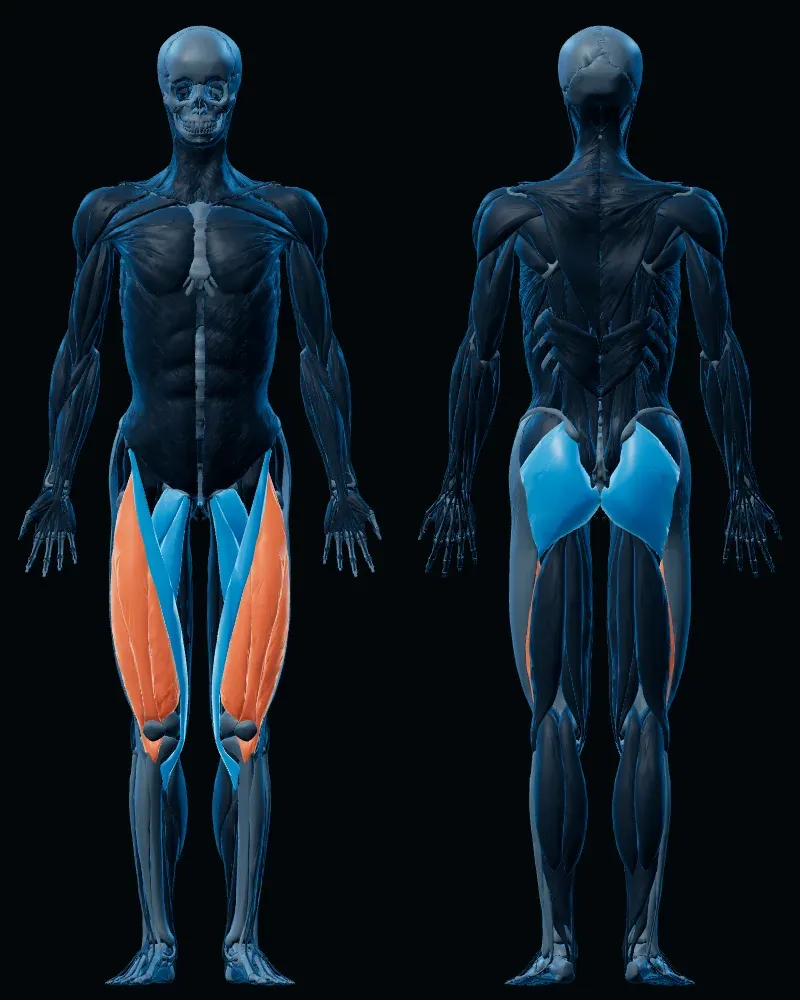
Muscles worked: quads
Main movers: rectus femoris and the three vasti
Assisting: adductors, sartorius and glutes
Table of contents
Muscle specific volume tolerance is the idea that different muscles can handle different amounts of work and different frequencies. It shows up in the gym all the time: lateral raises 4 days a week feel fine, but a heavy squat day can wreck your legs for 3 days. The research supports a version of this, though the real driver is usually the exercise you pick and how hard you push it, not just how big the muscle is.
This article is a cluster under our training volume and frequency guide. Here we stay on one question: why does recovery differ between muscles, and how should that change your weekly frequency?
Why can you train side delts so often but not quads?
Short answer: lateral raises are a different kind of stress from squats.
A lateral raise uses 6-12 kg dumbbells, one joint, and a short lever. A heavy squat loads the hips, knees, spine and the whole system with 100 kg or more. Your side delts finish a set locally tired. Your legs finish a squat set with your breathing, grip, back and knees all in on it.
So when lifters say “small muscles recover faster”, they are mixing three things together:
- Load and joint torque: how much force the exercise asks of the muscle and the joint it crosses.
- Total work per set: how many reps and how much weight you actually move.
- Damaging features: long stretched positions under load, slow lowering and unfamiliar movements.
Muscle size sits somewhere behind these. A bigger muscle can do more total work in a set, which tends to cost more to recover from. But that is a tendency, not a law.
What does the research actually show?
Here is where I want to be careful. There is no clean trial that put side delts and quads head to head and measured how many days each one needs. What we have are pieces, and they do not all point the same way.
Squats do hit the legs harder than knee extensions
A 2022 study had 10 resistance-trained men do 5 sets of 8RM on a back squat and a knee extension on separate days. Thigh muscle thickness, leg circumference and soreness were higher after the squat at several time points up to 36 hours (de Camargo et al., 2022). So within the same muscle group, the multi-joint lift produced more of the markers lifters use to judge recovery.
But single-joint is not automatically easier
You might expect the opposite for arms. In 16 highly trained men, 8 sets of 10RM of a unilateral seated row and a preacher curl were compared on opposite arms. Peak elbow flexor torque dropped 26.8% right after the curl versus 15.1% after the row, and the rowing arm was back to baseline within 24 hours while the curling arm was still 8.4% down. Soreness was also greater and lasted longer after the curl (Soares et al., 2015).
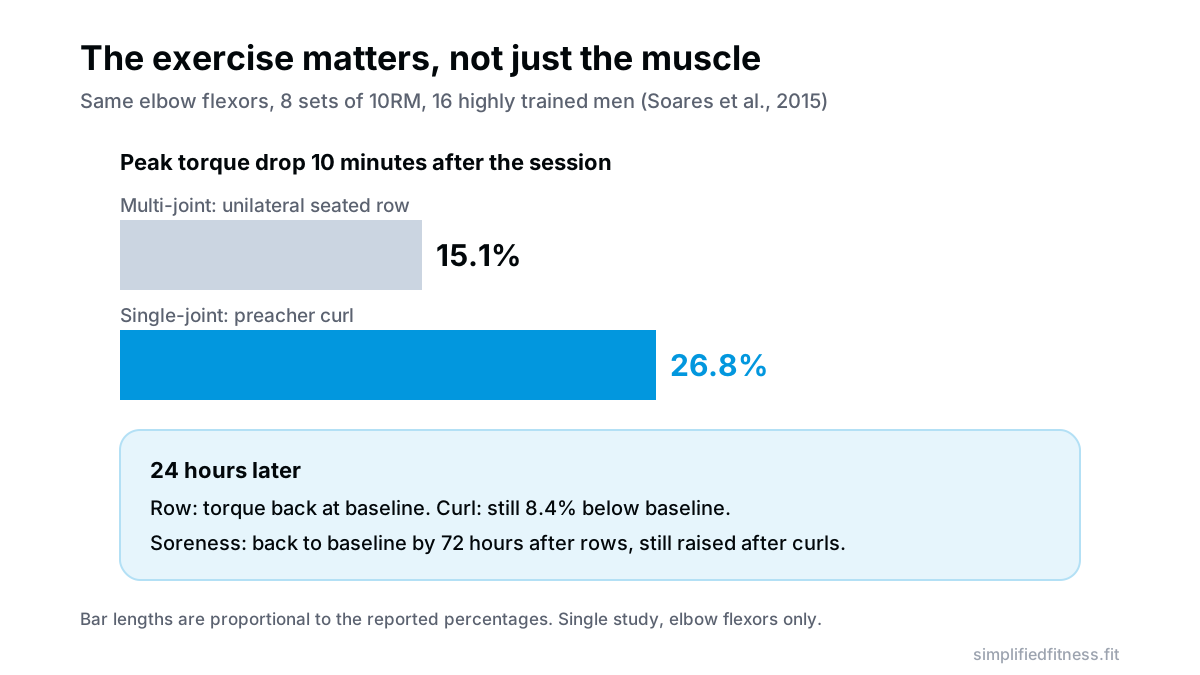
That is a useful reality check. A curl is a stretched, isolated, high-effort set for the biceps. That is exactly the kind of work that can leave a small muscle sore for 2-3 days.
Arms can be more damaged than legs under the same eccentric stimulus
In a 2019 study, 15 sedentary young men performed nine eccentric exercises (5 sets of 10 eccentric reps at 80% of maximal strength) for arm, leg and trunk muscles. Strength losses were larger for the elbow flexors, elbow extensors and pecs than for the other muscles, and soreness was greatest for the elbow flexors, elbow extensors and lower back (Chen et al., 2019). These were untrained men doing unaccustomed eccentrics, so it should not be copied straight onto your usual training. But it argues against the simple idea that arms always bounce back faster.
Heavy deadlifts are not always the recovery monster
Many lifters assume deadlifts and RDLs flatten you for days. In 12 well-trained men doing 4 sets to failure at 80% of 1RM, recovery measures after squat, bench press and deadlift did not differ between lifts, and bar speed did not drop after the deadlift (Belcher et al., 2019). That was a one-off session in a lab, not an RDL-heavy training block, so it does not prove your hamstrings recover in a day. It does mean the horror stories are partly about habit and unfamiliarity.
Conflicting results, in plain terms
- Study A (de Camargo, 2022) found the squat produced more damage markers than the knee extension in the same legs.
- Study B (Soares, 2015) found the single-joint curl was harder to recover from than the multi-joint row.
- Why they may differ: different muscles, different loads, and different measures (thigh swelling and soreness versus torque and soreness).
- Practical takeaway: do not assume. Judge each exercise by how you perform and feel next session.
Does recovery speed change how often you should train a muscle?
Less than most people think, as long as weekly sets are matched.
A 2016 meta-analysis of 10 studies found a higher weekly frequency was associated with greater hypertrophy, and suggested training major muscle groups at least twice a week (Schoenfeld et al., 2016). A larger 2019 meta-analysis of 25 studies then found no significant difference between higher and lower frequency when volume was equated, including in trained people and when upper and lower body were looked at separately (Schoenfeld et al., 2019). The newer review’s conclusion was that, for a given volume, people can choose frequency based on preference.
Why would the two reviews differ? The 2016 one pooled only 10 studies. The 2019 one had 25, enough to analyse volume-equated studies, trained lifters and upper versus lower body separately. It did find an advantage for higher frequency in studies where volume was not equated, which suggests extra sets, not extra days, explained much of the earlier signal.
So what is frequency for? Mainly for two things:
- Spreading sets so each session stays high quality. That matters more for demanding lifts.
- Fitting your life. Three short sessions are easier to repeat than one three-hour one.
For total volume itself, the picture is graded: more weekly sets were associated with more growth in a 2017 meta-analysis (about 0.37% more gain per extra set), and a trial in trained men found higher volumes gave greater growth in the elbow flexors and thighs (Schoenfeld et al., 2019). Our weekly set dose-response article covers that curve in detail. The point here: you only get the extra sets if you can recover from them.
How to set frequency by muscle in practice
Here is a framework, not a prescription. It is built from the physiology above and ordinary coaching practice, and it has not been tested head to head.
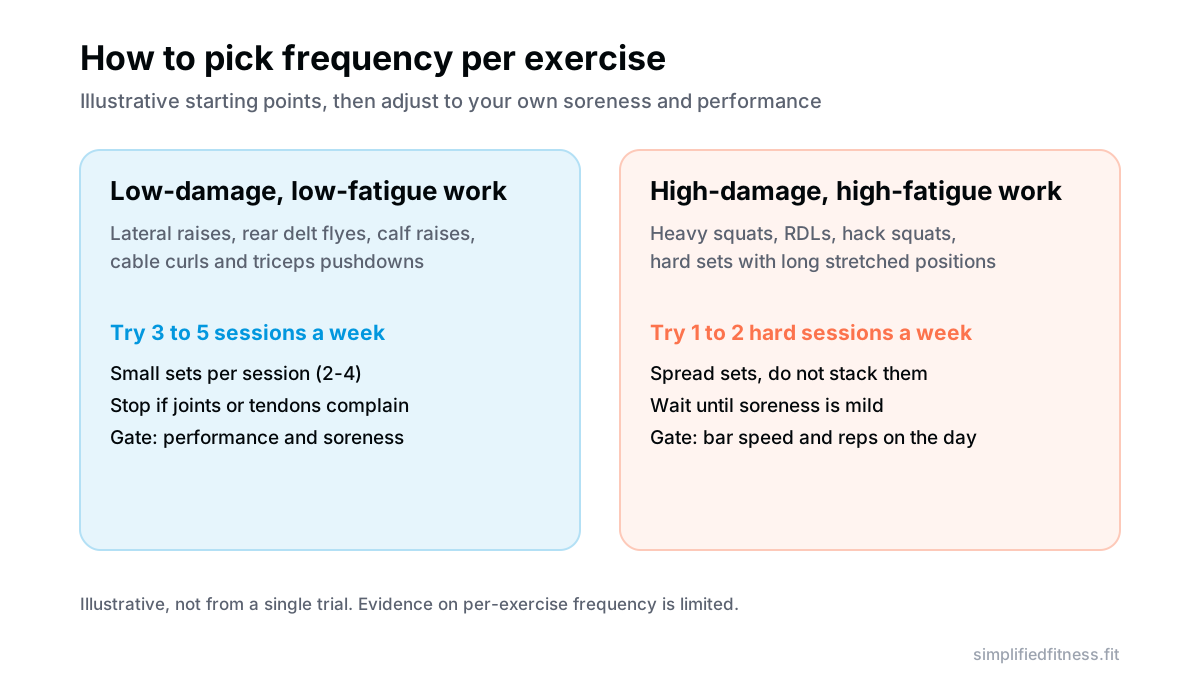
Low-fatigue, low-damage work: more often, fewer sets each time
Lateral raises, rear delt flyes, calf raises, cable curls and pushdowns are loaded lightly and rarely crush you. A few sets spread across 3-5 days is a reasonable experiment. Our lateral deltoid optimization article and calf science article go into exercise choice, and the 3D shoulder protocol shows one way to arrange shoulder frequency.
Rules for this group:
- Keep the sets short, 2-4 per session.
- Stop short of ugly, swinging reps.
- Back off if your elbows, shoulders or Achilles tendons ache. Tendons adapt more slowly than muscle.
High-damage, high-fatigue work: fewer hard sessions
Heavy squats, hack squats, RDLs and long-stretch sets belong here. One or two hard sessions a week is a common starting point. If you want more weekly sets, split them across two days rather than stacking them in one. Our article on direct vs fractional sets shows how the compound lifts also hit other muscles, which matters when you count weekly volume.
Use performance as the gate, not a calendar
Before repeating a hard session, ask:
- Can I match last session’s weight and reps?
- Is soreness mild enough that I can move through full range?
- Is my sleep okay?
A study in trained men found that strength can look recovered while the ability to repeat many reps is not. After 8 sets of bench press to failure, peak torque returned to baseline at 96 hours while total work had not (Ferreira et al., 2017). In other words, one heavy single can feel fine while your volume capacity is still low. Judge by your working sets, not your first rep.
Why soreness is a poor guide
New exercises and bigger increases in load cause the most soreness, and the effect fades after you repeat them. That “repeated bout effect” was similar across arm, leg and trunk muscles in Chen’s study (Chen et al., 2019). So a muscle that is brutally sore in week one may handle the same work easily in week four.
A simple weekly layout
This is an illustrative example for an intermediate lifter, using about 10-14 weekly hard sets per muscle as a rough upper range, which you should lower if you are new or short on sleep.
| Muscle | Typical exercises | Sessions a week to try | Sets per session |
|---|---|---|---|
| Side delts | Lateral raises (dumbbell or cable) | 3-4 | 3-4 |
| Rear delts | Reverse pec deck | 2-3 | 3-4 |
| Calves | Standing and seated raises | 3-4 | 3-4 |
| Quads | Squat or hack squat, leg extension | 2 | 4-6 |
| Hamstrings | RDL, seated leg curl | 2 | 3-5 |
This is a starting grid, not proof that these numbers are optimal. If your quads are lagging, add one set per session for two weeks and see whether your squat reps hold up. Our training volume calculator can total your weekly sets by muscle, and you can see how the sessions fit into a split with individual recovery profiling and the training frequency article.
Indian lifter notes
Hot, humid gyms and long commutes change recovery more than most muscle differences do. A June session in a non-air-conditioned gym on 5 hours of sleep will feel very different from a winter morning. Protein also matters: aim for dal, curd, paneer, eggs, soya chunks or chicken at each main meal, and use our protein calculator for a daily target. Cut sets before you cut sleep.
When to see a doctor
Normal soreness is dull, both-sided and fades within a few days. See a doctor if you have:
- sharp or one-sided pain, or a “pop” during a lift
- marked swelling of a limb
- dark, tea-coloured urine or severe weakness after hard training
- joint pain that lasts more than a couple of weeks
These can point to injury or a serious condition, not a problem you can fix with a different split.
The bottom line
Muscle specific volume tolerance is real as a gym observation, but it comes from the exercise and your own recovery more than a fixed rule about muscle size. Light, low-damage movements for side delts and calves can often be trained several days a week. Heavy compound work for quads and hamstrings usually needs spacing. The studies we have are small and mostly in young men, so treat the numbers here as starting points.
Pick a frequency, run it for 6-8 weeks, and let your reps tell you whether it works. For the bigger picture, head back to the training volume and frequency guide.
Frequently Asked Questions
Can you train side delts every day?
Some lifters do tolerate lateral raises very frequently, but there is no trial showing daily training is better than 3-4 sessions a week. Side delts get light loads and small joint torque, so fatigue is usually low, yet shoulder joints and tendons can still complain. Try 3-4 short sessions a week and add days only if performance and shoulder comfort stay good.
Why do quads take longer to recover than side delts?
Quads usually take longer because the exercises that load them, such as squats, are heavy, multi-joint and carry a lot of total work per set. A small study in trained men found a back squat raised thigh swelling and soreness more than a knee extension. Plan your hardest quad work with at least two days before the next hard leg session.
Do small muscles really recover faster than large muscles?
Not reliably. In highly trained men, a single-joint preacher curl hurt elbow flexor strength and soreness more than a multi-joint row, which shows exercise choice can matter more than muscle size. Treat 'small recovers faster' as a rough tendency, then test it on your own training log.
How long do muscles take to recover after resistance training?
Roughly 24-96 hours in the studies we cite, depending on the muscle, exercise and how hard the sets were. In well-trained men, soreness and performance measures after squats, bench press and deadlifts followed a broadly similar time course. Judge recovery by whether you can match last session's performance, not by a calendar.
Is soreness a sign I should train a muscle less often?
Heavy soreness is a sign the muscle is not ready to be trained hard again, but it is a poor measure of growth. Soreness is mostly an index of unfamiliar damage and fades with repeated exposure. If a muscle is still sore and weaker the next session, move that session or cut sets.
Do calves need to be trained more often?
Many lifters train calves 3-5 times a week because the exercise is light on the joints and soreness is mild, but direct evidence for an optimal calf frequency is limited. If calves are a weak point, spreading 8-12 weekly sets over 3-4 days is a reasonable experiment. Track calf size and Achilles comfort for 8-12 weeks before changing it.
Should I train every muscle twice a week?
Twice a week is a sensible default, but it is not required. A 2016 meta-analysis favoured twice weekly over once weekly, while a larger 2019 meta-analysis found no meaningful difference once total sets were equal. Pick the frequency that lets you perform your sets with good quality.
How many sets per session can a muscle tolerate?
There is no single number, and the limit is lower for heavy compound lifts than for isolation work. A common coaching range is a handful of hard sets per muscle per session, with extra volume pushed to another day. Add sets slowly and watch whether your performance drops by the last set.
Do rear delts and side delts need different frequencies from front delts?
Front delts already get heavy pressing work, so adding more is rarely necessary. Side and rear delts get little help from pressing and are loaded lightly, so more frequent sessions are easier to recover from. Use direct sets for side and rear delts and count your pressing for the front.
Does bigger body size mean longer recovery?
It can, because bigger lifters move heavier loads and do more total work per set. There is no clean study that proves body size alone sets recovery time. Use your own rep performance and soreness as the guide.
What should I do if my quads are always sore?
Check whether you are adding load, sets or new exercises too fast, since unfamiliar work causes the largest soreness. Soreness shrinks after you repeat the same session for a few weeks. Hold your sets steady for 2-3 weeks, and see a doctor if pain is sharp, one-sided, swollen or comes with dark urine.
Is it better to train legs once or twice a week?
Either can work. A 2019 meta-analysis found frequency did not meaningfully change hypertrophy when sets were equated, including for lower-body training. Choose once if one big session leaves you recovered, or twice if splitting the sets lets you lift with better quality.
Does the repeated bout effect change how often I can train a muscle?
Yes. After a muscle has been exposed to a given kind of work, the same session damages it less. In one study, the protective effect was similar across arm, leg and trunk muscles. Stay consistent with exercise choice for a few weeks before judging how much frequency you can handle.
Sources & References
Every claim above is checked against peer-reviewed research (PubMed, U.S. National Library of Medicine) or guidance from established health bodies. How we fact-check.
- Soares S, et al. Dissociated time course of muscle damage recovery between single- and multi-joint exercises in highly resistance-trained men. J Strength Cond Res. 2015. PMID: 25807025
- de Camargo JBB, et al. Dissociated time course of indirect markers of muscle damage recovery between single-joint and multi-joint exercises in resistance-trained men. J Strength Cond Res. 2022. PMID: 33394892
- Belcher DJ, et al. Time course of recovery is similar for the back squat, bench press, and deadlift in well-trained males. Appl Physiol Nutr Metab. 2019. PMID: 30779596
- Chen TC, et al. Damage and the repeated bout effect of arm, leg, and trunk muscles induced by eccentric resistance exercises. Scand J Med Sci Sports. 2019. PMID: 30663816
- Ferreira DV, et al. Dissociated time course between peak torque and total work recovery following bench press training in resistance trained men. Physiol Behav. 2017. PMID: 28595855
- Schoenfeld BJ, et al. How many times per week should a muscle be trained to maximize muscle hypertrophy? A systematic review and meta-analysis. J Sports Sci. 2019. PMID: 30558493
- Schoenfeld BJ, et al. Effects of resistance training frequency on measures of muscle hypertrophy: a systematic review and meta-analysis. Sports Med. 2016. PMID: 27102172
- Schoenfeld BJ, et al. Dose-response relationship between weekly resistance training volume and increases in muscle mass: a systematic review and meta-analysis. J Sports Sci. 2017. PMID: 27433992
- Schoenfeld BJ, et al. Resistance training volume enhances muscle hypertrophy but not strength in trained men. Med Sci Sports Exerc. 2019. PMID: 30153194

Umair Hazrami · Founder & Head Coach, Simplified Fitness
Umair Hazrami founded Simplified Fitness and the Simplified Lifter channel to cut through fitness noise. With 4+ years of consistent training and 10+ coaching clients, he writes every guide from the peer-reviewed research and links the sources so you can check them. Our editorial standards.
Educational content only, not medical advice. If you have a medical condition, are pregnant, or take medication, talk to a qualified doctor before changing your diet, supplements or training. Full disclaimer.
Keep reading
Programming
Autoregulation of Set Volume: Add or Cut Sets Based on Readiness and Velocity Loss
Autoregulation training volume explained: use warm-up speed, RIR and a 20-25% performance drop to add or cut sets, and what the evidence does or does not prove.
9 min read
Programming
The Biological Cost of High Volume: Sleep, Cortisol and Immune Strain
High volume lifting side effects: what research says about poor sleep, cortisol and colds, which warning signs matter, and how to scale back.
9 min read

Programming
How to Count Compound Sets Toward Weekly Volume: Direct vs Fractional Sets
How to count compound sets volume for arms, delts and hamstrings: the 1.0 and 0.5 fractional rule, a worked weekly example and what the research says.
9 min read
Programming
Distributing Weekly Volume: Full Body 3x vs Upper/Lower 4x vs PPL 6x
Distributing weekly volume across splits: how 12 sets per muscle look in full body, upper/lower and PPL, plus session length math and which fits your week.
9 min read