Why You Burn Out on 12 Sets While Your Partner Thrives on 20
Personalizing training volume starts with sleep, stress, age and genetics. Use our 5-question score to build a weekly set budget you can actually recover from.

TL;DR. The short answer
- Volume tolerance differs between lifters because sleep, life stress, age, job demands and biology all change how fast you recover. A set count that works for your gym partner can overshoot your own budget.
- Sleep restriction reduces maximal force in compound lifts (systematic review of 17 studies, mostly moderate or weak quality), so short sleepers may do better with a smaller set budget or longer gaps between hard sessions.
- In student studies, higher psychological stress was linked with slower strength recovery and smaller strength gains over 12 weeks. Stress is a real input, though the data come from young, small samples.
- Age alone does not seem to worsen exercise-induced muscle damage, but older lifters often have less sleep, more stress and less spare time. Judge recovery by your own response, not your birth year.
- Start from 6-16 hard sets per muscle per week based on a 5-question recovery score, hold it for 3-4 weeks, then add 1-2 sets if recovery is good or trim 25-30% if it is not, using performance, soreness and mood.
Part of our complete guide: Optimal Training Volume and Frequency: How Many Sets per Muscle Actually Build Muscle
Table of contents
Your gym partner runs 20 sets per muscle per week and looks fine. You try 12 and feel flat by Thursday. The short answer is that volume tolerance is personal, and it is set mostly by what happens outside the gym: sleep, stress, job demands, age and a bit of biology you cannot change.
This is where personalizing training volume beats copying a template. In this guide you will get a five-question recovery score, a starting set budget for it, and a simple way to adjust as life changes. (For the bigger picture on sets and frequency, start with our complete guide to training volume and frequency for hypertrophy.)
Why does your partner recover from 20 sets when you struggle at 12?
Because you are not running the same experiment. Same program, different recovery budgets.
Meta-analysis data say that, on average, more weekly sets produce more muscle. Across 15 studies, each additional weekly set was associated with roughly 0.37% more muscle gain (Schoenfeld et al., 2017). Averages hide people, though. A 2025 narrative review of trials in trained lifters notes that results are conflicting, and that between-subject variability and a lack of control for prior training volume make the dose-response picture harder to read (Camargo et al., 2025).
So two things are true at once. More volume tends to help on average, and the amount any one person can recover from varies a lot. Your partner may sleep eight hours, work at a desk and have no exams or deadlines. You may be on six hours, commuting two hours a day and running a team. Those are very different budgets.
What factors decide your personal volume tolerance?
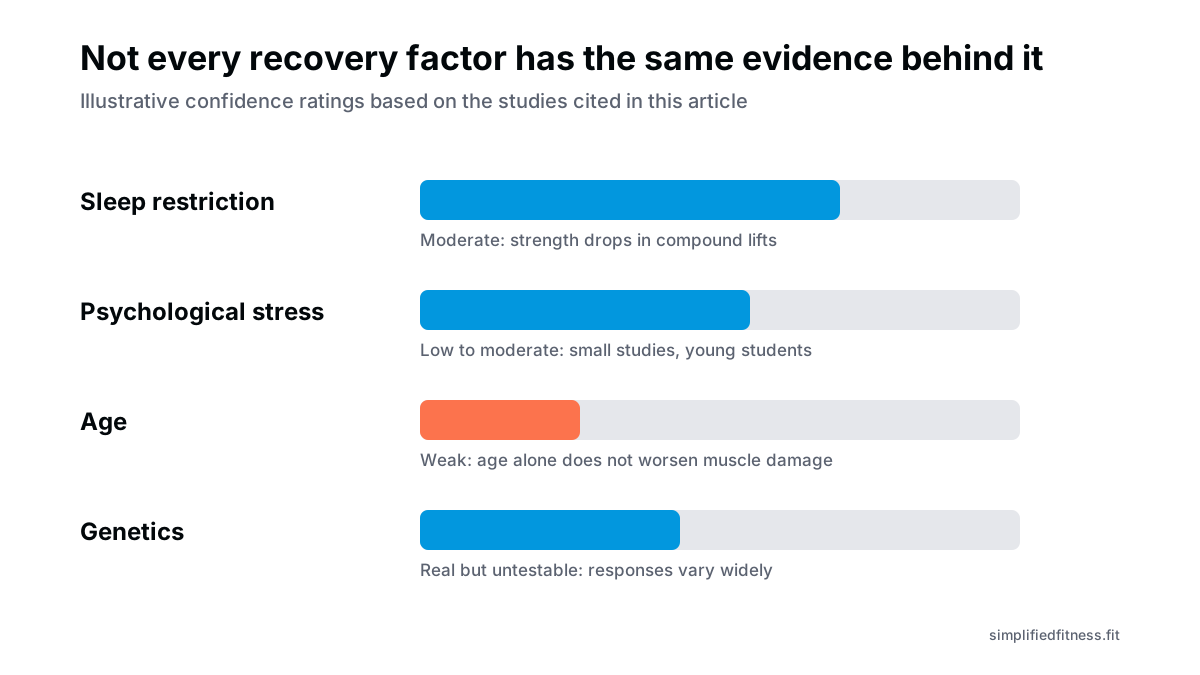
Five inputs matter most in practice. Evidence for each is uneven, and I will say where.
- Sleep. The best-supported factor.
- Psychological stress. Real signal, small studies.
- Work demands. Plausible, thin direct data.
- Age. Less of a factor than people assume.
- Biology. Real, but you cannot test it.
How does sleep duration change how much volume you can handle?
Short sleep hits your heavy compound work first. A systematic review of 17 studies (rated moderate or weak in quality) found that a single night without sleep had little effect on strength, but consecutive nights of restricted sleep could reduce force output in multi-joint movements, though not single-joint ones (Knowles et al., 2018). Hormonal responses were conflicting.
That pattern fits what many lifters notice. Squats and rows feel heavy while curls feel normal.
There is also a growth side. In a crossover study, ten trained young women did nine nights of 5-hour sleep opportunity and nine nights of normal sleep, with four resistance sessions in each condition. Sleep restriction alone did not change the muscle gene-expression profile, but the response to training did differ: only 39% of downregulated genes and 18% of upregulated genes were shared between conditions (Knowles et al., 2024). The authors suggest that training while sleep restricted may not give the same adaptive response as training fully rested. Ten participants, gene expression rather than measured muscle growth. Interesting, not conclusive.
Practical read: if you average under 6 hours, bias your budget toward the low end and protect your heavy lifts. If you can only fix one thing, fix the sleep window. For habits that help, see our sleep hygiene checklist for lifters.
How does stress affect muscle recovery?
Stress changes how quickly your strength returns, at least in the studies we have. In 31 undergraduate resistance-training students, researchers measured life-event stress and perceived stress, then had them do a hard leg session (10RM leg press plus six sets at 80-100% of 10RM). Over the next four days, higher stress was associated with worse recovery of maximal force, and also of perceived energy and soreness (Stults-Kolehmainen et al., 2014). Their conclusion: under inordinate stress, people may need to be more mindful about allowing enough recovery time.
A separate study followed 135 undergraduates over 12 weeks of twice-weekly weight training. Those with lower life stress gained more bench press and squat 1RM than the high-stress group (Bartholomew et al., 2008).
Now the honest caveats. Both samples are young students, the stress was self-reported, and neither tested what a lifter should change in the program. So the finding is “stress is associated with slower recovery and smaller strength gains,” not “stress makes your set count X.” For the deeper mechanism, see our article on how psychological stress slows muscle repair.
Does your job change your volume tolerance?
Probably, but there is little direct research, so treat this as coaching logic rather than settled science. A site engineer who walks 12,000 steps and carries tools all day draws on the same recovery pool as the gym. So does a night-shift nurse. A software developer on a chair does not pay the same physical cost, though they may pay it in stress and sleep.
A practical way to account for it:
- Heavy physical job: keep leg and back volume near the low end, and train them on days off or before rest days.
- Long commute or shift work: keep sessions short and consistent rather than cramming extra sets into the few days you have. Our guide on splits for high-stress careers and shift work goes deeper.
- Hot climate with outdoor work: heat and sweat loss add strain, so hydration and food matter more. Indian summers make this real.
Does age reduce how much volume you can recover from?
Less than you might think, at least for muscle damage. A 2025 meta-analysis of 36 studies compared older and younger adults after exercise that damages muscle. Change in muscle function at 24 and 72 hours did not differ between groups, muscle soreness was greater in the younger group, and creatine kinase was also higher in younger adults at 24 hours (Fernandes et al., 2025). The authors concluded that advancing age is not associated with greater symptoms of exercise-induced muscle damage.
That does not mean a 50-year-old can copy a 22-year-old’s program. Sleep often shortens, joints complain more, and life load tends to rise. Those are the practical reasons older lifters often do better on fewer hard sets per session and a bit more rest between sessions. The age effect, to the extent it exists, mostly shows up through these factors, not through slower muscle repair itself. If you are in this group, our guide to strength training for older adults covers the details.
Is volume tolerance genetic?
Probably in part, though the direct evidence is thin. People given the same program can end up with very different muscle gain, and not everything about that is explained by effort or diet.
One 2023 trial in strength-training novices selected 11 slow-typology and 10 fast-typology people using muscle carnosine measured by magnetic resonance spectroscopy. They trained to failure at 60% of 1RM for 10 weeks. Gains varied widely (total muscle volume +3% to +14%), and muscle typology did not explain that spread. Interestingly, the slow-typology group performed a significantly higher training volume to get similar gains (Van Vossel et al., 2023). Since everyone trained to failure at the same load, that likely reflects slow-typology muscle grinding out more reps per set, not a proven higher tolerance for sets. That is one small study in novices, so I would not build a program around it.
Here is the practical point. You cannot test your own genes for volume tolerance. What you can do is observe your response over several blocks. That is your real “genetic profile.” If you want to explore the topic further, see our piece on genetic variability and lifting responders.
The 5-question recovery score
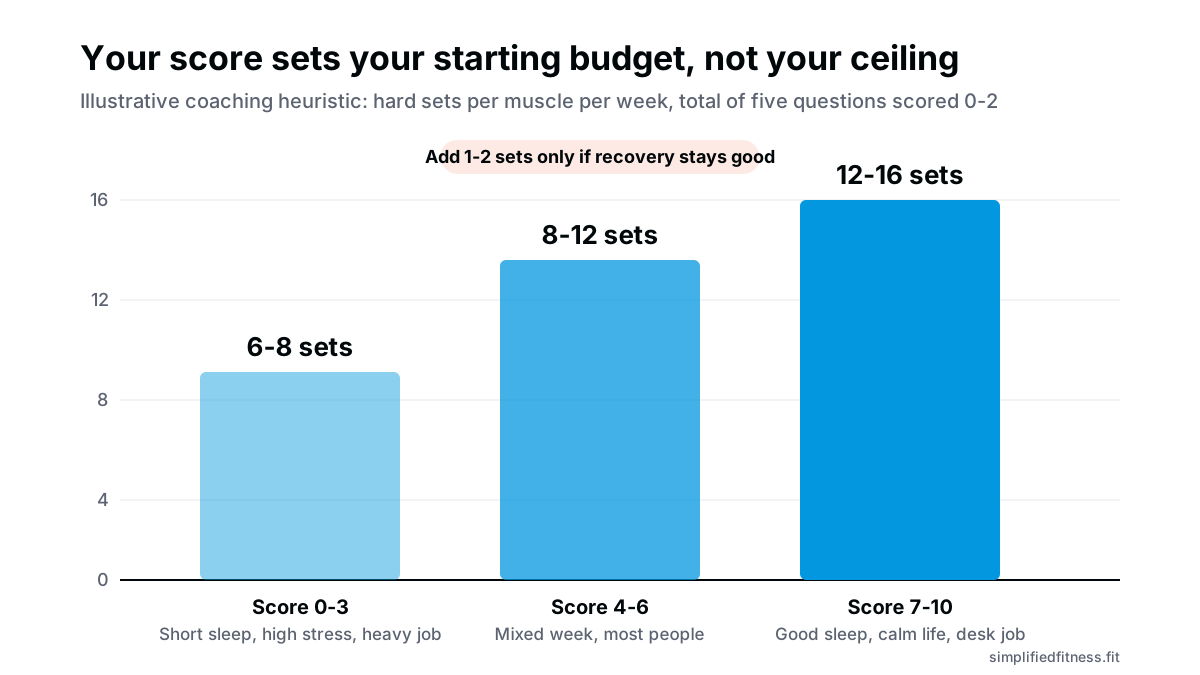
This is a coaching heuristic. It is not a validated test, and the cut-offs are my practical starting points, not research thresholds.
Score each question 0, 1 or 2. Be honest, since nobody else sees this.
| Question | 2 points | 1 point | 0 points |
|---|---|---|---|
| Average sleep last month | 7-9 hours, consistent | 6-7 hours or irregular | Under 6 hours |
| Life and work stress right now | Low or manageable | Moderate, with some bad weeks | High, constant pressure |
| Physical demand of your job | Mostly seated | Some walking or standing | On your feet or lifting all day |
| Training age and recovery history | Years of training, bounce back quickly | Some training, mixed recovery | New to lifting, or often sore for days |
| Food and body weight | Eating enough protein and calories | Inconsistent | Aggressive deficit or skipping meals |
Add up the five scores. Out of 10:
- 7-10: start at 12-16 hard sets per muscle per week.
- 4-6: start at 8-12 hard sets.
- 0-3: start at 6-8 hard sets.
Why those numbers? In a volume meta-analysis, higher weekly set counts were linked with more growth on average, and groups doing 10+ weekly sets per muscle tended to do best, though that category comparison fell short of statistical significance (Schoenfeld et al., 2017). So the middle band sits around that point and the other bands adjust for recovery budget. Treat it as a first draft.
Not sure how to count sets? Use our training volume calculator to total up a week, and see our guide on how to count hard sets properly.
How do you build and adjust your weekly set budget?
Think of sets as money. Your recovery score is your income. Every hard set is a purchase. If you overspend, performance is the first thing to bounce.
Step 1: Pick a starting number. Use your score band and pick the middle of it.
Step 2: Split it across the week. Spread sets over two or three sessions per muscle. That keeps each session manageable.
Step 3: Hold for 3-4 weeks. One rough session means little. A block average means more.
Step 4: Read the signals. Good signs: reps or load creeping up at similar effort, joints quiet, sleep stable, you want to train. Bad signs: reps falling for two or more sessions, daily joint aches, worse sleep, dread.
Step 5: Change by 1-2 sets per muscle. Up if everything is good and you have spare capacity. Down 25-30% if signs are bad. Then repeat.
If you want a more fine-grained approach, autoregulating sets with readiness and velocity is the next step. The RIR and RPE calculator helps you keep effort honest, since sets far from failure inflate your count without adding much stimulus.
What to do when life changes
Your budget should move with your life. A few examples:
- New baby, night shifts or exam season: drop to the lowest band for that stretch. Maintenance is a win.
- Holiday or lighter month: a good time to try the higher end of your range.
- Starting a cut: your recovery budget shrinks. Hold sets or trim a little.
- Big deload after a hard block: a short drop in volume can help you reset. See how deloads reset your response.
For vegetarian lifters in India, the practical add-on is simple: if dal, paneer, curd and soya are not getting you to a decent protein intake, recovery will feel worse than it should, and your budget score on food will be a 0 or 1. Fix that before blaming your volume.
When to see a doctor
Normal recovery trouble improves when you cut volume and sleep more. If you feel exhausted for several weeks regardless, or you have unexplained weight loss, frequent illness, low mood, dizziness, palpitations or chest symptoms, see a doctor. Anaemia, thyroid problems, sleep apnoea and depression can all look like “bad recovery,” and no program change will fix them. This article cannot diagnose anything.
The bottom line
Your gym partner is not a benchmark. Sleep, stress, work, age and biology decide how many sets you can recover from, and the evidence behind each is uneven: reasonable for sleep, suggestive for stress, weak for age on its own, and untestable for genes.
Score yourself, start in the matching band, hold for a month, then nudge by 1-2 sets based on what your lifts and body tell you. Rinse and repeat as life changes. If you want a plan built around your own schedule, our free training plans are a good starting point.
Frequently Asked Questions
Why do some people recover from more training volume than others?
Recovery capacity depends on sleep, stress, nutrition, age, training history and genetics, and these stack up differently in every person. Trials that put people on the same program still show a wide spread in muscle growth, so two lifters on identical sets can end up in very different places. Treat a published volume range as a starting point and let your own recovery signals set the final number.
How many sets per week should I do if my sleep is bad?
Lean toward the low end of your range, roughly 6-10 hard sets per muscle per week, until sleep improves. A systematic review found that repeated nights of restricted sleep can reduce force output in multi-joint lifts, so heavy compound work suffers first. Fix the sleep window before adding sets, because more volume on top of too little sleep is a poor trade.
Does work stress really affect muscle recovery?
It appears to, though the evidence is limited. In two small studies of undergraduates, higher life-event stress and perceived stress were associated with slower recovery of maximal force after a hard leg session. If your job is draining you this month, trimming a few sets is a cheap experiment.
Do older lifters need less training volume?
Not automatically. A 2025 meta-analysis of 36 studies found that older adults did not show greater exercise-induced muscle damage than younger adults. Many older lifters still do better with fewer sets per session and more rest days, mostly because of sleep, joints and life load. Start moderate, progress slowly, and let results decide.
Is volume tolerance genetic?
Probably in part, but nobody can measure your number from a test. People on the same program show large differences in muscle gain. One 2023 trial in novices found fibre-type makeup did not explain that spread, though slow-typology people did more total volume to reach similar gains. Since you cannot test your genes, run a 4-week trial and track your own response.
How do I know if I am doing too much volume?
Warning signs include performance dropping for two or more sessions, joints that ache every day, worsening sleep and a dread of training that lasts for weeks. Reps and loads falling while soreness stays high is the clearest sign. Cut sets by 25-30% for a week or two and see if numbers recover.
Can I increase volume when life gets easier?
Yes. When sleep improves, a stressful project ends or a holiday gives you spare time, add 1-2 sets per muscle and watch the response for two weeks. Volume tolerance is not fixed. Make the increase gradually, because sudden jumps are a common way to stall.
Does a physically demanding job reduce how much I can lift?
Probably, because a job on your feet or lifting loads all day draws on the same recovery pool as the gym. Direct evidence on this is thin, so use your own response as the guide. Put the hardest leg and back work on days off, and keep weekly sets near the lower half of your range.
How long should I test a new volume before judging it?
Give it three to four weeks. One bad session usually reflects sleep, food or stress that day, not the program. Compare average reps at the same load across the block, and change only one thing at a time.
Are 20 sets per muscle per week better than 10?
On average across studies, more sets per week produced slightly more muscle growth, but the gain per extra set is small and the studies vary a lot. A 2017 meta-analysis estimated about 0.37% more growth per additional weekly set, and a 2025 narrative review notes recent trials in trained people do not always agree. If you cannot recover from 20, you will not benefit from it.
What should I do if I only recover well on low volume?
Use it. Many people grow well on 6-10 hard sets per muscle per week if effort is close to failure and progression is consistent. Spend the saved energy on sleep, food and showing up every week, which usually beats grinding through volume you cannot recover from.
When should I see a doctor about constant fatigue?
See a doctor if fatigue is deep, lasts several weeks, or comes with unexplained weight loss, low mood, frequent illness, dizziness or chest symptoms. Poor recovery is sometimes a medical issue such as anaemia, thyroid problems, sleep apnoea or depression, and no training tweak will fix those. This article cannot diagnose anything, so get blood work and advice if in doubt.
Sources & References
Every claim above is checked against peer-reviewed research (PubMed, U.S. National Library of Medicine) or guidance from established health bodies. How we fact-check.
- Schoenfeld BJ, et al. Dose-response relationship between weekly resistance training volume and increases in muscle mass: A systematic review and meta-analysis. J Sports Sci. 2017. PMID: 27433992
- Camargo JBB, et al. Is there a volume saturation point for muscle hypertrophy in resistance-trained individuals? A narrative review. Eur J Appl Physiol. 2025. PMID: 40883636
- Knowles OE, et al. Inadequate sleep and muscle strength: Implications for resistance training. J Sci Med Sport. 2018. PMID: 29422383
- Knowles OE, et al. The interactive effect of sustained sleep restriction and resistance exercise on skeletal muscle transcriptomics in young females. Physiol Genomics. 2024. PMID: 38766755
- Stults-Kolehmainen MA, et al. Chronic psychological stress impairs recovery of muscular function and somatic sensations over a 96-hour period. J Strength Cond Res. 2014. PMID: 24343323
- Bartholomew JB, et al. Strength gains after resistance training: the effect of stressful, negative life events. J Strength Cond Res. 2008. PMID: 18545186
- Fernandes JFT, et al. Advancing age is not associated with greater exercise-induced muscle damage: a systematic review, meta-analysis, and meta-regression. J Aging Phys Act. 2025. PMID: 40174882
- Van Vossel K, et al. Can muscle typology explain the inter-individual variability in resistance training adaptations? J Physiol. 2023. PMID: 37038845

Umair Hazrami · Founder & Head Coach, Simplified Fitness
Umair Hazrami founded Simplified Fitness and the Simplified Lifter channel to cut through fitness noise. With 4+ years of consistent training and 10+ coaching clients, he writes every guide from the peer-reviewed research and links the sources so you can check them. Our editorial standards.
Educational content only, not medical advice. If you have a medical condition, are pregnant, or take medication, talk to a qualified doctor before changing your diet, supplements or training. Full disclaimer.
Keep reading
Programming
Autoregulation of Set Volume: Add or Cut Sets Based on Readiness and Velocity Loss
Autoregulation training volume explained: use warm-up speed, RIR and a 20-25% performance drop to add or cut sets, and what the evidence does or does not prove.
9 min read
Programming
The Biological Cost of High Volume: Sleep, Cortisol and Immune Strain
High volume lifting side effects: what research says about poor sleep, cortisol and colds, which warning signs matter, and how to scale back.
9 min read

Programming
How to Count Compound Sets Toward Weekly Volume: Direct vs Fractional Sets
How to count compound sets volume for arms, delts and hamstrings: the 1.0 and 0.5 fractional rule, a worked weekly example and what the research says.
9 min read

Programming
Distributing Weekly Volume: Full Body 3x vs Upper/Lower 4x vs PPL 6x
Distributing weekly volume across splits: how 12 sets per muscle look in full body, upper/lower and PPL, plus session length math and which fits your week.
9 min read