Overtraining Syndrome vs Overreaching: Signs, Biomarkers and Recovery Time
Overtraining syndrome vs overreaching: strength stuck for weeks is usually non-functional overreaching, not true OTS. See the signs, biomarkers and fixes.
TL;DR. The short answer
- If your lifts have been flat or falling for weeks, the likeliest explanation is non-functional overreaching or plain under-recovery (food, sleep, stress), not true overtraining syndrome. A 2020 scoping review of strength sports and resistance training found minimal evidence that true OTS has occurred in these populations.
- Functional overreaching is a short dip that rebounds after rest. Non-functional overreaching is a dip that does not. Overtraining syndrome is prolonged maladaptation, and the consensus statement says it can only be told apart from NFOR by clinical outcome and by excluding other causes.
- No single blood test or gadget number diagnoses overtraining. A consensus statement found that none of the hormone, performance, psychological, biochemical or immune markers meets all the criteria for general use, and a systematic review of resistance training found a sustained drop in performance was the only reliable marker.
- Check food, sleep, life stress and recent training jumps first, then take a deliberate deload. If fatigue, low mood or frequent illness persists, see a doctor, because other conditions can look the same.
Part of our complete guide: Optimal Training Volume and Frequency: How Many Sets per Muscle Actually Build Muscle
Table of contents
If your lifts have been flat or sliding for weeks, you probably do not have true overtraining syndrome. You most likely have non-functional overreaching, or simply a recovery problem (food, sleep, stress) stacked on top of hard training. In the research, overtraining syndrome vs overreaching comes down to time and exclusion: how long you stay flat, and whether anything else explains it.
This guide sits inside our training volume and frequency guide, where we cover how much work your body can actually absorb. Here we look at what happens when you overshoot, how to tell the three states apart, what the biomarkers can and cannot tell you, and what to do on Monday morning.
What is the difference between functional overreaching, non-functional overreaching and OTS?
All three describe the same story at different severities: training stress minus recovery. The joint consensus statement of the European College of Sport Science and the American College of Sports Medicine puts it this way. Successful training needs overload, but must avoid “excessive overload plus inadequate recovery” (Meeusen et al., 2013).
- Functional overreaching (FOR): a short-term performance dip without severe psychological or lasting symptoms. It eventually leads to better performance after recovery. This is the heavy last week of a block.
- Non-functional overreaching (NFOR): you did not respect the balance between training and recovery, and the dip does not turn into a rebound.
- Overtraining syndrome (OTS): the keyword in the consensus is “prolonged maladaptation”, involving several biological, neurochemical and hormonal regulation systems, not just sore muscles.
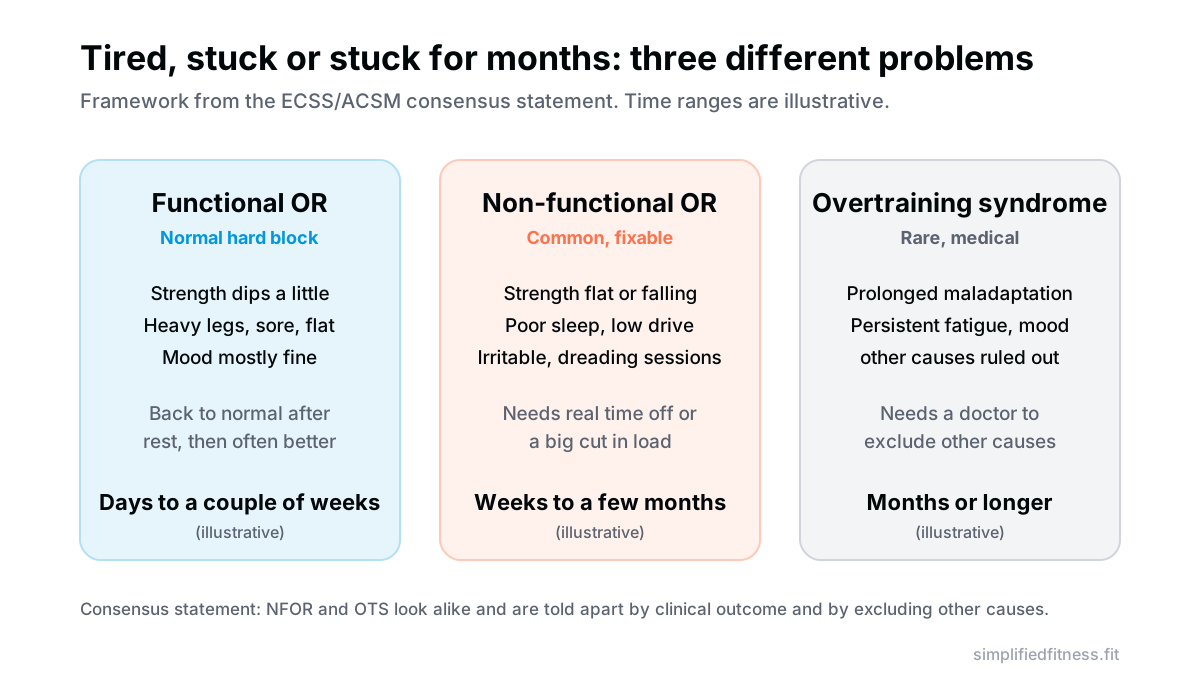
Here is the part that surprises people. The consensus statement says the distinction between NFOR and OTS is “very difficult” and depends on clinical outcome and exclusion diagnosis, and the athlete will often show the same signs and symptoms in both. It also says that symptoms of OTS are generally thought to be more severe than NFOR, but there is no scientific evidence to confirm or refute that.
So you cannot diagnose yourself from a symptom list. You find out by what happens after you back off.
Is true overtraining syndrome even common in lifters?
Less than gym culture suggests. A 2020 scoping review of 47 papers on strength sports and resistance training found that short periods of overreaching, from either high volume or high intensity, can produce functional overreaching, and that chronic high-volume or high-intensity training can lead to non-functional overreaching. But it found “minimal evidence” that true OTS has occurred in these populations (Bell et al., 2020).
A separate systematic review of 22 resistance-training studies reached a similar caution. Eight studies caused performance decrements and followed people afterwards, four showed a decrease with no follow-up, and ten reported no decline at all. The authors concluded that few studies have properly established FOR, NFOR or OTS in resistance training, and that overtraining may relate to frequent, high-intensity and monotonous training (Grandou et al., 2020).
Two honest caveats. First, many of these were short experiments in small groups, so they tell us it is hard to induce OTS on purpose, not that it never happens. Second, the research is mostly in athletes and trained volunteers, not the average person squeezing training between a job and a commute.
How extreme do protocols need to be? In one trial, 16 resistance-trained men were randomised to normal training (three speed-squat sessions) or a stressful block of 15 sessions in 7.5 days. The stressful group showed changes in muscle androgen and glucocorticoid receptor signalling afterwards (Nicoll et al., 2019). That is a lab model, not a normal Tuesday leg day.
Overtraining syndrome lifting symptoms: what to watch for
The consensus statement gives fatigue, performance decline and mood disturbance as examples of OTS symptoms. In gym terms, the pattern looks like this:
- Weights that moved last month now grind, and it is not one bad day.
- You are tired even after a rest day.
- Sleep gets worse even though you are exhausted.
- You dread sessions you used to enjoy.
- You feel irritable or flat.
- You keep catching colds.
Look at the last two. Mood and illness overlap with depression, thyroid conditions, anaemia and ordinary infections. That is why the consensus describes OTS as a diagnosis of exclusion, and why a persistent version of this list deserves a doctor, not a new supplement stack.
The EROS study gives a window into how real OTS cases look. It compared 14 athletes with OTS, 25 healthy athletes and 12 sedentary controls. The OTS group reported worse sleep quality, lower libido, worse mood, and lower intake of calories, carbohydrate and protein than healthy athletes. The authors suggested reduced calorie intake, worsened sleep and increased cognitive load are likely triggers (Cadegiani and Kater, 2018). It is a small cross-sectional study, so it shows association, not cause. Still, it points at the same boring suspects: food, sleep and stress.
Biomarkers of overtraining: what the research can and cannot tell you
People want a number. A blood value, an HRV score, a ring that glows red. The evidence is less satisfying.
The consensus statement reviewed hormones, performance tests, psychological tests, and biochemical and immune markers. Its verdict: several markers are used, “but none of them meet all the criteria to make their use generally accepted” (Meeusen et al., 2013). In the resistance training systematic review, no marker other than a sustained decrease in performance was established as a reliable indicator of overtraining (Grandou et al., 2020).
| Marker | What it can tell you | Main limitation |
|---|---|---|
| Strength and performance log | A sustained decline is the most reliable signal in resistance training | Cannot tell you why it dropped |
| Resting HRV | Weekly averages may show trends | Single readings changed little with overreaching in two meta-analyses |
| Heart rate recovery | Rose in functionally overreached athletes | Also rises with positive adaptation; studied in endurance athletes |
| Mood questionnaires (such as POMS) | Track mood and fatigue over time | Not accepted as a stand-alone diagnosis |
| Blood hormones | Help a doctor rule out other conditions | None validated for self-diagnosing OTS |
Heart rate variability: promising, but messy
A 2016 meta-analysis in endurance-trained athletes found that when performance fell after overreaching, resting RMSSD rose slightly (SMD 0.26), while resting high-frequency power and SD1 showed trivial changes. Post-exercise HRV and heart rate recovery rose with overreaching too, which they also do with positive adaptation, so the authors concluded these measures cannot cleanly separate good adaptation from bad on their own (Bellenger et al., 2016).
A 2021 meta-analysis added nuance. Pooled resting HRV did not detect parasympathetic hyperactivity in functionally overreached athletes, and isolated single readings did not reach significance, but weekly averaged HRV did (SMD 0.81), and heart rate recovery rose in overreached athletes (SMD 0.65) with no change in non-overreached athletes (Manresa-Rocamora et al., 2021).
Why the difference? Different measures, different time windows, and both analyses are in endurance athletes, not lifters. The cautious takeaway: if you wear a tracker, look at weekly averages, not one morning, and never override your logbook with it. More on this in our guide to heart rate variability and recovery.
Hormones and mood
Cortisol, testosterone and similar numbers get quoted constantly online, but the consensus statement does not endorse any hormone as a reliable stand-alone test. Mood questionnaires are in the same bucket: useful trend tools, not diagnoses. If you want a mood marker, a weekly 1-10 rating of energy, motivation and sleep in your training log does most of the same job.
How do I work out which one I have?
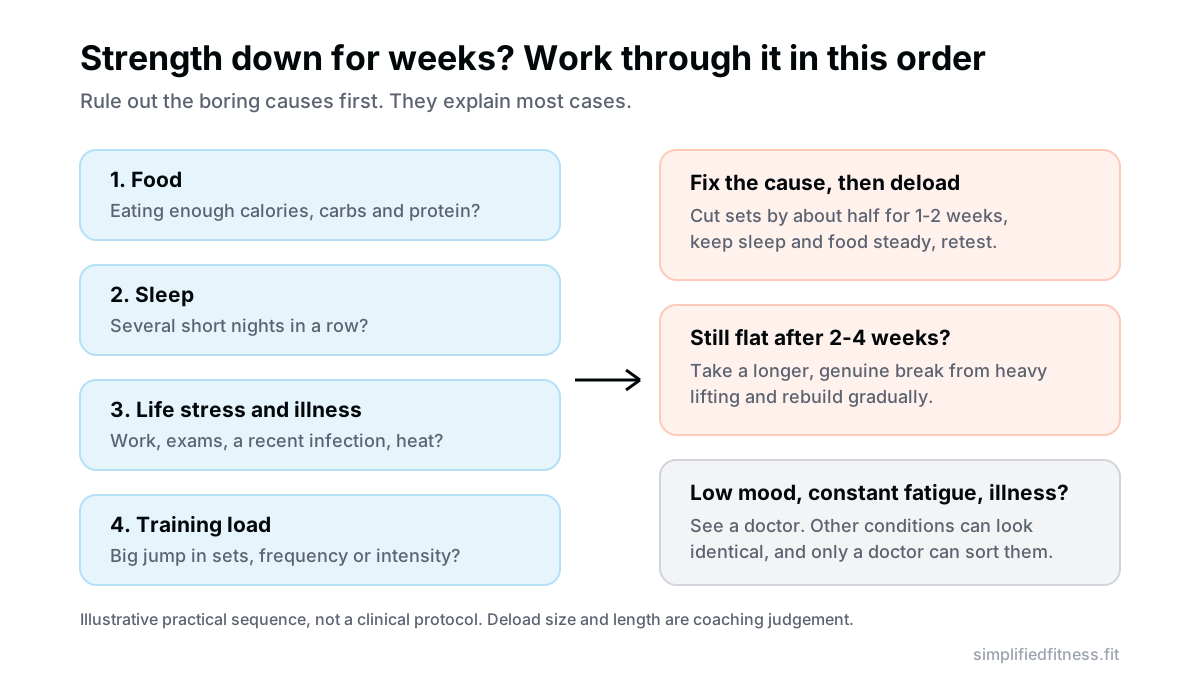
Start with the boring stuff. It explains most cases.
- Food. Are you eating enough overall, and enough carbohydrate and protein? In India this often means a week of dal-roti dinners and a thin breakfast on a heavy training schedule. Use our calorie calculator to sanity-check your intake.
- Sleep. A systematic review of 17 studies found consecutive nights of sleep restriction could reduce force output in multi-joint movements, though study quality was rated moderate or weak (Knowles et al., 2018). Late-night work followed by a 6 am session is a classic way to lose a squat PR.
- Life stress and illness. Exams, deadlines, a recent fever, a hot week with poor hydration.
- Training load. Did you jump from 10 to 20 sets per muscle, add a session, or run every set to failure? Our individual recovery profiling guide helps you estimate your own tolerance.
If something obvious shows up, fix it and retest in two weeks. If nothing does, move on to a deliberate deload.
How to recover from overtraining
The consensus statement’s approach centres on excluding organic disease, infection and dietary causes such as low energy intake or iron deficiency, and on identifying what triggered the problem. There is no trial-proven supplement or gadget that replaces this. Here is a practical ladder, written as coaching guidance rather than a clinical protocol.
Step 1: Deload, do not stop. Keep your main lifts but cut sets by roughly half for 1-2 weeks and stay away from failure. The mechanics are covered in the science of deloads, and our deload checklist helps you decide when.
Step 2: Repair the inputs. Eat to maintenance for a few weeks if you were in a deficit, protect 7-9 hours of sleep and lower non-training stress where you can. Our sleep and recovery guide goes deeper.
Step 3: If you are still flat after 2-4 weeks, take a longer break from heavy lifting. Walk, do easy cardio, move gently. Then rebuild volume over several weeks rather than snapping back to your old program.
Step 4: Get checked if it lingers. Persistent exhaustion, low mood, repeated infections, or changes in menstrual cycle or libido are medical questions. Your doctor may check iron, thyroid and other causes (see our iron deficiency guide). Do not self-treat.
What about timelines? Textbook ranges put FOR at days to a couple of weeks, NFOR at weeks to a few months, and OTS at months or longer. Treat those as rough guides: the consensus statement itself notes the stages are distinguished by clinical outcome, which means recovery time is how you find out, not something you can predict upfront.
How do I stop it happening again?
- Add volume slowly, a few sets at a time, instead of doubling it.
- Vary intensity through the week. The resistance training review linked overtraining with frequent, high-intensity and monotonous training.
- Plan a deload every 6-8 weeks if you push hard, or earlier when your log says so.
- Treat sleep and food as part of the program, not extras.
- Log your lifts and a weekly mood and energy score. A sustained drop is the best signal available.
- Stay realistic about your limits. Your recovery capacity shifts with job stress, heat and sleep, so tune volume with a training volume calculator and our weekly plans.
The bottom line
True overtraining syndrome looks rare in lifters, but non-functional overreaching and chronic under-recovery are common. The evidence does not give us a magic biomarker. It gives us a sustained drop in performance, a long list of boring causes to rule out first, and a deload as the first move. If fatigue, low mood or illness drags on, see a doctor and stop guessing.
Frequently Asked Questions
What is the difference between overreaching and overtraining syndrome?
Overreaching is a temporary drop in performance after hard training, while overtraining syndrome is a prolonged maladaptation that does not resolve with ordinary rest. The ECSS and ACSM consensus statement splits overreaching into functional (performance rebounds after recovery) and non-functional (it does not rebound quickly). If your strength has been down for weeks, treat it seriously, cut your load and check sleep and food.
Can lifters actually get overtraining syndrome?
It is possible in theory but rarely documented in lifters. A 2020 scoping review of 47 papers found minimal evidence that true OTS has occurred in strength sports or resistance training, though chronic high-volume or high-intensity work can cause non-functional overreaching. Most recreational lifters who feel wrecked are under-recovered, so fix sleep, food and volume before assuming the worst.
What are the symptoms of overtraining in the gym?
Typical signs are strength that stalls or drops, persistent fatigue, poor sleep, low mood and dreading sessions. The consensus statement gives fatigue, performance decline and mood disturbance as examples of OTS symptoms, and notes NFOR and OTS often look the same. Because these symptoms overlap with illness, low energy intake and stress, a doctor should check you if they linger.
How long does overtraining take to recover from?
It depends on the stage, and the timelines are not fixed by trial data. Functional overreaching usually clears within days to a couple of weeks, non-functional overreaching often needs weeks, and true OTS can take months or longer, though these ranges are commonly cited rather than firmly measured. Recovery time is actually how clinicians tell the stages apart, so track how quickly you bounce back.
Is there a blood test for overtraining?
No single blood test can diagnose it. The consensus statement reviewed hormones, performance tests, psychological tests, and biochemical and immune markers and found none meet all the criteria for general acceptance. Blood work is mainly useful for ruling out other causes such as low iron or thyroid problems, so ask your doctor rather than buying a panel to self-diagnose.
Does heart rate variability (HRV) detect overtraining?
Not reliably on its own. A meta-analysis in endurance athletes found resting HRV changed little with overreaching, and another found weekly averaged HRV picked up changes that single readings missed, while heart rate recovery also rose in overreached athletes. If you track HRV, look at trends over weeks, not one bad morning, and pair it with how you feel and how your lifts are moving.
What is the Profile of Mood States (POMS) and does it help?
POMS is a questionnaire that scores mood dimensions such as fatigue, vigour, tension and depression. The consensus statement includes psychological tests among the markers in use, while noting none is accepted as a stand-alone diagnostic. A simple weekly mood and energy rating in your log gives you a similar trend for free.
Is a plateau the same as overtraining?
No. A plateau is stalled progress, while overtraining involves a decline and wider symptoms like fatigue and poor mood. Plateaus usually come from programming, food or sleep rather than a systemic breakdown. Look at your last 4-6 weeks of logged sets before blaming overtraining.
Can undereating cause overtraining symptoms?
Yes, and it is one of the first things to rule out. The consensus statement lists negative energy balance and insufficient carbohydrate or protein as factors to exclude before diagnosing OTS, and the EROS study found athletes with OTS reported lower calorie, carbohydrate and protein intakes. If you are cutting hard and your lifts are collapsing, raise calories for a couple of weeks and see what happens.
Does poor sleep make strength worse?
It can. A systematic review found that consecutive nights of sleep restriction could reduce force output in multi-joint lifts such as squats and deadlifts, though study quality was moderate or weak. Aim for consistent sleep before changing your program, and use the sleep recovery guide below if you struggle.
Should I stop training completely if I think I am overtrained?
Not always. For mild cases a deload with roughly half the sets and the same movements is often enough, while a persistent decline may need a longer break from heavy lifting. If you feel genuinely unwell, with ongoing fatigue, low mood or frequent infections, see a doctor before deciding.
When should I see a doctor about overtraining symptoms?
See a doctor if exhaustion, low mood, poor sleep or repeated illness last more than a couple of weeks despite rest and eating enough. These symptoms overlap with depression, anaemia, thyroid problems and infections, and the consensus statement describes OTS as a diagnosis of exclusion. Bring your training log and sleep notes to the appointment.
How do I avoid overtraining?
Increase volume gradually, schedule deloads, sleep consistently and eat enough. The consensus statement frames successful training as overload without the combination of excessive overload plus inadequate recovery, and a review of resistance training links overtraining to frequent, high-intensity, monotonous work. Vary your intensity across the week and build a deload into every 6-8 weeks if you tend to push hard.
Sources & References
Every claim above is checked against peer-reviewed research (PubMed, U.S. National Library of Medicine) or guidance from established health bodies. How we fact-check.
- Meeusen R, et al. Prevention, diagnosis, and treatment of the overtraining syndrome: joint consensus statement of the European College of Sport Science and the American College of Sports Medicine. Med Sci Sports Exerc. 2013. PMID: 23247672
- Bell L, et al. Overreaching and overtraining in strength sports and resistance training: A scoping review. J Sports Sci. 2020. PMID: 32602418
- Grandou C, et al. Overtraining in Resistance Exercise: An Exploratory Systematic Review and Methodological Appraisal of the Literature. Sports Med. 2020. PMID: 31820373
- Bellenger CR, et al. Monitoring Athletic Training Status Through Autonomic Heart Rate Regulation: A Systematic Review and Meta-Analysis. Sports Med. 2016. PMID: 26888648
- Manresa-Rocamora A, et al. Heart rate-based indices to detect parasympathetic hyperactivity in functionally overreached athletes. A meta-analysis. Scand J Med Sci Sports. 2021. PMID: 33533045
- Cadegiani FA, Kater CE. Body composition, metabolism, sleep, psychological and eating patterns of overtraining syndrome: Results of the EROS study (EROS-PROFILE). J Sports Sci. 2018. PMID: 29313445
- Knowles OE, et al. Inadequate sleep and muscle strength: Implications for resistance training. J Sci Med Sport. 2018. PMID: 29422383
- Nicoll JX, et al. MAPK, androgen, and glucocorticoid receptor phosphorylation following high-frequency resistance exercise non-functional overreaching. Eur J Appl Physiol. 2019. PMID: 31420735

Umair Hazrami · Founder & Head Coach, Simplified Fitness
Umair Hazrami founded Simplified Fitness and the Simplified Lifter channel to cut through fitness noise. With 4+ years of consistent training and 10+ coaching clients, he writes every guide from the peer-reviewed research and links the sources so you can check them. Our editorial standards.
Educational content only, not medical advice. If you have a medical condition, are pregnant, or take medication, talk to a qualified doctor before changing your diet, supplements or training. Full disclaimer.
Keep reading
Programming
Autoregulation of Set Volume: Add or Cut Sets Based on Readiness and Velocity Loss
Autoregulation training volume explained: use warm-up speed, RIR and a 20-25% performance drop to add or cut sets, and what the evidence does or does not prove.
9 min read
Programming
The Biological Cost of High Volume: Sleep, Cortisol and Immune Strain
High volume lifting side effects: what research says about poor sleep, cortisol and colds, which warning signs matter, and how to scale back.
9 min read

Programming
How to Count Compound Sets Toward Weekly Volume: Direct vs Fractional Sets
How to count compound sets volume for arms, delts and hamstrings: the 1.0 and 0.5 fractional rule, a worked weekly example and what the research says.
9 min read
Programming
Distributing Weekly Volume: Full Body 3x vs Upper/Lower 4x vs PPL 6x
Distributing weekly volume across splits: how 12 sets per muscle look in full body, upper/lower and PPL, plus session length math and which fits your week.
9 min read