High-Protein Foods List: Protein per 100g, Cost per 30g and Meal Prep Guide
A high protein foods list with protein per 100g, protein per 100 calories, cost per 30g in rupees, raw vs cooked weights and a 3-hour meal prep plan.
TL;DR. The short answer
- The best high protein foods are the ones that give you the most protein per calorie and per rupee that you will actually eat: cooked chicken breast, tuna, eggs, Greek yogurt and tofu lead on protein density, while soya chunks, chana, peanuts and dal lead on cost.
- At illustrative Indian prices, soya chunks, chana and peanuts cost roughly Rs 8-16 per 30 g of protein, eggs and chicken breast about Rs 35, and paneer, curd and whey Rs 60-100. Check your own market, because the order matters more than the exact number.
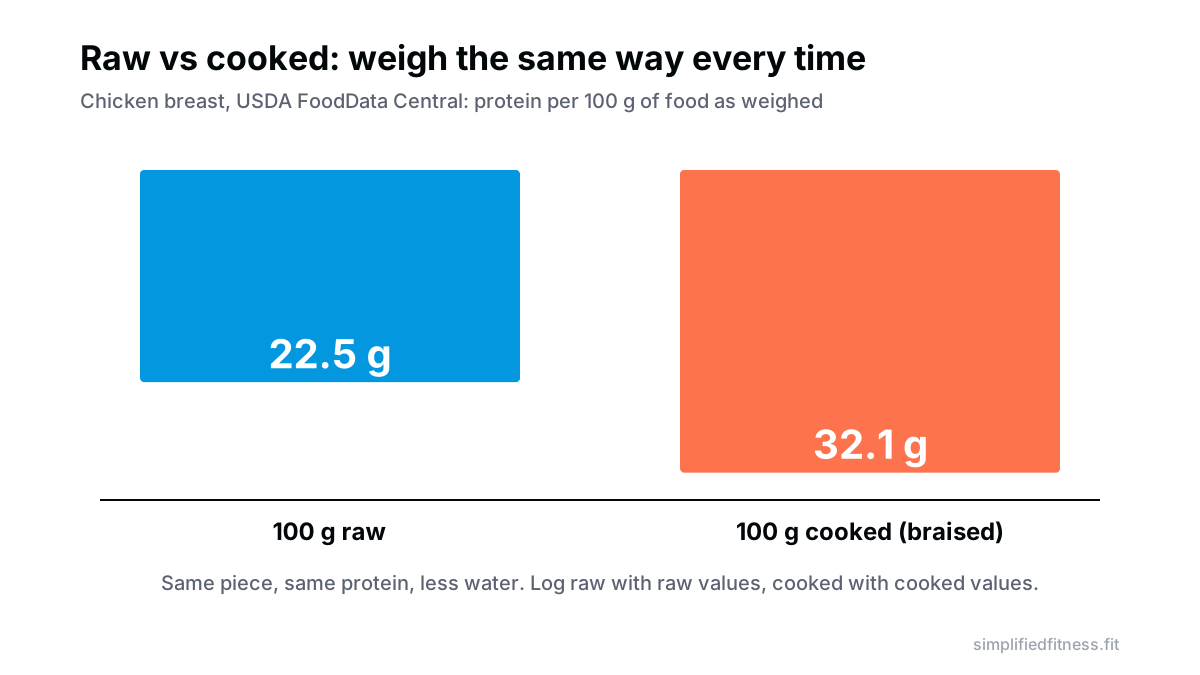
- Cooking removes water, not protein. 100 g of raw chicken breast has about 22.5 g of protein and 100 g of cooked chicken about 32 g, so always weigh and log in the same state (raw with raw values, cooked with cooked values).
- A 3-hour weekly batch cook (one carb, two proteins, one vegetable base) makes a target of roughly 1.4-2.0 g/kg a day much easier to hit without cooking every night.
- Total daily protein matters most. Spreading it over 3-4 meals of about 0.25-0.4 g/kg each is a sensible bonus, and plant proteins work well in the long run if the total is high enough.
Table of contents
The best high protein foods list is not one list. It is three: foods that pack the most protein into the fewest calories (chicken breast, tuna, Greek yogurt, tofu), foods that give you the most protein per rupee (soya chunks, chana, peanuts, dal), and foods you will still enjoy in week six. Pick from all three and you will hit your number without a supplement budget.
This is the reference page. It covers protein per 100 g, protein per 100 calories, cost per 30 g of protein, how raw and cooked weights differ, and a 3-hour batch cook. It sits beside our theory pages on how much protein you actually need and the Indian high-protein nutrition guide, so I will not repeat the requirements debate here. First, a target. Run your weight through the protein calculator, then come back and shop for it.
How much protein should this list actually deliver?
You need a target before a food list means anything. The International Society of Sports Nutrition (ISSN) position stand says 1.4-2.0 g of protein per kg of body weight a day is sufficient for most exercising people (Jäger et al., 2017). A meta-analysis of 49 trials found that extra protein beyond about 1.6 g/kg/day gave no further gain in fat-free mass in people doing resistance training (Morton et al., 2018).
So a 70 kg lifter is looking at roughly 100-140 g a day. Lean, trained people in a hard calorie deficit may need more: a systematic review of six studies suggested 2.3-3.1 g/kg of fat-free mass (Helms et al., 2014). That is a small, specialised evidence base, so treat it as a ceiling to consider, not a rule.
Top high protein foods list: protein per 100 g
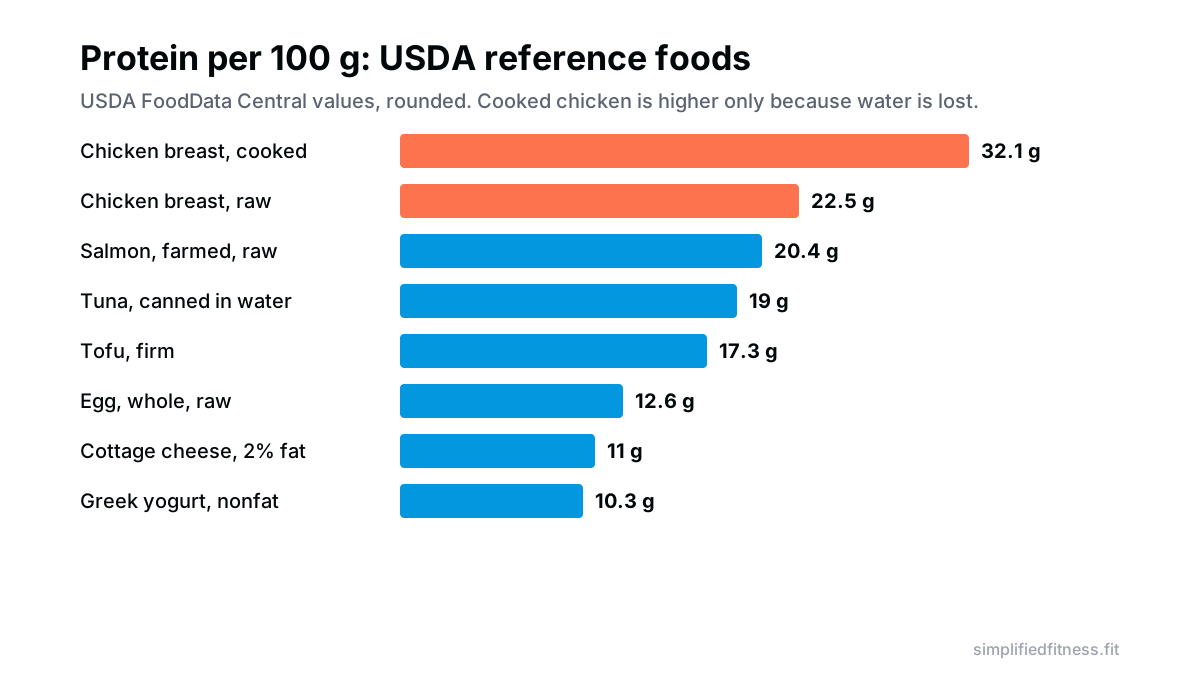
Here is the protein per 100 g chart. The values marked with a source are USDA FoodData Central reference entries I checked; the rest are typical pack values, rounded, and they vary by brand. Always trust your own label over a table.
| Food (per 100 g) | Protein (g) | Energy (kcal) | Protein per 100 kcal (g) |
|---|---|---|---|
| Chicken breast, cooked (braised) | 32.1 | 157 | 20.4 |
| Chicken breast, raw | 22.5 | n/a here | n/a here |
| Tuna, canned in water, drained | 19.0 | 90 | 21.1 |
| Greek yogurt, plain, nonfat | 10.3 | 61 | 16.9 |
| Cottage cheese, 2% fat | 11.0 | 84 | 13.1 |
| Tofu, firm (calcium sulfate) | 17.3 | 144 | 12.0 |
| Egg, whole, raw | 12.6 | 143 | 8.8 |
| Salmon, farmed, raw | 20.4 | 208 | 9.8 |
| Soya chunks, dry (typical pack) | ~50 | ~340 | ~15 |
| Paneer (typical) | ~18 | ~265 | ~7 |
| Moong or toor dal, dry (typical) | ~22-24 | ~340 | ~6-7 |
| Chana, dry (typical) | ~19-20 | ~360 | ~5 |
| Peanuts (typical) | ~25 | ~565 | ~4-5 |
The protein per 100 kcal column does the heavy lifting on a cut. Chicken breast, tuna and Greek yogurt are all around 17-21 g per 100 kcal, while paneer, dal and peanuts sit at 7 or below because they carry carbohydrate or fat alongside the protein. That is not a reason to avoid them. It is a reason to know what you are buying.
A word on “dry” versus “cooked”. Dal and chana in the table are dry weights. Once cooked, 100 g of boiled dal holds a fraction of that protein, because it has soaked up water. This is the single biggest source of confusion when people compare dal with chicken, and the next sections deal with it.
Which foods keep you full? Top 30 by satiety and protein density
I will not pretend there is one validated “top 30 by satiety” ranking. Satiety depends on protein, fibre, volume and how much you like the food. What the evidence does support is that higher-protein diets help with weight management: a meta-analysis of 37 studies in adults with excess weight found about 1.6 kg more weight loss on higher-protein diets than controls (Hansen et al., 2021). Those were weight outcomes, not satiety measurements, so treat protein as helpful, not magic.
In practice, the filling picks are:
- Lean animal protein: chicken breast, fish, tuna, egg whites, lean mutton.
- Dairy: hung curd, Greek yogurt, cottage cheese, chenna, skimmed milk.
- Soy: tofu, soya chunks, soy milk.
- Pulses: moong, masoor, chana, rajma, lobia, sprouts.
- Seeds, nuts and others: peanuts, pumpkin seeds, sattu, quinoa (small amounts).
For the full ranked version with protein per calorie, see top 30 high-protein foods ranked by protein per calorie. The two veg and non-veg deep dives are 25 high-protein vegetarian foods with macros and leucine and 25 high-protein non-vegetarian foods and lean meats. For cutting, high-volume, low-calorie foods tells you how to fill the plate; for bulking, calorie-dense foods for hardgainers does the opposite.
Vegetarian versus non-vegetarian: does the source matter?
Short answer: a bit, less than the internet says. A 2021 meta-analysis of 16 trials found that protein source did not change absolute lean mass or strength, but animal protein favoured percent lean mass, particularly in adults under 50 (about 0.41 kg more absolute lean mass) (Lim et al., 2021). The authors flag that total protein intakes were generally high at baseline, so these results may not apply to people eating little protein.
On soy specifically, a meta-analysis of nine studies (266 participants) found soy protein supplementation gave similar strength and lean mass gains to whey and other animal proteins during resistance training (Messina et al., 2018). Both of these look at supplementation over at least six weeks, not a whole vegetarian diet.
Why do plant proteins have a reputation as weaker? Digestibility and amino acid scores. A pig study comparing proteins found whey and milk proteins had higher digestibility of most essential amino acids than pea, soy and wheat (Mathai et al., 2017). Pigs are not people, so read that as a hint. A modelling paper (not a trial) estimated that a fully plant-based diet scaled to rugby players’ calorie needs could meet protein and leucine targets for muscle growth (Goldman et al., 2024).
The Indian vegetarian combination plays to this. Dal with rice or roti, curd or paneer on the side, and soya or tofu once a day gives a spread of amino acids without any special product. Our deep dives on soya chunks, paneer, dals and pulses and eggs cover each one.
What is the cheapest protein per gram? Cost per 30 g of protein
This is the table that gets saved and screenshotted, so I want to be careful: the prices below are illustrative mid-range Indian prices, not a market survey. They will be off in your city by 10-30 percent, and soya, dal and chicken swing with the season. Use the method, not my numbers.
Method: price per kg ÷ grams of protein per kg, times 30. Protein per kg is the label percentage times 10.
| Food | Illustrative price | Typical protein | Approx. cost per 30 g protein |
|---|---|---|---|
| Soya chunks (dry) | Rs 140/kg | ~52 g/100 g | Rs 8 |
| Chana (dry) | Rs 100/kg | ~20 g/100 g | Rs 15 |
| Peanuts | Rs 130/kg | ~25 g/100 g | Rs 16 |
| Toor dal (dry) | Rs 150/kg | ~22 g/100 g | Rs 21 |
| Chicken breast (raw) | Rs 260/kg | 22.5 g/100 g | Rs 35 |
| Eggs | Rs 7 each | ~6 g each | Rs 35 |
| Milk | Rs 60/litre | ~3.3 g/100 ml | Rs 55 |
| Curd | Rs 70/kg | ~3.5 g/100 g | Rs 60 |
| Paneer | Rs 380/kg | ~18 g/100 g | Rs 63 |
| Whey protein | Rs 2,500/kg | ~75-80% | Rs 96 |
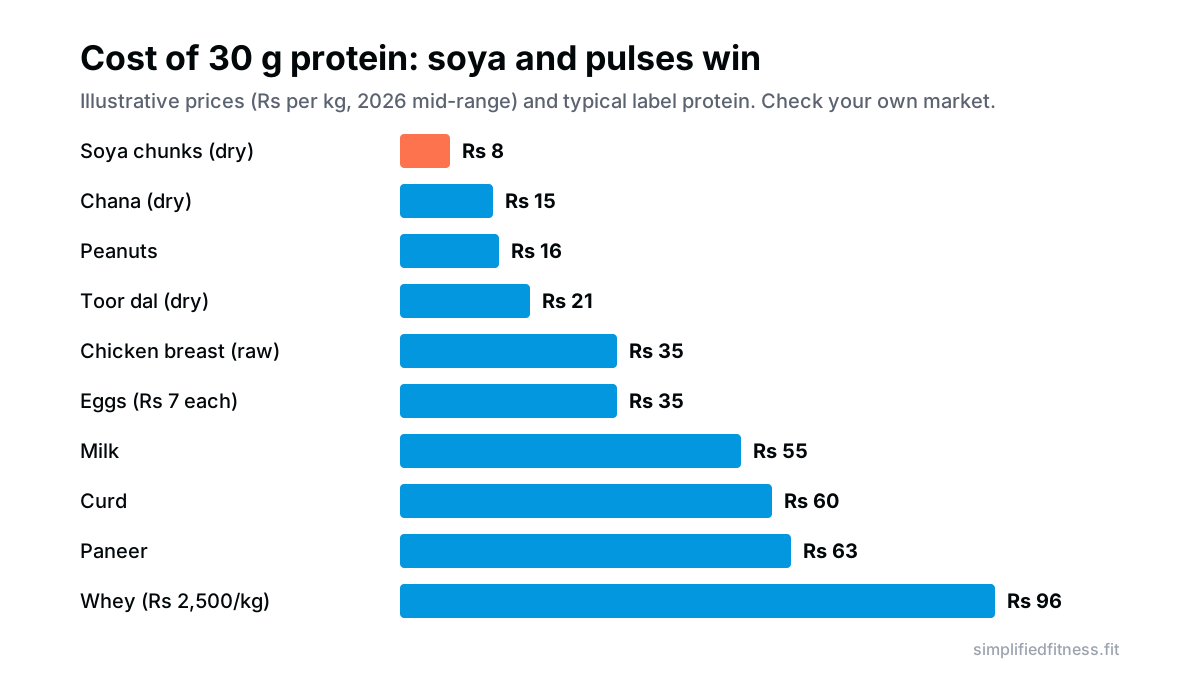
Two honest caveats. First, dry weights flatter the plant foods: you cook them in water, and protein quality and digestibility are somewhat lower than in animal foods. Second, cheap is not the same as easy. Eating 30 g of protein from dal alone means a very large bowl, and the carbohydrates come with it. Mixed plates win.
My usual advice is to anchor the day on one cheap workhorse (soya, dal, chana or eggs), add one convenience protein (curd, paneer, chicken) and use whey only when food leaves a gap. A longer comparison is in cost per 30 g of protein: economic comparison of foods, and the tight-budget version is eating healthy on a student budget.
Raw vs cooked meat weight: what changes and what does not
Cooking does not make protein vanish. It drives water out of meat and draws water into rice, dal and pasta. Protein per 100 g of food changes because the weight changes.
USDA FoodData Central lists skinless chicken breast at 22.5 g protein per 100 g raw and 32.1 g per 100 g cooked (braised). The cooked piece weighs less, so each 100 g of it is more concentrated. From those two numbers, braised breast lost roughly 30 percent of its weight, though the exact figure changes with method, time and cut.
The rules I would follow:
- Meat: weigh raw when you can. If you must weigh cooked, use cooked values for that cut and cooking method.
- Rice, dal, pasta: these gain weight. 100 g of dry dal becomes roughly two to three times heavier when cooked, which is why cooked dal has only a few grams of protein per 100 g.
- Mixed dishes: weigh the whole pot once, note the total, then portion by weight. That avoids guessing what is in each spoonful.
- Be consistent. An error that is the same every day cancels out. An error that keeps changing does not.
Our dedicated guide food scale mastery: raw vs cooked weight differences goes through the common Indian staples.
Meal prep for beginners: a 3-hour weekly batch cook
Meal prep is not a personality. It is a way to stop deciding what to eat at 9 pm when you are tired and a delivery app is open. Here is a simple Sunday structure for roughly 8-10 lunches and dinners.
The formula: one carb, two proteins, one vegetable base.
- Carb: a large pot of rice, or atta dough for fresh rotis later in the week.
- Protein 1 (cheap): a big pot of dal, chana masala or soya chunks curry.
- Protein 2 (convenient): chicken breast baked or pan-cooked, or paneer or tofu cubes, plus a dozen boiled eggs.
- Vegetables: one sabzi base and a washed, chopped salad mix.
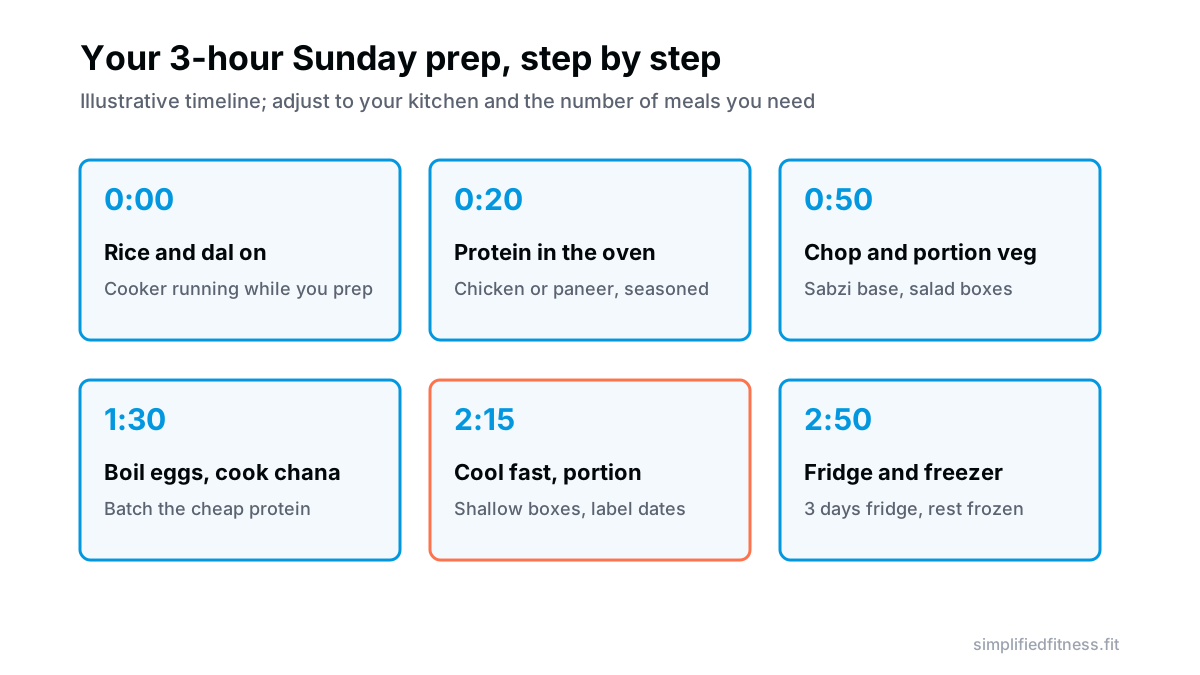
The order matters. Start the cooker items first (rice, dal, chana), because they need no attention. Season and bake the chicken or paneer in the oven while you chop. Boil the eggs while you portion. Finish by cooling everything in shallow boxes so it chills fast. Our full 3-hour weekly batch meal prep blueprint lists quantities, and the essential kitchen equipment guide covers what is genuinely worth buying.
Food safety: how long does meal prep keep?
Rice deserves a special mention. Rice is often contaminated with spores of Bacillus cereus, a soil bacterium. According to a 2021 review, it can multiply at temperatures as low as 4 C in cooked rice foods, and it can produce diarrhoeal or emetic toxins when enough cells grow (Rodrigo et al., 2021). That is a good reason not to leave a pot of rice on the counter all day in an Indian summer.
The practical habits, which are common food-safety guidance rather than findings from that review:
- Cool cooked rice, dal and meat quickly in shallow containers.
- Refrigerate within a couple of hours, and in a hot kitchen sooner.
- Eat refrigerated meals within about three days; freeze the rest.
- Reheat until steaming hot all the way through.
- If it smells off or you are unsure, do not eat it.
People who are pregnant, elderly, immunocompromised or who have had food poisoning before should be more cautious and follow local health authority guidance. For more detail see food storage and meal safety: shelf life of chicken and rice and freezing and reheating meal prep.
How should I spread protein through the day?
Total daily protein is the main thing. After that, spreading it is a sensible refinement. The ISSN suggests about 0.25 g/kg per meal, or an absolute 20-40 g, roughly every 3-4 hours (Jäger et al., 2017). A review of per-meal protein concluded that about 0.4 g/kg per meal across at least four meals is a sound target for reaching 1.6 g/kg a day (Schoenfeld and Aragon, 2018). The same paper notes that higher single doses do cause more amino acid oxidation, but not all the extra protein is wasted.
For a 70 kg person that is around 18-28 g per meal across four meals, which fits an Indian day naturally: eggs or a besan chilla at breakfast, dal and curd at lunch, a protein snack, and chicken or paneer at dinner. If you eat two big meals only, you will probably still do fine. The timing literature is less strict than the Instagram version.
Grocery shopping: a high-protein list for the week
A sensible weekly basket for one person aiming at about 120 g of protein a day looks like this. Adjust for your size, budget and diet.
- Cheap staples: soya chunks, toor or moong dal, chana, rajma, peanuts, rice, atta, oats.
- Convenience proteins: eggs, curd or hung curd, paneer or tofu, chicken breast or fish, milk.
- Produce: onion, tomato, spinach, cabbage, carrots, cucumber, seasonal fruit.
- Flavour: ginger, garlic, chilli, jeera, haldi, lemon, pickles in small amounts.
Read labels by protein per 100 g, not per serving, and check whether the number is for raw or cooked food. For label reading, see fitness grocery shopping blueprint and nutrition labels. For eating away from home, portable high-protein snacks that need no fridge and travel nutrition strategies fill the gaps.
When should you see a doctor or dietitian?
A high-protein diet is generally considered fine for healthy adults, and this article is not medical advice. If you have kidney disease, liver disease, are pregnant, have diabetes, a history of eating disorders or any chronic condition, check with your doctor or a registered dietitian before raising protein or changing your diet drastically. The same goes if you get repeated digestive problems after switching to a high-fibre pulse-heavy plan.
Putting the list to work
You do not need every food on this list. You need a target (use the protein calculator), two cheap staples, two convenience proteins you like, a weighing habit that stays consistent, and one weekly cook. If you want a full day laid out, our free diet plan page is a starting point. Then spend your effort on the part food lists cannot do: lifting hard enough to deserve the protein. For energy balance and how protein fits into a cut or bulk, see energy balance, fat loss and bulking.
Go deeper: every guide in this topic
- The 3-Hour Weekly Batch Meal Prep: Cooking 5 Days of Lunches and Dinners for Busy Lifters
- Cost per 30 Grams of Protein: 40 Common Fitness Foods Ranked by Price
- Eating Healthy on a Student Budget: High Protein Hostel and Dorm Room Meal Prep
- Essential Kitchen Equipment for Lifters: Scales, Air Fryers, Blenders and Containers
- Fast Food Survival Guide: Macro-Friendly Orders at Major Global Chains
- The Fitness Grocery Shopping Blueprint: Label Reading, Misleading Health Claims, and Sugar Traps
- Food Scale Mastery: Raw vs Cooked Weight Differences in Meats, Grains, and Vegetables
- Meal Prep Food Safety: How Long Cooked Chicken and Rice Last in the Fridge and Freezer
- Freezing and Reheating Meal Prep: High-Protein Dishes That Keep Their Taste and Texture
- Grocery Psychology: Overcoming Supermarket Marketing Traps, Endcaps, and Impulse Snacking
- High-Calorie Healthy Foods for Hardgainers: Peanut Butter, Oats, Nuts, Olive Oil
- High-Protein Low-Calorie Desserts: Protein Fluff, Casein Pudding and Greek Yogurt Bowls
- High-Volume Low-Calorie Foods: Cauliflower, Zucchini, Green Leaves, and Berries for Cutting
- How to Diet During Weddings and Family Dinners Without Wrecking Your Progress
- Portable High-Protein Snacks for Busy Professionals: Non-Refrigerated Fitness Options
- The 80/20 Rule in Nutrition: How to Fit Treats in and Stay Consistent for Years
- Top 25 High-Protein Non-Vegetarian Foods: Lean Poultry, Meats, Seafood, and Egg White Ratios
- Top 25 High-Protein Vegetarian Foods: Protein Density, Leucine Content, and Cooking Prep
- Top 30 High-Protein Foods Ranked by Protein per 100 Calories (With Indian Options)
- Travel Nutrition Strategies: Maintaining Calories and Protein on Flights, Road Trips, and Hotels
Frequently Asked Questions
What are the best high protein foods?
For protein density, cooked chicken breast, canned tuna, eggs, Greek yogurt, cottage cheese, tofu and soya chunks lead the list. Each gives a large amount of protein for relatively few calories, which is why they show up in most fitness diets. Pick two or three you enjoy and build your week around them.
How much protein is in 100g of chicken breast?
Raw skinless chicken breast has about 22.5 g of protein per 100 g, and cooked (braised) breast has about 32 g per 100 g, according to USDA FoodData Central. The difference is water lost during cooking, not extra protein. Weigh raw and use raw values, or weigh cooked and use cooked values.
What is the cheapest source of protein in India?
On illustrative prices, dry soya chunks, chana and peanuts cost the least per gram of protein, followed by dal, then eggs and chicken breast. Paneer, curd and whey cost more per gram. Prices change by city and season, so divide the price per kg by the grams of protein per kg in your own market.
How do I calculate cost per 30g of protein?
Divide the price per kg by the grams of protein in 1 kg (protein % on the label times 10), then multiply by 30. For example, soya chunks at Rs 140/kg with about 52 g protein per 100 g work out at about Rs 8 per 30 g. This lets you compare any two foods fairly, whatever the pack size.
Is soya chunks a good protein source?
Yes, dry soya chunks are one of the most protein-dense and cheapest foods available in India, at roughly 50 g per 100 g dry. A meta-analysis of resistance training trials found soy protein supplementation produced similar gains in strength and lean mass to whey protein (Messina et al., 2018). Soak and squeeze them well, and read our soya chunks guide for the safety questions.
Is plant protein as good as animal protein for muscle?
Mostly, if total protein is high enough. A 2021 meta-analysis found no difference in absolute lean mass or strength by protein source, though animal protein favoured percent lean mass, especially in adults under 50. Plant sources are less concentrated, so eat a bit more of them and mix dal, soya, curd and grains.
How much protein do I need per day?
The ISSN position stand says 1.4-2.0 g/kg of body weight a day is sufficient for most exercising people. Higher intakes of 2.3-3.1 g/kg of fat-free mass may help lean, trained people in a calorie deficit. Use our protein calculator to get a number for your body weight.
How many grams of protein per meal is best?
The ISSN suggests about 0.25 g/kg per meal, or an absolute 20-40 g, spread every 3-4 hours. Another review concluded about 0.4 g/kg per meal across at least four meals to reach 1.6 g/kg a day. The exact number is not critical, so aim for a solid protein serving at each main meal.
Is there a limit to protein absorbed per meal?
No, the body does not simply waste anything above about 25 g. A review found that larger doses lead to more amino acid oxidation, but not all of the extra is lost, since some goes to tissue building. Practically, a 40 g serving of dal, rice and curd is fine.
Do raw or cooked weights matter when tracking food?
Yes, because cooking changes water content. Raw chicken breast shows about 22.5 g of protein per 100 g and cooked about 32 g per 100 g. Pick one method and stick with it, and raw weights are usually the more consistent for meat, rice and dal.
How much does chicken shrink when cooked?
Meat commonly loses a noticeable share of its weight as water, and the USDA values above (22.5 g raw versus 32 g cooked per 100 g) imply a loss of roughly 30 percent for braised breast. Exact loss depends on method, time and cut. If you need precision, weigh one batch raw and cooked once, and use that ratio.
How should I start meal prep as a beginner?
Start with one batch session a week: one carb (rice or roti dough), two proteins (for example chicken or paneer plus boiled eggs or chana) and one vegetable base. Cook for three or four days, freeze the rest. Do not try to prep 21 meals in week one.
How long can I keep cooked rice and chicken in the fridge?
Cooked rice is a known food-safety risk because it often carries Bacillus cereus spores, and a 2021 review notes the bacteria can multiply at temperatures as low as 4 C in cooked rice dishes. Common guidance is to cool food quickly, refrigerate within a couple of hours and eat within about three days. Reheat until steaming hot, and if in doubt, throw it out.
Is whey protein worth the cost?
Whey is convenient but, at illustrative Indian prices, it costs several times more per gram of protein than soya, dal, eggs or chicken. The ISSN notes whole foods can meet protein needs, and supplements are a practical way to hit targets while minimising calories. Use it if food is not getting you there, not because you must.
What is the best high protein vegetarian food in India?
Soya chunks, tofu, paneer, Greek or hung curd, dal, chana, rajma and peanuts all contribute. No single one covers everything, because pulses are lower in some amino acids that grains supply and vice versa. Combine dal with rice or roti, and add soya or curd at one meal a day.
Is paneer a good protein source for the price?
Paneer is tasty and filling but costs more per gram of protein than soya, dal or eggs, and it brings a lot of fat. At about 18 g protein per 100 g, you need a big serving for 30 g. Use it as a treat meal or mix it with cheaper protein.
What are the best high protein foods for fat loss?
Look for high protein per 100 kcal: cooked chicken breast, canned tuna, Greek yogurt, cottage cheese, egg whites and tofu. A 2021 meta-analysis found higher-protein interventions produced about 1.6 kg more weight reduction than controls in adults with excess weight. Pair protein with vegetables and fibre for volume.
Do I need to eat meat to build muscle?
No. A modelling study suggests plant-based diets can reach protein and leucine targets for muscle building if energy intake is high enough, though it was not a trial. Vegetarian lifters in India can use dairy, eggs, soya and pulses to reach targets. Track your protein for a week to see where you land.
How do I read a protein label correctly?
Look at protein per 100 g, not per serving, because serving sizes are arbitrary. Check whether the figure is for raw or cooked food and whether it includes added ingredients such as sauces. Then compare foods using protein per 100 kcal and cost per 30 g.
Can I meal prep without a freezer?
Yes, but plan for 2-3 days at a time and cook in two shorter sessions. Dry-cooked items such as boiled eggs, roasted chana, sprouts and soya keep better than creamy gravies in hot weather. Keep rice cool and covered, and cook a fresh batch mid-week.
Does cooking destroy protein?
No. Cooking denatures protein, which generally makes it easier to digest, but the amount stays about the same. Weight loss during cooking is mostly water. Very long, very high heat can reduce quality somewhat, so there is no need to overcook meat.
How can I eat high protein on a student budget?
Build meals around dry soya chunks, dal, chana, eggs, curd and peanuts, which cost the least per 30 g of protein in the illustrative figures above. Batch cook once or twice a week in a rice cooker or pressure cooker. Our student meal prep guide has a hostel-friendly week.
Sources & References
Every claim above is checked against peer-reviewed research (PubMed, U.S. National Library of Medicine) or guidance from established health bodies. How we fact-check.
- Morton RW, et al. A systematic review, meta-analysis and meta-regression of the effect of protein supplementation on resistance training-induced gains in muscle mass and strength in healthy adults. Br J Sports Med. 2018. PMID: 28698222
- Helms ER, et al. A systematic review of dietary protein during caloric restriction in resistance trained lean athletes: a case for higher intakes. Int J Sport Nutr Exerc Metab. 2014. PMID: 24092765
- Jager R, et al. International Society of Sports Nutrition Position Stand: protein and exercise. J Int Soc Sports Nutr. 2017. PMID: 28642676
- Schoenfeld BJ, et al. How much protein can the body use in a single meal for muscle-building? Implications for daily protein distribution. J Int Soc Sports Nutr. 2018. PMID: 29497353
- Lim MT, et al. Animal protein versus plant protein in supporting lean mass and muscle strength: a systematic review and meta-analysis of randomized controlled trials. Nutrients. 2021. PMID: 33670701
- Messina M, et al. No difference between the effects of supplementing with soy protein versus animal protein on gains in muscle mass and strength in response to resistance exercise. Int J Sport Nutr Exerc Metab. 2018. PMID: 29722584
- Goldman DM, et al. Protein and leucine requirements for maximal muscular development and athletic performance are achieved with completely plant-based diets modeled to meet energy needs in adult male rugby players. Sports (Basel). 2024. PMID: 39058077
- Hansen TT, et al. Are dietary proteins the key to successful body weight management? A systematic review and meta-analysis of studies assessing body weight outcomes after interventions with increased dietary protein. Nutrients. 2021. PMID: 34579069
- Rodrigo D, et al. Risk of Bacillus cereus in relation to rice and derivatives. Foods. 2021. PMID: 33540849
- Mathai JK, et al. Values for digestible indispensable amino acid scores (DIAAS) for some dairy and plant proteins may better describe protein quality than values calculated using the concept for protein digestibility-corrected amino acid scores (PDCAAS). Br J Nutr. 2017. PMID: 28382889
- U.S. Department of Agriculture. FoodData Central (Foundation and SR Legacy foods). fdc.nal.usda.gov

Umair Hazrami · Founder & Head Coach, Simplified Fitness
Umair Hazrami founded Simplified Fitness and the Simplified Lifter channel to cut through fitness noise. With 4+ years of consistent training and 10+ coaching clients, he writes every guide from the peer-reviewed research and links the sources so you can check them. Our editorial standards.
Educational content only, not medical advice. If you have a medical condition, are pregnant, or take medication, talk to a qualified doctor before changing your diet, supplements or training. Full disclaimer.
Keep reading
Indian Diet
The 3-Hour Weekly Batch Meal Prep: Cooking 5 Days of Lunches and Dinners for Busy Lifters
Batch meal prep for the week in 3 hours: a station-by-station Sunday plan for 10 high-protein lunches and dinners, with Indian options and safe storage rules.
7 min read
Indian Diet
Budget Indian Diet for 120g Protein Under ₹100 a Day (Student Plan)
A budget Indian diet for 120g protein under 100 rupees a day: soya, eggs, milk and chana, with protein per rupee maths and two student plans you can copy.
8 min read
Indian Diet
Chicken Breast and Fish in India: Where to Buy, How to Cook, and Cost per 30 g Protein
Chicken breast price per kg India: compare wet market vs apps, learn safe handling, a brine method for juicy meat, and rohu vs chicken cost per 30 g protein.
11 min read
Indian Diet
How to Convince Indian Parents About Whey Protein: Kidney Fears, 'Chemicals' and the Real Evidence
How to convince Indian parents about whey protein: explain it as paneer-water dairy, answer the kidney fear with trial data, and read the label together.
9 min read