Top 25 High-Protein Vegetarian Foods: Protein Density, Leucine Content, and Cooking Prep
A high protein vegetarian foods list with 25 foods ranked by protein per 100 g, calories and leucine, plus how to cook them and whether plants build muscle.
TL;DR. The short answer
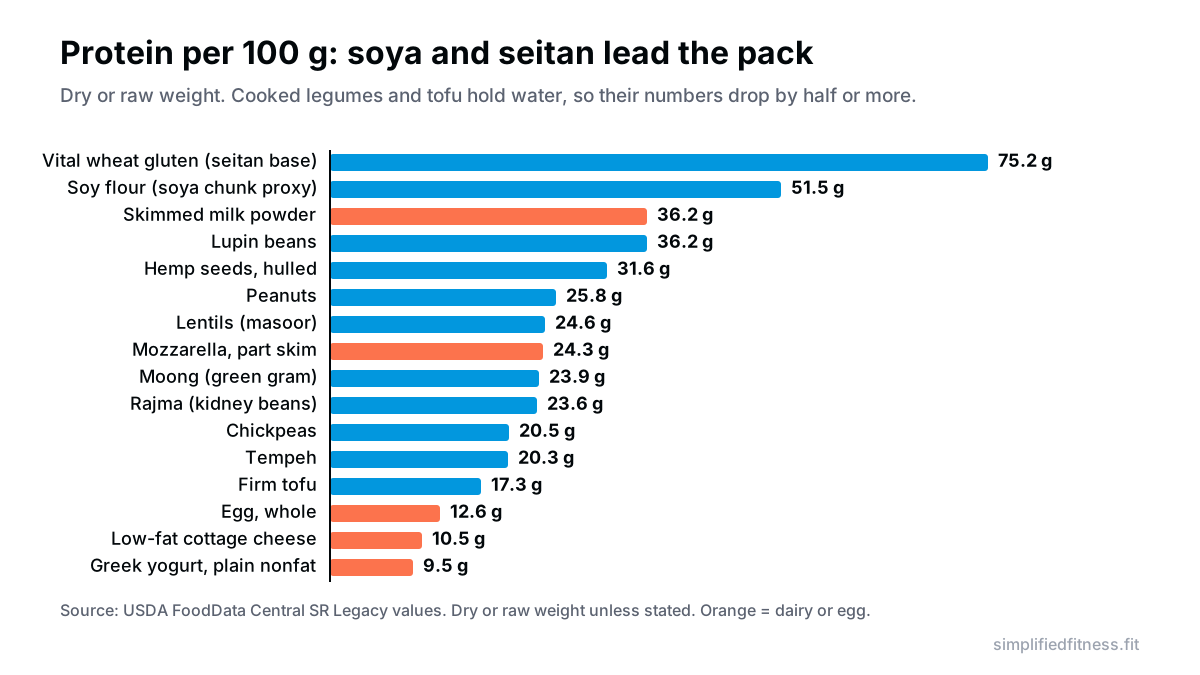
- The densest vegetarian protein sources per 100 g (dry weight) are seitan base (vital wheat gluten, about 75 g), soya chunks (about 50 g), lupin beans and dairy powders (about 36 g), and hemp seeds (about 32 g).
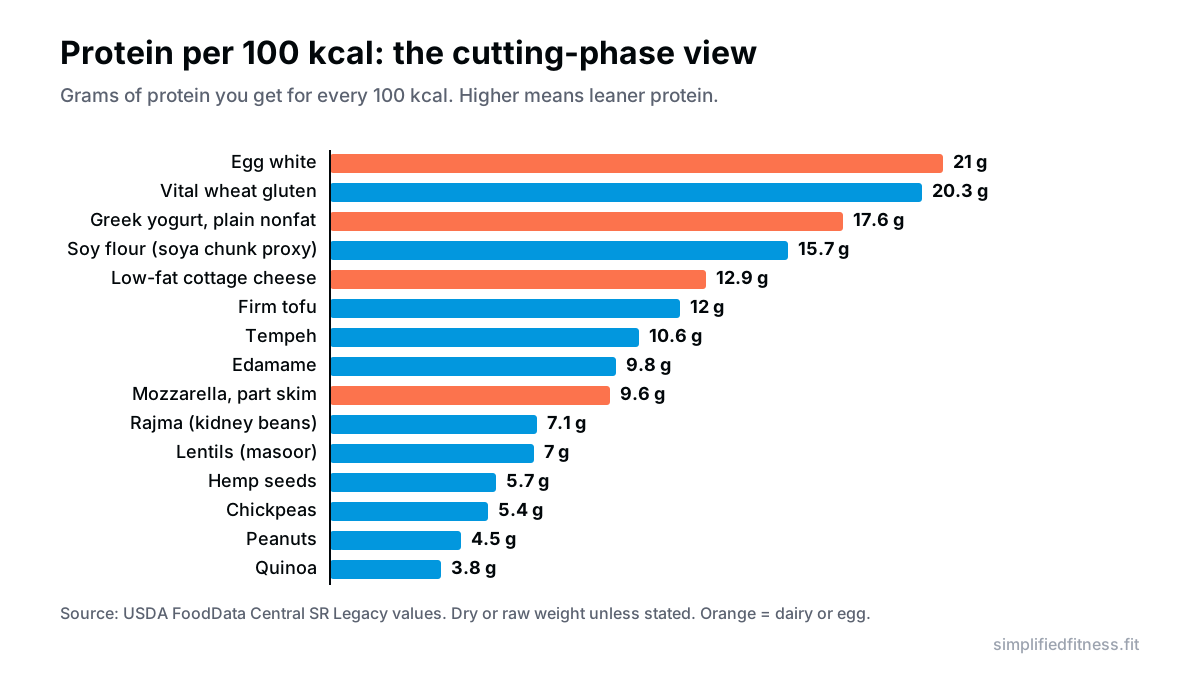
- Per calorie, the leanest options are egg white, vital wheat gluten, Greek yogurt, soya chunks, low-fat cottage cheese and tofu. Dals and rajma give about 7 g of protein per 100 kcal, with a lot of carbohydrate attached.
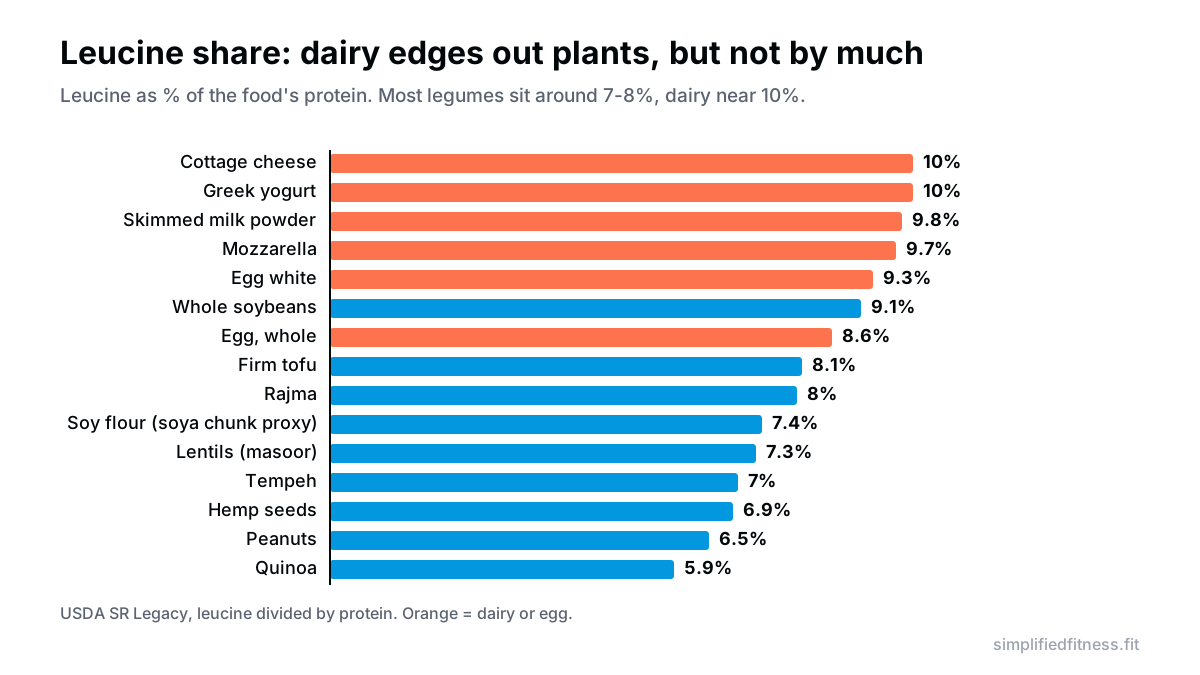
- Dairy and eggs carry about 9-10% leucine in their protein, soy and most legumes about 7-9%. Trials over weeks to months show small or no differences in muscle gain when total protein is high enough.
- Dry numbers are not cooked numbers. Dals, rajma and chickpeas absorb water, so weigh them raw or use a cooked-weight entry in your tracker.
- Aim for roughly 1.6 g/kg/day of total protein and spread it over 3-4 meals. Mix soya, dal, dairy and one or two extras so no single food has to do everything.
Part of our complete guide: High-Protein Foods List: Protein per 100g, Cost per 30g and Meal Prep Guide
Table of contents
The best high protein vegetarian foods (the core of our high-protein foods, meal prep and cost guide) are soya chunks, tofu, tempeh, seitan, Greek yogurt, low-fat cottage cheese or paneer, eggs (if you eat them), and dals and beans in sensible portions. On a dry-weight basis, vital wheat gluten and soya chunks beat everything else by a wide margin. Dairy has the most leucine per gram of protein, but trials suggest that matters less than hitting your daily total.
This is the full high protein vegetarian foods list we use for planning: 25 foods with protein, carbohydrate, fat, calories and leucine per 100 g. For costs and meal prep logistics, the parent guide has the rest.
Quick warning before the table. Most lists online quote protein for dry soya chunks next to cooked chicken. That is not a fair fight, and I will show you how to read the numbers properly.
How to read these numbers (dry vs cooked)
All figures below come from USDA FoodData Central (SR Legacy), per 100 g, for raw or dry food unless noted (USDA FoodData Central). Tempeh, tofu and edamame are listed as sold or prepared, since you do not cook them from a dry state.
Dals, rajma, chana, soya chunks and quinoa soak up water when cooked. A cooked bowl of moong therefore has far less protein per 100 g than the raw number suggests. Neither number is wrong. They just describe different weights.
My rule is simple. Weigh legumes and soya dry, log them dry, and cook the whole batch. If you only have a cooked weight, pick a “cooked” entry in your tracker instead of guessing.
Two other honest caveats:
- Soya chunks are not a separate USDA entry. I used defatted soy flour, the raw material they are made from. Brands vary, so read your pack.
- Paneer has no USDA entry that matches Indian paneer, and brands differ a lot in fat. Use the label, or cottage cheese as a rough stand-in.
The 25 foods, ranked by protein per 100 g
| # | Food (per 100 g) | Protein (g) | Carbs (g) | Fat (g) | kcal | Leucine (g) |
|---|---|---|---|---|---|---|
| 1 | Vital wheat gluten (seitan base) | 75.2 | 13.8 | 1.9 | 370 | not listed |
| 2 | Soy flour, defatted (soya chunk proxy) | 51.5 | 33.9 | 1.2 | 327 | 3.83 |
| 3 | Soybeans, dry | 36.5 | 30.2 | 19.9 | 446 | 3.31 |
| 4 | Skimmed milk powder | 36.2 | 52.0 | 0.8 | 362 | 3.54 |
| 5 | Lupin beans, dry | 36.2 | 40.4 | 9.7 | 371 | 2.74 |
| 6 | Hemp seeds, hulled | 31.6 | 8.7 | 48.8 | 553 | 2.16 |
| 7 | Pumpkin seed kernels | 30.2 | 10.7 | 49.1 | 559 | 2.42 |
| 8 | Peanuts, raw | 25.8 | 16.1 | 49.2 | 567 | 1.67 |
| 9 | Lentils (masoor), dry | 24.6 | 63.4 | 1.1 | 352 | 1.79 |
| 10 | Mozzarella, part skim | 24.3 | 2.8 | 15.9 | 254 | 2.37 |
| 11 | Moong (green gram), dry | 23.9 | 62.6 | 1.2 | 347 | 1.85 |
| 12 | Rajma (kidney beans), dry | 23.6 | 60.0 | 0.8 | 333 | 1.88 |
| 13 | Lobia (cowpeas), dry | 23.5 | 60.0 | 1.3 | 336 | 1.80 |
| 14 | Toor dal (pigeon pea), dry | 21.7 | 62.8 | 1.5 | 343 | 1.55 |
| 15 | Black beans, dry | 21.6 | 62.4 | 1.4 | 341 | 1.73 |
| 16 | Sunflower seed kernels | 20.8 | 20.0 | 51.5 | 584 | 1.66 |
| 17 | Chickpeas (chana), dry | 20.5 | 63.0 | 6.0 | 378 | 1.47 |
| 18 | Tempeh | 20.3 | 7.6 | 10.8 | 192 | 1.43 |
| 19 | Tofu, firm | 17.3 | 2.8 | 8.7 | 144 | 1.39 |
| 20 | Quinoa, dry | 14.1 | 64.2 | 6.1 | 368 | 0.84 |
| 21 | Egg, whole | 12.6 | 0.7 | 9.5 | 143 | 1.09 |
| 22 | Edamame, prepared | 11.9 | 8.9 | 5.2 | 121 | 0.75 |
| 23 | Egg white | 10.9 | 0.7 | 0.2 | 52 | 1.02 |
| 24 | Cottage cheese, low-fat (2%) | 10.5 | 4.8 | 2.3 | 81 | 1.05 |
| 25 | Greek yogurt, plain nonfat | 9.5 | 3.4 | 0.2 | 54 | 0.95 |
The ranking by raw protein density is a little misleading, because you do not eat 100 g of dry hemp seeds. A dessert-spoon of seeds on curd adds a few grams, not a meal. The table is a reference, so use it to build plates, not to crown a winner.
Which vegetarian foods give the most protein per calorie?
This is the cutting-phase question. If you are eating 1,800 kcal and need 130 g of protein, calories matter as much as grams.
On protein per 100 kcal, the leaders are egg white (about 21 g), vital wheat gluten (about 20 g), nonfat Greek yogurt (about 18 g), soy flour (about 16 g), low-fat cottage cheese (about 13 g) and firm tofu (about 12 g). Tempeh and edamame sit near 10 g.
Dals, rajma and chana land near 5-7 g per 100 kcal. That is fine, but remember what comes with the protein: about 60 g of carbohydrate per 100 g dry. Nuts and seeds land at about 4-6 g per 100 kcal, because most of their calories are fat.
Leucine: do vegetarian foods have enough?
Leucine is the amino acid most closely tied to switching on muscle protein synthesis. That is why you see it everywhere on supplement labels. (For the mechanism in full, see our deep dive on the leucine threshold and mTOR.)
Using USDA numbers, I divided leucine by protein for each food. Dairy lands around 10%, whole soybeans about 9%, tofu and rajma about 8%, soya chunks, lentils and tempeh about 7%, and quinoa and peanuts about 6%. So dairy and eggs are richer in leucine per gram of protein, and a few plant foods are lower.
Here is the part people skip. Does this gap show up in real life? The evidence says it is smaller than the gym rumour mill suggests.
- A 2018 meta-analysis of 9 trials (266 participants) found that soy protein supplementation produced similar strength and lean mass gains to whey and other animal proteins (Messina et al., 2018).
- A 2021 meta-analysis of 16 trials found that protein source did not change absolute lean mass or strength overall, but animal protein had a small advantage for percent lean mass, and in adults under 50 it also showed a small edge for absolute lean mass (Lim et al., 2021).
- A 2025 controlled-feeding trial of 40 active young adults compared vegan and omnivorous diets at 1.1-1.2 g/kg/day of protein. Over 9 days of resistance training, myofibrillar protein synthesis rates did not differ between diets or between balanced and unbalanced protein distribution (Askow et al., 2025).
Why do they differ? Messina’s review pooled supplement studies, mostly soy versus whey. Lim’s pooled a broader range of plant proteins and measured percent lean mass, which is more sensitive to small differences. Askow’s trial was short and measured protein synthesis rather than muscle size. So the fair reading is: animal protein may have a slight edge in some analyses, soy looks close to it, and none of this shows plant diets failing to build muscle.
For a deeper look, our article on plant vs animal protein for hypertrophy goes through the completeness argument.
Do you need to pair proteins like dal and rice?
The old advice says you must combine cereals and pulses in the same meal. The direct evidence on this is thin.
A 2026 randomized crossover trial gave 11 young adults 20 g of protein from black beans and rice, or a nutrient-matched mix of crystalline amino acids and other ingredients, after resistance exercise. Muscle protein synthesis did not differ between the two. In an exploratory comparison, ground pork produced a greater response than either (Zupancic et al., 2026).
Note what this trial did and did not test. It showed a whole-food beans-and-rice meal worked as well as its isolated amino acid equivalent, but it never fed beans or rice alone, so it cannot settle whether same-meal pairing matters. It was also small, in young active people, over 5 hours. In practice the question rarely comes up on a typical Indian plate, because dal with rice or roti is already a mix.
Protein quality scoring tells a similar story. A 2020 review of the digestible indispensable amino acid score (DIAAS) found soy and whey classed as high-quality, while pea, rice, oat and hemp proteins scored below 75, though blends of potato, soy and pea scored higher (Herreman et al., 2020). That is a lab score, not a muscle outcome, but it supports mixing sources: soya plus dal plus dairy beats one food on repeat.
How much protein do you actually need?
A 2018 meta-analysis of 49 trials (1,863 participants) found that protein supplementation improved strength and muscle size during resistance training, and that benefits for fat-free mass levelled off above total intakes of about 1.62 g/kg/day (Morton et al., 2018). Benefits were smaller with increasing age and larger in trained people.
So about 1.6 g/kg/day is a sensible target for most lifters. Some people eat more for fullness on a cut, which is fine. Note that this is a population average, not a personal ceiling.
The protein calculator gives you a number for your weight and goal. If you want it laid out in meals, our Indian diet plan tool builds one.
How to cook and prep the main foods
Soya chunks. Soak in hot salted water for 10-15 minutes, squeeze hard, then cook in masala, pulao or a dry stir-fry. Squeezing is what stops them tasting like sponge. For safety questions, see our soya chunks protein profile guide.
Tofu and tempeh. Press tofu for 10 minutes, cube it and pan-sear or bake. Tempeh can be steamed for 10 minutes and then fried. Our tofu and edamame guide for Indian kitchens has recipes.
Dals and rajma. Soak overnight, pressure-cook in batches and freeze portions. Moong cooks fastest. Log the dry weight before cooking. Our guide to dals and pulses covers the protein myth in detail.
Paneer and curd. Pick a low-fat paneer or make chenna at home from toned milk, and compare labels for protein and fat per 100 g. Our paneer vs low-fat paneer guide walks through it. Thick hung curd or Greek yogurt is the easiest 15-20 g protein snack.
Seitan. Mix vital wheat gluten with spices and water, knead, simmer and slice. It is chewy, very high in protein, and not suitable if you are coeliac or gluten-sensitive.
Seeds. Hemp, pumpkin and sunflower seeds are small add-ons for crunch and minerals. Treat them like a topping, not a protein plan.
A simple vegetarian day built from this list
Here is a sample day for a 70 kg lifter aiming for roughly 110-115 g of protein. It is an example, not a prescription, and the numbers use USDA values above.
- Breakfast: 200 g plain nonfat Greek yogurt (about 19 g) with a handful of peanuts.
- Lunch: 40 g dry soya chunks (about 21 g) cooked in a masala, plus roti and salad.
- Snack: 150 g firm tofu (about 26 g) or tempeh (about 30 g). Two whole eggs give only about 12-13 g, so add whites if you go that route.
- Dinner: 80 g dry moong or toor dal (about 17-19 g) with rice and a bowl of curd.
- Optional top-up: a scoop of whey or a glass of milk if you fall short.
With a handful of peanuts and a bowl of curd counted, that lands at roughly 95-105 g. Extra curd, milk or the optional whey fills the rest. Compare it with the top 30 foods ranked by protein per calorie if you want to swap items, and our guide on Indian vegetarian meal prep shows how to batch it.
When to talk to a doctor
Eating more protein is safe for most healthy adults, but not everyone. If you have kidney disease, are pregnant, have a soy or gluten allergy, or take thyroid medication, check your plan with a doctor or registered dietitian before you push protein or lean on soya. Persistent fatigue, hair thinning or unusual weakness on a vegetarian diet is also worth a blood test rather than a guess.
Frequently Asked Questions
What are the best high protein vegetarian foods for building muscle?
Soya chunks, tofu, tempeh, Greek yogurt, low-fat cottage cheese or paneer, eggs (if you eat them), lentils and rajma are the most practical picks. Soy is a complete protein with good leucine, and dairy gives the most leucine per gram of protein. Build each meal around one of these and add a second source rather than relying on dal alone.
Which vegetarian food has the most protein per 100g?
Vital wheat gluten (the base of seitan) has about 75 g of protein per 100 g dry, followed by defatted soy flour (about 51 g), the same family as soya chunks. This is dry weight, so the cooked portion you actually eat has far less per 100 g. Check the label on your pack of soya chunks, since brands differ.
How much protein is in 100g of soya chunks?
Dry soya chunks usually come in around 50 g of protein per 100 g, and USDA data for defatted soy flour, the same raw material, shows 51.5 g. Once soaked or boiled they hold a lot of water, so a cooked 100 g serving is far lower. Weigh them dry, about 30 g gives roughly 15 g of protein.
Can you build muscle on a vegetarian diet?
Yes, if total protein and training are in order. A 2018 meta-analysis found soy and animal protein supplements produced similar strength and lean mass gains, while a 2021 meta-analysis found no difference in absolute lean mass but a small edge for animal protein in younger adults. Eat enough protein, lift progressively, and use dairy or eggs if your diet allows.
Is dal a good source of protein for gym goers?
Dal is a decent source but a carb-heavy one: raw lentils and moong carry about 24 g of protein and about 62 g of carbohydrate per 100 g. A cooked bowl delivers far less per 100 g than the raw number, so dal supports your total rather than carrying it. Pair it with soya, curd or paneer to hit a full meal target.
Is paneer a high protein food?
Paneer is a useful protein source but it varies a lot by brand, and full-fat paneer carries plenty of fat along with its protein. Low-fat versions or home-made chenna from toned milk give more protein per calorie. Read the label for protein and fat per 100 g and compare brands.
Do vegetarians need to worry about leucine?
Leucine is the amino acid most linked to switching on muscle protein synthesis, and plant foods contain somewhat less of it per gram of protein than dairy. A 2025 trial found myofibrillar protein synthesis similar on vegan and omnivorous diets at 1.1-1.2 g/kg/day of protein over 9 days in young adults. Hitting your daily protein and using soy and dairy as anchors covers most of the gap.
Do I need to combine plant proteins at the same meal?
Probably not at every meal, though the direct evidence is thin. A 2026 trial in 11 young adults found that 20 g of protein from beans and rice stimulated muscle protein synthesis no differently from a nutrient-matched mix of isolated amino acids, but it did not test beans or rice on their own. Mixing sources across the day is the practical approach, and dal with rice or roti does this anyway.
How many grams of protein should a vegetarian eat per day?
A meta-analysis of 49 trials found no further muscle gain from protein beyond about 1.6 g/kg/day in lifters, so that is a sensible target. For a 70 kg person that is about 112 g. Use our protein calculator to get your own number and split it over 3-4 meals.
Are eggs vegetarian for fitness purposes?
It depends on your own rules. Many Indian lifters are eggetarian and treat eggs as fine, while strict vegetarians avoid them. Whole egg gives about 12.6 g of protein per 100 g and egg white is almost pure protein, so if eggs fit your diet they are cheap, high-leucine options.
What is the cheapest high protein vegetarian food in India?
Soya chunks, dals, chana and peanuts are usually the cheapest protein per rupee, with curd and eggs close behind. Prices vary by city and season, so compare the cost of 30 g of protein from your local shop rather than trusting a fixed ranking. Our cost per 30 g protein guide walks through the maths.
Is seitan a complete protein?
No. Wheat gluten is high in protein but low in lysine, so on its own it is incomplete. The practical fix is simple: eat it in a mixed diet with dal, soy or dairy, or pair it with a lysine-rich food in the same day.
How do I cook soya chunks so they taste good?
Soak or boil the chunks in hot salted water for 10-15 minutes, then squeeze out the water so they absorb flavour instead of tasting spongy. Sear them in a hot pan with spices or add them to a masala, pulao or curry. The squeezing step is what turns them from bland to meaty.
Sources & References
Every claim above is checked against peer-reviewed research (PubMed, U.S. National Library of Medicine) or guidance from established health bodies. How we fact-check.
- Morton RW, et al. A systematic review, meta-analysis and meta-regression of the effect of protein supplementation on resistance training-induced gains in muscle mass and strength in healthy adults. Br J Sports Med. 2018. PMID: 28698222
- Messina M, et al. No difference between the effects of supplementing with soy protein versus animal protein on gains in muscle mass and strength in response to resistance exercise. Int J Sport Nutr Exerc Metab. 2018. PMID: 29722584
- Lim MT, et al. Animal protein versus plant protein in supporting lean mass and muscle strength: a systematic review and meta-analysis of randomized controlled trials. Nutrients. 2021. PMID: 33670701
- Askow AT, et al. Impact of vegan diets on resistance exercise-mediated myofibrillar protein synthesis in healthy young males and females: a randomized controlled trial. Med Sci Sports Exerc. 2025. PMID: 40197715
- Zupancic Z, et al. Complementary plant protein pairing does not further increase postexercise myofibrillar protein synthesis after a 20 g protein dose within a high-carbohydrate whole-food matrix in young adults: a randomized controlled trial. Am J Clin Nutr. 2026. PMID: 42214492
- Herreman L, et al. Comprehensive overview of the quality of plant- and animal-sourced proteins based on the digestible indispensable amino acid score. Food Sci Nutr. 2020. PMID: 33133540
- U.S. Department of Agriculture. FoodData Central, SR Legacy dataset (nutrient values per 100 g). fdc.nal.usda.gov

Umair Hazrami · Founder & Head Coach, Simplified Fitness
Umair Hazrami founded Simplified Fitness and the Simplified Lifter channel to cut through fitness noise. With 4+ years of consistent training and 10+ coaching clients, he writes every guide from the peer-reviewed research and links the sources so you can check them. Our editorial standards.
Educational content only, not medical advice. If you have a medical condition, are pregnant, or take medication, talk to a qualified doctor before changing your diet, supplements or training. Full disclaimer.
Keep reading
Indian Diet
The 3-Hour Weekly Batch Meal Prep: Cooking 5 Days of Lunches and Dinners for Busy Lifters
Batch meal prep for the week in 3 hours: a station-by-station Sunday plan for 10 high-protein lunches and dinners, with Indian options and safe storage rules.
7 min read
Indian Diet
Cost per 30 Grams of Protein: 40 Common Fitness Foods Ranked by Price
Cost per 30g protein for 40 Indian gym foods, from soya chunks to whey and tuna. See the cheapest protein sources per gram and what to buy on a budget.
8 min read
Indian Diet
Eating Healthy on a Student Budget: High Protein Hostel and Dorm Room Meal Prep
A college student bodybuilding diet budget can still hit 130 g of protein. Cheap staples, no-cook hostel prep and a sample day, with the studies linked.
8 min read
Indian Diet
Essential Kitchen Equipment for Lifters: Scales, Air Fryers, Blenders and Containers
The best kitchen equipment for meal prep lifters: which four tools earn their space, what the research says about each, and what to buy first on a budget.
10 min read