Soya Chunks Protein: How Much Per 100g, Is It Safe, and Does It Cause Man Boobs?
Soya chunks protein per 100g, whether 50g a day is safe, and what 41 studies say about testosterone and estrogen. Prep tips for Indian lifters included.
TL;DR. The short answer
- Dry soya chunks (TVP) are labelled at roughly 50-52 g protein per 100 g dry weight on most Indian packs. Check your brand's label, because it varies slightly.
- A 2021 meta-analysis of 41 clinical studies found no significant effect of soy foods, soy protein or isoflavones on testosterone, estradiol or SHBG in adult men.
- There is no good evidence that moderate intake, such as 30-50 g dry weight a day inside a varied diet, causes gynecomastia. Extreme intakes are less studied, and one case report describes problems at very high soy milk intake.
- In a 12-week trial in untrained young men, soy protein supported muscle gain as well as whey when total protein was matched.
- Noticing breast tissue changes, low libido or other symptoms? See a doctor rather than guessing the cause.
Part of our complete guide: Indian High-Protein Nutrition Guide: Cutting and Muscle Building on Vegetarian and Non-Veg Diets
Table of contents
If you are a vegetarian lifter in India, soya chunks protein is probably the cheapest serious protein you can buy. Most packs label dry chunks at roughly 50-52 g protein per 100 g, and the research does not support the fear that a normal serving will lower testosterone or cause man boobs.
This guide sits inside our Indian high-protein nutrition guide and focuses on the one kitchen staple most Indian vegetarians actually buy: Nutrela-style soya chunks, also called textured vegetable protein (TVP). For the wider soy debate beyond chunks, see our deeper piece on soy protein, phytoestrogens and testosterone.
How much protein is in soya chunks?
Soya chunks are made from defatted soy flour that is cooked under pressure and shaped (extruded) into dry, lightweight pieces. Because the fat is removed, what is left is mostly protein and carbohydrate.
Packs sold in India typically list around 50-52 g protein per 100 g. I am quoting label values here, not a lab analysis, so brands will differ slightly. The number that matters is that it is dry weight. Once you soak the chunks they swell with water, and the same 100 g becomes a much heavier, much less protein-dense portion on the plate.
A quick, honest cost check. Prices change by brand and city, but chunks commonly sell for roughly ₹25-35 per 100 g. At about 50 g protein per 100 g, that is around ₹0.5-0.7 per gram of protein. Run the same sum on paneer, eggs or whey at your local prices and you will usually find chunks cheaper. (Use our protein calculator to see how many grams you actually need first.)
Is soya chunks protein complete?
Mostly yes. Soy is one of the few plant proteins that contains all nine essential amino acids in useful amounts, which is why it keeps showing up in plant-based sports nutrition research.
Quality scores give us a range. A 2022 quantitative review of soy products put the mean DIAAS at about 84.5 and the mean PDCAAS at about 85.6 across all soy products. After excluding post-processed data points, the means were about 86.0 and 92.4 (van den Berg et al., 2022). The authors also noted wide variation within product groups, and that heat treatment and moisture can raise or lower protein quality.
What does that mean for you? Soy is a high-quality plant protein, but not identical to every other soy product, and I cannot give you a precise score for any specific brand of chunks. If you want to understand these scoring systems, we explain them in DIAAS vs PDCAAS.
Do soya chunks cause man boobs or lower testosterone?
This is the question that stops a lot of Indian guys from eating chunks, so let us be exact about the origin of the worry.
Soy contains isoflavones, plant compounds that can weakly bind to estrogen receptors. That is why they are called phytoestrogens. Some rodent studies showed hormonal effects, and the leap to “it will feminise me” followed. But as Mark Messina notes in his critical review, rodents metabolise isoflavones differently from humans, and the animals were exposed to excessively high amounts (Messina, 2010).
So researchers tested it in men.
The 2010 meta-analysis. Pooling placebo-controlled treatment groups, it found no significant effect of soy protein or isoflavone intake on testosterone, SHBG, free testosterone or the free androgen index, regardless of statistical model (Hamilton-Reeves et al., 2010).
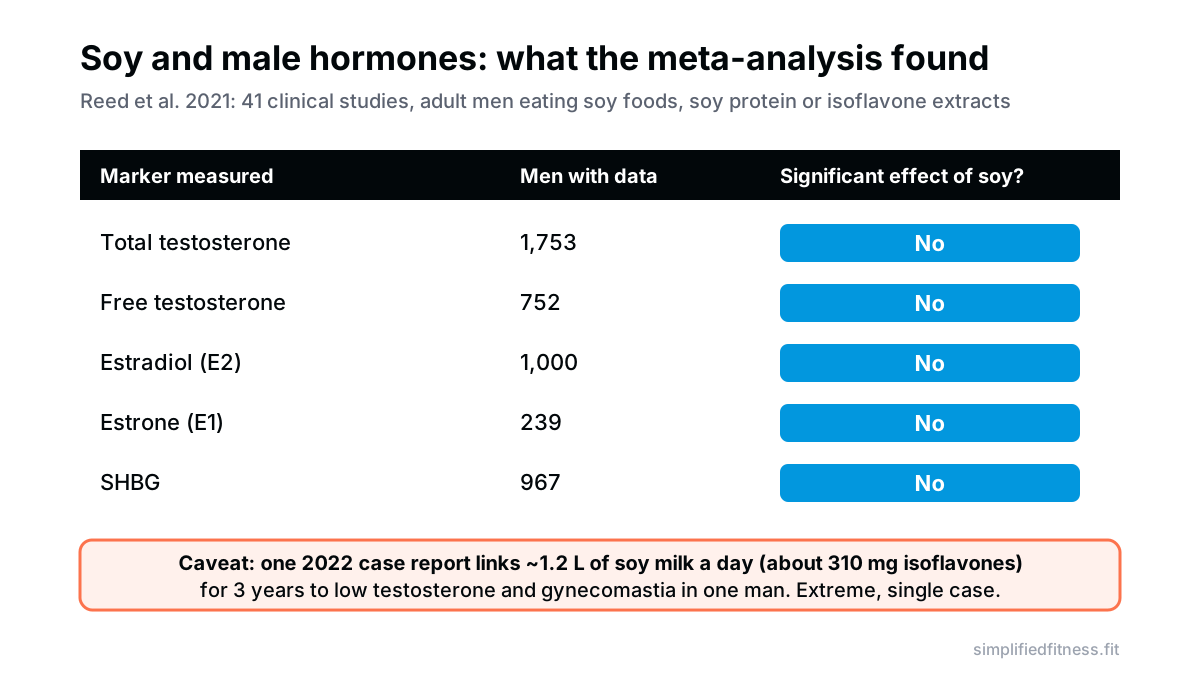
The 2021 update. A bigger meta-analysis added newer work and included 41 studies. Total testosterone was measured in 1,753 men and free testosterone in 752. Estradiol was measured in 1,000 men, estrone in 239 and SHBG in 967. Regardless of the statistical model, no significant effects of soy protein or isoflavone intake were found on any of them (Reed et al., 2021).
Messina’s review adds that isoflavone intervention data show no feminising effects on men at intakes equal to, and even well above, those typical for Asian males. He also notes that for sperm and semen parameters only three intervention studies existed, none longer than 3 months (Messina, 2010). That is a real limit, not a footnote.
What about the case reports?
Be fair to the other side. In 2022, Japanese doctors described a 54-year-old man who had been drinking roughly 1.2 L of soy milk a day (about 310 mg of isoflavones) for 3 years. He developed erectile dysfunction and gynecomastia, tests showed low gonadotropin and testosterone, and his gonadal function improved after he stopped (Imai et al., 2022).
Why can this and the meta-analyses both be true? A single case report cannot show cause and effect for the general population, and this was an unusually large, long, daily intake from one source. The meta-analyses average many men on typical-to-higher research doses. I cannot give you a clean comparison with a 50 g serving of chunks, because the isoflavone content of chunks varies by product and processing. The cautious takeaway: ordinary servings inside a varied diet look fine, extreme single-source intake is the scenario with a signal worth respecting.
Can you build muscle on soya chunks?
Yes, if total protein and training are right. The best human evidence comes from trials using soy protein isolate rather than chunks themselves, so apply it with that in mind.
A 12-week randomized trial in 61 untrained young adults (48 completed) compared 26 g of soy protein isolate with 19 g of whey isolate, each containing 2 g leucine, alongside supervised lifting 3 times a week. Lean mass and strength rose in both groups, with no difference between them (Lynch et al., 2020).
A second study compared 19 habitual vegans with 19 omnivores over 12 weeks of twice-weekly training. Protein was adjusted to 1.6 g/kg/day using soy for the vegans and whey for the omnivores. Leg lean mass rose by 1.2 kg in both groups, with no between-group differences in muscle size or strength measures (Hevia-Larraín et al., 2021).
Both studies were in untrained young people, so we should be careful about extending them to years of advanced training. Still, the practical message is consistent: protein source mattered less than total intake when intake was adequate. For the broader question of plant versus animal sources, read plant vs animal protein for hypertrophy.
How many soya chunks per day is safe?
Here I have to be straight with you. No trial I reviewed tested a specific daily weight of soya chunks. The safety evidence comes from soy foods, soy protein and isoflavone supplements in general, so any number for chunks is a practical extrapolation.
| Daily dry weight | Approx. protein (at ~50 g per 100 g) | Who it suits |
|---|---|---|
| 20-25 g | 10-13 g | Beginners, sensitive stomachs |
| 30-50 g | 15-26 g | Most vegetarian lifters, a sensible default |
| 50-70 g | 25-36 g | Heavier lifters with a varied diet around it |
I treat 30-50 g as the comfortable default and 50-70 g as the upper end where I would want the rest of your diet to be varied: dal, curd, paneer or eggs if you eat them, plus rice or roti. This is a coaching judgment, not a studied limit. If you are on thyroid medication, have a hormone-related condition, or are unsure, ask your doctor before going high.
How do you cook soya chunks so they taste good?
Plain chunks taste beany and spongy. That is a prep problem, not an ingredient problem.
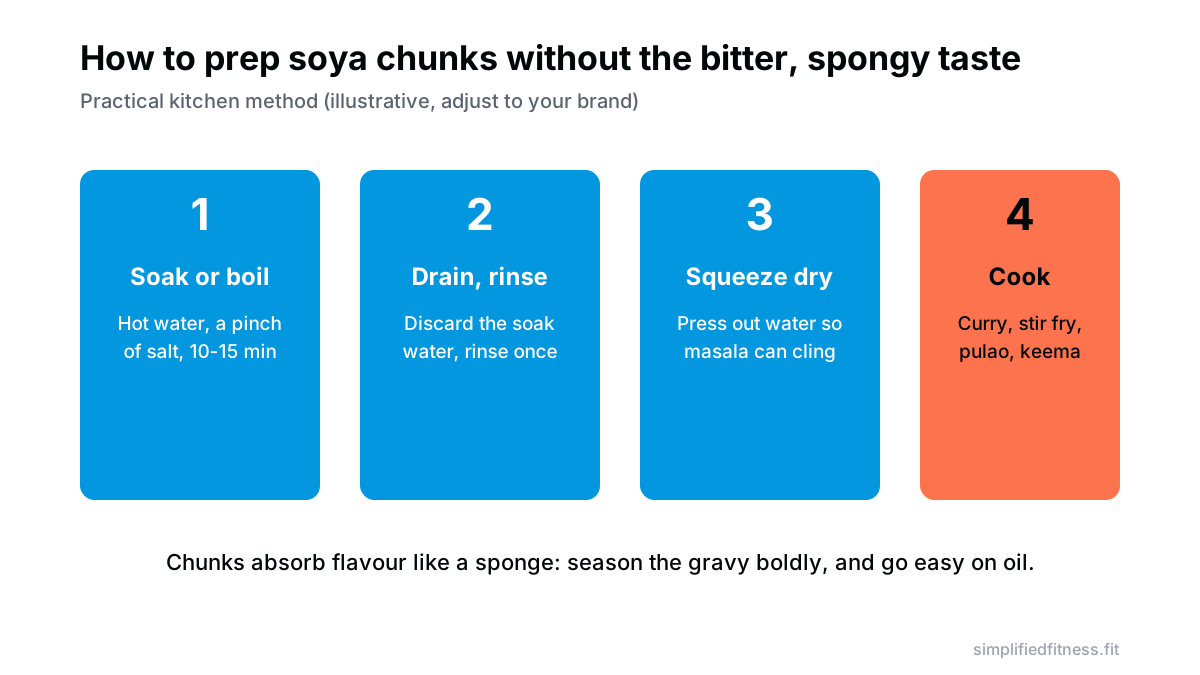
A few practical points:
- Soak in hot water with a pinch of salt for 10-15 minutes, then rinse. Some people boil them for a few minutes instead.
- Squeeze out the water. Wet chunks dilute your masala and turn watery.
- Marinate in curd, ginger-garlic and spices if you have 20 minutes. Chunks take on whatever you give them.
- Watch the oil. Chunks soak up fat like sponges, which can quietly add hundreds of calories to a “high-protein” sabzi.
- Ease in. Start around 20-25 g dry weight if you rarely eat it, because the fibre can cause gas.
Good Indian formats: soya keema with peas, soya pulao, soya curry with onion-tomato gravy, dry masala stir fry for meal prep, or chunks in a roti wrap. Our high-protein Indian vegetarian meal prep blueprint and the high-protein Indian snacks guide show how to batch them.
Soya chunks vs other budget proteins
Chunks are cheap and dense, but they are not the only tool. If you want something less processed, tofu and edamame offer soy protein in a different form, and our budget Indian diet guide shows how to combine chunks with dal, curd and eggs without overspending.
When should you see a doctor?
Soy is a food, not a drug, but a few situations deserve a professional opinion. See a doctor if you notice breast tenderness or lump-like tissue, persistent low libido or erectile problems, or other symptoms that worry you, regardless of what you eat. Also ask first if you take thyroid medication, have a hormone-sensitive condition, or have a soy allergy. This article is general education, not a diagnosis.
The practical bottom line
Eat soya chunks. Weigh them dry, prep them properly, keep portions around 30-50 g for most days, and let them sit alongside other protein foods. The hormone fear is not supported by 41 clinical studies, but extreme, single-source intake is the one area where I would stay cautious. If you want a daily structure, our free diet plan is a good place to start.
Frequently Asked Questions
How much protein is in 100g of soya chunks?
Most Indian brands label dry soya chunks at roughly 50-52 g of protein per 100 g. That figure is for dry weight, before soaking. Always check the pack, since brands differ a little, and weigh the chunks dry.
Do soya chunks cause man boobs (gynecomastia)?
There is no good evidence that normal amounts of soya chunks cause gynecomastia. A meta-analysis of 41 clinical studies found no significant effect of soy on testosterone or estrogen in men. If you notice breast tissue changes, see a doctor, because many other causes exist.
Do soya chunks lower testosterone?
Not in the clinical trials. Two meta-analyses (2010 and 2021) found that soy protein and isoflavones did not significantly change total or free testosterone in men. Eat soya chunks as part of a varied diet and keep training.
Is 50g of soya chunks a day safe?
For most healthy adults, 50 g dry weight a day fits within the range studied and is generally considered reasonable. Trials rarely test chunks specifically, so this is an extrapolation from soy food and isoflavone research. Spread your protein across dal, curd, paneer and eggs if you eat them, rather than relying on one food.
How many soya chunks can I eat per day?
A practical range is about 30-50 g dry weight daily, which gives roughly 15-26 g of protein. No fixed upper limit has been set from trials on chunks. If you go higher, keep variety in your diet and watch how your stomach feels.
Are soya chunks a complete protein?
Soy is one of the few plant proteins with a full essential amino acid profile. A 2022 review of soy products found mean DIAAS around 84-86 and PDCAAS around 86-92, which counts as high quality for a plant source. Processing can raise or lower these scores, so treat them as a range.
Are soya chunks as good as whey for building muscle?
When total protein is matched, soy has performed similarly to whey in trials. A 12-week study in untrained men and women found comparable lean mass and strength gains, and another in young men found no difference between a plant-based diet with soy and a mixed diet with whey. Evidence in advanced lifters is thinner, so hit your total protein target first.
Why do my soya chunks taste bitter or spongy?
Undersoaked or unrinsed chunks often taste beany and bland. Soak in hot salted water, drain, rinse, and squeeze out the water before cooking. Then cook them in a well spiced gravy or stir fry so they take up flavour.
Are soya chunks bad for the thyroid?
Evidence here is limited and I did not review thyroid trials for this article. If you have a thyroid condition or take thyroid medication, ask your doctor whether soy timing matters for you. Do not stop medication or add large amounts of soy on your own.
Can soya chunks cause gas or bloating?
Yes, for some people. Soy contains fibre and fermentable carbohydrates that can cause gas, especially if you jump from none to a large portion. Start with 20-25 g dry weight and build up over a couple of weeks.
Are soya chunks processed food?
They are a processed soy product made from defatted soy flour, but that is not automatically bad. They are high in protein and low in fat, and cheap compared with most protein sources. What matters is the gravy: heavy oil and cream can erase the benefit.
Are soya chunks safe for women?
Moderate soy foods are widely eaten by women and are generally considered safe. Women with hormone-sensitive conditions or on related medication should ask their doctor before eating large amounts. I did not review female-specific trials for this article.
How much do soya chunks cost per gram of protein?
Prices vary by brand and city, but soya chunks commonly sell for roughly 25-35 rupees per 100 g, which works out to around 0.5-0.7 rupees per gram of protein at about 50 g protein per 100 g. That is usually cheaper than paneer, eggs, chicken or whey. Check your local price and do the same maths.
Sources & References
Every claim above is checked against peer-reviewed research (PubMed, U.S. National Library of Medicine) or guidance from established health bodies. How we fact-check.
- Reed KE, et al. Neither soy nor isoflavone intake affects male reproductive hormones: An expanded and updated meta-analysis of clinical studies. Reprod Toxicol. 2021. PMID: 33383165
- Hamilton-Reeves JM, et al. Clinical studies show no effects of soy protein or isoflavones on reproductive hormones in men: results of a meta-analysis. Fertil Steril. 2010. PMID: 19524224
- Messina M. Soybean isoflavone exposure does not have feminizing effects on men: a critical examination of the clinical evidence. Fertil Steril. 2010. PMID: 20378106
- Imai H, et al. Secondary Hypogonadism due to Excessive Ingestion of Isoflavone in a Man. Intern Med. 2022. PMID: 35228414
- Lynch HM, et al. No Significant Differences in Muscle Growth and Strength Development When Consuming Soy and Whey Protein Supplements Matched for Leucine Following a 12 Week Resistance Training Program in Men and Women: A Randomized Trial. Int J Environ Res Public Health. 2020. PMID: 32486007
- Hevia-Larrain V, et al. High-Protein Plant-Based Diet Versus a Protein-Matched Omnivorous Diet to Support Resistance Training Adaptations: A Comparison Between Habitual Vegans and Omnivores. Sports Med. 2021. PMID: 33599941
- van den Berg LA, et al. Protein quality of soy and the effect of processing: A quantitative review. Front Nutr. 2022. PMID: 36238463
- van Vliet S, et al. The Skeletal Muscle Anabolic Response to Plant- versus Animal-Based Protein Consumption. J Nutr. 2015. PMID: 26224750

Umair Hazrami · Founder & Head Coach, Simplified Fitness
Umair Hazrami founded Simplified Fitness and the Simplified Lifter channel to cut through fitness noise. With 4+ years of consistent training and 10+ coaching clients, he writes every guide from the peer-reviewed research and links the sources so you can check them. Our editorial standards.
Educational content only, not medical advice. If you have a medical condition, are pregnant, or take medication, talk to a qualified doctor before changing your diet, supplements or training. Full disclaimer.
Keep reading
Indian Diet
Budget Indian Diet for 120g Protein Under ₹100 a Day (Student Plan)
A budget Indian diet for 120g protein under 100 rupees a day: soya, eggs, milk and chana, with protein per rupee maths and two student plans you can copy.
8 min read
Indian Diet
Chicken Breast and Fish in India: Where to Buy, How to Cook, and Cost per 30 g Protein
Chicken breast price per kg India: compare wet market vs apps, learn safe handling, a brine method for juicy meat, and rohu vs chicken cost per 30 g protein.
11 min read
Indian Diet
How to Convince Indian Parents About Whey Protein: Kidney Fears, 'Chemicals' and the Real Evidence
How to convince Indian parents about whey protein: explain it as paneer-water dairy, answer the kidney fear with trial data, and read the label together.
9 min read
Indian Diet
Curd vs Greek Yogurt vs Hung Curd: Protein Yield and the Home Recipe
Curd vs Greek yogurt protein in India: plain dahi gives about 3-4 g per 100 g. See how straining it into hung curd can triple that, and what studies show.
9 min read