Travel Nutrition Strategies: Maintaining Calories and Protein on Flights, Road Trips, and Hotels
A travel nutrition bodybuilding guide: hit 150 g protein on flights, road trips and hotel stays with a packing list, grocery run plan and Indian food swaps.
TL;DR. The short answer
- You can hit 150 g of protein while traveling by building the day around four or five 25-40 g anchors (eggs, curd, paneer, a whey sachet, tuna or chicken) rather than hoping dinner covers it.
- A few days of imperfect eating will not cost you meaningful muscle. Protein near your usual target (about 1.4-2.0 g/kg per the ISSN) matters more than perfect calories or meal timing.
- Pack a small backup kit (whey sachets, roasted chana, nuts, a tuna pouch) and do a grocery run within an hour of arriving at the hotel.
- Scale weight often jumps on trips from salt, travel stress and sitting, not fat. Judge the trip by your next normal week, not the first weigh-in.
- Drink to thirst and have water with each meal. Exercise studies suggest thirst is a reasonable guide for healthy people, though nobody has tested this on flights. If you have heart or kidney conditions or a fluid limit, follow your doctor.
Part of our complete guide: High-Protein Foods List: Protein per 100g, Cost per 30g and Meal Prep Guide
Table of contents
You can keep your protein and calories on track while traveling if you stop treating travel days as one big unknown and plan them as four or five small protein “anchors” instead. This travel nutrition bodybuilding guide shows how to do that on a flight, on a road trip and in a hotel, using food you can actually buy in India or abroad. It sits under our wider high-protein foods and meal prep guide, so use that for the food lists and costs.
The most common mistake is not eating junk. It is going eight hours without real protein, then trying to catch up at a late dinner.
How much does travel actually matter for muscle?
Less than people fear, for a short trip. Muscle is built and kept by training plus a reasonably adequate daily protein intake over weeks, not by any single day.
The ISSN position stand says 1.4-2.0 g of protein per kg body weight per day is sufficient for most exercising people to build or maintain muscle (Jäger et al., 2017). A 75 kg lifter lands around 105-150 g. So “150 g” is a comfortable upper-range target, not a number you must hit to the gram.
A meta-analysis of 49 trials (1,863 people) found protein supplementation helped resistance training gains, and that intakes above about 1.6 g/kg/day gave no further gain in fat-free mass (Morton et al., 2018). That is a ceiling worth knowing: if travel pushes you to 130 g instead of 150 g, you may lose very little. Those trials were mostly training blocks of weeks, not single trips, so treat this as general guidance and not a promise.
How to hit protein while traveling: build the day around anchors
The evidence on exact protein spacing is mixed, so here is the honest picture. In a 12-week trial of 26 young men, a group eating more protein at breakfast gained 2.5 kg of lean mass versus 1.8 kg in a group eating more at dinner, a difference that only tended toward significance (P = 0.06) (Yasuda et al., 2020). In a crossover trial of 24 rugby players, eating protein more often or in bigger main-meal boluses made no difference to lean mass gains over six weeks (MacKenzie-Shalders et al., 2016).
Why might they differ? Different populations, small samples and different designs. The cautious takeaway is that you do not need to be perfect, but a skewed day with almost nothing until dinner is the weaker plan. The ISSN suggests roughly 0.25 g/kg or 20-40 g per serving, spread across the day.
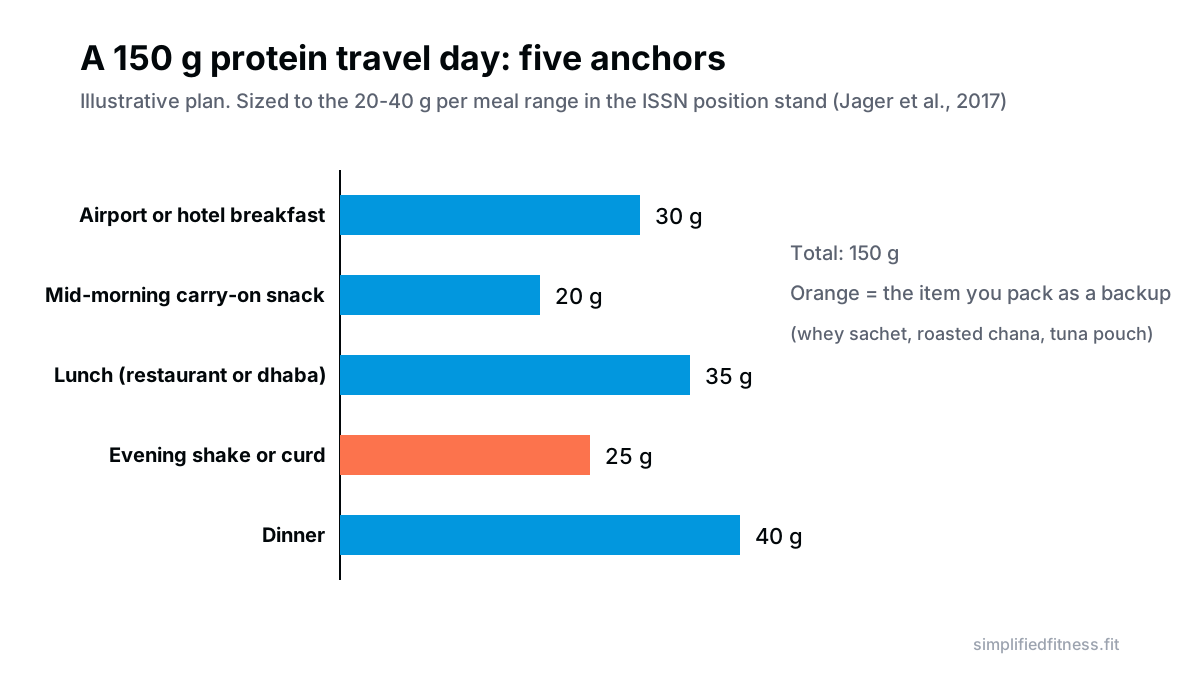
A simple routine for any travel day:
- Write the five anchors the night before.
- Eat protein first at each stop, then add rice, roti or fruit.
- Keep one packed backup (a whey sachet or tuna pouch) for when the plan fails.
You can work out your own number in seconds with our protein calculator.
What should I eat at the airport and on flights?
Airport food is expensive and often low in protein, so decide before you leave home.
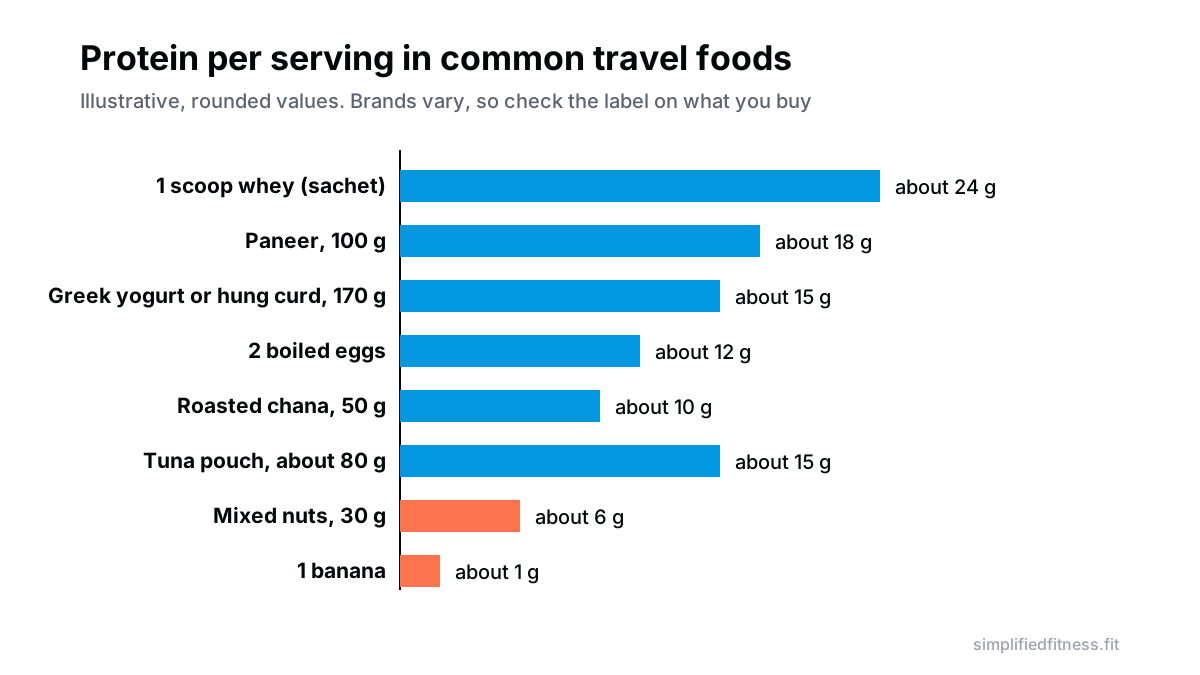
Pack: roasted chana, mixed nuts, protein bars you already tolerate, dry-roasted soya chunks or jerky, and single-serve whey sachets. If you want ideas that do not need a fridge, see our list of portable high-protein snacks that need no refrigeration.
Buy at the airport: Greek yogurt or curd cups, boiled eggs, egg-based breakfast items (egg bites and omelette wraps are common in many airports), chicken wraps, or paneer tikka. Check the label or ask, because protein amounts vary widely by brand and outlet.
Protein powder and security. Rules differ between airports and countries, and they change. Sachets are the safer bet because they are small and easy to inspect, while a large tub may trigger extra screening. Check your airline and airport guidance before flying.
Hydration on flights and water retention
Many people feel thirsty on a long flight and drink only when handed a cup. The evidence on flights specifically is thin, so here is what is actually supported.
A meta-analysis of five cycling time-trial studies (39 people) found that drinking to thirst gave better performance than drinking below thirst (Goulet, 2011). That is exercise data from a small number of healthy cyclists, not flight data, so treat it as a sensible guide and not a rule. If you have heart or kidney problems or are told to limit fluids, follow your doctor.
A practical plan: carry an empty bottle through security, fill it at the gate, and have water with each meal. Our water intake calculator gives a rough daily number, and the electrolytes guide covers sodium in hot climates.
Water retention. Restaurant food is often saltier, you sit for hours, and you may eat more carbohydrates than usual. That can push the scale up a kilogram or more without any fat gain. Our guides on daily scale weight fluctuations explain why. If you notice swollen legs, pain in one calf, or sudden breathlessness after a long trip, see a doctor promptly instead of blaming salt.
How do I eat well in a hotel without a kitchen?
This is where a plan beats willpower.
- When booking: request a mini-fridge. Many hotels provide one free or for a small fee.
- Within an hour of arriving: do a grocery run for curd, eggs, paneer, milk, fruit, nuts and bread or oats.
- Use the breakfast buffet strategically: eggs, curd, sprouts and dal-based items are protein-rich, and breakfast is one of the easiest anchors to hit.
- Bring a shaker: a whey sachet plus water or milk is a 25 g anchor in two minutes. See our comparison of whey isolate and concentrate if you are choosing what to pack.
- Order smart at restaurants: pick a protein (tandoori chicken, fish, paneer, egg dishes, dal) first, then add carbs.
Vegetarian travelers can lean on paneer, curd, milk, sprouts, dal, roasted chana and soya, with a whey sachet as a backup. Eggetarians have it easier with eggs everywhere.
If you plan to train, our hotel gym workout routine and vacation workout guide cover the session itself.
Road trip fitness snacks and highway food
Road trips are easier than flights because you control the bag.
Cooler bag: curd cups, boiled eggs, paneer cubes, milk or buttermilk, fruit. In hot Indian weather, keep these cold with ice packs and do not leave them in the car, because heat spoils protein foods fast. If in doubt, throw it out.
Dry kit: roasted chana, makhana, nuts, protein bars, whey sachets, dry-roasted soya, and a packet of poha or instant oats for a hotel breakfast.
Highway stops: choose tandoori chicken, egg bhurji, a plain omelette, dal with roti, or curd rice over fried snacks. Eat the protein first. Ask for less oil if you can.
A sample travel day for a vegetarian and an eggetarian
Here is how the anchors might look in practice. Treat the numbers as rough, not exact.
Vegetarian: hotel breakfast of curd plus sprouts and a paneer sandwich (about 30 g), roasted chana at the airport gate (about 10-15 g with a curd cup), a dal, curd and roti lunch with extra paneer (about 30 g), a whey sachet in the evening (about 24 g), and paneer tikka or soya curry for dinner (about 30-40 g). That lands around 130-140 g; a glass of milk or a second sachet closes the gap to 150 g.
Eggetarian: a three-egg omelette at breakfast (about 20 g) plus curd, two boiled eggs as a snack, egg curry and dal at lunch, a whey sachet or curd in the evening, and a paneer or egg-based dinner.
If you eat chicken or fish, tandoori chicken, grilled fish or a tuna pouch makes the lunch and dinner anchors easy. The point is the pattern, not the exact menu: protein first, a repeatable backup, and no long gaps.
What about calories, and what if I overeat?
Travel breaks the usual routine, so calories can swing in either direction. Matching your normal intake roughly, with protein first, is a reasonable default. Do not try to “make up” a big meal with a skipped one.
If you are cutting, you can lower the pressure by choosing one meal a day to enjoy freely and keeping the others simple. If you are bulking, restaurant portions often help, and a shake is a low-effort top-up. For jet lag and sleep (which affect appetite and training), the consensus statement on athletes notes that evidence is limited and recommendations are cautious (Janse van Rensburg et al., 2021), so our practical suggestion is simply to prioritise sleep and regular meals at your destination. Our jet lag protocol covers the timing in more detail.
The bottom line
Travel does not have to cost you progress. Plan four or five protein anchors, pack a small backup kit, shop within an hour of arriving, and drink to thirst. Expect the scale to be noisy for a few days. Then return to normal training and eating, and look at the trend over the next one or two weeks.
If you want a ready structure for meals, try our free diet plan and the protein calculator.
Frequently Asked Questions
How do I hit my protein target while traveling?
Plan four or five protein anchors of roughly 25-40 g each instead of relying on one big dinner. The ISSN suggests spreading protein across the day in doses of about 20-40 g, which is easier to do with eggs, curd, paneer, a whey sachet and one restaurant meal. Write the anchors on your phone the night before travel so you are not deciding while hungry.
Can I take protein powder on a plane?
Usually yes, but rules differ by country and airport, and powders in large containers may get extra screening. Single-serve sachets are easier to pack and to check, and they reduce the chance of a bag opened at security. Check your airline and airport rules before you fly, because they vary by route and change over time.
What are the best high-protein snacks for flights?
Dry, non-messy foods travel best: roasted chana, nuts, jerky or dry-roasted soya chunks, protein bars and whey sachets. Boiled eggs and paneer work for short journeys if kept cool, but they spoil in heat. Pick two or three you actually like, because a snack you do not eat does not help.
Do I need to worry about losing muscle on a short trip?
For a trip of a few days, there is little reason to expect meaningful muscle loss from slightly off nutrition. Muscle gain and retention depend mostly on keeping protein reasonably adequate and training when you can, and the evidence is stronger for long periods than for single weeks. Aim for your normal protein, do a basic hotel session, and carry on when you return.
How do I eat enough protein on a road trip?
Pack a small cooler or insulated bag with curd, boiled eggs and paneer, and stock a dry kit of nuts, roasted chana and whey sachets. Highway stops can still work if you choose tandoori chicken, egg bhurji, dal, curd or a plain omelette over fried sides. Eat protein first at each stop and fill up on rice or roti second.
How do I find protein in a hotel with no kitchen?
Request a mini-fridge when you book, then do a grocery run on arrival for curd, eggs, paneer, milk, fruit and nuts. Most of these need no cooking, and a shaker lets you mix a whey sachet with water or milk. Breakfast buffets are also one of the easiest protein wins, since eggs, curd and sprouts are usually on offer.
Why does my weight go up when I travel?
A quick rise on the scale is usually water, more sodium in restaurant food, extra carbohydrate (which holds water as glycogen), and bowel changes, not fat gain. Day-to-day weight can swing by a kilogram or more for these reasons. Wait a week of normal eating and training before judging, and see our guide on daily scale weight fluctuations.
How much water should I drink on a flight?
There is no single proven number, so drink regularly and use thirst as a guide. A meta-analysis of five cycling time-trial studies found that drinking to thirst performed better than drinking below thirst, though that was in exercise, not flying. Carry an empty bottle through security, fill it at the gate, and sip with meals.
Should I fast while traveling or skip meals to save money?
Skipping meals can work for some people, but it makes hitting 150 g of protein harder because you have fewer opportunities. Compressing protein into one or two meals goes against the usual advice to spread protein across the day. If you do skip, make the meals you eat count at 40 g or so, and keep a snack in your bag.
What should I eat after a long flight or drive?
Start with a protein-led meal and a drink, not a huge feast, especially if sleep was poor or timing is off. Protein and a few carbohydrates (rice, fruit, roti) support recovery without sitting heavy. If you are crossing time zones, our jet lag guide covers sleep and meal timing.
Is it fine to rely on protein bars while traveling?
Yes, as a backup, but they should not be your main protein source. Many bars have a lot of sugar or sugar alcohols, and the protein per rupee is often worse than eggs, curd or paneer. Read the label for at least 15-20 g protein and keep them for the gaps.
Do I need to eat more calories on a trip?
Not necessarily. If you walk far, carry bags and sightsee, you may burn more, but restaurant portions and snacks usually add up quickly. Match your normal intake roughly and let the scale settle before changing anything.
Sources & References
Every claim above is checked against peer-reviewed research (PubMed, U.S. National Library of Medicine) or guidance from established health bodies. How we fact-check.
- Morton RW, et al. A systematic review, meta-analysis and meta-regression of the effect of protein supplementation on resistance training-induced gains in muscle mass and strength in healthy adults. Br J Sports Med. 2018. PMID: 28698222
- Jager R, et al. International Society of Sports Nutrition Position Stand: protein and exercise. J Int Soc Sports Nutr. 2017. PMID: 28642676
- Yasuda J, et al. Evenly Distributed Protein Intake over 3 Meals Augments Resistance Exercise-Induced Muscle Hypertrophy in Healthy Young Men. J Nutr. 2020. PMID: 32321161
- MacKenzie-Shalders KL, et al. Increasing Protein Distribution Has No Effect on Changes in Lean Mass During a Rugby Preseason. Int J Sport Nutr Exerc Metab. 2016. PMID: 26132746
- Goulet ED. Effect of exercise-induced dehydration on time-trial exercise performance: a meta-analysis. Br J Sports Med. 2011. PMID: 21454440
- Janse van Rensburg DC, et al. Managing Travel Fatigue and Jet Lag in Athletes: A Review and Consensus Statement. Sports Med. 2021. PMID: 34263388

Umair Hazrami · Founder & Head Coach, Simplified Fitness
Umair Hazrami founded Simplified Fitness and the Simplified Lifter channel to cut through fitness noise. With 4+ years of consistent training and 10+ coaching clients, he writes every guide from the peer-reviewed research and links the sources so you can check them. Our editorial standards.
Educational content only, not medical advice. If you have a medical condition, are pregnant, or take medication, talk to a qualified doctor before changing your diet, supplements or training. Full disclaimer.
Keep reading
Indian Diet
The 3-Hour Weekly Batch Meal Prep: Cooking 5 Days of Lunches and Dinners for Busy Lifters
Batch meal prep for the week in 3 hours: a station-by-station Sunday plan for 10 high-protein lunches and dinners, with Indian options and safe storage rules.
7 min read
Indian Diet
Cost per 30 Grams of Protein: 40 Common Fitness Foods Ranked by Price
Cost per 30g protein for 40 Indian gym foods, from soya chunks to whey and tuna. See the cheapest protein sources per gram and what to buy on a budget.
8 min read
Indian Diet
Eating Healthy on a Student Budget: High Protein Hostel and Dorm Room Meal Prep
A college student bodybuilding diet budget can still hit 130 g of protein. Cheap staples, no-cook hostel prep and a sample day, with the studies linked.
8 min read
Indian Diet
Essential Kitchen Equipment for Lifters: Scales, Air Fryers, Blenders and Containers
The best kitchen equipment for meal prep lifters: which four tools earn their space, what the research says about each, and what to buy first on a budget.
10 min read