High-Calorie Healthy Foods for Hardgainers: Peanut Butter, Oats, Nuts, Olive Oil
High calorie healthy foods for hardgainers who feel full too fast: peanut butter, oats, nuts, milk and olive oil, with the research on liquid calories.
TL;DR. The short answer
- The best high calorie healthy foods for hardgainers are low in volume but high in energy: natural peanut butter (about 95 kcal per tablespoon), olive oil (about 120 kcal per tablespoon), nuts, whole milk, dates, oats and bananas.
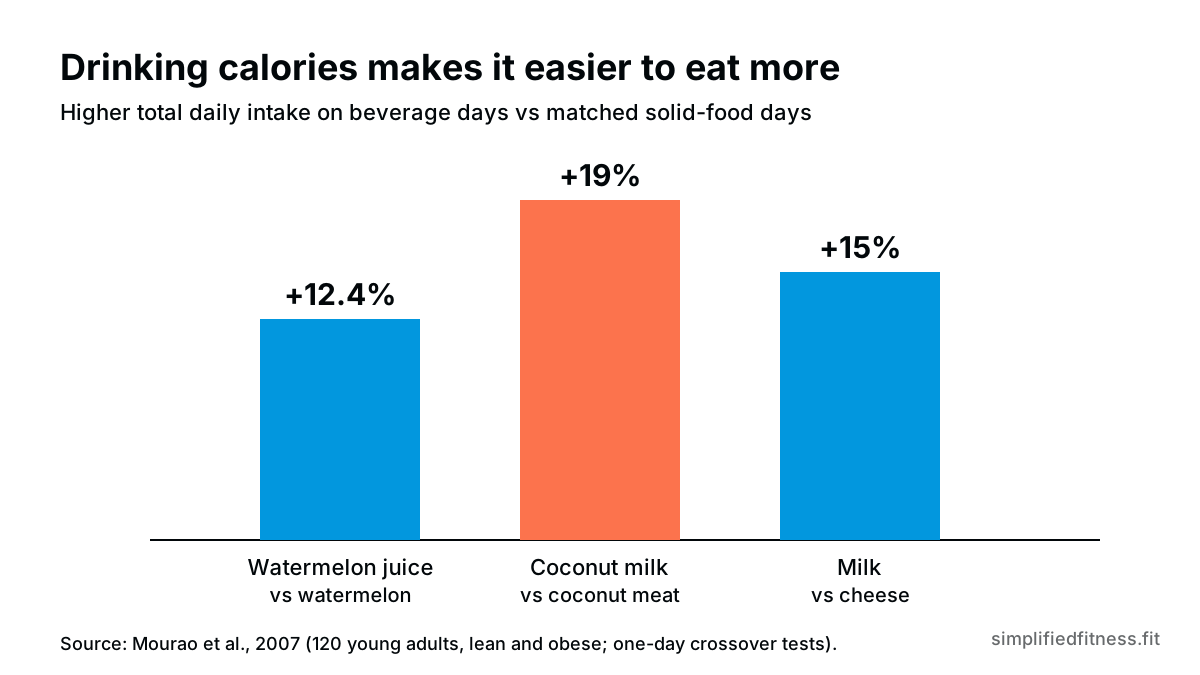
- Drinking calories makes overeating easier. In a 120-person crossover study, daily intake was 12-19% higher on days when the same food was taken as a drink instead of a solid.
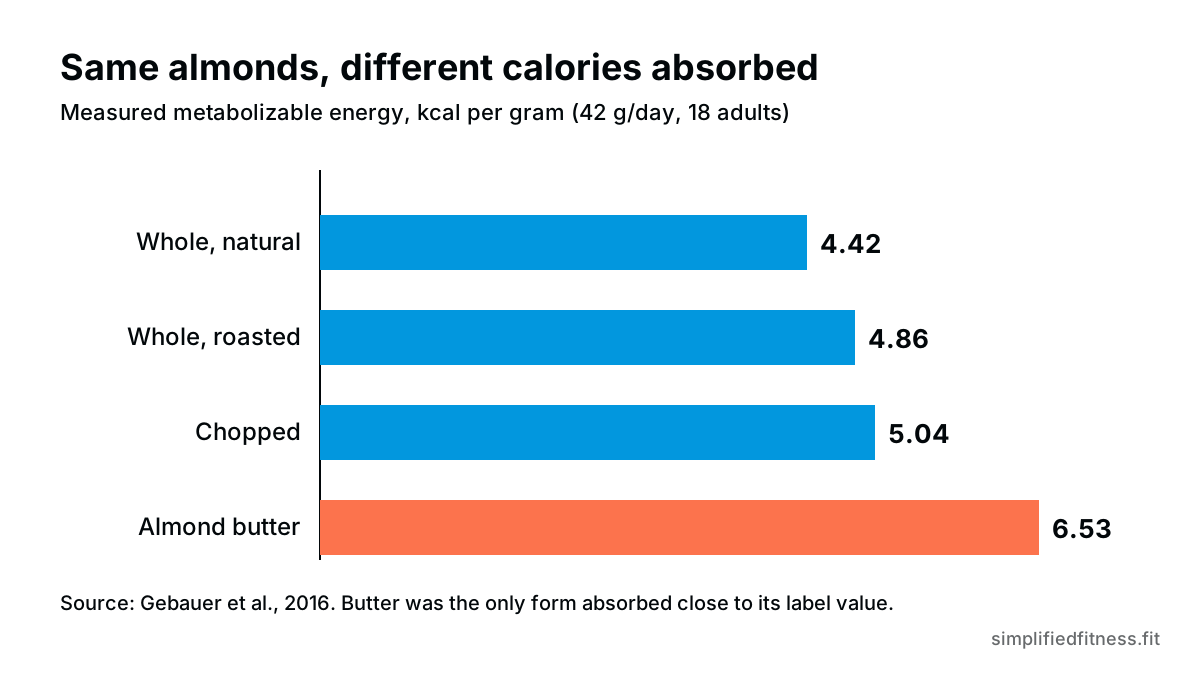
- Nuts are not as fattening as the label says. Whole almonds delivered about 4.4 kcal per gram in a controlled trial, while almond butter delivered about 6.5, so butter is the more reliable surplus food.
- Aim for a surplus of roughly 300-500 kcal a day, added in small steps to your usual meals, rather than forcing 3,000 kcal in three giant plates.
- If you are very thin, losing weight without trying, or get full after a few bites every time, see a doctor before assuming it is just a fast metabolism.
Part of our complete guide: High-Protein Foods List: Protein per 100g, Cost per 30g and Meal Prep Guide
Table of contents
The best high calorie healthy foods for hardgainers are the ones that pack a lot of energy into a small bite: natural peanut butter, olive oil, nuts, whole milk, dates, oats and bananas. They let you raise your daily calories without eating a mountain of food, which is what makes most skinny lifters give up on bulking.
This guide sits inside our wider high-protein foods and meal prep guide, but the problem here is different. You are not short of protein knowledge. You are full after two rotis and a bowl of dal, and 3,000 kcal looks impossible.
Why can’t skinny guys just eat more?
Because “just eat more” ignores volume. A plate of rice, dal and sabzi is filling and, per bite, fairly low in energy. You hit fullness long before you hit your calorie target.
Two things usually go wrong. First, people try to cram three giant meals, and feeling stuffed after one usually kills your appetite for the next. Second, people overestimate what they already eat. A couple of weeks of honest tracking often shows the “I eat loads” intake is closer to maintenance than to a surplus.
Is there ever a biological reason? Possibly. In a small 2-week overfeeding study, people classed as constitutionally thin (n=23, plus 22 normal-weight controls) failed to gain lean mass on an extra 600 kcal a day, and they had higher levels of appetite-suppressing gut hormones (Ling et al., 2020). That was a short study in a specific, clinically defined group, so it does not mean your slow progress is genetic. It is a reason to see a doctor if you are very underweight, losing weight unintentionally, or get full or sick after tiny meals. It is not a reason to skip the basics.
How big does the surplus need to be?
Sports nutrition guidance usually suggests adding about 300-500 kcal a day, with enough protein and carbohydrate, alongside hard resistance training. A 2022 review of that advice found the evidence for intentional weight gain is thinner than people assume, and that gaining about 0.45 kg a week mostly as lean mass may be difficult for some athletes (Larson-Meyer et al., 2022). The same review found that bigger portions, energy-dense foods and prioritising liquids over solids may help create the surplus.
Planning matters. In a randomised trial of 21 elite athletes, the group given a meal plan with a surplus of about 506 kcal a day gained more lean mass (2.8%) than the group eating freely, whose lean mass did not change (Garthe et al., 2011). These were young elite athletes training four times a week, so treat it as support for having a plan, not a promise of that exact gain.
To find your starting number, run your stats through the calorie calculator, then add 300-500 kcal. If you want the bigger picture on surplus size, see our article on lean bulking versus dirty bulking.
Which foods give the most calories for the least volume?
Think in “add-ons”, not new meals. Each of these slides into something you already eat.
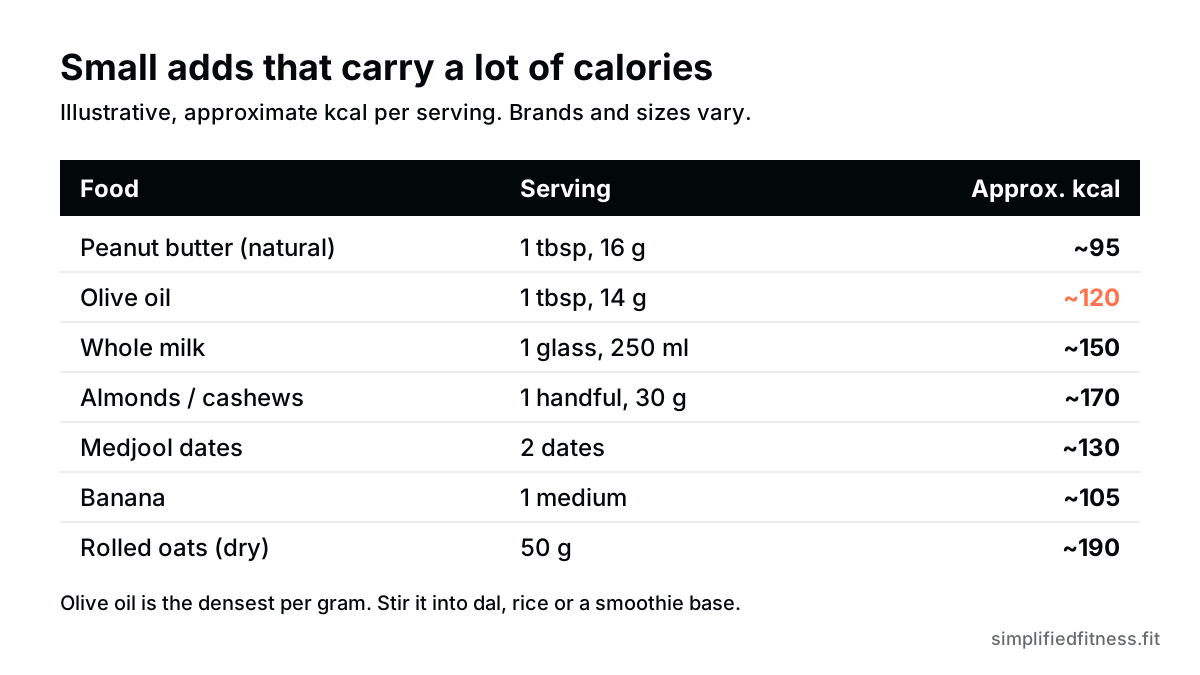
Values are rounded and approximate, so check your own labels. The reason fats work so well: they carry roughly twice the energy per gram of carbohydrate or protein, and a spoon of oil barely registers as “food” in your stomach.
Natural peanut butter
About 95 kcal per tablespoon, plus some protein and mostly unsaturated fat. A natural jar (peanuts and salt only) avoids added sugar and hydrogenated oils. Two tablespoons on roti, oats or a banana is roughly 190 kcal in under a minute.
Extra virgin olive oil (or ghee)
Around 120 kcal per tablespoon, with no added volume. Stir one or two tablespoons into dal, sabzi, khichdi or a smoothie base. Ghee is nearly the same per spoon, so use whichever fits your cooking.
Whole milk and curd
Whole milk brings roughly 150 kcal per 250 ml glass with protein and calcium. Full-fat curd and paneer do the same job in solid form. If you buy toned milk, you are giving up easy calories.
Nuts and dry fruit
A 30 g handful of almonds, cashews or peanuts is roughly 170 kcal. Medjool dates add fast carbohydrate and are easy to eat around training. Keep a box at your desk and in your bag.
Oats and bananas
Oats cooked in whole milk with a banana and a spoon of peanut butter reaches 500-600 kcal in one bowl, which is hard to say about most breakfasts. Bananas are cheap, portable and gentle on the stomach.
Do liquid calories help you gain weight?
Often, yes. Your body seems to compensate less precisely for calories you drink.
In a crossover study of 120 adults aged 18 to 50 (half lean, half obese, 40 people per food pair), the same foods were given as a drink or as a solid (watermelon and watermelon juice, cheese and milk, coconut meat and coconut milk). Total daily energy intake was 12.4%, 15% and 19% higher on the beverage days for the carbohydrate, protein and fat foods respectively, mainly because the drinks were less filling afterwards (Mourao et al., 2007).
The wider literature is mixed. A review of the evidence found that some studies show liquids are less satiating than solids and others show the opposite, with results depending on the person, the volume and the gap before the next meal (Almiron-Roig et al., 2003). So the practical takeaway is cautious: a smoothie or a glass of milk is worth trying as an extra, and you should watch whether it spoils your next meal. If it does, move it later.
A simple 700 kcal hardgainer smoothie
Blend 300 ml whole milk, 1 banana, 40 g oats, 2 tablespoons peanut butter and 2 dates. That is roughly 700 kcal by the figures above, and most people can drink it in ten minutes. Add a scoop of whey or a few spoons of milk powder if you need more protein.
Are nuts as fattening as the label says?
Less than you would think, and that cuts both ways.
Nuts are energy-dense, yet a meta-analysis of 55 randomised trials found that adding nuts to the diet caused no change in body weight (Guarneiri et al., 2021). One reason appears to be that you do not absorb all the fat. A systematic review of 21 studies found the energy people actually absorbed from almonds, cashews, hazelnuts, pistachios, walnuts and peanuts was consistently lower than label factors predict (Nikodijevic et al., 2023).
Form matters. In a controlled crossover trial of 18 adults, whole natural almonds delivered about 4.42 kcal per gram, roasted 4.86, chopped 5.04 and almond butter 6.53, which was close to the predicted value (Gebauer et al., 2016).
What does a 3,000 kcal day look like with Indian foods?
Here is one illustrative day, roughly 3,000 kcal. Swap items freely and adjust to your own needs.
| Time | Meal | Approx. kcal |
|---|---|---|
| Breakfast | Oats cooked in 300 ml whole milk, banana, 1 tbsp peanut butter | 650 |
| Mid-morning | Handful of almonds and peanuts, 2 dates | 300 |
| Lunch | 3 rotis with ghee, dal with 1 tbsp olive oil, paneer sabzi, curd | 850 |
| Pre-workout | Banana and a glass of whole milk | 250 |
| Dinner | Rice, rajma or chicken curry, sabzi, 1 tbsp oil in the cooking | 750 |
| Bedtime | Whole milk with a spoon of peanut butter on bread | 300 |
Roughly 3,100 kcal. Only two items here are large meals; the rest are small. For a fully vegetarian version with protein targets, see our Indian vegetarian lean bulking diet. If appetite is held back by gas or heaviness, our piece on digestive enzymes and bulking bloat covers what the evidence says.
In a hot climate, heavy fried food in the afternoon can kill appetite. Cold smoothies, lassi-style drinks and dry fruit are easier to get through in summer.
How do you make it easier to eat day after day?
- Eat on a clock. Set meals and snacks at fixed times. Waiting to feel hungry does not work for most hardgainers.
- Use the foods that do not need chewing much. Smoothies, milk, nut butter, oats, curd rice.
- Cook with oil. An extra tablespoon in each of two meals is 240 kcal that you do not taste.
- Do not skip protein. The surplus supports growth only if you are also training hard and eating enough protein; check yours with the protein calculator.
- Weigh yourself weekly, same conditions. If the average has not moved after two weeks, add 200-300 kcal.
- Be patient. The fix is consistency over months, not one heroic 4,000 kcal day.
For realistic monthly gain targets, read our guide to target rates of weight gain for natural lifters.
When should you see a doctor?
Get checked if you are underweight for your height, have lost weight without trying, feel full after a few bites every time, or have pain, vomiting, diarrhoea, or persistent fatigue. Thyroid problems, digestive conditions and other medical issues can all make weight gain hard, and food advice will not fix them. This guide is general information, not a diagnosis.
If you have diabetes, high cholesterol or a family history of heart disease, ask your doctor or dietitian before loading up on ghee, oil and sweetened drinks.
Frequently Asked Questions
What are the best high calorie healthy foods for hardgainers?
Natural peanut butter, whole milk, nuts, olive oil, ghee, dates, bananas, oats and paneer give the most calories for the least volume. They also bring protein, fats and micronutrients instead of just sugar. Pick three or four you actually enjoy and add them to meals you already eat.
How do I eat 3000 calories a day without feeling sick?
Spread the food over five or six smaller eating moments instead of three huge meals. Many people find a very large plate leaves them too stuffed to want the next meal, so smaller feeds more often are usually easier to finish. Add calories through oil, nut butter and milk rather than just more plates of rice.
Are liquid calories good for weight gain?
They can help, because studies show people compensate less for calories they drink than for the same food eaten solid. A 2007 crossover trial found total daily intake was 12-19% higher on beverage days. Use a smoothie or milk as an extra alongside meals, not as a replacement for them.
Is peanut butter good for muscle gain?
Yes, as a calorie-dense food with some protein and mostly unsaturated fat, it is a very practical choice. One tablespoon gives about 95 kcal but only a few grams of protein, so it supports a surplus rather than replacing protein foods. Choose a natural jar with just peanuts and salt, and measure the spoon at first.
Do nuts really have as many calories as the label says?
Probably a bit fewer when you eat them whole. A 2023 systematic review found the energy absorbed from nuts was consistently lower than predicted by standard calorie factors, and almond butter was absorbed more completely than whole almonds. If you want the maximum surplus, blend nuts into butter or smoothies.
Is olive oil a good way to add calories?
Yes, because it is the densest option here at about 120 kcal per tablespoon and you barely notice it. It adds no fullness, so it suits people who stop eating early. Stir a tablespoon or two into dal, sabzi, rice or a smoothie base.
Can I gain weight on a vegetarian Indian diet?
Yes, but you have to plan for it, because dal, roti and sabzi are filling and low in energy per bite. Add ghee, paneer, curd, peanuts, dry fruit and whole milk to push calories up without more volume. Our Indian vegetarian lean bulking guide gives a full day of meals.
How many extra calories do I need to gain muscle?
A surplus of about 300-500 kcal a day is the range commonly recommended for athletes who want to gain weight. A 2022 review notes that the evidence for exact numbers is thin, so treat it as a starting point and adjust to your scale weight every two weeks. Use a calorie calculator for your maintenance number first.
Why am I always full after small meals?
Big, high-fibre, high-water meals fill the stomach fast and can suppress appetite for hours. Swapping some volume for calorie-dense foods lets you eat the same plate with more energy on it. If fullness comes with pain, vomiting or weight loss, see your doctor.
Is it really a fast metabolism, or am I just not eating enough?
For most skinny lifters, the honest answer is not eating enough consistently, because it is easy to misjudge how much you really eat across a week. Tracking intake for two weeks will show you the real number. A small group of naturally very thin people do seem to resist weight gain, but that needs a doctor's assessment, not guesswork.
Should I do a dirty bulk if I struggle to eat?
It is tempting, but junk food adds sugar and fat without much protein or micronutrients and makes you feel worse. You can reach the same calories with whole foods that are just as easy to eat. Keep protein at a normal training level and let the extra energy come from nuts, oil, dairy and starches.
How fast should I expect to gain weight?
A common starting target is roughly 0.25-0.5 kg a week for beginners, and many people gain slower than the textbook numbers. A 2022 review noted that gaining 0.45 kg a week, mostly as lean mass, may be hard for some athletes. If the scale has not moved in two weeks, add about 200-300 kcal a day.
Is ghee better than olive oil for gaining weight?
Calorie-wise they are almost the same per spoon, so the better choice is the one you will actually use daily. Ghee suits rotis, dal and rice; olive oil suits salads and smoothies. Keep total saturated fat reasonable if you have high cholesterol, and ask your doctor if unsure.
Sources & References
Every claim above is checked against peer-reviewed research (PubMed, U.S. National Library of Medicine) or guidance from established health bodies. How we fact-check.
- Mourao DM, et al. Effects of food form on appetite and energy intake in lean and obese young adults. Int J Obes. 2007. PMID: 17579632
- Almiron-Roig E, et al. Liquid calories and the failure of satiety: how good is the evidence? Obes Rev. 2003. PMID: 14649371
- Gebauer SK, et al. Food processing and structure impact the metabolizable energy of almonds. Food Funct. 2016. PMID: 27713968
- Nikodijevic CJ, et al. The Metabolizable Energy and Lipid Bioaccessibility of Tree Nuts and Peanuts: A Systematic Review with Narrative Synthesis of Human and In Vitro Studies. Adv Nutr. 2023. PMID: 36934832
- Guarneiri LL, et al. Intake of Nuts or Nut Products Does Not Lead to Weight Gain, Independent of Dietary Substitution Instructions: A Systematic Review and Meta-Analysis of Randomized Trials. Adv Nutr. 2021. PMID: 32945861
- Larson-Meyer DE, et al. Weight Gain Recommendations for Athletes and Military Personnel: a Critical Review of the Evidence. Curr Nutr Rep. 2022. PMID: 35233712
- Garthe I, et al. Long-term effect of nutritional counselling on desired gain in body mass and lean body mass in elite athletes. Appl Physiol Nutr Metab. 2011. PMID: 21851204
- Ling Y, et al. Resistance to lean mass gain in constitutional thinness in free-living conditions is not overpassed by overfeeding. J Cachexia Sarcopenia Muscle. 2020. PMID: 32274897

Umair Hazrami · Founder & Head Coach, Simplified Fitness
Umair Hazrami founded Simplified Fitness and the Simplified Lifter channel to cut through fitness noise. With 4+ years of consistent training and 10+ coaching clients, he writes every guide from the peer-reviewed research and links the sources so you can check them. Our editorial standards.
Educational content only, not medical advice. If you have a medical condition, are pregnant, or take medication, talk to a qualified doctor before changing your diet, supplements or training. Full disclaimer.
Keep reading
Indian Diet
The 3-Hour Weekly Batch Meal Prep: Cooking 5 Days of Lunches and Dinners for Busy Lifters
Batch meal prep for the week in 3 hours: a station-by-station Sunday plan for 10 high-protein lunches and dinners, with Indian options and safe storage rules.
7 min read
Indian Diet
Cost per 30 Grams of Protein: 40 Common Fitness Foods Ranked by Price
Cost per 30g protein for 40 Indian gym foods, from soya chunks to whey and tuna. See the cheapest protein sources per gram and what to buy on a budget.
8 min read
Indian Diet
Eating Healthy on a Student Budget: High Protein Hostel and Dorm Room Meal Prep
A college student bodybuilding diet budget can still hit 130 g of protein. Cheap staples, no-cook hostel prep and a sample day, with the studies linked.
8 min read
Indian Diet
Essential Kitchen Equipment for Lifters: Scales, Air Fryers, Blenders and Containers
The best kitchen equipment for meal prep lifters: which four tools earn their space, what the research says about each, and what to buy first on a budget.
10 min read