The 80/20 Rule in Nutrition: How to Fit Treats in and Stay Consistent for Years
The 80 20 rule nutrition lifters use: 80% whole foods, 20% treats. See the maths, what research says about flexible dieting, and how to fit pizza into a cut.
TL;DR. The short answer
- The 80/20 rule means roughly 80% of your calories come from protein-rich whole foods and about 20% are left for foods you simply enjoy, such as pizza, ice cream or mithai. It is a practical rule of thumb, not a tested threshold.
- On a 2,000 kcal day, 20% is about 400 kcal. That is a real treat, but it is not an open buffet.
- Observational studies link flexible dietary control with better weight maintenance and rigid, all-or-nothing control with more food preoccupation. These are associations, not proof that flexibility causes better results.
- You can eat pizza while cutting if it fits your calorie budget and you have hit your protein target. Fat loss is decided by your overall weekly intake, not by one food.
- If food rules are causing binge eating, intense guilt or distress, speak to a doctor or a registered dietitian rather than tightening the rules further.
Part of our complete guide: High-Protein Foods List: Protein per 100g, Cost per 30g and Meal Prep Guide
Table of contents
Yes, you can eat pizza or chocolate every week and still keep a lean physique. The 80 20 rule nutrition approach says about 80% of your calories come from protein-rich whole foods, and the remaining 20% can be foods you just enjoy. It works because fat loss depends on your overall calorie balance, and because a plan with room in it is easier to follow for years. This sits inside our wider guide to high-protein foods and meal prep, which covers what goes into the 80%.
One honest caveat first. “80/20” is a coaching rule of thumb, not a number discovered in a lab. No trial has tested 80% versus 70% or 90%. What we do have is research on flexible versus rigid eating, weight maintenance and food preoccupation, and that is what this article leans on.
What is the 80/20 rule in nutrition, exactly?
It is a sorting rule for calories. Most of your intake comes from foods that give you protein, fibre and micronutrients: dal, eggs, paneer, curd, chicken, fish, soya, roti, rice, oats, fruit and vegetables. A smaller slice is discretionary: pizza, ice cream, chocolate, samosas, gulab jamun, a weekend biryani.
Here is the maths on a 2,000 kcal day.
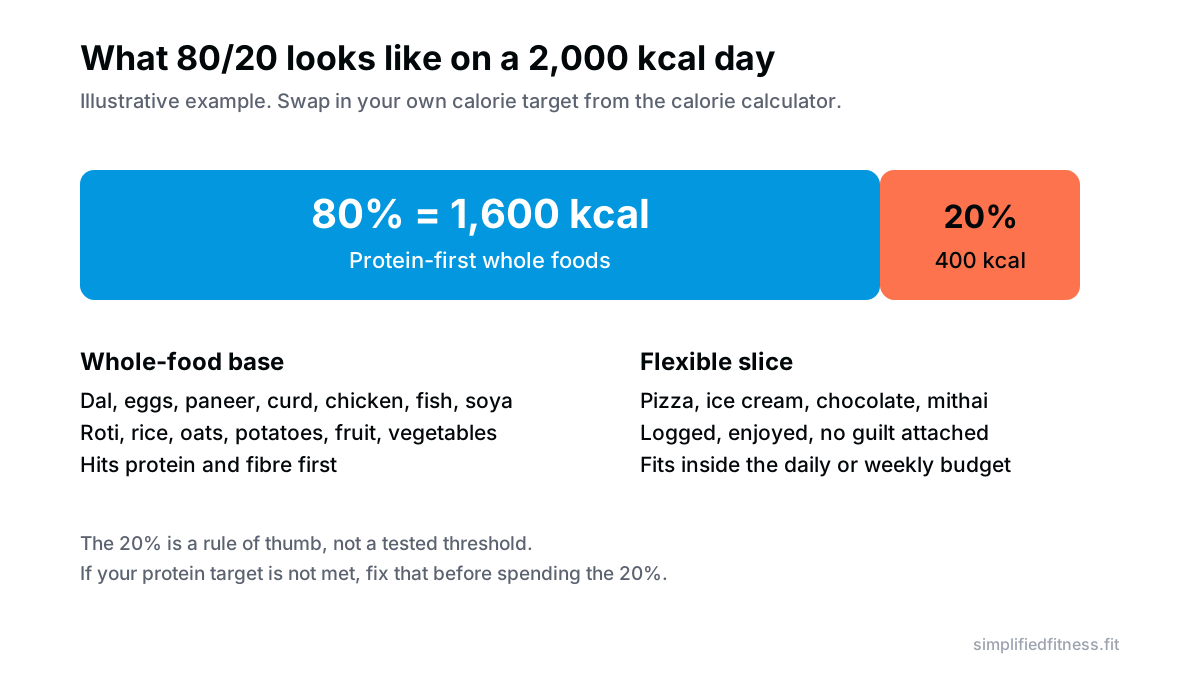
The key detail most people miss: the 20% is a share of your calorie target, not extra on top of it. If you are cutting at 1,800 kcal, your 20% is about 360 kcal. If you eat 1,800 kcal of clean food and then add a 400 kcal dessert, you are at 2,200 kcal, and the deficit you planned is gone. Work out your target with the calorie calculator first.
Can you eat pizza while cutting?
You can, with one condition: it has to fit. Fat loss comes from sustained intake below what you burn. One pizza night does not erase that if the rest of your week is in order, and one salad does not create it if the rest of your week is not.
Here is how a lifter might do it in practice:
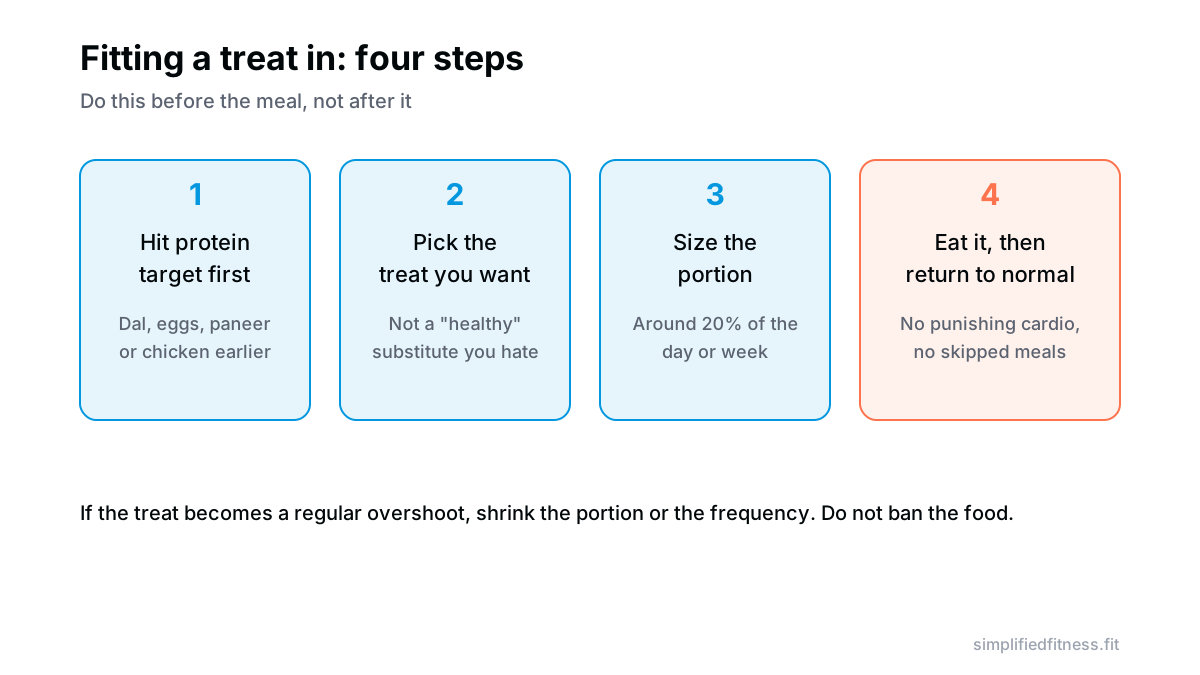
- Hit your protein target earlier in the day (dal, eggs, curd, paneer, chicken or fish).
- Eat lighter and simpler around the pizza meal.
- Decide the portion in advance, for example 2-3 slices rather than “until I stop”.
- Eat it without guilt, then eat your normal next meal.
Restaurant slices vary a lot in size and calories, so treat any figure you log as an estimate. If you need a plan for restaurant meals specifically, see our fast-food survival guide.
What does the research say about flexible versus rigid eating?
Psychologists separate two styles of dietary control. Rigid control is all-or-nothing: foods are allowed or banned, and one slip means the diet is ruined. Flexible control accepts that any food can appear in moderation and adjusts afterwards.
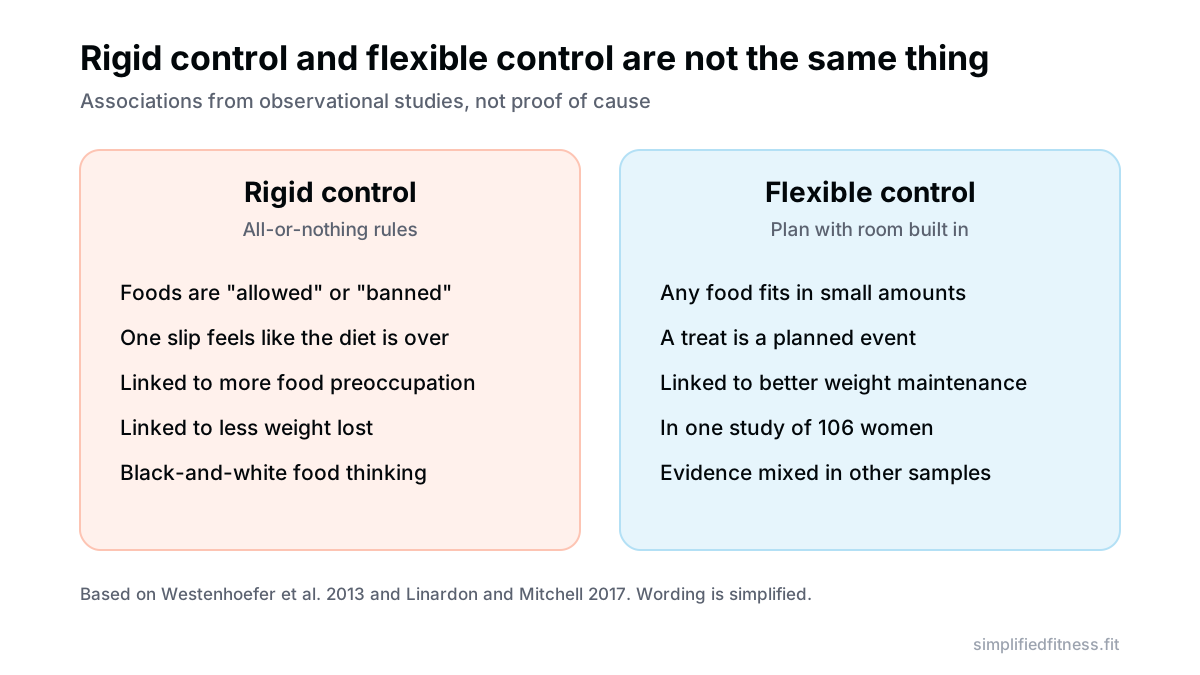
A few studies are worth knowing, along with their limits.
- Weight maintenance. In 106 women who had already lost weight with a slimming organisation, flexible restraint was associated with more weight lost and better maintenance over six months, while rigid restraint was associated with less weight loss. Rigid restraint was also linked to more attention to food and body-shape cues (Westenhoefer et al., 2013). This was an association in women using a commercial program, so we cannot assume it applies equally to male lifters or prove cause and effect.
- Disordered eating. Among 372 adults, intuitive eating predicted lower disordered eating and body image concerns, and the link ran through less all-or-nothing thinking. Flexible control gave a mixed picture: once rigid control was accounted for, it predicted lower disordered eating but higher body image concerns (Linardon and Mitchell, 2017). So the evidence for flexibility is not as clean as the fitness internet makes it sound.
- Dieting status. In 433 women, rigid control was strongly tied to dieting to lose weight, while both rigid and flexible control were tied to dieting to maintain weight. The authors said this needs more study (Timko and Perone, 2006).
What a cautious reader should take away: the studies lean the same way, that rigid, black-and-white thinking about food tends to go with worse outcomes. They are cross-sectional or short-term, mostly in women, and they do not prove that adding treats improves body composition. The sensible reading is that building flexibility into a plan is low-risk and may help you stick to it.
Why does this help you stay consistent for years?
Because most diets fail on adherence, not on maths.
Long-term maintainers give a clue. In a review of the National Weight Control Registry, whose members lost an average of 33 kg and kept it off for more than five years, successful maintainers reported high physical activity (about an hour a day), regular breakfast, self-weighing and a consistent eating pattern across weekdays and weekends. The same review noted that maintenance seems to get easier after two to five years (Wing and Phelan, 2005). This is a registry of people who succeeded, so it cannot tell us what would work for everyone.
Notice what that last point means for 80/20. Consistency matters, so a small treat most days or a modest treat a few times a week fits better than a 5,000 kcal Sunday after six days of restriction.
Self-monitoring also helps. A systematic review found a consistent association between tracking food, exercise or weight and weight loss, but rated the evidence as weak because of study limitations and mostly white female samples (Burke et al., 2011). You do not need to track forever. Tracking for a few weeks teaches you what 400 kcal of mithai actually looks like.
If you want the numbers-driven version of this, read our guide to long-term adherence with flexible dieting and IIFYM, and for the habit side see the behavioural science of gym habits.
Why the 80% still matters
Flexible does not mean “eat anything”. There is a reason the base of the diet needs to be whole food, and it is not morality.
In a tightly controlled 2019 inpatient trial, 20 weight-stable adults ate an ultra-processed diet for two weeks and an unprocessed diet for two weeks, in random order, with meals matched for presented calories, energy density, sugar, sodium, fibre and macronutrients. When allowed to eat as much as they liked, they ate about 508 kcal per day more on the ultra-processed diet (Hall et al., 2019). It was a small, short trial in a hospital setting, so the exact number will not translate neatly to your life. But it supports a practical point: highly processed food is easy to overeat, so most of your plate should be food that fills you up.
That is also why the 80% should be protein-first. Whole-food protein sources keep you full and make your calorie target feel generous instead of stingy. In the Indian context, that means dal, rajma, chana, curd, paneer, eggs, soya chunks and lean meats do most of the work, and your protein calculator number comes before dessert.
How do I set up my own 80/20 week?
You have two ways to do it.
Option 1: a small daily treat. Save about 10-20% of your calories for something you look forward to each day, such as a square or two of dark chocolate, a scoop of ice cream or a roti with extra ghee. This suits people who feel deprived without something every day.
Option 2: weekly planned meals. Keep the week simple and use the 20% on two or three planned meals, such as a pizza night, a family biryani lunch and a dessert. This suits people who prefer bigger, more satisfying treats and can go back to normal afterwards.
| Setup | Example on 14,000 kcal a week | Works well for | Watch out for |
|---|---|---|---|
| Daily small treat | About 200-400 kcal each day | People who crave something daily | Treats creeping up in size |
| Weekly planned meals | 2-3 meals totalling about 2,800 kcal | Social eaters, family dinners | Banking calories and bingeing |
| Mixed | Small daily treat plus one bigger meal | Most lifters | Losing count of the total |
Those weekly figures are illustrative. Use your own target.
What about diet breaks and very lean physiques?
For a long cut, planned breaks work in a similar spirit to 80/20. In the MATADOR trial, 47 men with obesity started either 16 weeks of continuous restriction or the same 16 weeks of restriction split into two-week blocks alternating with two-week blocks of energy balance. Among the 36 who completed the protocol, the intermittent group lost more weight (14.1 versus 9.1 kg) and more fat mass, with similar fat-free mass loss (Byrne et al., 2018). The participants were men with obesity, not lean lifters, and the intermittent group took 30 weeks in total, so this is not a quick-fix result. We compare breaks and refeeds in diet breaks vs refeeds.
At the very lean end, things change. A review of physique athlete nutrition recommends slower rates of weight loss (about 0.5% of body mass per week or less) and notes that physique athletes report higher rates of disordered eating and body image concerns, which certain traditional contest practices may worsen (Roberts et al., 2020). If you are chasing a stage-lean look, the room for treats shrinks, and professional support is worth having.
When to see a doctor or dietitian
80/20 is meant for healthy adults who want a calmer relationship with food. Speak to a doctor or registered dietitian if you:
- binge eat regularly or feel out of control around food
- feel strong guilt or shame after eating treats
- have diabetes, high blood pressure, high cholesterol, kidney disease or are pregnant
- find that food rules are limiting your social life
In those situations, “just apply 80/20” is not the right advice, and rigid food rules can make some of these patterns worse.
The bottom line
The 80 20 rule nutrition approach is simple: protein-first whole foods for most of your calories, a planned slice for the foods you love, and no moral labels attached to either. It does not guarantee a shredded physique, and the percentages are a convenience rather than a law. What it does is make a decent diet livable, and a livable diet is the one that is still running in year three.
Start by setting your calorie target, hit protein, then decide what your 20% looks like this week. If you want training that matches the diet, our free workout plans are a good place to start.
Frequently Asked Questions
What is the 80/20 rule in nutrition?
It is a flexible eating approach where about 80% of your calories come from nutrient-dense whole foods and about 20% come from foods you enjoy but would not call nutritious. It works because you still control total calories while removing the sense that any food is off limits. Pick a weekly calorie target first, then decide how much of it the 20% represents.
Can I eat pizza while cutting and still lose fat?
Yes, if the pizza fits inside your calorie budget for the day or week. Fat loss depends on a sustained calorie deficit, so one meal does not cancel it unless it pushes your total well over budget. Hit your protein first, plan the slices in advance and keep the rest of the day simple.
Is 80/20 the same as flexible dieting or IIFYM?
They overlap but are not identical. Flexible dieting usually tracks calories and macros so any food can fit, while 80/20 is a simpler guideline that uses food quality as the main sorting rule. If you like numbers, use macros; if tracking stresses you out, 80/20 is easier to run.
Should the 20% be daily or weekly?
Either can work, and the right one is whichever you can repeat. A daily 20% gives you a small treat every day, while a weekly 20% lets you save up for a bigger meal. Research on weight maintainers suggests keeping eating patterns fairly consistent across weekdays and weekends, so avoid putting the whole 20% into one blowout.
Will 80/20 slow my fat loss compared with strict dieting?
Not if your total calories are the same. A strict plan you abandon after six weeks is unlikely to beat a flexible plan you can follow for six months. Keep the deficit modest enough that the treat budget is realistic.
Do treats ruin muscle growth?
No, occasional treats do not stop muscle growth. Muscle gain depends mainly on progressive training, enough protein and an adequate calorie intake. If treats crowd out your protein, the problem is the protein shortfall, not the treat.
What counts as a whole food in the 80%?
Think of foods close to how they grew or were raised: dal, rajma, chana, eggs, paneer, curd, milk, chicken, fish, soya chunks, roti, rice, oats, potatoes, fruit and vegetables. Lightly cooked home food counts. If a food is mostly a packaged snack engineered to be easy to overeat, it belongs in the 20%.
Is eating junk food 20% of the time actually healthy?
The 80/20 rule is a behavioural tool, and no trial has tested it as a health guarantee. Heavily processed foods can be easy to overeat, so the base of your diet still needs to be whole foods with enough fibre and protein. If you have diabetes, high blood pressure or high cholesterol, ask your doctor what is realistic for you.
How do I stop one treat turning into a whole day of overeating?
The 'I already blew it' thought is a classic all-or-nothing pattern, and research links rigid thinking with more preoccupation with food. Plan the treat in advance, eat it slowly without distractions and go straight back to your normal next meal. Avoid skipping meals or doing extra cardio as punishment.
How many cheat meals should I have per week?
There is no research-backed number. A practical range is one to three planned treats a week that together stay inside your 20%, with the size matching your calorie target. The word 'cheat' also frames food as wrongdoing, so calling it a planned meal tends to work better.
Does the 80/20 rule work for vegetarians?
Yes. The only change is making the 80% protein-first using dal, curd, paneer, tofu, soya and eggs if you eat them. Vegetarian meals are often lower in protein density, so check your total before spending the 20%.
What if I am preparing for a competition or a very lean physique?
Very lean contest prep usually needs tighter control, and physique athletes report higher rates of disordered eating and body image concerns. A review for physique athletes recommends slow weight loss, notes that diet breaks and refeeds may help, and offers guidance on disordered eating and body image. If you are lean for a photoshoot or event, plan a return to a more flexible approach afterwards.
When should I speak to a professional about my eating?
See a doctor or registered dietitian if you binge eat regularly, feel intense guilt after eating, avoid social situations because of food, or have a medical condition such as diabetes. Rigid food rules can worsen disordered eating in some people. An assessment is better than guessing.
Sources & References
Every claim above is checked against peer-reviewed research (PubMed, U.S. National Library of Medicine) or guidance from established health bodies. How we fact-check.
- Westenhoefer J, et al. Cognitive and weight-related correlates of flexible and rigid restrained eating behaviour. Eat Behav. 2013. PMID: 23265405
- Linardon J, et al. Rigid dietary control, flexible dietary control, and intuitive eating: Evidence for their differential relationship to disordered eating and body image concerns. Eat Behav. 2017. PMID: 28131005
- Timko CA, et al. Rigid and flexible control of eating behavior and their relationship to dieting status. Eat Weight Disord. 2006. PMID: 17075235
- Wing RR, et al. Long-term weight loss maintenance. Am J Clin Nutr. 2005. PMID: 16002825
- Roberts BM, et al. Nutritional Recommendations for Physique Athletes. J Hum Kinet. 2020. PMID: 32148575
- Hall KD, et al. Ultra-Processed Diets Cause Excess Calorie Intake and Weight Gain: An Inpatient Randomized Controlled Trial of Ad Libitum Food Intake. Cell Metab. 2019. PMID: 31105044
- Byrne NM, et al. Intermittent energy restriction improves weight loss efficiency in obese men: the MATADOR study. Int J Obes. 2018. PMID: 28925405
- Burke LE, et al. Self-monitoring in weight loss: a systematic review of the literature. J Am Diet Assoc. 2011. PMID: 21185970

Umair Hazrami · Founder & Head Coach, Simplified Fitness
Umair Hazrami founded Simplified Fitness and the Simplified Lifter channel to cut through fitness noise. With 4+ years of consistent training and 10+ coaching clients, he writes every guide from the peer-reviewed research and links the sources so you can check them. Our editorial standards.
Educational content only, not medical advice. If you have a medical condition, are pregnant, or take medication, talk to a qualified doctor before changing your diet, supplements or training. Full disclaimer.
Keep reading

Indian Diet
The 3-Hour Weekly Batch Meal Prep: Cooking 5 Days of Lunches and Dinners for Busy Lifters
Batch meal prep for the week in 3 hours: a station-by-station Sunday plan for 10 high-protein lunches and dinners, with Indian options and safe storage rules.
7 min read

Indian Diet
Cost per 30 Grams of Protein: 40 Common Fitness Foods Ranked by Price
Cost per 30g protein for 40 Indian gym foods, from soya chunks to whey and tuna. See the cheapest protein sources per gram and what to buy on a budget.
8 min read
Indian Diet
Eating Healthy on a Student Budget: High Protein Hostel and Dorm Room Meal Prep
A college student bodybuilding diet budget can still hit 130 g of protein. Cheap staples, no-cook hostel prep and a sample day, with the studies linked.
8 min read
Indian Diet
Essential Kitchen Equipment for Lifters: Scales, Air Fryers, Blenders and Containers
The best kitchen equipment for meal prep lifters: which four tools earn their space, what the research says about each, and what to buy first on a budget.
10 min read