Food Scale Mastery: Raw vs Cooked Weight Differences in Meats, Grains, and Vegetables
Weigh food raw or cooked for macros? Raw is the most reliable default. See why, with chicken, rice and dal conversion tables and a simple batch cooking trick.
TL;DR. The short answer
- Weigh food raw (or dry) whenever you can, and log it against a raw or dry entry. Cooking changes the water in food far more than it changes the protein, carbs or fat.
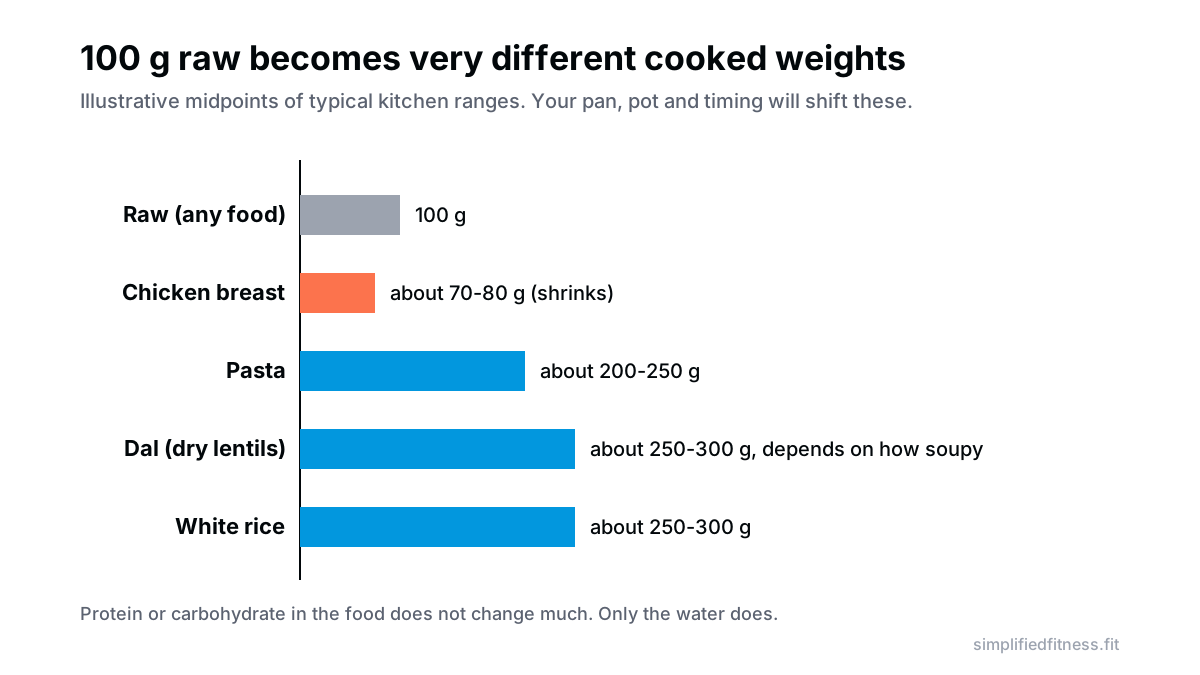
- Raw chicken breast loses roughly 20-30% of its weight as water when cooked, so 100 g raw is often about 70-80 g cooked, with about the same total protein. These are typical kitchen ranges, not fixed values.
- Dry rice, pasta and dal soak up water and can weigh two to three times as much cooked. A cooked-rice entry on a 100 g dry-rice weight will undercount your carbs by more than half.
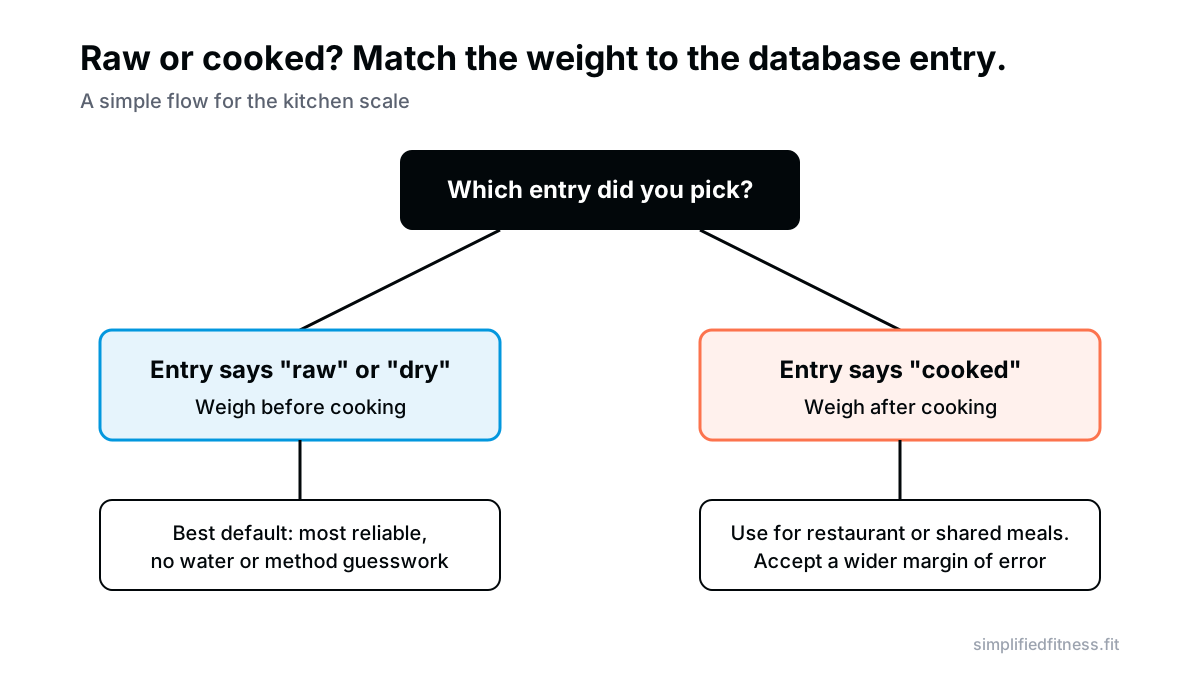
- The only real error is mixing the two: raw weight with a cooked entry, or the reverse. Always match the weight state to the database entry.
- For batch cooking, weigh the dry food, cook it, weigh the whole pot, then portion by the cooked weight. That gives you cooked-weight portions with raw-weight accuracy.
Part of our complete guide: High-Protein Foods List: Protein per 100g, Cost per 30g and Meal Prep Guide
Table of contents
Should you weigh food raw or cooked for macros? Raw (or dry) is the more reliable default, provided you log it against a raw or dry entry. Cooking mostly changes how much water the food holds, and that varies from pot to pot. The protein, carbs and fat barely move.
The real mistake is mixing the two states. This guide is part of our high-protein foods and meal prep guide, and it gives you the conversion logic, a few rough tables and a batch cooking workflow so you can stop second-guessing your scale.
(If you are still deciding between a scale and measuring cups, read food logging precision: digital scales vs measuring cups first.)
Why does raw vs cooked weight matter at all?
Because water is heavy and has zero calories.
When you cook chicken, water leaves the meat, so the piece weighs less. When you cook rice, water goes in, so the pot weighs more. The food’s macros are mostly unchanged. The weight is what moves.
That is why “100 g of chicken” and “100 g of rice” mean very different things depending on whether the scale reading came before or after the stove. A raw 100 g chicken breast and a cooked 100 g chicken breast are not the same amount of meat. A dry 100 g of rice and a cooked 100 g of rice are not even in the same ballpark.
Is raw weight really the gold standard?
It is the most practical one, and here is the reasoning.
Cooking yield is not a constant. Research on cooked meat shows that yield and nutrient retention shift with the cut, the animal’s age and the cooking method. One South African study of lamb and mutton found that cooking yields and moisture retention differed by cut (lower for lamb loin, higher for lamb leg), and that retention of several nutrients differed between lamb and mutton and between moist and dry heat (van Heerden et al., 2017). That was sheep, not chicken breast, so do not read the numbers across. But it makes the point: the cooked weight of the “same” food is a moving target.
Raw (or dry) weight avoids that. You weigh the food as it came out of the packet, before the pan, the cooker or the pressure whistle changes anything.
There is also reassuring evidence that this does not wreck accuracy. A household survey analysis in Kenya compared two ways of calculating nutrient intake: using raw-food nutrient values, or applying cooking yield and retention factors to get values for food as eaten. For dietary energy, protein, fat and carbohydrate, the two approaches gave statistically equivalent average intakes. Some vitamins, such as vitamin C and some B vitamins, did differ (Moltedo et al., 2021). This was a population-level survey, not a lifter’s food diary, so treat it as support for the principle rather than proof for any one meal. The principle is that macros mostly survive cooking.
Do you lose protein when you cook chicken?
Not enough to matter for tracking.
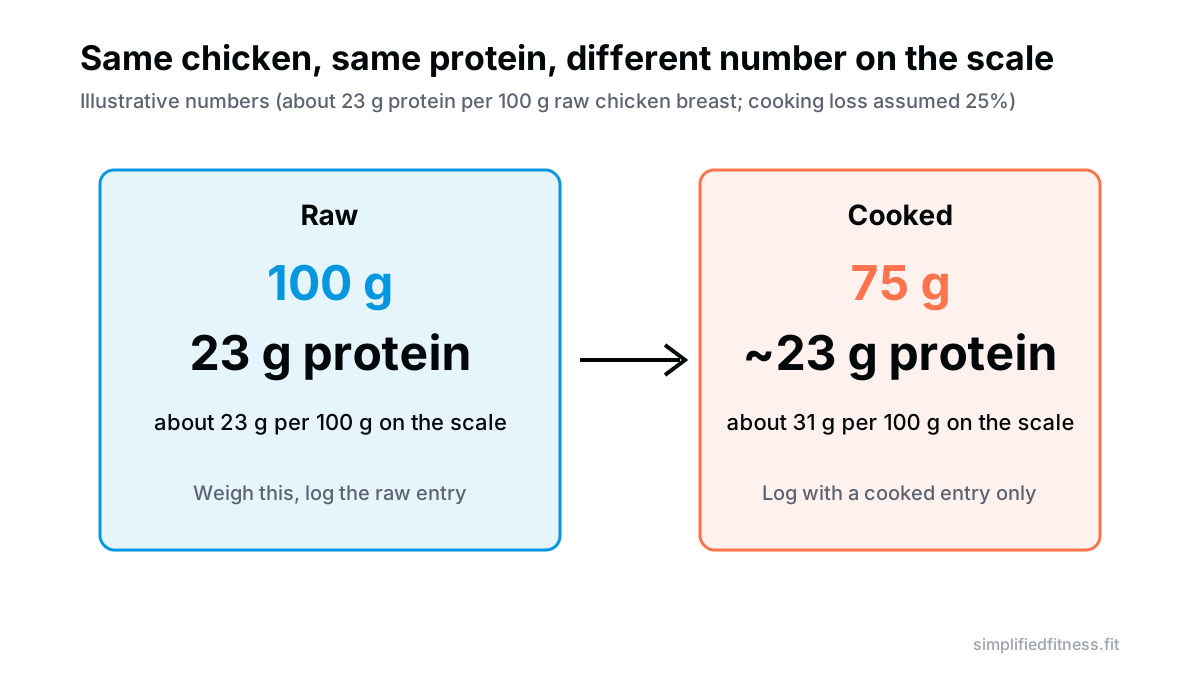
Here is the part that confuses people. Cooked chicken shows a higher protein number per 100 g than raw chicken. That is not extra protein. It is the same protein in less water.
Take 100 g of raw chicken breast. If it loses about a quarter of its weight in cooking, you end up with roughly 75 g on the plate. The protein in that piece is about the same as before. The cooked piece is just denser, so each gram of it carries more.
A caveat on the “same protein” idea. Some nutrients can leach into cooking liquid, especially when you boil in a lot of water and discard it. In a lab study on boiled beef, cooking time, how the meat was cut and the type of boiling water all changed how much phosphorus was lost, while the authors concluded that protein content was largely preserved (Ando et al., 2015). That study was designed for kidney-diet needs and I would not use it to estimate your chicken curry. For everyday pan cooking, baking or pressure cooking where you eat the gravy, the protein in the dish stays in the dish.
What are typical raw to cooked conversion numbers?
Treat these as starting points, not laws. Your stove, your pan and your timing change them. I would rather you weigh your own food raw and cooked twice and write your own multiplier on the fridge.
| Food (100 g raw or dry) | Typical cooked weight | Rough multiplier | What drives the range |
|---|---|---|---|
| Chicken breast | about 70-80 g | 0.7-0.8x | Cooking time, heat, cut thickness |
| Chicken thigh (boneless) | about 65-80 g | 0.65-0.8x | Fat content, how long it cooks |
| Fish fillet | about 75-85 g | 0.75-0.85x | Method (steamed vs pan-fried) |
| White rice | about 250-300 g | 2.5-3x | Water ratio, variety, softness |
| Pasta | about 200-250 g | 2-2.5x | Cooking time, shape |
| Whole dal (dry lentils) | about 250-300 g | 2.5-3x | How soupy you make it |
| Spinach or leafy greens | well under half | 0.1-0.3x | Water content, cooking time |
| Soya chunks (dry) | about 250-300 g after soaking | 2.5-3x | Soaking time, squeezing |
These are rule-of-thumb ranges from everyday cooking, not figures from a single study. The shape of the pattern is the useful bit. Meat and veg shrink. Grains, lentils and soya swell.
How do you convert raw weight to cooked weight?
Two simple formulas cover almost everything.
To convert raw to cooked: raw weight x your multiplier = expected cooked weight.
To convert cooked to raw: cooked weight / your multiplier = estimated raw weight.
Example, chicken. You cooked chicken and the plate reads 150 g. If your multiplier is about 0.75, the raw weight was around 200 g. If you know 100 g raw is about 23 g protein (check your database entry), that serving is roughly 46 g protein.
Example, rice. You have 300 g of cooked rice. With a multiplier of 2.75, that is about 110 g dry. Now you can look up carbs per 100 g of dry rice and scale from there.
Be honest about the margin. If your multiplier is off by 10%, your estimate is off by 10%. For a single meal that is small. For a daily total across rice, dal, roti and oil, it adds up, which is why weighing raw is the cleaner option.
What is the best way to weigh food for batch cooking?
This is the method I recommend for anyone who preps in bulk. It works for dal, rajma, chicken curry, khichdi and biryani alike. If you are planning a full prep session, pair it with the 3-hour weekly batch meal prep blueprint.
- Put an empty pot on the scale and zero it.
- Weigh each raw ingredient into the pot (chicken, dry rice, dry dal, oil, onion). Log them.
- Cook the batch.
- Weigh the whole cooked pot. Subtract the pot’s weight.
- Divide your total macros by the total cooked weight to get macros per gram.
- Weigh each portion cooked, and multiply by the per-gram value.
You get the best of both worlds. The raw weights fix the macro total, and the cooked weights let you serve fair portions without any maths in the moment. Water gains and losses stop mattering, because they are baked into the final pot weight.
Why do the rice and dal packets confuse everyone?
Because the label often does not tell you which state it is describing.
Most packets list nutrition per 100 g of the product as sold, which is usually dry. But some brands, ready-to-eat pouches and apps list values “as prepared” or “cooked”. Check the column heading before you trust a number. Words to look for are “as sold”, “dry”, “uncooked” and “as prepared”.
Apps add another layer. Many databases carry both a raw and a cooked entry for the same food, and user-submitted entries are not always labelled clearly. Pick one entry, label it in your own words (“rice, dry, white”) and keep using it.
For the Indian staples, the same logic applies to dals and pulses. Weigh the dry dal. Cooked dal is a mixture of lentils and however much water you added that day.
What about oil, ghee and everything else in the pan?
Weighing the chicken raw does not weigh the oil you fried it in. Oil and ghee need their own line in your log. They are dense in calories, and a casual glug into the kadhai can be more than you think. We cover this in hidden calorie traps in Indian cooking.
A simple habit: put the pan on the scale, zero it, pour in the oil and log the actual grams. It takes five seconds.
Raw vs cooked for vegetables, paneer, eggs and roti
Different foods behave differently, so here is a quick guide.
- Vegetables: weigh raw. They are low in calories, so even a loose estimate is fine. Greens like spinach shrink dramatically, so a cooked cup of palak holds a lot more spinach than it looks.
- Paneer: weigh it raw, as it comes out of the pack. Pan-frying changes the weight a little, but the macros are mostly set by the block you started with. Add the oil separately.
- Eggs: log by number or by weight of the shelled raw egg. Boiled and scrambled eggs have almost the same macros.
- Roti: weigh the dough ball or the atta before cooking, or count rotis if you always make them the same size. Cooked roti weight changes with how long it sits on the tawa.
- Soya chunks: weigh them dry, before soaking. They swell several times over.
Does weighing really improve results?
Probably, though the evidence is more modest than the gym internet suggests.
A systematic review of 22 studies on self-monitoring (15 of them on diet) found that self-monitoring was consistently associated with weight loss, but the authors rated the evidence as weak because of methodological limits such as samples that were mostly white and female, and heavy reliance on self-report (Burke et al., 2011). So tracking seems to help, but we do not know exactly how precise it has to be.
The other half of the picture is that people misreport. A review comparing self-reported intake against doubly labelled water, an objective measure of energy use, concluded that no self-report method was clearly more accurate, and that participants’ own characteristics shaped the underreporting (Trabulsi et al., 2001). Portion-size error is one piece of that. A review of portion estimation tools found that image-based aids tended to be more accurate than food models or household utensils, though few validation studies were high quality (Amoutzopoulos et al., 2020).
None of this says scales are required. It says eyeballing is noisy, and a scale removes one of the noisiest steps for the foods that carry most of your calories.
A practical raw vs cooked routine
Keep it simple and you will keep doing it.
- Default to raw or dry weights for chicken, rice, dal, pasta, soya, paneer and oil.
- Choose a “raw” or “dry” database entry and save it as a favourite.
- For batch meals, use the pot method above.
- For restaurant and family meals, log a cooked entry and move on. Do not let a perfect log get in the way of a good week.
- Check the trend. If your scale weight does not move the way your log predicts over two or three weeks, adjust calories by a small step rather than chasing a decimal.
Want daily targets to log against? Use our macro calculator and protein calculator, or start from the free diet plan. If you are building meals around poultry and fish, chicken breast and fish in India: sourcing, cooking and cost covers the buying side, and the lean non-vegetarian foods ranking shows which cuts earn their place.
When to talk to a professional
Careful weighing is a tool, not a requirement for everyone. If tracking food makes you anxious, leads you to skip meals, or starts to feel compulsive, step back and speak to a doctor or a registered dietitian. The same goes if you have a medical condition, such as kidney disease, diabetes or a history of disordered eating, that needs specific dietary advice. Food tracking is not a good fit for everyone, and that is okay.
The bottom line
Weigh food raw or dry, log it against a raw or dry entry, and keep your oil on its own line. When you cannot weigh raw, use a cooked entry and accept a wider margin. For bulk cooking, weigh the dry ingredients into the pot, weigh the finished batch, and portion by cooked weight.
Water shifts the weight. It does not shift the macros. Match the state to the entry, and the scale does the rest.
Frequently Asked Questions
Should I weigh food raw or cooked for macros?
Raw (or dry) is the more reliable default, as long as you log it against a raw or dry entry. Cooking mostly changes water content, which varies with time, heat and method, while the macros in the food stay roughly the same. Weigh before cooking when you can, and use cooked entries only for meals you cannot weigh raw.
Does chicken breast lose protein when you cook it?
Not in any meaningful way for tracking purposes. Cooking drives off water, so the chicken weighs less, but the protein is concentrated in what is left. Log the raw weight against a raw entry, or the cooked weight against a cooked entry, and your protein number will land in the right range either way.
How much does chicken breast shrink when cooked?
A typical range is roughly 20-30% of its raw weight, so 100 g raw is often about 70-80 g cooked. The exact figure depends on the cut, how long you cook it and how hot the pan is. Weigh your own chicken raw and cooked once or twice to get a personal multiplier.
How much does rice weigh after cooking?
Plain white rice usually ends up about 2.5-3 times its dry weight, because it absorbs water as it cooks. Stickier, softer rice absorbs more and firmer rice absorbs less. Weigh the dry rice instead, so the water ratio stops mattering.
Are the calories on a rice packet for raw or cooked rice?
Most packs list nutrition per 100 g of the dry, uncooked product, but check the column header because some list 'as prepared' values. Reading the wrong column can swing your carbs by more than half. Look for the words 'dry', 'uncooked' or 'as sold' before you log.
Do I weigh dal raw or cooked?
Dry is easier to log accurately. Cooked dal is a mix of lentils and water, and the thickness changes from one pot to the next, so 100 g of cooked dal can hold very different amounts of actual dal. Weigh the dry lentils, cook them, and divide the pot by the number of servings.
How do I weigh food when meal prepping in bulk?
Weigh the raw ingredients into the pot, cook, then weigh the whole finished batch. Divide the total macros by the total cooked weight to get a per-gram value for that batch, then weigh each portion cooked. The batch value already absorbs all the cooking changes for that pot.
Do vegetables change weight when cooked?
Yes, and by a lot for watery or leafy ones. Spinach and other greens collapse as they release water, while a few vegetables hold their weight or pick up a little from cooking liquid. Because veg is low in calories, most people can weigh them raw and not worry about the small error.
Does cooking oil count if I weigh raw food?
Yes. Raw weights track the food, not the oil you cook it in, so oil, ghee or butter needs its own entry. A tablespoon of oil adds around 120 kcal, which is often the biggest hidden source of tracking error. Weigh the oil in the pan, not just eyeball a pour.
Is a food scale really worth it for tracking macros?
For most people who track, yes. Studies of self-reported intake find that people often misreport their food intake, and portion size is one source of that error. A scale costs a few hundred rupees and removes much of the guesswork on the foods that matter.
Do I need to weigh everything forever?
No. Many people weigh for a few weeks to calibrate their eye, then spot check a few staples such as rice, chicken and oil. Once you know what 150 g of dry rice looks like in your usual katori, you can eyeball more. Re-weigh now and then to check you have not drifted.
What if I only have a cooked weight, like at a restaurant or a family meal?
Use a cooked entry for a similar dish and accept a wider margin of error. Image-based portion estimation tends to beat household utensils, but all estimation methods have error. Log your best guess, stay consistent, and judge the result by the trend in your body weight.
Sources & References
Every claim above is checked against peer-reviewed research (PubMed, U.S. National Library of Medicine) or guidance from established health bodies. How we fact-check.
- van Heerden SM, et al. Nutrient retention values and cooking yield factors for three South African lamb and mutton cuts. J Sci Food Agric. 2017. PMID: 28436039
- Moltedo A, et al. Raw versus cooked food matching: Nutrient intake using the 2015/16 Kenya Integrated Household Budget Survey. J Food Compost Anal. 2021. PMID: 34483479
- Ando S, et al. The Effect of Various Boiling Conditions on Reduction of Phosphorus and Protein in Meat. J Ren Nutr. 2015. PMID: 26163744
- Trabulsi J, et al. Evaluation of dietary assessment instruments against doubly labeled water, a biomarker of habitual energy intake. Am J Physiol Endocrinol Metab. 2001. PMID: 11595643
- Burke LE, et al. Self-monitoring in weight loss: a systematic review of the literature. J Am Diet Assoc. 2011. PMID: 21185970
- Amoutzopoulos B, et al. Portion size estimation in dietary assessment: a systematic review of existing tools, their strengths and limitations. Nutr Rev. 2020. PMID: 31999347

Umair Hazrami · Founder & Head Coach, Simplified Fitness
Umair Hazrami founded Simplified Fitness and the Simplified Lifter channel to cut through fitness noise. With 4+ years of consistent training and 10+ coaching clients, he writes every guide from the peer-reviewed research and links the sources so you can check them. Our editorial standards.
Educational content only, not medical advice. If you have a medical condition, are pregnant, or take medication, talk to a qualified doctor before changing your diet, supplements or training. Full disclaimer.
Keep reading
Indian Diet
The 3-Hour Weekly Batch Meal Prep: Cooking 5 Days of Lunches and Dinners for Busy Lifters
Batch meal prep for the week in 3 hours: a station-by-station Sunday plan for 10 high-protein lunches and dinners, with Indian options and safe storage rules.
7 min read
Indian Diet
Cost per 30 Grams of Protein: 40 Common Fitness Foods Ranked by Price
Cost per 30g protein for 40 Indian gym foods, from soya chunks to whey and tuna. See the cheapest protein sources per gram and what to buy on a budget.
8 min read
Indian Diet
Eating Healthy on a Student Budget: High Protein Hostel and Dorm Room Meal Prep
A college student bodybuilding diet budget can still hit 130 g of protein. Cheap staples, no-cook hostel prep and a sample day, with the studies linked.
8 min read
Indian Diet
Essential Kitchen Equipment for Lifters: Scales, Air Fryers, Blenders and Containers
The best kitchen equipment for meal prep lifters: which four tools earn their space, what the research says about each, and what to buy first on a budget.
10 min read