The Fitness Grocery Shopping Blueprint: Label Reading, Misleading Health Claims, and Sugar Traps
A fitness grocery shopping guide for lifters: decode ingredient lists, spot fake high protein claims, catch sugar traps, and use a weekly muscle grocery list.
TL;DR. The short answer
- Read the back of the pack, not the front. Check serving size, then the ingredient list (ordered by weight, heaviest first), then protein per 100 kcal.
- A 'high protein' claim tells you nothing about how much protein you get per calorie. Divide protein (g) by calories and multiply by 100 to compare any two products.
- 'Made with whole grains', 'zero cholesterol' and 'natural' are marketing phrases. Research shows health claims can make people judge a food as healthier than its panel suggests.
- Sugar alcohols (anything ending in -itol) are dose dependent: in one trial, 30-40 g of lactitol caused clear gut symptoms, and 40 g of isomalt did too. Many protein bars use them, so test one bar before buying a box.
- Build the cart from whole foods first (dal, eggs, paneer, curd, soya, chicken, vegetables, fruit) and treat packaged 'fitness' foods as convenience, not necessity.
Part of our complete guide: High-Protein Foods List: Protein per 100g, Cost per 30g and Meal Prep Guide
Table of contents
The best fitness grocery shopping guide fits in one sentence: ignore the front of the pack, read the back, and compare foods on protein per 100 kcal. Most “fitness” products in the supermarket win on packaging, not on nutrition.
This is a practical add-on to our guide to high-protein foods, meal prep and cost. That article tells you which foods to build meals around. This one tells you how to spot the products that pretend to be them, and what to put in the cart each week.
How do you read a nutrition label for bodybuilding?
You do not need to read everything. You need four checks, in order, and they take about 30 seconds per product.
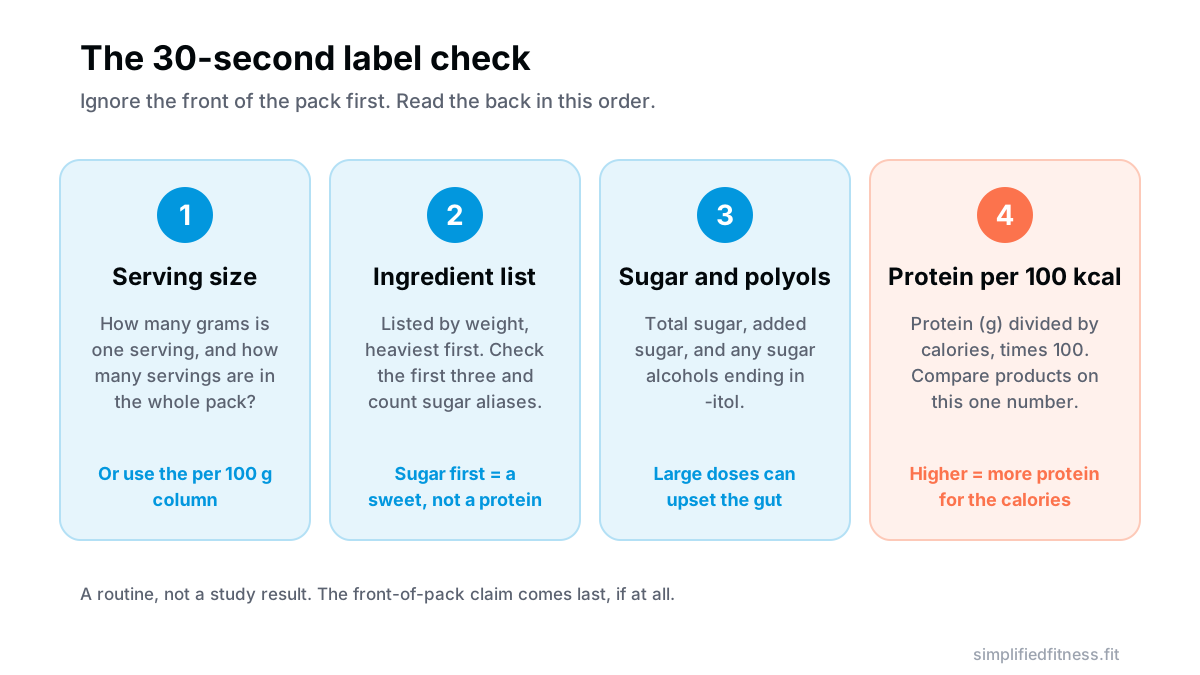
Step 1: serving size. Everything else on the panel is “per serving”, and the serving is whatever the brand decided. A pack of 4 servings eaten in one sitting quadruples every number. Look for the per 100 g column instead, because it is the same yardstick on every product.
Step 2: the ingredient list. In packaged food the list runs from the biggest ingredient by weight to the smallest. So the first three ingredients are what the product mostly is. If a “protein” biscuit starts with refined wheat flour, sugar and palm oil, the protein is an accessory.
Step 3: sugar and sweeteners. Look at total sugar, then scan the ingredients for the aliases (more on those below).
Step 4: protein per 100 kcal. Protein in grams, divided by calories, times 100. Simple. It is the single best number for comparing a protein bar with a packet of soya chunks or a cup of curd.
Does reading labels actually help?
Probably a little, though the evidence is weaker than the confidence around it. A systematic review of 26 studies found that using the nutrition facts label was associated with healthier diets. It also noted that results were inconsistent, that most studies were cross-sectional (a snapshot, not proof of cause), and that there was too little research on ingredient lists, serving sizes and front-of-pack labels (Anastasiou et al., 2019). It also reported that using health-related claims may be linked to poorer diets, though that evidence was inconclusive.
Read that fairly. People who read labels may just be more health-conscious. But the habit costs nothing, and it gives you control that a claim never will.
How do you spot misleading fitness food marketing?
The front of a pack is written by the marketing team. The back is partly constrained by rules. Research on “health halo” effects shows why that matters.
In one experiment (n = 274) on protein bars, putting “protein” in the product title raised people’s perception of the whole bar’s healthfulness, including nutrients that were never claimed, such as fiber and iron. A traffic-light warning label raised perceived sugar and calories but did not cancel out the halo (Fernan et al., 2018). It is one study of survey answers, not purchases, so treat it as a clue about psychology rather than a law.
A systematic review of 24 studies adds that the nutrition facts panel can reduce this bias, but only if shoppers actually look at it and interpret it correctly, which often does not happen (Talati et al., 2017).
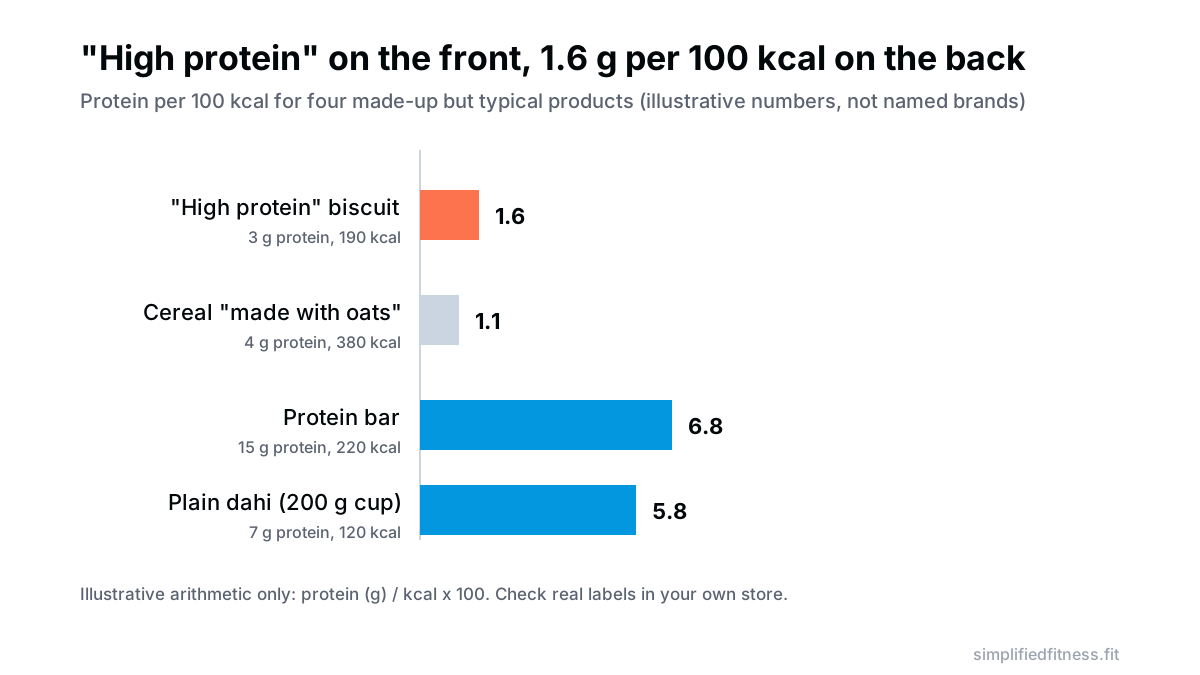
In the gym, this looks like grabbing a “protein cookie” because it says protein, and never noticing it has 1.6 g of protein per 100 kcal.
The claim decoder
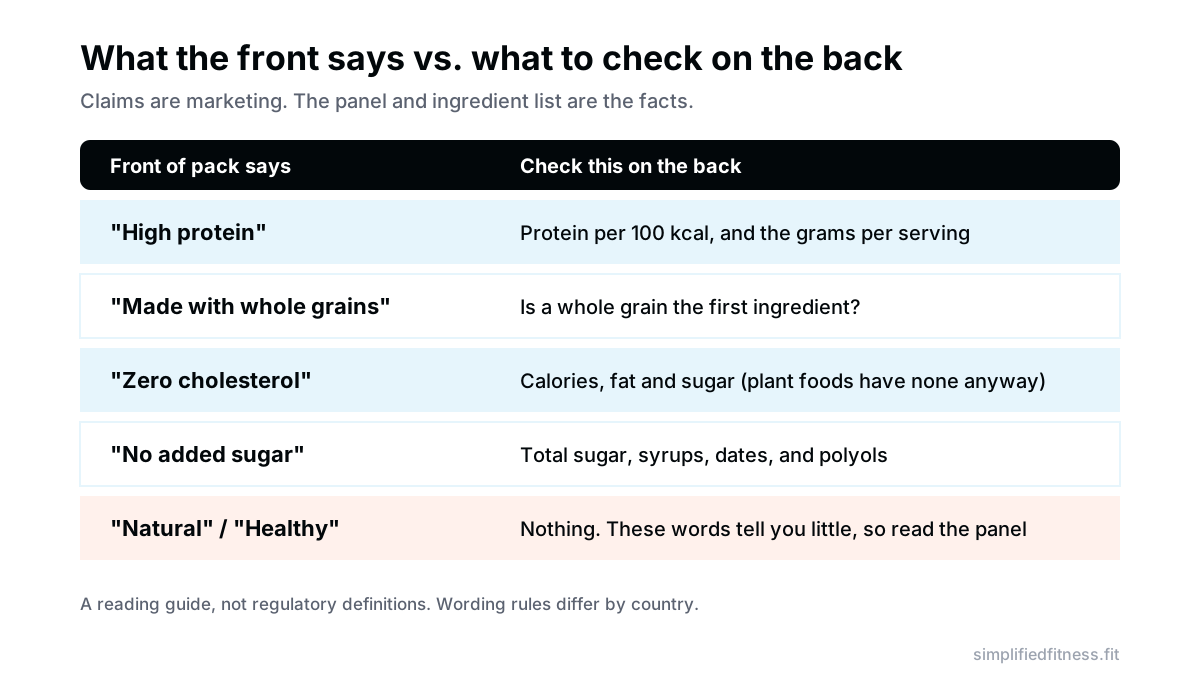
A few of these deserve a sentence each.
- “High protein” on a food with 3 g. If a 40 g biscuit has 3 g protein and 190 kcal, the claim is technically about “more than a normal biscuit”. It is not about being a protein source. Do the per 100 kcal math.
- “Made with whole grains”. “Made with” can mean a small amount. Look for whole wheat atta, oats or a similar whole grain as the first ingredient. “Multigrain” only means several grains, which may all be refined.
- “Zero cholesterol”. Cholesterol only occurs in animal foods, so a plant oil or a packet of namkeen says this with no effort. It tells you nothing about calories, sugar or saturated fat.
- “Natural”, “wholesome”, “fit”. These words usually carry no tightly defined meaning. Ignore them.
- “No added sugar”. Not the same as low sugar. Dates, fruit concentrates and milk solids still add sugar, and sugar alcohols can still be there.
Why do serving sizes matter so much?
Because the serving size is chosen by the brand and the same pack can look very different depending on it. A systematic review of labelled serving size and consumption found only five eligible studies. In three of them, smaller labelled servings or context referring to the whole package were linked to people eating less discretionary food. One found no difference, and one suggested a possible negative effect when servings were reduced (Bucher et al., 2018). The review itself says more research is needed, so do not over-read it.
The practical lesson is simple. Ask “how many servings are in this whole pack?” before you open it. A 100 g pack of makhana or a 250 g tub of peanut butter has far more calories than the front implies if you tend to finish things.
What are the hidden sugar traps?
Sugar rarely appears under one name. Scan the ingredient list for:
- sugar, brown sugar, jaggery, honey
- glucose syrup, glucose-fructose syrup, invert sugar
- dextrose, fructose, maltose
- maltodextrin (it is a carbohydrate that behaves a lot like sugar in your blood)
- fruit juice concentrate, date syrup
A useful rule: if three or more of these appear, sugar is being split across several names so that no single one lands at the top of the list. Because the list is ordered by weight, splitting sugar into several ingredients can push each one lower down. That is a labelling pattern worth knowing, not proof of intent.
Common offenders for lifters are flavoured oats sachets, muesli, “protein” cereals, ready-to-drink coffee, flavoured curd, granola bars and branded peanut butters with added sugar. Plain versions of all of these exist and are usually cheaper. We cover the bigger picture of supermarket psychology in grocery psychology and supermarket marketing traps.
What are sugar alcohols, and should you worry?
Many “low sugar” and “keto” protein bars swap sugar for sugar alcohols (polyols). The names usually end in -itol: maltitol, sorbitol, xylitol, erythritol, lactitol, isomalt. Most are only partly absorbed (erythritol is the exception: it is largely absorbed and passed in urine), so they carry fewer calories than sugar. The exact calories vary by type, so I would not trust a bar’s “net carbs” math blindly.
The catch is the gut. A randomized, double-blind crossover trial gave 59 healthy students 100 g of milk chocolate containing 40 g of sugar, isomalt, lactitol or maltitol (or mixtures). Lactitol at 30 g or 40 g caused a significant increase in the incidence and severity of every symptom measured (flatulence, rumbling, colic, frequent motions, loose stools). Isomalt at 40 g caused symptoms too, but none was rated severe. Maltitol at 40 g caused milder symptoms and no laxative effect. Overall, the symptoms were dose dependent (Koutsou et al., 1996).
Two cautions. It is a 1996 trial in young, healthy students using chocolate, not protein bars, so individual tolerance in your case could differ. And the doses were large. But it shows why eating three polyol-sweetened bars in a day, in a hot, dehydrated Indian summer commute, is a bad plan.
If you have a digestive condition such as IBS, or you are diabetic and use labels to manage blood glucose, talk to your doctor or dietitian rather than relying on gym advice.
Is a protein bar worth buying?
Sometimes. The honest answer is that bars are a convenience product. A 2023 audit of 558 formulated sports food products in Australian retail found stated nutrient content was highly variable, only 184 appeared to display the correct energy value based on their listed macros, and nutrition content claims appeared on 98.5% of products. Some packs carried dozens of claims (Chapple et al., 2023). That is an Australian market snapshot, so it does not tell you how a given Indian brand performs. It does tell you not to take the front of any pack at face value.
How to choose one if you want one:
- Protein per 100 kcal at or above roughly 6 g (a rule of thumb, not a standard).
- Fewer than three sugar aliases.
- A polyol you have already tested.
- A price per 10 g protein that beats your alternatives. Our cost per 30 g of protein comparison shows how often eggs, dal, curd and soya chunks win.
Also remember how much protein you actually need. A meta-analysis of 49 trials found protein supplementation added to resistance training gains, but no further gains in fat-free mass were seen once total protein passed about 1.6 g/kg/day (Morton et al., 2018). Work out your target with the protein calculator and stop buying “extra” once you are there.
Do processed foods really matter for fitness?
They matter mainly for calorie control. In an NIH inpatient trial, 20 adults ate ultra-processed or unprocessed diets for 2 weeks each, with meals matched for presented calories, sugar, sodium, fiber and macronutrients. On the ultra-processed diet they ate about 508 kcal a day more and gained 0.9 kg, while losing 0.9 kg on the unprocessed diet (Hall et al., 2019).
This is a small, short trial in a controlled ward, so it cannot tell you how much of the effect is texture, eating speed, taste or something else. It does support a sensible habit: build most plates from whole foods and treat packaged ones as the supporting cast. If you also cook with a lot of oil, our guide to hidden calorie traps in Indian cooking covers the other half of the problem.
Should you shop the perimeter of the supermarket?
As a loose shortcut, yes. Fresh produce, eggs, dairy, meat and fish tend to sit on the outer edges, and the middle aisles are crowded with snacks. But it is not a law. Dal, rice, oats, atta, soya chunks, frozen vegetables and tinned chickpeas live in the middle and belong in your cart. The rule that works better: shop food types, not aisles.
The weekly fitness grocery checklist
This is a template for one lifter on a typical Indian budget. Swap items to suit your diet (vegetarian, eggetarian, non-vegetarian) and your city. Treat it as a starting point, not a prescription.
| Category | Pick two or three | Label check |
|---|---|---|
| Protein, vegetarian | Dal (toor, moong, masoor), paneer, plain curd, soya chunks, chana, rajma | Soya chunks: ingredient list should be just soya. Paneer: check fat vs. “low fat” |
| Protein, non-veg | Eggs, chicken breast or thigh, fish | Fresh preferred. Frozen: no added water or phosphates listed |
| Carbs | Roti atta, rice, oats, potatoes, poha | Atta: “whole wheat” first. Oats: plain, no sachet sugar |
| Fruit and veg | Seasonal fruit, onion, tomato, leafy greens, frozen peas | Frozen veg: single ingredient |
| Fats | Peanuts, mustard or groundnut oil, small amount of ghee | Nuts: no sugar or coating |
| Convenience (optional) | Roasted chana, makhana, one tested protein bar | Run the four-step check |
| Flavour | Spices, lemon, curry leaves, garlic, ginger | Skip premixed sachets with added sugar |
Price and variety matter more than perfection. If you want ranked options and calorie-per-protein data, our list of the top 30 high-protein foods ranked by protein per calorie is the next step, and the budget guide to 120 g of protein under 100 rupees shows it with real constraints. For macros and a ready meal structure, use the free diet plan and the macro split formula.
A 10-minute store routine
- Go in with the list, and a protein target for the week.
- Fill the cart with the fresh and staple section first.
- Pick one or two packaged items from the convenience row only.
- Turn each over. Check serving size, first three ingredients, sugar, protein per 100 kcal.
- Put it back if the front claim and the back disagree.
You will be faster after two trips.
The bottom line
The front of the pack is advertising. The back is information. Reading it is not a guarantee of a perfect diet, and the research linking label reading to healthier eating is mostly observational, but it is cheap and it works in your favour. Compare on per 100 g, watch the first three ingredients, count the sugar aliases, test your polyols, and build your cart from foods that do not need a label at all.
If your weekly shop and your protein target still do not line up, a coach can look at your actual numbers and sort it out. Until then, start with the protein calculator and the checklist above.
Frequently Asked Questions
How do I read a nutrition label for bodybuilding?
Start with the serving size, then use the per 100 g column so products are comparable. Next, look at protein, total calories and sugar, and work out protein per 100 kcal. This takes about 30 seconds once you have done it a few times, and it stops the front-of-pack claim from doing your thinking.
What does it mean that ingredients are listed by weight?
On packaged food, ingredients are normally listed from the largest amount to the smallest. So if sugar, maida or palm oil sits in the first three spots, the product is mostly that. Scan the first three ingredients before you look at anything else.
How much protein should a 'high protein' food have?
There is no single answer, because the wording rules differ by country and brand. A better test is protein per 100 kcal: roughly 5-6 g or more is a decent protein source, while 1-2 g means the claim is mostly marketing. Compare the number on the back, not the word on the front.
Are protein bars actually healthy?
They can be a convenient protein source, but they vary a lot, and some are closer to a chocolate bar. A 2023 Australian audit of 558 sports food products found stated nutrient content was highly variable and many packs carried a large number of claims. Read the panel, and treat bars as a backup for busy days, not a daily staple.
What are sugar alcohols and are they bad for you?
Sugar alcohols (polyols) such as maltitol, lactitol, sorbitol and xylitol are lower-calorie sweeteners, most of which are only partly absorbed. In a randomized crossover trial of 59 students, gut symptoms were dose dependent, with lactitol worst and maltitol milder. Try a small portion first, and stay under what your stomach tolerates.
Does 'no added sugar' mean sugar free?
No. It means sugar was not added as an ingredient, but the food can still contain natural sugars from fruit, dates or milk, plus polyols. The panel's total sugar line is what counts. Check it and the ingredient list for syrups, dates and juice concentrates.
Is 'made with whole grains' the same as whole grain?
Not necessarily. The phrase can describe a product where whole grain is a small part and refined flour is the main ingredient. Look for a whole grain, such as whole wheat atta or oats, as the first ingredient.
Why do some products show the nutrition per serving instead of per 100 g?
Per serving numbers look smaller when the serving is small, which can flatter calories and sugar. A review of labelled serving size studies suggests serving information can influence how much people eat, though evidence is limited. Use the per 100 g column to compare, then work out what you will actually eat.
Are ultra-processed foods really bad for fitness?
In one tightly controlled 2019 inpatient trial of 20 adults, people ate about 508 kcal a day more on an ultra-processed diet than on an unprocessed one and gained 0.9 kg in 2 weeks. It was small and short, so it does not prove every processed food is a problem. Building most of your meals from whole foods makes calories easier to control.
What is the best supermarket grocery list for building muscle?
Anchor it on protein foods (eggs, dal, paneer, curd, soya chunks, chicken or fish), then add roti or rice, vegetables, fruit and a little healthy fat. The point is variety within a few cheap staples, not a long list. Use the weekly checklist in this guide and adjust to your budget.
Should I shop the perimeter of the supermarket?
As a rule of thumb, yes, because fresh produce, dairy, eggs and meat tend to sit on the edges. It is a shortcut, not a law, since lentils, oats and frozen vegetables live in the inner aisles and are excellent. Shop by food type, not by aisle position.
Does reading food labels actually improve your diet?
A systematic review of 26 studies found reading the nutrition facts label was associated with healthier diets, though results were inconsistent and mostly observational. That means label readers may simply be more health conscious to begin with. Still, it is a cheap habit that costs you a few seconds per product.
How many grams of protein do I actually need?
A meta-analysis of 49 trials found extra protein gave no further muscle gains in resistance training beyond about 1.6 g/kg/day. So buying more and more protein products past that point is not a good use of money. Use our protein calculator to get your number and shop to it.
Sources & References
Every claim above is checked against peer-reviewed research (PubMed, U.S. National Library of Medicine) or guidance from established health bodies. How we fact-check.
- Anastasiou K, et al. The relationship between food label use and dietary intake in adults: A systematic review. Appetite. 2019. PMID: 31010704
- Talati Z, et al. Consumers' responses to health claims in the context of other on-pack nutrition information: a systematic review. Nutr Rev. 2017. PMID: 28371913
- Bucher T, et al. The effect of the labelled serving size on consumption: A systematic review. Appetite. 2018. PMID: 29859775
- Koutsou GA, et al. Dose-related gastrointestinal response to the ingestion of either isomalt, lactitol or maltitol in milk chocolate. Eur J Clin Nutr. 1996. PMID: 8617186
- Hall KD, et al. Ultra-Processed Diets Cause Excess Calorie Intake and Weight Gain: An Inpatient Randomized Controlled Trial of Ad Libitum Food Intake. Cell Metab. 2019. PMID: 31105044
- Fernan C, et al. Health Halo Effects from Product Titles and Nutrient Content Claims in the Context of Protein Bars. Health Commun. 2018. PMID: 28853950
- Chapple CI, et al. Sports foods are not all they shake up to be. An audit of formulated supplementary sports food products and packaging in Australian retail environments. Front Nutr. 2023. PMID: 36866048
- Morton RW, et al. A systematic review, meta-analysis and meta-regression of the effect of protein supplementation on resistance training-induced gains in muscle mass and strength in healthy adults. Br J Sports Med. 2018. PMID: 28698222

Umair Hazrami · Founder & Head Coach, Simplified Fitness
Umair Hazrami founded Simplified Fitness and the Simplified Lifter channel to cut through fitness noise. With 4+ years of consistent training and 10+ coaching clients, he writes every guide from the peer-reviewed research and links the sources so you can check them. Our editorial standards.
Educational content only, not medical advice. If you have a medical condition, are pregnant, or take medication, talk to a qualified doctor before changing your diet, supplements or training. Full disclaimer.
Keep reading

Indian Diet
The 3-Hour Weekly Batch Meal Prep: Cooking 5 Days of Lunches and Dinners for Busy Lifters
Batch meal prep for the week in 3 hours: a station-by-station Sunday plan for 10 high-protein lunches and dinners, with Indian options and safe storage rules.
7 min read

Indian Diet
Cost per 30 Grams of Protein: 40 Common Fitness Foods Ranked by Price
Cost per 30g protein for 40 Indian gym foods, from soya chunks to whey and tuna. See the cheapest protein sources per gram and what to buy on a budget.
8 min read
Indian Diet
Eating Healthy on a Student Budget: High Protein Hostel and Dorm Room Meal Prep
A college student bodybuilding diet budget can still hit 130 g of protein. Cheap staples, no-cook hostel prep and a sample day, with the studies linked.
8 min read

Indian Diet
Essential Kitchen Equipment for Lifters: Scales, Air Fryers, Blenders and Containers
The best kitchen equipment for meal prep lifters: which four tools earn their space, what the research says about each, and what to buy first on a budget.
10 min read