Eggs in the Indian Diet: Whole Eggs vs Egg Whites, Cost per Gram, and Cholesterol Facts
How many eggs per day for bodybuilding in India? Cost per gram of protein, whole eggs vs egg whites, and what the cholesterol research actually shows.
TL;DR. The short answer
- For most healthy lifters, 1-3 whole eggs a day is a reasonable starting range, and most large cohort analyses have not linked up to about 1 egg a day to higher heart disease risk, though one 2022 meta-analysis found a small rise. Beyond that, the evidence is thinner, so use your own lipid report as the check.
- Eggs are usually one of the cheapest complete proteins in India. At an illustrative Rs 7 per egg, 30 g of protein costs about Rs 35, but prices vary by city and season.
- Whole eggs beat egg whites for muscle protein synthesis after a single workout in one small trial, yet a 12-week training study found no difference in muscle mass. The yolk helps, but it is not magic.
- Egg trials show small rises in total and LDL cholesterol, but also HDL, with no change in the LDL:HDL ratio. A minority of people respond more strongly, which is why a blood test beats guessing.
- If you have heart disease, diabetes, familial high cholesterol or are on statins, ask your doctor before changing how many eggs you eat.
Part of our complete guide: Indian High-Protein Nutrition Guide: Cutting and Muscle Building on Vegetarian and Non-Veg Diets
Table of contents
How many eggs per day for bodybuilding in India? For most healthy lifters (see our Indian high-protein nutrition guide for the full picture), 1-3 whole eggs a day is a reasonable place to start, with egg whites or other protein sources filling the rest. Eggs give roughly 6 g of complete protein for a few rupees each, and most large studies have not linked up to about one egg a day to heart disease.
That still leaves a few real, fairly common questions about yolks, cholesterol and what your family will say. This article focuses on the Indian side of it: price, cooking, culture and what the blood-test research actually shows.
If you want the pure muscle-science comparison of yolk versus white, see our deep dive on whole eggs vs egg whites for muscle protein synthesis. Here we stay practical.
How many eggs per day is reasonable for an Indian lifter?
There is no official bodybuilding limit, and anyone quoting a magic number is guessing. What we have is a pattern across the research.
In a pooled analysis of three large US cohorts (about 215,000 people followed for up to 32 years), eating at least one egg a day was not associated with cardiovascular disease compared with less than one a month. The hazard ratio was 0.93 (95% CI 0.82 to 1.05) (Drouin-Chartier et al., 2020). The authors also pooled prospective cohorts in a meta-analysis and found no association for each extra egg per day, with a possibly lower risk in Asian cohorts.
Notice the catch. Most people in those cohorts ate between one and fewer than five eggs a week. Data for 4-6 eggs a day barely exist. So 6 whole eggs daily is not proven harmful, but it is not proven safe either.
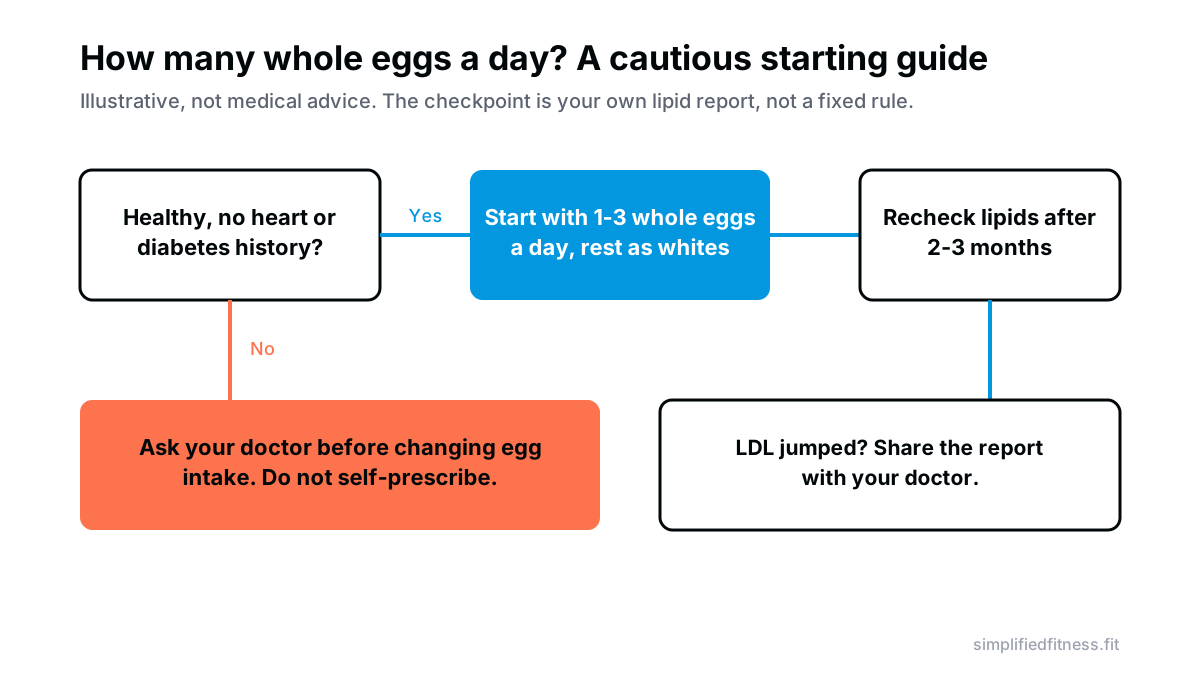
A cautious starting range:
- 1-3 whole eggs a day for most healthy adults
- Extra egg whites (2-6) if you need more protein without more yolk
- A lipid profile after 2-3 months on your new pattern
Is egg the cheapest protein source in India?
Often, yes, for non-vegetarians. But verify it with your own numbers, because prices change between Mumbai, Patna and Bengaluru, and between winter and summer.
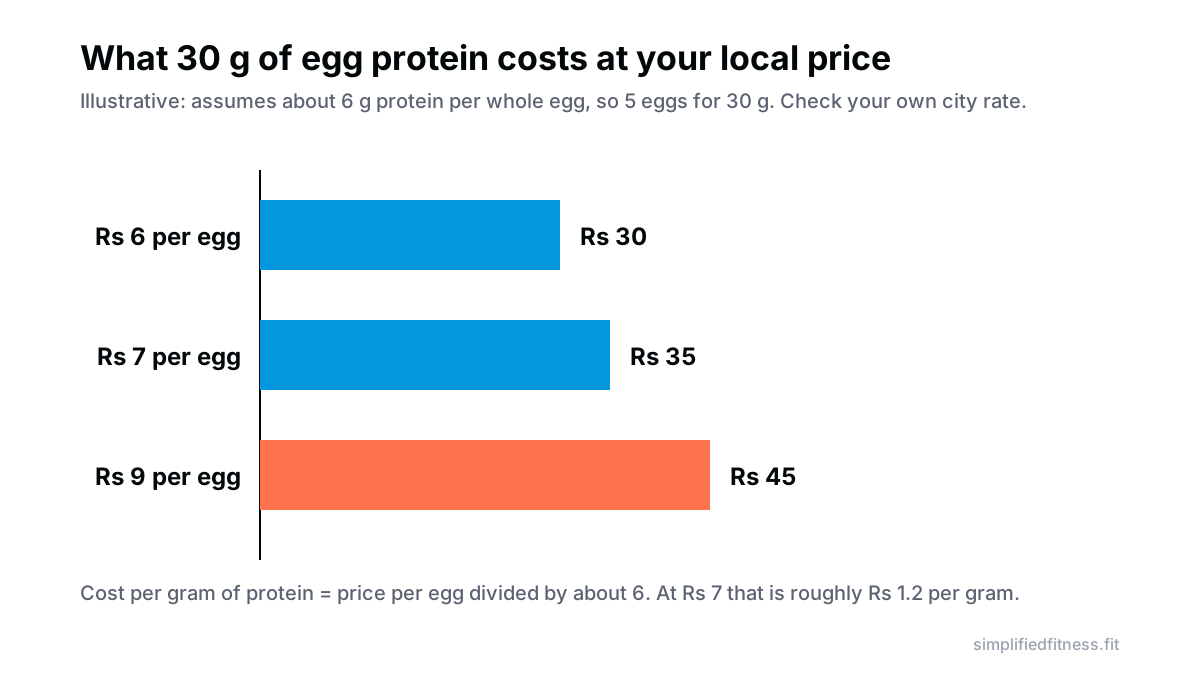
The brief version of the maths: a large whole egg gives roughly 6 g of protein. About 40% of an egg’s protein sits in the yolk (Santos et al., 2021), so a white alone is around 3.5 g. Cost per gram = price per egg divided by 6.
At an illustrative Rs 7 per egg, that is about Rs 1.2 per gram of protein, or roughly Rs 35 for 30 g. Whites cost more per gram, because you pay for the yolk either way. Three whole eggs plus six extra whites (nine eggs, Rs 63) give about 39 g of protein, or roughly Rs 1.6 per gram, and leave six yolks to use somewhere else. Do the same division for a packet of soya chunks, a litre of milk or a block of paneer and compare. Our budget guide to 120 g of protein under Rs 100 does that across foods.
Eggs also have a quality edge. Egg protein has long been described as highly digestible with an excellent amino acid profile (Puglisi and Fernandez, 2022). Cooked eggs scored higher than breads or hash browns on the DIAAS scale in a pig study, and the authors suggest eggs can offset the lower protein quality of plant foods in mixed meals (Fanelli et al., 2024). That was done in pigs, so treat it as supportive rather than conclusive for humans. For an Indian plate heavy on roti and rice, adding eggs is a simple way to lift protein quality. We cover the wider gap in our look at the traditional Indian diet protein conundrum.
Whole eggs vs egg whites: does the yolk matter for muscle?
A little, maybe. Here is what each study found.
In a crossover trial of 10 resistance-trained young men, 18 g of protein from whole eggs stimulated greater post-exercise myofibrillar protein synthesis than 18 g from egg whites (van Vliet et al., 2017). Egg whites digested faster, but total leucine availability was similar. It was a single bout of exercise, though.
Over a longer period, the picture is less clear. A 12-week trial in 30 resistance-trained men compared 3 whole eggs with 6 egg whites after every session. Muscle mass and cross-sectional area improved in both groups with no significant difference. The whole-egg group improved more in knee extension strength, handgrip strength and body fat percentage (Bagheri et al., 2021). A narrative review concludes the yolk does not appear to add muscle mass beyond whites when total protein is high, but that this rests on very limited evidence in young men (Santos et al., 2021).
Why might they differ? A single acute measurement captures a short-term signal, while a 12-week study captures all your training and eating on top. Small samples and young male participants also limit how far either result travels.
The practical read:
- Whole eggs are a fine default.
- Whites are a cheap, low-fat way to add protein.
- You do not need to bin every yolk to build muscle.
Do eggs raise cholesterol? What the studies show
This is where people get nervous, so let us be fair to both sides.
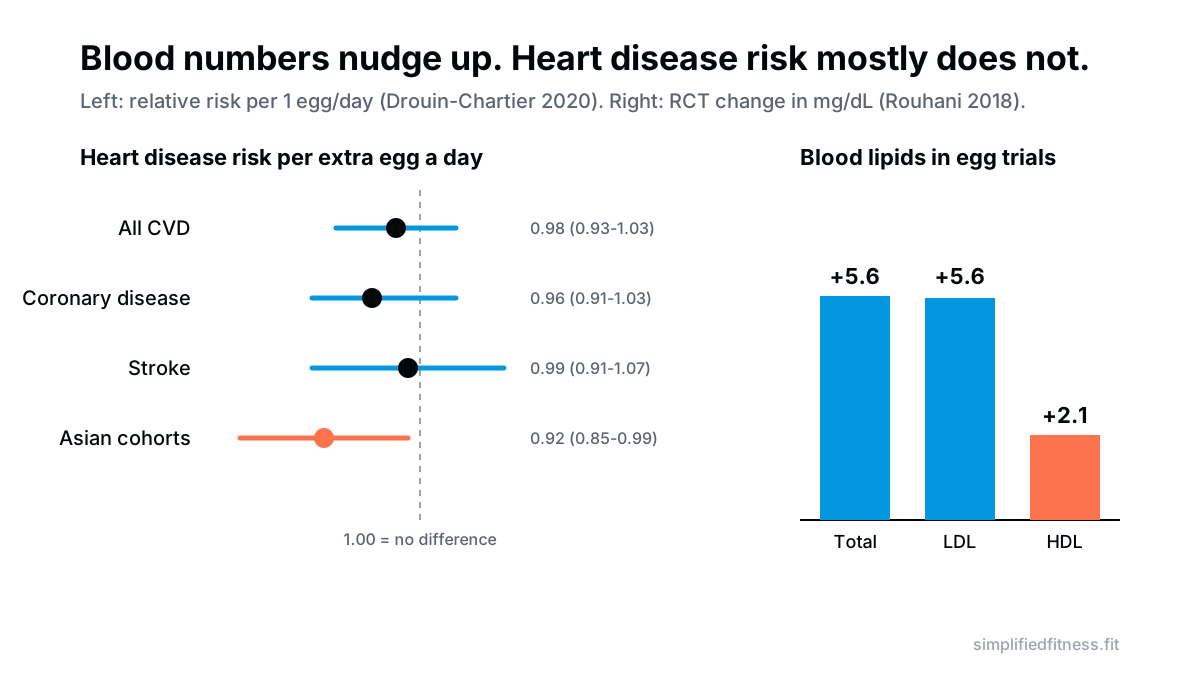
Trials show a small rise in blood lipids. A meta-analysis of 28 controlled trials found that eating eggs raised total cholesterol by 5.60 mg/dL and LDL by 5.55 mg/dL, and also raised HDL by 2.13 mg/dL. There was no effect on the LDL:HDL ratio, the total:HDL ratio or triglycerides (Rouhani et al., 2018).
Large cohorts mostly show no link to disease. In the PURE analysis of about 177,000 people from 50 countries, eating 7 or more eggs a week versus fewer than 1 was not significantly associated with blood lipids, total mortality or major cardiovascular disease (Dehghan et al., 2020). The same BMJ meta-analysis found a possibly lower risk in Asian cohorts (relative risk 0.92 per egg a day, 95% CI 0.85 to 0.99) (Drouin-Chartier et al., 2020).
But not every analysis agrees. A 2022 Circulation paper found higher dietary cholesterol and egg intake associated with higher overall and cardiovascular mortality in a Finnish male cohort. Its meta-analysis found each extra 50 g egg a day was linked to a pooled relative risk of 1.04 (95% CI 1.00 to 1.08), higher in US cohorts and not significant in Asian cohorts (Zhao et al., 2022).
Why the disagreement? These are observational cohorts, so what else people eat with eggs (bacon, white bread, butter) can confound the result. Heterogeneity between studies was high, and populations differ. A cautious takeaway: eggs are not a clear villain at moderate intakes, but they are not a free pass at any dose either.
The Indian angle: hyper-responders and the AIIMS egg trial
Indian-specific data are thin, so one small study matters. Researchers at AIIMS Delhi gave 18 healthy young lacto-vegetarians one boiled egg a day for 8 weeks in a crossover design. Average lipids were not significantly different from the egg-free period at 8 weeks, but total cholesterol was higher at 4 weeks, and 7 of 18 people had an appreciable rise in total or LDL cholesterol at 8 weeks. The authors suggest knowing your own response before making eggs a daily habit (Chakrabarty et al., 2002).
That is a tiny study from 2002 in young people, so do not stretch it. But it makes a useful point. Responses differ, and a lipid profile is cheaper than arguing about it.
Egg white bhurji: a high-protein recipe without oil
Egg white bhurji is the easiest way to turn spare whites into a meal. You can adjust it to your calories.
- Heat a non-stick pan on medium and add a splash of water (about 2 tablespoons), not oil.
- Add finely chopped onion, tomato and green chilli. Cook for 2-3 minutes until soft.
- Pour in 5-6 egg whites plus 1 whole egg beaten with haldi, salt and a little black pepper.
- Stir constantly on low heat for 2-3 minutes until just set. Overcooking makes whites rubbery.
- Finish with coriander. Eat with 2 rotis or a bowl of sprouts.
The whole egg stops it tasting flat. A bhurji with 6 whites and 1 whole egg gives roughly 27 g of protein by the 3.5 g and 6 g planning figures above, and each teaspoon of oil you skip saves around 40 kcal. For more ways to build breakfast, see our high-protein Indian breakfast recipes.
Cook eggs fully, store them in the fridge, and be careful with raw egg shakes, especially in hot weather and in places with poor cold-chain handling.
How to talk to your family about eating too many eggs
This one is cultural, not scientific, and it often decides whether you stick with eggs.
- Do not argue. Say you are testing it and will share your blood report.
- Be specific. “Up to about one egg a day was not linked to heart disease in most large studies” is better than “eggs are healthy”.
- Offer a compromise. 2-3 whole eggs, extra whites, a lipid test in 2-3 months.
- Respect real reasons. If a parent has heart disease or diabetes, their doctor’s advice is the rule.
If you are a vegetarian or eggetarian household, our guide to convincing Indian parents about whey safety uses the same approach.
Mistakes to avoid
- Eating only whites and skipping every yolk “for cholesterol” without checking your lipid report
- Jumping from 1 to 6 whole eggs overnight with no blood test
- Treating one study as final, in either direction
- Ignoring the rest of the plate, such as refined carbs, fried snacks and excess ghee
Who should be careful with daily eggs
Talk to your doctor or a registered dietitian before eating eggs daily if you:
- have heart disease, or have had a heart attack or stroke
- have diabetes
- have familial hypercholesterolaemia or a strong family history of early heart disease
- take statins or other cholesterol medication
- have an egg allergy (avoid eggs and get medical advice)
This article is general education, not a diagnosis or treatment plan.
The bottom line
Eggs are one of the most practical protein foods in India. They are cheap, easy and high quality. For most healthy lifters, 1-3 whole eggs a day plus extra whites is a reasonable starting point, and the evidence for much higher numbers is thin.
The cholesterol story is not a myth and not a scandal. Trials show small lipid shifts, big cohorts mostly show no link to disease, and some people respond more than others. A blood test settles it better than any argument.
Work out your daily target with our protein calculator, then fill the gap using the free diet plan.
Frequently Asked Questions
How many eggs per day is safe for bodybuilding in India?
For healthy adults, 1-3 whole eggs a day is a sensible range to start with, and most lifters fill extra protein with egg whites, dal, curd or paneer. Most large cohort analyses have not linked up to about one egg a day to higher heart disease risk, though not all agree, and data above that are limited. Get a lipid profile after two to three months and let your own numbers decide.
Can I eat 6 eggs a day?
Some healthy lifters do, but there is much less long-term research at that level, so treat it as a personal experiment rather than a proven safe dose. Individual cholesterol responses vary, and one 8-week Indian trial found some people had clear rises even at one egg a day. A safer pattern is 2-3 whole eggs plus egg whites, with a blood test to check the effect.
Are egg whites better than whole eggs for muscle gain?
Not really. Whole eggs stimulated greater post-exercise muscle protein synthesis in one small crossover study, and a 12-week trial in trained men found similar muscle gains between whole eggs and egg whites. Whole eggs also carry vitamins and minerals from the yolk, so use whites to add protein cheaply, not to replace every yolk.
Do eggs raise cholesterol?
Slightly, on average. A meta-analysis of 28 controlled trials found eggs raised total cholesterol by about 5.6 mg/dL and LDL by about 5.6 mg/dL, with HDL up by about 2.1 mg/dL and no change in the LDL:HDL ratio. Responses differ between people, so check your lipid profile if you change your intake.
Is the egg cholesterol myth true in India?
It is partly true and partly overstated. A small AIIMS crossover trial in young lacto-vegetarians found one egg a day raised cholesterol at 4 weeks, but values in most people returned to baseline by 8 weeks, though some hyper-responders stayed raised. Several large studies, including a 50-country analysis with Indian participants, did not link egg intake to heart disease or death, although a 2022 meta-analysis found a small rise in risk per extra egg, mainly in US cohorts.
How many grams of protein are in one egg?
A large whole egg gives roughly 6 g of protein, with about 40% of that in the yolk and the rest in the white. That means an egg white alone gives around 3.5 g. Exact numbers vary with egg size, so use 6 g per whole egg as a planning figure.
Is egg the cheapest protein in India?
Eggs are among the cheapest complete proteins for non-vegetarians, but dal, soya chunks and milk can match or beat them per gram depending on your city. Work out cost per gram yourself by dividing the price by the grams of protein in that pack or portion. Eggs also win on convenience, since they need no prep beyond boiling or a quick bhurji.
How do I make egg white bhurji high in protein without oil?
Use a non-stick pan on medium heat with a splash of water instead of oil, and stir the whites with onion, tomato, green chilli and haldi. The water steams the mixture so it does not stick, and you save about 40 kcal per teaspoon of oil you skip. Finish with coriander and add one whole egg so the bhurji does not taste flat.
What should I do with the leftover yolks?
Add them to your own bhurji, boil a few eggs whole, or fold them into atta chilla batter. Throwing away every yolk wastes the cheapest source of vitamins and minerals in the egg and raises your cost per gram of protein. If your doctor has asked you to limit yolks, follow that advice instead.
Are eggs safe for diabetics or people with heart disease?
Research is mixed, and this is a conversation for your doctor, not a gym coach. Some cohort analyses found no link between moderate egg intake and diabetes or heart disease, while others found higher risk in specific groups. Ask your doctor or dietitian for a personal limit before eating eggs daily.
Do I need to stop eggs if my LDL is high?
Not automatically, but you should discuss it with your doctor. Egg trials show LDL rises by a few mg/dL on average, with larger rises in hyper-responders, and saturated fat from the rest of your diet matters as well. Share your diet history, test again after changes, and let the doctor decide.
How do I handle family worries about eating too many eggs?
Be specific. Show them the lipid report rather than arguing, and mention that most large cohort studies did not link up to one egg a day to heart disease. Offer a compromise such as 2-3 whole eggs plus whites and a repeat blood test in a few months.
Are brown eggs or desi eggs healthier than white eggs?
The research in this article does not compare shell colour or breed, so I cannot claim one is better. Protein per egg depends mainly on size, so buy fresh eggs from a seller you trust and cook them fully. Spend the extra money on other things if budget is tight.
Sources & References
Every claim above is checked against peer-reviewed research (PubMed, U.S. National Library of Medicine) or guidance from established health bodies. How we fact-check.
- Drouin-Chartier JP, et al. Egg consumption and risk of cardiovascular disease: three large prospective US cohort studies, systematic review, and updated meta-analysis. BMJ. 2020. PMID: 32132002
- Dehghan M, et al. Association of egg intake with blood lipids, cardiovascular disease, and mortality in 177,000 people in 50 countries. Am J Clin Nutr. 2020. PMID: 31965140
- Rouhani MH, et al. Effects of egg consumption on blood lipids: a systematic review and meta-analysis of randomized clinical trials. J Am Coll Nutr. 2018. PMID: 29111915
- Zhao B, et al. Associations of dietary cholesterol, serum cholesterol, and egg consumption with overall and cause-specific mortality: systematic review and updated meta-analysis. Circulation. 2022. PMID: 35360933
- Chakrabarty G, et al. The effect of ingestion of egg on serum lipid profile in healthy young free-living subjects. Indian J Physiol Pharmacol. 2002. PMID: 12683227
- van Vliet S, et al. Consumption of whole eggs promotes greater stimulation of postexercise muscle protein synthesis than consumption of isonitrogenous amounts of egg whites in young men. Am J Clin Nutr. 2017. PMID: 28978542
- Bagheri R, et al. Whole egg vs. egg white ingestion during 12 weeks of resistance training in trained young males: a randomized controlled trial. J Strength Cond Res. 2021. PMID: 33306586
- Santos HO, et al. The effect of whole egg intake on muscle mass: are the yolk and its nutrients important? Int J Sport Nutr Exerc Metab. 2021. PMID: 34504041
- Puglisi MJ, et al. The health benefits of egg protein. Nutrients. 2022. PMID: 35889862
- Fanelli NS, et al. The digestible indispensable amino acid score (DIAAS) in eggs and egg-containing breakfast meals is greater than in toast breads or hash browns served without eggs. J Nutr Sci. 2024. PMID: 39703894

Umair Hazrami · Founder & Head Coach, Simplified Fitness
Umair Hazrami founded Simplified Fitness and the Simplified Lifter channel to cut through fitness noise. With 4+ years of consistent training and 10+ coaching clients, he writes every guide from the peer-reviewed research and links the sources so you can check them. Our editorial standards.
Educational content only, not medical advice. If you have a medical condition, are pregnant, or take medication, talk to a qualified doctor before changing your diet, supplements or training. Full disclaimer.
Keep reading
Indian Diet
Budget Indian Diet for 120g Protein Under ₹100 a Day (Student Plan)
A budget Indian diet for 120g protein under 100 rupees a day: soya, eggs, milk and chana, with protein per rupee maths and two student plans you can copy.
8 min read

Indian Diet
Chicken Breast and Fish in India: Where to Buy, How to Cook, and Cost per 30 g Protein
Chicken breast price per kg India: compare wet market vs apps, learn safe handling, a brine method for juicy meat, and rohu vs chicken cost per 30 g protein.
11 min read

Indian Diet
How to Convince Indian Parents About Whey Protein: Kidney Fears, 'Chemicals' and the Real Evidence
How to convince Indian parents about whey protein: explain it as paneer-water dairy, answer the kidney fear with trial data, and read the label together.
9 min read

Indian Diet
Curd vs Greek Yogurt vs Hung Curd: Protein Yield and the Home Recipe
Curd vs Greek yogurt protein in India: plain dahi gives about 3-4 g per 100 g. See how straining it into hung curd can triple that, and what studies show.
9 min read