Top 30 High-Protein Foods Ranked by Protein per 100 Calories (With Indian Options)
Protein per 100 calories ranking of 30 foods, from shrimp to almonds, plus what the research says about satiety and which Indian staples actually fit a cut.
TL;DR. The short answer
- By protein per 100 calories, shrimp, turkey breast, canned tuna, white fish and egg whites lead at roughly 20-24 g, followed by chicken breast at about 19 g and low-fat dairy at about 17 g.
- Most Indian vegetarian staples are lower: soya chunks give about 15 g per 100 kcal, while dal, rajma, paneer and chana sit at roughly 5-8 g, so portion and total calories matter.
- Higher-protein diets give a modest satiety benefit and help preserve lean mass in a deficit, but the evidence on long-term hunger is mixed and depends on sticking to the plan.
- Protein density is a tool, not a rule. Fibre, water and food volume also drive fullness, so a cutting plate works best when it combines lean protein with dal, sabzi and salad.
Part of our complete guide: High-Protein Foods List: Protein per 100g, Cost per 30g and Meal Prep Guide
Table of contents
If you want the most protein per 100 calories, eat shrimp, turkey breast, canned tuna, white fish, egg whites and chicken breast. They deliver roughly 19-24 g of protein per 100 kcal. Low-fat cottage cheese and nonfat Greek-style curd follow at about 17 g, and dry soya chunks at about 15 g, while dal, paneer and nuts sit far lower.
This chart is the quick reference for anyone cutting who keeps running out of calories before they run out of hunger. It sits inside our wider high-protein foods, meal prep and cost guide, so here we only rank the foods and explain how to use the ranking. How protein itself affects fullness is covered separately in satiety and the thermic effect of protein.
How to read this protein per 100 calories chart
Every number below is grams of protein per 100 kcal of the food as listed. I took typical rounded values for each food, the kind you see in standard food composition databases. Treat them as approximate. Brands, cuts, fat trimming and cooking methods shift them by a few grams, and the egg white, whey and gluten rows come from raw or dry products.
Two cautions before you trust any ranking.
First, protein per calorie ignores everything else on the plate. Dal has far less protein density than chicken, but it brings fibre and carbohydrate that keep many people full and energised for training.
Second, this is about efficiency, not “good” versus “bad”. Peanuts rank near the bottom and are still a fine food. You just cannot count them as a protein source on a 1,500 kcal day.
Which foods have the most protein per calorie?
Here is the full ranking of 30 foods.
| Rank | Food (per 100 g) | kcal | Protein (g) | Protein per 100 kcal |
|---|---|---|---|---|
| 1 | Shrimp, cooked | 99 | 24 | 24 |
| 2 | Whey isolate (typical) | 370 | 85 | 23 |
| 3 | Turkey breast, roasted | 135 | 30 | 22 |
| 4 | Tuna, canned in water | 116 | 25.5 | 22 |
| 5 | Cod, cooked | 105 | 23 | 22 |
| 6 | Egg white | 52 | 10.9 | 21 |
| 7 | Tilapia, cooked | 128 | 26 | 20 |
| 8 | Vital wheat gluten (dry) | 370 | 75 | 20 |
| 9 | Chicken breast, cooked | 165 | 31 | 19 |
| 10 | Pork tenderloin, cooked | 143 | 26 | 18 |
| 11 | Greek yogurt, nonfat | 59 | 10.2 | 17 |
| 12 | Low-fat cottage cheese | 72 | 12.4 | 17 |
| 13 | Soya chunks, dry | 345 | 52 | 15 |
| 14 | Lean beef mince (5% fat), cooked | 193 | 26 | 13 |
| 15 | Chicken thigh, skinless, cooked | 209 | 26 | 12 |
| 16 | Salmon, farmed, cooked | 206 | 22 | 11 |
| 17 | Firm tofu | 76 | 8.1 | 11 |
| 18 | Tempeh | 192 | 20 | 10 |
| 19 | Skim milk | 34 | 3.4 | 10 |
| 20 | Edamame, boiled | 121 | 12 | 10 |
| 21 | Whole egg | 143 | 12.6 | 9 |
| 22 | Low-fat curd (dahi) | 63 | 5.3 | 8 |
| 23 | Masoor dal, cooked | 116 | 9 | 8 |
| 24 | Rajma, cooked | 127 | 8.7 | 7 |
| 25 | Moong dal, cooked | 105 | 7 | 7 |
| 26 | Full-fat paneer | 290 | 18 | 6 |
| 27 | Chickpeas, cooked | 164 | 8.9 | 5 |
| 28 | Peanuts | 567 | 26 | 5 |
| 29 | Quinoa, cooked | 120 | 4.4 | 4 |
| 30 | Almonds | 579 | 21 | 4 |
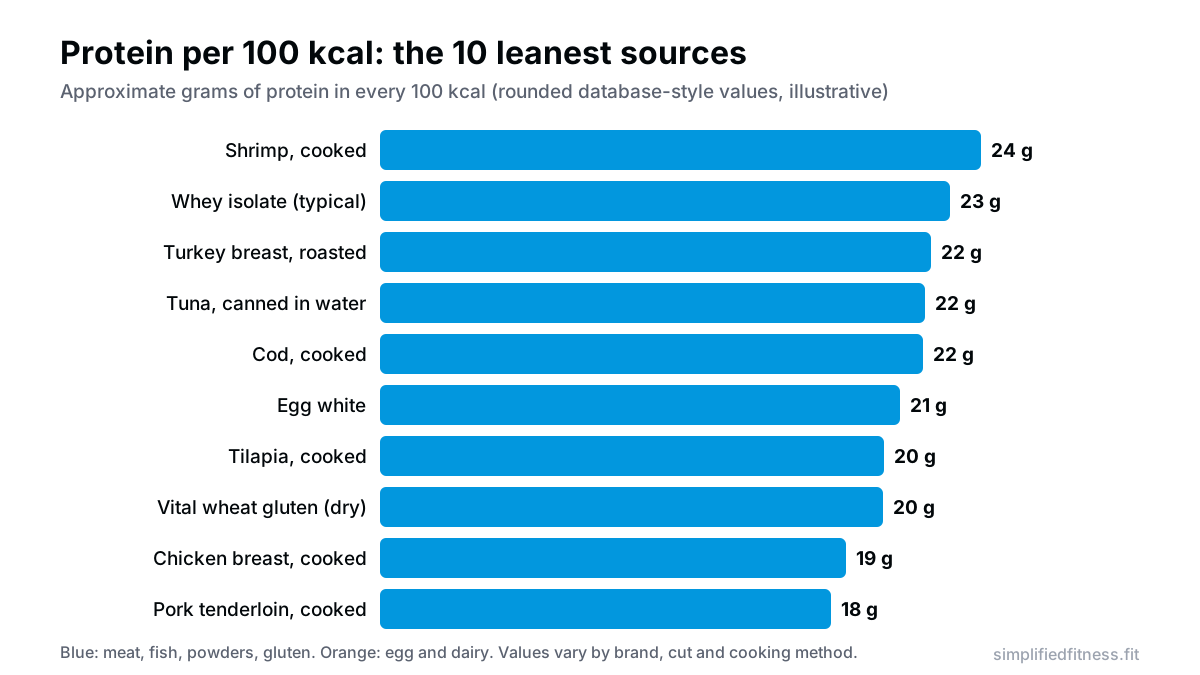
A few patterns jump out.
Lean and watery wins. Seafood, egg whites and low-fat dairy carry a lot of protein and almost no fat, so each calorie works harder. Fat has 9 kcal per gram, so any food where fat is a big share of the calories slides down the chart fast.
Dry vs cooked matters. Soya chunks look excellent at 15 g per 100 kcal, but that is the dry weight. Once soaked and squeezed, 100 g of chunks is far lighter in calories and protein, so weigh dry if the label does. The same goes for gluten and whey powder. Our guide to raw vs cooked weight differences shows how to avoid mixing the two.
Chicken is good, not the best. Skinless breast sits around 19 g, comfortably high, while thigh drops to about 12 g because of its extra fat. That is a real difference when you eat 300 g a day.
The Indian vegetarian reality check
This is where the ranking gets uncomfortable for a lot of readers. Most staple Indian protein foods are lower on density than people assume.
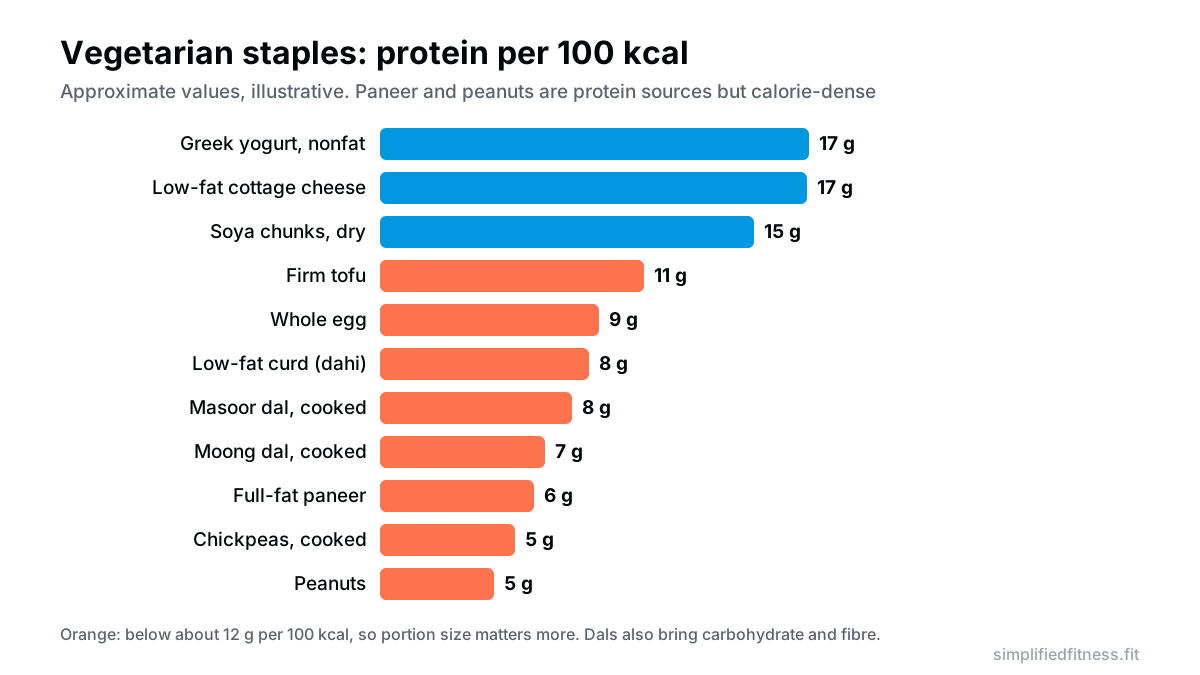
- Dal and rajma (about 7-8 g per 100 kcal). Useful, but each also brings carbohydrate. A katori of dal is a side contribution to protein, not the main act. See dals, pulses and the protein myth.
- Paneer (about 6 g). Rich in protein in absolute terms, but efficient only if you manage portions. Chenna or low-fat paneer shifts it up, as we explain in paneer vs low-fat paneer.
- Soya chunks (about 15 g dry). The densest common Indian vegetarian staple, and cheap. Read soya chunks, isoflavones and the safety myths if you are worried about overdoing it.
- Curd and cottage cheese (about 8 and 17 g). Hung curd or low-fat cottage cheese fits a cut well, a plain katori of regular curd less so.
Do high-protein foods keep you full?
The honest answer is “somewhat, and it depends on what you measure.”
A 2015 review by Leidy and colleagues looked at the protein and weight management literature. It reported a modest satiety effect from higher-protein meals, meaning greater perceived fullness and higher satiety hormones, but the review did not find support for lower energy intake at the next eating occasion (Leidy et al., 2015). Long-term studies were limited and conflicting, and the authors suggested that adherence explains much of the discrepancy: people who stuck to higher-protein diets did better than those who did not. Their overall reading was that intakes of roughly 1.2-1.6 g/kg per day, with at least about 25-30 g of protein per meal, can improve appetite and weight management.
A separate analysis pooled 38 experimental trials in which people ate from menus with set macronutrient mixes. Higher percent protein was linked to lower total energy intake, whether carbohydrate or fat was the diluted nutrient (Gosby et al., 2014). The authors read this as support for the “protein appetite” idea: if protein is diluted in your diet, appetite may push you to eat more total energy to reach it. That is a model supported by this data, not proof for every individual.
A meta-analysis of 24 trials (1,063 adults) compared energy-restricted high-protein, low-fat diets with standard-protein diets. The higher-protein diets produced somewhat more fat loss (about 0.87 kg more) and better preservation of fat-free mass (about 0.43 kg), with greater satiety reported in 3 of 5 studies that measured it (Wycherley et al., 2012). The average diet lasted about 12 weeks and the effects were described as modest.
So where do studies disagree? Short, tightly controlled feeding trials tend to show clear benefits. Longer free-living ones are messier, probably because real people drift away from the plan. The cautious takeaway: high-protein eating helps most when you can actually keep it up.
Why protein per calorie matters most in a deep deficit
When calories are high, protein density barely matters. You can hit 150 g of protein with a mix of foods and still have room for everything else.
When calories are low, the arithmetic changes. Two findings explain why people push protein up while cutting.
A systematic review of six studies in resistance-trained, lean athletes who were restricting calories concluded that protein needs are likely about 2.3-3.1 g per kg of fat-free mass, scaling up with how severe the restriction is and how lean the person is (Helms et al., 2014). That is a review of a small number of studies, so use it as a range, not a rule.
In a 4-week randomised trial in young men, a roughly 40% energy deficit with intense training saw the group eating 2.4 g/kg of protein gain about 1.2 kg lean mass and lose about 4.8 kg fat, versus about 0.1 kg lean gain and 3.5 kg fat loss on 1.2 g/kg (Longland et al., 2016). It was short, with 20 young men per group and an unusually hard training load, so it does not map neatly onto a busy office worker doing three sessions a week.
Put simply, if you need 150 g of protein and only have 1,800 kcal, going for foods with 17-24 g per 100 kcal leaves room for carbohydrate and fat. Going for 6-8 g per 100 kcal foods can eat most of your day’s energy before you reach the target. Use the protein calculator for your number and the calorie calculator for your budget. Our guide to high protein during caloric restriction covers the rest.
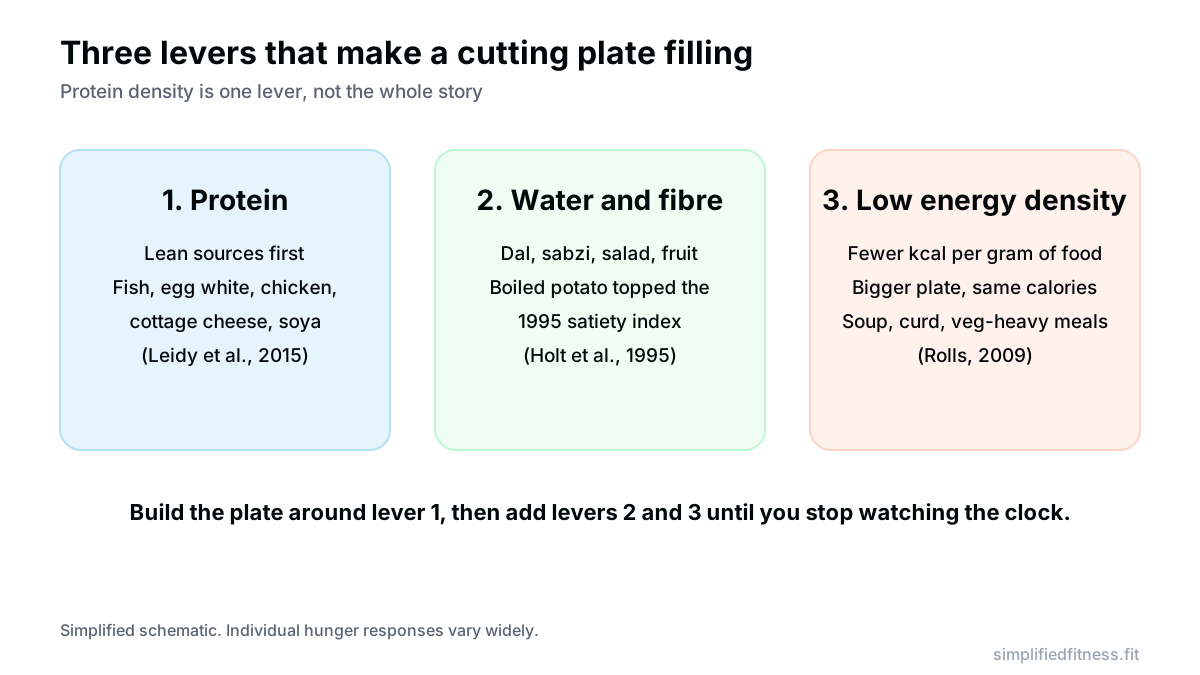
Protein is only one lever for hunger
Do not build your whole cut around the top of the table. Eating nothing but shrimp and egg whites is joyless and rarely sustainable.
Two other factors have good evidence behind them. In a 1995 study, people ate equal 240 kcal servings of 38 foods and rated their fullness for two hours. Boiled potatoes scored highest, and protein, fibre and water content were all positively linked to satiety, while fat content was negatively linked (Holt et al., 1995). Sample sizes were small (11-13 people per food), but the pattern fits what many people experience.
Energy density, meaning calories per gram of food, matters too. Rolls reviewed the evidence and noted that people tend to eat a fairly consistent weight of food, so lowering the energy density of available foods tends to lower intake, and adding water-rich fruit and vegetables was linked to weight loss in several trials (Rolls, 2009). The author also noted that controlled data beyond several days is limited.
How to use this chart in a real week
- Set your protein and calorie targets first. Use the calculators linked above, or see your coach or a registered dietitian if you have a medical condition.
- Anchor each meal with one food from the top 15. For vegetarians that means soya chunks, cottage cheese or Greek-style curd. Eggetarians can add egg whites.
- Treat dal, rajma, paneer and nuts as bonus protein. Count them, but do not rely on them for the bulk.
- Watch the cooking fat. A teaspoon of ghee or oil adds about 40 kcal and can undo a lean choice. That is why the same chicken breast can land very differently depending on the tadka.
- Add volume. Sabzi, salad, cucumber, soup or fruit on the side costs few calories and takes up plate space.
- Check cost too. Shrimp and tuna are efficient per calorie but expensive in many Indian cities. Our cost per 30 g of protein comparison helps balance the two.
- Mind hot weather and safety. Cooked fish, chicken and dairy spoil quickly in heat, so refrigerate promptly.
When to speak to a professional
A high-protein diet suits most healthy adults, but speak to a doctor or registered dietitian first if you have kidney disease, are pregnant or breastfeeding, have a history of disordered eating, or are managing diabetes with medication. This article is general information, not a diagnosis or a personal diet plan.
The bottom line
For efficient protein, lean seafood, turkey, chicken breast, egg whites and low-fat dairy sit at the top, with whey isolate and dry soya chunks close behind. Most Indian vegetarian staples are lower, which is fine as long as you plan portions. The research says higher-protein diets give a modest satiety benefit and help protect lean mass in a deficit, but long-term results depend on whether you can keep eating that way. Use the chart to pick your anchors, then add fibre, water and volume so the plan stays livable.
Frequently Asked Questions
Which food has the most protein per calorie?
Among common whole foods, cooked shrimp is near the top at roughly 24 g of protein per 100 kcal, with turkey breast, canned tuna, white fish and egg whites close behind. Values depend on the database, cut and cooking method, so treat them as approximate. Check the label or a food database for the exact brand you buy.
What is the highest protein per calorie vegetarian food in India?
Leaving aside whey powder and vital wheat gluten (the base of seitan), low-fat cottage cheese and nonfat Greek-style curd are the densest everyday vegetarian options at roughly 17 g per 100 kcal, followed by dry soya chunks at about 15 g. Egg whites also work if you eat eggs. If you only have dal and paneer, use them but watch portions, since both are far less protein-dense.
Is paneer a good protein source for cutting?
Full-fat paneer gives roughly 6 g of protein per 100 kcal because much of its energy comes from fat. It is still a decent protein source, just not an efficient one in a tight deficit. Use a smaller portion, or switch to low-fat paneer, hung curd or cottage cheese on harder days.
Are egg whites better than whole eggs for fat loss?
Egg whites carry about 21 g of protein per 100 kcal versus about 9 g for a whole egg, so they are more efficient per calorie. Whole eggs add fat-soluble vitamins and satisfying fat, and one trial in overweight adults found an egg breakfast lowered later energy intake compared with cereal. A mix, such as 1 whole egg plus 3 whites, is a practical middle ground.
Do high-protein foods really keep you full?
Modestly, yes. A 2015 review concluded that higher-protein meals raise perceived fullness and satiety hormones, though they did not clearly lower intake at the next meal. Use protein as one lever and add fibre-rich and water-rich foods too.
How much protein per 100 calories is considered high?
There is no official cut-off, but foods above roughly 15 g per 100 kcal are usually treated as lean, high-density protein sources. Foods in the 8-15 g range are fine but need a little portion control. Below that, such as dal or nuts, treat the food as a mixed source with protein as a bonus.
Is protein per calorie more important than protein per rupee?
It depends on your goal. In a deep deficit, protein per calorie decides how much room you have left for carbohydrate and fat, while on a tight budget cost per gram of protein can matter more. Compare both before you shop, and see our cost-per-30g guide for the price side.
Can I hit my protein target only with Indian vegetarian foods?
Yes, it is possible, but it usually takes more planning and more calories than a non-vegetarian diet. Combining soya chunks, curd, cottage cheese, dal and, if you eat them, egg whites makes the maths work. Use our protein calculator to find your daily target and then build meals backwards from it.
Are protein powders good for protein per calorie?
A typical whey isolate gives roughly 20-25 g of protein per 100 kcal, which puts it among the most efficient options. It is convenient, not magic, and whole foods bring fibre and micronutrients that powders lack. Use it to fill gaps rather than replace meals.
Do I need to count protein per calorie if I eat enough protein?
Not necessarily. If you already hit your protein target and your weight is moving at the right pace, this ranking is just a reference. It becomes useful when you struggle to fit protein inside your calories or feel constantly hungry on a cut.
Does cooking change protein per 100 kcal?
Cooking mostly removes water, so cooked foods show more protein and calories per 100 g than raw ones, but the ratio of protein to calories changes much less. Added oil and ghee are what really drag the ratio down. Weigh foods the same way every time, as explained in our raw vs cooked guide.
How much protein do I need while cutting?
Research on energy-restricted, resistance-trained athletes suggests intakes at the higher end of common ranges, in some reviews about 2.3-3.1 g per kg of fat-free mass. The right number rises with leanness and the size of the deficit. A simpler starting point for most people is the protein calculator, then adjust with a coach or dietitian.
Sources & References
Every claim above is checked against peer-reviewed research (PubMed, U.S. National Library of Medicine) or guidance from established health bodies. How we fact-check.
- Leidy HJ, et al. The role of protein in weight loss and maintenance. Am J Clin Nutr. 2015. PMID: 25926512
- Gosby AK, et al. Protein leverage and energy intake. Obes Rev. 2014. PMID: 24588967
- Helms ER, et al. A systematic review of dietary protein during caloric restriction in resistance trained lean athletes: a case for higher intakes. Int J Sport Nutr Exerc Metab. 2014. PMID: 24092765
- Longland TM, et al. Higher compared with lower dietary protein during an energy deficit combined with intense exercise promotes greater lean mass gain and fat mass loss: a randomized trial. Am J Clin Nutr. 2016. PMID: 26817506
- Wycherley TP, et al. Effects of energy-restricted high-protein, low-fat compared with standard-protein, low-fat diets: a meta-analysis of randomized controlled trials. Am J Clin Nutr. 2012. PMID: 23097268
- Holt SH, et al. A satiety index of common foods. Eur J Clin Nutr. 1995. PMID: 7498104
- Keogh JB, et al. Energy intake and satiety responses of eggs for breakfast in overweight and obese adults: a crossover study. Int J Environ Res Public Health. 2020. PMID: 32756313
- Rolls BJ. The relationship between dietary energy density and energy intake. Physiol Behav. 2009. PMID: 19303887

Umair Hazrami · Founder & Head Coach, Simplified Fitness
Umair Hazrami founded Simplified Fitness and the Simplified Lifter channel to cut through fitness noise. With 4+ years of consistent training and 10+ coaching clients, he writes every guide from the peer-reviewed research and links the sources so you can check them. Our editorial standards.
Educational content only, not medical advice. If you have a medical condition, are pregnant, or take medication, talk to a qualified doctor before changing your diet, supplements or training. Full disclaimer.
Keep reading
Indian Diet
The 3-Hour Weekly Batch Meal Prep: Cooking 5 Days of Lunches and Dinners for Busy Lifters
Batch meal prep for the week in 3 hours: a station-by-station Sunday plan for 10 high-protein lunches and dinners, with Indian options and safe storage rules.
7 min read

Indian Diet
Cost per 30 Grams of Protein: 40 Common Fitness Foods Ranked by Price
Cost per 30g protein for 40 Indian gym foods, from soya chunks to whey and tuna. See the cheapest protein sources per gram and what to buy on a budget.
8 min read
Indian Diet
Eating Healthy on a Student Budget: High Protein Hostel and Dorm Room Meal Prep
A college student bodybuilding diet budget can still hit 130 g of protein. Cheap staples, no-cook hostel prep and a sample day, with the studies linked.
8 min read
Indian Diet
Essential Kitchen Equipment for Lifters: Scales, Air Fryers, Blenders and Containers
The best kitchen equipment for meal prep lifters: which four tools earn their space, what the research says about each, and what to buy first on a budget.
10 min read