How to Convince Indian Parents About Whey Protein: Kidney Fears, 'Chemicals' and the Real Evidence
How to convince Indian parents about whey protein: explain it as paneer-water dairy, answer the kidney fear with trial data, and read the label together.

TL;DR. The short answer
- Whey protein is a dairy product: it is the watery liquid left after milk is curdled (the same liquid that separates when paneer is made), filtered and dried. It is not a steroid and not a synthetic drug.
- In healthy adults, a 2018 meta-analysis of 28 trials (1,358 people) found higher-protein diets did not worsen kidney function measured by GFR. People who already have kidney disease are a different case and need their doctor's advice.
- Most lifters do not need more than about 1.6 g/kg/day of total protein for muscle gain, so a sensible plan uses food first and a scoop to fill the gap.
- The real risks are product quality and overuse, not the milk protein itself. Check the label, the FSSAI licence and a test report you can open.
- Do not argue. Show the label, cook with the whey, offer a doctor visit, and let your parents set a trial period.
Part of our complete guide: Indian High-Protein Nutrition Guide: Cutting and Muscle Building on Vegetarian and Non-Veg Diets
Table of contents
If you are wondering how to convince Indian parents about whey protein, the short answer is this: stop defending a “supplement” and start explaining a dairy food. Whey is the protein-rich liquid that separates from milk when paneer is made, filtered and dried. The kidney worry has a fair answer in the research on healthy adults, and the quality worry has a fair answer on the label.
This article sits inside our complete guide to Indian high-protein nutrition. It is written for the 19-year-old who has a tub in his cart and a mother who thinks it is “chemical powder for gym boys”. Her concern comes from love, so treat it that way.
Why do Indian parents distrust protein powder?
Their worries are usually a mix of three things, and only one is mostly myth.
“It is a steroid.” Steroid misuse in gyms is real, and some tubs on sale online are not what they claim. Parents connect the two.
“It will damage the kidneys.” A relative once had kidney trouble and someone blamed protein. Headlines rarely mention that most such stories involve people who already had kidney disease.
“It is chemicals, not food.” The tub looks like a laboratory product, so it feels unnatural next to dal and roti.
Notice what this means. Two of the three fears have a grain of truth: contaminated products exist, and protein is a real concern if your kidneys are already unwell. So the winning approach is not “you are wrong”. It is “you are right to check, so let’s check together”.
What is whey protein actually made from?
Milk has two main protein groups, casein and whey. When milk is curdled with acid or rennet to make paneer or cheese, the solids set and the watery part stays behind. That liquid is whey. Indian dairy researchers describe it as a liquid by-product of making coagulated milk products like paneer and cheese (Ghanshyambhai et al., 2015).
Whey protein powder is that liquid with most of the water removed and the protein concentrated. Most commercial whey comes from cheese-making rather than paneer, but it is the same kind of liquid. Plenty of Indian homes that make paneer pour the whey down the sink or use it to knead atta. You can show your mother this directly: next time paneer is made at home, point at the pot.
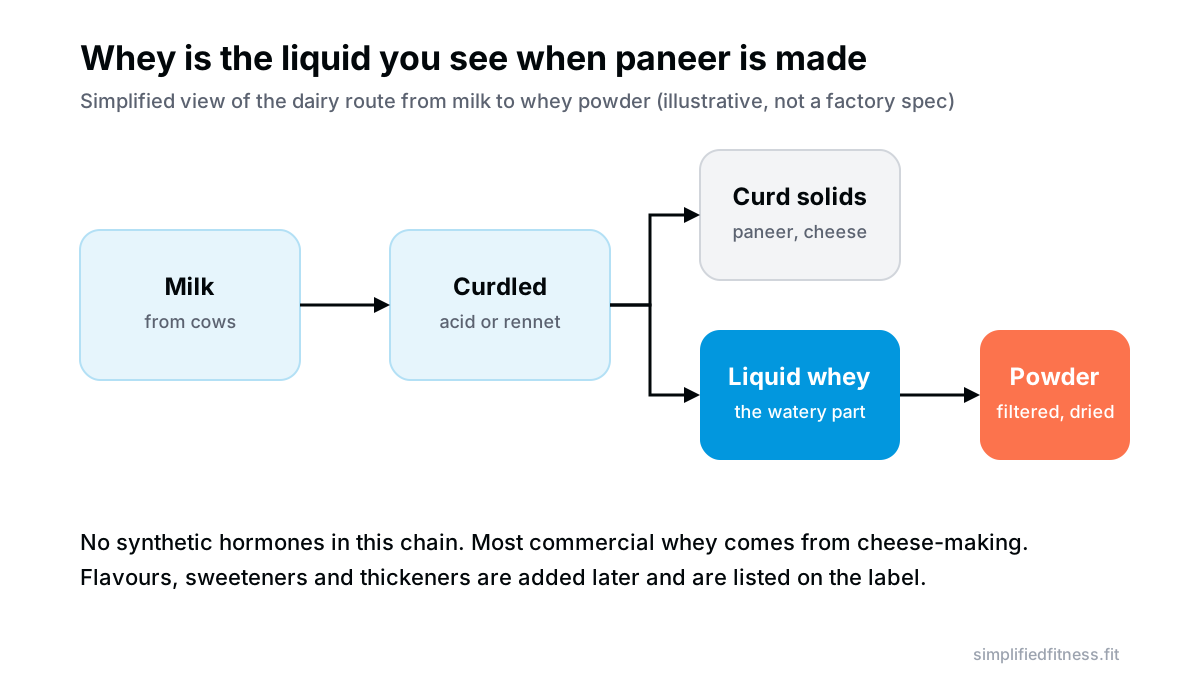
A small detail that helps: casein, the paneer-side protein, digests slowly, while whey digests quickly. That is why whey is popular after training. It is a texture-and-speed difference between two parts of milk, not a different kind of substance.
Whey is not a steroid
Steroids are synthetic hormones. Whey is a protein that your body breaks into amino acids, exactly as it does with the protein in curd, paneer or eggs. It does not bind hormone receptors, and it has no steroid-like action.
The honest caveat is contamination. A review of the sports supplement literature documented products containing undeclared anabolic steroids and stimulants, mostly attributed to poor manufacturing, though some deliberate adulteration was suspected (Maughan, 2005). That review is about supplements in general and is from 2005, so it does not tell you how any single Indian brand performs today. It does tell you why “buy the cheapest unbranded tub from a stranger” is a bad plan. We cover another quality issue in our article on heavy metals in protein powders.
Is whey protein safe for kidneys? What the studies show
This is the question that decides most family conversations, so let’s be careful and fair.
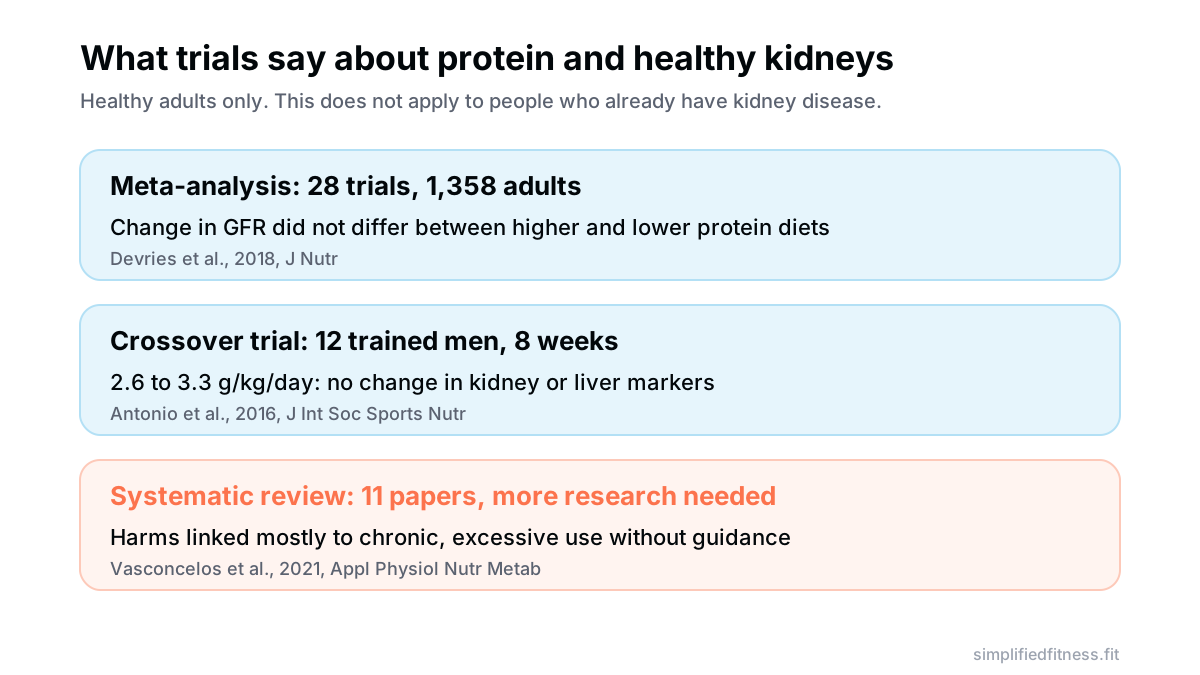
What healthy-adult studies found. A 2018 meta-analysis pooled 28 randomized trials with 1,358 adults without kidney disease. It compared higher-protein diets with normal or lower ones and measured glomerular filtration rate (GFR), the standard marker of how well the kidneys filter. Changes in GFR did not differ between groups, and the authors concluded that higher protein intakes do not adversely influence kidney function in healthy adults (Devries et al., 2018). The authors did flag unclear risk of selection bias in some trials.
A smaller trial looked at lifters specifically. Twelve resistance-trained men followed their usual diet (about 2.6 g/kg/day of protein) and a higher-protein diet (about 3.3 g/kg/day) for eight weeks each in a crossover design. There were no changes in blood lipids or markers of kidney and liver function (Antonio et al., 2016). Twelve men for eight weeks cannot settle lifelong safety, but it is directly relevant to the “gym boy” worry.
What the cautionary review found. A 2021 systematic review of 11 papers on whey supplementation reported that most of the harms it found were tied to chronic, excessive and unsupervised use, with kidney and liver the organs most often mentioned. The authors themselves called for more research (Vasconcelos et al., 2021).
Why these can be reconciled. The reassuring data come from healthy people at sensible intakes under study conditions. The cautionary review is about chronic, excessive use, and its authors say more research is needed. Neither says a normal scoop is dangerous for a healthy person, and neither says it is safe for someone with existing kidney problems.
How much protein do you actually need?
A reassuring thing to tell your parents is that the plan is moderate. The ISSN position stand says that 1.4-2.0 g/kg/day is sufficient for most exercising people to build and maintain muscle (Jäger et al., 2017). A meta-analysis of 49 trials with 1,863 participants found protein supplementation modestly increased muscle gains in training, and that intakes beyond about 1.6 g/kg/day did not add further fat-free mass gains (Morton et al., 2018). Note that one author of that paper disclosed grant support and honoraria from the US National Dairy Council, and the supplement effect on lean mass was small (about 0.3 kg overall).
For a 70 kg lifter, 1.6 g/kg is about 112 g a day. A realistic Indian day might look like this:
| Source | Approximate protein |
|---|---|
| 2 eggs | 12 g |
| 1 cup dal (cooked) | 10-15 g |
| 100 g paneer | 18 g |
| 200 g curd | 7-8 g |
| 1 scoop whey | 20-25 g |
These are rough figures that vary by brand and recipe, and they are for orientation only. They add up to roughly 70-80 g, with roti, rice, milk and other foods covering much of the rest. That is where a scoop fits: it fills a gap, it does not replace meals. Work out your own number with the protein calculator, and see our guide on optimal daily protein for muscle growth for the research behind it.
How do I read a whey protein label with my family?
This is the most persuasive step, because it turns fear into a task your parents can do themselves.
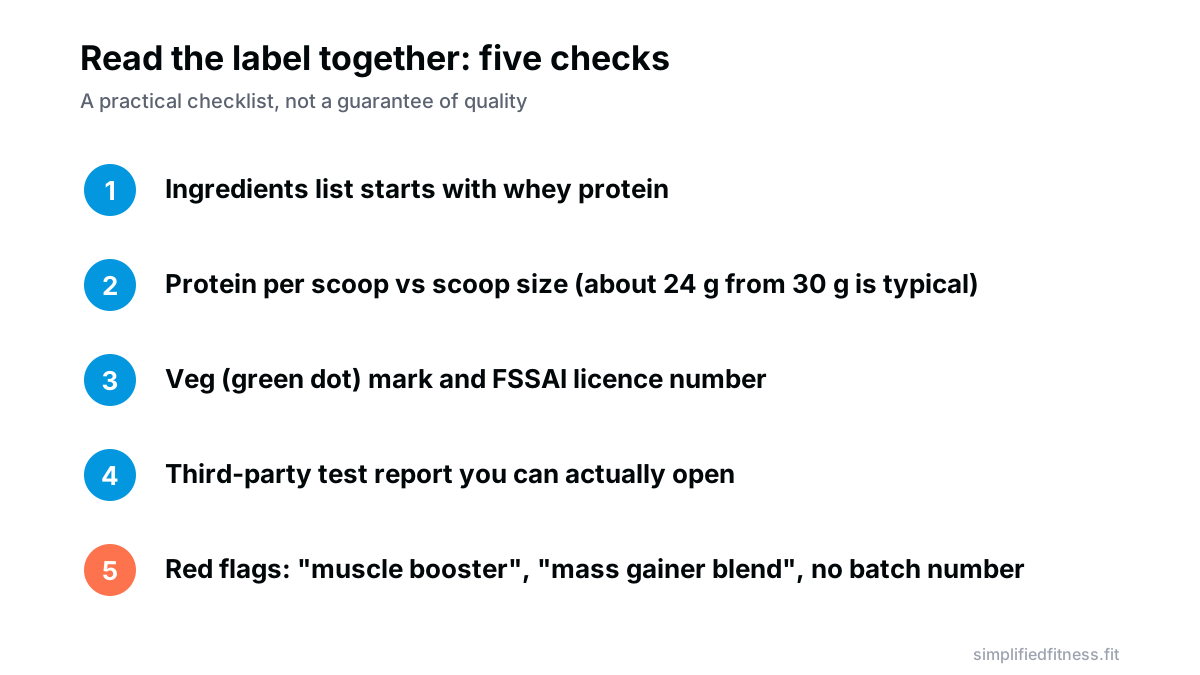
- Ingredients. Whey protein (concentrate or isolate) should be first. A long list of “blends” and proprietary “matrix” claims is a reason to pause.
- Math. Compare grams of protein per scoop with scoop size. A scoop of about 30 g giving about 24 g of protein is common, though it varies. Much lower than that suggests filler.
- Veg mark and licence. Indian packaged foods carry the green dot for vegetarian products and an FSSAI licence number. Parents recognise these instantly.
- Third-party testing. Look for an independent lab report you can actually open for that batch, not just a logo. Indian and international testing programmes such as Trustified or Labdoor exist, but check what each one really tests before you rely on it, and I have not verified any specific brand.
- Red flags. “Muscle booster”, mixed “mass” blends, no batch number, or a price far below competitors.
The difference between concentrate and isolate, including lactose, is covered in whey isolate vs concentrate.
A step-by-step way to have the conversation
There is no script that works on everyone, but this order tends to go well.
- Pick a calm moment. Not during dinner and not after an argument.
- Start with their worry. Say “I know you are worried about kidneys and steroids, and I want to check that too.”
- Explain what whey is. The paneer water example is very effective.
- Show your total plan. A moderate daily number, mostly from food.
- Offer a doctor visit. A basic check, especially if there is any family kidney history, shows you take safety seriously.
- Propose a trial. Four to eight weeks, one scoop a day, then review how you feel.
- Cook with it if needed. Stirring a scoop into oats or lassi can make it feel like part of the kitchen.
Skip the shaker bottle display. You do not need to prove anything in a gym-bro way.
What if your parents are still not convinced?
Respect it. A food-first plan works too. Dal, soya, paneer, curd, eggs and milk already get most Indian lifters most of the way. Our guide to sattu as a desi protein option is an example of a food-based middle ground, and you can reach a decent protein intake without a tub at all.
Whey is convenient, not magic. A meta-analysis found its effect was smaller in older people and larger in trained lifters, and it was only about 0.3 kg of fat-free mass on average across studies. If waiting a few months for family comfort costs you very little in muscle, the relationship is probably worth more.
Also be honest about two side questions.
Acne. The evidence is mixed. In a 6-month randomized trial of 49 young men with mild to moderate acne, 30 g of whey daily was not worse than a non-whey supplement for acne lesions, though the trial was small (Sompochpruetikul et al., 2024). If your skin changes, stop and see a dermatologist.
Digestion. Concentrate contains some lactose. If dairy gives you gas, try isolate or a small portion first.
When to talk to a doctor first
Speak to a doctor before using whey or increasing protein if you:
- have kidney disease, reduced kidney function, or diabetes that affects your kidneys
- have liver disease
- have a strong family history of kidney problems
- are under 18, pregnant or breastfeeding
- take regular medication and are unsure about interactions
Seek medical advice promptly if you notice swelling in your legs or face, much less urine than usual, blood in urine, or persistent nausea or tiredness. These can have many causes and are not a diagnosis, but they deserve a proper check.
The bottom line
Whey protein is milk protein: the liquid left after paneer is made, filtered and dried. Studies in healthy adults have not shown that higher protein intake harms kidney function, though long-term data are limited and people with kidney disease should get medical advice first. The real risks are poor-quality products and overdoing it, and a label check solves the first while a moderate plan solves the second.
If your family says no, food first is a perfectly good plan. If you want a structure to train on while you sort it out, start with our free diet plan and keep your protein around the range your body weight actually needs.
Frequently Asked Questions
How do I convince my Indian parents to let me use whey protein?
Start with what whey actually is: milk protein, the liquid that separates when paneer is made, filtered and dried. Parents usually soften once the fear shifts from 'chemical' to 'dairy', and once they can read the label and see your total protein plan is moderate. Offer a 4-8 week trial with a doctor check if they want one.
Is whey protein made from milk?
Yes. Milk has two main protein families, casein and whey, and whey is the one that stays in the liquid when milk is curdled for paneer or cheese. That liquid is filtered, concentrated and spray-dried into powder, so the starting material is dairy. Flavours and sweeteners are added later, which is why you read the ingredients list.
Is whey protein a steroid?
No. Steroids are synthetic hormones, while whey is a food protein that your body digests into amino acids like any other protein. Whey does not act on hormone receptors. The only way a steroid ends up in a tub is contamination or fraud, which is why choosing tested products matters.
Does whey protein damage the kidneys?
In healthy adults, research has not shown that higher protein intake harms kidney function. A 2018 meta-analysis of 28 trials found no adverse effect on GFR, and an 8-week crossover trial in resistance-trained men eating 2.6-3.3 g/kg/day also found no change in kidney markers. If you have kidney disease, diabetes with kidney involvement or reduced kidney function, speak to your doctor before using protein supplements.
Why do Indian parents think protein powder is harmful?
Usually because of mixed messages: stories about steroid use in gyms, unregulated products sold online, and headlines about kidney failure that never mention pre-existing disease. These fears are not irrational, since contaminated supplements do exist. Meet the worry with the label, a tested brand and honest numbers instead of dismissing it.
Is whey protein safe for teenagers?
Evidence in teens is thinner than in adults, so be cautious. A teenager eating dal, paneer, curd, eggs and milk may already be near their needs, and food should come first. If a teen wants whey, talk to a doctor or dietitian first and keep it to one scoop at most.
How much whey protein is safe per day?
For most lifters, one or two scoops (about 25-50 g of protein) is plenty, as part of a total intake around 1.4-2.0 g/kg/day, the range given in the ISSN position stand. Gains in a large meta-analysis levelled off beyond about 1.6 g/kg/day of total protein. More than that adds cost without clear muscle benefit.
Can whey protein cause acne?
Evidence is mixed and the best trial is small. A 6-month randomized trial in 49 young men with mild to moderate acne found whey was not worse than a non-whey supplement for acne lesions. If your skin breaks out after starting, stop for a few weeks and see a dermatologist rather than guessing.
I am lactose intolerant. Can I take whey?
Whey concentrate contains some lactose, so it can cause gas or loose stools in lactose-sensitive people. Isolate has less lactose. Try a small serving and compare options in our guide to whey isolate vs concentrate, or use a plant protein if dairy never agrees with you.
Are Indian whey protein brands safe?
Some are well made and some are not, and price alone does not tell you which. Supplement contamination has been documented in the research literature, so look for a clear ingredient list, FSSAI licence, batch number and a lab report from an independent tester. When in doubt, skip the product.
Do I even need whey if I eat dal, paneer and curd?
Not necessarily. Whey is a convenience tool, not a requirement, and a meta-analysis found its benefit shrinks when total protein is already high. If your day already reaches your target from food, a scoop adds little. Use our protein calculator to see whether you actually have a gap.
Is whey protein vegetarian in India?
Whey comes from milk, so it is vegetarian in the Indian sense (no meat or egg), and Indian packs carry a green dot when that applies. It is not vegan. Check the label for the green mark, since some products add egg-based or non-veg ingredients.
What should my parents ask a doctor before I start?
Ask whether any personal or family history of kidney, liver or metabolic disease makes extra protein a bad idea, and whether a baseline blood test is worth doing. A doctor can interpret kidney markers in context, which a WhatsApp forward cannot. Bring the product label and your planned daily protein.
Sources & References
Every claim above is checked against peer-reviewed research (PubMed, U.S. National Library of Medicine) or guidance from established health bodies. How we fact-check.
- Devries MC, et al. Changes in Kidney Function Do Not Differ between Healthy Adults Consuming Higher- Compared with Lower- or Normal-Protein Diets: A Systematic Review and Meta-Analysis. J Nutr. 2018. PMID: 30383278
- Antonio J, et al. The effects of a high protein diet on indices of health and body composition--a crossover trial in resistance-trained men. J Int Soc Sports Nutr. 2016. PMID: 26778925
- Vasconcelos QDJS, et al. Whey protein supplementation and its potentially adverse effects on health: a systematic review. Appl Physiol Nutr Metab. 2021. PMID: 32702243
- Morton RW, et al. A systematic review, meta-analysis and meta-regression of the effect of protein supplementation on resistance training-induced gains in muscle mass and strength in healthy adults. Br J Sports Med. 2018. PMID: 28698222
- Jager R, et al. International Society of Sports Nutrition Position Stand: protein and exercise. J Int Soc Sports Nutr. 2017. PMID: 28642676
- Sompochpruetikul K, et al. Whey protein and male acne: A double-blind, randomized controlled trial. J Dermatol. 2024. PMID: 38291989
- Maughan RJ. Contamination of dietary supplements and positive drug tests in sport. J Sports Sci. 2005. PMID: 16195040
- Ghanshyambhai MR, et al. Standardization of the method for utilization of paneer whey in cultured buttermilk. J Food Sci Technol. 2015. PMID: 25892776

Umair Hazrami · Founder & Head Coach, Simplified Fitness
Umair Hazrami founded Simplified Fitness and the Simplified Lifter channel to cut through fitness noise. With 4+ years of consistent training and 10+ coaching clients, he writes every guide from the peer-reviewed research and links the sources so you can check them. Our editorial standards.
Educational content only, not medical advice. If you have a medical condition, are pregnant, or take medication, talk to a qualified doctor before changing your diet, supplements or training. Full disclaimer.
Keep reading
Indian Diet
Budget Indian Diet for 120g Protein Under ₹100 a Day (Student Plan)
A budget Indian diet for 120g protein under 100 rupees a day: soya, eggs, milk and chana, with protein per rupee maths and two student plans you can copy.
8 min read
Indian Diet
Chicken Breast and Fish in India: Where to Buy, How to Cook, and Cost per 30 g Protein
Chicken breast price per kg India: compare wet market vs apps, learn safe handling, a brine method for juicy meat, and rohu vs chicken cost per 30 g protein.
11 min read
Indian Diet
Curd vs Greek Yogurt vs Hung Curd: Protein Yield and the Home Recipe
Curd vs Greek yogurt protein in India: plain dahi gives about 3-4 g per 100 g. See how straining it into hung curd can triple that, and what studies show.
9 min read
Indian Diet
Is Dal a Good Source of Protein? Moong, Chana and Rajma Reality Check
Is dal a good source of protein? Moong, chana and rajma give some protein but far more carbs. See the numbers and how to build a plate that works for lifters.
8 min read