How to Diet During Weddings and Family Dinners Without Wrecking Your Progress
How to diet during weddings and social events: a 4-step plan with calorie banking, a protein pre-load and a next-morning reset, built on real research.
TL;DR. The short answer
- One wedding dinner will not undo a cut. In a 195-adult NIH study, the whole mid-November to January holiday period added only about 0.37 kg on average.
- Bank a modest 300-500 kcal earlier in the day with protein-heavy, high-volume meals, but do not starve yourself. Arriving ravenous usually backfires.
- A protein-rich snack 60-90 minutes before the event can lower how much you eat at the buffet. In lab trials, whey preloads with more protein led to less intake at the next meal.
- Choose one or two dishes you actually love, eat protein first, and skip filler. Then eat normally the next morning, with no punishment workout.
- Rigid all-or-nothing rules may backfire. In one lab study, women with flexible control ate less after a preload, while those with rigid control did not.
Part of our complete guide: High-Protein Foods List: Protein per 100g, Cost per 30g and Meal Prep Guide
Table of contents
You can diet during weddings and family dinners without gaining fat. Plan a modest calorie buffer earlier in the day, eat about 25-30 g of protein before you leave, then choose one or two dishes you really want. One celebratory meal changes your average intake very little, and the next morning’s normal breakfast is the whole repair job.
If the invitation card already has you anxious, you are in good company. Cutting and social life collide constantly, especially in India where a single wedding can mean a mehendi, a sangeet and a reception in three days. This guide sits inside our high-protein foods and meal prep guide and focuses on the part tracking apps ignore: how to eat well in a room full of people, food and opinions.
Will one wedding dinner actually ruin your progress?
No. The fear is bigger than the physics.
The best real-world data we have is about holiday seasons, which are repeated parties across weeks, not one dinner. In a prospective study of 195 adults, average weight rose by 0.37 kg across the mid-November to January holiday period (Yanovski et al., 2000). A narrative review of adult studies found gains in the 0.4-0.9 kg range (Diaz-Zavala et al., 2017). That is a small number for weeks of festivals.
There is a catch. The Yanovski study found the gain was not reversed afterwards, so small gains can accumulate across years. That is an argument for returning to your routine quickly, not for fearing the buffet.
Part of the scale jump you see the next morning is not fat at all. A salty, rich meal pulls in water, and your gut simply holds more food. Give it 2-4 days of normal eating before judging.
How to diet during weddings: the four-step plan
Here is the routine I would hand to a lifter who is mid-cut and heading to a wedding. It is a practical framework, not a published protocol, so adjust it to how your own appetite behaves.
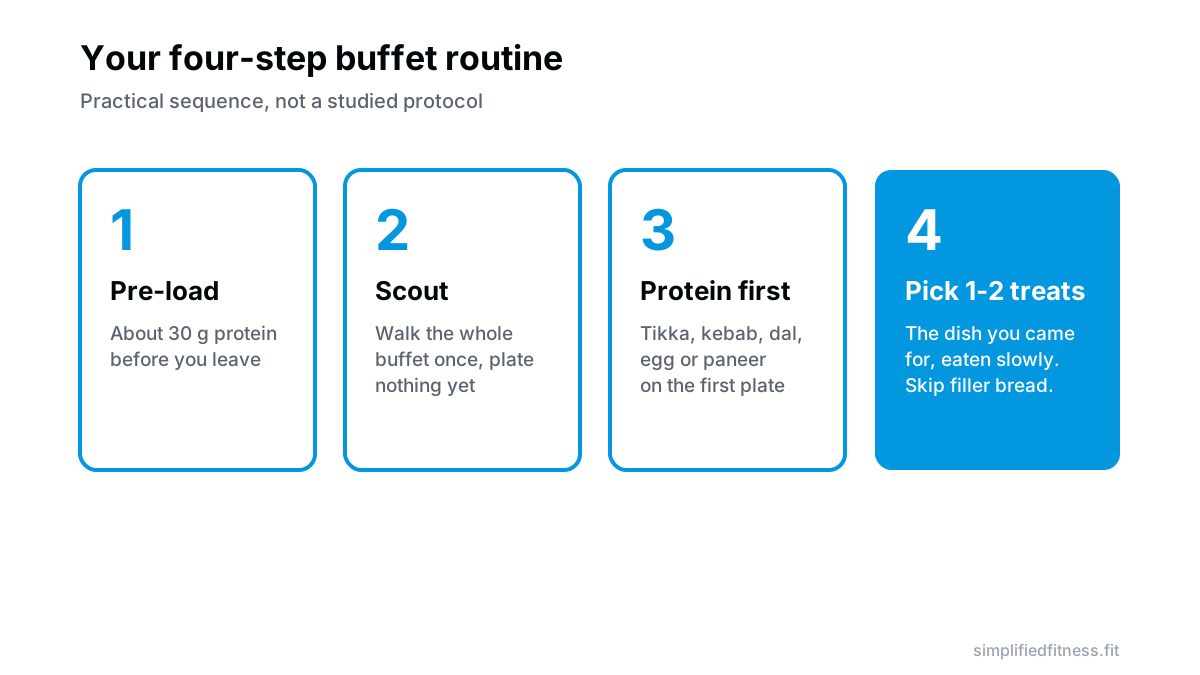
- Bank a little earlier in the day. Aim for 300-500 kcal of room.
- Pre-load protein. About 25-30 g before you leave the house.
- Scout, then plate. Walk the whole buffet once before you pick anything up.
- Choose 1-2 treats on purpose. Eat them slowly. Skip the filler.
Let’s go through each.
What is calorie banking, and how much should you save?
Calorie banking means eating slightly less earlier so a planned big meal fits inside your usual day. The logic is simple: your body does not run a separate calorie account for each meal, so a lighter lunch can leave room for a heavier dinner.
Be honest about the limits, though. No trial has tested “banking” as a strategy against not banking. The 300-500 kcal figure is a coaching rule of thumb. Smaller is fine.
How to do it without arriving hungry:
- Keep protein at your normal level, or slightly above. Eggs, curd, dal, paneer, soya chunks, chicken.
- Cut the low-value calories first: biscuits, chai with extra sugar, juice, the second paratha.
- Add volume. A big sabzi and salad fills the plate for few calories.
- Leave dinner’s slot open. Do not snack through the afternoon “because it is a wedding day”.
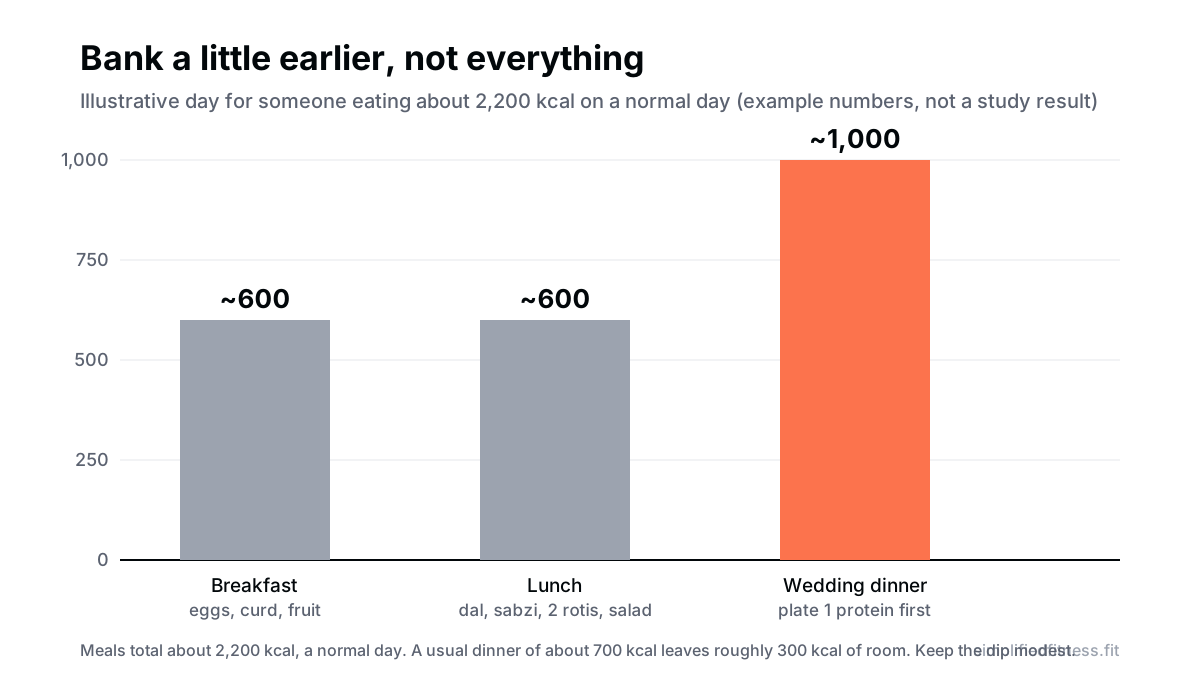
If you have a calorie target, work out your usual day with the calorie calculator first so you know what you are banking against.
Does a protein pre-load before a party work?
It may help. The best evidence comes from lab studies on liquid preloads, so apply it with some caution.
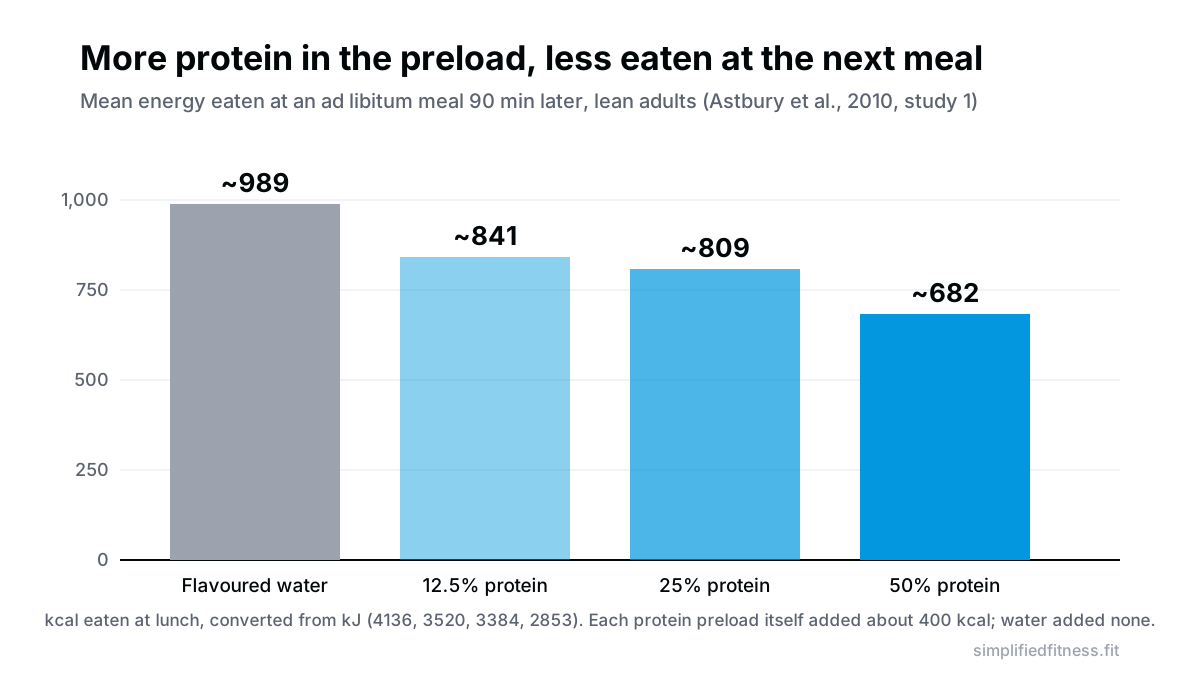
In two crossover trials in lean men and women, people drank one of several 400 ml preloads, matched for energy within each study, then ate freely 90 minutes later. In the first study, intake at the test meal was about 989 kcal after flavoured water. It fell to about 841 kcal, 809 kcal and 682 kcal after preloads with 12.5%, 25% and 50% of their energy from protein. The authors describe a dose-response effect on subsequent energy intake (Astbury et al., 2010).
Things to keep in mind:
- The participants were lean, healthy adults, and the test meal was a lab lunch, not a wedding buffet.
- The preloads themselves carried about 400 kcal, while the water had none. Lunch plus preload was not lower than after water, so the useful comparison is between the protein levels, not “preload vs nothing”.
- Appetite ratings did not differ between preloads in that trial, so the effect showed up in how much was eaten rather than how hungry people said they felt.
- A systematic review in people with overweight or obesity found that higher protein intake tended to raise fullness, but the evidence quality was low (de Carvalho et al., 2020).
So the takeaway is hedged: protein before you go probably makes it easier to choose, but it is not a switch. Try 25-30 g about an hour before leaving. A whey shake, three or four eggs, or a large bowl of high-protein curd all do the job. If you want to understand why protein fills you up, see our guide on satiety and the thermic effect of protein.
Our protein calculator will tell you your daily target so a 30 g pre-load fits into your day rather than adding to it.
How to eat at an Indian wedding buffet
Indian buffets have a particular trap. Everything arrives at once, the starters keep coming, and the food stations are designed for abundance.
A routine that keeps you in control:
- Scout first. Walk the whole spread before picking up a plate. It stops you filling up on the first thing you see.
- Protein on plate one. Tandoori or tikka items, paneer, chicken, egg curry, dal, chana, rajma, curd-based raita.
- Veg next. A salad and one sabzi.
- Then pick your treat. One serving of the thing you came for, whether that is biryani, a particular curry or the mithai.
- Skip the filler. Bread baskets, extra naan, fried starters in bulk, fizzy drinks.
Starters are the stealth calorie source. Passed trays at a sangeet can easily out-eat the main meal if you say yes to everything. Pick two items you like, then wave the rest off.
For the hidden fat in rich gravies and tadka, our guide to hidden calorie traps in Indian cooking shows where the calories actually sit.
How do you eat family dinners on a cut without the awkwardness?
Family dinners are harder than weddings. The pressure is personal. “Eat a little more, beta” is love, not sabotage.
A few scripts that work:
- Take a small serving with a smile, then ask for seconds of one dish only.
- Say “I will have more after a bit” and mean it, or let the plate sit half full.
- Compliment the cook specifically. “This dal is exactly how Nani made it” lands better than “no thanks”.
- Tell one trusted relative your goal beforehand so they can run interference.
If you are explaining your training to parents, our guide on peer pressure around healthy eating goes deeper on that conversation.
What should you do about alcohol?
Alcohol makes the maths harder in two ways: the drinks have calories, and they tend to make eating easier.
In a trial of 52 adults, an apéritif with alcohol led to higher energy intake at the following ad libitum lunch than equal-energy liquid carbohydrate, fat or protein appetizers, and 24-hour intake was higher on the apéritif day (Westerterp-Plantenga and Verwegen, 1999). The sample was healthy adults over a single lab session, so treat it as a pattern, not a rule.
Practical version: decide how many drinks you will have before you arrive, alternate with water and eat before you drink. For the training side, see alcohol and muscle growth.
Why guilt makes it worse, not better
This is the psychological core of the whole article, so let’s slow down on it.
Researchers have studied what happens when people who are watching their weight eat something they consider off limits. In one experiment, restrained eaters ate more afterwards whether a milkshake preload was described as high or low in calories, suggesting that even a low-calorie “forbidden” food can trigger disinhibited eating (Mills and Palandra, 2008). It was a single lab experiment, so it will not map perfectly onto a wedding. But it fits the familiar “I have already blown it” thinking that turns one plate into three.
A second study separated two styles of control. In 133 young women, those with more flexible control of eating cut back after a preload, while those with rigid control did not show that reduction. The authors suggest flexible control may be a less problematic long-term strategy, and rigid control may be linked to high susceptibility to eating problems (Westenhoefer et al., 1994). Again, women only, and a lab ice-cream task.
Put them together and the cautious takeaway is clear: a flexible plan beats a rigid one, and permission to enjoy a planned treat probably protects you from the spiral.
This is the same principle behind the 80/20 approach to flexible eating and the wider case for long-term adherence with flexible dieting.
What to do the morning after
Do almost nothing different.
- Eat your normal breakfast, with protein. Do not skip it as punishment.
- Drink water. Do not weigh yourself and panic on a salty, full-gut morning.
- Train as planned. A normal session, not a revenge session.
- Do not slash calories. That is how one event becomes a restrict-binge loop.
- Re-weigh after 2-4 days of normal eating if you want a clean read.
Where evidence on self-monitoring exists, it favours a calm routine. In a randomised trial of 111 adults, daily self-weighing with graphical feedback prevented holiday weight gain, while the control group gained about 2.65 kg (Kaviani et al., 2019). That does not mean you should weigh daily if it makes you anxious, since the study did not test emotional effects. But it supports noticing trends early rather than ignoring them.
If you have a history of eating disorders, or events send you into binge-restrict cycles you cannot break, talk to your doctor or a registered dietitian. This article is general education and cannot replace personal advice.
Quick reference: what to do before, during and after
| Stage | Do | Skip |
|---|---|---|
| Earlier that day | Normal protein-led meals, a modest 300-500 kcal trim, plenty of water | Fasting, crash dieting, extra cardio |
| Before leaving | About 25-30 g protein, a short walk | Arriving ravenous |
| At the event | Scout, protein first, 1-2 chosen treats, eat slowly | Mindless bread, trays of starters, tracking every bite |
| Next morning | Normal breakfast, normal training | Punishment workouts, skipped meals |
| Following days | Back to your plan, check trends over a week | Judging the scale after one night |
If you have several events in one week
Treat each event with the same plan, but keep the days between very ordinary. Home-cooked dal, sabzi and rotis, enough protein, normal training and sleep. Our Indian diet plan is a good default for those in-between days, and our travel nutrition guide helps if the wedding also involves a train or a hotel.
If it is a major run of events, such as a full wedding season, the honest answer may be to pause the aggressive deficit for a week and eat at maintenance. A planned break often beats a tense week of white-knuckling. Our guide on diet breaks versus refeeds covers that choice.
The bottom line
One wedding will not ruin a cut. Bank a little, eat protein first, choose your treats on purpose and go back to normal the next morning. The evidence on each step is partial, mostly short lab trials in healthy adults, but it all points the same way: plan lightly, eat flexibly and keep the week as the unit that matters. Your relatives will remember the dinner. They will not remember your macros.
Frequently Asked Questions
How do I diet during a wedding?
Plan the day around one big meal rather than trying to track every bite. Eat protein-led, high-volume meals earlier, have a protein snack before you leave, and fill your first plate with protein and vegetables before the treats. The goal is a reasonable day, not a perfect one, so skip exact tracking for that meal.
Will one big dinner ruin my fat loss?
Almost certainly not. Fat loss is driven by your average intake over weeks, and one large meal is a small part of that picture. In a prospective study of 195 adults, average weight rose only 0.37 kg across the entire mid-November to January holiday period [(Yanovski et al., 2000)](https://pubmed.ncbi.nlm.nih.gov/10727591/). Eat normally the next day and the scale will mostly settle.
What is calorie banking?
Calorie banking means eating a little less earlier in the day so you have room for a planned big meal. It works on the simple idea that total daily calories matter more than how they are split, though no trial has tested banking on its own. Bank only 300-500 kcal, keep protein high, and never skip meals entirely.
Should I skip meals before a wedding or party?
No, it usually backfires. Arriving very hungry makes it harder to pick deliberately, and fast eating is easy at a buffet. Eat normal, protein-led meals during the day and bank a little from low-protein extras like snacks and sugary drinks.
Does eating protein before a party help?
It may, especially with a decent amount. In two lab trials in lean adults, preloads with more protein led to less energy eaten at a meal 90 minutes later [(Astbury et al., 2010)](https://pubmed.ncbi.nlm.nih.gov/20875183/). Try about 25-30 g of protein, such as a whey shake, a few eggs or a bowl of high-protein curd, roughly an hour before you go.
How do I handle family dinners when everyone is pushing food on me?
Accept a smaller serving, say you will have more later, and eat slowly so you are visibly part of the meal. Declining food can feel rude in many Indian families, so taking a small portion with thanks usually works better than a flat no. If you have a script ready beforehand, the moment gets much easier.
How do I stop feeling guilty after overeating at a party?
Guilt rarely fixes the first episode and may set up a second. Research on restrained eaters finds that even a so-called forbidden food can set off disinhibited eating [(Mills and Palandra, 2008)](https://pubmed.ncbi.nlm.nih.gov/17888542/). Treat it as one data point, eat your usual breakfast and move on.
Should I do extra cardio or skip meals the day after?
No. Punishment cardio and fasting turn a normal event into a restrict-binge pattern, which is the thing you are trying to avoid. Go back to your usual meals and your usual training, and let the weekly average do the work.
Why does the scale jump after a wedding?
Most of the jump is water and food still in your gut, not fat. A salty, carb-heavy meal holds extra water for a day or two, and your gut simply has more content in it. Weigh yourself under the same conditions after 2-4 days of normal eating before drawing conclusions.
What should I eat at an Indian wedding buffet?
Start with protein: tandoori or tikka items, paneer, dal, chana, egg or chicken dishes, and curd-based sides. Add a salad or sabzi, then one portion of your favourite rich dish or mithai. Leave the filler, such as extra naan, fried starters in bulk and sugary drinks, for last or skip them.
How many calories should I bank for a wedding?
A modest 300-500 kcal is a sensible range for most lifters. That is roughly one fewer snack plus lighter sides, not a skipped meal. It is a practical rule of thumb rather than a researched figure, and a smaller dip is fine.
Is alcohol a problem when dieting at events?
It can be. In one trial, adults ate more at lunch after an apéritif than after an equivalent liquid carbohydrate, fat or protein appetizer [(Westerterp-Plantenga and Verwegen, 1999)](https://pubmed.ncbi.nlm.nih.gov/9989681/). Decide your drinks beforehand, alternate with water and eat before you drink.
What if I have multiple wedding functions in one week?
Treat each event as its own plan, but keep the days between events very normal. Hit your protein, move your body, sleep, and eat plain home meals. The goal is to keep the average near maintenance for the week.
Should I track macros at a family dinner?
Usually not. Logging a plate you cannot weigh adds stress and false precision, and the memory of it can sour the evening. Eyeball sensible portions, enjoy the meal, and resume your normal tracking at the next one.
Sources & References
Every claim above is checked against peer-reviewed research (PubMed, U.S. National Library of Medicine) or guidance from established health bodies. How we fact-check.
- Yanovski JA, et al. A prospective study of holiday weight gain. N Engl J Med. 2000. PMID: 10727591
- Diaz-Zavala RG, et al. Effect of the Holiday Season on Weight Gain: A Narrative Review. J Obes. 2017. PMID: 28744374
- Kaviani S, et al. Daily Self-Weighing to Prevent Holiday-Associated Weight Gain in Adults. Obesity (Silver Spring). 2019. PMID: 31119881
- Astbury NM, et al. Dose-response effect of a whey protein preload on within-day energy intake in lean subjects. Br J Nutr. 2010. PMID: 20875183
- de Carvalho KMB, et al. Dietary protein and appetite sensations in individuals with overweight and obesity: a systematic review. Eur J Nutr. 2020. PMID: 32648023
- Westenhoefer J, et al. Cognitive control of eating behaviour and the disinhibition effect. Appetite. 1994. PMID: 7826055
- Mills JS, et al. Perceived caloric content of a preload and disinhibition among restrained eaters. Appetite. 2008. PMID: 17888542
- Westerterp-Plantenga MS, et al. The appetizing effect of an aperitif in overweight and normal-weight humans. Am J Clin Nutr. 1999. PMID: 9989681

Umair Hazrami · Founder & Head Coach, Simplified Fitness
Umair Hazrami founded Simplified Fitness and the Simplified Lifter channel to cut through fitness noise. With 4+ years of consistent training and 10+ coaching clients, he writes every guide from the peer-reviewed research and links the sources so you can check them. Our editorial standards.
Educational content only, not medical advice. If you have a medical condition, are pregnant, or take medication, talk to a qualified doctor before changing your diet, supplements or training. Full disclaimer.
Keep reading

Indian Diet
The 3-Hour Weekly Batch Meal Prep: Cooking 5 Days of Lunches and Dinners for Busy Lifters
Batch meal prep for the week in 3 hours: a station-by-station Sunday plan for 10 high-protein lunches and dinners, with Indian options and safe storage rules.
7 min read
Indian Diet
Cost per 30 Grams of Protein: 40 Common Fitness Foods Ranked by Price
Cost per 30g protein for 40 Indian gym foods, from soya chunks to whey and tuna. See the cheapest protein sources per gram and what to buy on a budget.
8 min read
Indian Diet
Eating Healthy on a Student Budget: High Protein Hostel and Dorm Room Meal Prep
A college student bodybuilding diet budget can still hit 130 g of protein. Cheap staples, no-cook hostel prep and a sample day, with the studies linked.
8 min read
Indian Diet
Essential Kitchen Equipment for Lifters: Scales, Air Fryers, Blenders and Containers
The best kitchen equipment for meal prep lifters: which four tools earn their space, what the research says about each, and what to buy first on a budget.
10 min read