Essential Kitchen Equipment for Lifters: Scales, Air Fryers, Blenders and Containers
The best kitchen equipment for meal prep lifters: which four tools earn their space, what the research says about each, and what to buy first on a budget.
TL;DR. The short answer
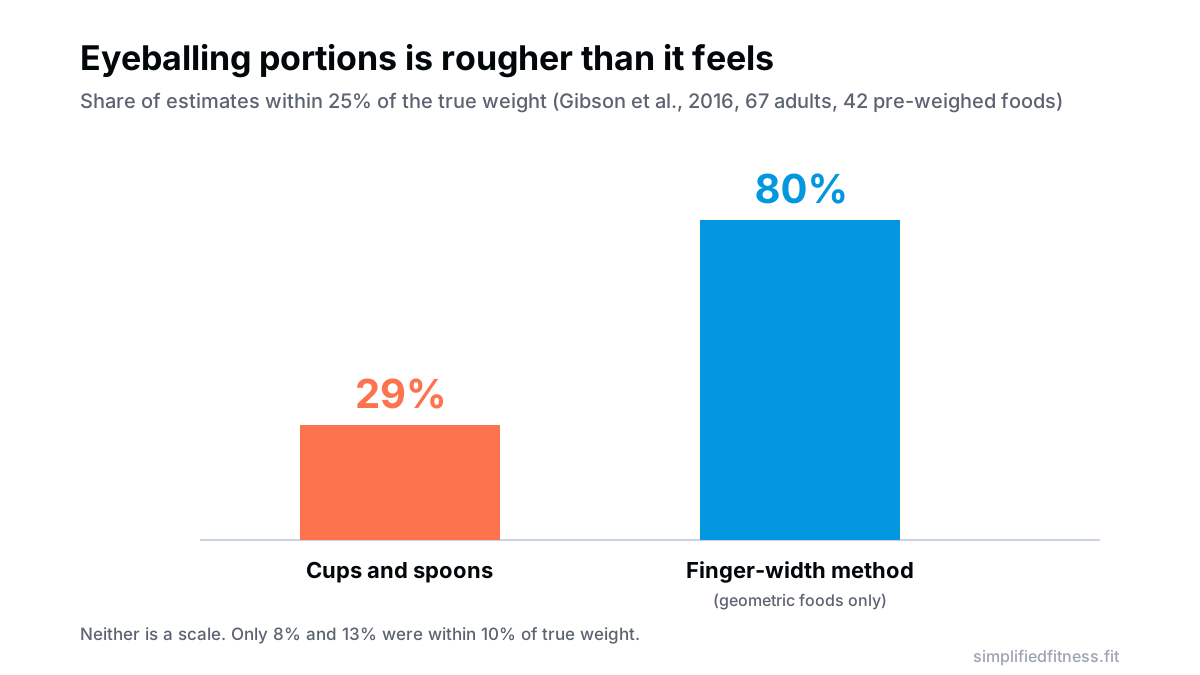
- A digital gram scale is the highest-value tool for most lifters. Self-reported intake is commonly under-reported when compared with measured energy expenditure, and household measures like cups and spoons were within 25% of true weight only 29% of the time in one study.
- An air fryer is a convenience tool, not a nutrition upgrade. It cooks paneer, chicken and tofu with little oil, but one small potato study found acrylamide was no lower than in deep or oven frying.
- A blender is most useful if you struggle to eat enough. Evidence on liquid calories is mixed, so on a cut treat smoothies as meals you count, not extras.
- Glass or steel containers are about practicality and taste first. Studies show heating plastic can release BPA, but amounts measured in one microwave study were far below the EU limit.
- On a tight budget, buy in this order: scale, containers, air fryer, then blender. A pressure cooker and a basic mixer-grinder already do most of the same work.
Part of our complete guide: High-Protein Foods List: Protein per 100g, Cost per 30g and Meal Prep Guide
Table of contents
The best kitchen equipment for meal prep lifters is a short list: a digital gram scale, airtight containers, and then, if your routine needs them, an air fryer and a blender. The scale does the most for your results. The rest mostly buy you time and make cooking in bulk less annoying.
This guide sits inside our high-protein foods and meal prep cost guide, and it is the hardware chapter. For the cooking schedule itself, see the 3-hour weekly batch prep blueprint. Here we ask a simpler question: which tools are worth the money, and what does the research say about each one?
Fair warning. Nobody has run a trial on “air fryer vs. no air fryer” for muscle gain. For most of this gear, the evidence is indirect, and I will say so each time.
What kitchen tools do lifters actually need?
Think of the kitchen as a small production line. You buy protein, cook it in batches, portion it, store it and reheat it. Each tool in this guide fixes one step.
- Scale: accurate portions
- Blender: easy extra calories, fast
- Air fryer: quick, crispy protein with little oil
- Containers: storage you will actually use
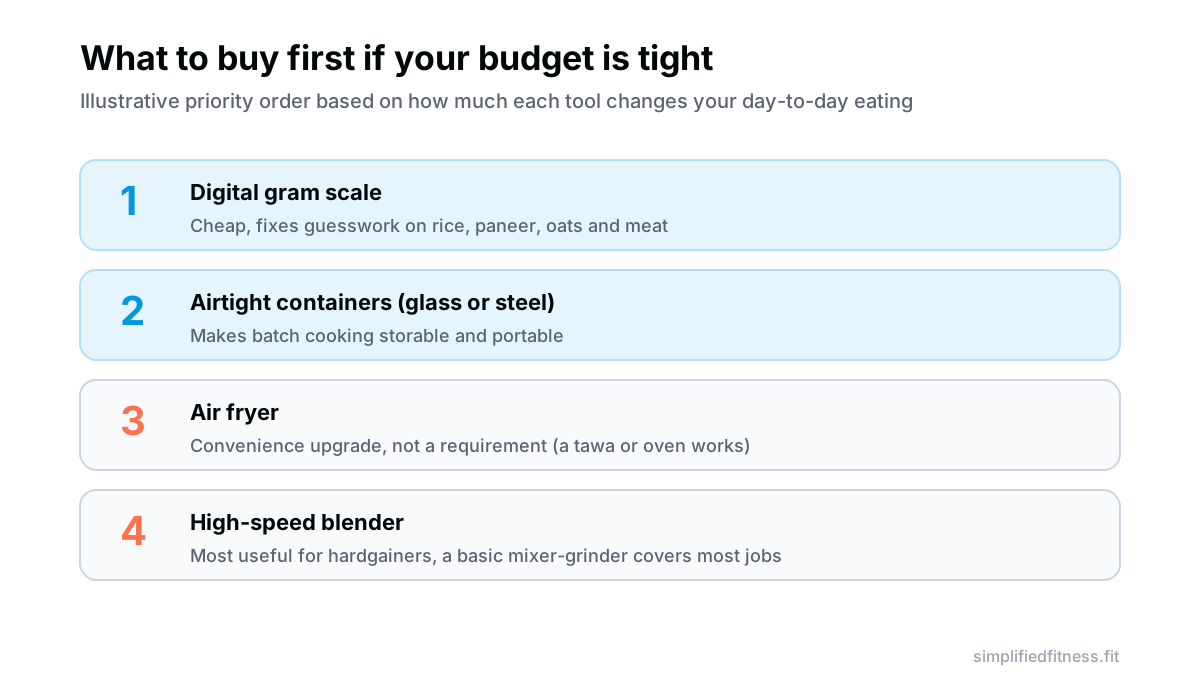
Everything else (a pressure cooker, a heavy tawa, a decent knife) you probably have already. A pressure cooker is the unsung hero of Indian meal prep, since dal, rajma, chole and rice all come out of it in a batch.
Do you really need a digital food scale?
Short answer: it is the one tool I would buy even if I could buy nothing else.
The reason is that people are bad at judging how much they eat. A review of studies that compared self-reported intake with doubly labelled water (a lab method that measures energy expenditure) found that when people report their own intake, it is generally lower than what they actually burn (Hill and Davies, 2001). Under-reporting is common across many groups, and it is not only about body size. Dietary restraint and socio-economic factors also play a role.
A later case-controlled study of 91 adults repeated this. Successful weight-loss maintainers under-reported intake by a median of about 605 kcal a day, versus about 308 kcal in normal-weight controls and 310 kcal in controls with overweight or obesity (Dahle et al., 2021). Diet diaries, not scales, were the tool being tested there, but the point stands: your memory and your eyes are not accurate instruments.
Portion estimation is shaky too. In a study of 67 adults estimating 42 pre-weighed foods, only 29% of estimates made with cups and spoons landed within 25% of the true weight, and just 8% were within 10% (Gibson et al., 2016). A finger-width method did better for geometrically shaped foods, with 80% within 25%, but that is still not a scale.
What to look for in a scale
- Tare function: lets you zero the weight of the bowl, so you add ingredients one by one.
- 1 g precision: 0.1 g is overkill for food, though handy for creatine or spices.
- Capacity of 3-5 kg: enough for a big bowl of cooked chicken.
- Flat surface and easy-wipe top: you will get oil and masala on it.
- Spare batteries: a dying battery gives odd readings.
How to use it without becoming obsessive
You do not have to weigh everything forever. Weigh your staples (rice, dal, paneer, oats, chicken, peanut butter, oil) for two weeks. After that you will know what 150 g of cooked rice looks like in your own katori, and you can go back to eyeballing the easy stuff.
Once you have your weights, put your targets into the protein calculator or macro calculator, so the scale is measuring toward a number.
Is a high-speed blender worth it for lifters?
It depends on one question: is eating enough your problem, or is eating too much your problem?
If you are a hardgainer, a strong blender is a legitimate tool. A shake can pack 600-700 kcal into something you can drink in five minutes, with no chewing and no appetite required. A rough Indian version: 300 ml whole milk, a banana, 40 g oats, 30 g peanut butter and a scoop of whey. By typical label values that comes to roughly 700-750 kcal and 45-50 g protein, though your brands will differ, so check them on your own scale.
If you are cutting, the same blender can work against you. Which brings up the liquid calorie question.
Do liquid calories count less?
The evidence is mixed. In a small crossover trial of 15 adults, people ate either soda or jelly beans (about 1,880 kJ a day) for four weeks each. When they ate the solid, they cut their other eating by more than the load (compensation of 118%). When they drank the same energy as soda, they did not reduce other eating, and body weight rose only in the liquid period (DiMeglio and Mattes, 2000).
A different study found something else. In 32 young adults, 300 kcal of cola and 300 kcal of cookies suppressed hunger equally, and what mattered more was timing: the closer the preload was to lunch, the less people ate (Almiron-Roig et al., 2004). Cola in that study was not a smoothie, so the findings cannot be mapped directly.
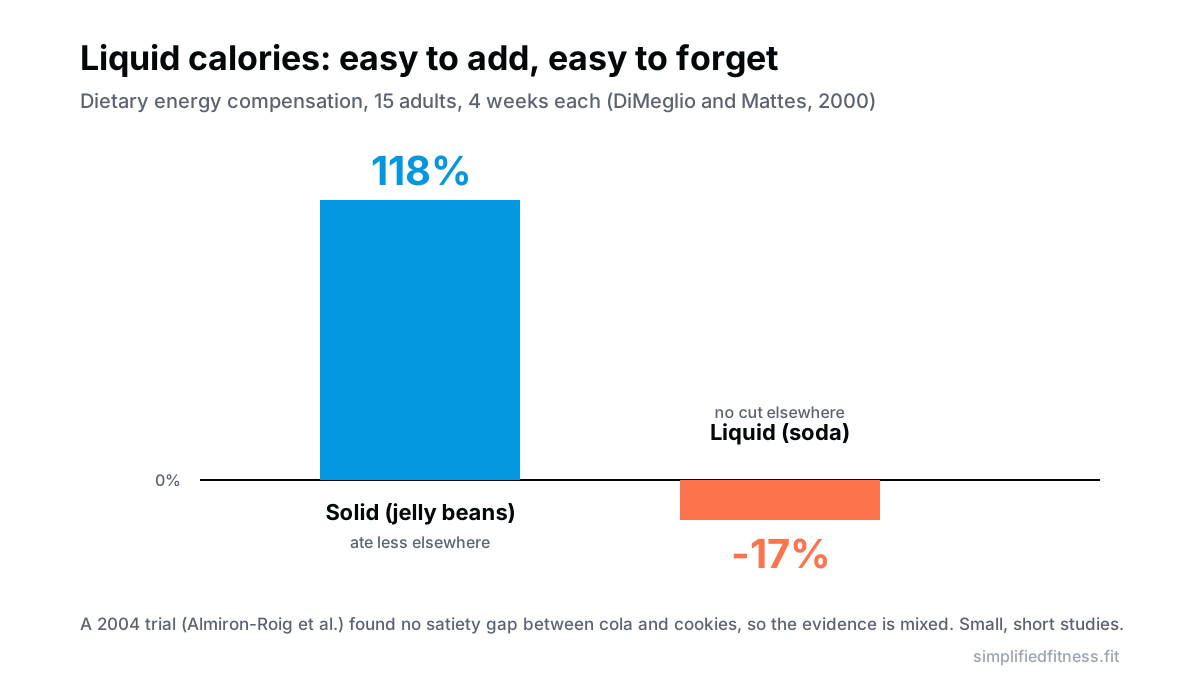
Both studies were short, small and used sugary drinks in healthy young people, not protein smoothies in lifters. My cautious takeaway: if you are bulking, liquid calories are a handy way to close a gap. If you are cutting, count the smoothie as a meal and have it alongside something solid.
Blender versus mixer-grinder
A regular Indian mixer-grinder handles banana, milk, oats and peanut butter fine if you give it a minute and blend in stages. A high-speed blender gives a smoother texture, handles ice and frozen fruit, and is easier to rinse. It is a quality-of-life upgrade, not a requirement.
Is an air fryer worth it for high-protein cooking?
If you cook protein most days, yes, it is convenient. If you do not, it will gather dust.
An air fryer circulates hot air, so food crisps with a thin coat of oil. That makes it good for the foods lifters actually eat:
- Chicken breast or thigh pieces, marinated in curd and spices
- Tandoori paneer or tofu cubes
- Soya chunks, after soaking
- Fish fillets
- Boiled eggs, in many models
- Sweet potato or potato wedges
It is quick, and it needs less oil than shallow or deep frying, which helps if you are watching calories. Cooking times vary by model, so check that chicken is cooked through before eating.
Is it healthier? The acrylamide question
You will see “healthy fries” claims everywhere. The research is less flattering. In a 2023 study, potato sticks were air-fried, deep-fried or oven-fried, and acrylamide (a compound that forms when starchy foods are cooked at high heat) was highest in the air fryer at 12.19 μg/kg, versus 8.94 for deep frying and 7.43 for oven frying. The differences were not statistically significant, and soaking the potatoes beforehand lowered acrylamide in all three methods (Navruz-Varli and Mortas, 2023).
One small lab study of potatoes does not tell you about paneer or chicken, and it does not mean air fryers are dangerous. It does mean “no oil, so healthy” is overselling it. Cook to golden, not dark brown, and do not burn the edges.
What I would buy
A 4-5 litre basket-style model is enough for one person. Check that the basket is removable and non-stick coated without scratches, because that is the part you will wash most. If you already own an oven and a tawa, an air fryer saves time rather than adding capability.
Are glass meal prep containers worth the money?
For meal prep in particular, usually yes. But the reasons are more about practicality than toxicology.
Practical reasons:
- Glass does not hold onto curry smell or stain from turmeric and tomato gravy
- It can go from fridge to microwave without transferring food
- It does not warp or turn cloudy after months of washing
Downsides:
- Heavier in a gym bag
- Breaks if dropped
- Costs more per box
- The lids are usually plastic, so they still need care
Steel tiffins are a good alternative for carrying, but you cannot microwave them.
What about BPA and plastic?
This is where a lot of marketing overreaches, so let us stay precise. BPA is a chemical used in some polycarbonate plastics and can-linings. In a 2009 lab study, polycarbonate bottles filled with steamed rice or cooked pork showed no detectable BPA (limit of detection 1 ppb) at room temperature or in a boiling water bath. After microwaving to 100 degrees C for 9 minutes, migration rose to 6-18 ppb for rice and 5-15 ppb for pork. Those levels were still well below the EU limit of 600 ppb (Lim et al., 2009).
In a separate small study, 20 people in five families switched for three days to fresh foods not canned or packaged in plastic. Their urinary BPA fell by 66% and DEHP metabolites by 53-56% (Rudel et al., 2011). That study was tiny, short, and tested packaged food overall, not meal prep boxes. It tells you packaging matters for exposure, not that your plastic tiffin is harmful.
My view: using glass is a sensible, low-cost way to cut unnecessary exposure, but you do not need to panic if you have plastic boxes. Skip microwaving in scratched or old plastic, and use boxes labelled microwave safe. If you are pregnant, or have a health condition and are worried about chemical exposure, ask your doctor.
Budget vs premium: what to spend where
| Tool | Budget choice | Premium choice | Worth upgrading? |
|---|---|---|---|
| Digital scale | Basic 1 g kitchen scale | Scale with USB charging and app | Rarely, accuracy matters more than features |
| Blender | Standard mixer-grinder | High-speed blender | Yes, if you drink a lot of shakes |
| Air fryer | 4 L basket model | Dual-zone or oven-style | Only if you cook for several people |
| Containers | Steel tiffins, reused jars | Glass sets with locking lids | Yes, if you reheat meals at work |
For the full cost picture of what goes inside those containers, see the cost per 30 g of protein comparison.
How much time can this gear actually save?
I will not pretend there is a precise number. The research on home cooking is mostly observational. A UK cohort of 11,396 adults found that those who ate home-cooked meals more than five times a week, compared with fewer than three, ate about 98 g more vegetables a day and were 28% less likely to have overweight BMI. The authors note that causality has not been established (Mills et al., 2017).
So the honest claim is this: gear that makes cooking easier probably makes you cook more, and cooking at home is linked to better diet quality. The tools do not make the meals healthy by themselves.
Where the time actually goes:
- Cooking in batches: pressure cooker and air fryer running together
- Portioning: scale and tare, about two minutes per box once you have a routine
- Cleaning: easier with non-stick baskets and dishwasher-safe lids
Maintenance basics
- Scale: wipe with a damp cloth, never submerge, and replace batteries when readings drift.
- Air fryer: wash the basket after each use. Wipe the heating coil area when cool.
- Blender: rinse right away. Run warm water with a drop of dish soap for 20 seconds.
- Containers: let hot food cool slightly before sealing. Replace warped or cracked lids.
For storing what you cook, see food storage and shelf life for chicken and rice and our guide to freezing and reheating meal prep. Keep your plan consistent with the free diet plan.
The bottom line
Buy a scale. Buy decent containers. Add an air fryer if you cook protein daily, and a blender if you struggle to eat enough. Skip anything that promises to make you lean on its own, because no kitchen gadget does that.
What the research supports is small but useful. Self-reported intake is unreliable, eyeballing portions is rough, and cooking at home is linked to better diet quality. A small outlay on equipment can turn those facts into a routine you will actually keep.
Frequently Asked Questions
What is the best kitchen equipment for meal prep for lifters?
A digital gram scale, airtight containers, a good pan or pressure cooker, and optionally an air fryer and a blender cover almost everything. The scale gives you accuracy, the containers give you storage, and the rest save time. Buy the scale and containers first, then add the other tools only if your cooking routine actually needs them.
Is a digital food scale really necessary for building muscle?
It is not necessary for everyone, but it is the cheapest way to remove guesswork. Research on self-reported intake shows people commonly under-report what they eat compared with measured energy expenditure, so estimates drift. If your weight or your lifts are not moving, weigh your food for two weeks and see what changes.
Should I weigh food raw or cooked?
Either works as long as you stay consistent, but raw weights match most nutrition labels and packaging. Cooked rice and dal absorb water, so the same grams carry very different calories than dry grains. Pick one method and use it every time, and read our guide on [raw vs cooked food weights](/blog/food-scale-mastery-raw-vs-cooked-weight-differences) for the details.
Is an air fryer healthy for bodybuilding?
It can be a useful tool, but it is not magic. It cooks protein with much less oil than deep frying, which helps if you are watching calories. A 2023 study of potatoes found acrylamide in air-fried samples was not significantly different from deep or oven frying, so do not assume it removes every concern.
What can I cook in an air fryer for high protein meals?
Chicken breast pieces, tandoori-style paneer, tofu, fish, eggs and soya chunks all work well. They crisp on the outside in a short time without a pan of oil. Season and marinate in curd and spices first, and check chicken is cooked through before eating.
Is a high-speed blender worth it for lifters?
It depends on your goal. A strong blender makes it easy to drink 500-700 kcal in a minute, which helps hardgainers who struggle to eat enough. If you are cutting, a regular mixer-grinder is enough and the extra spend is hard to justify.
Do smoothies make you gain weight more easily than solid food?
They can, but the evidence is mixed. One small crossover trial found people did not cut their other eating when they drank liquid carbohydrate, while another trial found no satiety difference between cola and cookies. If you are gaining weight on purpose, that is a feature; if you are cutting, count the smoothie and pair it with solid food.
Are glass meal prep containers better than plastic?
Glass does not absorb smells or stain and is easy to reheat in. Studies show BPA can migrate from some polycarbonate plastics when microwaved, though levels in one test were far below the EU limit. Use glass or steel if you can afford it, and avoid microwaving old, scratched or unmarked plastic.
Is it safe to microwave food in plastic containers?
Only if the container is labelled microwave safe. A 2009 study found BPA was not detected in polycarbonate bottles filled with food at room temperature, but it appeared after microwaving to 100 degrees C. Transfer food to a glass or ceramic dish to reheat if you are unsure.
How long can meal prep last in the fridge?
Most cooked rice, dal and chicken dishes are generally kept for about 3-4 days in the fridge, though exact safe times depend on temperature and handling. Cool food quickly, keep your fridge cold and use airtight containers. Our guide on [food storage and shelf life](/blog/food-storage-meal-safety-shelf-life-chicken-rice) covers the rules in detail.
Can I meal prep without buying special equipment?
Yes. Cooking at home is what matters, and you can do it with a pressure cooker, a kadhai, a tawa and ordinary steel boxes. A large UK cohort of 11,396 adults linked eating home-cooked meals more often with better diet quality, though that was observational. Add a scale first, because it is the one tool that improves accuracy.
What is the most important tool for a lifter's kitchen?
For most people it is the digital scale. It turns protein and calorie targets from guesses into numbers you can actually hit. Spend a few minutes weighing your staples once, and you will learn what your usual portions look like.
How do I clean and maintain an air fryer and blender?
Clean both after every use so that oil and protein residue do not build up. Wash the air fryer basket and blender jar with warm soapy water, and wipe the heating area dry. Check the manufacturer's manual for dishwasher use and for replacing worn seals or gaskets.
Sources & References
Every claim above is checked against peer-reviewed research (PubMed, U.S. National Library of Medicine) or guidance from established health bodies. How we fact-check.
- Gibson AA, et al. Accuracy of hands v. household measures as portion size estimation aids. J Nutr Sci. 2016. PMID: 27547392
- Hill RJ, Davies PS. The validity of self-reported energy intake as determined using the doubly labelled water technique. Br J Nutr. 2001. PMID: 11348556
- Dahle JH, et al. Underreporting of energy intake in weight loss maintainers. Am J Clin Nutr. 2021. PMID: 33742193
- Burke LE, et al. Self-monitoring in weight loss: a systematic review of the literature. J Am Diet Assoc. 2011. PMID: 21185970
- Navruz-Varlı S, et al. Acrylamide formation in air-fried versus deep and oven-fried potatoes. Front Nutr. 2023. PMID: 38274202
- DiMeglio DP, et al. Liquid versus solid carbohydrate: effects on food intake and body weight. Int J Obes Relat Metab Disord. 2000. PMID: 10878689
- Almiron-Roig E, et al. No difference in satiety or in subsequent energy intakes between a beverage and a solid food. Physiol Behav. 2004. PMID: 15327915
- Lim DS, et al. Potential risk of bisphenol A migration from polycarbonate containers after heating, boiling, and microwaving. J Toxicol Environ Health A. 2009. PMID: 20077198
- Rudel RA, et al. Food packaging and bisphenol A and bis(2-ethyhexyl) phthalate exposure: findings from a dietary intervention. Environ Health Perspect. 2011. PMID: 21450549
- Mills S, et al. Frequency of eating home cooked meals and potential benefits for diet and health: cross-sectional analysis of a population-based cohort study. Int J Behav Nutr Phys Act. 2017. PMID: 28818089

Umair Hazrami · Founder & Head Coach, Simplified Fitness
Umair Hazrami founded Simplified Fitness and the Simplified Lifter channel to cut through fitness noise. With 4+ years of consistent training and 10+ coaching clients, he writes every guide from the peer-reviewed research and links the sources so you can check them. Our editorial standards.
Educational content only, not medical advice. If you have a medical condition, are pregnant, or take medication, talk to a qualified doctor before changing your diet, supplements or training. Full disclaimer.
Keep reading
Indian Diet
The 3-Hour Weekly Batch Meal Prep: Cooking 5 Days of Lunches and Dinners for Busy Lifters
Batch meal prep for the week in 3 hours: a station-by-station Sunday plan for 10 high-protein lunches and dinners, with Indian options and safe storage rules.
7 min read
Indian Diet
Cost per 30 Grams of Protein: 40 Common Fitness Foods Ranked by Price
Cost per 30g protein for 40 Indian gym foods, from soya chunks to whey and tuna. See the cheapest protein sources per gram and what to buy on a budget.
8 min read
Indian Diet
Eating Healthy on a Student Budget: High Protein Hostel and Dorm Room Meal Prep
A college student bodybuilding diet budget can still hit 130 g of protein. Cheap staples, no-cook hostel prep and a sample day, with the studies linked.
8 min read
Indian Diet
Fast Food Survival Guide: Macro-Friendly Orders at Major Global Chains
A fast food survival guide for lifters: how to build a high protein order at any chain, cut hidden calories, handle sodium and stay on track while travelling.
8 min read