Chicken Breast and Fish in India: Where to Buy, How to Cook, and Cost per 30 g Protein
Chicken breast price per kg India: compare wet market vs apps, learn safe handling, a brine method for juicy meat, and rohu vs chicken cost per 30 g protein.
TL;DR. The short answer
- Boneless chicken breast from a local wet market has typically cost somewhere around Rs 240-300 per kg in many Indian cities, which works out to roughly Rs 30-40 for 30 g of protein. Prices vary by city and season, so check your own butcher.
- Packaged delivery apps cost more per kg, mainly for cleaning, packing and delivery. You are paying for convenience and consistency, not extra protein.
- Do not wash raw chicken under the tap. It can spread bacteria by splashing, and cooking all the way through is what makes it safe.
- Dry, rubbery breast is usually overcooked breast. A 30-60 minute salt-water brine, a hot sear and a gentle finish keep it juicy.
- Rohu and other freshwater fish give a similar protein hit per serving but usually cost more per 30 g once bones and trimming are counted. Rotate them in for variety and omega-3 fats rather than as a budget swap.
Part of our complete guide: Indian High-Protein Nutrition Guide: Cutting and Muscle Building on Vegetarian and Non-Veg Diets
Table of contents
Chicken breast price per kg in India has typically sat around Rs 240-300 for boneless meat at a local wet market, though it shifts by city and season. That works out to roughly Rs 30-40 for 30 g of protein, which makes it one of the cheaper lean animal proteins you can buy.
The price is only half the question. Where you buy it, how you handle it and how long you cook it decide whether it is safe and whether you enjoy eating it for the tenth time this month. This guide sits inside our Indian high-protein nutrition guide and covers the practical side: sourcing, hygiene, the cooking method for soft, juicy breast, and how fish like rohu compares. For a full day of meals, see the non-vegetarian cutting diet plan.
A quick note on prices. Every rupee figure below is an example, not a quote. Rates change by city, week and festival, so plug in what your butcher actually charges.
How much does chicken breast cost per kg in India?
Price per kg is a misleading number on its own. What you want is the cost of the protein you actually eat.
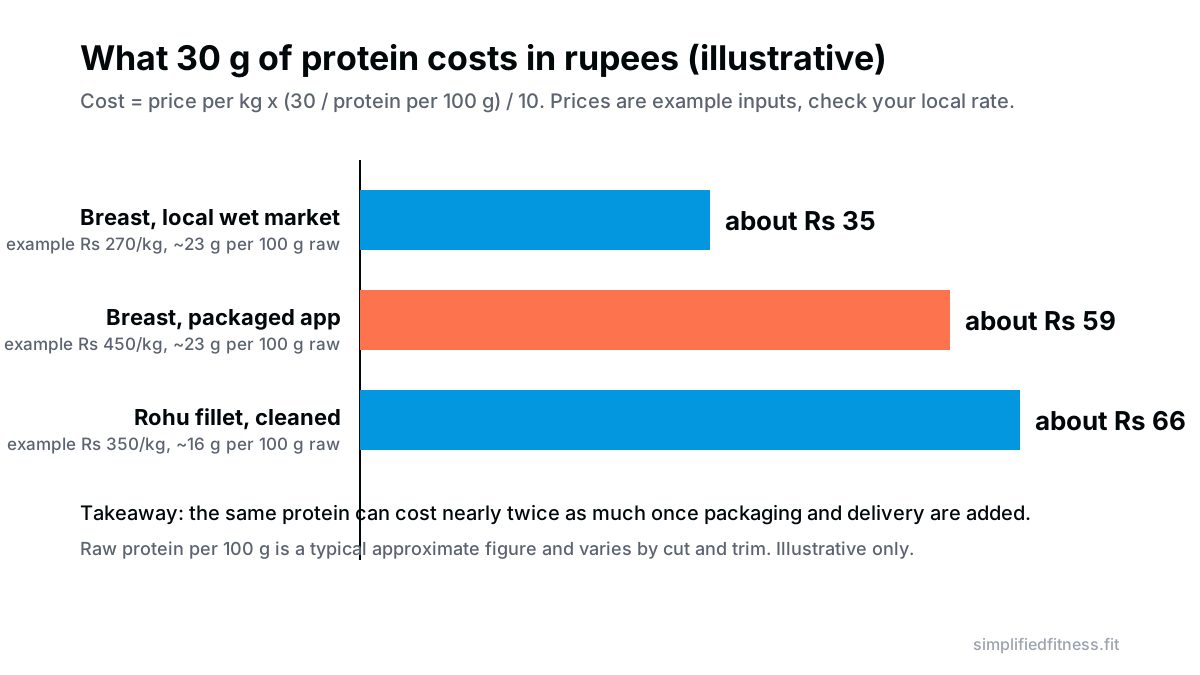
Raw boneless chicken breast has roughly 23 g of protein per 100 g (a typical approximate label figure; cuts and trimming vary). So 30 g of protein needs about 130 g of raw breast. The formula is simple:
Cost of 30 g protein = price per kg x (30 / protein per 100 g) / 10
Using that, here is what the examples look like.
| Source | Example price per kg | Approx. protein per 100 g raw | Approx. cost for 30 g protein |
|---|---|---|---|
| Boneless breast, local wet market | Rs 240-300 | ~23 g | Rs 31-39 |
| Boneless breast, packaged app | Rs 450 | ~23 g | ~Rs 59 |
| Rohu fillet, cleaned | Rs 350 | ~16 g | ~Rs 66 |
All of these are illustrative inputs, not market data. Replace them with your own prices.
If you eat 130 g of raw breast at lunch and the same at dinner, that is about 60 g of protein a day for roughly Rs 70 at the wet market example. Add eggs, curd and dal and you can reach a decent daily target without a big bill. Our cost per 30 g protein comparison puts chicken next to paneer, soya, eggs and whey so you can see where it lands, and the budget protein diet guide shows how to stretch it further.
Local butcher vs delivery app: which is better?
Honestly, it depends on the shop. A brand name is not a safety guarantee, and a local stall is not automatically dirty.
Local butcher or wet market
- Usually cheaper per kg.
- You can ask for boneless breast, skin off and fat trimmed, cut the way you want.
- Quality swings by shop. Cleanliness, ice, fly control and how long the meat has been sitting out all matter, especially in summer.
Packaged apps and chilled brands
- Cleaned, cut and packed, often with a more consistent cold chain.
- Higher cost per kg, and the pack weight may include a little liquid.
- Convenient if you have no good butcher nearby.
What do the data say about safety? A 2025 systematic review and meta-analysis of 90 studies on retail chicken in India estimated pooled prevalence of about 18% for Salmonella and about 18% for Campylobacter, with higher figures for bacteria such as S. aureus and E. coli (Ayoub et al., 2025). The review covered retail chicken meat and associated environments broadly, and it did not rank butchers against brands, so it cannot tell you one channel is safer. What it does say is that you should treat all raw chicken as if it is contaminated.
That leads to the practical rule. Buy from a place that looks clean and keeps meat chilled, and then handle every piece as raw poultry regardless of where it came from.
Should you wash chicken before cooking?
Many Indian kitchens rinse meat with water and sometimes lime or turmeric before cooking. It feels like cleaning. The evidence suggests it does more harm than good.
In an observational study of 18 households in Portugal, 12 of 18 people (66.6%) rinsed their chicken under running tap water, and 14 of the 18 chicken samples (77.8%) carried Campylobacter. Cross-contamination was detected in four kitchens, involving cutting boards, sinks and a kitchen cloth (Cardoso et al., 2021). It is a small study in a different country, so do not read too much into the exact percentages. But it shows how quickly raw poultry bacteria can reach surfaces around the kitchen.
Another set of lab-based estimates found that cutting boards, hands and knives were equally important routes for moving Campylobacter from chicken to salad, and that good hygiene practices brought bacteria in the salad below the detection limit (van Asselt et al., 2008).
So the practical order of importance is:
- Keep raw chicken away from anything that is eaten without cooking, such as salad, raita, cut fruit and chutney.
- Use a separate board and knife for raw meat.
- Wash your hands, board, knife and sink with soap and hot water after handling it.
- Cook the chicken all the way through.
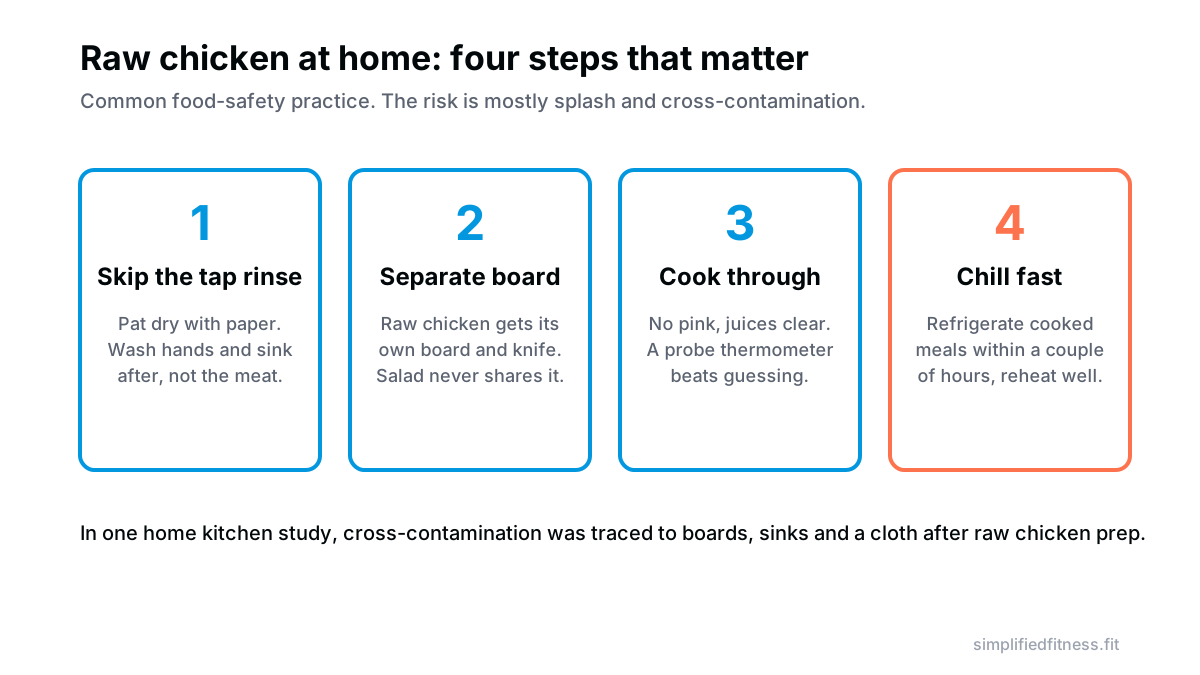
Cooking through is what kills the bacteria. Common food-safety guidance is to cook poultry until it reaches about 74 degrees C in the thickest part, with no pink and clear juices. A cheap probe thermometer is a better judge than colour.
If you want to see how long cooked chicken and rice keep in a hot kitchen, our chicken and rice storage guide covers fridge times and reheating.
How to cook chicken breast soft and juicy
Chicken breast is lean. That is why we eat it, and also why it dries out so fast. With almost no fat in the way, a few minutes too long takes it from tender to chalk.
The most common mistake here is simply overcooking. People are nervous about undercooked chicken, so they cook it hard until it is grey and stringy. A thermometer lets you stop at a safe temperature instead of well past it.
The method
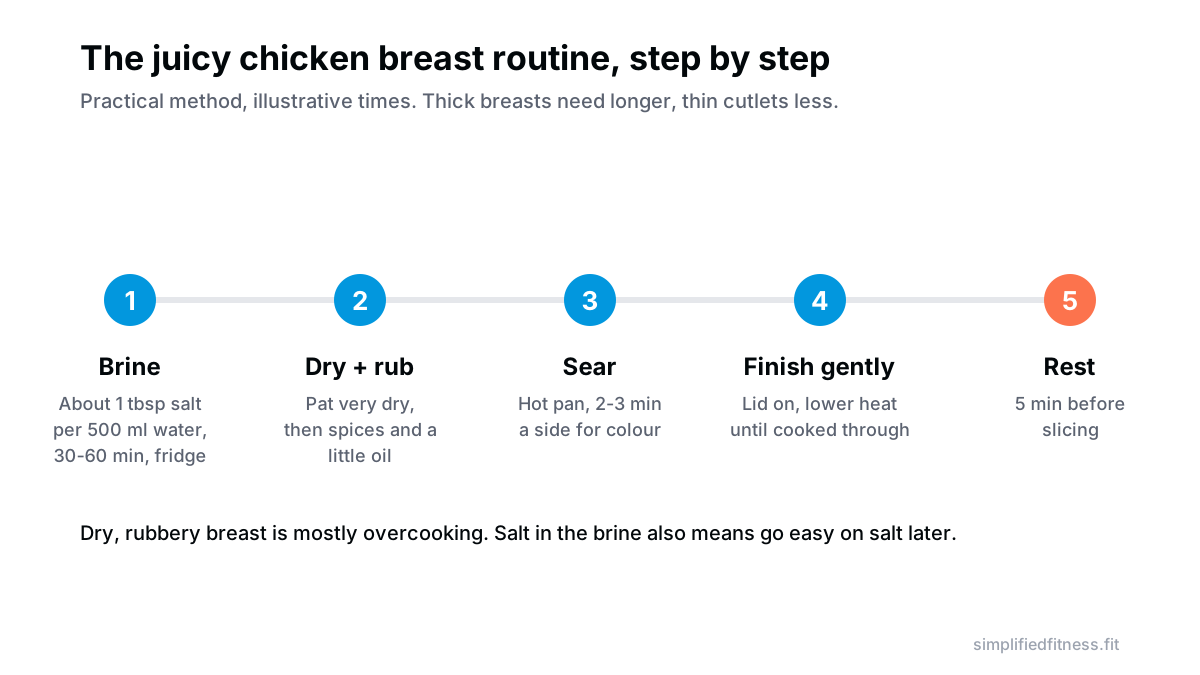
- Brine for 30-60 minutes. Dissolve about 1 tablespoon of salt in 500 ml of water, add the breast pieces and keep them in the fridge. Salt seasons the meat and helps it hold on to water as it cooks.
- Even out thickness. Slice thick breasts in half horizontally or pound them lightly, so thin ends do not dry out while the middle catches up.
- Pat very dry, then rub. Wet meat steams instead of searing. Use a little oil plus your spices.
- Sear in a hot pan for 2-3 minutes a side for colour and flavour.
- Finish gently. Lower the heat and cover with a lid until cooked through. Pull it off as soon as it is done.
- Rest for about 5 minutes before slicing so juices settle.
What does the research say about brining? Direct trials on home brining are limited. One poultry science study found that breast fillets differ in their natural water-holding capacity, and that fillets with higher water-holding capacity took up more brine and lost less moisture in cooking (Bowker et al., 2015). That is a meat-quality study on fillets, not a cooking trial, so treat brining as sensible kitchen practice with a plausible mechanism rather than a proven trick. It also helps explain why two breast pieces from different batches can cook so differently.
Because the brine already carries salt, go easy on salt in the marinade or gravy afterwards.
Indian spice rubs that work
- Tandoori style: hung curd, Kashmiri chilli, ginger-garlic paste, lemon juice, kasuri methi and a little mustard oil. Keep the marinade time to a few hours, since acidic marinades can make the surface mushy if left too long.
- Pepper garlic: crushed black pepper, garlic, a little turmeric and curry leaves, finished with a squeeze of lime.
- Coriander-green chilli: blended coriander, mint, green chilli and lemon, rubbed on after brining.
- Simple masala: chilli powder, cumin, coriander powder, amchur and salt, then cooked quickly in a pan.
For a leaner tadka or gravy, watch the oil. Our guide to hidden calories in Indian cooking explains how a spoonful or two adds up.
If your breast keeps turning out dry despite all this, try chicken thigh occasionally. It has more fat, so it forgives overcooking. Breast is leaner, thigh is easier.
Rohu, catla and surmai: how fish compares with chicken
Fish is a good partner to chicken rather than a replacement. The typical raw protein figures are roughly 16-17 g per 100 g for freshwater fish like rohu and catla, a bit higher for many sea fish, against about 23 g for chicken breast. These are approximate values and differ by species, fat content and how the fish is cleaned, so use them as a guide.
| Chicken breast | Rohu or catla | Surmai (kingfish) | |
|---|---|---|---|
| Typical protein per 100 g raw | ~23 g | ~16-17 g | ~20 g (approximate) |
| Cost per kg | Usually lowest | Mid, depends on region | Often highest |
| Waste if bought whole | Low (boneless) | High (bones, head, skin) | Cut steaks are easier |
| Main bonus | Lean, flexible | Variety, fish fats | Few bones, steak style |
What does the research say about fish and muscle? In a small trial of 22 adults aged 50-85, eating 150-170 g of fish twice a week for 10 weeks was followed by higher skeletal muscle mass and better handgrip strength (Alhussain and Alshammari, 2021). It had no control group and was in older adults, so it cannot show that fish builds more muscle than chicken. It suggests fish is a useful protein source, not a magic one. For omega-3 fats from fish and supplements, see our omega-3 EPA and DHA guide.
Buying and cooking fish
- Check for clear, bright eyes, red gills, firm flesh and no strong ammonia smell.
- Whole fish costs less per kg but loses a lot of weight to bones, head and guts. Price the edible part, not the whole.
- Rohu and catla have many fine bones. Ask the seller for steaks and take care when eating, especially with children.
- Steam, shallow-pan or grill with turmeric, ginger and lemon. Overcooked fish goes dry just like chicken.
- Fish spoils faster than chicken in hot weather, so cook it the same day or freeze it.
Fish allergies, pregnancy and mercury concerns with some large sea fish are health questions, so ask your doctor if they apply to you.
How much chicken and fish do you actually need?
Not as much as most people think. The point is to reach your daily protein target and spread it sensibly.
A major meta-analysis of resistance-training trials with protein supplementation found that, in healthy adults, benefits for fat-free mass did not increase beyond total intakes of about 1.62 g per kg per day (Morton et al., 2018). For a 70 kg lifter, that is about 112 g a day. A review on per-meal protein suggested a target of about 0.4 g per kg per meal across at least four meals (Schoenfeld and Aragon, 2018). For that same 70 kg lifter, that is roughly 28 g per meal, so 130 g of raw breast covers one meal on its own. Our protein distribution guide goes deeper on spacing.
When you are cutting, the picture shifts a little. A systematic review of lean, resistance-trained athletes in an energy deficit suggested that protein needs may be higher, around 2.3-3.1 g per kg of fat-free mass, scaled up with the severity of the deficit and leanness (Helms et al., 2014). That review covered only six studies of lean athletes, so most recreational lifters should not feel they need to chase the top of that range. Work out your own number with the protein calculator.
A simple weekly pattern
Here is one way to mix chicken and fish without getting bored. Adjust to your budget, religion, family tastes and what your local market stocks.
- Chicken breast 3-4 days a week, in different styles: tandoori, pepper garlic, simple masala, shredded in a roll.
- Fish 1-2 days a week, rohu, catla, surmai or whatever is fresh and fairly priced.
- Eggs, curd, dal, paneer or soya on the other days. See eggs in the Indian diet for the cheapest everyday option.
- Batch cook two or three days at a time in summer, rather than a full week.
Chicken with roti, rice and a vegetable sabzi is a normal Indian meal that also happens to be a good gym meal.
When to see a doctor
Food poisoning from poultry often causes diarrhoea, stomach cramps and fever. Most cases settle on their own, but see a doctor if symptoms are severe, last more than a few days, include blood in the stool, or you cannot keep fluids down. Young children, older adults, pregnant women and people with weak immune systems should be especially careful with raw or undercooked meat. If you have kidney disease, gout or a medical condition that changes your protein or fish intake, ask your doctor or a dietitian before increasing it.
The bottom line
For most Indian lifters, boneless chicken breast from a clean local shop is one of the cheapest lean animal proteins per 30 g, with delivery apps charging extra for convenience. Skip the tap rinse, use a separate board, and cook it through. Brine for 30-60 minutes, sear hot and stop early for soft, juicy breast.
Add fish a couple of times a week for variety. Then let the real work happen in the gym. If you need a training plan to go with your meals, start with our free push pull legs plans, and set your protein number first with the protein calculator.
Frequently Asked Questions
What is the price of chicken breast per kg in India?
Boneless breast has often been quoted at roughly Rs 240-300 per kg at local wet markets, with packaged apps charging noticeably more. Prices move with city, season and festivals, so treat any number as a guide. Ask two or three butchers for today's rate and compare it per kg of boneless meat, not per kg with bone.
How much does 30 g of protein from chicken breast cost?
Raw breast has roughly 23 g of protein per 100 g, so you need about 130 g raw for 30 g of protein. At Rs 240-300 per kg that is around Rs 31-39, and about Rs 59 at an app price of Rs 450 per kg. Use price per kg x 30 / protein per 100 g / 10 with your own numbers.
Is a local butcher or Licious-style app better for chicken?
Neither is automatically better; it depends on cleanliness and your budget. A good local butcher is usually cheaper per kg, while apps give packaging, cutting and a cold chain. Visit the shop once, check for a clean counter and chilled storage, and judge on that rather than the brand.
Should you wash chicken before cooking it?
No, rinsing raw chicken under running water is not needed and can spread bacteria around the sink and counter. In a small home-kitchen study, most people rinsed their chicken, and Campylobacter spread from raw chicken to boards, sinks and a cloth in four of 18 kitchens. Pat the meat dry with paper, then wash your hands, board and sink with soap.
How do you cook chicken breast so it is soft and juicy?
Soft chicken breast mostly comes down to not overcooking it. Brining draws in a little extra water and seasons the meat, and a hot sear plus a gentle finish keeps the inside moist. Brine for 30-60 minutes, pat dry, sear, finish on lower heat with a lid and rest for 5 minutes.
Why is my chicken breast always dry and rubbery?
The usual cause is cooking it too hot for too long, especially thick breasts cooked straight from the fridge. Breast is very lean, so there is little fat to buffer overcooking. Cut thick breasts in half horizontally, cook until just done and use a thermometer if you have one.
How long should I brine chicken breast?
Around 30-60 minutes in the fridge is enough for ordinary breast pieces. Longer soaks have not been shown to make meat juicier, and they can make it salty. Skip extra salt in the marinade afterwards and rinse nothing, just pat dry.
Is rohu fish as good as chicken for protein?
Rohu is a good protein source but a little less concentrated than chicken breast. A typical raw rohu fillet is around 16-17 g of protein per 100 g against roughly 23 g for chicken breast, so you eat a bigger portion for the same 30 g. It also brings fish fats and variety, so it works well alongside chicken.
Is fish good for building muscle?
Fish is a complete protein, and one small trial in adults aged 50-85 found more muscle mass after eating 150-170 g of fish twice a week for 10 weeks. That study had 22 people and no control group, so it is encouraging rather than proof. Eating fish a couple of times a week is a sensible habit alongside lifting.
Which is cheaper per gram of protein, chicken or fish?
In most Indian cities chicken breast is cheaper per 30 g of protein than fresh river fish fillets, because chicken has more protein per 100 g and less waste. Whole fish with bones and head costs less per kg but you lose a lot to trimming. Compare on cleaned, edible weight.
How much chicken do I need to hit my protein goal?
Evidence reviews suggest about 1.6 g of protein per kg body weight a day is where extra gains in muscle mass level off for most lifters. For a 70 kg person that is about 112 g a day, spread over meals, with 0.4 g per kg per meal as a practical target. Cover part of it with chicken and fish and the rest with eggs, curd, dal and paneer.
Is raw chicken in India often contaminated with bacteria?
Surveys suggest it is common. A 2025 meta-analysis of 90 Indian studies estimated that about 18% of retail chicken samples carried Salmonella and about 18% Campylobacter. That does not mean you will get sick, it means you should cook thoroughly and keep raw meat away from ready-to-eat food.
Can I store cooked chicken for meal prep?
Yes, if you cool it quickly and keep it cold. Hot Indian weather speeds bacterial growth, so do not leave cooked chicken out for long. Put it in the fridge within two hours, or within one hour on a very hot day, and reheat it until steaming hot.
Sources & References
Every claim above is checked against peer-reviewed research (PubMed, U.S. National Library of Medicine) or guidance from established health bodies. How we fact-check.
- Ayoub H, et al. Systematic Review and Meta-Analysis on Prevalence and Antimicrobial Resistance Patterns of Important Foodborne Pathogens Isolated from Retail Chicken Meat and Associated Environments in India. Foods. 2025. PMID: 40001999
- Cardoso MJ, et al. Cross-contamination events of Campylobacter spp. in domestic kitchens associated with consumer handling practices of raw poultry. Int J Food Microbiol. 2021. PMID: 33277046
- van Asselt ED, et al. Cross-contamination in the kitchen: estimation of transfer rates for cutting boards, hands and knives. J Appl Microbiol. 2008. PMID: 18713282
- Bowker B, et al. Relationship between water-holding capacity and protein denaturation in broiler breast meat. Poult Sci. 2015. PMID: 26009757
- Morton RW, et al. A systematic review, meta-analysis and meta-regression of the effect of protein supplementation on resistance training-induced gains in muscle mass and strength in healthy adults. Br J Sports Med. 2018. PMID: 28698222
- Schoenfeld BJ, et al. How much protein can the body use in a single meal for muscle-building? Implications for daily protein distribution. J Int Soc Sports Nutr. 2018. PMID: 29497353
- Helms ER, et al. A systematic review of dietary protein during caloric restriction in resistance trained lean athletes: a case for higher intakes. Int J Sport Nutr Exerc Metab. 2014. PMID: 24092765
- Alhussain MH, et al. Association Between Fish Consumption and Muscle Mass and Function in Middle-Age and Older Adults. Front Nutr. 2021. PMID: 34966766

Umair Hazrami · Founder & Head Coach, Simplified Fitness
Umair Hazrami founded Simplified Fitness and the Simplified Lifter channel to cut through fitness noise. With 4+ years of consistent training and 10+ coaching clients, he writes every guide from the peer-reviewed research and links the sources so you can check them. Our editorial standards.
Educational content only, not medical advice. If you have a medical condition, are pregnant, or take medication, talk to a qualified doctor before changing your diet, supplements or training. Full disclaimer.
Keep reading
Indian Diet
Budget Indian Diet for 120g Protein Under ₹100 a Day (Student Plan)
A budget Indian diet for 120g protein under 100 rupees a day: soya, eggs, milk and chana, with protein per rupee maths and two student plans you can copy.
8 min read
Indian Diet
How to Convince Indian Parents About Whey Protein: Kidney Fears, 'Chemicals' and the Real Evidence
How to convince Indian parents about whey protein: explain it as paneer-water dairy, answer the kidney fear with trial data, and read the label together.
9 min read
Indian Diet
Curd vs Greek Yogurt vs Hung Curd: Protein Yield and the Home Recipe
Curd vs Greek yogurt protein in India: plain dahi gives about 3-4 g per 100 g. See how straining it into hung curd can triple that, and what studies show.
9 min read
Indian Diet
Is Dal a Good Source of Protein? Moong, Chana and Rajma Reality Check
Is dal a good source of protein? Moong, chana and rajma give some protein but far more carbs. See the numbers and how to build a plate that works for lifters.
8 min read