Grocery Psychology: Overcoming Supermarket Marketing Traps, Endcaps, and Impulse Snacking
Supermarket marketing traps fitness goals: see how endcaps, checkout displays and hunger drive junk purchases, and the 3 shopping rules that beat them.
TL;DR. The short answer
- Supermarkets put snack displays at checkouts, end-of-aisle spots and island bins so exposure is close to unavoidable. In a 2012 audit of 35 Melbourne supermarkets, only five stores did not have snack foods at every checkout.
- In-store promotions are linked to big sales jumps, mostly for unhealthy foods. In a 2023 analysis of 179 stores, candy sold 136% more when promoted, while low-calorie drinks rose 16%.
- The advice to never shop hungry has weaker evidence than most people assume. One 1996 study found hunger did not consistently change purchases, so treat it as cheap insurance, not a guarantee.
- A written list plus a fixed route (produce, meat, eggs, dairy first, middle aisles only for listed staples) cuts the number of decisions you make at the shelf, where displays do their work.
- Shelf placement alone did not shift cereal sales in a 2020 pilot, and shoppers said price and brand mattered more. Decide before you enter the store, not at the shelf.
Part of our complete guide: High-Protein Foods List: Protein per 100g, Cost per 30g and Meal Prep Guide
Table of contents
You planned a clean week, walked in for chicken, eggs and oats, and walked out with biscuits and a cold drink you did not want. Supermarket marketing traps for fitness goals are real: store layouts and promotions concentrate snack exposure at endcaps and checkouts, and promoted snacks sell far more than unpromoted ones. Our guide to high-protein foods, meal prep and cost covers what to buy, so this article covers the store itself.
Below: how layout and displays push you toward snacks, what the research says about the usual advice (shop full, use a list, stay on the edges), and a routine that works. For label reading and building the actual list, use our fitness grocery shopping blueprint.
How do grocery stores trick you into buying junk food?
Stores do not need to trick you in a sinister way. They just arrange space where attention is most valuable, and the most valuable spots go to products with the best margins and the most promotion. Four patterns show up again and again.
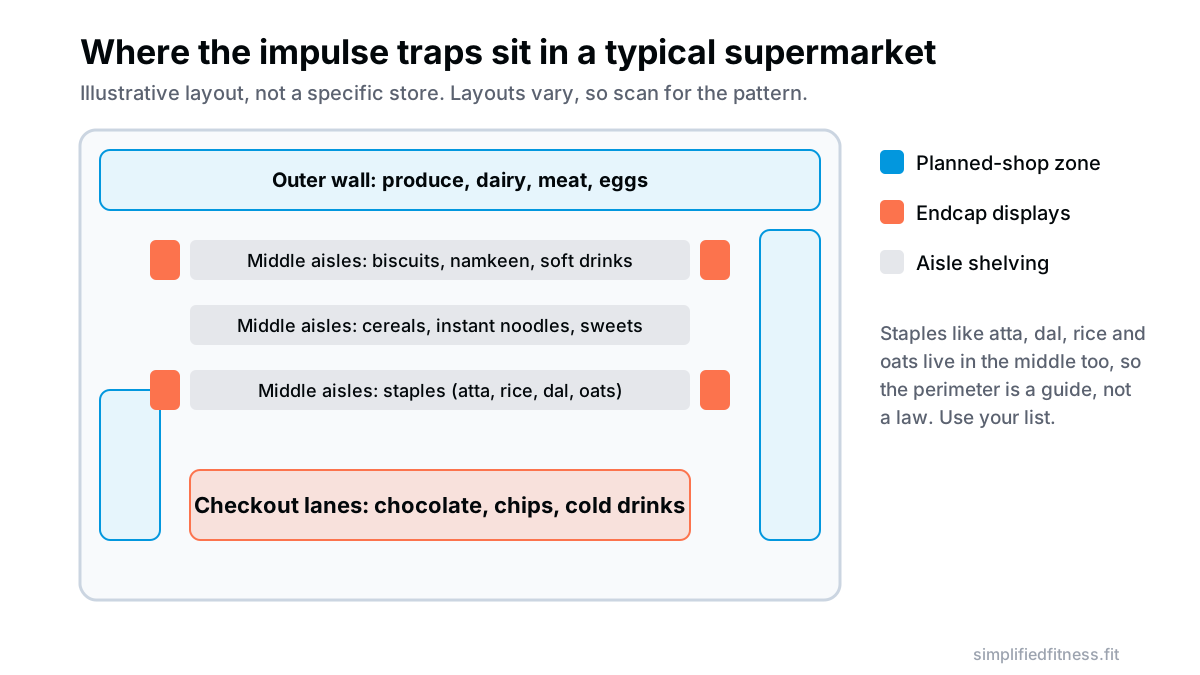
Checkout lanes. You wait there, you cannot walk away, and the snacks are at arm’s reach. In a 2012 audit of 35 Melbourne supermarkets, snack foods were present at 100% of checkouts in all but five stores, and chocolate was the most common item on display (Thornton et al., 2012).
End-of-aisle displays (endcaps). These sit where aisles meet the main walkway, so every shopper passes them. The same audit found snack displays at end-of-aisle positions at the front (median 38%) and back (median 33%) of the store, plus island bin displays. The authors concluded that exposure to snack foods is almost unavoidable in these stores.
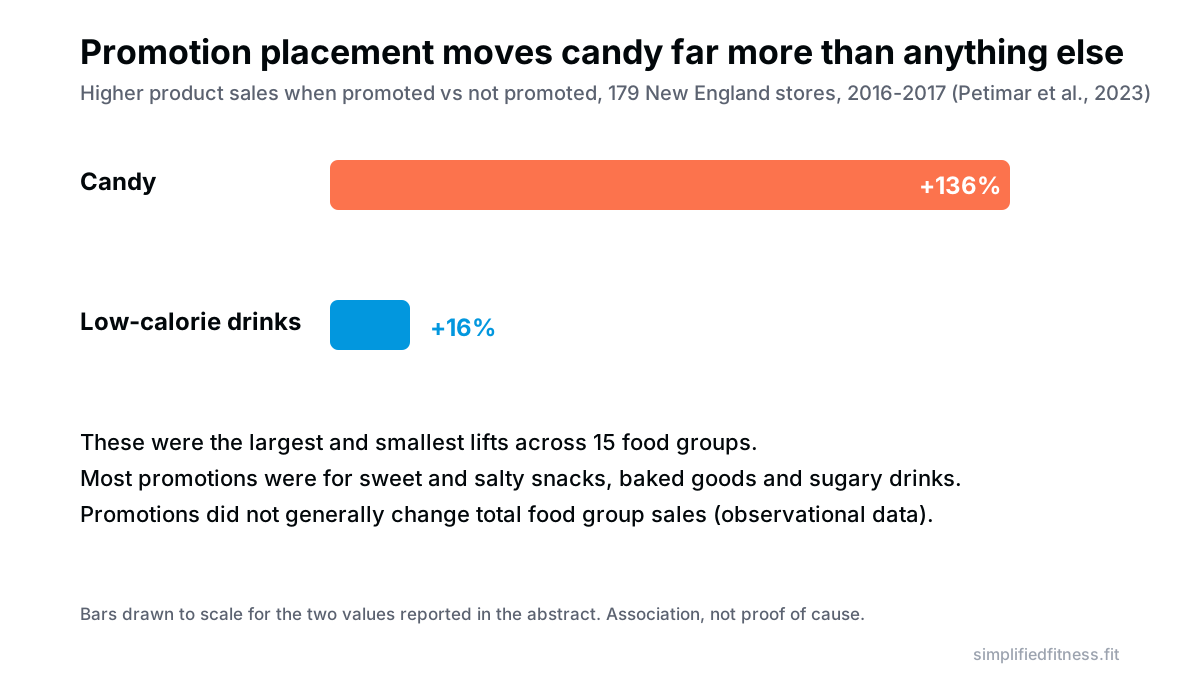
Promotion. A 2023 analysis of 274 million transactions from a 179-store New England chain found that products sold between 16% (low-calorie drinks) and 136% (candy) more when promoted than when not. Promotions were mostly for sweet and salty snacks, baked goods and sugary drinks, and beans and fruit were promoted far less often (Petimar et al., 2023). This is observational data, so it shows association, not proof that the display alone caused each sale.
Shelf height and layout. Eye-level placement is the folk wisdom here, but the evidence is weaker than the folk wisdom. More on that below.
Why do supermarket marketing traps work on a planned shopper?
By the time you reach the checkout you have made dozens of small decisions: which dal, which brand of curd, whether paneer is worth the price. This is often called decision fatigue, though none of the studies cited here measured it in shoppers, so treat it as a plausible idea rather than an established effect. What the store data do show is where the displays sit: at the end of aisles and at the till, where you pass or wait.
There is also a simple exposure effect. If a display is the first thing you see after a long queue, the question changes from “do I want this?” to “why not?”.
The practical lesson is not “be stronger”. It is to make fewer decisions at the shelf, because decisions made at home on a calm evening are cheaper than decisions made in aisle 6.
Should you never shop when hungry?
This is rule number one in most grocery advice, and it is a good habit. But the evidence is more mixed than the confident advice suggests, and it is worth being honest about that.
A 1996 study recruited 198 shoppers just before they entered a large supermarket and recorded time since last meal, self-reported hunger and dietary restraint, then checked itemised receipts afterwards. There were no consistent main effects of hunger or time since last eating on the number or cost of items bought, including unintended purchases. There was a weight-status interaction: normal-weight shoppers tended to buy more as deprivation increased, while the number and cost of food items fell markedly among overweight shoppers (Mela et al., 1996). The authors said the results run counter to common recommendations.
Why might this differ from what you expect? Likely because hunger is only one of several drivers. Budget, habit, store layout, who you are shopping for and time pressure also shape the trolley. The study also measured purchases at the till, not what people ate later.
Cautious takeaway: hunger probably is not the only thing sending you to the biscuit aisle, but eating something with protein before a shop costs nothing and removes one variable. Do it, then still use the list.
Does a shopping list actually work?
Again, mixed. A 1985 survey of 596 female shoppers analysed purchases by caloric value and failed to support either “shop with a list” or “shop after a meal” as ways to reduce food purchases. It did find that overweight shoppers bought more total calories, with more of them coming from fat (Beneke and Davis, 1985). It is an old survey and it does not tell us how good the lists were.
My reading: a list on its own is not magic, because a list that says “snacks” is just an invitation. A list that comes from a plan does something specific. It turns a shop from “what do I feel like?” into “collect these items.” If you are building the plan from scratch, the 3-hour batch meal prep blueprint shows how to go from a menu to a list, and our free diet plan gives you a starting structure.
A good list for a lifter has three features:
- Grouped by store section so you do not backtrack through temptation.
- Specific quantities (1 kg paneer, 2 dozen eggs, 1 kg dal), not just categories.
- One line for a planned treat.
Is shopping the perimeter really a good rule?
The classic advice is to shop the outer wall (produce, meat, dairy) and skip the middle. As a heuristic it works: much of the minimally processed food does sit along the edges, and much of the packaged snack food sits in the middle. I could not find a study in this review that directly tests the perimeter rule, so treat it as a rule of thumb.
It also breaks down in an Indian shopping context. Oats, dal, rice, atta, chana, rajma, roasted makhana and soya chunks usually sit in the middle aisles, and these are some of the cheapest ways to get protein and fibre (our cost per 30 g protein comparison shows how they stack up). Skipping the middle entirely would cost you good food.
A better version: start on the perimeter, then enter the middle only for listed staples, and leave. The goal is fewer unplanned stops, not avoiding whole aisles.
Are healthier checkouts and shelves the fix?
Store-side research shows what works for retailers, which is useful because it tells you what is hard to beat alone.
In two Dutch supermarket experiments, fully replacing less healthy checkout snacks with healthier ones led to 2.4 times fewer checkout snacks being purchased (95% CI 1.9-2.7). But when healthier snacks were added next to the existing ones, healthier purchases rose by a factor of 2.1 while purchases of less healthy snacks did not fall and even rose slightly (Huitink et al., 2020). In other words, adding a healthy option does not cancel the temptation next to it. Removing the temptation does.
Shelf height was less decisive than people claim. In a six-store pilot in Auckland, putting healthier cereals at adult eye level did not change the proportion of healthier cereal sales (56% in both intervention and control stores), and shoppers said brand preference and price mattered more (Young et al., 2020). It was a small pilot with 12-week phases, so it cannot rule out a modest effect.
Wider reviews are cautiously positive. A 2016 systematic review of 42 studies found most reported that in-store interventions raised healthy purchases, but the average quality score was only 65% (Adam and Jensen, 2016). A 2014 review of 32 point-of-sale studies found short-term monetary incentives looked promising and that good evidence for most other approaches was lacking (Liberato et al., 2014).
What this means for you: you cannot count on the store to remove temptation, so your system has to. The simple version is to avoid being exposed, which means a lane choice and a route, not willpower.
Why does it matter for lifters? The ultra-processed angle
Part of the reason to care is that snack-aisle foods tend to be ultra-processed, and the best controlled trial we have suggests that these foods may increase intake. In a 2019 inpatient randomised crossover trial, 20 weight-stable adults ate ultra-processed or unprocessed diets for 2 weeks each, with meals matched for presented calories, energy density, macronutrients, sugar, sodium and fibre. Energy intake was about 508 kcal per day higher on the ultra-processed diet, and participants gained 0.9 kg on it and lost 0.9 kg on the unprocessed diet (Hall et al., 2019).
Be careful with this one. It is 20 adults over 4 weeks total, in a hospital ward, so it shows a plausible mechanism and not exactly what happens in your kitchen. Still, it is a good reason to keep a few high-protein, minimally processed options at home. If you want to see why protein foods keep you fuller, read our piece on satiety and the thermic effect of protein.
The 3 shopping rules, rebuilt for real life
The brief version of grocery advice is three rules. Here is what each looks like once you account for the evidence.
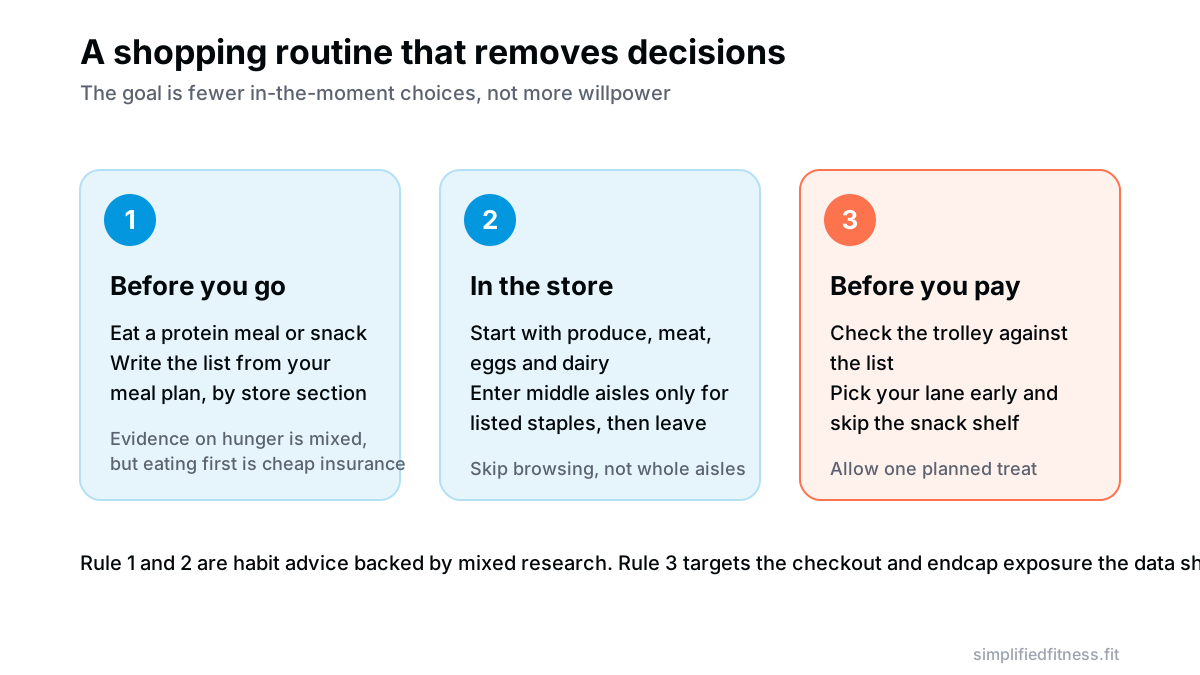
Rule 1: Do not shop hungry. Eat a small protein-rich snack first (two boiled eggs, a glass of milk, or a bowl of curd with roasted chana). The evidence that hunger drives purchases is mixed, but the cost of the rule is nearly zero.
Rule 2: Shop from a pre-written list, built from a plan. Write it at home, grouped by section, with quantities and one planned treat. Do not add things in the store unless something on the list is out of stock.
Rule 3: Perimeter first, middle by exception. Do the walls first for protein, produce and dairy. Enter the middle for listed staples only, and take the same route each week so you stop browsing.
Two extra habits close the loop at the places where the data say temptation is concentrated:
- Choose your checkout lane before you reach it. Decide in advance that the checkout shelf is not part of your shop, and use a lane with fewer snacks on display if your store has one.
- Pay for the list first. If your store lets you scan as you go, scan your listed items and treat anything extra as a conscious purchase.
If cost is the real driver of the “junk in the trolley” problem, our guide to portable high-protein snacks gives you cheaper replacements for the biscuit-and-chips reflex. And if you want to know how many calories your shop should actually cover, our calorie calculator gives you a target to build the list around.
What if one treat is part of the plan?
Rigid rules often backfire. A planned treat on the list (a bar of dark chocolate, a packet of makhana, whatever you like) takes away the feeling of being deprived, which may make the checkout display easier to walk past. That is a coaching observation, not something these studies tested. This fits the idea behind our 80/20 rule for flexible adherence. And if you are cutting and want filling food for fewer calories, high-volume low-calorie foods are worth building the list around.
When to see a doctor
If shopping regularly triggers binge eating, a feeling of loss of control, or distress around food, that goes beyond store psychology. Speak to your doctor or a registered dietitian, and especially if you have a history of an eating disorder. The tips here are for ordinary impulse buying, not for treating disordered eating.
The bottom line
Supermarkets are arranged so that snack exposure is hard to avoid, and promoted snacks sell dramatically more. The common advice (eat first, use a list, stay on the edges) has mixed research behind individual pieces, but together they reduce the number of decisions you make in a place designed to exploit them.
Eat before you go. Write a sectioned list from a plan. Walk the walls first, enter the middle by exception, decide your checkout lane early, and allow one planned treat. That routine costs nothing and takes the pressure off your willpower.
Frequently Asked Questions
How do supermarkets trick you into buying junk food?
They put high-margin snacks where you cannot avoid seeing them: checkouts, end-of-aisle displays and island bins. An audit of 35 Melbourne supermarkets found snack foods at 100% of checkouts in all but five stores, and a large US chain analysis linked promotion to far higher sales of candy. Walk in with a list and plan which lane you will use before you reach it.
What is an endcap display in a supermarket?
An endcap is the shelf unit at the end of an aisle, facing the main walkway, and it is prime space for promoted products. In a 2023 US study of 274 million transactions, products sold between 16% and 136% more when promoted than when not, with candy at the top of that range. Treat an endcap as paid advertising, and check the unit price before assuming it is a deal.
Should you really never shop when hungry?
It is sensible but not well proven. A 1996 study of 198 shoppers found no consistent effect of hunger on how many items or how much they bought, and among overweight shoppers longer food deprivation was linked to fewer items purchased. Since hunger is easy to fix, eat a protein-rich snack first anyway, but do not rely on it alone.
Does a shopping list actually reduce impulse buying?
The research is mixed. A 1985 survey of 596 female shoppers did not support the idea that shopping with a list lowers calories purchased, though it did not test whether the list was a good one. A list built from a planned weekly menu removes decisions at the shelf, so write it from your meals, not from memory.
Is it true that you should only shop the outer perimeter of the supermarket?
It is a useful rule of thumb, not a scientific rule. Fresh produce, meat, eggs and dairy often sit along the walls, but oats, dal, rice, atta and tinned legumes sit in the middle aisles and are excellent staples. Use the perimeter for your first pass, then go into the middle only for items on your list.
Why do supermarkets put sweets at the checkout?
Checkout is where you wait, often tired after decisions, and where snacks are within arm's reach. Dutch supermarket experiments in 2020 found that fully replacing unhealthy checkout snacks with healthier ones cut checkout snack purchases by a factor of 2.4. If your store still sells sweets there, decide before you queue that you will not buy from that shelf.
Does eye-level shelf placement change what people buy?
Not reliably on its own. In a 2020 New Zealand pilot across six supermarkets, putting healthier breakfast cereals at adult eye level did not change the share of healthier cereal sales, and customers said price and brand preferences mattered more. Compare unit prices and nutrition labels at all shelf heights, including the lowest.
How do I stop impulse snacking at the grocery store?
Reduce the number of decisions you make in the store. Eat first, bring a list grouped by section, and take the same route each week. Allow yourself one planned treat so the urge has a legal outlet.
Do ultra-processed foods really make you eat more?
In one tightly controlled 2019 inpatient trial of 20 adults, people ate about 508 kcal per day more on an ultra-processed diet than on an unprocessed one over 2 weeks, even though meals were matched for presented calories. That is a small, short study, so it supports caution but is not final proof. Keeping ultra-processed snacks out of the trolley means they never reach your kitchen.
Is online grocery shopping better for avoiding junk food?
It removes endcaps and checkout lanes, but it adds its own prompts such as promoted items and suggestion bars. The evidence reviewed here comes from physical stores, so we cannot say online shopping reduces junk purchases. If you use it, shop from a saved list of staples and ignore the recommendations.
Are supermarket interventions to help people buy healthier food effective?
Often yes, but quality varies. A 2016 review of 42 studies found most reported that in-store interventions increased healthy purchases, with an average quality score of 65% (medium). Designs that combine price, information and easy access seem most promising, which is why your own system should remove friction for healthy foods and add some for junk.
What should I do if I overspend on snacks every week?
Treat it as a system problem, not a character flaw, because the store layout is built to exploit exactly this. Set a fixed weekly treat budget, put it on the list, and pay for the rest of the trolley first. If shopping triggers uncontrolled eating or distress rather than simple overspending, talk to your doctor or a registered dietitian.
Sources & References
Every claim above is checked against peer-reviewed research (PubMed, U.S. National Library of Medicine) or guidance from established health bodies. How we fact-check.
- Mela DJ, et al. Relationships of consumer characteristics and food deprivation to food purchasing behavior. Physiol Behav. 1996. PMID: 8916190
- Beneke WM, et al. Relationship of hunger, use of a shopping list and obesity to food purchases. Int J Obes. 1985. PMID: 3830932
- Petimar J, et al. In-Store Marketing and Supermarket Purchases: Associations Overall and by Transaction SNAP Status. Am J Prev Med. 2023. PMID: 36878416
- Thornton LE, et al. The availability of snack food displays that may trigger impulse purchases in Melbourne supermarkets. BMC Public Health. 2012. PMID: 22420759
- Huitink M, et al. Can Healthy Checkout Counters Improve Food Purchases? Two Real-Life Experiments in Dutch Supermarkets. Int J Environ Res Public Health. 2020. PMID: 33228189
- Young L, et al. The effect of a shelf placement intervention on sales of healthier and less healthy breakfast cereals in supermarkets: A co-designed pilot study. Soc Sci Med. 2020. PMID: 32950330
- Adam A, et al. What is the effectiveness of obesity related interventions at retail grocery stores and supermarkets? A systematic review. BMC Public Health. 2016. PMID: 28031046
- Liberato SC, et al. Nutrition interventions at point-of-sale to encourage healthier food purchasing: a systematic review. BMC Public Health. 2014. PMID: 25192584
- Hall KD, et al. Ultra-Processed Diets Cause Excess Calorie Intake and Weight Gain: An Inpatient Randomized Controlled Trial of Ad Libitum Food Intake. Cell Metab. 2019. PMID: 31105044

Umair Hazrami · Founder & Head Coach, Simplified Fitness
Umair Hazrami founded Simplified Fitness and the Simplified Lifter channel to cut through fitness noise. With 4+ years of consistent training and 10+ coaching clients, he writes every guide from the peer-reviewed research and links the sources so you can check them. Our editorial standards.
Educational content only, not medical advice. If you have a medical condition, are pregnant, or take medication, talk to a qualified doctor before changing your diet, supplements or training. Full disclaimer.
Keep reading
Indian Diet
The 3-Hour Weekly Batch Meal Prep: Cooking 5 Days of Lunches and Dinners for Busy Lifters
Batch meal prep for the week in 3 hours: a station-by-station Sunday plan for 10 high-protein lunches and dinners, with Indian options and safe storage rules.
7 min read
Indian Diet
Cost per 30 Grams of Protein: 40 Common Fitness Foods Ranked by Price
Cost per 30g protein for 40 Indian gym foods, from soya chunks to whey and tuna. See the cheapest protein sources per gram and what to buy on a budget.
8 min read
Indian Diet
Eating Healthy on a Student Budget: High Protein Hostel and Dorm Room Meal Prep
A college student bodybuilding diet budget can still hit 130 g of protein. Cheap staples, no-cook hostel prep and a sample day, with the studies linked.
8 min read
Indian Diet
Essential Kitchen Equipment for Lifters: Scales, Air Fryers, Blenders and Containers
The best kitchen equipment for meal prep lifters: which four tools earn their space, what the research says about each, and what to buy first on a budget.
10 min read